Documenting ATV and tractor safety training for vineyard employees
TL;DR
- OSHA's General Industry and Agriculture standards require employers to train workers on ATV and tractor hazards and keep written records proving it.
- A compliant training record names the employee, the equipment covered, the trainer, the date, and the specific hazards addressed.
- Records must be available for OSHA inspection and, under the EPA Worker Protection Standard, for 2 years after the training date.
Why does OSHA require written training records for vineyard equipment?
OSHA doesn't just want you to train people. It wants proof you trained them. The logic is plain: if a worker gets hurt on a tractor and you can't produce a training record, OSHA's compliance officer will assume no training happened, and you'll face a citation regardless of what you actually did.
For agricultural employers, the governing standard is 29 CFR 1928.57, which covers agricultural equipment including tractors [1]. That standard requires the employer to ensure workers are instructed in the safe operation of the equipment they use, but OSHA reads "ensure" to mean documented proof of instruction. The General Industry Hazard Communication standard (29 CFR 1910.1200) layers on top of that for chemical-handling tasks often tied to tractor or ATV spray runs [2].
Small vineyards sometimes assume the agricultural exemption wipes out their recordkeeping obligations. It doesn't. The exemption at 29 CFR 1928.1 only covers farms with 10 or fewer employees that also haven't had a temporary labor camp in the preceding 12 months. Most commercially operated vineyards blow past that threshold during harvest. Even if you're under it, civil liability exposure in a state OSHA jurisdiction (California, Washington, Oregon all have their own plans) can be identical to federal requirements [3].
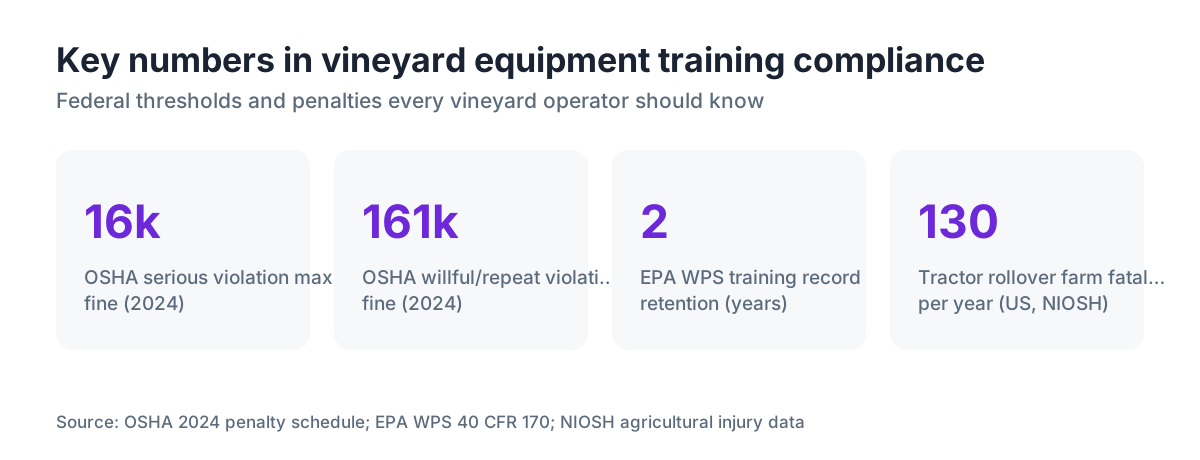
Here's the bottom line. A one-page sign-in sheet, signed, dated, and filed, is the minimum. It costs you nothing and protects you from citations that run $16,131 per serious violation under 2024 federal penalty levels [1].
What exactly goes into a compliant ATV and tractor training record?
A compliant record has seven fields. Miss one and an auditor can treat the whole document as incomplete.
- Employee full name and job title
- Date of training (day, month, year, more than "spring 2024")
- Specific equipment covered (make and model matters; "tractor" is too vague)
- Hazards addressed (rollover, PTO entanglement, slope operation, bystander awareness)
- Training method (hands-on demonstration, video plus Q&A, ride-along evaluation)
- Trainer name and qualifications
- Employee signature confirming they received and understood the training
That last point trips up a lot of operations. The signature line isn't optional. If an employee refuses to sign, note that on the form, have a supervisor witness it, and keep the dated note in the file. OSHA has accepted that approach during inspections.
For ATV training specifically, the ATV Safety Institute's guidelines (widely cited by Cornell and WSU extension) add a practical evaluation component: the employee should demonstrate the skill, more than watch someone else do it [4]. Your record should reflect that. A field like "hands-on evaluation completed: yes/no" takes 10 seconds to add and turns your form from a passive attendance sheet into an active competency record.
The EPA Worker Protection Standard (WPS), 40 CFR Part 170, applies when ATVs or tractors are used to apply or handle pesticides. Under the 2015 revised WPS, employers must keep training records for at least 2 years and must make them available to workers and their designated representatives on request [5]. The record needs to include the date, the trainer's name and contact info, and enough content detail to confirm WPS-required topics (hazards, decontamination, emergency procedures) were actually covered.
What are the most common tractor hazards you must address in training?
Tractor rollovers kill roughly 130 U.S. farm workers every year, which makes it the single leading cause of farm fatality [6]. That number comes from the National Institute for Occupational Safety and Health (NIOSH), and it has held roughly flat for two decades despite ROPS (rollover protective structures) being widely available.
Your training record should show these hazard categories were covered:
Rollover prevention. Slopes, soft soil near row ends, irrigation risers, and wet grass all contribute. UC Davis extension recommends training include identifying maximum safe slope angles for your specific equipment and field conditions [7].
PTO (power take-off) entanglement. Clothing, twine, and hose can catch a spinning PTO shaft in under a second. Training must cover PTO guard inspection before every use.
Hitchhiking and bystander contact. No passengers. No one walking in the work zone without a spotter protocol.
Pre-operation inspection checklist. Brakes, steering, tire pressure, ROPS integrity, seatbelt condition. Make the checklist part of the training record so the same document you use for training becomes the daily inspection log template.
WSU Extension's tractor safety program specifically calls out that vineyard terrain (tight row spacing, uneven headlands, steep hillside blocks) creates rollover scenarios that flat-field tractor operators haven't encountered [8]. If your workers transfer in from grain or row-crop operations, vineyard-specific re-training is warranted and worth documenting separately.
What ATV-specific hazards need to be covered in the training record?
ATVs kill more people per mile traveled than almost any other farm vehicle, and vineyards use them constantly for scouting, irrigation checks, and light hauling.
The Consumer Product Safety Commission reported 81,800 ATV-related emergency room visits in 2022 alone, though that counts all uses, not only agricultural [9]. Farm-specific data from NIOSH puts the overturn/rollover mechanism at the top of the agricultural ATV fatality list.
For your training documentation, cover these ATV-specific topics and check a box or add a note confirming each was addressed:
- Weight limits and load distribution (overloading an ATV rear rack is a major rollover trigger on vineyard slopes)
- Helmet and PPE requirements, and your operation's specific policy
- Speed limits in the vineyard, including near workers and equipment
- Passenger prohibition (most ATVs are single-rider by design)
- Pre-ride inspection: tires, controls, brakes, lights
- Slope operation: contour vs. up/down travel, when to dismount
- Crossing irrigation lines and vine row ends
The ATV Safety Institute offers a free online training course at atvsafety.org that many vineyards use as a baseline module [4]. It takes about 90 minutes to complete. If you send employees through it, print the completion certificate, attach it to your internal training form, and file both. That combination creates a strong documentation trail.
How long do you need to keep equipment training records?
The answer depends on which standard triggered the training.
| Standard | Minimum Retention | Access Requirement |
|---|---|---|
| EPA WPS (40 CFR 170) | 2 years from training date | Available to workers on request |
| OSHA Hazard Communication (1910.1200) | Duration of employment + 30 years for SDSs | Available to employees and their reps |
| OSHA Agricultural Equipment (1928.57) | No explicit duration stated; OSHA recommends 3 years minimum | Available during inspection |
| Cal/OSHA (CA vineyard operators) | 3 years for pesticide handler training | Available to Cal/OSHA on demand |
The safest practical approach: keep all equipment training records for 5 years. That clears every threshold listed above, survives a multi-year audit window, and costs you nothing beyond a file cabinet drawer or a folder in your record-keeping software.
For California vineyards, the Department of Pesticide Regulation (CDPR) adds its own layer. Pesticide safety training records must be kept for 3 years and include the employee's identification, training date, and trainer certification number [3]. An ATV or tractor used for spray applications falls under CDPR's handler training requirements, so the same record may need to satisfy both OSHA and CDPR at once. Design your form to capture all required fields the first time.
What's the difference between initial training and refresher training records?
Initial training happens before an employee first operates a piece of equipment. Refresher training happens after an incident, after equipment changes, or on a scheduled cycle.
OSHA's agricultural standard doesn't mandate annual refresher training by name, but OSHA's general enforcement policy treats a refresher cycle as evidence of an effective safety program. Cornell's agricultural safety resources recommend annual ATV refresher training as best practice, especially when staffing turns over seasonally [10].
Your documentation should clearly distinguish between the two. Use a separate form or a checkbox field that marks the record as "initial" or "refresher" and, for refreshers, notes the trigger (annual cycle, post-incident review, new equipment introduction, regulatory update).
Post-incident refresher records carry extra weight. If OSHA investigates an accident and you can show that a prior near-miss triggered documented retraining, that history demonstrates a functioning safety culture. It won't eliminate liability, but it's material evidence in penalty reduction negotiations.
For vineyards running seasonal H-2A workers, initial training records for every new worker are non-negotiable. H-2A compliance audits specifically check safety training documentation. Keep those records organized by worker and by season so they're retrievable fast.
How should training records be stored and organized for an OSHA inspection?
An OSHA compliance officer can show up without advance notice. When they ask for training records, "I'll have to find them" is the wrong answer.
Organize records by employee, not by date or equipment type. When OSHA audits, they pull a random sample of workers and ask for that person's complete training history. A binder per employee, or a folder per employee in your digital system, lets you produce that in under two minutes.
Physical binders work fine. They just need to be in one place, labeled clearly, and protected from the elements (a locked filing cabinet in the winery office beats a cardboard box in the equipment shed). If you store records digitally, use a system that timestamps entries, shows who created or edited each record, and can export a PDF on demand. A basic spreadsheet with no audit trail is harder to defend than a proper log.
VitiScribe's vineyard compliance tools include a training log module that timestamps entries and generates a printable record per employee, which is worth a look if you're already managing spray records and other field logs in one place.
Backup matters. If your physical records burn in a wildfire (a real risk in California and Oregon wine regions), you want a cloud copy. If your digital system goes down, you want a printed set. OSHA doesn't grade on natural disaster sympathy; they check whether records exist.
Does bilingual or multilingual training change what you need to document?
Yes, and this is an area where vineyards get caught.
The EPA Worker Protection Standard explicitly requires that training be provided in a language the worker understands [5]. OSHA's general duty clause has been interpreted the same way by enforcement. If your workforce is primarily Spanish-speaking, training conducted only in English doesn't satisfy the standard, and a training record in English signed by a worker who didn't understand the content won't protect you.
Your training record should include a field for "language of instruction." It should note whether a certified interpreter was used, or whether the trainer is a fluent speaker of the worker's language. If you used a translated video or a bilingual handout, note the title and source of that material.
UC Davis extension has produced Spanish-language agricultural safety materials for decades, including tractor and equipment safety guides [7]. WSU Extension also has Spanish-language resources for Washington vineyard operations [8]. Using extension-produced bilingual materials and documenting which ones you used is a defensible approach.
For operations running multiple languages (Spanish, Mixtec, Triqui are all present in California vineyard workforces), verbal confirmation by a fluent interpreter, documented on the training record with the interpreter's name, is currently the practical standard. Nobody has a perfect solution here. The WPS guidance from EPA acknowledges the challenge and focuses on demonstrated comprehension rather than a specific delivery method.
What does a good training record form actually look like?
Here's a working template structure. You can build this in a word processor, a spreadsheet, or a dedicated compliance tool. The fields are what matter.
Header
Farm/vineyard name, address, owner or manager name, date of record creation
Employee section
Full name, job title, hire date, primary work language
Training event
Date of training, start and end time, location (e.g., "equipment barn, Block 7 headland")
Equipment covered
Make, model, year, and unit ID for each piece of equipment (tractor, ATV, sprayer if applicable)
Hazards and topics covered
Checkboxes work well here. List each major hazard category (rollover, PTO, slope operation, bystander safety, PPE, emergency procedures, WPS topics if applicable). Add a free-text field for anything else covered.
Training method
Checkboxes: classroom/video, hands-on demonstration, supervised operation, written test, oral Q&A
Trainer information
Full name, qualification or certification (e.g., certified pesticide applicator license number if applicable, ATV Safety Institute instructor ID)
Competency confirmation
Did the employee demonstrate understanding? Yes/No. If yes, briefly describe how (e.g., "completed hands-on pre-ride inspection without prompting").
Signatures
Employee signature and date, trainer signature and date
Notes
Any accommodations made, language of instruction, materials used, follow-up required
One page, double-sided if needed. Print a fresh copy for each training event. File the original; give the employee a copy if they request one (WPS requires this on request).
For more on how vineyard field records fit into overall compliance systems, see our overview at vineyard.
What happens if an employee is injured and you don't have training records?
The absence of training records is evidence. It won't be read charitably.
In a workers' compensation claim, lack of training documentation can affect the employer's experience modification rate and, in some states, supports findings of employer negligence that shift cost exposure. In a wrongful death case, plaintiffs' attorneys specifically request training records in discovery; an empty file creates a factual vacuum the jury fills with assumptions.
OSHA's penalty structure matters here. A serious violation (one where there's substantial probability that death or serious physical harm could result, and the employer knew or should have known about the hazard) runs up to $16,131 per violation under 2024 levels [1]. A willful or repeated violation tops out at $161,323. Failure to train is typically cited as a serious violation. Failure to train combined with no records can become willful if the compliance officer determines the employer consciously disregarded the requirement.
The math is simple. Designing a one-page training form and filing it takes maybe 15 minutes per employee per year. A single OSHA citation for failure to document training costs you $4,000 to $16,000 before attorney fees. There's no scenario where skipping the paperwork saves you money.
For California operators, the agricultural labor commissioner also conducts compliance audits that include safety training documentation. A CDPR pesticide safety violation can result in license suspension for the responsible party, more than a fine.
How do university extension programs approach ATV and tractor safety training?
Three extension programs stand out as genuinely useful for vineyard operators building or improving a training program.
UC Davis's Agricultural Safety and Health program (part of their Agricultural Sustainability Institute) has published tractor rollover prevention guides, slope safety fact sheets, and Spanish-language operator resources specifically for California vineyard conditions [7]. Their materials are free and citable, which helps when you want to show an auditor that your training content came from a credible source.
Cornell Cooperative Extension's agricultural health and safety team covers New York wine region hazards, including ATV use on steep Finger Lakes terrain and equipment operation in late-season mud conditions [10]. Their ATV safety checklist is formatted to double as a training record for small operations.
WSU Extension's Center for Agricultural Safety and Health (AgSafety) addresses Pacific Northwest vineyard specifics: hillside operations in the Columbia Gorge, working near irrigation systems, and cold-weather equipment operation [8]. WSU also runs in-person tractor safety clinics periodically that count toward continuing education for pesticide applicator license renewal in Washington state.
All three programs agree on one core point: training effectiveness depends on hands-on demonstration, more than watching a video. Your documentation should reflect that your training included a practical component, because extension guidance consistently says the video-only approach doesn't transfer to actual risk reduction in the field.
Are there specific requirements for H-2A workers that change how you document training?
H-2A workers must receive the same safety training as domestic workers under OSHA and EPA standards. There's no separate H-2A training standard, but the H-2A program's own compliance framework (administered by the Department of Labor) treats worker safety documentation as evidence of contract compliance.
In practice, H-2A audits pull three types of records: wage and hour documentation, housing inspection records, and safety training documentation. An H-2A compliance officer who finds a gap in training records can refer the case to OSHA and can find the employer in breach of the job order, which affects future H-2A certification.
For H-2A workers, initial training must happen before first equipment use, not during the first week. Document the exact date each worker completed training relative to their start date. If a worker starts on a Monday and you train the group on Wednesday, the worker should not have operated a tractor or ATV in that gap. That sounds obvious but it's a common source of violations during audit review.
Language documentation matters especially for H-2A workers. The job order filed with DOL identifies the worker's native language region; your training record should match the language your training was actually conducted in. If you brought in an outside bilingual trainer for a group session, note that person's name and the agency or organization they represent.
Frequently asked questions
Does OSHA require a written training record for every employee who drives a farm tractor?
Yes, in practice. OSHA's 29 CFR 1928.57 requires employers to ensure workers are instructed in safe tractor operation, and OSHA compliance officers treat written documentation as the proof of that instruction. Without a signed record showing the employee's name, the date, the equipment covered, and the hazards addressed, OSHA can cite you for failure to train even if training actually occurred.
How long does OSHA require vineyard employers to keep ATV and tractor training records?
OSHA's agricultural equipment standard doesn't name a specific retention period, but OSHA's enforcement guidance recommends 3 years. The EPA Worker Protection Standard requires 2 years for pesticide safety training records. California's CDPR requires 3 years for pesticide handler training. The practical answer: keep all equipment training records for 5 years to clear every applicable threshold.
What topics must be covered in tractor safety training under federal law?
29 CFR 1928.57 requires training to address safe operation of the specific equipment the worker will use. OSHA enforcement and extension guidance consistently list: rollover hazards and ROPS use, PTO entanglement prevention, pre-operation inspection, slope and terrain operation, bystander safety, and emergency procedures. Training records should show each topic was addressed, more than that training occurred.
Can I use an online ATV safety course as the official training record?
An online course like the ATV Safety Institute's program can satisfy the training content requirement, and the completion certificate works as supporting documentation. Attach the certificate to your internal training form, which should still capture the employee name, date, equipment covered, and supervisor signature. The certificate alone isn't enough; it doesn't prove the specific worker at your operation on your equipment was evaluated.
What's the difference between OSHA agricultural standards and Cal/OSHA for California vineyard operators?
California operates a state OSHA plan approved by federal OSHA, and Cal/OSHA's standards must be at least as protective as federal rules. In several areas, including pesticide safety and heat illness prevention, Cal/OSHA is stricter. For equipment training documentation, Cal/OSHA follows federal 29 CFR 1928.57 requirements but CDPR adds pesticide handler training record requirements (3-year retention, trainer certification number on the record) for any worker handling pesticides during tractor or ATV operations.
Do I need to retrain employees every year or only when something changes?
Federal OSHA doesn't mandate annual retraining by name for general agricultural equipment, but it expects evidence of an active safety program. Cornell Extension recommends annual ATV refresher training as best practice. Retraining is specifically required when: an employee is involved in an incident, new equipment is introduced, hazard conditions change, or a compliance officer identifies inadequate initial training. Document every retraining event as a separate record with a noted trigger reason.
What language does ATV and tractor safety training need to be in?
The EPA Worker Protection Standard (40 CFR 170) requires training in a language the worker understands. OSHA's general duty clause is interpreted the same way. Training conducted only in English for non-English-speaking workers doesn't satisfy the standard. Document the language of instruction on every training record. UC Davis and WSU Extension both publish free Spanish-language equipment safety materials you can incorporate and cite in your records.
What records does the EPA Worker Protection Standard require for tractor and ATV spray operators?
When equipment is used to apply or handle pesticides, the EPA WPS (40 CFR 170) requires the employer to keep training records for 2 years. Required fields: employee identification, training date, trainer name and contact information, and enough content detail to confirm WPS topics (hazard information, decontamination, emergency procedures) were covered. Workers can request a copy of their own training record, and the employer must provide it.
What should I do if an employee refuses to sign a training record?
Note the refusal on the form, have a supervisor or second witness sign and date the notation, and file the record. This creates a contemporaneous document showing training occurred and the refusal was recorded. OSHA has accepted this format during inspections. Never alter or backdate training records; that creates a fraud exposure far worse than an unsigned form.
Do seasonal and H-2A workers need the same training documentation as year-round employees?
Yes. Seasonal and H-2A workers must receive equipment safety training before first use, and records must be as complete as for permanent staff. H-2A compliance audits specifically check safety training documentation. Initial training must be completed before the worker operates equipment, not during the first week. Document the exact training date relative to the worker's start date and note the language the instruction was conducted in.
How do I document training for employees who operate both a tractor and an ATV?
Create a separate training record or a separate section within the same record for each equipment type. Hazards, operating procedures, and competency demonstrations differ enough between a tractor and an ATV that combining them into one generic "equipment safety" record is hard to defend in an audit. If an employee operates multiple tractor models (e.g., a vineyard sprayer and a mowing tractor), note each unit's make and model.
What qualifies someone to be a tractor or ATV safety trainer?
OSHA's agricultural standard doesn't require a specific credential for the trainer, but it does require that training be effective. A trainer should have demonstrated competency with the specific equipment and knowledge of relevant hazards. For pesticide application training under WPS, the trainer must be a certified applicator or a trained commercial pesticide applicator. Documenting the trainer's qualifications on the record (license number, years of experience, any formal safety certification) strengthens your position in an audit.
Are there any free training record templates I can use for vineyard ATV and tractor training?
UC Davis Agricultural Safety and Cornell Cooperative Extension both publish free fact sheets and training documentation guides that include template fields. The ATV Safety Institute offers printable training records on their website. OSHA's small business resources also include basic training log templates. Any template you use should capture the seven core fields: employee name, date, equipment, hazards covered, training method, trainer information, and employee signature.
Does a ROPS-equipped tractor reduce my training documentation requirement?
No. Having a ROPS (rollover protective structure) installed is a separate requirement from training documentation under 29 CFR 1928.52. A ROPS reduces fatality risk if a rollover occurs but doesn't eliminate the training requirement. Your training record should actually confirm that the employee was trained on proper ROPS use, including seatbelt engagement, because a ROPS without a seatbelt significantly reduces its protective value in a rollover event.
Sources
- OSHA, 29 CFR 1928 Agricultural Operations standards and OSHA penalty levels 2024: OSHA 29 CFR 1928.57 governs agricultural equipment operation including tractors; 2024 serious violation penalty ceiling is $16,131 per violation
- OSHA, 29 CFR 1910.1200 Hazard Communication standard: Hazard Communication standard requires training documentation for workers handling hazardous chemicals, including pesticides applied via tractor or ATV
- California Department of Pesticide Regulation, Pesticide Safety Information Series: CDPR requires pesticide safety training records to be kept for 3 years and include employee ID, training date, and trainer certification number
- ATV Safety Institute, Training Programs and Resources: ATV Safety Institute guidelines recommend hands-on demonstration as part of ATV training, not video instruction alone; offers a free online training course
- NIOSH, Agricultural Safety: Tractor Overturns: Tractor rollovers kill approximately 130 U.S. farm workers per year, making it the leading cause of farm fatality
- UC Davis Agricultural Sustainability Institute, Agricultural Safety and Health: UC Davis extension publishes tractor rollover prevention guides, slope safety fact sheets, and Spanish-language operator resources for California vineyard conditions
- WSU Extension, AgSafety Center for Agricultural Safety and Health: WSU Extension's AgSafety program addresses Pacific Northwest vineyard equipment hazards and offers in-person tractor safety clinics counting toward WA pesticide applicator CE
- U.S. Consumer Product Safety Commission, ATV Annual Report 2022: CPSC reported 81,800 ATV-related emergency room visits in 2022; NIOSH identifies overturn/rollover as the leading mechanism in agricultural ATV fatalities
- OSHA, 29 CFR 1928.52 Rollover protective structures for tractors: 29 CFR 1928.52 is a separate ROPS installation requirement, distinct from and in addition to the training documentation requirement under 1928.57
- U.S. Department of Labor, H-2A Temporary Agricultural Program compliance: H-2A compliance audits include review of worker safety training documentation; gaps can result in DOL referral to OSHA and affect future H-2A certification
Last updated 2026-07-10