Weight ticket record keeping requirements for vineyard to winery deliveries
TL;DR
- Weight tickets for vineyard-to-winery grape deliveries must capture the grower name, vineyard block or AVA, variety, date, gross and tare weights, and net tons delivered.
- Federal TTB rules require wineries to keep these records for at least three years.
- California, Washington, and Oregon add their own tonnage report and payment disclosure rules.
- Missing or incomplete weight tickets are the most common compliance gap found in state agricultural audits.
What is a weight ticket and why does it matter for grape deliveries?
A weight ticket, sometimes called a scale ticket or load slip, is the document that proves how many tons of grapes moved from a vineyard to a winery on a given date. It's the handshake between two parties. For federal and state regulators, it's the chain-of-custody record that ties raw fruit to finished wine.
Without it, a winery can't accurately report production to the Alcohol and Tobacco Tax and Trade Bureau (TTB) [1], and a grower can't prove what they sold. Most grape purchase contracts make the weight ticket the legal basis for payment. So a missing or altered ticket isn't only a compliance problem. It's a payment dispute waiting to happen.
The TTB's wine production regulations at 27 CFR Part 24 require wineries to keep records of all fruit received, including the source and quantity [1]. Those records start with the weight ticket. State rules layer on top of that baseline, sometimes in ways that conflict slightly with each other, which is why growers and wineries working across state lines need to track each jurisdiction separately.
What information must a weight ticket include?
The minimum fields that satisfy both federal TTB requirements and most state agricultural codes are listed below. Get these on every ticket and you've covered the floor for a TTB audit and a state tonnage report at the same time.
| Field | Why it's required |
|---|---|
| Date of delivery | Ties the load to a crop year and payment period |
| Grower name and address | Identifies the responsible party for pesticide records and payment |
| Vineyard block or ranch ID | Needed for AVA sourcing claims and USDA organic certification |
| Grape variety | Required for TTB wine type designation records |
| Gross weight | Raw scale reading before tare deduction |
| Tare weight | Weight of the bin, lug, or gondola |
| Net weight (tons or pounds) | The deliverable quantity used for payment |
| Scale certification number | Proves the scale is legal for trade under Weights and Measures law |
| Receiving winery license number | Required in CA, WA, OR for tonnage report matching |
| Signature or initials of receiving party | Confirms acceptance |
California's Department of Food and Agriculture (CDFA) requires that scales used for grape weighing be certified under the California Business and Professions Code Section 12500 et seq. [2]. Washington State's Department of Agriculture has an equivalent requirement under RCW 19.94 [3]. The scale certification number on the ticket is what an auditor checks first.
Some wineries also add a Brix reading and pH at delivery. Those aren't legally required, but they matter for winemaker quality records and can change the price under contracts with quality-tiered pricing. Put them on the ticket if your contract calls for them, even when the state doesn't.
How long do wineries and growers need to keep weight tickets?
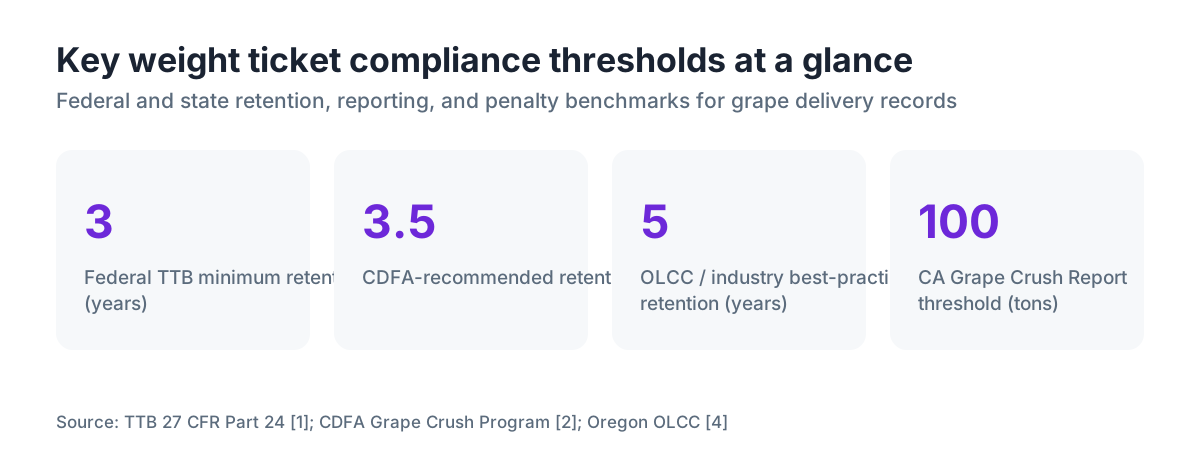
The TTB requires wineries to retain records of fruit received, including quantity and source, for a minimum of three years from the date of the transaction [1]. That's the federal floor. States often go further.
California's CDFA Grape Crush Report program requires that supporting records, including weight tickets, be kept for at least three years from the reporting deadline, which works out to about three and a half years from harvest [2]. Washington's tonnage reporting rules run on a three-year window [3]. Oregon's Oregon Liquor and Cannabis Commission (OLCC) follows the federal three-year baseline but recommends five years given how often the state's fragmented grape supply chain generates contract disputes [4].
My honest recommendation: keep everything for five years, full stop. Storing PDFs costs nothing. Losing a weight ticket in the middle of a payment dispute or a TTB audit costs plenty. If you're on paper, scan tickets at the end of each harvest day, name the files by date and load number, and back them up off-site. Paper fades, barns flood, and harvest is chaos.
Growers should keep their copies independent of the winery. Never treat the winery as your archive.
What are the California-specific weight ticket and tonnage reporting rules?
California has the most detailed grape delivery documentation rules in the country, largely because the state runs a mandatory Grape Crush Report that feeds USDA and CDFA market statistics [2].
Every winery or custom crush facility that receives California-grown grapes must file a Grape Crush Report with CDFA by a statutory deadline each year (typically in February following the harvest year). The data in that report has to reconcile with the weight tickets on file. CDFA auditors can request weight tickets to verify reported tonnage, price per ton, and variety classification [2].
California also requires that scales at commercial receiving points be inspected by county weights and measures officials. If your winery takes in grapes and you haven't had your scale certified recently, that's a real gap. County inspection cycles vary but usually run annually [2].
For growers delivering into Paso Robles wineries or other multi-AVA regions, the block-level vineyard ID on the weight ticket is what proves origin. California's AVA labeling rules require 85% of the fruit to come from the stated AVA, and the weight ticket is the paper trail that backs that claim at a TTB audit [1].
One practical note. The Grape Crush Report asks for price per ton along with tonnage. Weight tickets don't always carry price, which usually lives in a separate purchase agreement. You need both documents to survive a CDFA audit, so treat them as a paired set.
What are the Washington and Oregon weight ticket requirements?
Washington requires that all commercial weighing of agricultural commodities, wine grapes included, happen on a scale certified by the Washington State Department of Agriculture under the Washington Weights and Measures Act (RCW 19.94) [3]. The certified scale ticket is the legal proof of quantity, and the WSDA can audit wineries and growers for compliance.
Washington also has a mandatory Grape Tonnage Report filed through the Washington State Liquor and Cannabis Board (WSLCB). Wineries must report all grapes received, including out-of-state fruit, with variety, county of origin, and price data. That report has to match the weight tickets. A discrepancy triggers a follow-up request [3].
Oregon's OLCC requires bonded wineries to keep records of all fruit purchases sufficient to account for all wine produced [4]. The OLCC doesn't spell out every field a weight ticket must contain, but its audit guidelines make clear the record has to establish variety, quantity, and source for every lot. Oregon also runs an annual crop report through the Oregon Department of Agriculture that wineries reconcile against their production records.
One difference worth knowing. Washington treats electronic weight tickets signed by both parties as legally equivalent to paper under RCW 19.34, the state's electronic signature act [3]. Oregon hasn't issued formal guidance on electronic tickets as of this writing, so check with OLCC directly if you're going paperless there.
What do TTB wine production records actually require from weight tickets?
The TTB's wine regulations at 27 CFR Part 24 require bonded wine producers to keep records of all materials received, including the kind (variety), quantity, and source [1]. A TTB officer can inspect those records during normal business hours.
The TTB doesn't publish a prescribed weight ticket form. What the regulation says, in plain terms, is that records must be enough to reconstruct production. In practice, an auditor pulls your weight tickets and matches them against your wine production logs (the Winery Record of Operations) and your federal excise tax returns.
The TTB has flagged origin documentation for appellation claims as an audit focus [1]. If you label a wine with an AVA or a single-vineyard designation, the weight tickets behind that claim need to show specific block-level origins, not "various sources."
Wineries that take grapes from several growers for the same variety and vintage need a lot-tracking system that connects each weight ticket to the fermentation tank or lot code. Without that chain, you can't defend an AVA labeling claim and you can't complete your Winery Record of Operations accurately. That's where a tool like VitiScribe closes the gap, linking each incoming load to a production lot instead of forcing you to reconstruct it at audit time.
Can weight tickets be electronic, and what makes an e-ticket legally valid?
Yes, in most jurisdictions. The federal Electronic Signatures in Global and National Commerce Act (E-SIGN Act, 15 U.S.C. 7001) establishes that electronic records and signatures are legally equivalent to paper in commercial transactions [5]. That covers the weight ticket as a commercial document between grower and winery.
For the TTB, electronic records are acceptable under 27 CFR Part 24 as long as they are readily retrievable and reproducible in a legible format for inspection [1]. The TTB doesn't require a wet signature on a weight ticket. It requires that the record be accurate and available.
State acceptance varies. California accepts electronic records for CDFA Grape Crush reporting, and CDFA guidance says supporting documents like weight tickets may be retained electronically [2]. Washington's RCW 19.34 makes electronic signatures valid for commercial transactions [3]. Oregon's rules are less explicit, so confirm with OLCC before going fully paperless there.
An electronic weight ticket that holds up needs three things: a timestamp that can't be altered after the fact, a clear record of who created and accepted it, and a backup that keeps it available for the full retention period. A PDF emailed from a scale house and saved to a named folder with the date in the filename is fine for a small operation. A dedicated system with an audit trail is better once you're moving more than a few hundred tons a season.
One thing that doesn't work: a spreadsheet you filled in weeks later with no timestamp. Auditors can tell.
How do weight tickets connect to pesticide records and worker safety compliance?
The grower's name and vineyard block on the weight ticket are the link between a load of grapes and the pesticide application records for that block. This matters for two reasons.
First, under the EPA Worker Protection Standard (WPS) at 40 CFR Part 170, agricultural employers must keep pesticide application records accessible for inspection [6]. If a winery is also the grower, those records need to match the blocks on the weight tickets. If the winery buys fruit from independent growers, the winery doesn't hold the WPS records but may need to request them if there's a pre-harvest interval concern or a residue question on a particular lot.
Second, California's Department of Pesticide Regulation requires growers to file Pesticide Use Reports that tie applications to specific fields by county, section, and commodity [7]. A CDFA audit of a Grape Crush Report can trigger a cross-check with DPR records, and the vineyard block ID on the weight ticket is the shared identifier. If the block ID on your ticket doesn't match the field ID in your pesticide records, you have a paperwork problem that looks worse than it is.
WSU viticulture Extension has published guidance on aligning vineyard block records across spray logs, water use records, and harvest records to head off exactly this kind of ID mismatch [8]. UC statewide Integrated Pest Management materials give similar field-records guidance [9]. The short version: pick one block naming convention and use it everywhere, from the spray log to the weight ticket.
Growers delivering to facilities like South Coast Winery or Ponte Winery in Southern California, where inspectors from multiple agencies sometimes coordinate, will find that consistent block IDs across every record are the difference between a quick audit and a long one.
What happens if a weight ticket has errors or is missing?
Missing tickets are the most common documentation gap found in state agricultural program audits of wineries and growers. The consequences run from minor to serious depending on the context.
At the TTB level, a missing weight ticket for a load that went into an AVA-designated wine can invalidate the appellation claim. The TTB can require relabeling, which costs real money, or assess penalties for false labeling when the pattern is systematic [1].
In California, a winery that can't reconcile its CDFA Grape Crush Report data with the underlying weight tickets can face a referral to CDFA enforcement. Penalties under the California Food and Agricultural Code for Grape Crush reporting violations can run up to $1,000 per violation per day [2]. In practice, CDFA usually gives first-time offenders a correction period rather than going straight to fines, but the authority is there.
Errors on an existing ticket are a different situation. A crossed-out and initialed correction with both parties' signatures is generally fine to auditors if it's done contemporaneously. A correction made weeks later with one party's initials is not. If you find an error after the load is gone, write a correction memo, attach it to the original ticket, have both parties sign it, and explain what happened. Keep the original and the memo together.
For growers, a lost weight ticket means you're leaning on the winery's copy to prove what you delivered. That's a weak spot in a payment dispute. Get your copy before the truck leaves.
How should vineyard managers organize weight ticket records for audit readiness?
The target is a retrieval time under five minutes for any ticket from the last five years. That sounds obvious, but most operations that fail audits don't fail because the tickets are gone. They fail because nobody can find them fast enough, or they're in a format the auditor can't read.
A simple paper system that works: one binder per harvest year, organized by delivery date, with a cover-sheet index listing grower, variety, date, and net tons for each load. Keep it somewhere fireproof. Scan the whole binder after harvest and store the PDF off-site or in cloud storage.
A digital system that works: a spreadsheet or database where each row is a load, the columns match the required fields, and the ticket file (PDF or image) is attached or linked. Cornell Cooperative Extension has published vineyard record-keeping templates built for New York requirements that you can adapt for your own use [10].
If you manage records for a multi-block operation that also tracks spray applications, soil sampling, and harvest data, keeping all of it in one place cuts the chance of ID mismatches. VitiScribe is built for this, connecting harvest deliveries to block-level field records so that when a TTB auditor or CDFA inspector asks for the history of a specific block in a specific vintage, you're not pulling from three separate folders.
One thing worth doing before harvest: number your loads sequentially and put that number on every related document, the weight ticket, the bill of lading if you have one, and the entry in your harvest log. That sequential number is your audit trail anchor.
Do small growers and hobby-scale vineyards have to follow the same rules?
The TTB thresholds matter here. A household producing up to 100 gallons per year (200 gallons for two-adult households) for personal or family use is exempt from TTB permits and most record-keeping [1]. But that exemption disappears the moment you sell grapes or wine commercially, even a small amount.
For growers who sell grapes to a licensed winery, the winery's TTB obligations drive the documentation on both sides of the transaction. Even if a grower delivers one ton from a half-acre block, if the receiving winery is bonded, the load needs a weight ticket that meets the standard requirements. The winery's license is on the line, more than the grower's relationship with the buyer.
California's Grape Crush Report has a reporting threshold: wineries that receive 100 or more tons in a season must file [2]. Below that, a winery is encouraged to file but not penalized for skipping it. The weight ticket requirements under 27 CFR Part 24 apply regardless of volume as long as the winery is bonded.
The practical answer for small growers delivering a few tons a season: use the same weight ticket format larger operations use. The paperwork takes about five minutes per load. The cost of skipping it isn't proportional to your scale.
Frequently asked questions
What fields are legally required on a grape weight ticket?
The minimum legally required fields, combining federal TTB (27 CFR Part 24) and typical state requirements, are: delivery date, grower name and address, vineyard block or ranch identifier, grape variety, gross weight, tare weight, net weight, and a certified scale identification number. California and Washington additionally require the receiving winery's license number so tonnage reports can be reconciled.
How long must a winery keep weight tickets?
The TTB requires a minimum of three years from the transaction date under 27 CFR Part 24. California's CDFA has supporting records, including weight tickets, kept three years from the Grape Crush Report deadline, roughly three and a half years from harvest. Industry best practice, and the recommendation of Oregon's OLCC, is five years to cover the typical window for contract disputes and audit cycles.
Are electronic weight tickets legally valid?
Yes, at the federal level under the E-SIGN Act (15 U.S.C. 7001), and in California and Washington under their respective electronic records laws. The TTB accepts electronic records under 27 CFR Part 24 as long as they are readily retrievable and legible for inspection. Oregon has not issued explicit guidance, so confirm with OLCC before going fully paperless in that state.
What does the TTB look for in weight tickets during a winery audit?
TTB auditors reconcile weight tickets against the Winery Record of Operations and federal excise tax returns. They look for variety and quantity matching production logs, source documentation strong enough to support any AVA or vineyard designation on the label, and a clear lot-level chain from incoming fruit to finished wine. Origin documentation for appellation claims is a stated TTB audit focus.
Does a grower need to keep a copy of the weight ticket, or is the winery's copy enough?
Growers should keep their own copy, independent of the winery. In a payment dispute, relying on the winery's records puts you in a weak position. Grower copies also serve as supporting documentation if you need to cross-reference pesticide application records by block or if a state agricultural audit requests your crop records directly.
What happens if the weight recorded on the ticket later turns out to be wrong?
Contemporaneous corrections, crossed out and initialed by both parties, are generally acceptable to auditors. Corrections made after the fact should be documented in a written correction memo signed by both parties and attached to the original ticket. Never alter or replace the original document. If a scale malfunction is discovered post-delivery, document it in writing and notify the receiving winery as soon as possible.
Do California's Grape Crush Report requirements affect the weight ticket format?
Indirectly, yes. The CDFA Grape Crush Report requires wineries to report tonnage by variety, county of origin, and price per ton. Weight tickets are the primary supporting document for that data. To satisfy a CDFA audit, your weight tickets need to clearly show variety and vineyard origin. Price usually lives in the purchase contract rather than the ticket itself, but both documents should be retained together.
How do weight tickets connect to pesticide use records?
The vineyard block identifier on the weight ticket is the link to Pesticide Use Reports and spray logs for that block. Under California's Department of Pesticide Regulation, growers must file applications by field. A CDFA audit can cross-reference those reports against Crush data. If block IDs are inconsistent across weight tickets and spray records, you create a paperwork gap that can complicate both pesticide compliance and crop origin claims.
What scale certification is required for grape weighing in California?
Scales used at commercial grape receiving points in California must be certified under the California Business and Professions Code Section 12500 et seq., administered by county weights and measures officials. Inspections are typically annual. The certified scale's ID number must appear on the weight ticket. An uncertified scale means the weight has no legal standing for trade, which invalidates the ticket as a payment document.
Can weight tickets be used to support organic certification claims?
Yes. USDA National Organic Program (NOP) certified operations must trace organic fruit from field to finished product. Weight tickets with specific block-level vineyard identifiers are part of the audit trail a certifying agent reviews. If the block ID on your weight ticket doesn't match the field certified by your certifier, you have a traceability gap that can jeopardize your organic certification for that lot.
What records does a winery need if it receives grapes from multiple states?
The winery must meet the TTB requirements for all fruit received, regardless of origin, under 27 CFR Part 24. For the state where the winery is licensed, the relevant tonnage report (California Grape Crush Report, Washington WSLCB tonnage report, Oregon OLCC production records) must account for all fruit. Out-of-state grapes must be identified by origin state and variety. Weight tickets from out-of-state growers need the same core fields as in-state deliveries.
Is there a standard weight ticket form that satisfies all state requirements?
No single form exists. Most commercial scale houses print tickets that meet their state's Weights and Measures requirements, but those don't always include every field wineries need for TTB or Grape Crush reporting. The safest approach is to create a custom form or use scale-house software that lets you add fields like winery license number and vineyard block ID to the printed output.
How does a vineyard manager handle weight tickets when using a custom crush facility?
When a grower delivers to a custom crush facility rather than a bonded winery, the custom crush facility is typically the bonded winery of record and holds the TTB recordkeeping obligation. The grower should still receive and retain a copy of the weight ticket. The facility then keeps the production records tying that fruit to the client's wine lot. Both parties should confirm whose records are primary before harvest begins.
Does Washington accept electronic weight tickets between a grower and winery?
Yes. Washington's electronic signature act, RCW 19.34, treats electronic signatures as valid for commercial transactions, which includes weight tickets signed by both parties. The underlying weighing still has to happen on a scale certified under the Washington Weights and Measures Act (RCW 19.94). Keep the electronic ticket retrievable and legible for the full retention window in case the WSDA or WSLCB requests it.
Sources
- U.S. Alcohol and Tobacco Tax and Trade Bureau (TTB), 27 CFR Part 24 (Wine): TTB requires bonded wineries to keep records of all fruit received, including kind, quantity, and source, for a minimum of three years; origin documentation for appellation claims is an audit focus.
- California Department of Food and Agriculture (CDFA), Grape Crush Report Program: California requires wineries receiving 100+ tons to file the Grape Crush Report, and supporting records including weight tickets must be retained for at least three years from the reporting deadline; scales must be certified under California Business and Professions Code Section 12500.
- Washington State Department of Agriculture, Weights and Measures Program; RCW 19.94: Washington requires commercial grape weighing scales to be certified under RCW 19.94; Washington's RCW 19.34 makes electronic signatures valid for commercial transactions including weight tickets.
- Oregon Liquor and Cannabis Commission (OLCC), Winery Licensing and Record Requirements: Oregon's OLCC requires bonded wineries to maintain records of all fruit purchases sufficient to account for all wine produced, and recommends five-year retention for supporting documents.
- U.S. Congress, Electronic Signatures in Global and National Commerce Act (E-SIGN), 15 U.S.C. 7001: The E-SIGN Act establishes that electronic records and signatures are legally equivalent to paper documents in commercial transactions at the federal level.
- U.S. EPA, Agricultural Worker Protection Standard, 40 CFR Part 170: Under the EPA Worker Protection Standard, agricultural employers must maintain pesticide application records accessible for inspection, tying applications to specific fields and time periods.
- California Department of Pesticide Regulation, Pesticide Use Reporting: California growers must file Pesticide Use Reports tying applications to specific fields by county, section, and commodity, which can be cross-referenced against Grape Crush Report data using vineyard block IDs.
- Washington State University Extension, Viticulture and Enology: WSU Extension has published guidance on aligning vineyard block records across spray logs, water use records, and harvest records to avoid field ID mismatches across document types.
- University of California Statewide Integrated Pest Management Program: UC Statewide IPM provides field records guidance including consistent block naming conventions across spray logs and harvest records to ensure documentation integrity.
- Cornell Cooperative Extension, Vineyard Record Keeping Templates: Cornell Cooperative Extension has published vineyard record-keeping templates adapted for New York state requirements that can be adapted for harvest and delivery records.
- USDA National Organic Program (NOP), 7 CFR Part 205: USDA NOP certified operations must trace organic fruit from field to finished product; weight tickets with block-level identifiers are part of the audit trail reviewed by certifying agents.
Last updated 2026-07-11