Bee protection requirements during vineyard bloom and spray record notation
TL;DR
- During bloom, EPA label restrictions under FIFRA plus state pesticide rules limit or ban bee-toxic sprays, especially organophosphates, neonicotinoids, and adjuvant-loaded fungicide mixes.
- Federal WPS requires you to record the product name, EPA registration number, active ingredient, crop and location, date, and restricted-entry interval, kept two years.
- Add bloom stage and a pre-spray bee check.
- That notation is your defense in an audit or a bee-kill complaint.
What federal rules govern pesticide use around bees in vineyards?
No single federal statute says 'no spraying during bloom.' Three overlapping federal requirements do the work: FIFRA label compliance, WPS recordkeeping, and pollinator-protection label language. Together they create obligations that apply to every vineyard in the country.
The Federal Insecticide, Fungicide, and Rodenticide Act (FIFRA) is the anchor. Under FIFRA section 12(a)(2)(G), using any pesticide in a manner inconsistent with its label is a federal violation. That matters enormously for bloom sprays, because most insecticide labels now carry explicit bee-protection language, and the label is federal law. [1]
The EPA's Worker Protection Standard (WPS), at 40 CFR Part 170, is a separate layer. The agency revised it heavily in 2015, and it took full effect by January 2017. Its core provisions cover agricultural workers and handlers. But the recordkeeping sections shape how you document what you spray and when. WPS requires pesticide application records to be kept for two years and made available for inspection by workers, their designated representatives, and state or federal inspectors. [2]
The EPA has also built pollinator risk-mitigation into label language on many neonicotinoids and organophosphates. Since 2013 the agency has required 'bee advisory boxes' on labels for products highly toxic to bees, meaning an acute contact LD50 less than 2 micrograms per bee. Those boxes spell out bloom restrictions, and some carry outright prohibitions on application when bees are actively foraging. [3]
Here is the short version. Federal law never bans bloom spraying outright, but it makes your label the enforceable rule, and it makes your records the proof you followed it.
What do state regulations add on top of federal bee-protection rules?
States add reporting deadlines, longer record retention, apiary notification, and sometimes county-level bloom orders. The gap between the most protective states and the least is wider than most growers expect.
California has the most developed framework. The California Department of Pesticide Regulation (CDPR) runs the Pesticide Use Reporting (PUR) system, which requires growers to report every commercial pesticide application to their county agricultural commissioner within a month. [4] Beyond reporting, Food and Agriculture Code section 12996 lets county commissioners issue temporary bee-protection orders when colonies are known to be present near fields in bloom. [10] If a beekeeper has registered an apiary location with the county, a grower may have to give advance notice before applying certain pesticides.
Washington, a major wine grape producer, requires pesticide application records under WAC 16-228 and adds provisions through its Endangered Species Protection Bulletin system. WSU Extension has documented that bloom-period applications of some fungicides, particularly copper or sulfur at high rates, can compromise bee nutrition indirectly even when they aren't acutely lethal. [5]
New York, under 6 NYCRR Part 325, requires application records retained for three years, one year longer than the federal WPS minimum. Cornell Cooperative Extension notes that Concord and hybrid varieties bloom earlier and cooler than vinifera, which can overlap with early-season bumble bee activity before honey bees are widely out. [6]
Oregon requires notification to registered beekeepers within a set radius before applying any pesticide classified as highly toxic to bees during bloom. The radius and timing have changed in recent rule revisions, so check the current Oregon Department of Agriculture page rather than an old extension handout.
Know three things for your state: the PUR or application record deadline, the apiary notification rule if one exists, and whether your county has layered on a local bee-protection ordinance.
Which pesticides used in vineyards are most dangerous to bees, and when?
Organophosphates, neonicotinoids, pyrethroids, and carbamates carry the highest acute bee toxicity in vineyard chemistry, and timing matters as much as chemistry. Systemic materials expose foragers no matter when you spray. Contact-toxic ones can be managed by spraying before bees fly.
Organophosphates (chlorpyrifos, phosmet, dimethoate) are acutely toxic. Contact LD50 values sit well below 1 microgram per bee for several of them. Chlorpyrifos use is banned or heavily curtailed in California and other states, but it can still show up in older spray programs. If your operation runs any organophosphate, the label almost certainly carries a bloom restriction. [3]
Neonicotinoids (imidacloprid, thiamethoxam, clothianidin) are both acutely and chronically toxic. Soil-applied neonicotinoids move into vine flowers and pollen, so even a dormant-season application can reach bees at bloom. EPA label language for most of them now restricts application 'when bees are foraging,' and in some cases during any bloom period regardless of bee activity. [1]
Pyrethroids (bifenthrin, lambda-cyhalothrin) hit bees hard on contact but break down faster than neonicotinoids. Many pyrethroid labels restrict bloom applications. The residual period on plant surfaces is the risk window that counts.
Fungicides get less attention. They aren't harmless. Trifloxystrobin and other strobilurins have shown sub-lethal effects on bee navigation in some studies. Sulfur at high rates can be directly toxic at close range. Captan and some sterol-inhibiting fungicides can block bee detoxification pathways when bees are exposed to certain insecticides at the same time, a synergistic effect that is hard to capture in a field record but worth understanding.
Adjuvants slip through the cracks. Organosilicone spreader-stickers have shown lethal effects at high concentrations in some bioassays. They won't appear in your pesticide use report, because they usually carry no EPA registration number, but they belong in your field notes.
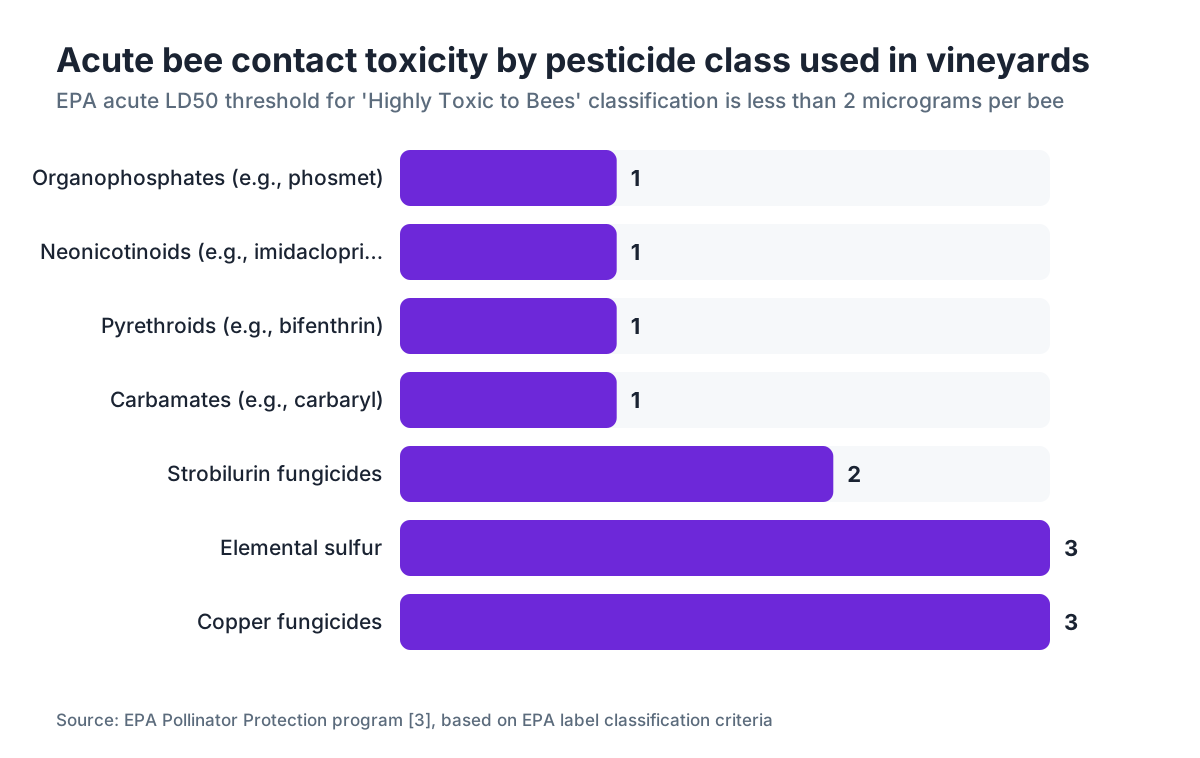
The table sums up the acute contact toxicity classifications that matter for vineyard chemistry.
| Chemical Class | Example Active Ingredient | EPA Bee Toxicity Class | Typical Label Bloom Restriction |
|---|---|---|---|
| Organophosphate | Phosmet | Highly toxic (Class I) | No application when bees foraging |
| Neonicotinoid | Imidacloprid | Highly toxic (Class I) | No application at bloom |
| Pyrethroid | Bifenthrin | Highly toxic (Class I) | No application when bees foraging |
| Carbamate | Carbaryl | Highly toxic (Class I) | No application at bloom |
| Strobilurin fungicide | Trifloxystrobin | Moderate concern | Precautionary label language |
| Sulfur fungicide | Elemental sulfur | Low acute toxicity | None typically, but rate matters |
| Copper fungicide | Copper hydroxide | Low acute toxicity | None typically |
What does 'vineyard bloom' mean for spray timing decisions?
Bloom in wine grapes is a window, not a day. It runs from the first open flowers (Eichhorn-Lorenz stage 23, caps loosening) through full bloom (E-L 26, half the caps fallen) into fruit set (E-L 27 to 29). The whole process takes two to four weeks depending on variety, region, and season. [7]
Bee visitation in vineyards is real, and easy to underestimate. Grapes are mostly wind-pollinated, but bees forage on vine flowers for pollen, and cover crops in the row or interrow can make a blooming vineyard genuinely attractive to foragers. Clover, phacelia, or mustard flowering under vines that are themselves in bloom pushes the exposure risk far above a clean floor.
Most bee-toxic labels use one of two trigger phrases, and they are not the same standard. 'When bees are actively foraging' can be satisfied by spraying at night or early morning before flight begins, typically before temperatures reach around 55 degrees Fahrenheit. 'During bloom' with no time-of-day qualifier is harder to work around, and often forces you to hold the whole application until petal fall.
UC Davis Cooperative Extension notes that on California's Central Coast, Chardonnay usually blooms late April to mid-May, while Cabernet Sauvignon may not hit full bloom until late May or June. A cool, wet spring stretches the bloom window and also stretches peak botrytis pressure, which sets disease management and pollinator protection against each other at exactly the wrong time. [8]
What must a spray record include to meet WPS and state requirements?
Federal WPS at 40 CFR 170.309 requires six things in every application record: the product name and EPA registration number, the active ingredient, the crop and location (field or block ID), the application date, and the restricted-entry interval. [2] States pile more fields on top. This is where a lot of vineyard operators fall short.
California PUR records must also include the application method, equipment type, pounds of active ingredient applied, application rate per acre, total acres treated, and the grower's pesticide use permit number or exempt status.
For bee protection, record two more items even though no rule strictly demands them: the bloom status of the block at the time of application, and whether bees were observed foraging in or next to the block. Neither is a WPS requirement. Both are gold if you face a bee-kill complaint. Writing down that the vines were at E-L 21 (pre-bloom, cluster elongating) when you sprayed a bloom-restricted material is direct evidence of compliance. Writing down that you walked the block at 7 a.m. and saw zero bee activity supports a 'not foraging' defense.
A practical bloom-period entry looks like this:
Block: South Vineyard Block 4 (Chardonnay, 3.2 acres)
Date applied: [date]
Product: [Product name], EPA Reg. No. [number]
Active ingredient: [AI], rate [X oz/acre]
Application method: Air-blast sprayer
REI: 24 hours
Bloom status: E-L 23 (10% caps falling), first open flowers observed
Bee activity check: Block inspected 6:45 a.m., temperature 52 F, no bee foraging observed
Cover crop status: Interrow mustard in bloom, mowed prior to application
Applicator: [Name, license number]
That level of detail takes maybe three extra minutes. It is worth it.
How do you notify beekeepers before a bloom-period spray?
Beekeeper notification is state-driven, never federal. But even where the law doesn't require it, it is operationally smart. A phone call before you spray is a lot cheaper than a county investigation after a bee kill.
California has no universal mandatory notification law for all crops, though several counties have adopted local notification ordinances and CDPR has pushed voluntary notification for years. The state operates a BeeWhere registry that lets beekeepers log colony locations and lets growers search for registered apiaries near their fields. Searching that registry and notifying registered beekeepers at least 48 hours ahead of a bloom-period application is the current best-practice standard CDPR recommends. [4]
Oregon's notification requirement covers all pesticides classified as highly toxic to bees. The Oregon Department of Agriculture maintains a pesticide notification registry. Growers applying covered pesticides must check the registry and notify registered beekeepers within a specified radius. That radius has shifted across rule revisions, so pull current ODA guidance for the number in force.
Washington runs a voluntary registry and active extension guidance, with no mandating statute as of this writing. WSU Extension recommends notifying any known beekeepers within at least one mile of the application site when you apply highly bee-toxic materials during bloom. [5]
For your records, log every notification: the beekeeper's name, the contact method, the date and time, and what you told them (expected spray date, product, block location). If you used a registry like BeeWhere, log the date you searched it and whether any registered apiaries showed up inside your notification radius.
What are the best practices for timing spray applications to protect bees?
Shift applications to early morning or evening, when bees aren't flying. That is the single highest-impact move. Most honey bee foraging happens between roughly 9 a.m. and 5 p.m. on warm days, so a spray made before sunrise or after dusk cuts exposure sharply for contact-toxic materials.
For systemic materials, especially neonicotinoids, the timing trick barely helps. Residues persist long enough to expose foragers no matter when you sprayed. The only real protection is keeping systemics out of the bloom period entirely, or picking alternatives with a lower bee hazard.
Mow or terminate flowering cover crops before bloom. This is standard advice from UC Davis and other extension programs. A cover crop in flower under blooming vines can pull more bees into the block than the vines themselves, and it drives up forager exposure. Mowing the interrow two to three weeks before anticipated vine bloom removes the attractor and lets the residue break down before bee activity peaks. [8]
If you're fighting botrytis during bloom (a real agronomic need in cool climates), product choice moves the bee risk a lot. SDHI fungicides and most DMI fungicides carry low acute bee toxicity and are generally acceptable, though a strobilurin-SDHI premix earns a label check. Elemental sulfur, sometimes flagged for direct toxicity at high rates, is still the lower-risk pick against loading a spray with adjuvants that push droplets deeper and raise the odds of inadvertent bee contact.
Document the timing logic in your record. Something like 'application timed to early morning, pre-flight conditions; temperature at spray start: 49 F.' Not required language, but it ties your decision to something an investigator can verify.
What are the recordkeeping retention requirements, and who can inspect your records?
Federal WPS at 40 CFR 170.309 requires application records retained for two years from the date of application and made available for inspection. [2] The standard says records must be available to agricultural workers and their representatives on request, and to inspectors from EPA or the relevant state lead agency.
State rules usually run longer. New York requires three years. [6] California's PUR system requires monthly reports to the county agricultural commissioner, so the records go beyond on-farm retention and become part of a state database. Oregon and Washington require two-year retention matching the federal floor, but both can demand records during a compliance inspection.
Who actually shows up and asks? In California, county agricultural commissioners run routine inspections and respond to bee-kill complaints. CDPR investigates larger incidents. EPA Region offices can inspect directly under FIFRA authority. WPS also gives agricultural workers or their designated representatives the right to request a copy of application records for any pesticide applied in a field where they work. The 2015 revision strengthened that right, and many operators overlook it.
Here is the practical reality. If a bee-kill complaint lands, the first thing an investigator asks for is your spray records for the preceding 14 days across any block within flight range of the affected apiary. Records that are complete, legible, and immediately accessible are your primary defense.
VitiScribe's spray log module builds records around the federal WPS fields plus the extra state-required fields for California, New York, Washington, and Oregon, and keeps them searchable for the full retention period. If your paper or spreadsheet system misses required fields, fix that before peak bloom, not during it.
How should you document a potential bee-kill incident in your spray records?
See dead or dying bees in or near your vineyard? Treat it as a recordkeeping event right away, whether or not you think your sprays caused it. Document immediately.
Write down the date, time, and location of the observation. Note the rough number of dead bees and where they were (on the ground near vines, at a hive entrance visible from your property, in the cover crop). Note weather. Note whether you sprayed anything within the previous 72 hours on any adjacent block.
Do not add retroactive justifications to earlier spray records after an incident. Regulators can spot altered records, and altering pesticide records after a complaint is a separate violation, usually treated worse than the underlying spray incident. If an earlier record is incomplete, note the gap separately and explain it. Leave the original alone.
Call your county agricultural commissioner proactively. In most states growers aren't legally required to self-report bee kills, but proactive contact establishes good faith and gets your version into the record before an investigation runs on the beekeeper's complaint alone. Bring your spray records.
Some states run bee-kill investigation programs. CDPR maintains a pesticide incident surveillance and reporting database, and documented incidents are public record that can be cited in later permit or license proceedings. [12] A well-documented record from your side of the event can change how the incident gets classified.
What spray record notation system works best for bloom-period compliance?
Use a standard template with required fields someone must fill in for every application. That is the fix for the most common failure in vineyard records: inconsistency. Some entries run detailed, others are a product name and a date. An auditor who sees ragged records zeroes in on the sparse ones, and a sparse entry during bloom reads like concealment even when it's just sloppiness.
Paper templates work. Spreadsheets work. Software works. A blank notebook where entry quality depends on who held the pen does not.
For bloom-period entries, build these fields into the template:
- Block ID and acreage
- Variety and approximate growth stage (E-L number or plain description like 'early bloom, 20% caps fallen')
- Product name, EPA reg number, formulation
- Rate per acre and total amount used
- Application equipment and calibration date
- REI and any bloom-specific label restrictions noted
- Pre-application bee activity check: time, temperature, observation
- Cover crop or interrow status (mowed, unmowed, in bloom)
- Wind speed and direction at time of application
- Applicator name and license or certification number
- Beekeeper notification: yes/no, method, date/time notified
That list runs longer than the federal WPS minimum. Every extra field earns its place: it either documents a legal requirement or documents a good-practice decision that can defend you in a bee-kill dispute.
The VitiScribe spray log is built on this field-level structure, and it tags entries by growth stage, so you can pull every bloom-period application across a season with one filter. That retrieval matters when a complaint arrives three months late and you need to reconstruct what happened in block 4 during the second week of May.
Where can you find current training and extension guidance on vineyard bee protection?
Three university programs carry the deepest vineyard-specific pollinator guidance: UC Davis, Cornell, and WSU. Read your labels first, your state regulations second, and the regional extension guidelines third.
UC Davis Cooperative Extension publishes bloom-period spray management guidance for wine grapes, including a pest management guidelines document that covers bee safety alongside efficacy data for approved fungicides and insecticides. The UC IPM program keeps current label summaries for the major vineyard pesticides. [8]
Cornell Cooperative Extension has documented bloom timing for the major New York varieties and covers where disease management (downy mildew and botrytis in particular) collides with pollinator protection during the bloom window. Their Integrated Crop and Pest Management guidelines for grapes carry explicit pollinator-risk ratings for common materials. [6]
WSU Extension covers Washington's wine grape regions and its hop production, which shares some of the same spray-timing headaches. Their pest management publications include pollinator guidance calibrated for the Pacific Northwest's early-season bee activity, including native solitary bees whose flight windows differ from managed honey bees. [5]
Beyond extension, the EPA's pollinator protection page links current label requirements, the national managed pollinator protection plan framework, and state plan summaries. EPA also runs the Pesticide Registration Review program, where you can check whether a specific active ingredient is under review for new bee-protection label language. [3]
For a working vineyard operator, the reading list is short and specific: your product labels (re-read every season), your state's current bee-protection provisions, and the UC, Cornell, or WSU pest management guidelines for your region and varieties.
Frequently asked questions
Does the EPA require me to notify beekeepers before spraying my vineyard during bloom?
No. Federal law does not require beekeeper notification. Notification rules come from state law and vary a lot. Oregon requires notification for highly bee-toxic materials. California encourages voluntary notification through CDPR's BeeWhere registry. Washington's system is voluntary. Check your state's current pesticide regulations, not a generic summary, because these rules have been updated in recent years.
What is the WPS restricted-entry interval, and how does it appear in spray records?
The restricted-entry interval (REI) is the minimum time after an application before workers without personal protective equipment can enter the treated area. WPS at 40 CFR 170.309 requires the REI in every application record. Common REIs for vineyard pesticides run from 4 hours to 5 days depending on the product. You write it directly into the entry, and it sets when workers can re-enter without PPE.
Can I spray sulfur during vineyard bloom without violating bee-protection rules?
Elemental sulfur has low acute toxicity to bees and usually carries no bloom-period prohibition on its label. At high rates, or applied directly onto foraging bees, it can still cause mortality. The practical standard: sulfur applied early morning before bee flight at label rates is generally acceptable. Adding organosilicone adjuvants to a sulfur spray changes the risk profile and calls for extra caution.
How long do I need to keep vineyard spray records to comply with federal requirements?
Federal WPS requires two-year retention from the application date. Several states require longer: New York mandates three years. California's PUR system requires monthly submission to the county agricultural commissioner, so records effectively become permanent in the state database. Keep your own copies at least three years to cover the common state standards, and store them in a form an inspector can actually read and verify.
What information must be in a vineyard spray record to pass a WPS inspection?
Federal WPS at 40 CFR 170.309 requires: product name, EPA registration number, active ingredient(s), location and crop, application date(s), and the restricted-entry interval. States add fields: California PUR requires application method, equipment type, rate per acre, total acres, and pounds of active ingredient. For bloom-period entries, also document growth stage and a pre-application bee-activity check, even though those aren't federally required.
Are neonicotinoids banned in California vineyards during bloom?
Not universally banned, but heavily restricted. California banned most uses of chlorpyrifos, not neonicotinoids as a class. Most neonicotinoid product labels now carry explicit bloom restrictions under EPA's pollinator-protection label program. Applying a neonicotinoid during bloom in a way that violates its label is a federal FIFRA violation regardless of state law. Check each product's current label; restrictions have been updated multiple times since 2013.
Do cover crops in the vineyard interrow affect bee-protection compliance?
Not directly in legal terms, but practically yes. A flowering cover crop sharply increases bee forager traffic in your block, which raises the exposure risk from any bloom-period spray. UC Davis and most extension programs recommend mowing interrow cover crops two to three weeks before anticipated vine bloom to reduce that attractor effect. Document the mowing in field notes, because it shows you took reasonable steps to limit bee exposure.
What is the 'bee advisory box' on pesticide labels, and when does it apply to vineyard sprays?
The EPA began requiring 'bee advisory boxes' on labels for pesticides highly toxic to bees starting in 2013. The box appears on the front of a label, states that the product is toxic to bees, gives the acute LD50 classification, and outlines restrictions during bloom or when bees are foraging. If your product has a bee advisory box, those restrictions carry the force of federal law under FIFRA. Re-read labels each season, because the box language can change at registration review.
Can workers request to see my vineyard spray records?
Yes. The 2015 WPS revision at 40 CFR 170.309 gives agricultural workers and their designated representatives the right to request application records for any pesticide applied in a field where they work or recently worked. You must make those records available within 15 days of a request. Refusing, or providing incomplete records, is a WPS violation independent of any underlying spray issue.
What happens if a bee kill is traced to a vineyard spray?
The county agricultural commissioner or state department of agriculture investigates. They request spray records, inspect the site, and may collect bee samples for residue analysis. Outcomes range from a warning letter to civil penalties under FIFRA or state law. Penalties vary: California CDPR can issue penalties up to $5,000 per violation per day. Complete, honest spray records are your primary defense. Altered records typically end worse than an honest incomplete one.
Do native bee species in vineyards get the same legal protection as honey bees?
Federal law does not distinguish honey bees from native bees in pesticide label restrictions. Label language that says 'toxic to bees' or 'do not apply when bees are foraging' covers all bee species. Some native solitary bees have different flight windows than honey bees, including cool-morning activity, so time-of-day restrictions built around honey bee patterns may protect native species less. This is an area where label language has not fully caught up with the science.
Is there a standard growth-stage notation I should use in bloom-period spray records?
The Eichhorn-Lorenz (E-L) scale is the international standard for grapevine growth staging and the one most extension programs reference. Bloom runs from roughly E-L 23 (individual flower separation) through E-L 27 (fruit set). Using E-L numbers makes an entry precise and verifiable, and it ties directly to the language in most pesticide label bloom restrictions and in UC, Cornell, and WSU guidance documents.
Do I need a separate log for beekeeper notifications, or can that go in the spray record?
No federal rule requires a separate beekeeper notification log. The cleanest approach puts notification details directly in the spray record entry for that application: the beekeeper's name, your contact method, and the date and time you notified them. If your state uses a registry like California's BeeWhere, log the date you searched it and the results. Keeping it in the spray record means everything about that application lives in one place.
Sources
- EPA, Federal Insecticide Fungicide and Rodenticide Act (FIFRA) overview: Under FIFRA section 12(a)(2)(G), using a pesticide in a manner inconsistent with its label is a federal violation; label language constitutes federal law.
- EPA, Agricultural Worker Protection Standard (40 CFR Part 170): WPS requires application records including product name, EPA reg number, active ingredient, crop, location, application date, and REI, retained for two years and available for inspection by workers and inspectors.
- EPA, Pollinator Protection: Since 2013 EPA has required 'bee advisory boxes' on labels for pesticides with acute bee contact LD50 less than 2 micrograms per bee, specifying bloom restrictions.
- California Department of Pesticide Regulation, Pesticide Use Reporting program: California PUR system requires growers to report every commercial pesticide application monthly to the county agricultural commissioner, with fields including application method, rate per acre, pounds of active ingredient, and total acres treated.
- Washington State University Tree Fruit and Extension pest management program: WSU Extension documents that high-rate copper or sulfur bloom applications can affect bee nutrition indirectly and recommends notifying beekeepers within one mile before applying highly bee-toxic materials during bloom.
- Cornell Cooperative Extension, Integrated Pest Management for grapes: Cornell documents earlier, cooler bloom in Concord and hybrid varieties overlapping bumble bee activity, and provides pollinator-risk ratings in its grape pest management guidelines; New York requires three-year record retention under 6 NYCRR Part 325.
- Coombe, Modified E-L system for grapevine growth stages, published via the Australian Society of Viticulture and Oenology: Bloom in wine grapes spans E-L stages 23 through 29, from first flower cap loosening through fruit set, a period that can last two to four weeks depending on variety and season.
- UC Statewide IPM Program, Grape Pest Management Guidelines: UC IPM provides bloom timing data for California wine grape varieties and recommends mowing interrow cover crops two to three weeks before vine bloom to reduce bee-forager attraction during spray-sensitive periods.
- California Food and Agriculture Code, Section 12996: California Food and Agriculture Code section 12996 authorizes county agricultural commissioners to issue temporary bee-protection orders when colonies are known to be present near fields in bloom.
- California Department of Pesticide Regulation, pesticide incident surveillance and enforcement: CDPR maintains an incident surveillance database for pesticide-related bee kills; documented incidents are public record and can be cited in subsequent permit proceedings; civil penalties can reach $5,000 per violation per day.
Last updated 2026-07-10