How to start a vineyard: a practical guide for new growers
TL;DR
- Starting a vineyard takes 3-5 years before your first commercial harvest, $15,000-$50,000 per acre in establishment costs, and serious planning around soil, climate, variety selection, and regulatory compliance.
- The biggest mistakes are choosing the wrong site and underestimating cash flow during the establishment years, when vines produce nothing sellable.
What does it actually cost to start a vineyard?
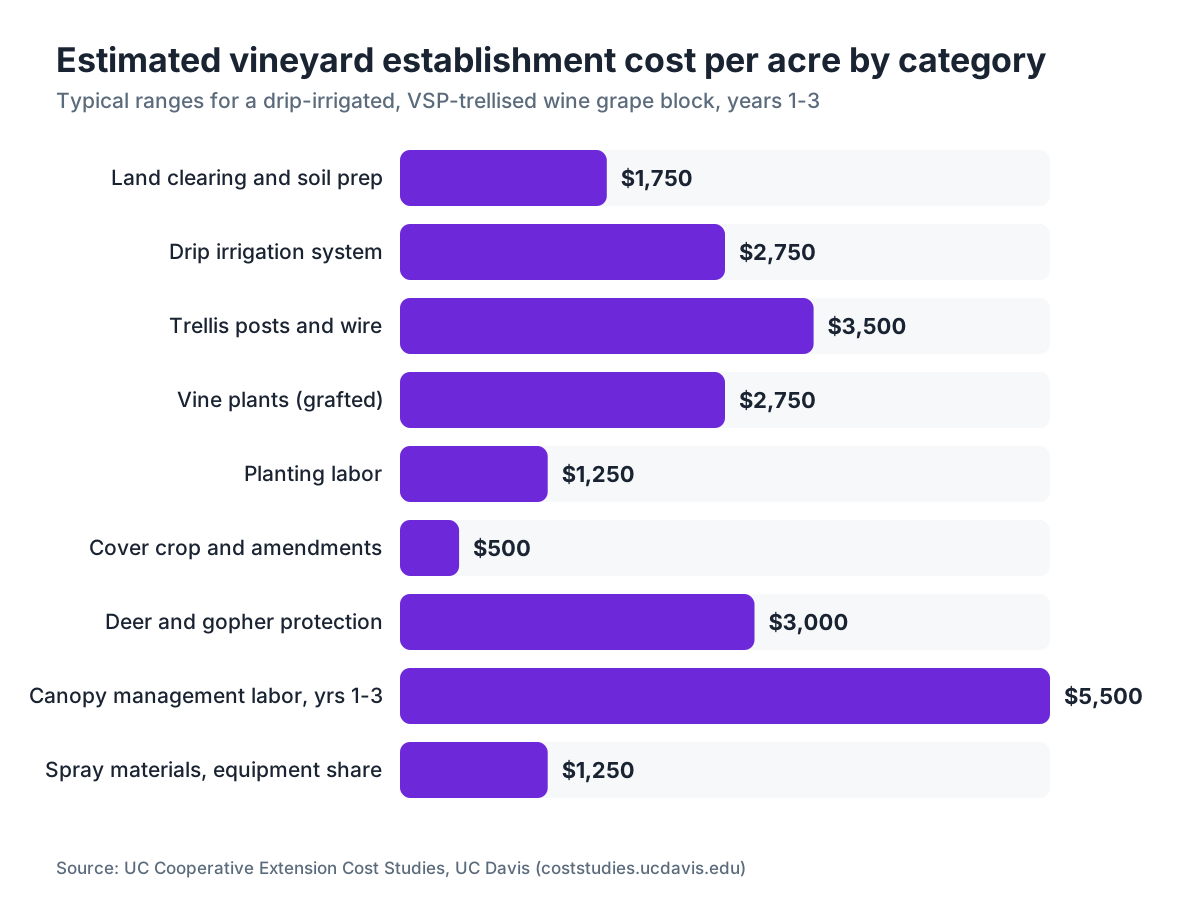
The honest number ranges from about $15,000 to $50,000 per acre to get through establishment, depending on your region, the varieties you plant, your trellis system, and whether you're hiring labor or doing the work yourself. That spread is not vague padding. A dry-farmed head-trained vineyard in a low-cost Central Valley site really does come in under $20,000 per acre. A densely planted, drip-irrigated Pinot Noir block in the Willamette Valley with a VSP trellis, deer fencing, and hired crews can easily push $45,000 or more [1].
Here's the rough breakdown of where the money goes in years one through three:
| Cost Category | Typical Range (per acre) |
|---|---|
| Land clearing and soil prep | $500, $3,000 |
| Irrigation system (drip) | $1,500, $4,000 |
| Trellis posts and wire | $2,000, $5,000 |
| Vine plants (own-rooted or grafted) | $1,500, $4,000 |
| Planting labor | $500, $2,000 |
| Cover crop and soil amendments | $200, $800 |
| Deer and gopher protection | $1,000, $5,000 |
| Canopy management labor, years 1-3 | $3,000, $8,000 |
| Spray materials and equipment share | $500, $2,000 |
| Year 1-3 totals | $10,800, $33,800 |
That table does not include land purchase or lease, water rights acquisition, permits, or equipment. A used tractor appropriate for vineyard work runs $15,000 to $40,000 [2]. A new sprayer, mower, and cultivator add another $20,000 to $60,000 depending on whether you buy new or used.
Most new growers underestimate operating expenses in years two and three because the vines are in the ground and "done," but you're still paying for water, labor, fuel, materials, and debt service with zero revenue. Plan for three to four years of negative cash flow per acre. That's not pessimism. That's what the numbers say.
How do you choose the right site for a vineyard?
Site selection is the one decision that matters most, and it's the one you can't fix later without losing your whole investment. Grapevines can live and produce for 30 to 50 years. A wrong choice compounds across every single one of those vintages.
The variables that decide the outcome are climate (heat summation and frost risk), soil drainage, aspect, water access, and proximity to labor markets and buyers. UC Davis uses Winkler degree-day regions to classify California's wine growing areas, and similar heat-summation frameworks exist for every major region [3]. A Chardonnay vineyard needs a different climate than a Cabernet Sauvignon vineyard. That's not a subtle preference. It's the difference between sugar-acid balance and wine that never ripens or always over-ripens.
Soil drainage matters more than soil fertility. Grapevines in wet, poorly drained soils suffer from root rot and produce inferior fruit. Well-drained, moderately fertile soils that would disappoint a corn farmer often produce the best wine grapes. Get a full soil profile done before you commit, ideally with percolation testing to 4 feet. Cornell's viticulture extension recommends verifying that your site can achieve at least 18 inches of workable, well-drained rooting depth [4].
Frost is a serious budget item. A single late frost event can wipe out 80-100% of a crop. Look at 10-year frost date records for your county, more than the regional average. Cold air drainage patterns on your specific parcel can put you in a frost pocket even if the hillside above you is frost-free. Talk to neighbors who farm fruit. They know the microclimates better than any weather station.
Water access deserves its own conversation. In the arid West, water rights can cost more than the land itself. In the East and Pacific Northwest, water is usually more available, but permits and wells still take time and money. Know what your water source is, what it costs, and whether it can be relied on before you plant a single vine.
Which grape varieties should a new vineyard plant?
Plant what grows best in your climate and what buyers in your region actually want to purchase. That's the short version. The longer version turns on three things, market, climate suitability, and disease pressure, and you want all three pointing the same direction before you commit.
For cool climates in the East and Midwest, cold-hardy hybrid varieties like Marquette, Frontenac, La Crescent, and Traminette have genuine commercial traction and survive winters that would kill Vitis vinifera outright. Cornell's New York State Agricultural Experiment Station at Geneva has done decades of breeding and trial work on cold-hardy varieties and publishes variety trial results regularly [4]. If you're in USDA Hardiness Zone 5 or colder, read those publications closely before choosing vinifera.
For California, the Pacific Northwest, and the broader West, climate data drives variety choice more than anything else. Cool-climate sites favor Pinot Noir, Chardonnay, Pinot Gris, and Riesling. Warm interior sites favor Cabernet Sauvignon, Zinfandel, Syrah, Merlot, and Rhone blending varieties. Washington State University Extension's viticulture program at Prosser publishes regional variety recommendations based on trial block data from the Columbia Valley and surrounding areas [5].
One thing that doesn't get enough attention: rootstock. If Phylloxera is present in your region (and it's present in most of California and much of the East), own-rooted vines are a slow disaster. Grafted vines on appropriate rootstock are not optional in those areas. Ask your local farm advisor or extension viticulturist which rootstocks are performing well in your specific soil type. The wrong rootstock can cause vine decline over years before anyone figures out what went wrong.
What permits and licenses do you need to start a vineyard?
Permits fall into two buckets: farming permits and winery/sales permits. If you're only growing grapes to sell to a winery, the regulatory burden is lighter but not trivial. If you want to make wine and sell it, you're looking at a separate and significant licensing layer.
For farming operations, the key requirements are:
- Pesticide applicator license or certified private applicator status, required by state departments of agriculture for restricted-use pesticide application. Requirements vary by state but generally involve a written exam and renewal credits [6].
- Agricultural water well permits, if you're drilling a new well.
- Grading or land disturbance permits for significant earthmoving, typically from your county.
- A pesticide use report (PUR) filed with your county agricultural commissioner in California, and equivalent reporting systems in other states [6].
- Compliance with the EPA Worker Protection Standard if you have any employees or farm workers who may be exposed to pesticides. The WPS covers training, notification, and re-entry interval recordkeeping [7].
If you plan to bond a winery, add: a Federal Basic Permit from the Alcohol and Tobacco Tax and Trade Bureau (TTB), a state winery license, local use permits (often the slowest piece), and in many counties a Conditional Use Permit that involves public hearings. Budget 12 to 24 months and $5,000 to $30,000 in fees and consulting costs for the winery licensing process. That range reflects real variation across California, Oregon, Washington, and New York.
One practical note: file for permits earlier than you think you need to. Land use approvals in wine country can take 18 months. Starting the permit process while your vines are establishing beats waiting until you have fruit to process.
How long does it take to get a vineyard to first harvest?
Three years is the standard answer, and it's basically correct for the first small crop. Year one, you're planting and training the vine to establish a trunk. Year two, you're beginning to form the permanent structure. Year three, you might get 10-30% of a mature crop on well-managed vines, depending on variety and conditions.
Full production takes five to seven years for most varieties on standard spacing. "Full production" typically means 3 to 6 tons per acre for wine grapes, though the range is enormous. High-end Pinot Noir blocks managed for quality often target 2 to 3 tons per acre. High-yielding San Joaquin Valley table wine blocks can hit 8 to 12 tons. Your target yield should come from your buyers and your business model, not from what the vines can technically produce.
The UC Cooperative Extension in Napa and Sonoma publishes sample establishment cost and returns budgets that show a five-year ramp to full production, and they note that the break-even point for most California wine grape vineyards falls in year six or seven, assuming a purchase price, yield, and contract price that are favorable [1]. That timeline stretches longer in cooler climates or on marginal soils.
Record everything from day one. Field operations logs, spray records, phenological observations, yield by block. The records you keep in year one become the baseline you use to make better decisions in year five. Tools like VitiScribe are built specifically to handle spray records, worker protection logs, and compliance documentation for small and mid-sized vineyard operations, so you're not scrambling at audit time.
What is the best vineyard trellis system for a new grower?
The most commonly planted trellis system in new American vineyards is Vertical Shoot Positioning (VSP), a bilateral cordon trained to a fruiting wire with foliage wires that hold the shoots upright. It's not the only option, but it works well across most varieties and climates, vineyard workers already understand it, and it's compatible with most mechanized equipment.
High Cordon or Scott Henry systems are worth considering in high-vigor sites where VSP struggles with excessive canopy density. Head training on its own (no trellis wire system, a free-standing gnarled trunk) is traditional for some varieties like Zinfandel and Grenache in dry-farmed situations, and it's much cheaper to establish, roughly $800 to $1,200 per acre versus $2,000 to $5,000 for a full VSP system. But head training requires specific climate conditions (low disease pressure, low frost risk) and is very hard to mechanize.
Post spacing, wire gauge, and end-post anchoring are the places new growers cut corners and regret it. A line post that's too small or spaced too far apart will deform under crop load within five years. The extension cost budgets from UC Davis and WSU both assume industry-standard 9-gauge wire on treated wood posts at 18-20 foot spacing, and those specs exist because cheaper alternatives fail in practice [1][5].
Row spacing is largely determined by your equipment width. Most tractors used in vineyards need at least 8 feet, with 10-12 feet being more comfortable and allowing more airflow for disease management. In-row vine spacing (3 feet to 8 feet) affects yield, vine balance, and ultimately wine quality. Tighter spacing costs more to plant but can improve quality. Talk to a viticulture consultant before you finalize your layout.
How do you manage vineyard pests and diseases?
The pest and disease complex you face depends almost entirely on where you farm. Powdery mildew is the most universal and economically damaging disease in American viticulture, present in every wine region. Downy mildew is serious in humid East Coast climates. Botrytis bunch rot hits anywhere with rain near harvest. Pierce's Disease, spread by the glassy-winged sharpshooter, is a genuine wipeout threat in California below roughly 2,000 feet elevation in warmer areas [8].
For new growers, an Integrated Pest Management (IPM) approach built around scouting, threshold-based decisions, and minimum effective rates will save you money over calendar-based spray programs and cut your regulatory exposure. Your local farm advisor or county UC Cooperative Extension office is the right place to start building a regional IPM plan. The UC Statewide IPM Program publishes specific guidelines for wine grapes that are updated regularly and freely available online [8].
Every pesticide application requires accurate records. In California, every application of a registered pesticide (restricted or not) must be reported to the county agricultural commissioner within 30 days [6]. Other states have varying reporting requirements. The Federal EPA Worker Protection Standard mandates that pesticide application records be kept for two years and be accessible to workers and handlers, and that workers receive specific training before entering treated areas [7]. The WPS statement from the EPA is direct: "Agricultural employers must provide workers and handlers with information about pesticides to which they may be exposed."
Insect pests vary by region: grape berry moth in the East, leafrollers in the West, mealybugs in California, Japanese beetles in the Mid-Atlantic. Your local extension viticulturist is the best resource for what's actually causing economic damage in your county. Don't let a pesticide salesperson tell you what to spray. Get independent diagnostic help.
Do you need a business plan to start a vineyard?
Yes, and not a generic one. A vineyard business plan needs to be built around your specific acreage, your water costs, your labor market, and, above all, your revenue path: are you selling bulk fruit, direct-to-winery contracts, or making and selling your own wine?
The economics are completely different across those three paths. A grower selling Napa Valley Cabernet Sauvignon at $4,000 to $8,000 per ton has a fundamentally different business than a grower selling Central Coast Chardonnay at $600 to $900 per ton. Both numbers reflect real prices from California's annual grape crush report [9]. The financial model for each requires different acreage to be viable.
At minimum, your plan should cover:
- Year-by-year cash flow projections through year seven (three establishment years plus four production years)
- All capital costs with realistic contingencies of 15-20%
- Revenue assumptions with named potential buyers, not hypothetical prices
- Labor plan: how much can you do yourself, what will you hire out
- Equipment plan: what you'll own versus custom hire
- Water cost and reliability
- Exit scenarios
Financing sources for vineyards include USDA Farm Service Agency loans, which have specific programs for beginning farmers and can cover operating expenses and equipment, and USDA's Value-Added Producer Grant program for those moving toward wine production [10]. Farm Credit institutions also make vineyard loans regularly, and they understand the negative-cash-flow establishment period in ways community banks often do not.
For the record-keeping side of the business, you'll want a system that handles spray records, employee pesticide training documentation, and field operation logs from the beginning. Papering that together from spreadsheets is workable but fragile, and regulators don't give credit for good intentions when records are missing. VitiScribe is designed specifically for this layer of vineyard operations compliance.
What do you need to know about water and irrigation for a new vineyard?
Water is the resource most new growers underplan for. Grapevines, once established, are more drought-tolerant than most crops, but in the establishment phase you need consistent moisture to build root systems and trunk development. In the first two years, most vineyards require supplemental irrigation regardless of climate.
For drip irrigation, the standard design for wine grapes is one or two emitters per vine at 0.5 to 1.0 gallon per hour. A one-acre vineyard with 450 plants at 1 gallon per hour would need 450 gallons per hour at peak, though actual vineyard irrigation events are typically 2 to 8 hours and are managed based on soil moisture monitoring or evapotranspiration data from CIMIS (California Irrigation Management Information System) in California or equivalent tools in other states [11].
In California and other Western states, water rights are not automatic with land ownership. Check whether the parcel has riparian rights, a water appropriation permit, or is relying on a well. If you're buying land with the intent to farm, verify water rights as carefully as you verify the soil. A vineyard deed that comes with no water rights in a drought-prone area is a very expensive problem.
Eastern growers often have adequate rainfall during the growing season but still need frost protection systems (overhead sprinklers or wind machines) that require substantial water volume and infrastructure. A frost protection overhead sprinkler system needs to deliver roughly 0.10 inches of water per hour continuously during a frost event to protect buds, which translates to significant pump and pipeline capacity.
How do you hire and manage vineyard labor?
Labor is typically the largest operating cost for a commercial vineyard, running from roughly $1,500 to $4,000 per acre per year in a mature production vineyard, depending on the trellising system, region, wage rates, and how much mechanization you've invested in [1]. The biggest labor draws are dormant pruning (usually 30 to 60 hours per acre for hand pruning), shoot positioning and hedging, and harvest.
In California, agricultural employers are subject to all standard labor code requirements including overtime rules that changed under AB 1066, which brought agricultural workers to the same daily and weekly overtime thresholds as other California workers, phased in over several years [12]. Oregon and Washington have similar agricultural overtime rules. New growers often don't realize they face the same payroll complexity as any other employer.
If you use any pesticides and have workers who enter treated areas, the EPA Worker Protection Standard is non-negotiable. It requires: a pesticide safety training program for workers and handlers before they work with or near pesticides, posting of Application Exclusion Zones and Re-Entry Intervals, access to pesticide labeling and Safety Data Sheets at the site, and records of all training. USDA and EPA jointly publish WPS training materials in multiple languages, and your state department of agriculture often provides train-the-trainer programs at no cost [7].
For a new small vineyard, hiring custom harvest crews through an established labor contractor is often the most practical path in years one through three. As acreage and complexity grow, direct employment makes more sense economically. Either way, get competent payroll and HR help from the start. Agricultural labor law violations are genuinely expensive.
What are the realistic income expectations from a vineyard?
Vineyard income depends more on where you are and what you're selling than on how well you farm, at least at the top line. The California Department of Food and Agriculture publishes an annual grape crush report that shows average prices paid per ton by variety and county [9]. In 2022, average prices ranged from around $450 per ton for San Joaquin Valley Colombard to over $7,000 per ton for Napa Valley Cabernet Sauvignon. The same variety in the same county can fetch wildly different prices depending on contract terms, reputation, and buyer relationships.
For a standalone grape-growing operation (selling fruit, not making wine), the math is simple in structure: tons per acre times price per ton minus costs per acre equals gross margin. The catch is that input costs in premium wine country have risen sharply and gross margins for many mid-tier appellations have thinned considerably. Growers with strong contracts (long-term agreements with established wineries) are in a much better position than those selling spot fruit.
If you're making and selling wine, the revenue per ton of grapes you grow is theoretically much higher, but so are the capital requirements, regulatory complexity, and marketing costs. A ton of grapes that becomes 60 cases of wine at $20 per bottle retail generates $14,400 in gross revenue versus perhaps $1,000 to $2,500 for the same ton sold as fruit. But you've added winemaking, bottling, distribution, tasting room, insurance, and compliance costs to get there.
The most profitable vineyard businesses are usually vertically integrated, growing premium fruit that goes into wines they control and sell direct. The least profitable are mid-tier bulk fruit growers in overcrowded appellations with no long-term contracts. Know which category you're aiming for before you plant. It shapes everything else.
If you're curious about what successful vineyard destination models look like, studying established operations like Gervasi Vineyard or larger regional players such as Ponte Winery can show you what the hospitality and direct-sales layer of the business looks like at scale. For a broader view of how wine-focused visitor destinations work in premium appellations, Paso Robles wineries make up one of the most studied growth markets of the past 20 years.
What resources and extension programs should new vineyard growers use?
The three university extension programs with the deepest publicly available resources for new vineyard growers in the U.S. are UC Cooperative Extension (UC Davis and county offices), Cornell Cooperative Extension (especially the NYSAES Geneva facility), and Washington State University Extension (the Irrigated Agriculture Research and Extension Center at Prosser). All three publish free, peer-reviewed, regionally specific guidance on variety selection, pest management, irrigation, and economics [1][4][5].
UC ANR (Agriculture and Natural Resources) publishes the UC Pest Management Guidelines for Grapes, updated regularly, which is the most widely cited IPM resource in American viticulture [8]. Cornell Cooperative Extension publishes variety trial data for cold-climate viticulture and regional pest management guides. WSU's viticulture program at Prosser publishes specific recommendations for Washington, Oregon, and Idaho growers.
For compliance and regulatory resources, your state department of agriculture's pesticide regulation division and your county agricultural commissioner are the primary contacts. The EPA's Worker Protection Standard resources are available at epa.gov and include training videos, model training records, and materials in multiple languages [7].
Practical peer communities matter a lot for new growers. Most wine regions have grower associations that host field days, spray clinics, and variety tastings. ASEV (American Society for Enology and Viticulture) publishes the American Journal of Enology and Viticulture, the primary peer-reviewed research journal for the field [13]. You don't need to read every paper, but knowing the research exists and how to find it when a question comes up is genuinely useful.
For a broader sense of how the industry operates at the established winery level, looking at how destination wineries like South Coast Winery or Mountain Winery have built their businesses gives context for what your long-term market and infrastructure goals might realistically look like.
Frequently asked questions
How many acres do you need to start a profitable vineyard?
For a standalone grape-growing operation selling fruit, most farm advisors suggest a minimum of 5-10 acres to cover costs and generate meaningful income, though it depends heavily on grape prices in your region. For a small estate winery, 2-5 planted acres can support a viable operation if you're making and selling wine direct at decent retail prices. Under 2 acres, the economics rarely pencil out unless you're selling very high-end fruit or running a premium wine club.
Can you start a vineyard with no farming experience?
Yes, but you'll pay tuition one of two ways: hiring good advisors and spending money to learn faster, or making avoidable mistakes and spending money to fix them. Most successful first-generation vineyard owners hire a vineyard management company or consulting viticulturist for at least the first three years. A good farm advisor, typically $500 to $1,500 per month for a small property, is almost always cheaper than a serious mistake in site preparation, variety selection, or early canopy management.
What climate is best for growing wine grapes?
Wine grapes need a long, warm growing season (roughly 150-180 frost-free days), moderate humidity during the growing season, and cold dormancy in winter. UC Davis's Winkler heat summation system defines five degree-day regions, from Region I (cooler, suited to Pinot Noir and Riesling) to Region V (hottest, suited to table wine varieties). The best climate for your vineyard is the one that matches the varieties you want to grow and the wine style you're targeting.
Do you need a license to grow grapes commercially?
To grow grapes and sell them to a winery, you generally don't need a special license beyond a standard agricultural business registration and a pesticide applicator certification from your state. If you apply any restricted-use pesticides, a licensed private applicator certificate is required in every state. If you employ workers who may be exposed to pesticides, EPA Worker Protection Standard compliance is mandatory regardless of operation size. Making and selling wine requires separate state and federal licensing.
How do vineyard spray records and pesticide reporting work?
In California, all pesticide applications to a commercial vineyard must be reported to the county agricultural commissioner within 7 days (restricted-use materials) or 30 days (all materials) via a Pesticide Use Report. Federal EPA Worker Protection Standard requires keeping pesticide application records for two years, with specific information including product name, EPA registration number, active ingredient, rate, date, and re-entry interval. Most states outside California have similar but less intensive reporting requirements through their state department of agriculture.
What is the Winkler heat summation system and why does it matter?
The Winkler Index, developed at UC Davis, measures the cumulative heat above 50°F (the temperature at which grapevines begin growing) during the April through October growing season. It divides wine regions into five zones from Region I (below 2,500 degree-days) to Region V (above 4,000 degree-days). It matters because variety-climate matching based on this index is one of the strongest predictors of whether a specific grape variety will ripen properly in a given location.
How do you protect a new vineyard from deer and gophers?
Deer exclusion fencing is the only fully reliable solution for deer, typically woven wire or high-tensile electric at 8 feet high, costing $2,000 to $5,000 per acre of perimeter depending on terrain. Individual vine tubes offer partial protection for young vines and cost $1 to $3 per vine. Gophers are controlled with underground wire mesh (expensive and labor intensive) or active trapping and baiting programs. Both pests can kill young vines in their first two years when root systems are small and vulnerable.
Can you start a vineyard in the eastern United States?
Yes. The industry is well-established in New York, Virginia, North Carolina, Michigan, Missouri, and many other Eastern states. The main challenges compared to the West are higher disease pressure (requiring more frequent fungicide applications), winter cold risk, and a shorter, more humid growing season. Cold-hardy hybrid varieties bred at Cornell and the University of Minnesota perform reliably in Zones 4-6. Vitis vinifera is viable in many Eastern sites but requires careful site selection and more intensive management.
What is the EPA Worker Protection Standard and does it apply to small vineyards?
The EPA Worker Protection Standard (WPS) applies to any agricultural operation that uses pesticides and has employees or family members who work in or around treated areas. It is not limited to large operations. It requires pesticide safety training for workers and handlers before they are exposed, posting of application information and re-entry intervals, access to Safety Data Sheets, and recordkeeping for two years. Non-compliance fines can reach $10,000 or more per violation. The full standard is published at epa.gov.
How long do grapevines live and when do they peak in quality?
Grapevines can live 80-100 years or more if healthy and well-managed. Most commercial vineyards begin producing commercially usable crops in year three, reach full production by year five to seven, and are often considered "old vines" at 25-30 years. Old vine fruit commands a premium in some varieties (especially Zinfandel and Grenache) because lower yields from aging root systems concentrate flavors. Economically, most large commercial vineyards replant at 30-40 years when yields decline below profitable thresholds.
What USDA programs can help finance a new vineyard?
USDA Farm Service Agency (FSA) offers direct and guaranteed farm operating loans and farm ownership loans, with specific Beginning Farmer programs that offer lower interest rates and relaxed equity requirements. USDA's Value-Added Producer Grant (VAPG) program can help fund feasibility studies or working capital for vineyard-to-winery transitions. USDA NRCS (Natural Resources Conservation Service) offers conservation programs including EQIP (Environmental Quality Incentives Program) that sometimes covers irrigation system installation or cover crop establishment. All programs are described at fsa.usda.gov.
What cover crops should a new vineyard use between the rows?
A mix of resident vegetation managed by mowing is simplest and lowest cost. Seeded cover crops between vine rows commonly include annual ryegrass, cereal rye, bell beans, or native grasses, depending on your climate, soil, and goals. Cover crops can suppress weeds, reduce erosion, improve soil organic matter, and moderate vine vigor through competition. In the vine row itself, most growers maintain a vegetation-free strip through herbicide or cultivation in the first two to three years to reduce competition while root systems establish.
How do you find buyers for vineyard grapes before you plant?
Talk to wineries in your region before you put a vine in the ground. Winery grape buyers and assistant winemakers are usually approachable at industry events and tastings, and many wineries actively look for reliable growers of specific varieties. Your county farm bureau, state grower association, and regional viticulture extension advisor can help with introductions. Getting even a letter of interest from a winery before planting dramatically reduces your financial risk and gives you a market signal on which varieties to plant.
Sources
- UC Cooperative Extension, Sample Costs to Establish a Vineyard and Produce Wine Grapes (various county editions): Establishment costs per acre, labor budgets through year 5, and break-even timeline estimates for California wine grapes
- USDA National Agricultural Statistics Service, Farm Equipment Prices: Typical price ranges for farm tractors and equipment used in vineyard operations
- UC Davis Department of Viticulture and Enology, Winkler Regions: Winkler degree-day heat summation system and regional classification for California wine growing areas
- Cornell Cooperative Extension, Cornell AgriTech / NYS Agricultural Experiment Station, Geneva: Cold-hardy variety trial data, rooting depth site guidance, and cold-climate viticulture recommendations
- Washington State University Viticulture and Enology Program: Regional variety recommendations and trellis and wire specifications from Columbia Valley trial block data
- California Department of Pesticide Regulation, Pesticide Use Reporting: Pesticide use reporting requirements, timelines, and licensed private applicator certification requirements for California agricultural operations
- US EPA, Agricultural Worker Protection Standard: WPS requirements for training, recordkeeping, re-entry intervals, and the applicability to all agricultural operations using pesticides with workers
- UC Statewide IPM Program, UC IPM Pest Management Guidelines: Grape: Integrated pest management guidelines for powdery mildew, Pierce's Disease, and other key wine grape pests and diseases
- California Department of Food and Agriculture, California Grape Crush Report: Annual average price per ton paid by variety and county for California wine grapes, including 2022 price ranges cited
- USDA Farm Service Agency, Farm Loans and Beginning Farmer Programs: FSA direct and guaranteed loan programs for beginning farmers and Value-Added Producer Grant program for vineyard and winery operations
- California Irrigation Management Information System (CIMIS), California Department of Water Resources: CIMIS evapotranspiration data used for irrigation scheduling in California vineyard operations
- American Society for Enology and Viticulture, American Journal of Enology and Viticulture: Primary peer-reviewed research journal for American viticulture and enology
Last updated 2026-07-09