How to track pesticide use reports for county agricultural commissioner submission

TL;DR
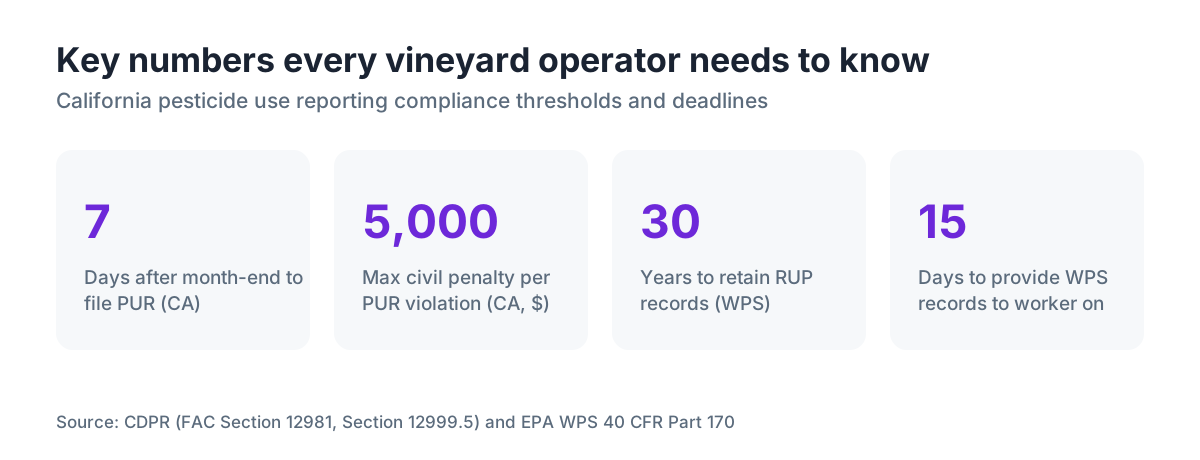
- In California, every commercial pesticide application has to be recorded and reported to your County Agricultural Commissioner within 7 days after the month ends.
- You need the product name, EPA registration number, acres treated, pounds of active ingredient applied, applicator license number, and field location.
- Most other states run similar systems.
- Paper logs, spreadsheets, or dedicated software all work.
- Errors cost you.
What is a pesticide use report and who has to file one?
A Pesticide Use Report (PUR) is the official record of every pesticide application you make on a commercial agricultural site. In California the requirement comes from California Food and Agricultural Code Section 12981, which tells all licensed pest control operators and the growers who hire them to report each application to the County Agricultural Commissioner (CAC) where it happened. [1]
If you grow grapes commercially, you file. Full stop. The homeowner exemption does not reach vineyard operations, even if you farm three acres in the backyard.
Other states run parallel systems. Washington has applicators report to the Washington State Department of Agriculture under WAC 16-228. Oregon requires reporting under ORS 634.372. New York collects data through licensed commercial applicators rather than directly from growers, but the record-keeping obligation still lands on whoever holds the applicator certificate. [7]
The federal layer is the Worker Protection Standard (WPS) under 40 CFR Part 170. It says application records have to stay on-site and available to workers and handlers, kept 30 years for restricted-use pesticides (RUPs) and 2 years for general-use products. [3] The WPS record and the state PUR are two separate obligations. You satisfy both, or you fail both.
What information do you need to record for each application?
California's PUR data fields are the most detailed in the country, which makes them a good benchmark for any grower building a tracking system. Under California Department of Pesticide Regulation (CDPR) rules, each application record has to include: [1]
- Date of application
- Pesticide product name exactly as it reads on the label
- EPA registration number
- Pounds of active ingredient applied (not product volume)
- Acres or units treated
- Site description and township/range/section (GPS coordinates work in many counties)
- Name and license number of the qualified applicator
- Pest or pests targeted
- Commodity (for vineyards: grapes, wine grapes, or table grapes)
- County where the application occurred
The pounds-of-active-ingredient number trips up a lot of new growers. You can't just write "1 gallon of Captan 80WP." You do the math. Apply 2 lb of product per acre over 5 acres at 80% active ingredient by weight, and you applied 8 pounds of active ingredient. CDPR's PUR Reporting Guide walks through the calculation for each formulation type. [4]
For restricted-use pesticides you also need the grower's name and address when the applicator is a separate PCO, plus the written recommendation or permit number if the product required one.
When are pesticide use reports due to the county?
California's deadline is firm: reports are due within 7 days after the end of the month the applications happened in. [1] Spray sulfur on July 14 and again on July 28, and both go on a July report that has to reach the CAC by August 7.
Some counties take early filing. None take late filing without consequences.
Washington's commercial applicator reporting runs on a similar monthly cadence. Oregon files quarterly for many grower categories but monthly for restricted-use products. Check your state ag department's website for the exact schedule. Deadlines shifted in several states between 2020 and 2023, and what your neighbor remembers may be two rulebooks out of date.
One practical note. If you made zero applications in a month, most California counties still want a "no application" report or a signed waiver. Call your CAC office each January to confirm their current preference, because it varies county to county.
| State | Reporting Frequency | Filed With | Key Statute/Rule |
|---|---|---|---|
| California | Monthly, due within 7 days of month-end | County Agricultural Commissioner | FAC Section 12981 |
| Washington | Monthly (commercial applicators) | WA State Dept. of Agriculture | WAC 16-228 |
| Oregon | Monthly (RUPs), Quarterly (general use) | OR Dept. of Agriculture | ORS 634.372 |
| New York | Annual summary via licensed applicator | NY DEC | ECL Article 33 |
How do fines and penalties work if you miss a deadline or file incorrectly?
California's civil penalty for late or incomplete PUR filing can reach $5,000 per violation under Food and Agricultural Code Section 12999.5. [1] In practice, first-time offenders usually get a written warning and a correction period. Repeat failures escalate fast.
The CAC audits PURs against pesticide dealer sales records. If a dealer sold you a case of chlorpyrifos in May and your June report shows no application, expect a call. This cross-referencing has been routine in California since CDPR digitized dealer records in the 1990s.
WPS violations carry their own federal penalties. Under 40 CFR Part 170, EPA can assess civil penalties up to $19,866 per violation. That figure is inflation-adjusted periodically, so confirm the current ceiling on EPA's pesticide worker safety page before you quote it to anyone. [3] Application record-keeping failures are a common WPS citation during CAC inspections.
Here's the honest reality. Most small vineyard operators who get cited already have a record-keeping system. It's just sloppy. An application that never got logged in the field, a transcription error on the active ingredient math, a wrong EPA registration number. The fix is catching those before the report goes in, not after.
What are your actual options for tracking pesticide applications day-to-day?
You have three realistic options, each with real tradeoffs.
Paper field logs. A carbonless NCR spray record book works. You fill it out at the spray rig before you leave the block. One copy stays in the tractor cab, one goes to the office. CDPR publishes a free sample log form. [4] The failure mode is the log that stays in the cab and gets rained on, or the application that happens "real quick" and never gets written down. Paper is free but fragile.
Spreadsheets. A well-built Excel or Google Sheets template handles everything CDPR wants. UC Cooperative Extension has published spreadsheet templates for wine grape operations that pre-calculate active ingredient pounds from product amounts and label concentration. [5] Spreadsheets fall apart when several people make applications and nobody is sure who owns the master file. Version control is the silent killer.
Dedicated record-keeping software. This is where a tool like VitiScribe fits, with a mobile log that pushes application records to a central database and builds the county report format for you. The monthly report becomes a print-and-sign job instead of a data-assembly one. Worth the cost past about 20 acres, or any time you run multiple applicators.
Whatever you pick, the log gets filled out at the time of application, not reconstructed at month-end. Your compliance defense and your liability defense both ride on contemporaneous records.
How do you calculate pounds of active ingredient applied, and why does it matter?
Pounds of active ingredient (lbs a.i.) is the core unit CDPR uses to build its statewide pesticide database. It's how regulators track exposure loads by watershed, by commodity, by compound. Your number has to be right, because the county doesn't audit product volume. It audits lbs a.i. and cross-checks against your dealer's sales records.
The formula is short:
Lbs a.i. applied = (Amount of product applied, in lbs) x (Percent active ingredient / 100)
For liquid formulations, convert volume to weight first using the label density (usually printed as pounds per gallon).
Example: You apply Pristine WG (25.2% pyraclostrobin, 12.8% boscalid) at 14.5 oz per acre over 8 acres.
- Total product = 14.5 oz x 8 acres = 116 oz = 7.25 lbs
- Pyraclostrobin lbs a.i. = 7.25 x 0.252 = 1.83 lbs
- Boscalid lbs a.i. = 7.25 x 0.128 = 0.93 lbs
Both active ingredients get their own line on the PUR, because CDPR's database tracks them under separate registration contexts. Multi-active products trip people up right here. When in doubt, CDPR's PUR reporting instructions spell out how to handle tank mixes and co-formulated products. [4]
WSU Extension's record-keeping guidance for Washington growers uses a nearly identical lbs a.i. framework, so the skill transfers if you farm in more than one state. [2]
How do you submit the report to the county agricultural commissioner?
Submission methods vary by county in California. Ask your specific CAC office which one they want, because many modernized their process in the last five years.
Three common routes:
- Paper forms, dropped off or mailed. Every county has an official PUR form. Many still accept paper, and some require it. Get the current form from your CAC, not a three-year-old Google cache.
- County-specific online portals. Some larger agricultural counties (Fresno, Kern, Tulare) run their own web portals for PUR submission. These need a one-time grower registration.
- CDPR's eSPUR system. CDPR built an electronic submission system for direct filing. As of 2024, county adoption varies. Some accept eSPUR data directly, others still want the county form with eSPUR as backup. Check with your CAC before you assume eSPUR satisfies your local obligation. [4]
Out of state: Washington uses the AgriMetrix system for commercial applicator reporting. Oregon takes submissions through the Oregon Department of Agriculture's online portal or by paper.
Keep a copy of every filed report with its submission confirmation or postmark for at least three years. CDPR's data retention runs longer, but three years covers most audit windows.
What records do you need to keep on-site for worker protection standard compliance?
The EPA's Worker Protection Standard, codified at 40 CFR Part 170, requires agricultural employers to keep specific application records that overlap with PUR records but are not identical to them. [3] Under WPS, restricted-use pesticide records stay 30 years. General-use records stay 2 years.
The WPS regulatory text requires employers to keep records of each pesticide application, including the product name, EPA registration number, active ingredients, the location and description of the treated area, and the date of application.
Those records have to be available to workers and their designated representatives on request. That's not vague. If a worker asks to see the application records for a block they worked, you are legally required to provide access within 15 days. [3]
Coordinating WPS records with your PUR data pays off, because the fields overlap so much. Build one source of truth, not two logs. The main difference is the retention clock (2 or 30 years for WPS versus whatever your county wants for PUR copies, usually 3 years).
The UC Statewide Integrated Pest Management Program publishes WPS record-keeping guidance specific to California wine grape production. [5]
How do you build a tracking system that holds up through a busy spray season?
From bud break through veraison you can be spraying every 7 to 14 days, sometimes several materials in one week. Most record-keeping failures happen because the system built for light traffic collapses under real load, not because growers don't know the rules.
A few things that actually work:
Assign the log to the equipment, not the person. A clipboard mounted in the spray rig, or a tablet in a waterproof case, keeps the log where the application happens. Whoever is spraying fills it out before moving on.
Set a weekly transfer, not a monthly scramble. Every Friday, someone pulls the field logs and moves the data to the master record. Compiling 30 applications from memory at month-end is exactly how errors get in.
Use the EPA reg number as your primary identifier. Product names change with reformulations, name swaps, and label acquisitions. The EPA reg number is stable, and it's what CDPR actually tracks. Keep a reference card in the cab with the reg numbers for every product in this season's spray program.
Pre-populate what you can. If your spray program is planned in advance (and it should be), pre-fill product name, reg number, and target pest for each planned application. The applicator adds date, acres, and rate in the field.
For vineyards farming sites across county lines, records need to be split by county, because each county gets its own filing. This is where software earns its keep. VitiScribe handles multi-county block assignments automatically, so month-end reports route to the right CAC without hand-sorting.
For the foundational picture of spray records in wine grape production, the UC IPM guidelines for grapes are worth reading front to back. [5]
What do you do if you discover an error in a previously submitted report?
Errors happen. The right move is to contact your CAC office directly and early, not to hope the discrepancy slips by.
Most CAC offices run a formal amendment process. You submit a corrected PUR with a cover note explaining what changed and why. CDPR's guidance says corrections should go in as soon as you find the error. [4] Voluntary correction before an audit finds the mistake usually means no penalty, or a reduced one.
The errors that matter most:
- Wrong active ingredient pounds. This one feeds the statewide exposure data. Always correct it.
- Wrong application location or site code. Can misattribute your pesticide load to the wrong watershed.
- Missing application. The worst kind. Submit a late report with a cover letter right away.
- Wrong EPA reg number. Correct it, but it's lower urgency than the rest.
Active ingredient calculation mistakes are the issue extension advisors flag most. WSU Extension's record-keeping resources include a checklist for reviewing a completed PUR before you send it, specifically because the lbs a.i. math generates so many slips. [2]
Don't let fear of the correction process stop you from fixing a mistake. A self-reported error on a five-year-old report gets handled very differently from one an enforcement audit finds.
Are there any reporting exemptions for small vineyards or organic operations?
Short answer: no, not in California.
California's PUR requirement applies to all commercial agricultural pesticide applications, whatever your acreage or certification. Organic vineyards use pesticides, including copper fungicides, sulfur, and various OMRI-listed materials, and every one of those applications gets reported just like a conventional program. Copper draws particular regulatory attention because it builds up in vineyard soils, and CDPR tracks copper application rates through PUR data. [1]
The common misconception is that "natural" or "organic" pesticides don't need reporting. They do. If it has an EPA registration number (and any pesticide sold commercially does), it belongs on your PUR.
The only meaningful California exemption covers applications made by a state or local agency for public health purposes on public land. That has nothing to do with a private vineyard.
Small-farm exemptions exist in some other states for record-keeping formats, not for reporting to regulators. In Oregon, acreage-based exemptions apply to some record formats but not to the obligation to track RUP applications. Check your state ag department directly. The Oregon Department of Agriculture's pesticide division keeps a clear FAQ on this. [10]
How does CDPR use the data you submit, and does it affect future regulations?
CDPR publishes the California Pesticide Use Report data as a public dataset, updated annually. [1] It's the most detailed statewide pesticide use database in the country, and researchers, environmental advocates, and regulators all pull from it.
What that means for you: your individual applications, once aggregated, show up in county-level and watershed-level summaries. When CDPR weighs restricting a pesticide, PUR data is the primary evidence for how much is going out, where, and on what crops. Wine grapes consistently rank among the highest-pesticide-use commodities per acre in the dataset, which means viticulture is always in the frame when fungicide and insecticide restrictions come up for review.
For chlorpyrifos, which California pulled from agricultural use in 2020, PUR data was central to CDPR's impact assessment. For copper, where the EU has a 28 kg/ha cumulative cap and California is watching closely, your reported copper applications are part of the evidence that will shape the next rule. [1]
The point is simple. Accurate, complete PUR records are more than compliance theater. They are the data that decides whether the products you depend on stay on the shelf.
Frequently asked questions
How many days after the month ends do I have to submit a pesticide use report in California?
California requires pesticide use reports to be filed with the County Agricultural Commissioner within 7 days after the end of the month the application occurred, per Food and Agricultural Code Section 12981. July applications are due by August 7. Some counties run their own portals or paper forms, so contact your local CAC at the start of each season to confirm the current submission process.
Do I need to report organic pesticide applications like copper and sulfur?
Yes. Every commercial pesticide application on agricultural land gets reported in California, whether or not the product is OMRI-listed or used in a certified organic program. Copper fungicides and sulfur carry EPA registration numbers and get tracked closely because of soil accumulation concerns. Organic certification creates no exemption from the PUR filing requirement.
What happens if I miss the pesticide use report deadline?
California's civil penalty for late or incomplete PUR filing can reach $5,000 per violation under Food and Agricultural Code Section 12999.5. First offenses usually bring a written warning and a correction window, but repeat violations escalate. File as soon as you realize the report is late and contact your CAC proactively rather than waiting for them to call you.
How do I calculate pounds of active ingredient for a multi-active-ingredient product?
Multiply the total weight of product applied by the percent of each active ingredient separately. Pristine WG has two active ingredients (pyraclostrobin 25.2% and boscalid 12.8%), so each gets its own calculation and its own line on the PUR. CDPR's PUR Reporting Guide on the CDPR website works through examples for liquid, granular, and wettable powder formulations.
Can I submit pesticide use reports electronically, or does it have to be paper?
It depends on your county. CDPR runs the eSPUR electronic submission system, but county acceptance of it varies. Some larger agricultural counties (Fresno, Kern) run their own online portals. Call your County Agricultural Commissioner's office directly to confirm which methods they accept before assuming an electronic filing satisfies your obligation.
What records do I need to keep for the EPA Worker Protection Standard versus the county PUR?
The data fields overlap heavily but the retention periods differ. WPS under 40 CFR Part 170 requires restricted-use pesticide records kept 30 years, general-use records 2 years, and both accessible to workers within 15 days of a request. PUR copies are typically kept 3 years for county audits. Build one unified application log that satisfies both rather than running two separate systems.
Do I need to report if I made no pesticide applications in a given month?
Most California counties expect either a no-application report or a signed waiver confirming no applications happened that month. This varies by county. Call your CAC office at the start of each year to confirm their current requirement. Assuming a blank month means no filing is a common mistake that opens compliance gaps in your record.
If I farm blocks in two different counties, do I file separate reports with each county?
Yes. In California, PUR reports go to the CAC in the county where the application occurred, not where your business sits. Blocks in Napa and Sonoma counties mean a separate monthly report with each. Your records need to be split by county at the data level before you compile the reports at month-end.
How long do I need to keep copies of submitted pesticide use reports?
California's general recommendation is three years for PUR copies, which covers most audit windows. WPS requirements for restricted-use pesticides run to 30 years, so those underlying application records need much longer retention. Keep submission confirmations (postmarks or portal receipts) with the report copies. Cloud storage with backup is more reliable than paper archives over long retention periods.
What pesticide information has to be recorded at the time of application versus later?
Regulators expect the log filled out contemporaneously, meaning at or right after the application, not reconstructed at month-end. Product name, EPA reg number, date, acres treated, and rate applied all get recorded in the field. The pounds-of-active-ingredient calculation can wait until you transfer data to the master record, but the raw application data has to be captured in the field.
How does the county cross-check my pesticide use report for accuracy?
California's County Agricultural Commissioners cross-reference PUR data against pesticide dealer sales records. CDPR digitized dealer records decades ago, so if a dealer sold you a restricted-use pesticide in a month and that product never shows up in your PUR, the discrepancy is detectable in routine audits. Active ingredient quantities are the primary cross-check variable.
Are there software or apps built specifically for vineyard pesticide use reporting?
Yes. Several platforms are built for agricultural compliance record-keeping and can auto-populate CDPR-required fields, calculate active ingredient pounds from product rates, and generate the month-end report. Look for mobile logging in the field, multi-county block assignment, and export formats that match your CAC's preferred submission. Weigh the time savings against the subscription cost for your operation's scale.
What is the difference between a restricted-use pesticide record and a general-use pesticide record for reporting purposes?
In California, both categories go on your monthly PUR. For restricted-use pesticides you also need a written recommendation or permit from a licensed pest control adviser, plus the grower's name and address if a PCO makes the application. The WPS retention difference (30 years versus 2 years) matters for archive planning. Check each label; restricted-use products say 'Restricted Use Pesticide' at the top.
Sources
- California Department of Pesticide Regulation, Pesticide Use Reporting: California FAC Section 12981 requires monthly PUR filing within 7 days of month-end; civil penalties up to $5,000 per violation under FAC Section 12999.5
- Washington State University Extension, Pesticide Record Keeping for Agricultural Producers: WSU Extension publishes pesticide record-keeping guidance for Washington growers including lbs a.i. calculation framework and WAC 16-228 monthly reporting requirements
- U.S. EPA, Worker Protection Standard 40 CFR Part 170: WPS requires restricted-use pesticide application records kept 30 years, general-use 2 years, accessible to workers within 15 days of request; civil penalties up to $19,866 per violation
- California Department of Pesticide Regulation, PUR Reporting Guide and eSPUR System: CDPR publishes official PUR reporting instructions including active ingredient calculation examples and operates the eSPUR electronic submission system
- UC Statewide Integrated Pest Management Program, Grape Pest Management Guidelines: UC IPM publishes spray record templates and WPS record-keeping guidance specific to California wine grape production
- Cornell Cooperative Extension, New York State Pesticide Safety Education Program: New York structures pesticide reporting through licensed commercial applicators under ECL Article 33 with records collected by the NY DEC
- California Food and Agricultural Code Section 12981: FAC Section 12981 is the statutory basis for California's mandatory pesticide use reporting to County Agricultural Commissioners
- U.S. EPA, Pesticide Registration and EPA Registration Numbers: Every commercially sold pesticide in the U.S. carries an EPA registration number that serves as the primary product identifier in state PUR systems
- Oregon Department of Agriculture, Pesticides Program: Oregon's pesticide division publishes guidance on acreage-based record-keeping formats and RUP tracking obligations
- California Department of Food and Agriculture, County Agricultural Commissioners: CAC offices serve as the local receiving and enforcement body for California PUR filings and cross-reference submissions against dealer sales records
Last updated 2026-07-09