Deadline for submitting pesticide use reports in California vineyards

TL;DR
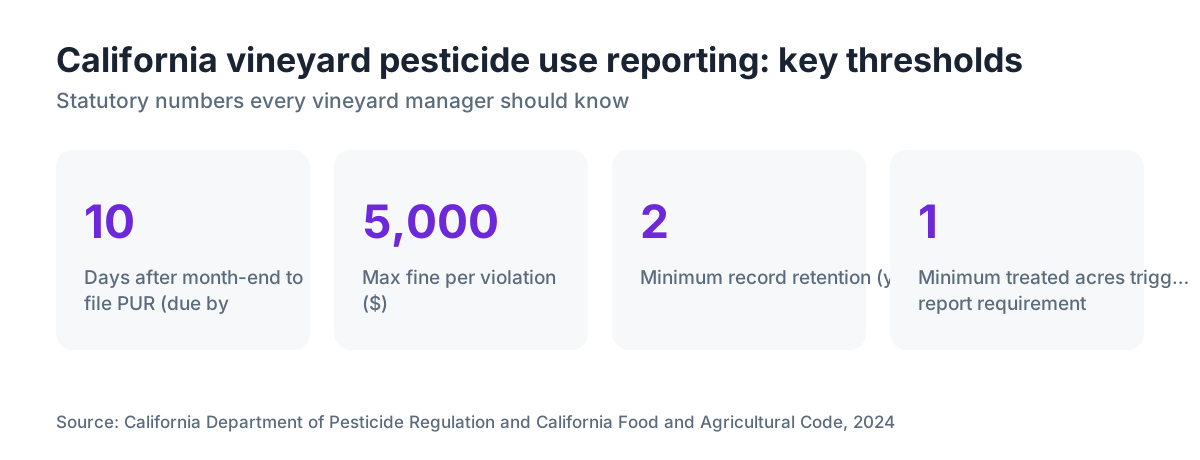
- In California, growers submit pesticide use reports (PURs) to their county agricultural commissioner by the 10th of the month following application.
- Reports cover every pesticide applied, organics included.
- Missing the deadline can mean fines up to $5,000 per violation.
- The Department of Pesticide Regulation collects the data and publishes it in a public database going back to 1990.
What is the deadline for pesticide use reports in California vineyards?
The 10th of the month following any month you applied pesticides. Apply anything in June, and your report is due July 10. Apply in December, and January 10 is your hard stop.
This requirement lives in California Food and Agricultural Code Section 13160 and its implementing regulations at California Code of Regulations Title 3, Section 6624. [1] The report goes to your county agricultural commissioner (CAC), not to the state directly. The California Department of Pesticide Regulation (CDPR) aggregates the data after the counties process it.
No applications in a given month means you owe nothing. There's no null report requirement for quiet months. But the moment you apply anything covered under the law, the clock starts.
Which pesticides have to be reported for vineyard operations?
Practically everything. The reporting requirement under CCR Title 3, Section 6624 covers all pesticide applications made by, or under the supervision of, a licensed pest control adviser (PCA) or pest control operator (PCO), plus all applications made to more than one acre of an agricultural commodity. [1] Vineyards almost always clear that one-acre bar.
That list includes:
- Conventional fungicides (sulfur, captan, mancozeb, copper)
- Synthetic insecticides
- Herbicides applied under or between rows
- Rodenticides
- Organically approved materials like copper hydroxide, spinosad, and kaolin clay
- Growth regulators like gibberellic acid
Organic vineyards report too. CDPR has been explicit that organic and conventional operations carry the same PUR obligations. [2] This trips up a lot of new organic operators who assume OMRI-listed materials get a pass. They don't.
One gray area: plant-incorporated protectants (PIPs) follow different rules under EPA. But for California state PUR purposes, if it comes out of a sprayer, you report it.
What information goes on a California pesticide use report?
CDPR sets the required data fields, and each county documents them in its Pesticide Use Report form instructions. Every record needs the grower name, site location, commodity, acres treated, product name, EPA registration number, active ingredient amounts, and application date and method. [2]
Here's the full field list:
- Grower name, address, and operator identification number (OIN)
- Site location (usually township/range/section or GPS coordinates)
- Commodity (grape, raisin grape, wine grape)
- Acres treated
- Product name and EPA registration number
- Active ingredient(s) and amounts applied (lbs of active ingredient)
- Application date
- Application method (airblast, ground rig, hand application, etc.)
- Name of the PCA who recommended the application, if applicable
Counties have some room to add fields, so check with your CAC. Fresno, Napa, Sonoma, San Luis Obispo, and Kern counties each run their own electronic submission portals with slightly different intake steps, though the core data elements are state-mandated. [1]
If you work with a PCA, they have to give you a written recommendation before each application. That document carries most of the data you need for the PUR, so filing them as they come in makes report assembly fast.
How do you actually submit a pesticide use report in California?
Most counties now accept or require electronic submission. You go through either the county's own online portal or third-party reporting software that exports in the county's accepted format.
A handful of smaller, rural counties still take paper. Call your CAC office before you assume anything. Contact information for all 58 county agricultural commissioners sits on the CDPR website. [2]
Run blocks in more than one county? Say a large operation with vines in both Napa and Sonoma. You file separately in each county for the applications that happened there. No single statewide window covers multiple counties at once.
Farm management software can automate the field-to-report pipeline. VitiScribe, for one, is built for vineyard compliance and generates county-formatted PUR exports straight from the spray records you already keep. Purpose-built software or a spreadsheet, the goal doesn't change: don't wait until the 9th to rebuild a month of applications from memory.
UC Davis Cooperative Extension has published practical guidance on record-keeping systems for small vineyard operations, and their advisors field PUR questions directly. [3]
What are the penalties for missing the pesticide use report deadline?
The California Food and Agricultural Code authorizes fines up to $5,000 per violation for PUR non-compliance. [1] Each missing or late report for a given application event counts as its own potential violation, so a busy month with eight spray events could mean eight separate violations.
County enforcement varies in practice. Some counties issue warnings for first-time late filers. Others run tighter, especially where drift or water quality complaints have put agricultural operations under scrutiny. Napa and Sonoma, where public and regulatory attention on vineyard pesticide use runs high, tend to enforce harder.
There's a second risk beyond fines. If you ever land in a drift investigation or a worker exposure complaint, regulators pull your PUR history. Gaps or late filings give them a reason to look harder at everything else.
Then there's the PCA license angle. If a pest control adviser signed off on applications that never got reported, their license is exposed too. Your PCA has a professional stake in keeping you on schedule.
Does the pesticide use report deadline change for restricted-use pesticides?
No. The monthly deadline is identical for restricted-use pesticides (RUPs) and general-use pesticides. The 10th-of-the-following-month rule applies to both.
RUPs stack extra requirements on top, though. To buy and apply a restricted-use pesticide, you need a valid pesticide applicator's license or you work under someone who has one. The application has to follow the label, which carries federal legal force under FIFRA. [4] And a recommendation from a licensed PCA is required for most RUP applications in California.
Common RUPs in California vineyards include methyl bromide (heavily restricted and phased down), chlorpyrifos (prohibited for most agricultural uses in California as of 2021 under AB 1979), and certain systemic insecticides. [5] If you're unsure whether a product is restricted-use, the label's EPA registration number will tell you, and CDPR maintains a searchable database of California-approved pesticide products. [2]
How do California's pesticide reporting rules compare to other wine regions?
California runs the most detailed and strictly enforced pesticide use reporting system of any wine-producing state. Here's the quick comparison:
| State | Reporting Requirement | Deadline | Public Database? |
|---|---|---|---|
| California | All agricultural applications >1 acre | 10th of following month | Yes (CDPR PUR database) |
| Washington | Certified applicator applications only | Annual | No public parcel-level data |
| Oregon | Similar to Washington; working toward expansion | Annual | Limited |
| New York | Required for certified applicators; expansion ongoing | Monthly for commercial | Partial |
Washington State University Extension has documented the differences across state PUR systems, noting California's is the only one with parcel-level, crop-specific, publicly searchable granularity. [6] The CDPR PUR database goes back to 1990 and gets used by public health researchers, water quality regulators, and journalists.
That public availability matters. Your spray records, aggregated at the section level, are visible to anyone who looks. Accuracy matters even more than timeliness.
What records do you need to keep, and for how long?
California requires that pesticide use records be kept for two years from the date of application, and your copies of PCA recommendations must be kept the same two years. [1]
The practical minimum for a well-run vineyard runs longer, three to five years. Water board inspections, worker protection audits, and lease or sale due diligence often look back further than the legal floor. UC Davis Cooperative Extension recommends keeping spray records for at least three years, noting that pesticide residue questions from buyers or certifiers can surface well after the two-year statutory minimum. [3]
EPA Worker Protection Standard (WPS) record-keeping intersects here. Under the WPS, employers must keep records of each pesticide application for two years, including product name, EPA registration number, active ingredient(s), location, date, and the restricted entry interval (REI). [7] Those WPS records sit separate from your PUR data but overlap heavily, so one well-organized spray log can satisfy both.
Keep your records in a format you can actually pull up. A shoebox of paper is technically compliant and useless during a fast-moving inspection.
How does the EPA Worker Protection Standard interact with California's PUR requirements?
They're parallel systems with different jobs. California's PUR requirement is about public data collection and resource management. The EPA WPS is about protecting agricultural workers and early-entry handlers from pesticide exposure. [7]
Under the WPS, before any pesticide application, you post information about the pesticide, the restricted entry interval (REI), and the treated area. Workers can't enter treated areas during the REI unless they're early-entry handlers with proper training and PPE. You provide workers access to central posting information and to safety data sheets (SDS) for any pesticide applied in the last 30 days.
EPA revised the WPS in 2015, updating training requirements, application exclusion zones (AEZs), and handler certification. [7] California's own regulations, enforced by the county ag commissioner, are generally at least as strict as the federal WPS and go further in some areas.
Here's the connection to PUR: your spray log, maintained well, supplies the WPS-required application record at the same time. But the WPS also demands worker notification steps before entry that have nothing to do with the monthly PUR filing. Don't fold the two together.
Are there special rules for vineyard pesticide reporting in specific California counties?
Yes, and this catches vineyard managers off guard. The state sets the floor. Counties can go further.
Napa County has run a voluntary pesticide use reduction program and holds specific reporting expectations tied to its agricultural preservation ordinances. Sonoma County's Ag Commissioner office publishes annual pesticide use summaries and has a long record of active enforcement around drift complaints near residential areas. [8]
San Luis Obispo County, home to Paso Robles wine country, carries a large volume of vineyard acreage on its own electronic reporting system. Growers there report reminder communications from the CAC office as the 10th approaches. [See also: /paso-robles-wineries]
Kern County, which grows table and raisin grapes alongside wine grapes, handles one of the highest volumes of pesticide use reports in the state through a well-documented electronic intake system.
Download your specific county's PUR instructions. Don't assume what worked in one AVA carries over to new blocks in another county.
What's the best way to stay ahead of the monthly deadline?
The operators who miss deadlines are almost always the ones compiling records at month-end. The ones who never miss file as they go.
Make the spray log entry the day of application. That's when the applicator, the product, the rate, the acres, and the equipment are all in front of you. Wait even 48 hours and ambiguity creeps in. Did we treat block 4A or 4B? Was it 6 oz or 8 oz per acre?
A paper field log works fine if it gets transcribed promptly. A tablet or phone app that captures GPS-tagged spray records at the time of application works better. Some vineyard operations run VitiScribe for exactly this, keeping field records in the same system that generates the county-format PUR export, so the 10th-of-the-month submission becomes a review-and-send job instead of a reconstruction.
Set a calendar reminder for the 7th of every month. That buys you three days to catch errors and handle anything your county's portal kicks back.
For multi-block operations with contract applicators, hand one person the log. "Everybody's responsible" means nobody is. [See also: /vineyard]
Where can vineyard managers find official guidance and support?
CDPR is the primary authority. Their website carries the PUR instructions, the searchable pesticide product database, and contact information for all county agricultural commissioners. [2]
Your county agricultural commissioner's office is the practical first call for county-specific questions. They want you to file correctly. Most CAC staff answer procedural questions without turning it into a compliance event.
UC Davis Cooperative Extension (UC ANR) publishes viticulture-specific pest management guidelines with compliance notes. [3] Their Pest Management Guidelines for Grapes cover each major pest and disease, with notes on registration status and reporting implications for common materials.
Washington State University Extension and Cornell Cooperative Extension have published general frameworks on PUR systems that help you understand the broader regulatory context, even where they aren't California-specific. [6][9]
For PCA-related questions, the California Department of Food and Agriculture and CDPR both publish exam study materials and continuing education requirements. If your PCA isn't fluent in the monthly PUR deadline mechanics, that's a gap worth closing.
Frequently asked questions
What is the exact due date for California vineyard pesticide use reports?
Reports are due by the 10th of the calendar month following any month you made pesticide applications. Applications in March are due April 10, applications in October are due November 10, and so on. This deadline is set in California Code of Regulations Title 3, Section 6624. It doesn't shift for weekends or holidays unless your county specifically says so, so confirm with your county agricultural commissioner.
Do organic vineyard operations have to file pesticide use reports in California?
Yes. Organic certification creates no exemption from California's pesticide use reporting requirements. If you apply an OMRI-listed or CDFA-approved organic material to more than one acre of an agricultural commodity, you report it. Copper hydroxide, sulfur, kaolin clay, spinosad, and similar materials all go on the PUR. CDPR has clarified this repeatedly, and county ag commissioner offices enforce it.
What happens if I miss the pesticide use report deadline?
California Food and Agricultural Code allows fines up to $5,000 per violation. Each unreported or late application event counts as its own potential violation. Enforcement intensity varies by county, with some issuing warnings for first-time offenders and others moving straight to fines. Repeated violations or gaps found during a drift or exposure investigation get stricter treatment. Contact your county agricultural commissioner immediately if you've missed a deadline.
Who receives the pesticide use report, the state or the county?
You submit to your county agricultural commissioner (CAC), not directly to the state. The CAC processes and validates the reports, then forwards the data to the California Department of Pesticide Regulation, which aggregates it into the statewide PUR database. That database is publicly searchable and goes back to 1990. You file separately in each county where you have applications.
Do I have to report pesticide applications made by a contract applicator on my vineyard?
Yes. The reporting obligation follows the site of application and the commodity. If a licensed pest control operator (PCO) or applicator treats your vineyard, that application must be reported. In most cases the PCO or their employing company handles the PUR filing as part of their service, but confirm this in writing before you assume it. You as the grower stay responsible if it doesn't get filed.
How long do I need to keep vineyard pesticide use records in California?
The statutory minimum under California law is two years from the date of application. The EPA Worker Protection Standard also requires two-year retention for application records. In practice, UC Davis Cooperative Extension and most compliance advisors recommend three to five years, because residue questions, lease negotiations, and organic certification reviews often look back further than the legal floor.
Does the monthly reporting deadline apply to restricted-use pesticides differently than general-use pesticides?
No. The 10th-of-the-following-month deadline applies equally to restricted-use pesticides (RUPs) and general-use materials. RUPs carry extra purchase, application, and recommendation requirements, including a mandatory written PCA recommendation in California, but the PUR filing deadline is the same. If anything, be more careful with RUP records, because those applications draw more regulatory scrutiny.
Can I file pesticide use reports electronically in California?
Most counties now accept or require electronic submission. Common methods include the county's own web portal and third-party farm management software that exports in the county's accepted format. A few smaller counties still take paper. Check with your specific county agricultural commissioner before your first submission season, and don't assume any particular format is acceptable without confirming. Contact information for all 58 county ag commissioners is on the CDPR website.
What is an operator identification number (OIN) and do I need one for PUR filing?
The OIN is a unique identifier your county agricultural commissioner assigns to each agricultural operation. You need it on every pesticide use report you file. If you don't have one, contact your CAC office before your first filing. It's a simple registration, usually handled when you first set up your agricultural operation or apply for any pesticide-related permit.
Does the EPA Worker Protection Standard replace California's pesticide use reporting requirement?
No, they're separate systems with different purposes. The EPA WPS, revised significantly in 2015, governs worker safety: training, application exclusion zones, restricted entry intervals, and notification to workers before field entry. California's PUR system is a data collection mechanism for public health research, water quality monitoring, and regulatory oversight. You must comply with both, though a well-kept spray log can generate the records each one needs.
Are there reporting requirements for pesticides applied to cover crops in vineyards?
If you apply a pesticide to a cover crop within a vineyard block, California regulations typically treat that as an agricultural application subject to PUR requirements, especially past the one-acre threshold. List the commodity as the cover crop species or "vineyard cover crop" per your county's convention. When in doubt, ask your county agricultural commissioner. Better to over-report than to leave an application off.
How do I find out what pesticides are registered for use on wine grapes in California?
CDPR maintains the California Pesticide Information Portal (CalPIP), a searchable database of pesticide products registered for use in California. For crop-specific guidance, UC Davis Cooperative Extension's Pest Management Guidelines for Grapes list approved materials for each pest and disease, with notes on pre-harvest intervals, resistance management, and registration status. Always cross-check the product label, which carries legal force, against both databases before applying.
Do I need a pest control adviser recommendation before every application to file a PUR?
A PCA recommendation is required by California law before applying any pesticide to an agricultural commodity that requires one. Most pesticide applications in commercial vineyards meet this threshold. The written recommendation should precede the application and becomes part of your records. When you file the PUR, you'll often record the PCA's license number. If you're doing your own pest scouting and applications, you may need your own PCA license depending on what you're applying.
Is California's pesticide use reporting database public, and what does that mean for my operation?
Yes. The CDPR's PUR database is publicly searchable, going back to 1990. Data reports at the township/range/section level, not parcel by parcel, so individual growers keep some aggregation protection. But reporters, environmental groups, water quality researchers, and public health academics analyze it regularly. Accurate, on-time filing means your operation's record reflects what you actually did, rather than leaving gaps or anomalies that invite a closer look.
Sources
- California Legislative Information, Food and Agricultural Code Section 13160 and CCR Title 3 Section 6624: PURs are due by the 10th of the month following application; violations carry fines up to $5,000; records must be retained for two years
- California Department of Pesticide Regulation, Pesticide Use Reporting: All agricultural applications over one acre must be reported, including organic materials; county ag commissioners receive the reports; CDPR publishes the searchable PUR database
- UC Davis Cooperative Extension / UC ANR, Pest Management Guidelines: Grapes: UC Cooperative Extension recommends keeping spray records for at least three years and publishes grape pest management guidelines including compliance notes
- U.S. EPA, Federal Insecticide Fungicide and Rodenticide Act (FIFRA): Pesticide labels have the force of federal law under FIFRA; restricted-use pesticides require licensed applicators
- California Department of Pesticide Regulation, Chlorpyrifos Cancellation: Chlorpyrifos was prohibited for most agricultural uses in California under AB 1979, effective 2021
- Washington State University Extension, Pesticide Safety Education Program: California's PUR system is unique among wine states for its parcel-level, crop-specific, publicly searchable granularity; other states report annually with less geographic detail
- U.S. EPA, Worker Protection Standard for Agricultural Pesticides: The EPA WPS requires two-year retention of application records and was significantly revised in 2015 to add application exclusion zones and updated training requirements
- Sonoma County Agricultural Commissioner, Annual Pesticide Use Report Summary: Sonoma County publishes annual pesticide use summaries and has active enforcement around drift complaints near residential areas
- Cornell Cooperative Extension, Pesticide Safety and Compliance Resources: Cornell Cooperative Extension publishes general frameworks on pesticide reporting systems useful for comparative context
- California Department of Food and Agriculture, Pest Control Adviser Licensing: California requires a written PCA recommendation before most commercial pesticide applications to agricultural commodities; PCA licenses are at risk for unreported applications
Last updated 2026-07-09