How to write a corrective action report after a spray drift incident
TL;DR
- A corrective action report after a spray drift incident documents what happened, why it happened, and what you're changing to prevent a repeat.
- Most states require written notice within 24 to 72 hours of a drift complaint or confirmed off-target movement.
- The report needs five sections: incident facts, affected parties, root cause, corrective steps, and a follow-up timeline.
- Keep the file at least two years.
What is a corrective action report and when do you need one after spray drift?
A corrective action report (CAR) is a written record that explains an adverse event, names why it happened, and lists the specific steps that stop it from happening again. In a vineyard, you write one after an application drifts onto a neighbor's property, a road, a water body, a beeyard, or a person.
Not every state calls this a "corrective action report." California's Department of Pesticide Regulation (CDPR) treats it as a "written report of investigation" once a County Agricultural Commissioner (CAC) gets involved. Washington State Department of Agriculture (WSDA) uses "corrective action plan" in its enforcement letters. The label changes. The substance doesn't. You're building a legal record that shows regulators you understood the problem and fixed it. [1]
Write one when any of these happens: a neighbor complains about spray on their property, a bystander or worker reports illness or skin irritation, you watch visible drift during application, your own post-application scouting finds product on a non-target area, or a regulator calls. Don't wait for a formal notice. A report written within 24 hours, before anyone asks, is the single best thing you can do for your compliance standing.
If the drift involves a Worker Protection Standard pesticide and a person may have been exposed, you're also on the hook for EPA WPS requirements covering decontamination, emergency assistance, and incident investigation under 40 CFR Part 170. [2] Those obligations run alongside the state drift report, and your corrective action report should cover both.
What are the legal reporting deadlines for pesticide drift incidents?
Deadlines vary by state, and missing one usually turns an incident into a reportable violation with civil penalties attached. Here's the practical picture.
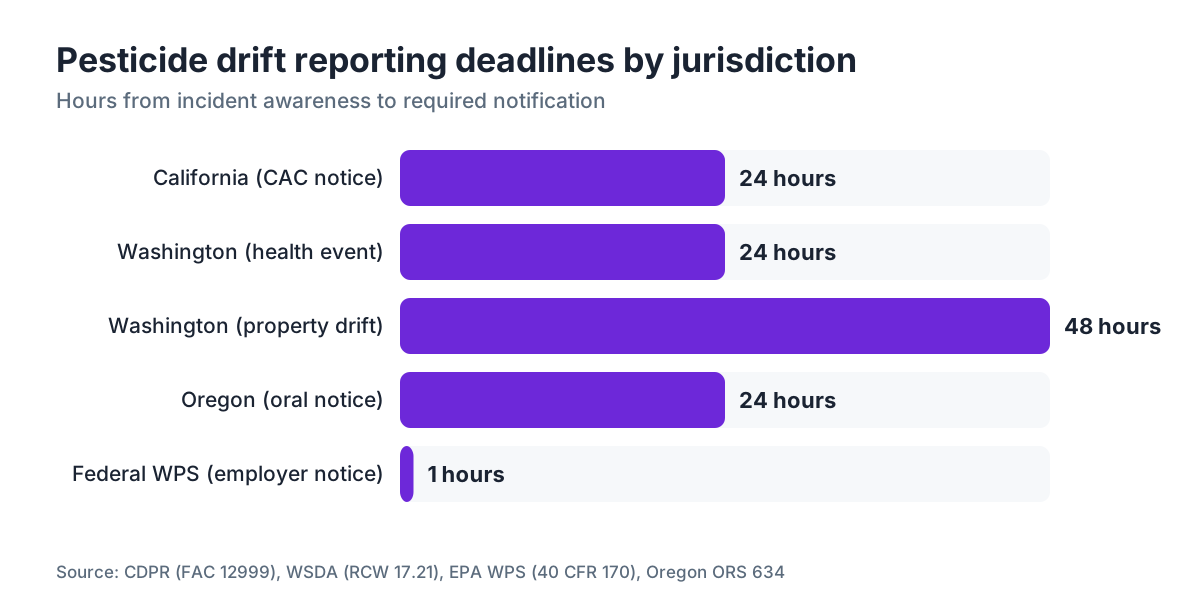
In California, a licensed pest control operator must notify the CAC within 24 hours of learning about a drift complaint or adverse effect, under Food and Agricultural Code Section 12999 and CCR Title 3 Section 6618. [3] The CAC opens a formal investigation, and the grower or PCA is expected to give a written response within 10 days of the investigation notice.
In Washington, WSDA wants incident reports within 24 hours for acute human health events and within 48 hours for other drift damage, under RCW 17.21. [4] Oregon runs a similar 24-hour oral notice rule with a written follow-up usually due within 5 to 10 days.
Federal EPA sets no universal drift-reporting deadline for growers, but the WPS requires that any possible pesticide exposure to a worker or handler be reported to the employer right away, and that records stay on file at least two years. [2]
One honest caveat. Multi-state operations, or incidents near a state or county line, can trigger obligations in more than one place. A Paso Robles grower whose application drifts toward a neighboring county should call both county ag commissioners. The safe rule: report first, report fast, and let a regulator tell you the window was longer than you thought.
| State | Initial Notice Required | Written Report Deadline | Authority |
|---|---|---|---|
| California | 24 hours to CAC | 10 days after investigation notice | FAC 12999 / CCR 3-6618 |
| Washington | 24 hours (health event) / 48 hours (property) | 30 days or as directed | RCW 17.21 |
| Oregon | 24 hours oral | 5 to 10 days written | ORS 634 |
| Federal (WPS) | Immediately to employer | 2-year record retention | 40 CFR 170 |
What are the five required sections of a spray drift corrective action report?
Every regulator, from a county ag commissioner to an EPA regional office, looks for the same five things. Build your report around them and nothing falls through.
1. Incident facts (the what and when)
Date, time, and GPS location of the application. Product name, EPA registration number, and application rate. Equipment used, including nozzle type and pressure settings. Weather at application time: wind speed, wind direction, temperature, relative humidity, and inversion risk. Who applied, with the licensed applicator's name and license number. [5]
2. Affected parties and area (the where and who)
Name and address of any affected neighbor or third party. Description of the non-target crop, property, or person hit. Estimated acreage or area of impact. Any documented injuries, symptoms, or crop damage. Photos, if you have them, with GPS metadata intact.
3. Root cause analysis (the why)
This is where most growers write the weakest section, and it's the one regulators read hardest. Don't write "wind shifted unexpectedly." Write what the wind speed was, what your threshold was, and why you kept going. Did you exceed the label's application threshold? Did a nozzle clog throw off distribution? Was the buffer zone too thin for the conditions? UC Cooperative Extension's wine grape pest management guidelines note that wind above 10 mph sharply raises drift probability for most orchard and vineyard sprayers. [6] Say what the actual cause was.
4. Corrective actions (the fix)
Specific changes, not good intentions. "We will be more careful" is not a corrective action. "We are recalibrating all sprayer nozzles to reduce droplet size variability and setting a hard wind cutoff of 7 mph for all foliar applications" is. Cover equipment changes, protocol changes, training changes, and any new monitoring steps.
5. Follow-up timeline and responsible party
Name the person responsible for each corrective action and give a completion date. Re-training staff? Give the training date. Replacing nozzles? Give the purchase and install date. Regulators close investigations faster when accountability comes with dates attached.
How do you document weather conditions and application data for the incident record?
Weather documentation is where drift reports hold up or fall apart. Best case, you were already pulling real-time weather data during the application. If you weren't, here's what to reconstruct now and what to gather from here on.
Start with the nearest NOAA weather station for the date and time. Weather Underground runs personal weather station networks that give hyper-local conditions, and regulators accept that data when it comes from a nearby station. Log wind speed, wind direction (ideally from a boom-mounted anemometer), temperature, relative humidity, and inversion indicators. Cool, still mornings with high humidity are the classic inversion setup. [7]
For the application itself, pull the GPS track log from your sprayer if it has precision capability. Many modern vineyard sprayers log it. No GPS track? Document time-in and time-out for each block, the equipment settings (pressure, nozzle type, canopy setting, speed), and the product and rate.
Corner the data you already keep in your spray records: application date, applicator name, product. Cornell Cooperative Extension's WPS compliance guidance says spray records should be finished within 24 hours of application, which means the data should already exist if your record-keeping is current. [8] If it isn't, that gap becomes part of your corrective action.
VitiScribe's spray record module captures this data at the time of application, weather fields included, from a phone in the field. The documentation sits in place before an incident ever happens instead of getting reconstructed after.
How do you write a root cause analysis that will satisfy a county ag commissioner?
The root cause section is not a confession. It's a structured explanation that shows you understand your own operation well enough to fix it.
Use a simple format. The immediate cause (what physically caused the drift), the contributing cause (what conditions made it possible), and the systemic cause (what process or training gap let those conditions exist). This three-layer approach mirrors WSDA's grower guidance and is standard across agricultural compliance work. [4]
An example. Immediate cause: spray droplets moved off-target onto the adjacent certified organic vineyard. Contributing cause: wind rose from 4 mph to 11 mph during the last pass of the block, past the sprayer's safe window. Systemic cause: no on-equipment wind monitoring, and the pre-application weather check ran two hours before the sprayer started.
Don't minimize. If the real cause was an applicator rushing to beat rain, say that. Regulators have read thousands of these. They know a cover story when they see one. An honest root cause analysis is the fastest path to a closed investigation.
One practical note. If a third party was involved (a custom applicator, a PCA, a labor contractor), the root cause section still has to say what your operation will do differently, rather than pin it all on them. Your name is on the permit.
What corrective actions actually satisfy regulators and prevent repeat violations?
Regulators want corrective actions that are specific, verifiable, and sized to the incident. A first-time low-wind event with minor overspray onto a dirt road needs a different response than drift that puts pesticide on a school garden.
Equipment: recalibrate nozzles to manufacturer spec, mount a boom weather station or anemometer, add windbreak plantings on the upwind boundary, switch to a lower-drift nozzle. Turbo TeeJet flat fan nozzles, for one, are widely documented to cut drift by 50 percent or more versus standard flat fans at equivalent pressures, per USDA ARS application technology research. [9]
Protocols: set a written wind speed threshold and post it in the spray truck. Most labels and most extension guidance land on 10 mph as the max for aerial and airblast work, but 7 mph is a more defensible number next to a sensitive neighbor. Use the label's language wherever the label sets a number. Pesticide label restrictions are federal law under FIFRA, and EPA states flatly that "the label is the law." [10]
Training: document applicator re-training with a sign-in sheet and a summary of what you covered. Washington State University Extension's IPM resources include free drift management materials you can print and use. [11]
Monitoring: commit to post-application scouting within 24 hours. Write down what you found, even when you found nothing. That record is proof of a working system, more than a crisis response.
The one corrective action that never works: saying you'll be more careful. That's not a corrective action. It's a wish.
Who gets a copy of the corrective action report, and how long do you keep it?
Distribution depends on what triggered the report.
If a county agricultural commissioner investigation is open, the CAC gets a copy. In California this is formal: you submit a written response to the investigation, and the CAC files it with the incident record. In Washington and Oregon, WSDA may request the document directly or as part of an enforcement response.
If the incident involved an EPA WPS covered pesticide and a worker or handler may have been exposed, the employer keeps a copy under 40 CFR Part 170.315, and the record has to be available to workers, handlers, and their representatives. [2] The federal WPS retention requirement is two years from the date of the incident.
If a neighbor or adjacent property owner was affected, most states don't require you to share the report with them. Sharing it, in plain language, often keeps things from escalating to a lawsuit. Talk to your farm attorney before you decide either way.
For your own records: keep the full file, including the incident description, weather data, photos, the report itself, and any follow-up, for at least three years. Some states can re-open a violation within three years if a pattern shows up. The full record proves you handled it.
For vineyards tracking spray records, incident reports, and corrective actions across blocks and seasons, VitiScribe holds all of it in one place, with date-stamped entries that survive an audit.
How does the EPA Worker Protection Standard apply to spray drift incidents involving workers?
The WPS (40 CFR Part 170, revised 2015) kicks in any time an agricultural worker or pesticide handler may have been exposed to a pesticide, drift included. [2] For a drift incident, the obligations that matter are decontamination, emergency medical assistance, and incident documentation.
Under the 2015 revisions, agricultural employers have to make sure a handler stops the application if workers or others enter the application exclusion zone (AEZ). That zone runs at least 100 feet in all directions for aerial applications and 25 feet for ground-based airblast sprayers. If drift reaches a worker anyway, decontamination supplies (water, soap, clean clothing) have to be immediately available.
For the corrective action report, document the WPS-specific items: whether any worker or handler was in or near the AEZ during application, what decontamination happened, whether medical care was sought or needed, and what changes you'll make to AEZ monitoring going forward.
The WPS also requires that pesticide safety information (the product safety data sheet and the WPS safety poster) be posted at a central location, with an emergency contact number available. If those weren't in place during the incident, add them to your corrective actions and say so.
EPA publishes a WPS compliance guide for agricultural employers that walks through these requirements step by step. [2] UC Davis's Agricultural Health and Safety program has adapted WPS guidance for California vineyard operations. [12]
What mistakes do growers most often make when writing drift incident reports?
The most common mistake is waiting too long. Growers want the full story before they write anything, which is understandable and backwards. Write the facts you have now, flag what you're still checking, and update the record. A report started within 24 hours and updated over the next week beats one written 10 days later with every detail buttoned up.
Second most common: vague corrective actions. "We will review our spray procedures" means nothing. A specific action with a name and a date means something.
Third: skipping photographs. Photos taken within hours, with GPS metadata, are the strongest factual anchor in any investigation. Even when the damage looks minor, shoot the application area, the adjacent area, and any visible symptoms on non-target vegetation. Regulators and courts lean on photo evidence to establish or rule out the extent of damage.
Fourth: contradicting the spray record. If your spray record says 6 a.m. in 5 mph winds and the corrective action report says 7 a.m. in shifting winds, someone will ask why. Line up your spray records and your incident report, and if there's a discrepancy, explain it out loud.
Fifth: no neighbor contact on record. If a neighbor complained, write down the exact date, time, and substance of the complaint. That protects you from later claims that the damage was worse than first reported.
What's the difference between a corrective action report and a pesticide incident report to the state?
These are two different documents, and mixing them up creates compliance gaps.
A pesticide incident report to the state (or to the county ag commissioner in California) is the official notification that an adverse event happened. It opens a regulatory investigation. In California, licensed pest control operators file it with the CAC under CCR 3-6618. [3] It asks for basic facts: product, date, location, nature of the incident.
A corrective action report is the response document you write after the incident, explaining root cause and remediation. A regulator may request it as part of the investigation, or you may produce it on your own to show good faith.
Think of it this way. The incident report opens the file. The corrective action report closes it.
Small vineyard operators often fold the two into a single narrative and send it to the CAC or WSDA proactively. That works fine as long as the combined document carries the formal notification elements (product, date, location, applicator) and the corrective action elements (root cause, specific remedies, follow-up timeline). Label both sections clearly if you go that way.
Where there's a PCA, the PCA usually helps draft the incident notification. The corrective action report is normally the grower's or operator's job, because it turns on internal operational changes.
Can a corrective action report reduce or eliminate fines after a spray drift violation?
Yes, in real and documented ways, though nobody should write a report only to shave a penalty.
California's CDPR civil penalty structure under Food and Agricultural Code Section 12999.5 lists "steps taken to prevent recurrence" as a mitigating factor when calculating penalties. [3] First-time violations with documented corrective actions consistently draw lower penalties than repeat violations or incidents where the grower took no visible steps.
Washington's WSDA uses a similar structured penalty matrix under RCW 17.21.140. Cooperation with investigators and written corrective action plans are cited in enforcement guidance as factors that can pull penalties below the maximum schedule. [4]
EPA, for WPS violations, follows a penalty framework that weighs gravity (how serious the violation was), business size, good faith, and history. A prompt, thorough corrective action report is evidence of good faith. EPA's enforcement response policy for WPS says "good faith compliance efforts" can reduce base penalties. [2]
Plainly put: a grower who files within 48 hours, takes verifiable steps, and keeps clean records for two seasons faces a very different enforcement outcome than one who stonewalls. Nobody has good public data on the average penalty reduction from a CAR, because settlement terms often stay private, but every agricultural attorney in pesticide compliance says the same thing. Document early. Document honestly.
How do you prevent the next drift incident instead of just documenting this one?
The corrective action report looks backward. Preventing the next incident looks forward, and the best time to build that system is in the weeks right after you've written the report, while the details are still fresh.
Start with equipment. Test nozzles against their rated output at least once a season, twice is better. A nozzle worn by 10 percent can shift your droplet spectrum enough to matter. UC Davis Cooperative Extension publishes vineyard sprayer calibration guides that walk through exactly how. [12]
Then look at your buffers. Plenty of vineyards sit next to organic operations, homes, schools, or beeyards, all of which carry higher sensitivity and more regulatory attention. Map those adjacencies and set buffers that beat the label by at least 25 feet. Label numbers are minimums, not best practice.
Build weather monitoring into the pre-application routine as a go/no-go gate, not a box to check. Wind speed threshold, inversion risk, and buffer confirmation belong in your written spray SOPs. WSU Extension's spray drift fact sheets are a practical place to set those thresholds. [11]
Close the loop after every application, not only the ones that go wrong. A quick check of the downwind boundary, logged in your spray record, is the documentation that proves a working compliance system. It takes about 10 minutes. It's the difference between "we got lucky" and "we have a process."
For vineyards managing records across blocks and seasons, a tool like VitiScribe that ties spray records to block maps and flags adjacency conditions helps catch the pre-conditions before they turn into incidents.
Frequently asked questions
Do I have to write a corrective action report if my neighbor didn't complain?
Not always, but write one anyway if you saw drift or if conditions during application fell outside label parameters. Proactive documentation protects you if a complaint surfaces later. A dated internal record showing you found and fixed the problem before anyone asked is far stronger than a reactive report written after a formal complaint lands.
How long does a spray drift investigation typically take?
In California, county agricultural commissioner investigations usually close within 30 to 90 days for straightforward cases. Complex incidents with crop damage claims or human health effects can run six months or longer. Washington WSDA timelines are similar. Submitting a thorough corrective action report early, within 10 days of notification, is the single factor most likely to shorten the timeline.
What's the maximum fine for a pesticide drift violation in California?
Under California Food and Agricultural Code Section 12999.5, civil penalties can reach $5,000 per violation per day for most pesticide use violations. For violations involving restricted materials or significant adverse effects, penalties can run higher. First-time violations with cooperative growers and documented corrective actions almost always land well below that maximum.
Who is legally responsible for drift: the grower or the custom applicator?
Both can be held liable. The custom applicator holds the applicator license and bears direct responsibility for application conditions. The grower, as permit holder and landowner, also carries liability for pesticide use on the property. If you hired a custom applicator, their insurance should be primary, but California and Washington enforcement routinely names both parties.
Does drift onto an organic vineyard require a different report?
The state drift report process is the same. What's different is the civil exposure: organic certification can be suspended or lost if an unauthorized pesticide is detected, and the economic damages to the affected grower can be steep. Notify your liability insurer right away. Document everything. The organic grower may also file with their certifying agency, which opens another investigation track.
What weather conditions do I need to document in the report?
At minimum: wind speed and direction, temperature, relative humidity, and time of day. If you can get it, include atmospheric stability (inversion risk). The nearest NOAA weather station data for the date and time is acceptable if you had no on-site monitoring. On-site boom-mounted anemometer data is stronger and increasingly expected in enforcement proceedings.
Do workers have the right to see the corrective action report after a WPS incident?
Under the 2015 WPS revision at 40 CFR Part 170.315, workers and handlers (and their designated representatives) have the right to request pesticide application and hazard information. Incident records have to be kept for two years and provided on request. That includes documentation tied to a drift incident where a worker may have been exposed.
Can I use photos taken on my phone as incident documentation?
Yes. Smartphone photos with GPS metadata and automatic timestamps are widely accepted in regulatory investigations and civil litigation. Shoot photos immediately, before any cleanup. Keep location services on so the coordinates embed in the file. Back photos up to a cloud service with the original metadata intact, and don't apply filters or edits that could change the file timestamp.
What if I disagree with the county ag commissioner's finding?
You have the right to contest a finding in writing. In California, you can request an informal conference with the CAC within 20 days of receiving a notice of violation. If you still disagree after the conference, you can request an administrative hearing. Document your position clearly, with supporting data from your corrective action report and spray records. A pesticide compliance attorney is worth the cost here.
How detailed does the root cause section really need to be?
Detailed enough to be credible and specific enough to show you actually investigated. One paragraph naming the immediate cause, the contributing conditions, and the systemic gap is usually enough. Skip legal language and corporate hedging. A clear three-sentence root cause analysis satisfies most regulators. Vague language like 'application conditions were not optimal' will not.
Is there a standard form or template for spray drift corrective action reports?
No universal federal form exists. Some states have their own: California's CDPR provides investigation response templates through county agricultural commissioners, and WSDA has guidance documents for corrective action plans. For growers writing their own, the five-section structure (incident facts, affected parties, root cause, corrective actions, follow-up timeline) covers the required elements in all major wine-producing states.
What should I do in the first hour after noticing a spray drift incident?
Stop the application if it's still running. Check on anyone who may have been in the drift path. Start taking photographs right away. Note the exact time, wind speed, and wind direction. Call your PCA if you have one. Then call the county agricultural commissioner to give verbal notice. Don't wait for every answer; early oral notification is almost universally required and always beats late written notification.
Sources
- California Department of Pesticide Regulation, Pesticide Enforcement: California requires written response to CAC investigation notice; enforcement procedures under CCR Title 3 and FAC 12999
- U.S. EPA, Agricultural Worker Protection Standard (40 CFR Part 170): WPS requires decontamination, emergency assistance, and two-year incident record retention for agricultural pesticide exposure events
- California Food and Agricultural Code Section 12999 and 12999.5: Licensed PCOs must notify CAC within 24 hours of drift complaint; civil penalties up to $5,000 per violation per day
- Washington State Department of Agriculture, Pesticide Program (RCW 17.21): WSDA requires 24-hour reporting for acute health events and 48-hour reporting for other drift damage; penalty matrix under RCW 17.21.140
- U.S. EPA, Pesticide Registration under FIFRA: The pesticide label is the law under FIFRA; label wind speed and buffer zone restrictions are legally binding application conditions
- UC Statewide Integrated Pest Management Program, Wine Grape Pest Management Guidelines: Applications above 10 mph wind speed dramatically increase drift probability for airblast and orchard sprayers
- NOAA National Centers for Environmental Information: NOAA station data provides documentable historical wind speed, direction, temperature, and humidity for incident date and time
- Cornell College of Agriculture and Life Sciences, Worker Protection Standard resources: Spray records should be completed within 24 hours of application per WPS compliance guidance; Cornell provides WPS training resources for farms
- USDA Agricultural Research Service: Low-drift nozzle designs reduce drift by 50 percent or more compared to standard flat fans at equivalent pressures in documented ARS studies
- U.S. EPA, Safe Pest Control and Pesticide Labels: EPA states that the pesticide label is a legally binding document and that 'the label is the law' under FIFRA
- Washington State University Extension: WSU Extension provides drift management training materials and wind threshold guidance for vineyard and orchard applications
- UC Davis, Western Center for Agricultural Health and Safety: UC Davis provides vineyard sprayer calibration guides and WPS compliance guidance adapted for California wine grape operations
Last updated 2026-07-09