After pruning grape vines, should you cover the cut?
TL;DR
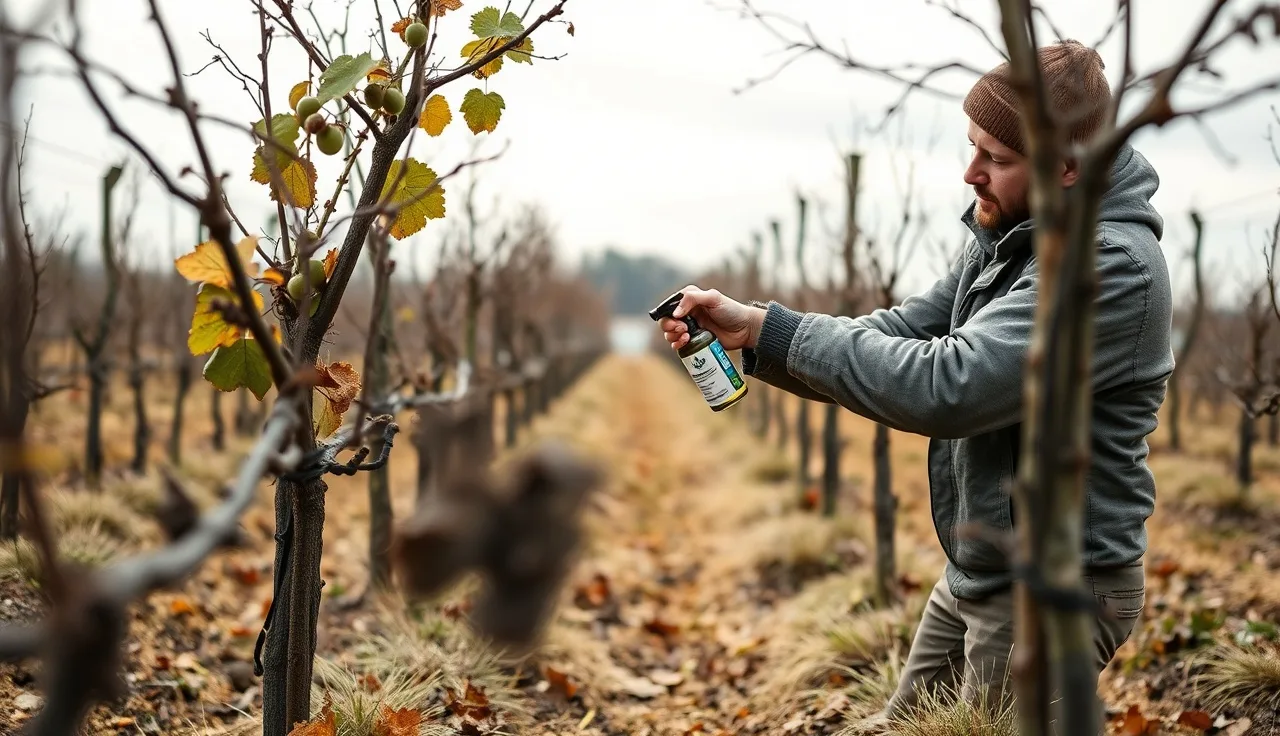
- Cover large grapevine pruning cuts (roughly thumb-width or bigger) in regions where Eutypa dieback or trunk diseases show up.
- For small spur and cane cuts, sealants are less consistently proven.
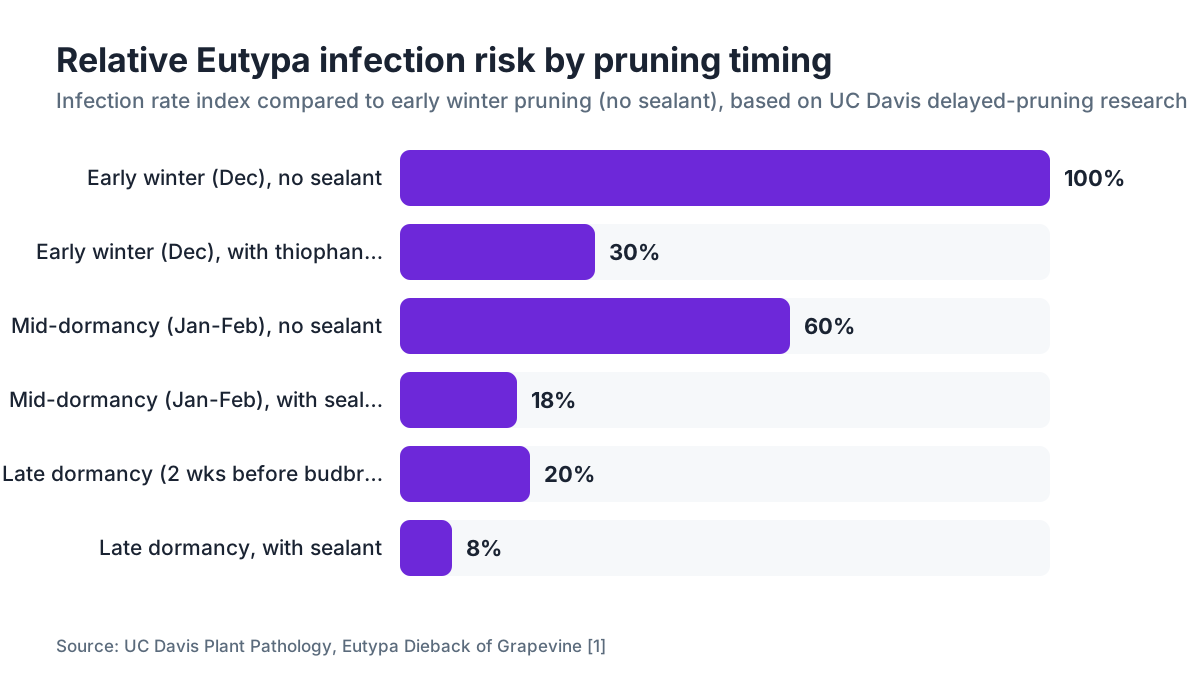
- Timing beats any product: prune late in the dormant season, close to budbreak, and UC Davis trials show Eutypa infection drops around 80% with no sealant at all.
Do you actually need to cover grapevine pruning wounds?
Sometimes yes, sometimes no, and the size of the cut decides most of it.
Here's why the question keeps coming up. A fresh pruning wound is an open door for fungal pathogens, especially the group that causes Eutypa dieback (Eutypa lata), Botryosphaeria canker, and Esca. Those three fall under the heading of grapevine trunk diseases, and they kill vines slowly in every major wine region on earth. UC Davis plant pathologists put the cost to California grape growers in the tens of millions of dollars a year in lost production, though nobody has a clean industry-wide figure [1].
Wound sealants are not magic, and the researchers say so themselves: the evidence for commercial sealants is mixed. The strong case is for large cuts. Removing a cordon, reworking a vine's structure, or cutting out dead wood leaves a big surface that stays open for weeks. Those wounds are worth protecting. The small cuts you make leaving a two-bud spur on an established cordon are a much weaker case, especially if you prune late in dormancy.
The single best thing you can do costs nothing. Time your pruning so you shrink the window when spores are flying. Eutypa lata spores in most California regions release during rain events from late fall through early spring [1]. Prune close to budbreak and you dodge most of that window while the wound closes faster in warmer weather.
What diseases are actually entering through pruning wounds?
Three disease complexes matter, and they behave differently enough to keep them separate.
Eutypa dieback (Eutypa lata) is the most studied. Rain splash carries the spores onto fresh cuts. The fungus creeps through the wood for years before you notice anything, and the first sign is usually a stunted, dead-looking shoot cluster growers call 'dead arm.' By the time you diagnose it, the infection is old. UC Davis work shows wounds stay open to infection for weeks to months depending on temperature and how fast the vine heals [1].
Botryosphaeria canker is a group of several fungal species. In warmer, drier regions it's arguably more common than Eutypa. WSU Extension reports that Botryosphaeria species get in through wounds and natural openings, and that wound sealants cut infection in some trials [2].
Esca is the one nobody fully understands. It's a syndrome tied to several fungi that colonize the wood over many years. Cornell's viticulture program is upfront that wound protection for Esca is on shakier ground than it is for Eutypa [3]. Esca hits harder in older vines and in places with warm, dry summers.
All three get worse when it's wet at pruning time. That's the reason timing keeps surfacing as the strongest lever you have.
When is pruning wound protection most important?
Risk isn't the same across every cut, region, or week of the season. Four things move it.
Wound size does a lot of the work. A large cut, anything past roughly 2 cm across, exposes more xylem for spores to land in and takes longer to callus over. Cordon removal, trunk cuts, and cuts made when you retrain an old vine are the wounds worth guarding.
Timing does even more. A UC Davis study found that delaying pruning to two weeks before budbreak cut Eutypa infection sharply compared with early-winter pruning [1]. The reason is plain: the wound heals faster as temperatures climb, and the peak Eutypa spore season is behind you. In the real world that fights with your labor calendar, because everyone wants crews cutting in January and February. Most experienced California growers now run 'delayed pruning' on at least part of the vineyard, starting with susceptible varieties like Chardonnay and Cabernet Sauvignon.
Variety matters. Chardonnay and Cabernet Sauvignon are the most susceptible to Eutypa in California research, year after year. Grenache and Carignan hold up better, though neither is immune [1].
So does climate. Where winters are wet and springs come early (Sonoma, Napa, most of the Willamette Valley, the Finger Lakes), spore pressure runs high and sealants earn their keep. In dry desert blocks with little winter rain, the risk window is short.
For most commercial vineyard operations the playbook is simple. Protect large cuts every time, prune as late as your crew size allows, and think about sealants on small cuts only for high-value or Eutypa-prone blocks.
What wound sealants actually work, and what's the evidence?
The market is ahead of the science, so this needs some honesty.
Three kinds of products show up in the field.
Fungicide-based wound protectants. The best-studied active ingredients are thiophanate-methyl and boscalid, painted straight onto the cut. UC Davis trials found thiophanate-methyl products (like Topsin-M) applied right after cutting cut Eutypa infection sharply against untreated cuts [1]. In those trials 'sharply' usually means a 60 to 80% drop in infection frequency, not full protection.
Biological wound protectants. Products built on Trichoderma species (mainly T. atroviride) are registered for grapevines in several states and across Europe. They work by competitive exclusion: the Trichoderma takes the wound surface before the pathogen can. WSU Extension research found Trichoderma products (Vinevax and similar) matched synthetic fungicides in some trials, but with more site-to-site variability [2]. They need to go on within hours of the cut, which is a headache at scale.
Plain wound paints and sealants (no active ingredient). These are the latex or petroleum products at the farm store, usually sold for trees. Honest answer: with no fungicide in them, they haven't shown steady disease protection on grapevines. They may slow desiccation on a big cut, which is worth a little, but they don't kill spores. Don't spend real money on these for disease control.
Application method matters. You need product on the cut within 30 minutes to a few hours. Getting crews to carry that material row by row is harder than it sounds. Some use spray bottles, some use paint rollers, and a few have moved to applicator tools that dose the wound as part of the cut.
How should you apply wound sealant during pruning operations?
The window is short. Eutypa lata can infect a fresh wound within hours in wet, cool weather, so 'I'll treat it tomorrow' is not a plan.
On a small operation, the practical move is spray bottles of the fungicide mix, carried by each pruner or by a second person walking right behind the crew. One prunes, the next treats. On a big operation that step roughly doubles your treatment labor.
Bigger operations can look at purpose-built applicator tools that clip onto the shears and release a dose with each cut, sold mostly by European viticulture suppliers. They haven't caught on much in the U.S. yet, partly on cost and partly on unclear registration for that application method, but they're worth knowing if you run hundreds of acres.
Trichoderma biologicals need care. They're live organisms and they die in heat, drying, and UV. Mix only what you'll use that day, keep the containers out of the sun, and read the storage temperatures on the label. Skip those details and you've killed the biology and wasted the money.
Keep the records. Under the EPA Worker Protection Standard, if the label carries a re-entry interval or record requirement, you document it [4]. Most pruning wound fungicides count as pesticide applications and need a record of product, rate, target pest, location, and applicator. If you run VitiScribe or another spray record system, log wound treatments right next to your regular spray program so the audit trail is whole.
Don't skip PPE. Plenty of registered fungicides call for gloves and eye protection even for a wound-paint pass. Read the label.
Does pruning timing reduce the need for wound sealants?
Yes, and by a lot. This is the most underused tool in trunk disease management.
Growers call it 'delayed pruning' or 'late pruning,' and it works through two effects that stack. First, wounds made later in dormancy heal faster as soil warms and the vine wakes toward budbreak. A cut made in March in California may callus over in two to four weeks; the same cut in December can sit open for three months. Second, in most California regions peak Eutypa spore release rides the winter rain events between December and March. Prune in late February or early March and the worst of that window is past.
UC Davis field trials found vines pruned two weeks before budbreak had Eutypa infection rates roughly 80% lower than vines pruned in late November or December, with no sealant at all [1]. That beats most commercial sealants outright.
The labor trade-off is real. Nobody has unlimited crews, and jamming all pruning into the two weeks before budbreak can't scale. Extension advisors say to put late pruning on your most susceptible varieties and highest-value blocks first, then use sealants on any big cuts you're forced to make early.
Double pruning is the other option gaining ground. Run a rough mechanical pre-prune earlier in the season, cutting long canes down to 8 to 12 inches, then come back near budbreak for the final hand pruning. That first cut is sacrificial wood you remove later; the final cuts, the ones that matter for disease, happen late [9]. It adds cost, but it can pencil out on high-value Chardonnay or Pinot Noir blocks with a trunk disease history.
What does the research say about wound healing time in grapevines?
Grapevine wounds heal in a predictable order, and knowing it tells you how long a cut stays vulnerable.
After pruning, the exposed xylem dries slightly and forms a thin barrier. Over the next few weeks, callus tissue (wound wood) grows out from the cambium at the edge of the cut and slowly covers the exposed face. A typical spur cut takes two to six weeks to close depending on temperature. Bigger cuts take proportionally longer.
WSU Extension research found the critical infection window for most trunk disease pathogens is the first two to four weeks after cutting, with susceptibility falling off fast once callus starts forming [2]. That's why both timing and prompt sealant matter: you're covering the gap between the cut and the moment the vine's own biology takes over.
Temperature drives callus. Grapevines need soil and cambium temperatures above roughly 10 degrees C (50 F) for real callus growth. In cold-winter regions like New York's Finger Lakes or eastern Washington, a wound made in deep winter can sit essentially unchanged for months before healing starts, which is part of why trunk diseases are serious there too, not only in California [3].
There's some evidence that vine nutrition, particularly nitrogen and boron status, affects healing, but nobody has good controlled data on how much that matters against timing and direct protection. The closest work I know of is European Esca research suggesting stressed, low-vigor vines heal more slowly, which makes nutrition a reasonable indirect piece of a trunk disease program.
How do you remove diseased wood and should those cuts be treated differently?
Cutting out trunk disease is a different job from routine pruning, and the wound question gets sharper.
Removing diseased wood usually means large cuts deeper into the trunk or cordons. You cut back to clean white wood, past the brown or gray staining that marks Eutypa or Botryosphaeria canker. That leaves big wounds, and those absolutely should get a registered fungicide-based protectant right away.
Tool sanitation matters enormously here and gets skipped constantly. UC ANR recommendations call for disinfecting shears between vines in infected blocks with a 10% bleach solution or 70% isopropyl alcohol [7]. Move from a diseased vine to the next one without sanitizing and you're spreading the pathogen by hand. This is one of the most under-practiced steps in the whole vineyard.
Pull diseased pruning debris out of the vineyard or burn it where the rules allow. Wood left on the ground or in the row feeds the inoculum reservoir that spits out next year's spores.
When Esca or Eutypa has taken the main trunk, your options are trunk renewal (training a sucker to replace the infected trunk) or ripping the vine and replanting. Cornell Extension recommends starting trunk renewal proactively when vines first show symptoms rather than waiting for collapse, because renewal takes two to three years to bring a fruiting vine back [3].
If you manage a block with real trunk disease history, note which rows and vine positions show symptoms across seasons. That map lets you plan remedial work before infection turns into an economic problem, and it's the same field scouting record that backs your pesticide and IPM documentation.
Are wound sealants required by law or regulation?
No. No federal or state rule makes you seal grapevine pruning cuts. This is an agronomic call, nothing more.
What is regulated is how you apply any registered pesticide, including wound fungicides. The EPA Worker Protection Standard requires every agricultural pesticide application to follow the label, and the label carries the force of federal law [4]. Apply a fungicide-based wound protectant and you must:
- Use it only on crops the label lists
- Apply at or below the labeled rate
- Follow the re-entry interval (REI) on the label
- Keep application records (applicator, date, product, rate, location, target pest) for at least two years under federal law, longer in some states [4]
- Give pesticide safety training to workers who might enter treated areas within the REI
Biological products like Trichoderma protectants are usually registered as biological fungicides and carry the same WPS and record-keeping duties as synthetic ones. Read each product's label, because registration details shift state to state.
In California, Pesticide Use Reports (PURs) are required for restricted-materials applications and for all applications on agricultural land [5]. Most wound fungicides aren't restricted materials, so a PUR may not apply to those specific products, but you still need the internal records. Check with your County Agricultural Commissioner if you're unsure.
Small operations underestimate this because pruning feels cultural, not chemical. Apply a registered fungicide and it's a spray event, full stop.
What's the cost of wound protection, and is it worth it?
Whether it pencils out comes down to disease pressure, vine age, and how much your variety is worth.
Fungicide-based wound protectants run roughly $30 to $80 per gallon of concentrate depending on active ingredient and formulation. The diluted volume per vine is small, so materials often land around $20 to $60 per acre, though nobody has published a definitive cost study for vineyard wound treatment specifically.
Labor is where it stacks up. If four people are pruning and you add one to treat right behind them, you've added 20 to 25% to your pruning labor. On 50 acres at $400 to $600 per acre in pruning labor, that's real money.
The case gets stronger against the cost of the disease. UC Cooperative Extension figures a block losing 20% of its vines to trunk disease over 15 years gives up roughly two to three years of production revenue, plus replant costs of $8,000 to $12,000 per acre for site prep, plant material, and training infrastructure [8]. The exact numbers swing hard by region, rootstock, and training system.
My honest take. If you grow Chardonnay or Cabernet Sauvignon in a wet-winter region and you've already seen trunk disease symptoms, the ROI on wound protection is good. If you grow a tolerant variety in a dry region and you prune late, you can probably skip the sealant on routine spur cuts without much risk. Put your money on late-season pruning and tool sanitation first. Both cost less and have cleaner evidence.
| Factor | Low disease pressure | High disease pressure |
|---|---|---|
| Small spur cuts | Sealant probably not needed | Consider sealant if pruning early |
| Large structural cuts | Sealant recommended | Sealant strongly recommended |
| Pruning timing | Late pruning alone may suffice | Late pruning + sealant |
| Tool sanitation | Good practice | Non-negotiable |
| Diseased wood removal cuts | Treat regardless | Treat regardless |
How do you keep track of wound treatment applications and pruning records?
Pruning wound treatments sit in a compliance blind spot that trips up small operations: they feel like field work but they're legally pesticide applications.
The minimum records under federal law (and expanded rules in California, Oregon, and Washington) include the product name and EPA registration number, the date and location, the rate, the target pest, the applicator's name and certification number if it applies, and any relevant re-entry interval [4][5].
For a small vineyard, a spreadsheet or even a paper field log does the job. For operations running multiple blocks across parcels, or anyone who has to hand documentation to a third-party auditor, a dedicated system saves real time. VitiScribe was built for this kind of field record-keeping, with spray and wound treatment logs that tie to block maps and generate the reports USDA programs and state ag departments ask for.
Good records do more than keep you legal. They teach you. Note which blocks were pruned on which date, what treatment went on, then track disease incidence in later seasons and you build your own vineyard-specific data on what works. Extension advisors say the most useful thing they can hand a grower is that grower's own history reflected back, and most growers don't have it in usable shape.
Frequently asked questions
How soon after pruning should you apply wound sealant?
Within 30 minutes to a few hours of the cut, ideally right away. Eutypa lata and Botryosphaeria spores can start infecting a fresh wound within hours in wet, cool weather. Treating the next day sharply cuts effectiveness. Best practice is to keep the treatment material in the row so it goes on immediately after each cut.
Does regular latex or petroleum-based wound paint protect grapevines from disease?
Probably not on its own. Plain wound paints with no fungicide haven't shown steady disease protection in grapevine trials. They may slow desiccation on large cuts, a minor benefit, but they don't stop spore germination. For real disease protection you need a product with a registered fungicide like thiophanate-methyl or a Trichoderma biological.
What is the best fungicide for grapevine pruning wound treatment?
Thiophanate-methyl (e.g., Topsin-M) has the most UC Davis trial data behind it for Eutypa protection. Boscalid products have also shown efficacy. Trichoderma-based biologicals (products with T. atroviride) are a solid option, especially if you're reducing synthetic inputs, but they need careful timing and handling to work.
Does pruning timing really reduce trunk disease without sealants?
Yes, dramatically. UC Davis research found pruning two weeks before budbreak cut Eutypa infection roughly 80% versus early-winter pruning, with no sealant applied. Wounds heal faster in warmer weather, and peak spore release for Eutypa lata rides winter rain events that are mostly past by late February or early March in California.
Do you need to sanitize pruning tools between vines?
Yes, especially in blocks with known trunk disease. UC ANR recommendations call for sanitizing shears between vines with a 10% bleach solution or 70% isopropyl alcohol in infected areas. Skip it and you spread pathogens vine to vine. Most operations keep two pairs of shears per pruner and alternate, soaking one while using the other.
Which grape varieties are most susceptible to Eutypa dieback through pruning wounds?
Chardonnay and Cabernet Sauvignon are consistently the most susceptible in California research. Grenache and Carignan hold up better. Merlot and Syrah fall in the middle. If you grow high-susceptibility varieties in a wet-winter region, wound protection and delayed pruning are better investments than for tolerant varieties in dry climates.
Can trunk disease spread from vine to vine through the soil?
No. Eutypa lata, Botryosphaeria species, and Esca pathogens spread through airborne spores that infect fresh wound surfaces, not through root contact or soil. The main inoculum sources are infected wood in the vineyard (including left-behind pruning debris) and nearby trees like almonds, which also host Eutypa lata. Removing infected wood lowers the local spore load.
How do you know if a pruning wound has become infected with Eutypa or Botryosphaeria?
You often can't for years. Both grow slowly through the wood and may show no symptoms for three to seven years after infection. The first visible sign is usually a stunted, dead-looking shoot cluster (dead arm) or wedge-shaped staining in cross-section. If you suspect it, cut back progressively toward the trunk until you reach white, healthy wood. Brown or gray staining means active colonization.
Do wound sealants need to be re-applied if it rains after pruning?
Most fungicide-based protectants are rainfast within a few hours of application, like other fungicide sprays. If heavy rain hits within one to two hours before the product dries, re-application may be warranted. Trichoderma biologicals wash off more easily and may need reapplying after significant rain. Check the specific product label for rainfast guidance.
Is there a USDA or federal program that covers trunk disease management costs?
USDA's Natural Resources Conservation Service (NRCS) sometimes covers trunk disease practices under the Environmental Quality Incentives Program (EQIP), often as part of an IPM plan. Availability and payment rates vary by state and annual funding. Contact your local NRCS service center about current practice codes and whether wound treatment or late pruning programs qualify.
What records do you need to keep for pruning wound fungicide applications?
Under the EPA Worker Protection Standard and most state rules, you need the product name and EPA registration number, date and location, rate, target pest, and applicator identity. California requires Pesticide Use Reports for some materials. Keep records at least two years federally; California requires three years for most. Treat wound treatments like any other spray event in your records.
Can double pruning replace wound sealant applications?
Double pruning (a rough pre-prune early in dormancy leaving long stubs, then final pruning near budbreak) cuts disease risk by making the cuts that matter happen late, when healing is faster and spore pressure is lower. It doesn't fully replace sealant on large cuts but reduces the need on routine spur cuts. The trade-off is added labor for the pre-pruning pass.
Are biological fungicides like Trichoderma products safe for organic vineyards?
Many Trichoderma products are approved for certified organic production, but verify each product's OMRI listing or check with your certifier before use. Not all are OMRI listed. Application in organic programs still needs record-keeping and should go in your spray records. Formulation matters: some carrier materials in biological products may not be organically acceptable.
Sources
- UC Davis Plant Pathology, Eutypa Dieback of Grapevine: Eutypa lata spore release coincides with winter rain; delayed pruning to two weeks before budbreak reduces infection rates dramatically; Chardonnay and Cabernet Sauvignon are most susceptible; thiophanate-methyl wound treatments reduce infection frequency 60-80%
- Washington State University Extension, Grapevine Trunk Diseases: Botryosphaeria species infect through wounds; wound sealants including Trichoderma-based biologicals have shown protective effects in WSU trials; wound susceptibility is highest in first two to four weeks post-pruning
- Cornell University Cooperative Extension, Grape Disease Management: Esca wound protection less established; trunk renewal recommended proactively when symptoms first appear; wounds in cold climates may stay open for months before healing begins
- EPA, Worker Protection Standard for Agricultural Pesticides: WPS requires pesticide application records including product, date, location, rate, target pest, and applicator; records must be kept minimum two years; pesticide labels have the force of federal law
- California Department of Pesticide Regulation, Pesticide Use Reporting: California requires Pesticide Use Reports for applications on agricultural land; records required for three years; County Agricultural Commissioner oversees enforcement
- UC ANR, Integrated Pest Management for Grapevines: Tool sanitation with 10% bleach or 70% isopropyl alcohol recommended between vines when pruning in infected blocks; infected pruning wood should be removed from vineyard to reduce inoculum
- UC Cooperative Extension, Trunk Disease Economic Impact: Trunk diseases cost California grape growers tens of millions annually in lost production; 20% vine mortality over 15 years equivalent to two to three years of lost production revenue plus replanting costs of $8,000-$12,000 per acre
- WSU Extension, Double Pruning for Trunk Disease Management: Double pruning approach (early rough pre-prune followed by late final prune near budbreak) reduces infection risk on final cuts; adds labor but reduces need for wound sealants on spur cuts
- Oregon State University Extension, Grapevine Pruning and Disease Management: Wet-winter regions including Willamette Valley have high spore pressure for trunk disease pathogens; biological wound protectants require application within hours of cutting for best results
Last updated 2026-07-09