How to document a drift reduction technology choice on spray records

TL;DR
- A complete spray record entry for drift reduction technology (DRT) includes the nozzle type or adjuvant name, the rated drift reduction percentage (from the EPA DRT registry or label), application pressure, and a short note on site conditions.
- Most state pesticide rules require this detail, and EPA WPS records must be kept for at least two years.
What is drift reduction technology and why does it belong on a spray record?
Drift reduction technology covers any nozzle design, spray adjuvant, or equipment change that measurably cuts pesticide drift below the baseline of a standard flat-fan nozzle at the same pressure and volume. The EPA defined DRT in its 2001 spray drift framework and maintains a voluntary registry of evaluated nozzles and adjuvants through the National Pesticide Information Center. Documenting DRT on your record is more than ticking a box. It creates an auditable trail showing you made a deliberate, product-consistent decision about how pesticide reached the canopy and what happened to the rest of it.
State lead agencies under FIFRA have long required applicators to record the equipment used, the application method, and any label-required drift management steps [1]. When a label says 'use only drift-reducing equipment' or 'a drift-reducing adjuvant is required,' your spray record has to show you complied. If it doesn't, an inspector has no evidence you did. A two-minute note at the time of application is the only thing standing between you and a label-violation finding.
For vineyard managers, the stakes run higher than for many row-crop operations. Vines sit close to property lines, rural homes, and creeks. A neighbor complaint about drift triggers a state agriculture department investigation, and the first document an investigator asks for is the spray record. A clean DRT entry can end that conversation fast. A missing one drags it out.
What do federal regulations say about documenting application equipment and drift management?
FIFRA Section 8(a) lets the EPA require pesticide use records, and that authority is delegated to state lead agencies for most commercial applications [2]. Certified applicators in most states must keep records that include the applicator's name and certification number, the date and location, the pest treated, the product name and EPA registration number, the rate applied, and the total area or volume treated.
Equipment specifics like nozzle type aren't uniformly required in every state's minimum record set, but they matter in two situations. First, if the pesticide label itself calls for DRT equipment, documenting that equipment is part of proving label compliance, and label compliance is a federal requirement under FIFRA Section 12 [2]. Second, if a state has adopted enhanced record-keeping rules (California, Washington, and New York have the most detailed), nozzle type and application technology may be required fields [3].
The EPA Worker Protection Standard (WPS), revised in 2015 and codified at 40 CFR Part 170, requires employers to keep records of each pesticide application for two years. The WPS record must include the product name, EPA registration number, active ingredient, REI, location, and date [4]. It doesn't explicitly require nozzle type, but it does require the application method. Writing 'air-blast sprayer with AI 110-03 nozzles at 60 PSI, rated 90% drift reduction' under application method fills that field and documents your DRT choice in the same stroke. That's the move.
The National Pesticide Information Center's EPA DRT registry lists nozzles and adjuvants that passed standardized ASABE S572.1 drift reduction testing [5]. Citing a registry-listed product on your record adds credibility no self-description can match.
What specific fields should a spray record include to document a DRT choice?
A complete DRT entry has ten fields, and each one should show up on the record, either in a dedicated column or a notes section. Here's what that looks like in practice.
| Field | What to Record | Example |
|---|---|---|
| Nozzle model or adjuvant name | Exact manufacturer model number or product name | TeeJet AI 110-03 or Interlock \@ 0.1% v/v |
| DRT rating | Drift reduction % from EPA registry or label | 92% reduction vs. reference nozzle |
| Operating pressure | PSI at the nozzle | 45 PSI |
| Volume/rate | GPA applied | 50 GPA |
| Travel speed | MPH | 3.5 MPH |
| Boom or airblast height/angle | Inches above canopy or degree of fan deflection | 12 inches above row |
| Wind speed and direction | Measured at time of application | 4 mph NW |
| Temperature and RH | From on-site thermometer or weather station | 72°F, 58% RH |
| Buffer zones in effect | Any label-specified buffer honored | 25-ft buffer from creek maintained |
| Label requirement met | Yes/No, with label section referenced | Yes, per label Section 6.3 |
The DRT rating is the field people skip most, and it's the one worth the most. Write '92% reduction' and an inspector knows instantly you used a tested technology. Write 'low-drift nozzle' and you've told nobody anything enforceable.
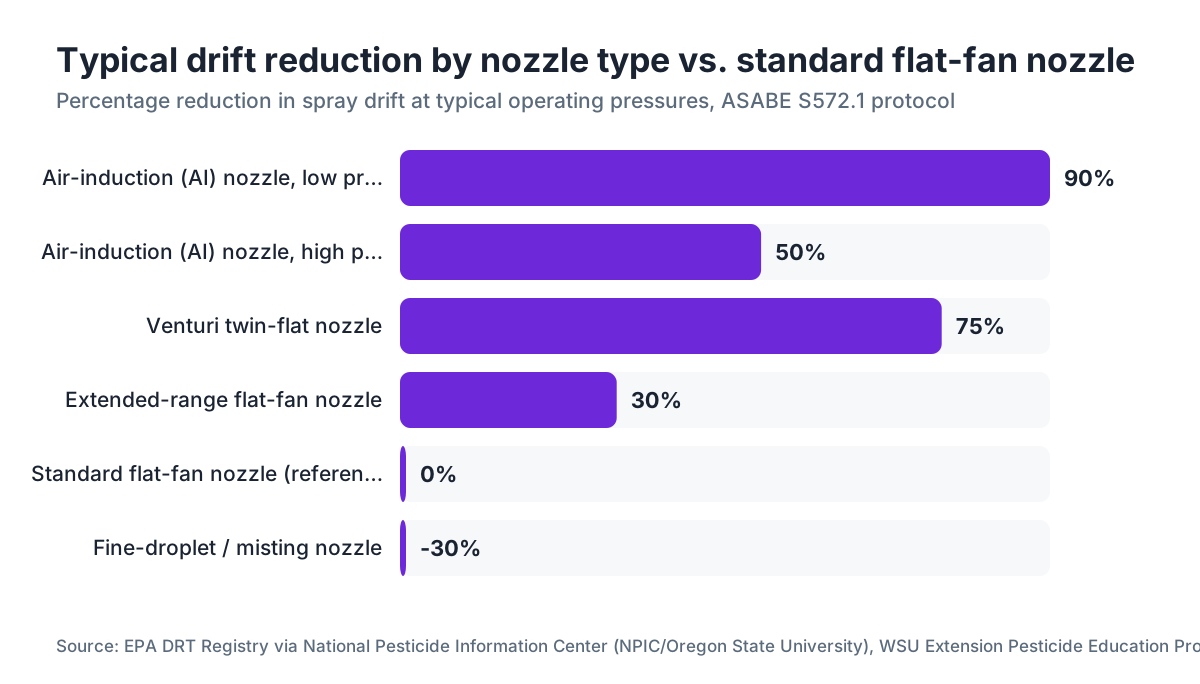
Washington State University Extension reports that air-induction nozzles typically hit 50 to 90 percent drift reduction depending on pressure, while fine-droplet nozzles raise drift risk [6]. Stating the specific percentage ties your record to published testing data instead of a subjective description.
How do you find the official drift reduction rating for a nozzle or adjuvant?
Start with the EPA's voluntary DRT registry, run through the National Pesticide Information Center at Oregon State University. The registry lists nozzles and adjuvants evaluated under the ASABE S572.1 (nozzles) or ASABE S634 (adjuvants) protocols. You search by manufacturer or product name and get back a drift reduction percentage relative to a standard reference nozzle [5].
If a nozzle isn't on the EPA registry, check the manufacturer's technical data sheet. TeeJet, Greenleaf, Lechler, and Wilger publish wind-tunnel and field-tested drift data, usually as a percentage reduction versus their own reference nozzle or versus an ISO F-110-03 standard. That number works on a spray record as long as you cite the source: 'Per TeeJet technical bulletin TB-AI110, rated 85% drift reduction at 40 PSI.'
For adjuvant-based DRT, the label or the manufacturer's SDS states the rating if the product was tested under ASABE S634. Some adjuvants sold as 'drift reducers' have never been formally evaluated. Note that on your record honestly: 'Adjuvant X used per label recommendation; no independent drift reduction rating available.' That beats claiming a rating you can't back up.
UC Davis Cooperative Extension has published guidance on spray technology for California vineyards, including a comparison of airblast sprayer configurations and their measured drift profiles [7]. That's useful background when you're matching a nozzle to a realistic drift claim.
Does the pesticide label control what DRT documentation you need?
Yes, and it overrides everything else. The label is a federal document. If it says 'applicators must use a nozzle with a minimum 50% drift reduction rating as listed on the EPA DRT registry,' you have to document that you used such a nozzle and what its registry rating is. No flexibility there.
Some labels use softer language: 'drift-reducing equipment is recommended' or 'applicators should consider using DRT.' That doesn't legally require it. But if you do use DRT, it still earns a record entry, because it shows you read the label and acted on its guidance. Courts and state enforcement bodies look at that favorably when something goes wrong.
A few labels, especially for newer fungicides registered under reduced-risk criteria, get specific. They name ASABE testing protocols and minimum percentage thresholds. Some mancozeb formulations, for instance, specify buffer distances that shrink if you use a nozzle with a stated minimum drift reduction percentage [1]. Want the reduced buffer? Document the nozzle's rating. No documentation, no reduced buffer, and if a drift incident happens, no legal defense.
Cornell Cooperative Extension's pesticide safety program recommends reading the Directions for Use section of every label specifically for equipment requirements before each season, because label language changes with re-registrations [8].
How do state requirements differ from federal minimums for DRT record-keeping?
Federal minimums are a floor, not a ceiling. Several states have gone well past it.
California: The California Department of Pesticide Regulation (CDPR) requires licensed pest control operators and farm advisors to submit use reports through the county agricultural commissioner system. Required data fields include the application method, equipment type, and any label-mandated drift management measures [3]. California also keeps a specific list of sensitive sites (schools within 0.25 miles, and others) where extra documentation applies. Farm in a California Pesticide Use Reporting county and your DRT information belongs in the PUR filing.
Washington: The Washington State Department of Agriculture (WSDA) requires commercial applicator records to include equipment type and application method. WSDA has published orchard and vineyard guidance noting that nozzle type is a required field when the label specifies drift management [9].
New York: New York State DEC requires certified commercial applicators to keep records showing the method of application. DEC's record-keeping guidance names nozzle type as part of the method description.
Oregon: The Oregon Department of Agriculture requires records of application method and equipment for restricted-use pesticides and has tied nozzle selection to sensitive area buffer compliance in its guidance.
If you work across state lines or source grapes from different AVAs, check each state's lead agency separately. Nothing replaces reading your state's actual regulation.
What does a properly completed spray record entry for DRT look like?
Here's a realistic entry for a fungicide application in a Paso Robles vineyard. This is the kind that satisfies both EPA WPS requirements and California's PUR system.
Date: June 14, 2025
Operator: J. Martinez, CA License #AG-1234567
Location: Block 3, North Zinfandel, APN 999-001-003
Pesticide: Luna Sensation SC, EPA Reg. No. 264-1115
Active Ingredient: Fluopyram + Trifloxystrobin
Target Pest: Botrytis cinerea
Rate: 8.0 fl oz/ac
Area Treated: 14.2 acres
Water Volume: 45 GPA
Application Method: Airblast sprayer, Rear-discharge vertical
Nozzle: TeeJet AITTJ60 11003, rated 78% drift reduction, EPA DRT Registry confirmed
Operating Pressure: 55 PSI
Travel Speed: 3.2 MPH
Boom Height: N/A (airblast, fan centered at 36 inches)
Wind Speed/Direction: 5 mph SE at 7:00 AM; 8 mph SE at 10:00 AM (application stopped)
Temperature: 68°F start, 74°F end
RH: 62% start, 52% end
Buffer Zones: 25-ft buffer from Vineyard Road maintained per label
Label DRT Requirement: Label Section 5 recommends nozzles with minimum 50% drift reduction; requirement met
REI: 12 hours, flagging posted Block 3 north and south entries
Retained Until: June 14, 2027 (WPS 2-year requirement)
That record answers every question an inspector, a neighbor's attorney, or a workers' comp adjuster could ask. It took about four minutes on paper, less than two in digital field-record software. If you manage multiple blocks and spray dates, digital tools that pre-populate nozzle specs from a saved equipment library speed this up a lot. VitiScribe, for one, lets you store nozzle DRT ratings as defaults and attach them to any spray event with one tap, which cuts out the transcription step where errors usually creep in.
What wind speed and weather conditions should you record alongside a DRT entry?
Weather at the time of application isn't optional on most spray records, and it matters even more with DRT, because DRT performance depends on conditions. An air-induction nozzle rated at 90% drift reduction in calm air can perform far worse in a 15 mph crosswind.
EPA's 2001 Spray Drift Risk Assessment names wind speed as the single most influential environmental variable in pesticide drift [10]. Many labels cap application wind speed, commonly at 10 mph, sometimes 7 mph for sensitive use sites. Your record should show what the wind was doing throughout the application, not only at the start. If you stopped because wind passed the label limit, note that and the time you stopped.
Temperature and relative humidity matter because they drive evaporation. Above 90°F with RH below 30%, fine droplets can vaporize before they reach the canopy even behind DRT nozzles. Recording these numbers shows you were watching conditions, which counts in a post-incident investigation.
WSU Extension recommends using a calibrated anemometer or Kestrel weather meter at spray height and recording measurements every hour during application [6]. Smartphone weather apps don't cut it, because they report nearby station data, not on-site conditions. A $40 handheld anemometer fixes this.
How long do you have to keep spray records that include DRT documentation?
The federal baseline is two years from the date of application under the WPS [4]. That's the minimum for any employer of agricultural workers where pesticides are applied.
State rules often run longer. California requires PCO use reports to be kept for three years. Washington requires three years for commercial applicators. Oregon is three years too. New York matches the federal two-year minimum for most records but may require longer for certain restricted-use categories.
A practical rule: keep everything for five years. Storage is cheap. Litigation and regulatory investigations can drag on past the state minimum. A 2019 drift complaint that turns into a 2022 lawsuit will want records you'd have legally shredded in 2022 under a two-year rule.
Store records in at least two places. A paper binder in the shop office plus a scanned PDF in cloud storage is the floor. If your spray records live only in a notebook in the truck, you have a single point of failure.
What happens if a spray record is missing DRT documentation during an inspection?
The outcome depends on the state, the product, and whether drift actually happened. Best case, the inspector issues a warning and asks you to fix the record going forward. That's common for minor omissions on non-restricted-use pesticides with no incident.
If the label required DRT and your record doesn't show you used it, you're looking at a possible label violation under FIFRA Section 12(a)(2)(G), which prohibits use inconsistent with label directions [2]. Penalties run from a warning letter to civil fines. EPA can assess up to $5,500 per violation per day for commercial applicators under FIFRA Section 14 as of the current penalty schedule. State-level penalties vary widely and can stack on top of federal ones.
If drift actually reached a neighbor's property, a stream, or an unprotected worker, missing documentation gets far more serious. Your spray record is your defense. 'I used appropriate drift management' is a claim with nothing behind it. 'See line 7 of the June 14 record: AI nozzle, 78% DRT, wind 5 mph' is a defense.
A complete record protects you even when nothing goes wrong, because you can't predict when something will.
How is DRT documentation different for aerial versus ground applications in vineyards?
Aerial application in vineyards is rare in the U.S. but not unheard of on steep terrain. Aerial applicators carry separate federal and state licensing and their own record-keeping rules under FAA and state pesticide regulations. For aerial work, the flight path, GPS coordinates, and wind conditions at application altitude are required fields. DRT for aerial application works differently: GPS-guided boom geometry and droplet size selection replace nozzle choice as the main drift control variables.
Ground airblast covers essentially all California and Pacific Northwest vineyard spraying, and its DRT documentation centers on nozzle selection, pressure, and sprayer configuration. A tunnel sprayer, which recovers undeposited spray, reduces drift through a completely different mechanism than a nozzle does. If you run one, document that: 'Tunnel sprayer with spray recovery, 80%+ drift reduction by design, no EPA DRT registry rating available for this configuration.'
Canopy-adapted airblast sprayers with variable-geometry deflectors are showing up more in wine country. WSU Extension has published calibration guidance for these systems [6]. If your machine uses sensor-based canopy detection to cut output in gaps, document the sensor mode and any calibration checks you ran that day. State agencies haven't fully standardized documentation for this emerging DRT category, so thorough notes are the safe move.
Where can vineyard managers get training on spray records and DRT compliance?
Three university extension programs run the deepest vineyard-specific pesticide record-keeping resources: UC Davis, Cornell, and WSU. Each publishes guides you can download and hand to a new spray crew supervisor.
UC Davis Cooperative Extension publishes integrated pest management guidelines for winegrapes with sections on application technology and record-keeping specific to California's PUR system [7]. Its pesticide safety program also runs periodic webinars.
Cornell Cooperative Extension's Pesticide Management Education Program (PMEP) offers detailed guidance on record-keeping for New York commercial applicators, including what the state lead agency looks for during audits [8].
WSU Extension's pesticide education program covers record-keeping under Washington's commercial applicator regulations, with vineyard-specific calibration and drift management guidance [6].
Beyond extension, your state's department of agriculture or lead pesticide agency usually offers free record-keeping compliance checklists. Download them annually, because they change as regulations do. CDPR, for example, publishes yearly updates to its PUR filing guidance [3].
For managers who want one system to hold equipment profiles, nozzle DRT ratings, weather logs, and spray events together, VitiScribe's spray record module was built around these compliance requirements, with fields that map to what California, Washington, and Oregon regulators ask for.
Frequently asked questions
Does every spray record need a DRT rating, or only when the label requires it?
Only when the label requires it is the federal minimum, but documenting DRT voluntarily is smart practice. If you use an air-induction or other rated nozzle, noting its EPA registry rating costs nothing and creates a paper trail showing a deliberate, informed equipment choice. In a dispute with a neighbor or a state inspector, that documentation helps even when it wasn't legally mandatory.
Can I use a manufacturer's drift reduction claim instead of the EPA DRT registry number?
Yes, if the label doesn't specifically require an EPA-registry-listed product. Cite the specific manufacturer document: model number, technical bulletin, and the stated percentage at the operating pressure you're using. The EPA registry is the most defensible reference, but manufacturer wind-tunnel data tested to ASABE S572.1 protocols is also credible. Be honest if data isn't available; don't claim a rating you can't document.
What's the difference between a drift-reducing adjuvant and a drift-reducing nozzle for record-keeping purposes?
Both belong in the same spray record fields, but you document them differently. For a nozzle, record the model number, DRT rating, and operating pressure. For an adjuvant, record the product name, EPA registration number if it has one, concentration in the tank mix, and the stated drift reduction rating from the label or manufacturer sheet. Some adjuvants have been evaluated under ASABE S634 and carry a registry rating; many have not.
What wind speed should I record on a spray record, and how do I measure it correctly?
Record measured wind speed at canopy height, not from the weather station or a phone app. Use a handheld anemometer at the spray site. Take readings at the start of application and at least hourly during long applications. Record both speed and direction. Most labels cap application at 10 mph, and some sensitive-area labels cap at 7 mph. If you stopped because wind exceeded the limit, record the time you stopped.
How do I document DRT when I'm using a tunnel sprayer or other spray recovery system?
Describe the equipment type specifically: 'Tunnel sprayer with spray recovery.' Note that no EPA DRT registry rating exists for your specific configuration, and reference any manufacturer-published efficiency data. Tunnel sprayers reduce drift through physical containment rather than droplet size, so the normal rating framework doesn't apply cleanly. Inspectors familiar with the equipment will understand; an honest description beats a made-up percentage.
Are spray records required for restricted-use pesticides, general-use pesticides, or both?
Federal law (FIFRA Section 8) requires certified commercial applicators to keep records for restricted-use pesticides. General-use pesticides have no universal federal record-keeping requirement, but many states require records for all commercial pesticide applications regardless of classification. California, Washington, and Oregon all require use reports for general-use pesticides applied commercially. Check your state's rule; don't assume the federal minimum is enough.
Can I keep spray records digitally, or do they need to be on paper?
EPA WPS and most state regulations accept electronic records as long as they can be printed and provided to an inspector on request. The record must be legible and complete. Some states have specific requirements for electronic records, including audit trails showing when an entry was created or edited. If you use software, check that it exports records in a format your state agency accepts for PUR submissions or compliance audits.
What's the EPA DRT registry and where do I find it?
The EPA's voluntary Drift Reduction Technology registry lists nozzles and spray adjuvants that passed standardized testing under ASABE S572.1 (nozzles) or ASABE S634 (adjuvants). It's maintained by the National Pesticide Information Center at Oregon State University. Each listed product shows a drift reduction percentage relative to a standard reference nozzle at specified operating conditions. Search by manufacturer or product name at the NPIC website.
How do I handle DRT documentation when I change nozzles mid-block because of changing conditions?
Document both configurations on the same record with a time split. Note the time you switched nozzles, the reason (for example, wind picked up and you moved to a higher-rated tip), and the DRT rating for each nozzle set. Estimate the area treated under each configuration separately if you can. This level of detail is unusual but fully defensible and shows good judgment rather than a problem.
Do worker protection standard records need to show DRT information, or is that separate from WPS compliance?
WPS records (40 CFR Part 170) require application method but don't explicitly list nozzle type as a required field. Including DRT information in the application method field satisfies WPS requirements and pesticide record-keeping requirements at once. Keep one unified record rather than two separate documents. The WPS record must be kept for two years and made available to workers, their representatives, and state or federal inspectors on request.
If I hire a custom applicator, who is responsible for DRT documentation?
The custom applicator (if licensed) is typically responsible for their own pesticide use records under state law. As the grower, request a copy of every spray record for applications made on your property. Under California's PUR system, the PCO files the use report, but the grower keeps liability for what's applied on their land. Get a written agreement specifying who keeps which records, and get copies of everything.
What's a common mistake vineyard managers make when documenting DRT on spray records?
The most common error is a vague description like 'drift-reducing nozzle' or 'low-drift tip' without a model number or DRT rating. That language is legally meaningless because it can't be verified. Write the specific model number, the rating source (EPA registry or manufacturer bulletin), and the operating pressure at which that rating applies. Those three details turn a vague note into a compliant record.
Does documenting DRT reduce my liability if drift still occurs?
Good documentation reduces legal exposure but doesn't erase liability if drift actually caused damage. What it does is show you made reasonable, informed decisions: you selected appropriate equipment, operated within label conditions, monitored weather, and kept records. That's the standard of care a court or regulatory body looks for. Without documentation, you can't demonstrate reasonable care even if you actually exercised it.
Sources
- EPA, FIFRA Section 12 and pesticide labeling requirements: Using a pesticide inconsistent with label directions is a federal violation under FIFRA Section 12; label-specified DRT requirements must be documented to demonstrate compliance.
- EPA, FIFRA full text, Cornell Legal Information Institute: FIFRA Section 8(a) authorizes EPA to require pesticide use records; Section 12(a)(2)(G) prohibits use inconsistent with labeling; Section 14 sets civil penalty authority up to $5,500 per violation per day for commercial applicators.
- California Department of Pesticide Regulation, Pesticide Use Reporting: California requires licensed pest control operators to report application method, equipment type, and label-mandated drift management measures through the county agricultural commissioner PUR system.
- EPA, Worker Protection Standard 40 CFR Part 170: The EPA WPS (revised 2015) requires employers to maintain pesticide application records for two years, including product name, EPA registration number, active ingredient, REI, application location, and date.
- National Pesticide Information Center (Oregon State University), EPA Drift Reduction Technology Registry: The EPA voluntary DRT registry, maintained through NPIC, lists nozzles and adjuvants evaluated under ASABE S572.1 and S634 protocols, providing documented drift reduction percentages relative to a standard reference nozzle.
- Washington State University Extension, Pesticide Education Program: WSU Extension reports air-induction nozzles typically achieve 50 to 90 percent drift reduction depending on pressure and recommends measuring wind at spray height with a calibrated anemometer hourly during application.
- UC Statewide Integrated Pest Management Program, UC ANR: UC Cooperative Extension publishes integrated pest management guidelines for winegrapes covering application technology, airblast sprayer configurations, and record-keeping for California's PUR system.
- Cornell Cooperative Extension, Pesticide Management Education Program (PMEP): Cornell PMEP recommends reading the Directions for Use section of every label specifically for equipment requirements before each season, because label language changes with re-registrations.
- Washington State Department of Agriculture, Pesticide Management: WSDA requires commercial applicator records to include equipment type and application method, and its orchard and vineyard guidance notes nozzle type as a required field when the label specifies drift management.
- EPA, Spray Drift of Pesticides: EPA's spray drift assessment work identifies wind speed as the single most influential environmental variable in pesticide drift and established the framework referenced in current DRT registry evaluations.
- ASABE, Standard S572.1 Spray Nozzle Classification by Droplet Spectra: ASABE S572.1 is the standardized protocol used for nozzle drift reduction testing; products listed on the EPA DRT registry have been evaluated against this standard.
- California Department of Pesticide Regulation, Enforcement and Licensing: California requires PCO use reports to be retained for three years; applicators must include application method and equipment type in each filing.
Last updated 2026-07-09