Keeping track of restricted use pesticide purchase records at the winery

TL;DR
- Federal law (7 CFR Part 110) requires certified applicators to keep a record of every restricted use pesticide purchase for at least 2 years.
- Each record needs five things: product name, EPA registration number, amount purchased, date, and the dealer's name and address.
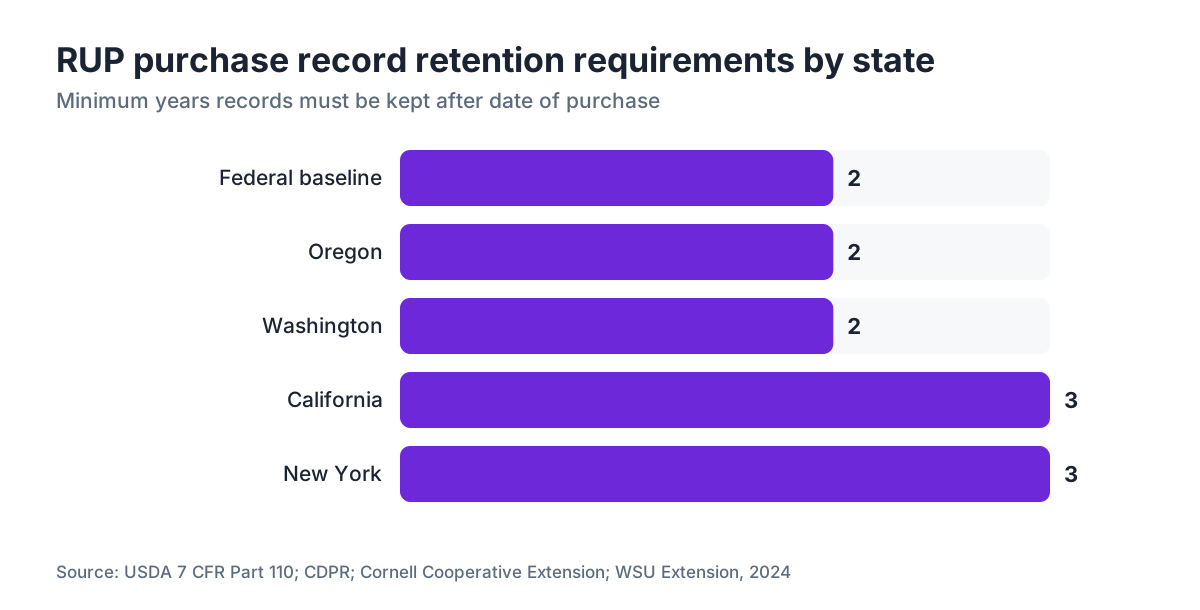
- California and New York require 3 years.
- Missing records can cost you your applicator license, more than a fine.
What are restricted use pesticides and why does recordkeeping matter for wineries?
A restricted use pesticide (RUP) is any product EPA has decided carries enough risk to people, livestock, or the environment that only a certified applicator, or someone working under that applicator's direct supervision, can buy or apply it. EPA publishes the classifications and keeps a searchable product database, but you don't need either to spot one. The words "RESTRICTED USE PESTICIDE" are printed right on the label [1].
For grape growers this hits harder than it does for a lot of crops. Vineyards lean on products such as certain neonicotinoids and a handful of restricted fungicides, and some regions still use materials that California has phased out. The moment money changes hands for one of these, a federal clock starts.
The record exists for more than audits. It tracks where product moves through the supply chain, it feeds post-incident investigations, and it backs the goal of the EPA Worker Protection Standard: giving workers and handlers real information about what they were around [2]. If a worker or a neighboring property ever claims harm, your purchase records are the first thing an investigator asks to see.
Small wineries tend to file this under "vineyard manager's problem." Mostly fair. But if the licensed applicator is on the winery payroll and the winery owns the land, the legal weight sits on that entity, and the applicator's license is the thing on the line when records go missing.
What federal law actually requires you to keep in an RUP purchase record?
The rule is 7 CFR Part 110, the USDA National Pesticide Recordkeeping Program, authorized by the Food, Agriculture, Conservation, and Trade Act of 1990 [3][9]. It applies to any certified applicator who buys a federally classified RUP. Five fields. That's the whole federal purchase-record requirement.
| Field | What to record |
|---|---|
| Product name | The brand name on the label |
| EPA registration number | The "EPA Reg. No." on the label |
| Total amount purchased | Quantity in label units (oz, lb, gal) |
| Date of purchase | The calendar date of the transaction |
| Dealer name and address | Full name and address of the seller |
That's the federal floor, and its simplicity is the trap. Because it looks easy, people get sloppy. They photograph the receipt and lose the photo. They toss paper receipts in a box that gets rained on. They let the vineyard manager keep everything on a personal phone.
Here's the part people mix up. You do not record who applied the product, where, or when under the purchase-record rule. That belongs to the separate application-record requirement, which most states pile on top. Conflating the two is the most common mistake extension advisors catch on farm visits. UC Cooperative Extension lays out where one ends and the other starts [4].
Keep these records for 2 years from the date of purchase [3]. USDA's Agricultural Marketing Service can inspect them during that window. After 2 years the federal hold releases, but your state may not.
How do state requirements differ from federal rules, and which states are stricter?
Federal law is the floor, and plenty of states build above it. If your vineyard sits in California, Washington, or New York, you're almost certainly under a stricter regime than 7 CFR Part 110 alone.
California is the toughest. The California Department of Pesticide Regulation (CDPR) requires 3-year record retention, and county agricultural commissioners run compliance checks in many counties every year [5]. California also wants the permit number from the county ag commissioner on application records, which get filed with that commissioner within 7 days of application. Different record type from the purchase record, but California audits both together, so both systems have to run clean.
Washington requires 2 years of pesticide records under WAC 16-228, matching the federal baseline. State Department of Agriculture inspectors are known to cross-check purchase records against application records on site. WSU Extension's pesticide safety materials tell growers to file the purchase record next to the matching Safety Data Sheet for every product bought that season [6].
New York runs on 3 years under state DEC rules, with Cornell Cooperative Extension guidance filling in the practical detail. Some counties add local oversight on top [7].
Run vineyards across state lines, as some larger winery groups do, and each state's rules apply on their own terms. A 2-year record satisfies nobody if that same product went onto a vineyard in a 3-year state.
| State | Retention period | Key authority | Annual inspection? |
|---|---|---|---|
| Federal baseline | 2 years | 7 CFR Part 110 | On demand |
| California | 3 years | CDPR / County Ag Commissioner | Yes (many counties) |
| Washington | 2 years | WAC 16-228 | Risk-based |
| New York | 3 years | NYDEC | Risk-based |
| Oregon | 2 years | ODA | On demand |
When you're unsure, keep 3 years everywhere. The extra year of digital storage costs nothing next to a violation.
Who is legally responsible for the records, the winery or the applicator?
The certified applicator is personally responsible under federal law [3]. The rule puts the obligation on the certified applicator who buys the RUP, not on a company. The person holding the license is the person at risk when records go missing.
Winery operations muddy this in practice. A lot of winery-owned vineyards run one or two certified applicators, and the records drift into personal vehicles, home offices, or a phone camera roll. That's a problem waiting to happen. If the applicator quits mid-season and walks off with their records, the winery has no defense during an inspection, even though the product was bought on the company account.
The cleaner setup keeps the record obligation on the applicator, because that's where the law puts it, and requires copies of every purchase record filed with the winery office within 24 hours. Some shops use a shared cloud folder. Others run a spray record system. What matters is redundancy: the applicator's copy and the company's copy both exist, in two places.
The EPA Worker Protection Standard, last revised in 2015, adds a nearby layer. Handlers who apply RUPs need access to label information, and the establishment has to post central pesticide information for agricultural workers [2]. Purchase records aren't the same as WPS posting, but an inspector looks at both, and a mess in one area usually earns a harder look at the other.
What records does a pesticide dealer have to give you, and can you rely on their copy?
Dealers who sell a federally classified RUP to a certified applicator keep their own records. The dealer's record has to include the applicator's name, certification number, the issuing state, and the same product information you keep [3][9]. That creates a backup, and the backup tempts people into thinking they can just call the dealer if their own file goes missing.
You can't. The dealer's copy satisfies the dealer's obligation, not yours. An inspector auditing your operation wants your records. "The dealer has them" gets logged as a missing record, full stop.
What you can do is use the dealer's invoice as the primary document in your own file, as long as it carries all five required fields. Most dealer invoices already list product name, EPA registration number, quantity, date, and business address. If yours doesn't, ask them to fix the invoice format. You're not begging a favor. A complete invoice serves their recordkeeping duty too.
Buying from an online retailer or a farm supply chain? Make sure the digital receipt or confirmation email captures all five fields before you close the tab. Print it or save it somewhere structured. An email buried in a personal inbox is not an organized record.
What physical and digital formats actually hold up in an inspection?
Federal regulation names no required format. It requires one thing: that records stay available for inspection through the 2-year window, or your state's longer one [3]. So you pick.
Paper works if you keep it readable and findable. A three-ring binder, sorted by calendar year and indexed by product, gets through most inspections. Paper's failure modes are water, fire, and the way small operations let it pile up unsorted. If paper is your system, scan every receipt and keep a digital backup. No exceptions.
Spreadsheets beat paper alone. A sheet with a column for each required field takes about two minutes per purchase and it's searchable. UC Davis extension materials include templates you can adapt [4].
Dedicated software is the most defensible option once you're past a dozen RUP purchases a season. Tools like VitiScribe log purchase records alongside application records, attach the label, and spit out the summary report an inspector actually wants. The audit trail builds itself instead of getting assembled the night before, which matters when the inspection notice gives you 48 hours.
Whatever the format, store records at the business, not with a person. When the certified applicator changes, the records stay with the operation.
How should you organize RUP purchase records to make an inspection actually painless?
Build the filing habit at the point of purchase, not at season's end. Every time a restricted use pesticide shows up or gets picked up, the record goes into the system that day. Not next week. That day. This one habit fixes most of the problems that sink inspections.
Here's a structure that works for a small to mid-size winery vineyard.
Separate purchase records from application records. They're related, but they're different legal documents, and jamming them together slows an inspection and raises your error rate.
Organize by calendar year, then by product. If an inspector asks for every record tied to one EPA registration number over the last two years, you want that pull done in under two minutes. Digging through a mixed pile of receipts is not a two-minute job.
Keep a one-page cover sheet per year listing every RUP bought, the EPA registration number, total quantity, and transaction count. The law doesn't require it. It makes you look organized and it flags anything missing at a glance.
Link each purchase record to the matching label and Safety Data Sheet, using the version current at the time of purchase, not a later one with different language. SDS documents change. The one in the record should match the purchase date.
Running multiple vineyard properties? Note which property each purchase was headed for even though the purchase rule doesn't demand it. Your application records will need that detail anyway, so capturing it now costs nothing.
What happens if your RUP purchase records are incomplete or missing during an inspection?
The consequences stack. At the federal level, USDA can refer a violation to EPA, and civil penalties under FIFRA (the Federal Insecticide, Fungicide, and Rodenticide Act) reach up to $5,000 per violation for a private applicator and up to $25,000 per violation for commercial applicators [8]. Each missing record can count as a separate violation.
The state side hurts sooner. CDPR, for one, can levy fines, order remedial training, and suspend or revoke the pest control license you or your applicator holds [5]. A suspended license means nobody on your payroll can legally buy or apply RUPs. In the middle of a powdery mildew outbreak, that's a genuine operational crisis, not a paperwork footnote.
Inspections come from neighbor complaints, worker complaints, and routine compliance sweeps. They also follow incidents: a drift event, a worker illness, a fish kill in a drainage ditch. In those situations, missing records flip the story from "accident" to "negligent operation" fast.
One piece of good news. Inspectors usually separate incomplete records from absent ones. A record missing a single field, say a dealer address, is fixable if you can show how you'd reconstruct it. A purchase with no record at all, one the inspector can confirm through the dealer's file, is the hard case. Don't land there.
How long do you actually need to keep RUP purchase records?
The federal minimum is 2 years from the date of purchase, not from the end of the season or the calendar year [3]. Buy a product in March and its record has to be available through at least March two years later.
California and New York want 3 years. In those states, run every record on a 3-year cycle regardless of the product-by-product math. Simpler, and there's no gap to fall through.
Once the window closes, no federal rule makes you keep anything. A few reasons argue for hanging on anyway. Civil litigation has no clean cutoff the way regulatory inspections do. If a former worker claims a chronic health issue years down the road, your purchase records from that period help establish what they were actually around. Plenty of winery operations keep pesticide records indefinitely in a compressed archive, and digital storage for that runs close to free.
For records past their required window that still carry practical value, move them to a clearly labeled archive folder, separate from active files. Your working records stay clean and inspection-ready, and the history survives.
Can technology actually solve the problem, or is it just another subscription?
Straight answer: a spreadsheet is fine for an operation making 10 to 20 RUP purchases a year. If you run one or two blocks and buy product four or five times a season, dedicated software probably doesn't pay for itself on recordkeeping alone. Don't buy it to buy it.
At 50-plus acres, several certified applicators, or California with its annual commissioner inspections, a purpose-built system earns its keep quickly. The value isn't storing data. It's the structure that stops fields from getting skipped, and the audit-ready export that saves you from assembling a paper file at 11 p.m. before a 9 a.m. inspection.
Want to test the idea before committing? VitiScribe runs a trial covering both purchase and application records in one log. Worth running alongside your current system for a season to see whether the structure matches how your operation actually works.
Whatever you run, the record is only as good as the input. Software has no idea you bought 2.5 gallons of a fungicide on Tuesday. Someone has to type it in. The best system is the one fast enough that your applicator actually enters it the same day.
What's the difference between RUP purchase records and pesticide application records?
Two different legal documents. Different fields, different triggers.
The purchase record gets created when you buy an RUP. It documents the transaction between you and the dealer. Its five fields (product name, EPA reg number, quantity, date, dealer info) capture the product moving through the supply chain [3].
The application record gets created when you apply a pesticide, RUP or general use, to a crop or site. Application records under the WPS and most state programs want more: location treated, crop or target site, application rate, the applicator's name, the certification number, and the restricted entry interval (REI) [2]. In California, application records go to the county agricultural commissioner within 7 days of application [5].
The two connect. A product logged in a purchase record should show up in one or more application records later in the season. When an inspector cross-references them, quantity purchased and quantity applied should roughly balance. A big gap prompts questions about where the product went.
Extension programs at Cornell, WSU, and UC Davis all publish templates for both record types, worth downloading as a baseline even if you customize them later [4][6][7].
For vineyard operations tied to winery facilities, keeping both record types aligned also helps if you're ever asked to document crop inputs for a TTB conversation. The records back each other up.
Frequently asked questions
Does a winery need to keep RUP purchase records if it contracts out vineyard spraying?
The obligation follows the certified applicator who makes the purchase, not the landowner. If a licensed pest control operator or contractor buys the RUP and applies it on your vineyard, their certification covers their own purchase records. You should still get a copy of the application record for your files under the Worker Protection Standard, and verify the contractor's license before they ever buy product for your site.
What is the EPA registration number and where do I find it on a pesticide label?
The EPA registration number is a unique identifier for each product, formatted as two number strings split by a hyphen, for example "EPA Reg. No. 62719-553." You'll find it near the bottom of the front panel, often close to the net contents statement. The first number identifies the registrant company; the second identifies the specific product. This number is required on your purchase record.
Can I store RUP purchase records digitally, or does the law require paper?
Federal rules under 7 CFR Part 110 do not require paper. Digital records are fine as long as they stay accessible for inspection during the retention window. The practical test is whether you can produce a readable, complete record on short notice. Scanned PDFs, spreadsheet entries, or software records all work. Back up digital records off-site or in the cloud; a hard drive failure is not a legal defense.
How much can you be fined for missing RUP purchase records?
Under FIFRA, civil penalties reach up to $5,000 per violation for private applicators and up to $25,000 per violation for commercial applicators. Each missing record can count as a separate violation. State penalties vary, and California can also suspend or revoke pesticide licenses. Federal and state penalties combined, plus the disruption of a suspended license, make this a high-consequence gap against a low-cost fix.
Do I need to record RUP purchases made for use on non-grape crops on the same property?
Yes. The requirement under 7 CFR Part 110 covers any RUP purchase by a certified applicator, regardless of the destination crop or site. If your winery operation also runs a small orchard or a cover crop program using a restricted use product, those purchases need the same records as your vineyard-specific buys.
What records does my pesticide dealer have to keep, and can I rely on them?
Dealers selling federally classified RUPs keep records that include the buyer's name, certification number, issuing state, product name, EPA registration number, quantity, and date. That creates a backup, but it satisfies the dealer's obligation, not yours. An inspector auditing your operation expects your records. "The dealer has them" is not a compliant response and gets logged as a recordkeeping violation.
How do California's RUP recordkeeping requirements differ from federal requirements?
California requires 3-year retention versus the federal 2-year minimum. Licensed pest control operators file application records with the county agricultural commissioner within 7 days of application. County commissioners run annual compliance inspections in many counties. California also requires a permit from the county ag commissioner before applying most RUPs. The California Department of Pesticide Regulation is the governing authority.
Do RUP purchase records need to include the certified applicator's license number?
The five federal fields under 7 CFR Part 110 for the applicator's purchase record do not list the license number. The dealer's record, though, must capture the buyer's certification number. Many state programs require the applicator to include their license number in their own records. Check your state's pesticide agency; California and New York both require it in state-level documentation.
What's the difference between a restricted use pesticide and a general use pesticide for recordkeeping purposes?
General use pesticides carry no federal purchase recordkeeping requirement. The 7 CFR Part 110 obligation applies only to products EPA has formally classified as restricted use, a status printed on the label. Some states require application records for general use pesticides on food crops, but federal purchase records are an RUP-specific obligation. When unsure, check the label and EPA's online pesticide product database.
Can a vineyard worker handle RUP purchase recordkeeping if they're not the certified applicator?
The legal obligation sits with the certified applicator, but the data entry can be delegated. Many operations have an office manager or vineyard administrator maintain the file. The applicator stays responsible for the accuracy and availability of those records. The applicator should review entries regularly and sign off on a summary at least seasonally to confirm the records are complete and correct.
How should I handle RUP purchase records when I sell or transition the winery operation?
Records must be kept for their full retention window regardless of ownership change. If you sell the winery, the business agreement should spell out who keeps the pesticide records and for how long. Federal rules don't transfer the obligation to a buyer automatically; the certified applicator who made the purchase stays the responsible party. Make copies for both sides and document the handover in your transaction paperwork.
Are there template forms I can download for RUP purchase records?
Yes. UC Cooperative Extension, WSU Extension, and Cornell Cooperative Extension all publish pesticide recordkeeping templates covering both purchase and application fields. The USDA National Agricultural Library also maintains resources tied to the 7 CFR Part 110 program. These templates are free and generally accepted by state inspectors as adequate format. Add your operation name and any state-required fields before relying on them.
Do I need to keep the actual pesticide label with the purchase record?
Federal purchase rules don't require attaching the label, but keeping a copy of the label version current at the time of purchase is strongly recommended. Label language shifts between registration cycles, and having the label from the time of use matters if a product's application instructions ever get questioned in a legal or regulatory context. Extension advisors at WSU and Cornell both recommend filing labels alongside purchase records.
Sources
- EPA, Pesticides: Restricted Use Products (RUP) Report: Restricted use pesticides may only be purchased and applied by certified applicators or persons under their direct supervision; the designation appears on the product label.
- EPA, Worker Protection Standard for Agricultural Pesticides: The Worker Protection Standard requires central posting of pesticide information and that handlers have access to product label information for pesticides applied at the establishment.
- USDA Agricultural Marketing Service, 7 CFR Part 110, National Pesticide Recordkeeping Program: Certified applicators who purchase federally classified RUPs must record product name, EPA registration number, amount purchased, date, and dealer name and address, and retain those records for 2 years.
- UC Cooperative Extension, Pesticide Safety and Use Records: UC Cooperative Extension materials distinguish purchase records from application records and provide templates for each; purchase records capture the transaction while application records capture use details.
- California Department of Pesticide Regulation, Pesticide Use Reporting: California requires 3-year retention of pesticide records, filing of application records with county agricultural commissioners within 7 days, and conducts annual compliance inspections in many counties.
- WSU Extension, Pesticide Safety Education Program: WSU Extension recommends keeping purchase records alongside the corresponding Safety Data Sheet for each product purchased in a given season.
- Cornell Cooperative Extension, Pesticide Applicator Recertification: New York requires 3-year retention of pesticide records under state DEC requirements, with some counties having additional local oversight.
- EPA, FIFRA Civil Penalty Policy: Civil penalties under FIFRA can reach $5,000 per violation for private applicators and up to $25,000 per violation for commercial applicators, with each missing record potentially treated as a separate violation.
- USDA National Agricultural Library, Pesticide Recordkeeping Program: The National Pesticide Recordkeeping Program was authorized by the Food, Agriculture, Conservation, and Trade Act of 1990 and requires dealers who sell RUPs to keep records that include the buyer's name, certification number, and issuing state.
- Oregon Department of Agriculture, Pesticide Licensing and Recordkeeping: Oregon requires a 2-year retention period for pesticide purchase and use records, matching the federal baseline.
Last updated 2026-07-10