Managing a vineyard: the complete field operations guide
TL;DR
- Managing a vineyard means juggling pruning, canopy work, irrigation, pest programs, worker safety rules, and detailed spray records all year.
- The hard part is timing.
- Most high-impact decisions cluster into two short windows: dormant pruning and the 30 days around bloom.
- Get the calendar right, keep clean records, and the rest gets easier.
What does managing a vineyard actually involve day to day?
The honest answer: more paperwork than most people expect, and more walking than any software can replace.
A vineyard manager's day splits into three buckets. Field operations (pruning, training, canopy management, irrigation). Pest and disease management (scouting, spray timing, record-keeping). Compliance (worker protection, pesticide licensing, water board reporting). None of it ever fully stops. Even in January, with the vines dormant, you're walking rows to assess cane selection, ordering materials, reviewing last season's disease maps, and confirming that last year's Pesticide Use Reports actually got filed.
Scale changes the texture but not the structure. A 10-acre family block and a 500-acre commercial operation need the same core records: pesticide application logs, worker safety documentation, water use records in many states, and input receipts for organic or sustainable certification. The big operation has a foreman handing out daily tasks. The small one has the owner doing everything. The records look identical.
Here's what surprises new managers: how much time goes into pre-work. UC Cooperative Extension cost studies suggest planning and record-keeping can eat 15-20% of a small operation's total labor hours [1]. That's not wasted time. That's how you catch a Botrytis problem before it costs you a whole block.
What's the annual vineyard management calendar and what are the busiest months?
The vineyard calendar is lumpy. Two periods set the season's quality ceiling: dormant pruning (roughly December through February in the northern hemisphere) and the 30-day window around bloom and fruit set (late May into June for most Vitis vinifera). Everything else matters, but those two windows are where the year gets decided.
Below is a general outline for a northern California or Pacific Northwest site. Shift it 4-6 weeks for cooler or warmer regions, and lean on your local extension office for phenology data specific to your cultivar and site [2].
January-February: Dormant pruning. Your highest-leverage weeks. Every cane you keep or cut decides vine balance, crop load, and disease susceptibility for the whole season. Budget 8-12 hours per acre for hand pruning, depending on trellis system and vine age [1].
March-April: Bud swell through shoot emergence. Start preventive copper or sulfur sprays if you carry downy or powdery mildew pressure. Open your spray log now, even if the first entry is a single copper pass.
May-June: Bloom and fruit set. The highest-risk window for powdery mildew (Erysiphe necator). Many managers spray fungicide on a 7-14 day interval through here. Shoot positioning, hedging, and fruit-zone leaf pulling happen now to improve airflow and spray coverage.
July-August: Veraison. Color and sugar start moving. Irrigation calls matter most here as you manage vine water status against berry size, flavor, and disease. Leafroll virus symptoms turn visible too, which makes this your best window for roguing decisions.
September-October: Harvest. Everything converges. Pre-harvest intervals for any material you applied must be respected, and this is exactly where thin spray records come back to bite you.
November-December: Post-harvest vine care, cover crop management, equipment winterization, and annual reporting.
The table below shows rough labor intensity by season phase, drawn from UC Cooperative Extension cost studies for North Coast wine grapes [1].
| Season Phase | Approx. Labor Hours/Acre | Primary Tasks |
|---|---|---|
| Dormant (Dec-Feb) | 12-18 | Pruning, brush removal, dormant sprays |
| Early season (Mar-May) | 6-10 | Shoot thinning, early sprays, trellising |
| Bloom/set (May-Jun) | 8-12 | Fungicide program, shoot positioning, leaf pulling |
| Mid-season (Jul-Aug) | 4-8 | Irrigation, canopy management, disease scouting |
| Harvest (Sep-Oct) | 10-20 | Hand harvest or machine setup, fruit delivery |
| Post-harvest (Nov) | 3-5 | Cover crops, equipment, reporting |
How do you manage vineyard irrigation and water scheduling?
Water is the biggest single lever you have on berry size and vine vigor. Most vineyards still run it on gut feel. That's shifting, partly because western states now demand better reporting, and partly because deficit irrigation research has gotten concrete enough to act on.
The baseline most viticulture extension programs recommend is midday stem water potential, measured with a pressure bomb, to define vine water status [3]. UC Davis has published target ranges. For most premium wine grape production you aim for stem water potential between -8 and -12 bars from berry set through veraison, then let it drift to -12 to -16 bars post-veraison to slow berry expansion and concentrate flavor [3]. No pressure bomb of your own? Renting one for the key measurement windows costs roughly $50-80 per day, and some farm advisors fold it into their service.
Drip is now standard on new plantings across most California AVAs, and it's common in Washington and Oregon. Regulated deficit irrigation (RDI) and partial rootzone drying (PRD) build on deliberate, measured stress. Neither is guesswork. Both need you to track soil moisture data alongside vine tissue readings.
In practice, many small managers set the schedule from ET (evapotranspiration) data at the nearest CIMIS (California Irrigation Management Information System) station or a comparable state network, then calibrate with pressure bomb readings two or three times a season [3]. ET for scheduling, pressure bomb for calibration. It's cheap, and it gives you enough data to defend your decisions if water regulators come asking.
One honest note. Nobody has great data on the economic return of precision irrigation below 50 acres. The closest published work comes from UC Cooperative Extension enterprise budgets, which show water for drip-irrigated North Coast vineyards averaging $150 to $350 per acre-foot depending on source [1]. Your breakeven on a soil moisture sensor network rides almost entirely on your water cost.
What pest and disease management does a vineyard manager need to know?
There are about six problems every wine grape grower in North America has to take seriously. The rest is regional or sporadic.
Powdery mildew (Erysiphe necator) is the number one fungal disease in nearly every wine grape region. It spreads fastest at 70-85 degrees Fahrenheit and needs no free moisture, which is exactly why warm, dry climates struggle with it. UC IPM recommends a preventive fungicide program starting at half-inch shoot growth and running through 4-6 weeks post-bloom on a 7-14 day interval [4]. Sulfur is still the most cost-effective material for most operations. Synthetics in the DMI, QoI, and SDHI groups come in where resistance is a concern.
Botrytis (gray mold) hits tight-clustered varieties hardest near harvest. Leaf pulling and shoot positioning during the season are your best cultural tools. Targeted sprays at bloom and pre-harvest are the chemical ones.
Grape leafroll virus has no cure. You scout, you rogue infected vines, and you buy certified clean planting material. Washington State University's viticulture program has done some of the most practical work on leafroll spread rates and roguing thresholds [2].
Phylloxera (Daktulosphaira vitifoliae) is managed almost entirely through rootstock choice at planting. Replanting? Get current rootstock recommendations from your county farm advisor. The AXR1 collapse in California in the 1980s and 1990s is the expensive cautionary tale.
Leafhoppers and mealybugs are the two insects most likely to force a real spray decision in California. In the Pacific Northwest, grape berry moth carries more weight.
Spotted wing Drosophila is a rising concern for early-ripening varieties in cooler regions.
For all of them, the decision structure is the same. Scout first. Identify the pest accurately. Check economic thresholds. Pick the least-disruptive material that works. Apply it at the right point in the pest's biology. Record everything. The record isn't only compliance. It's how you figure out what actually worked.
In California, your county agricultural commissioner requires a Pesticide Use Report (PUR) for any restricted material application [5]. Other states run similar systems with different triggers for mandatory reporting.
What are the pesticide record-keeping and spray log requirements for vineyards?
This is where a lot of small operations fall short, and usually not because they're breaking rules. They just don't realize how specific the records have to be.
In California, any grower applying a pesticide under a restricted materials permit must file a Pesticide Use Report with the county agricultural commissioner within 7 days of application [5]. The report needs applicator name and license number, product name and EPA registration number, application date and time, specific field location (often by section or GPS), target pest, method and equipment, acres treated, amount applied, and weather at the time of application. That's 10 data fields, minimum, per application.
The EPA Worker Protection Standard (WPS), revised in 2015, stacks on another layer. The WPS requires that pesticide application and hazard information be posted at a central location on the establishment, that workers and handlers get safety training, and that the label's personal protective equipment requirements be enforced [6]. The WPS defines "workers" as anyone doing hand labor in the vineyard and "handlers" as anyone mixing, loading, or applying pesticides. Those two roles carry different training and documentation rules.
The WPS states that agricultural employers must post pesticide application and hazard information "at a central location on the agricultural establishment" during the application and for 30 days after the restricted-entry interval expires [6].
For organic operations, the USDA National Organic Program requires that you keep records of all inputs, approved pesticides and fertilizers included, for 5 years [7]. Those records have to be ready for your certifier.
A realistic spray log for a 30-acre vineyard with an active disease program runs 30 to 50 entries a season, each with 10 or more fields. Doing it on paper is legal everywhere. It's also tedious and easy to botch. A spreadsheet template from your county farm advisor handles most of it. Tools like VitiScribe are built for this exact workflow if you'd rather keep application records, PHI tracking, and compliance alerts in one place instead of scattered across notebooks and binders.
Worth knowing: inspectors aren't hunting for perfection. They want completeness and consistency. A log filled out the same way every time, even with a correction or two, beats a log with gaps every day of the week.
How do you manage vineyard workers and stay compliant with labor laws?
Agricultural labor law is complicated enough to deserve its own article. Here's what every vineyard manager has to have handled.
The EPA Worker Protection Standard requires annual pesticide safety training for all agricultural workers and handlers before they enter treated areas during any restricted-entry interval [6]. Training has to cover how to find and use pesticide safety information, the hazards of pesticides, how to prevent exposure, and what to do in an emergency. Document that each worker got the training, with name and date. EPA provides approved training materials in multiple languages at no cost [6].
California's Heat Illness Prevention standard (Cal/OSHA Title 8, Section 3395) requires shade, water, and cool-down rest periods once temperatures hit 80 degrees Fahrenheit, with added requirements above 95 [8]. Enforcement is real. Penalties for serious violations commonly land in the thousands of dollars per citation and climb for repeat offenses, so treat the shade and water rules as non-negotiable.
At the federal level, the Migrant and Seasonal Agricultural Worker Protection Act (MSPA) covers most commercial vineyards using more than a handful of seasonal workers. The Department of Labor enforces its housing, transportation, wage, and disclosure requirements.
The honest advice: pay a labor law attorney or a farm labor consultant for a one-time review of your worker policies. It runs $500 to $2,000 and almost always earns its keep. UC Davis, Cornell, and WSU all publish agricultural labor management resources that are free and kept reasonably current [1][2][9].
How do you manage vine training systems and canopy effectively?
Your trellis and training system is a 20-year decision. Think it through hard before the first vine goes in the ground.
The common systems in North American wine grape production are vertical shoot positioning (VSP), Scott Henry, Lyre (U-trellis), and head-trained or own-rooted systems in older plantings. VSP is the default for new plantings because it works with modern equipment and gives you a defined canopy that's easier to spray and pick. Cornell's viticulture program has published detailed comparisons of training systems by variety and region [9].
In-season canopy work is four jobs. Shoot thinning (pulling excess shoots at the spur or cane). Shoot positioning (tucking shoots into the trellis wires). Fruit-zone leaf removal (better airflow and spray penetration, lower Botrytis risk). Hedging (trimming runaway growth to cut shading).
How much leaf removal is right? It depends on your site, variety, and climate. In cooler regions, stripping too much drops berry temperature and slows ripening. In hot regions, a little cluster shade guards against sunburn and holds acid. UC Cooperative Extension guidelines for Napa and Sonoma suggest 1-2 leaves removed per cluster on the morning-sun side as a reasonable starting point for most VSP-trained varieties [1].
One thing growers consistently undervalue: the first two or three years of training decide the structural quality of the vine's permanent wood for the next three decades. Rush it and you pay for it. Most experienced viticulturists spend years one and two just building clean trunk and arm structure, even if that means little or no crop.
What does it cost to manage a vineyard per acre per year?
Everyone asks this. Almost nobody answers it honestly, because the range is genuinely huge.
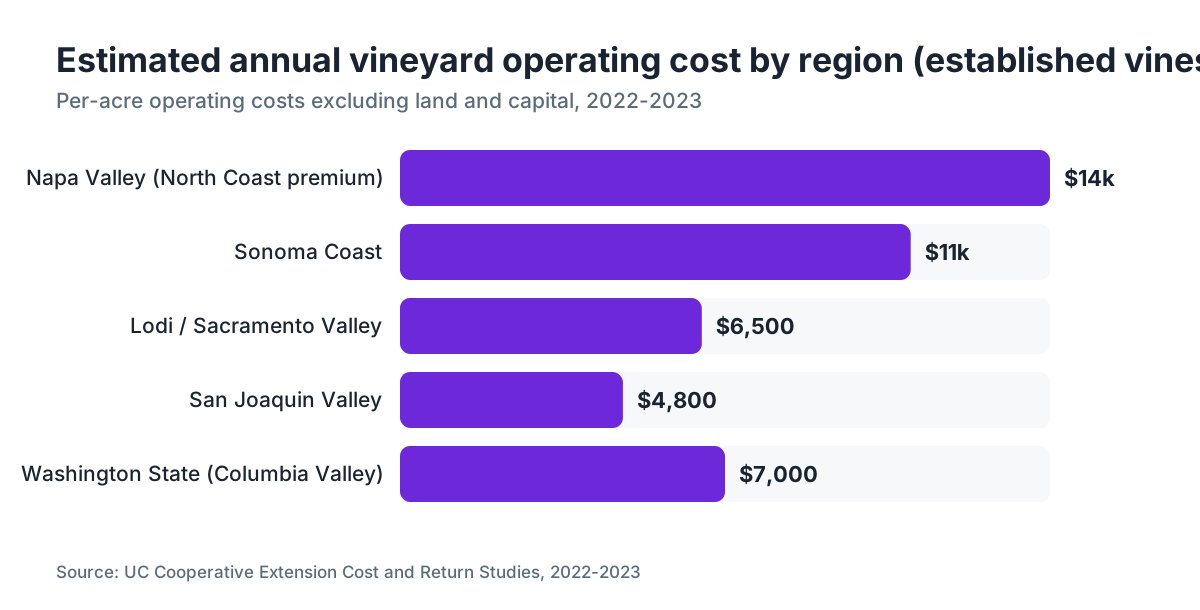
UC Cooperative Extension publishes annual enterprise budgets for wine grape production by California region. In the 2022-2023 studies, established vineyard operating costs (excluding land and capital) ran from roughly $4,800 per acre per year in the San Joaquin Valley to about $14,000 per acre per year in premium Napa Valley AVAs [1]. Those figures cover labor, materials, irrigation water, equipment operating costs, and management overhead, but not land payments or interest.
Washington State University's Viticulture and Enology program publishes similar budgets for Columbia Valley and other Washington appellations, where established operating costs typically run $5,000 to $9,000 per acre per year depending on variety and irrigation infrastructure [2].
Two line items swing the total the most. Labor can be 50-65% of operating costs. Fungicide and pesticide materials can jump from $300 to $1,500 per acre depending on pressure and the products you reach for.
For a new planting, add establishment costs. In California, planting through the third leaf typically runs $25,000 to $45,000 per acre all-in before the vine yields a single commercial crop, with wide swings for trellis complexity, irrigation, and vine material cost [1].
Nobody's going to tell you this pencils out easily at small scale. It often doesn't. Most operations under 10 acres either own the land outright, carry a high-value brand that works at low volume, or subsidize the vineyard with winery revenue or outside income. That's not a flaw in the model. It's just what high-cost, artisan wine grape production looks like.
How do you scout for vineyard problems and what records should you keep?
Scouting is walking the vineyard with a purpose. Well-run operations do a full block walk at least once a week from budbreak through veraison, and twice a week during bloom and the 3-4 weeks before harvest.
A useful scouting record for each block captures date and time, growth stage (use the Eichhorn-Lorenz scale, or just "early bloom," "fruit set," and so on), pest and disease observations with a severity rating, vigor notes, and any action taken or planned. Kept consistently, that record turns into a historical map of your problem blocks and recurring pressure zones.
GPS-tagged photo documentation has gotten cheap enough that every manager should be doing it. A phone with a simple field-notes app can pin a Botrytis observation to an exact row. Come January, when you review the season, that data beats "north end of block 3 had some rot" by a mile.
For disease forecasting, most regions have weather station networks feeding models for powdery mildew risk (UC IPM's Powdery Mildew Risk Index) and other pathogens [4]. These aren't magic. They do help you justify stretching spray intervals during low-risk stretches, which saves money and cuts pesticide load.
Cornell's viticulture extension resources at the New York State Agricultural Experiment Station in Geneva include practical scouting protocols for eastern pests that translate reasonably well to any humid continental region [9]. UC IPM has California-specific guidelines by pest and crop [4]. WSU Extension covers the Pacific Northwest [2]. Use the tools that already exist. They're free, and people who spent careers in the field built them.
What technology and software actually helps vineyard managers?
The vineyard tech market has exploded over the past decade, and a lot of it is noise. Here's a straight take on what earns its keep at typical operation scale.
Weather stations and disease models give the best return for most operations. A basic on-site station ($400 to $1,500) wired to a disease model tells you when powdery mildew infection periods hit and lets you justify your spray intervals. The UC IPM Powdery Mildew Risk Index is free to run with your own weather data [4].
Spray record software pays off once you pass roughly 20 acres or more than one full-time person applying pesticides. The time saved on compliance reporting alone covers it. For California growers, software that generates PUR-formatted reports directly is a genuine time saver.
Soil moisture sensors help if you're running precision deficit irrigation across variable soils. Under 20 acres with uniform soil, a pressure bomb plus ET data from a public weather network is usually enough and a lot cheaper.
Canopy sensors and NDVI mapping (often from drone flights) earn their place at larger scales for spotting vigor variation inside blocks. Under 50 acres, a careful walk finds the same variation. At 100-plus acres, NDVI helps you steer labor and inputs where they matter.
Accounting and inventory software that ties vineyard inputs to crop records is worth a look if you run a winery alongside the vineyard. Keeping chemical inventory, application dates, and pre-harvest intervals in the same system that builds your PUR reports cuts double-entry errors.
For spray records and compliance tracking specifically, VitiScribe is built around the workflow managers actually use: logging applications in the field, tracking PHI windows, and generating reports for county ag commissioner submissions.
Honest caveat. The best technology is the one you'll actually use. A $50 paper log filled out the same way every time beats a $3,000 system nobody logs into after March.
How do you handle vineyard compliance for organic or sustainable certification?
Organic and sustainable certifications run in parallel with your baseline regulatory duties, not instead of them. You still hold your pesticide applicator license. You still file PURs in California. WPS still applies. Certification just layers on input restrictions and documentation.
For USDA National Organic Program (NOP) certification, the vineyard requirements come down to three things. A 3-year transition period during which prohibited materials cannot be applied (you can sell the fruit, just not as certified organic during that window). Use of only NOP-approved materials for pest, disease, and nutrient management. And records of all inputs kept for 5 years [7]. The USDA Agricultural Marketing Service publishes the National List of Allowed and Prohibited Substances, your definitive reference for what's legal under NOP [7].
Sustainable programs, like CSWA (California Sustainable Winegrowing Alliance) or Salmon-Safe, are voluntary and vary a lot in requirements and rigor. They generally don't restrict materials as tightly as organic, but they do want documented pest management decisions (integrated pest management records), water use records, and biodiversity practices. They're often easier to enter than organic and can be a realistic first step for operations not ready for a full organic transition.
The documentation load for organic is real. Your certifier runs an annual inspection and reviews your input purchase receipts, application logs, and field records. Gaps in documentation are the most common reason certifications get delayed or denied. Build the record-keeping system first, then chase certification. Not the reverse.
What should a new vineyard manager learn first?
Stepping into vineyard management for the first time, whether you took over a family property or got hired into a commercial operation, here's a realistic priority order.
First, understand what you have. Walk every block. Know the varieties, the rootstocks if grafted, the trellis systems, the irrigation infrastructure, the soil types. Get a soil test if you don't have recent data. Pull the last three years of spray records and crop reports. You can't make good decisions without a baseline.
Second, get your pesticide applicator license if you'll be making application decisions. Requirements vary by state. Most require passing an exam, and some require continuing education credits for renewal. In California, start at your county ag commissioner's office [5].
Third, connect with your local farm advisor, through UC Cooperative Extension, WSU Extension, or Cornell Cooperative Extension depending on your region [1][2][9]. These advisors exist to help growers in their county. They know the local pest pressure, the disease history, the regulatory climate. Their help is free or close to it.
Fourth, build your record-keeping system before you need it. The worst time to design a spray log is late May, mid-fungicide program. Set it up in February when the vineyard is quiet.
Fifth, find other managers in your region. Your county farm bureau, your appellation growers association, and local field days are where the practical knowledge lives. The research is excellent, but the person who's farmed your specific county for 20 years knows things no publication carries.
For the broader context of grape growing operations, see our overview of the vineyard landscape in the U.S., or look at how established operations like Gervasi Vineyard and Ponte Winery tie their vineyard management to hospitality and production goals. The Paso Robles wineries region and South Coast Winery are useful reference points for how California AVA operations structure their field teams.
Frequently asked questions
How many acres can one vineyard manager handle alone?
Without any full-time help, a hands-on manager can reasonably run 15-25 acres of wine grapes if the blocks are contiguous and mechanized. Above that, pruning and harvest alone need more than one person's hours. UC Cooperative Extension budgets show labor at 50-65% of operating costs, and most operations start hiring seasonal crew around 20 acres.
What licenses do you need to manage a vineyard?
In most states, a Qualified Pesticide Applicator License or equivalent is required to apply or supervise restricted-use pesticides. California issues it through the county agricultural commissioner. You may also need a state water board permit if you pump from surface water, and a licensed pest control adviser (PCA) if you write pesticide recommendations for hire. Check your state department of agriculture for current requirements.
What's the best cover crop for a vineyard?
It depends on your goal. For nitrogen fixation, legume mixes like bell beans, vetch, or clover are standard. For erosion control on steep slopes, cereal rye or annual ryegrass establishes fast. For moisture competition in vigorous soils, a perennial grass sod in every other row cuts vine vigor without stripping organic matter. UC Davis and UC Cooperative Extension have cover crop trial data by region and soil type.
How do I know when to harvest grapes?
Harvest timing combines Brix (sugar, read with a refractometer), pH, titratable acidity, and sensory checks on skin and seed maturity. Most winemakers set target Brix by variety; 22-26 Brix is typical for reds, though natural wine producers often pick lower. Brix alone isn't enough. A berry at 24 Brix with green seeds and high acid isn't ready. Sample 100-plus berries across a block for a representative reading.
How long does it take a new vineyard to become productive?
Grafted vines on commercial rootstock typically give a small crop by the third leaf (third growing season) and hit full production by the fifth to seventh year, depending on variety, training system, and management. Most viticulturists harvest minimally or not at all in years one and two to build structure. Establishment costs of $25,000-$45,000 per acre in California reflect that multi-year wait before revenue.
What's the difference between a vineyard manager and a viticulturist?
In common use, a vineyard manager runs day-to-day operations: scheduling crews, applying inputs, keeping records, making tactical calls. A viticulturist usually has formal training (often a degree) and works at the strategic level, advising on variety selection, rootstock, and canopy systems. At small operations one person does both. At large ones, the viticulturist may oversee several managers across different blocks or properties.
How do you prevent powdery mildew in a vineyard?
Prevention starts with a preventive fungicide program at half-inch shoot growth, before symptoms show. Sulfur-based fungicides on 7-14 day intervals through 4-6 weeks post-bloom are the backbone of most programs. Cultural practices help too: shoot positioning and leaf removal improve airflow and spray penetration. UC IPM's Powdery Mildew Risk Index, built on temperature and humidity data, flags high-risk infection periods and helps you time sprays.
What are the pre-harvest interval (PHI) requirements for vineyard pesticides?
Every registered pesticide has a pre-harvest interval printed on its label, the minimum days between the last application and harvest. PHIs range from 0 days for some contact materials to 30-plus days for some systemic fungicides. Federal law requires following these label restrictions. Violations can trigger crop rejection by a winery, loss of certification, and regulatory action. Tracking PHI windows is one of the most common uses for vineyard software.
What EPA Worker Protection Standard requirements apply to vineyard operations?
The WPS requires annual safety training for all agricultural workers and pesticide handlers before they work in treated areas during a restricted-entry interval. Employers must post application and safety information at a central location during applications and for 30 days after the REI expires. The WPS also requires decontamination supplies (water, soap, towels) near treated areas and emergency medical help if needed. The revised 2015 rules are enforced by the EPA.
How often should you spray fungicide in a vineyard?
Most programs call for 7-14 day intervals during high-risk periods (bloom through 4-6 weeks post-bloom for powdery mildew) and can stretch to 14-21 days in lower-risk stretches with shorter nights and drier conditions. Interval length depends on the material's residual activity, disease pressure from a risk model, and weather (rain or high humidity speeds spread). UC IPM and your local farm advisor are the right resources for timing.
What's the best irrigation system for a new vineyard planting?
Drip with pressure-compensating emitters is standard for new plantings across most western regions and increasingly used in the East. It puts water at the root zone, cuts weed pressure in the row, and allows fertigation. Installation typically runs $2,000-$4,000 per acre depending on terrain and distance to the water source. Overhead sprinklers are sometimes used for frost protection rather than primary irrigation. In year one, frequent light irrigation drives vine establishment.
How do you manage phylloxera in a vineyard?
There's no effective chemical treatment once vines are infested. Management is almost entirely preventive: planting on resistant rootstocks (AXR1 is not reliably resistant; St. George, 110R, and 140Ru have better profiles), sanitation to avoid moving infested soil on equipment, and never replanting own-rooted vines in infested ground. Establishing a new vineyard in California or any phylloxera-prone region? Your rootstock choice is your phylloxera program.
Do small vineyard operations need a pest control adviser (PCA)?
In California, any grower buying restricted-use materials must have a written recommendation from a licensed PCA before purchasing or applying them. This applies regardless of size. A PCA can be a farm advisor, an independent consultant, or in some cases a licensed applicator acting as their own PCA. Other states set different thresholds. In California, applying anything on the restricted materials list means you need a PCA recommendation or your own PCA license.
Sources
- UC Cooperative Extension, Wine Grape Cost and Return Studies: Established vineyard operating costs in California range from approximately $4,800 to $14,000 per acre per year; labor is 50-65% of operating costs; planning and record-keeping can consume 15-20% of total labor hours on small operations
- Washington State University Extension, Viticulture and Enology: Established vineyard operating costs in Washington typically run $5,000-$9,000 per acre per year; WSU has published practical work on leafroll virus spread rates and economic thresholds
- UC Davis, Department of Viticulture and Enology: Midday stem water potential targets for premium wine grapes: -8 to -12 bars from berry set through veraison, -12 to -16 bars post-veraison
- UC IPM, Grape Pest Management Guidelines: UC IPM recommends preventive fungicide program starting at half-inch shoot growth, continued through 4-6 weeks post-bloom on 7-14 day intervals for powdery mildew management; Powdery Mildew Risk Index is available for growers
- California Department of Pesticide Regulation, Pesticide Use Reporting: California growers applying restricted materials must file a Pesticide Use Report with the county agricultural commissioner within 7 days of application, including 10+ required data fields per application
- EPA, Worker Protection Standard for Agricultural Pesticides: The WPS requires annual pesticide safety training for all agricultural workers and handlers, posting of application and hazard information at a central location during applications and for 30 days after the REI expires
- USDA Agricultural Marketing Service, National Organic Program: NOP requires a 3-year transition period, use of only NOP-approved inputs, and maintenance of all input records for 5 years, available for certifier inspection
- Cornell University College of Agriculture and Life Sciences, Viticulture Extension: Cornell's viticulture extension program publishes training system comparison data by variety and region, and practical scouting protocols for eastern wine grape pests from the NY State Agricultural Experiment Station in Geneva
Last updated 2026-07-09