Managing grapevine nutrition and vineyard soil health
TL;DR
- Grapevines need 16 essential nutrients.
- Nitrogen, potassium, and boron are the ones most likely to run short in commercial vineyards.
- Aim for soil pH 5.5 to 6.5, organic matter above 2%, and drainage that actually works.
- Petiole testing at bloom gives the most reliable read on vine nutrition.
- Soil and tissue data together are the only honest basis for a fertilizer program.
What nutrients do grapevines actually need?
Grapevines need 16 essential elements. Carbon, hydrogen, and oxygen come from air and water. The other 13 come from soil or fertilizer, and getting the balance right is what separates a vineyard that produces good fruit from one that limps through vintage after vintage fighting problems that started in the ground.
The macronutrients, the ones vines need in the largest quantities, are nitrogen (N), phosphorus (P), potassium (K), calcium (Ca), magnesium (Mg), and sulfur (S). The micronutrients are needed in much smaller amounts but no less essential: boron (B), zinc (Zn), manganese (Mn), iron (Fe), copper (Cu), molybdenum (Mo), and chlorine (Cl) [1].
Nitrogen is the most managed nutrient in vineyards. Too little and vines push weak, pale shoots with poor fruit set. Too much and you get the opposite: a jungle canopy, poor color, delayed maturity, and a fruit-to-leaf ratio that makes winemakers unhappy. Potassium is the most abundant cation in grape berries and it drives juice pH directly, so K management is more of a winemaking decision than an agronomic one [2]. Boron deficiency is common, especially on sandy soils or in high-rainfall regions that leach it out, and it shows up as poor fruit set or "hen and chicken" berry development.
Phosphorus gets ignored because most established vineyard soils test adequate for it, and grapevine roots form mycorrhizal partnerships that scavenge what's there. Magnesium deficiency turns up on soils high in K or Ca, because those cations fight for the same uptake pathway. Iron chlorosis on high-pH soils is a chronic headache in limestone country, and the fix is usually rootstock selection or soil acidification. Throwing chelated iron at it treats the symptom, not the cause.
What is the right soil pH range for grapevines?
Target pH 5.5 to 6.5 for grapevines. Most authorities land there, with 6.0 as the sweet spot that keeps nutrients available and soil biology active [1]. Outside that band, nutrient availability drops off fast even when the element is physically present in the soil.
Above pH 7.0, iron and manganese go insoluble and vines show interveinal chlorosis on young leaves. Boron availability drops. Zinc gets harder to reach above 6.5. Below pH 5.0, aluminum and manganese can turn soluble at toxic levels, and phosphorus locks up as aluminum or iron phosphate.
pH is one of the slowest things you can change. Agricultural lime to raise pH on an acid soil takes 6 to 18 months to show its full effect, and you can't rush it. Elemental sulfur to lower pH on an alkaline soil works even slower, usually 1 to 2 years to move pH by a full unit, and only if soil biology is active enough to oxidize the sulfur. Plan ahead. Establishing a new block? Fix pH before you plant. Trying to correct a pH problem in a mature vineyard row under a drip line is slow, frustrating, and expensive.
Where pH stays high because of calcareous (high-calcium) parent material, rootstock is your best long-term lever. Lime-tolerant rootstocks like 41B or Fercal are standard in the calcareous soils of France and are available in the U.S. through nurseries certified under state budwood programs [3].
How do you test vineyard soil and grapevine tissue correctly?
You need two tests to make good nutrition decisions, and they answer different questions. A soil test tells you what's in the reservoir. A tissue test tells you what the vine is actually pulling up. Skip either one and you're guessing.
Soil sampling belongs on a 3 to 5 year cycle in established vineyards, or annually if you're chasing a known deficiency. Pull 15 to 20 cores per block from the top 12 inches, mix them into one composite, and send it to a certified lab. Pull a second set from 12 to 24 inches deep if you're worried about subsoil pH or deep potassium. Most university and commercial labs return results with recommended amendments. UC Cooperative Extension labs are widely used across California [1]. The Midwest Grape and Wine Industry Institute at Iowa State has parallel resources for Midwest growers [4].
Leaf tissue testing is where grapevine nutrition gets precise. The standard protocol, confirmed by WSU Extension, is to collect petioles (the leaf stems, not the blade) from the leaf opposite the basal cluster at or near full bloom, usually late May to early June depending on your region. A second sampling at veraison, using the same leaf position, gives you a second data point. Collect 50 to 100 petioles per block from healthy, representative vines. Steer clear of vines sprayed with a foliar nutrient recently or any showing odd symptoms [5].
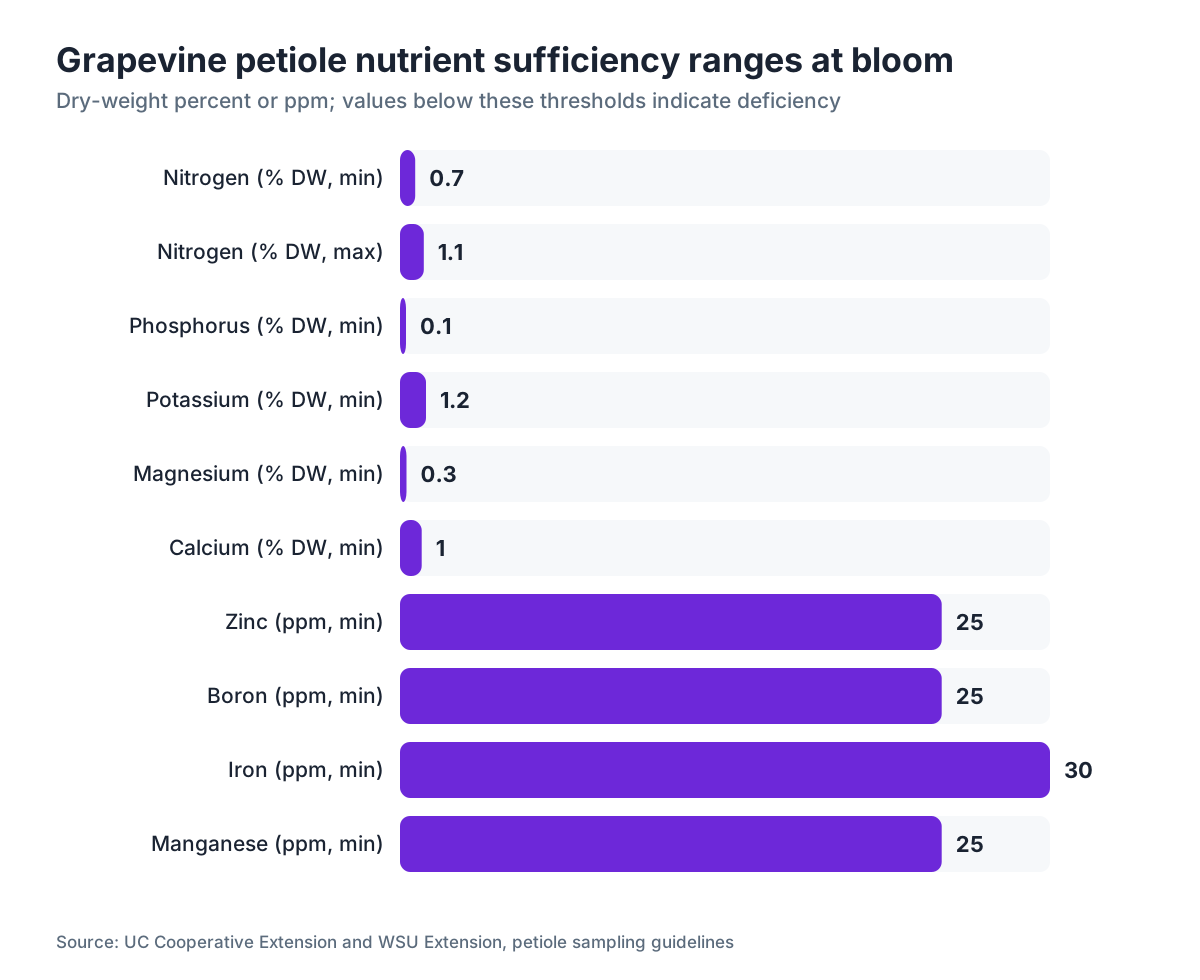
Petiole analysis beats leaf blade analysis for most nutrients. The University of California critical values table for petioles at bloom is the most cited reference in California; WSU's Small Fruit Horticulture program publishes similar sufficiency ranges tuned for the Pacific Northwest [5]. Results below the sufficiency threshold mean a real deficiency. Borderline results mean sample again and look at the whole picture before you spend money on fertilizer.
One honest caveat. Nobody has clean data on exactly how much tissue values shift with rootstock, variety, and irrigation timing. The sufficiency ranges are well established for major varieties on standard rootstocks. Grow something unusual, or use a rootstock that's rare in your region, and you should treat the published numbers as directional, not gospel.
What are the visual symptoms of common grapevine nutrient deficiencies?
Knowing what to look for in the field saves time, but visual diagnosis alone should never drive a fertilizer decision. Symptoms overlap too much. Magnesium and potassium deficiencies can look nearly identical. Iron chlorosis and sulfur deficiency both turn leaves yellow. Confirm with tissue testing.
Here's what to look for.
Nitrogen deficiency: Pale yellow-green canopy, short internodes, small clusters, early leaf drop. Canes ripen early and stay thin. Worse on sandy soils or in cool, wet springs when root uptake slows.
Potassium deficiency: Leaf margins turn yellow, then brown, then scorch, usually in midsummer. Starts on older leaves. Fruit ripens unevenly. Common on sandy soils in warm, dry years.
Magnesium deficiency: Interveinal chlorosis on older leaves. Veins stay green while the tissue between them yellows. Looks like K deficiency but starts between the veins rather than at the margins. Common on high-K soils where K crowds out Mg uptake.
Boron deficiency: Poor fruit set, misshapen berries, hen-and-chicken clusters. Also stunted shoot tips and distorted young leaves. Boron is phloem-immobile, so symptoms hit new growth first.
Iron deficiency: Bright yellow-green new leaves with green veins, usually on high-pH or waterlogged soils. A classic sign of calcareous ground.
Zinc deficiency: Stunted shoots, small mottled leaves, poor fruit set, tight clusters full of shot berries. Common in sandy coastal soils and after heavy rain [2].
When you're walking rows and something looks off, take photos, note the block and row, and pull tissue samples before jumping to a fix. Foliar micronutrients act fast but fade fast. Soil applications work slower but build the reserve.
How much nitrogen does a vineyard actually need?
Less than you think, and most vineyards overshoot. Nitrogen is the nutrient most likely to cause trouble when overapplied, and most established vineyards on reasonable soils need less of it than growers assume.
A common rule of thumb from UC Cooperative Extension is roughly 20 to 50 pounds of actual nitrogen per acre per year, with young establishing vines at the low end and heavy-cropping mature vines potentially needing more [1]. Those numbers are for bearing vineyards on non-cover-cropped, low-organic-matter soils. Run a legume cover crop (hairy vetch, crimson clover) and it may be fixing 50 to 150 lbs of N per acre per year. Credit that against your application rate or you will overfertilize [12].
Timing matters as much as rate. Vine N demand peaks at bloom and again during rapid shoot growth in spring. Applications made in fall or early winter, after veraison, are mostly wasted or converted to nitrate that leaches over winter, which is an environmental problem in regulated regions. California's Irrigated Lands Regulatory Program and similar programs in other states are scrutinizing nitrogen management for exactly that reason.
For drip-irrigated vineyards, fertigation with a soluble source like calcium nitrate gives you precise timing and placement. For dry-farmed or furrow-irrigated blocks, granular urea broadcast and incorporated before the season works, but mind the timing. Urea applied to wet soils in cool weather can volatilize a lot of ammonia before it converts to plant-available nitrate [6].
The honest bottom line: if your petiole N is in the sufficient range at bloom and shoot growth looks normal (12 to 18 inches before hedging in most varieties), you probably don't need to add nitrogen. Test first. Fertilize on evidence, not the calendar.
How do you build organic matter and long-term soil health in a vineyard?
Organic matter is the metric most closely tied to long-term vineyard soil health. It drives microbial activity, holds water, buffers pH swings, releases nutrients slowly, and improves the structure of both sandy and clay soils. Getting it above 2% in most vineyard soils is a realistic goal and worth working toward over years, not seasons [4].
Cover cropping is the most effective tool most vineyards have. A permanent sod (fescues, bluegrass, or a mix) or a seasonal cover crop (cereals, legumes, mustards) adds biomass, feeds soil organisms, holds down erosion, and in the case of legumes, fixes nitrogen. WSU Extension work in Washington shows cover crops can improve soil organic matter by 0.1 to 0.3 percentage points per year in active programs. That sounds like nothing until you see what it adds up to over a decade [5].
Compost works, but it's expensive. Well-finished compost at 2 to 5 tons per acre every 2 to 3 years builds organic matter you can measure. The catch is that compost quality varies wildly. A lab analysis of your source for nutrient content and heavy metals (especially if it's municipal biosolids or recycled material) is worth the roughly $40 test cost. Uncomposted winery pomace is a reasonable amendment once it's aged at least 6 months, but fresh pomace ties up nitrogen during decomposition and smells.
Mycorrhizal fungi earn a mention because they're heavily marketed and just as heavily misapplied. Established vineyard soils that haven't been fumigated usually already carry functional mycorrhizal populations. Inoculating transplants in fumigated or sterile nursery soils has real value. Adding mycorrhizal products to established vines in reasonable soil is, in my view, mostly money spent on marketing.
Tillage is one of the fastest ways to wreck organic matter and soil structure. If your equipment allows, move toward reduced tillage or no-till in the row middles to protect what you've built. Here the science and the economics actually agree: fewer passes means less fuel, less compaction, and better biology [4].
What does a practical vineyard fertilization program look like?
A real fertilization program isn't a product list. It's a decision process that starts with data and ends with a targeted application, written down in your field records.
Here's a workable framework for a bearing vineyard:
- Soil test every 3 to 5 years, or when you suspect a problem. Fix pH first, before anything else.
- Pull petiole samples at bloom every year, or at least every other year if resources are tight.
- Compare tissue results to sufficiency ranges. Flag any nutrient below the critical level.
- Estimate nitrogen supply from soil organic matter, cover crop, and any compost or organic amendments. Subtract that from your need before buying fertilizer.
- Apply what the data says you need, not what the sales rep suggests.
For a typical California coastal vineyard on loam with a cover crop, a baseline program might read: lime or gypsum as needed to correct pH or the Ca/Mg ratio, a spring application of 15 to 20 lbs actual N per acre as fertigated calcium nitrate, and a foliar zinc/boron shot at prebloom if tissue tests show marginal levels. That's it. Plenty of healthy vineyards need nothing beyond that.
Documentation matters on two levels. First, it's your agronomic record. You can look back three years and see whether the program is working. Second, it's your compliance record. The California Department of Pesticide Regulation tracks pesticide use, and while pure fertilizers aren't pesticides, many auditors and certifiers (organic, sustainable, LODI Rules) want fertilizer records as part of farm plan review. Keeping those records in one place, whether a field notebook or a system like VitiScribe, makes audits less painful.
One thing I'd say flat out: if you're spending more than $300 to $400 per acre per year on fertilizer in an established, dry-farmed vineyard with a cover crop, ask hard questions about what the data says you're actually correcting. More is not better.
How does irrigation affect nutrient uptake in vineyards?
Water and nutrients are the same problem, not two separate ones. Nutrient uptake runs on mass flow and diffusion through the soil solution, so if the soil is too dry, nutrients don't move to the root surface no matter how much you've applied. Too wet and you get the same dead end through waterlogging, low oxygen, and roots that quit working.
For drip-irrigated vineyards, the payoff is precision. You can fertigate nitrogen, potassium, and micronutrients straight into the wetted zone, timed to vine demand. The risk is salt building up in the drip zone if your irrigation water has high EC (electrical conductivity) or you're pushing high rates of soluble fertilizer. Soil EC above 1.5 dS/m starts to drag on grapevine performance, and most varieties show yield loss above 2.0 dS/m [3].
Deficit irrigation, common in premium wine regions, makes the timing of stress a nutritional question. A mild deficit from veraison to harvest slows vegetative growth and concentrates fruit, but a vine already K-stressed going into that window can slide from marginal into a visible deficiency. Watch tissue values alongside your irrigation data.
Calcium and boron are the two nutrients most sensitive to water management. Both ride the transpiration stream (xylem), so anything that cuts transpiration, including water stress, shading, or cool weather, cuts their uptake even when soil levels look fine. Bunch stem necrosis, a disorder tied to calcium and sometimes boron, shows up more in years with erratic moisture around bloom.
What do cover crops do for vineyard soil health?
Cover crops are one of the highest-return investments in vineyard soil management, and they're underused in many regions because the benefits come slow and diffuse rather than fast and obvious.
A good cover crop mix does several jobs at once. It adds organic matter as it breaks down. It shields the soil surface from raindrop impact and erosion. It crowds out weeds in the row middles, cutting herbicide use. Legumes fix atmospheric nitrogen. Deep-rooted species like tillage radish or chicory punch through compaction layers and open biopores that improve water infiltration. And a diverse mix supports beneficial insects, which feeds directly into pest management.
Wine grapes come with a catch: you have to manage cover crop competition with the vines, especially in dry years or on unirrigated blocks. A cover crop growing hard during spring shoot push is drinking the same water the vine needs. Mow or roll it early in dry regions. In high-rainfall country like western Oregon or the Finger Lakes, competition is much less of a worry.
The Cornell Viticulture program has published widely on cover crop management for northeastern vineyards, including species mixes that hold up in cold, humid conditions [7]. UC Cooperative Extension has parallel work for California, with guidance tuned for both Napa-style and coastal Sonoma sites [1].
The row under the vine is a separate call. Leaving a resident weed population or permanent cover right against the trunk affects vine vigor and can shelter pests. Most growers keep a 2 to 3 foot weed-free strip under the vine, with herbicide or mechanical cultivation, and cover crop only the middles. That's a sound balance.
For more on how established wine regions manage soil and site, the vineyard article has context on regional practices.
How do organic and sustainable certification programs affect vineyard fertilizer choices?
Certified organic under USDA NOP rules means your fertilizer inputs have to be approved materials. That rules out synthetic nitrogen like urea or ammonium sulfate and most soluble synthetic micronutrient formulations. Approved organic sources include feather meal, blood meal, composted manure, fish emulsion, and mined mineral products like Chilean nitrate, which carries quantity restrictions under NOP [8].
The practical fallout is that organic nitrogen sources release slowly and resist precise timing. They depend on soil microbes to mineralize them, so in a cold spring they're nearly useless until soils warm past 50 degrees F. That bites in regions with cold, wet springs, like parts of the Pacific Northwest or New York. Building soil organic matter is part of the answer: more organic matter means more microbial biomass and faster mineralization once conditions allow.
For LODI Rules, Sustainability in Practice (SIP), and similar third-party programs, the requirements are looser than USDA NOP but still demand documentation. Most ask you to show that your nitrogen applications rest on tissue or soil test data and follow a nutrient management plan. They don't ban synthetic fertilizer, but they make you justify your rates.
The EPA Worker Protection Standard (WPS) shows up here too, even for fertilizers, because many nutrient products (concentrated copper, zinc sulfate, and other micronutrients) are also registered pesticides. Copper is the classic case, used both as disease control (Bordeaux mixture, copper hydroxide) and as a micronutrient source, and it's subject to WPS recordkeeping and restricted-entry intervals [9]. Don't assume a product labeled as a nutrient sits outside pesticide rules. Read the label.
Keeping records that satisfy multiple certification standards at once is one of the real operational burdens for small vineyards. A system that lets you log an input once and populate both your nutrient management file and your pesticide use report saves real time. VitiScribe is built for that kind of dual-purpose record.
For producers in Paso Robles, the South Coast, and other California AVAs, local sustainable winegrowing coalitions often keep regional nutrient management resources tuned to local soils and climate. The Paso Robles wineries community has been active here through the Paso Robles Wine Country Alliance.
What soil amendments actually work, and which are a waste of money?
The amendment market for vineyards is full of products with big claims and thin data. Here's a direct read on the common ones.
Agricultural lime (calcium carbonate): Works. The cheapest reliable way to raise soil pH and add calcium. Slow but dependable. Agricultural lime runs roughly $40 to $80 per ton before application, and rates of 1 to 3 tons per acre are typical for pH correction.
Gypsum (calcium sulfate): Useful in high-sodium soils or where you want calcium and sulfur without moving pH. It also flocculates clay particles, which can improve drainage in heavy clay. Not much use in soils already saturated with calcium. A Cornell study found gypsum improved yield and vine performance on soils with high sodium saturation but did almost nothing on normal vineyard soils [7].
Elemental sulfur: Lowers pH, but only in biologically active soils and over a long horizon. It also works as a fungicide, which is why it's everywhere in vineyards. The fungicidal use is economical. Using it purely as a soil acidifier is slow and hard to predict.
Humic acid products: Here's where I slow down. A few products have real data behind them; most don't. The underlying idea, that humic substances improve nutrient retention and stimulate microbes, is sound. The problem is that most commercial humic acid products vary wildly in composition and concentration, and the dose you'd need to move the needle in the field is far higher than the label suggests. If you're adding compost regularly, you're already getting more from its humic fraction than from a bottle.
Silicon products: Silicon isn't an essential nutrient for grapevines, though some work suggests it strengthens cell walls and slightly reduces fungal disease pressure. The data isn't consistent enough across environments to make a strong call. Save the money unless you have specific disease pressure and a clear trial result from your own region.
Biostimulants (seaweed extracts, amino acids, and the like): The category is legitimate; the specific products are a mixed bag. Seaweed-based products have the best supporting literature, especially around fruit set and stress response. But the effect sizes in most studies are small. On a high-value block with tight costs, get the macronutrients right before you spend on biostimulants.
How do you track and document vineyard nutrition records for compliance?
Nutrition records serve two purposes that feel separate but are really one: agronomic continuity and regulatory compliance. Agronomically, you want to know what you applied, when, at what rate, and how the vine responded. For compliance, most organic certifiers, sustainability programs, and a growing number of state nutrient management rules want the same information in a specific format.
At minimum, capture for each fertilizer application: date, block or field ID, product name and formulation, application rate (lbs per acre or gallons per acre), method (ground rig, air, fertigation), and who applied it. If the product is also a registered pesticide (copper, sulfur, or zinc sulfate at high rates), it has to appear in your pesticide use records under the California Department of Pesticide Regulation's reporting requirements, and likely under equivalent rules in your state [10].
File soil and tissue test results with the year's records so you can show the data that justified each application. Certifiers look for the chain: the data showed a deficiency, here's what you applied, here's the follow-up data showing it worked. Vineyards that can't produce that chain often get flagged in audits even when they're doing everything right.
Digital recordkeeping beats paper here, not because paper is wrong but because paper doesn't search, summarize, or warn you when a restricted-entry interval is up or a registration expires. It also won't email your certifier a PDF when they ask. The case for digital is plain efficiency.
For the broader operations context that nutrition management sits inside, the vineyard overview covers site, variety, and production considerations that all touch soil management.
Frequently asked questions
What is the ideal soil pH for grapevines?
The target range is pH 5.5 to 6.5, with 6.0 considered optimal by most extension programs including UC Cooperative Extension and WSU. Below 5.0, aluminum and manganese become toxic. Above 7.0, iron, zinc, and boron get harder for the vine to reach. Test soil pH every 3 to 5 years and adjust with lime (to raise) or elemental sulfur (to lower), ideally well before planting.
When should I collect petioles for grapevine tissue testing?
Collect petioles at bloom, from the leaf opposite the basal cluster on actively growing shoots. A second collection at veraison adds a data point. Pull 50 to 100 petioles per block from representative, healthy vines. Skip vines treated recently with foliar nutrients or showing abnormal symptoms, since both skew the results.
How do I fix iron chlorosis in my vineyard?
Iron chlorosis in grapevines is almost always caused by high soil pH making iron unavailable rather than a true iron shortage. Soil applications of elemental sulfur or acidifying amendments lower pH over time but work slowly. Foliar chelated iron (EDTA or DTPA forms) gives a quick cosmetic fix but doesn't touch the root cause. Long term, lime-tolerant rootstock like 41B or Fercal is the most durable answer in calcareous soils.
How often should I apply compost in a vineyard?
Most extension recommendations suggest 2 to 5 tons of finished compost per acre every 2 to 3 years to maintain organic matter, or annually during the first few years of establishment. Get a nutrient analysis of your compost before applying, since quality varies a lot. Age uncomposted pomace at least 6 months before soil application to avoid nitrogen tie-up during decomposition.
Can cover crops replace nitrogen fertilizer in a vineyard?
A legume cover crop (hairy vetch, crimson clover, or similar) can fix 50 to 150 lbs of nitrogen per acre per year under good conditions, enough to fully replace or substantially cut synthetic nitrogen in many vineyards. The nitrogen releases as the cover crop decomposes, so timing matters. Mow or incorporate before bloom to line up the release with the vine's peak N demand.
What fertilizers are allowed under USDA organic certification in vineyards?
USDA National Organic Program (NOP) allows fertilizers from natural sources: composted manure, feather meal, blood meal, fish emulsion, kelp meal, Chilean nitrate (with quantity limits), and approved mined minerals like gypsum, lime, and rock phosphate. Synthetic nitrogen sources like urea and ammonium sulfate, and most soluble synthetic micronutrient formulations, are prohibited. Verify a product's NOP compliance with your certifier before use.
What are the symptoms of potassium deficiency in grapevines?
Potassium deficiency shows as marginal leaf scorch, starting at the leaf edges on older leaves in midsummer and moving inward. In severe cases leaves drop early. Fruit ripens unevenly, and K-deficient fruit tends to have higher juice acidity (lower pH) because potassium is the main cation neutralizing organic acids in the berry. Confirm with petiole tissue testing; visual diagnosis alone isn't enough.
Does soil organic matter level actually matter for grapevines?
Yes. Organic matter above 2% improves water-holding capacity, nutrient exchange, soil structure, and microbial activity. Vineyards on low-organic-matter soils (below 1%) are more prone to deficiencies, compaction, and erratic vine performance. Building organic matter takes years of consistent cover cropping and compost, but it's the most reliable indicator of long-term soil health. UC Cooperative Extension and WSU both use 2% as a general benchmark.
How does irrigation scheduling affect grapevine nutrient uptake?
Nutrients move to roots mostly by mass flow in the soil solution, so adequate soil moisture is a prerequisite for uptake. In drip-irrigated vineyards, nutrients applied by fertigation stay in the wetted zone and are highly available. Even brief severe water stress interrupts calcium and boron uptake, since both depend on transpiration-driven xylem flow. Monitor soil moisture and tissue values together for the fullest picture.
What records do I need to keep for vineyard fertilizer applications?
At minimum: date, block or field ID, product name and formulation, application rate, method of application, and applicator name. If the product is also a registered pesticide (copper, sulfur, zinc sulfate at high concentrations), it has to appear in your pesticide use records under your state's rules. Organic and sustainability certifiers also want the soil or tissue test data that justified the application. File test results with each year's input records.
How do I know if I'm over-fertilizing my vineyard with nitrogen?
Signs of excess nitrogen include heavy vegetative growth (long internodes, dense canopy), poor fruit color and delayed maturity, and petiole nitrogen values well above the sufficiency range at bloom. The UC Cooperative Extension sufficiency range for petiole N at bloom in most varieties is roughly 0.7 to 1.1 percent dry weight; values above 1.5 percent are a red flag. Excess canopy sets off a cascade of pest, disease, and quality problems.
Are mycorrhizal inoculant products worth applying in established vineyards?
Generally no. Established vineyard soils that haven't been recently fumigated or heavily disturbed usually carry functional native mycorrhizal populations. Adding commercial inoculants to established vines in reasonable soil hasn't shown consistent benefits in controlled trials. The real value of these products is at transplanting into fumigated or severely depleted soils, where native populations have been wiped out.
What is the EPA Worker Protection Standard requirement for vineyard fertilizer applications?
The EPA Worker Protection Standard applies when a fertilizer product is also registered as a pesticide, which covers copper-based and sulfur-based products used as both nutrients and disease controls. Under WPS, employers must post pesticide application information, provide personal protective equipment, and observe restricted-entry intervals. WPS doesn't cover pure fertilizers with no pesticide registration, but check the product label every time.
How does boron deficiency affect grapevine fruit set?
Boron is essential for pollen tube growth and fertilization. Deficiency before and during bloom leads to poor fruit set, producing clusters with many small, seedless shot berries alongside normal ones, a pattern called hen and chicken. Because boron is phloem-immobile, symptoms hit new growth first. Pre-bloom foliar boron at 0.1 to 0.2 lbs actual boron per acre is a common corrective; confirm deficiency with tissue testing before applying.
Sources
- UC Cooperative Extension, UC Davis - Grapevine Nutrition and Soil Management: Target soil pH range of 5.5 to 6.5 for grapevines; nitrogen need of 20 to 50 lbs actual N per acre per year for bearing vines; standard petiole collection at bloom protocol
- UC Cooperative Extension - Grapevine Micronutrient and Potassium Nutrition: Potassium is the most abundant cation in grape berries and directly affects juice pH; zinc deficiency common in sandy soils and after heavy rain
- UC Cooperative Extension - Rootstock Selection for California Vineyards: Rootstocks with lime tolerance including 41B and Fercal used in calcareous soils; soil EC above 2.0 dS/m associated with yield reduction in most grapevine varieties
- Midwest Grape and Wine Industry Institute, Iowa State University Extension: Organic matter above 2% as a target for vineyard soil health; cover crops can improve organic matter 0.1 to 0.3 percentage points per year; tillage accelerates organic matter loss
- WSU Extension - Viticulture and Enology, Small Fruit Horticulture: Standard petiole sampling protocol: leaf opposite basal cluster at bloom; sufficiency ranges for Pacific Northwest varieties; cover crop effects on soil organic matter in Washington vineyards
- UC Cooperative Extension - Nitrogen Management in Vineyards: Urea applied to wet soils in cool weather can volatilize significant ammonia before converting to plant-available nitrate; timing of nitrogen application relative to vine demand
- Cornell University Grapes and Wine Program - Cover Crops and Soil Health: Cover crop management guidance for northeastern vineyards; gypsum improved yield on high-sodium soils but had minimal effect on normal vineyard soils in Cornell studies
- USDA National Organic Program - Rules and Regulations: Approved organic fertilizer sources under NOP include feather meal, blood meal, composted manure, fish emulsion, Chilean nitrate (with quantity limits), and mined minerals; synthetic nitrogen sources prohibited
- EPA - Agricultural Worker Protection Standard: WPS applies to agricultural pesticides including copper and sulfur products registered as both nutrients and pesticides; employers must post application information, provide PPE, and observe re-entry intervals
- California Department of Pesticide Regulation - Pesticide Use Reporting: California requires pesticide use reporting for all restricted-use and many general-use pesticides including copper and sulfur fungicides used in vineyards; records required per application event
- UC Cooperative Extension - Petiole Sampling and Analysis for Vineyards: Critical petiole N sufficiency range at bloom is approximately 0.7 to 1.1% dry weight; values above 1.5% indicate excess nitrogen; standard 50 to 100 petiole collection per block
- WSU Extension - Cover Crop Management in Pacific Northwest Vineyards: Legume cover crops can fix 50 to 150 lbs nitrogen per acre per year in vineyards; nitrogen release from decomposing cover crops timed to vine demand by mowing before bloom
Last updated 2026-07-09