3 row vineyard sprayer: how to choose, size, and run one right

TL;DR
- A 3-row vineyard sprayer treats three vine rows in one tractor pass, roughly tripling coverage over a single-row unit.
- Tank sizes run 200 to 600 gallons.
- New units cost $18,000 to $80,000 depending on airblast style and controls.
- They fit operations of 50 to 300 acres where per-acre spray cost and labor hours hurt.
What does a 3-row vineyard sprayer actually do?
A 3-row vineyard sprayer treats both sides of three adjacent vine rows in one tractor pass. The machine straddles the center row and reaches the canopy faces of the two flanking rows at the same time. Most designs pull this off with airblast fans, multi-boom arrangements, or a split-tower head that angles nozzle clusters outward at roughly 15 to 45 degrees from center.
The payoff is simple. One pass covers what used to take three. On a 100-acre block, that's about 67% fewer tractor laps, less soil compaction in your drive rows, lower fuel burn, and fewer labor hours per spray event. When a rain front is closing your spray window or disease pressure spikes overnight, that speed is the whole point.
Most 3-row machines ride on a standard three-point hitch or pull behind on a drawbar. The wider head geometry means you have to confirm your tractor's wheelbase fits the row spacing before you buy anything. Standard California and Washington wine grape row spacing is 8 to 12 feet center-to-center [1]. A 3-row unit at 10-foot spacing needs to cover roughly 30 feet of canopy width. Some manufacturers handle that with a folding boom that tucks for transport and opens in the block.
Here's the tradeoff from a vineyard operator's chair. You're swapping a simpler, cheaper machine for complexity and capacity. The coverage math works in your favor on flat ground with uniform canopy. On steep hillside blocks or uneven cordon heights, a 3-row head can skip canopy pockets that a single-row operator would catch by nudging position every pass.
How does a 3-row sprayer compare to a 5-row unit?
The step up to a 5-row sprayer is real, and it's not always worth it. Here's where the two machines actually part ways.
A 5-row unit treats five rows per pass. At 10-foot row spacing that's 50 feet of canopy in a single shot. Coverage efficiency is excellent on large, uniform blocks, usually 200 or more acres of contiguous plantings with consistent canopy and dead-flat ground. On a 300-acre block, a 5-row machine can cut spray time close to 80% against single-row work.
The tradeoffs pile up fast. 5-row machines are heavier, often 3,000 to 6,000 lbs more than a comparable 3-row unit. They need bigger tractors, usually 100 to 140 PTO horsepower minimum versus 60 to 90 hp for most 3-row rigs [2]. End-of-row headland turns get ugly. Many 5-row designs fold but still need 40 to 50 feet of headland to turn safely. Older blocks with end-posts near the road edge often just don't have the room.
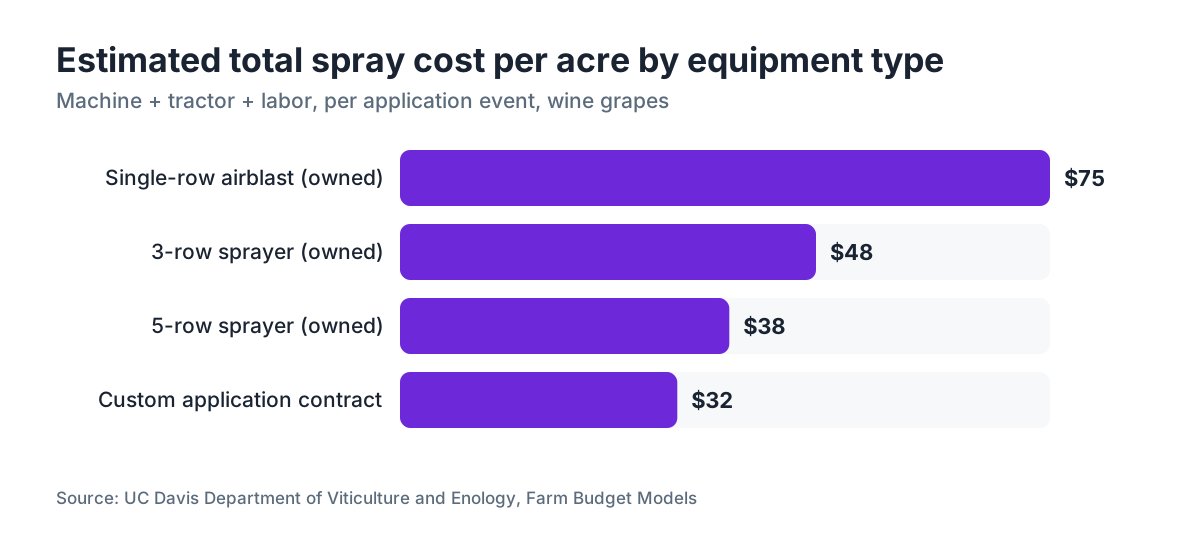
Cost gap is wide. A mid-spec 3-row unit runs roughly $25,000 to $55,000 new. A comparable 5-row from the same maker typically runs $45,000 to $90,000 or more once you add the airflow to push spray 25 feet out to the far rows [3]. Nobody publishes clean per-acre cost breakdowns across machine sizes, but farm budget models from UC Cooperative Extension put total spray operation cost (machine plus tractor plus labor) at $40 to $80 per acre per application for mid-size mechanized operations [4].
For most small-to-mid wineries and estate vineyards under 200 acres with mixed block sizes and some terrain, the 3-row machine is the practical answer. The 5-row is for large, uniform commercial ground where row count per pass is the single biggest cost driver.
| Feature | 3-row sprayer | 5-row sprayer |
|---|---|---|
| Rows per pass | 3 | 5 |
| Typical tank size | 200-600 gal | 400-1,000 gal |
| New cost range | $18,000-$80,000 | $45,000-$120,000+ |
| Min tractor PTO hp | 60-90 hp | 100-140 hp |
| Headland needed | 25-35 ft | 40-55 ft |
| Best block size | 50-250 acres | 150-500+ acres |
| Terrain tolerance | Moderate | Low to moderate |
What spray volume and tank size do you need for 3-row coverage?
Tank sizing starts with application rate, not acreage. Target gallons per acre for most fungicide and insecticide programs in wine grapes runs 20 to 100 gallons of dilute mix per acre depending on canopy size, growth stage, and product label [5]. A compact canopy early in the season might take 25 gallons per acre. A dense mid-summer canopy at full shoot growth might want 75 to 100 gallons per acre for full penetration.
Here's the math. Say you're spraying at 50 gallons per acre, your 3-row unit covers 3 rows at 10-foot spacing, and you're moving at 3.5 mph. You're covering roughly 1.0 acre per minute of net spraying time. A 300-gallon tank empties over 6 acres before a refill stop. A 500-gallon tank takes you to about 10 acres.
Refill time is the cost nobody puts on the spreadsheet. If your water source is 15 minutes away and it takes 10 minutes to fill, that's 25 minutes of dead time per tank. On a tight spray window, it adds up fast. Sizing up the tank so you can spray 10 to 15 acres between fills is almost always worth the extra purchase cost and weight.
Weight is the counterweight to that logic. Water weighs 8.34 lbs per gallon [6]. A 500-gallon tank full of spray mix is over 4,000 lbs before you count the frame, fans, and pump. Check your tractor's rear axle load rating. Overloading compacts soil, stresses axle seals, and on hillside ground it's a rollover risk you can measure.
WSU Extension's calibration guidance is blunt about checking your work: catch nozzle output in a container for a measured time interval and compare it to the nozzle manufacturer's chart at least once per season [2].
What types of 3-row sprayer designs are available?
Three design approaches cover most of the 3-row market.
Airblast tower sprayers use a tall vertical fan on the center unit that throws air, and droplets with it, outward. Some designs split the air column left and right from a single fan. Others run two or three independent fan heads on a shared frame. The upside is good canopy penetration, especially on tall or dense systems like vertical shoot positioning with a double-wire catch. The downside is drift, which gets bad fast if wind conditions are wrong and nozzle deflectors aren't set carefully.
Multi-boom or tunnel sprayers wrap the vine row inside a partial or full canopy tunnel. Nozzles spray inward from both sides, and much of the spray that misses the canopy gets caught by panels and recirculated. These machines cut pesticide use hard, sometimes 30 to 40% per acre compared to open airblast, and knock down drift [7]. They cost more and demand very consistent canopy to work well. They're rare in 3-row form but not unheard of among large Lodi and Central Valley operations.
Pneumatic flat fan boom sprayers skip the airblast and run high-pressure nozzles on articulated booms held close to the canopy. They do well for low-volume precision work but struggle on dense canopies. They're the lightest option and often the cheapest entry point.
For most wine grape operations, the standard airblast 3-row unit is the right pick. Tunnel and recovery systems earn their price at very high application frequencies (8 or more sprays per season) or where pesticide cost per acre is high enough that recovered spray is real money.
How do you calibrate a 3-row vineyard sprayer?
Calibration is where spray programs live or die, and it doesn't take long to do right. The goal is to confirm your actual output per acre matches your intended rate before you spray a single acre of product.
Start with nozzle output. Run the sprayer at operating pressure (check the product label for the recommended range, usually 50 to 150 PSI depending on nozzle type) and catch each nozzle's output in a graduated container for exactly 30 seconds. Multiply by 2 to get output per minute. Compare to the nozzle manufacturer's chart for that nozzle at that pressure. Replace any nozzle more than 10% above or below spec [8].
Next, measure field speed. Drive a marked 100-foot course at your normal operating RPM and gear, timing the run. Use the formula: mph = (distance in feet x 0.682) / seconds. Cornell Cooperative Extension has published tables that convert this straight to gallons per acre at common nozzle outputs [9].
Then calculate total output. For a 3-row unit at 10-foot row spacing, you're covering a 30-foot swath. Use: GPA = (GPM per swath x 5,940) / (mph x swath width in feet). If the number misses your target, adjust speed or nozzle size before you touch pressure. Pressure changes shift droplet size a lot and can push you into drift-prone fine droplet ranges.
Write the calibration down. Date, nozzle model, pressure, speed, and calculated GPA. If you track spray records digitally, that's where a tool like VitiScribe earns its keep: spray events, calibration records, and product use logs all land in one place, which matters when your farm plan or WPS audit asks for documentation.
Calibrate at the start of each season and after any nozzle replacement. Nozzles wear faster than most operators expect. Stainless or ceramic tips outlast brass. Polymer tips are cheapest and wear fastest.
What does a 3-row vineyard sprayer cost, new and used?
New pricing for 3-row vineyard sprayers spans a wide band depending on manufacturer, airblast style, tank size, and control system.
Entry-level units from smaller manufacturers or import brands run $18,000 to $30,000 for a basic airblast tower with a 200 to 300 gallon tank and manual controls. Mid-tier machines from established brands (Gregoire, Hardi, Caffini, Durand-Wayland) with 400 to 500 gallon tanks and basic rate controllers land at $35,000 to $60,000. High-end units with GPS-controlled section valves, variable-rate capability, and large tanks can top $80,000 [3].
Used pricing is harder to pin down. A well-kept 5-to-10-year-old 3-row unit in good mechanical shape typically sells for 30 to 50% of original list at auction or private sale, so roughly $12,000 to $40,000 for most mid-tier machines. Older machines (15 years and up) go for $5,000 to $15,000 but often carry worn fans, corroded tanks, or dead nozzle bodies that need immediate replacement.
Budget for operating costs too. Spray pumps need regular inspection and diaphragm replacement, typically every 2 to 4 seasons at $500 to $1,500 per service. Nozzle tips should be replaced annually on a standard schedule; a full set for a 3-row unit with 12 to 20 nozzle positions costs $200 to $600 depending on tip material. Fan belts, filter screens, and agitator seals are routine annual items.
Rental gets overlooked. Some farm equipment dealers and custom applicators in California and Washington offer 3-row sprayer rental or contract spray service. If you're under 30 acres or spray only 3 to 4 times a season, the math on ownership versus custom application can flip in a hurry.
How does the EPA Worker Protection Standard apply to 3-row sprayer operations?
The EPA's Worker Protection Standard (WPS), codified at 40 CFR Part 170, covers agricultural workers and handlers involved in pesticide applications in vineyards [10]. Operating a 3-row sprayer counts as pesticide handling under WPS, which carries specific duties beyond reading the label.
Handlers (the person running the sprayer) have to get WPS handler training before working with pesticides in a vineyard. The training covers pesticide safety, emergency procedures, decontamination, and the specific hazards on the operation. It has to be repeated every year [10].
Personal protective equipment is non-negotiable. The product label sets the minimum PPE. For many fungicides common in wine grapes (copper-based products, sulfur, DMI fungicides), that means chemical-resistant gloves, long sleeves, and eye protection at minimum. Some systemic insecticides call for respirators and chemical-resistant coveralls. The handler must have access to and wear all label-required PPE during mixing, loading, and application.
Re-entry intervals (REIs) govern when other workers can enter a treated block. REIs range from 4 hours (many fungicides) to 48 hours (some insecticides and contact herbicides). WPS requires the REI to be posted at the field entrance and that workers stay out of treated areas during the REI without full handler PPE [10]. On a 3-row sprayer covering a lot of ground quickly, tracking which blocks got sprayed when is genuinely hard to keep straight without a system.
The EPA's WPS rule puts the notification duty plainly: "Agricultural employers must ensure that workers and handlers are informed of pesticide applications that affect the areas where they work" [10]. That also means decontamination water and supplies within a quarter mile of the work site, and a central posting area where workers can check application information.
California layers on more under the California Department of Pesticide Regulation (CDPR), including a Pesticide Use Report (PUR) filed monthly for all pesticide applications above de minimis thresholds [11]. The Washington State Department of Agriculture runs parallel notification and posting requirements under state pesticide law [12].
What nozzle and airflow settings give you the best canopy coverage?
Coverage quality on a 3-row unit rides on three linked variables: droplet size, air velocity from the fan, and travel speed. Get any one badly wrong and you're either drifting product off-target or leaving canopy gaps.
Droplet size is measured in microns. Fungicide applications aimed at powdery mildew or botrytis want medium-to-fine droplets (200 to 350 microns VMD) to reach tight cluster zones. Systemic products that absorb into the leaf are more forgiving and can run coarser droplets (350 to 450 microns) that cut drift risk [8]. Water-sensitive papers clipped at different canopy depths (outer leaf layer, middle cluster zone, interior) tell you whether your pressure and speed are actually landing droplets where you want them. Use them. They cost almost nothing and the answer is direct.
Fan speed and travel speed trade against each other. Slowing down adds dwell time but cuts air turbulence in the canopy. Many experienced applicators run 3 to 4 mph in dense mid-season canopy and step up to 4 to 5 mph early season when the canopy is thin. WSU Viticulture Extension has documented that typical Concord and wine grape canopy needs air speeds of 15 to 25 mph at the canopy face for penetration beyond the outer leaf layer [2].
Nozzle positioning matters on a 3-row head. Most manufacturers give you adjustable nozzle towers or booms. Aim nozzles into the lower cluster zone (roughly knee to waist height on a 6-foot cordon system) rather than straight horizontal. Point too high and you miss clusters. Point too low and you're spraying dirt.
Spray at night or early morning to cut evaporation and dodge the drift-prone afternoon wind that's common in coastal California and the Columbia Valley [4].
How do you maintain a 3-row sprayer between and during the season?
End-of-season cleanup does more for sprayer life than anything else you'll do. Rinse the tank, lines, pump, and every nozzle body with clean water right after the last spray event. Then run a tank cleaner or buffered ammonia solution (check your last product's label for compatibility) through the system to neutralize residue. Drain it completely. Spray mix left in lines over winter corrodes fittings, ruins diaphragms, and taints your first application next season with whatever broke down in the dark.
Before the first application each season:
- Inspect all nozzle tips and replace any showing wear, cracking, or flow deviation above 10%.
- Check all filter screens. The inline strainer before the pump and the individual nozzle body screens both collect debris you don't want pushing through nozzle orifices.
- Test pressure gauge accuracy against a calibrated reference gauge. A gauge that reads wrong makes every rate calculation wrong.
- Check fan belt tension and condition. A loose belt slips under load and drops air output with no obvious sign while you spray.
- Inspect the tank for cracks, UV degradation (common on white polyethylene tanks in high-sun country), and fitting integrity.
During the season, after every spray event, rinse the outside of the machine to strip product buildup off booms and fan housings. Copper-based fungicides eat aluminum and untreated steel. Watch the spray pattern during application for clogs; a missing or off-angle fan pattern from one nozzle is usually a clog or a failed check valve.
Keep a maintenance log. Record every service, nozzle change, belt swap, and pump job. It matters for resale value, and it's the only way to catch a failure pattern before a part quits mid-spray.
How do spray records from a 3-row sprayer operation satisfy compliance audits?
Spray records are where compliance holds up or falls apart under scrutiny. California's CDPR requires that pesticide applications in commercial agriculture be reported to the county agricultural commissioner within 30 days of application, including product name, EPA registration number, amount used, acreage treated, and application date [11]. Washington's Department of Agriculture has parallel record-keeping requirements under RCW Chapter 17.21 [12].
For a 3-row sprayer hitting multiple blocks in one pass or one day, the record-keeping problem is tracking which product at what rate went on which block. Spray six blocks in one morning with two tank mixes and you need six records (or a multi-block record that names each block), not one. That block-level granularity matters because residue setbacks, REI posting, and crop removal dates are all block-specific.
Good records also satisfy food safety audit requirements under FSMA's Produce Safety Rule and private certification programs like LODI RULES or SIP Certified that many wine grapes carry [13]. Auditors want to see date of application, product name and EPA reg number, formulation, rate applied (per acre and total), equipment used, applicator name, weather at time of spray, and the target pest.
Plenty of vineyard managers still run these records on paper or spreadsheets, which works if you're disciplined. The weak point is time. A mid-season spray audit covering 15 events across 8 blocks means flipping through a lot of paper while someone waits. Digital record-keeping, including what VitiScribe is built around, keeps those records searchable by block, date, or product, which is how auditors actually ask for them.
UC Davis viticulture and farm management resources recommend keeping spray records for at least 3 years from application date, though individual certifications may require longer retention [4].
What are the most common mistakes vineyard managers make with multi-row sprayers?
The biggest one is assuming the outside rows get the same coverage as the center row. On a 3-row machine, the physics work against you at the outer canopy faces. Air and spray travel further and lose velocity before they hit the outside canopy. In practice, outer row coverage can run 15 to 25% less deposited product than center row coverage, depending on machine geometry and canopy density. Water-sensitive papers prove or disprove this on your specific setup. Don't assume.
The second mistake is spraying too fast in dense canopy. Speed lifts throughput but cuts dwell time and air turbulence in the canopy interior. A 2016 WSU study on airblast application parameters found coverage in interior canopy positions dropped sharply once travel speed passed 4 mph on dense vertical shoot positioned canopy [2]. Every extra half-mile per hour trades coverage depth for coverage speed.
Overfilling the tank is genuinely dangerous on sloped ground. A fully loaded 3-row sprayer can weigh 8,000 to 12,000 lbs on the tractor's rear end. On a 15-degree cross slope, that's a rollover risk you can feel. Use a load cell or flow meter to track how much you're loading, and run partial fills on hillside blocks.
Ignoring nozzle wear is a slow, invisible leak. Worn nozzles push more flow, which means you're applying more product per acre than your records claim. That's both a regulatory problem and a money problem. A nozzle 15% over spec is putting down 15% more pesticide and 15% more cost per acre than you calculated.
Last, operators skip pre-season calibration because they're slammed. That's how whole blocks get under- or over-applied before anyone notices. Build calibration into your spray prep in March the same way you build in tractor service.
Frequently asked questions
What row spacing does a 3-row vineyard sprayer work with?
Most 3-row sprayers adjust within a range, typically built for 8 to 12 foot center-to-center row spacing, which covers the bulk of wine grape plantings in California, Washington, and Oregon. Some machines adjust down to 6-foot spacing for close-planted Old World-style blocks. Confirm the manufacturer's rated range before buying, and measure your actual block spacing at several points, since older vineyards drift out of true.
How many acres per hour can a 3-row vineyard sprayer cover?
At 3.5 mph with 10-foot row spacing (30-foot swath), a 3-row sprayer covers roughly 4.4 acres per hour of net spraying time. Real-world throughput after turns, refills, and repositioning is typically 2.5 to 3.5 acres per hour in the field. Large blocks with long rows and a nearby water source push you toward the top. Short rows and distant water pull you well below it.
What size tractor do I need to pull a 3-row vineyard sprayer?
Most 3-row airblast sprayers with 300 to 500 gallon tanks need 60 to 90 PTO horsepower minimum. Larger tanks or multi-fan designs may want 90 to 110 hp. Check the manufacturer's minimum PTO hp spec, not drawbar hp, since the pump and fans draw continuous PTO power while loaded. A tractor undersized for the PTO load will overheat and fight to hold fan speed.
Is a 3-row sprayer worth it for less than 50 acres?
Probably not if ownership is your only path. On 50 acres or under, a 3-row machine's purchase and maintenance cost rarely beats a single-row unit or custom application. The exception is spraying 6 to 8 or more times a season, running very long rows, or pooling spray work across several small blocks. Custom applicator rates in most California and Washington markets run $20 to $45 per acre per application, worth an honest comparison against ownership.
How do I prevent pesticide drift with a 3-row airblast sprayer?
Spray at wind speeds under 10 mph, ideally 2 to 7 mph. Early morning application before daily heating builds wind is standard in most wine regions. Use nozzle tips rated for medium to coarse droplet size at your operating pressure. Drop fan speed when the canopy is thin early season. Coarse droplets (400-plus micron VMD) resist drift much better than fine droplets but may give up some penetration in dense growth.
What pesticide records are legally required after each sprayer application?
In California, a Pesticide Use Report (PUR) goes to your county agricultural commissioner within 30 days of each application. Required fields include application date, product name, EPA registration number, formulation, rate, acres treated, and applicator information. Washington has parallel record requirements under state pesticide law. Federal WPS also requires application records be available to workers and handlers on request. Retention is typically 3 years minimum.
Can a 3-row sprayer apply both fungicides and insecticides in the same pass?
Yes, if the products are label-compatible and the mix stays physically stable in the tank. Always check compatibility before mixing with the jar test: combine small amounts of each product in a jar in your intended load order and watch for separation, precipitation, or gelling. Some fungicide-insecticide combinations are listed on one product's label as incompatible. Never assume compatibility from past experience, because formulations change.
How often should I replace nozzle tips on a vineyard sprayer?
Replace tips when individual nozzle output runs more than 10% above the manufacturer's rated flow at your operating pressure, or at least once per season on high-use equipment. Stainless steel and ceramic tips last 2 to 3 seasons under normal use. Polymer tips may need annual replacement. Run the 30-second catch test at the start of each season and after any high-volume spray period mid-season to catch wear before it skews your rates.
What is the re-entry interval after spraying with a 3-row sprayer in a vineyard?
The re-entry interval (REI) is set by the product label, not the machine. Common wine grape fungicides like captan carry a 24 to 48 hour REI; copper-based products and most sulfur formulations run 24 hours; many systemic fungicides run 12 to 24 hours. Some insecticides, including certain organophosphates, run 48 hours or longer. The REI must be posted at the field entry point under EPA WPS before any worker re-enters.
What's the difference between an airblast and a tunnel sprayer in a vineyard?
An airblast sprayer uses high-velocity air to carry droplets from nozzles positioned outside the canopy into the vine row. Spray that misses the canopy escapes into the air and can drift. A tunnel sprayer wraps the vine row between two panels, sprays inward, and recovers un-deposited product through collection panels at the back. Tunnel sprayers can cut pesticide use 30 to 40% per acre versus open airblast but cost far more and need very uniform canopy to recover well.
What WPS training do sprayer operators need before applying pesticides in a vineyard?
Anyone who mixes, loads, or applies pesticides in a vineyard is a pesticide handler under EPA's Worker Protection Standard. Handler training is required before they begin work and must be repeated annually. It covers safe handling, emergency procedures, decontamination, and personal protective equipment. The employer can provide it using EPA-approved materials. Records of training completion must be kept for 2 years.
Do 3-row sprayers work on hillside or sloped vineyards?
They can, with limits. Cross-slope operation on grades above 15 degrees creates rollover risk with a full tank. Many manufacturers rate their machines for a maximum slope angle; check those specs. Articulated or self-propelled 3-row units handle slopes better than tractor-towed units. On hillside blocks, many operators run partial-fill tanks or switch to single-row equipment above a certain grade. Soil compaction from repeated heavy passes on slopes is a real concern too.
How do I calculate how much pesticide to load for a 3-row spray pass?
Multiply the acres you plan to spray by the product's label rate per acre for total product needed. Then multiply acres by your calibrated application volume (gallons per acre) for total water needed. Add both to the tank in the correct load order (usually water first, then wettable powders, then liquid concentrates, then emulsifiable concentrates). Cross-check that product quantity per full tank equals (tank volume in gallons / GPA) x label rate per acre.
Sources
- UC Cooperative Extension, Napa County - Vineyard Row Spacing Practices: Standard wine grape row spacing in California and Washington is typically 8-12 feet center-to-center
- Washington State University Extension - Spray Application in Vineyards: Air speeds of 15-25 mph at canopy face are needed for adequate penetration; coverage in interior canopy positions drops significantly above 4 mph travel speed on dense VSP canopy; annual calibration recommended
- Vineyard and Winery Management - Equipment Pricing Survey: 3-row vineyard sprayer new cost ranges $18,000-$80,000+; 5-row units $45,000-$120,000+ depending on configuration and controls
- UC Davis Department of Viticulture and Enology - Farm Budget Models: Total spray operation cost (machine, tractor, labor) runs $40-$80 per acre per application for mid-size mechanized operations; spray records recommended for minimum 3 years
- UC Cooperative Extension - Pesticide Use in Wine Grapes: Application rates for wine grape pesticide programs run 20-100 gallons of dilute mix per acre depending on canopy size and growth stage
- USGS Water Science School - Water Density and Weight: Water weighs 8.34 pounds per gallon at standard conditions
- Cornell Cooperative Extension - Pesticide Application Technology in Vineyards: Tunnel/recovery sprayers can reduce pesticide use 30-40% per acre compared to open airblast application
- Cornell Cooperative Extension - Sprayer Calibration for Vineyards: Replace any nozzle more than 10% above or below manufacturer flow spec; fungicide applications benefit from 200-350 micron VMD droplet size; coarser droplets (350-450 microns) reduce drift risk
- Cornell Cooperative Extension - Field Sprayer Calibration Tables: Cornell Extension publishes tables converting nozzle output and field speed to gallons per acre for common swath widths
- EPA - Worker Protection Standard, 40 CFR Part 170: WPS requires annual handler training, label-specified PPE, posting of REIs at field entry, and employer notification of pesticide applications; quote: 'Agricultural employers must ensure that workers and handlers are informed of pesticide applications that affect the areas where they work'
- California Department of Pesticide Regulation - Pesticide Use Reporting: California requires monthly Pesticide Use Report filed with county agricultural commissioner within 30 days of application, including product name, EPA reg number, rate, and acreage
- Washington State Department of Agriculture - Pesticide Management: Washington state has parallel pesticide record-keeping and notification requirements under RCW Chapter 17.21
- USDA Agricultural Marketing Service - FSMA Produce Safety Rule Overview: FSMA Produce Safety Rule and private certification programs require spray application records including date, product, rate, and applicator information
Last updated 2026-07-09