OMRI listed spray materials for powdery mildew in organic vineyards

TL;DR
- The organic materials that actually control grape powdery mildew are elemental sulfur, potassium bicarbonate, narrow-range horticultural oils, and copper, backed by UC Davis, Cornell, and WSU trial data.
- Sulfur anchors nearly every program.
- Biologicals like Bacillus subtilis and Reynoutria sachalinensis work as supplements, not primary controls.
- Spray interval decides whether the whole thing works.
What is powdery mildew and why is it so hard to control organically?
Grape powdery mildew is the single most damaging disease in wine grape production worldwide, and it is harder to hold back organically because your materials have short residual and no systemic action. The fungus is Erysiphe necator (formerly Uncinula necator), an obligate biotroph that infects every green tissue: shoots, leaves, clusters, and berries. In the cool coastal regions of California, Oregon, and New York, it can run from early shoot growth through veraison if you miss your window.
The biology is what makes it brutal. E. necator overwinters as chasmothecia on bark and as mycelium in dormant infected buds. Primary infections show up at or shortly after 50 percent budbreak when temperatures sit between 50 and 86 degrees Fahrenheit, and the disease cycles every 5 to 7 days in warm conditions. You do not need free water on the leaf for infection. That one fact wrecks most of the disease intuitions growers bring over from botrytis or downy mildew.
Organic materials have a narrower residual window than synthetics like myclobutanil or tebuconazole, and none of them move systemically inside the vine. So your spray interval matters more in an organic program than a conventional one. Miss a week at flag shoot stage and you are suppressing an established infection instead of preventing one. Suppression is possible. It just costs you higher rates and tighter intervals.
Resistance is the other trap. Powdery mildew builds tolerance to some organic materials too, bicarbonates especially, when you lean on one of them alone. Rotating modes of action is not optional, even in a fully organic program. [1][11]
What does OMRI listed actually mean for vineyard spray materials?
OMRI listed means the Organic Materials Review Institute, an independent nonprofit, reviewed the specific product formulation against the USDA National Organic Program (NOP) standards in 7 CFR Part 205 and found it compliant [3]. It does not mean the product is cleared in your own certifier's operation plan, and it does not replace your certifier's sign-off.
This trips up growers constantly. Two products with the same active ingredient can have different OMRI status when their inert ingredients differ. A sulfur product blended with a petroleum spreader-sticker that is not on the National List can be denied a listing even though elemental sulfur itself is permitted. Read the full label and the OMRI certificate, then clear it with your certifier before you buy anything new.
OMRI runs a free searchable database at omri.org showing every currently listed product with its certifying body and approval date. UC IPM advises organic growers to treat that database as a first filter, not a final answer. [4] Your state department of agriculture may keep a supplemental list too; California's CDFA Organic Program maintains a roster of registered organic operations and resources at cdfa.ca.gov.
OMRI listing is product-specific, not ingredient-specific. Even when the generic active ingredient is permitted under NOP, each product needs its own listing. When you spot a 30 to 50 percent price gap between two sulfur fungicides at the ag supply, the cheaper one may be a conventional formulation with no OMRI listing, even if the bag says "elemental sulfur." Check the label and the database first.
Which OMRI listed sulfur materials work best on grape powdery mildew?
Elemental sulfur is the most effective and cheapest organic material for grape powdery mildew. Full stop. UC Davis plant pathologist W. Douglas Gubler's work behind the Powdery Mildew Risk Index, published in Plant Disease in 1999, set sulfur as the preventive tool that organic programs get built around [9]. The risk index is still the best free model for timing your first spray.
Sulfur works by contact and by vapor. It kills conidia and blocks germination, but it does not chase existing mycelium into plant tissue. The vapor action depends on temperature: strongest between 70 and 90 degrees Fahrenheit, nearly dead below 50. Above 95 degrees it burns foliage and berries, and thin-skinned cultivars (Concord, Pinot Gris) can show damage as low as 85 degrees Fahrenheit.
Label rates for wettable sulfur on grapes usually run 3 to 5 pounds of active ingredient per acre per application, on 7 to 14 day intervals depending on pressure. Dry flowable (DF) and wettable powder (WP) formulations cover dense canopies better than liquid flowables. Cornell recommends intervals no longer than 10 days during rapid tissue expansion when conditions favor infection. [2]
A few OMRI listed sulfur categories worth knowing:
| Product type | Example formulation | Typical AI% | Phytotox risk |
|---|---|---|---|
| Wettable sulfur (WP) | Sulfur 90W | 90% | Moderate above 90°F |
| Dry flowable sulfur | Microthiol Disperss | 80% | Moderate above 90°F |
| Liquid flowable sulfur | Thiolux Jet | 72% | Higher (spreader contact) |
| Dust (dry) | Various | 90-99% | Lower (no spreader) |
Dust sulfur is cheap, but coverage in a trellised canopy is uneven without the right equipment. Most growers running an airblast sprayer get better results from DF or WP formulations. Product lines change, so check the OMRI database for current listings. [4]
Most sulfur labels carry a zero pre-harvest interval (PHI), but confirm it on the specific product. Sulfur also has essentially no resistance risk, which is exactly why it should anchor every organic program no matter what you rotate around it.
How do potassium bicarbonate and sodium bicarbonate compare for organic mildew control?
Potassium bicarbonate (KHCO3) is the better bicarbonate for grapes, and the data backs that. It raises the pH on the leaf surface above 8.0, which disrupts fungal cell membranes and collapses hyphae. It also has direct contact activity on colonies that are already sporulating, which sulfur does not.
WSU viticulture research found potassium bicarbonate at 2.5 to 5 pounds per acre in 100 gallons of water gave control comparable to conventional fungicides in moderate-pressure years. [5] In high-pressure years, or when you spray after early infection has taken hold, efficacy falls off. The residual window is shorter than sulfur, roughly 5 to 7 days, so intervals tighten when bicarbonate is your primary material.
Brand names in the OMRI database include Kaligreen and Armicarb (now sold under various labels since the patent expired). Rates run 2.5 to 5 lb per acre per application. Do not tank-mix potassium bicarbonate with sulfur. The alkaline reaction degrades both and can burn tissue. Keep them on separate schedules.
Sodium bicarbonate (baking soda) is NOP-permitted for some uses, but it loads sodium into the soil over time, so most OMRI programs stick with potassium bicarbonate. Cornell extension recommends against routine sodium bicarbonate use in vineyards for exactly that reason. [2]
One honest limit: lean on bicarbonate alone with no rotation, and you can select for tolerance in the E. necator population. Alternate it with sulfur or oil.
Do horticultural oils actually help with powdery mildew in grapes?
Yes, and growers underuse them. Narrow-range horticultural mineral oils (98 to 99 percent refined petroleum) and plant oils like neem and jojoba have real activity against powdery mildew. They work by smothering conidia and disrupting spore germination.
Mineral oil at 1 to 2 percent (1 to 2 gallons per 100 gallons of water) gives solid contact activity and a useful rotational mode of action. UC IPM data shows season-long programs that alternate narrow-range oil with sulfur cut powdery mildew severity compared to sulfur alone in some trial years. [1]
Two cautions that matter in the field. Do not apply oil within two weeks of a sulfur application, because the combination causes severe phytotoxicity, and this is not a warning to shrug off. And most petroleum mineral oils are not OMRI listed because of their origin, though JMS Stylet-Oil and a handful of others earned listings on purity and formulation. Check the OMRI database before you assume any mineral oil is cleared for your operation.
Neem oil (from Azadirachta indica seed extract) is OMRI listed in several formulations. At 0.5 to 1 percent it shows moderate activity, better as a protectant than a curative, and its active azadirachtin breaks down fast in UV light, so evening or early-morning timing helps. Neem also has insecticidal activity, which can hit beneficials.
Jojoba oil (Simmondsia chinensis) is OMRI listed and has shown efficacy in some California trials. It costs more per acre than mineral oil and is harder to source in volume, so most large vineyards use it as a rotational supplement rather than a mainstay.
How well do biological fungicides like Bacillus subtilis and Reynoutria sachalinensis work?
Biological fungicides have real activity, but they will not replace sulfur or bicarbonate in a high-pressure year. Use them as rotation partners, not as the backbone of the program.
Bacillus subtilis strain QST 713 (trade name Serenade) is the most studied biological for grape powdery mildew. It produces iturin lipopeptides that break down fungal cell membranes. Cornell trials found Serenade on a 7-day interval cut powdery mildew severity by 40 to 60 percent versus untreated controls in moderate-pressure seasons, but that dropped to 20 to 35 percent in high-pressure seasons. [2] Useful in a rotation. Not enough on its own when pressure spikes.
Reynoutria sachalinensis (trade name Regalia) works another way. This plant extract induces systemic acquired resistance (SAR) in the vine, priming the plant's own defenses instead of killing the pathogen directly. Regalia is OMRI listed and EPA registered as a biofungicide. UC research found it performs best applied preventively and rotated with sulfur, not as a standalone material. It does nothing against heavy established infection.
Ampelomyces quisqualis (AQ10) is a hyperparasite of powdery mildew and is OMRI listed, though harder to find commercially in North America. It needs existing mildew colonies to parasitize, so its timing runs opposite to preventive sprays.
Here is the honest summary. Build the program around sulfur. Rotate in bicarbonate and oils on alternating intervals. Slot biologicals into windows where sulfur or oil phytotoxicity risk is high (heat events, tender shoots) or to widen your rotation. Do not buy biologicals expecting conventional-level control, because nobody has published data showing that. [1][2][5]
What are the correct application rates and spray intervals for an organic mildew program?
Interval decides whether your organic program works. Everything else is secondary.
For sulfur through the high-risk period (flag shoot to 6-inch shoot growth, cluster through bloom, and berry set), a 7-day interval is the default. Stretch to 10 to 14 days only when pressure is low and it is dry and hot. Cornell and WSU both call 7-day intervals during bloom non-negotiable. [2][5]
A general spray calendar for a high-pressure region like the Finger Lakes, Willamette Valley, or the North Coast of California:
| Growth stage | Material | Rate (per acre) | Interval |
|---|---|---|---|
| 1-3 inch shoot | Sulfur 90W | 4 lb AI | 10-14 days |
| 6 inch shoot to pre-bloom | Sulfur or KHCO3 | 4 lb / 3 lb | 7-10 days |
| Bloom | Sulfur (not oil) | 4 lb AI | 7 days |
| Post-set to pea size | Sulfur or KHCO3 | 4-5 lb / 4 lb | 7 days |
| Bunch closure to veraison | Sulfur or oil rotation | 4 lb / 1 gal | 10-14 days |
| Post-veraison | Reduce or stop | - | As needed |
Keep oil off during bloom. It can burn pollen and developing flower tissue. Sulfur is the pick at and through bloom.
Water volume matters more than growers think. For most airblast setups, 50 to 100 gallons per acre per side gives adequate coverage. Dense canopies need 75 to 100 gallons. Low-volume precision sprayers calibrated to canopy volume can cut that, but only if you have actually measured your tree row volume (TRV). Guesswork on water volume is one of the most common reasons organic programs fail.
For records, document application date, material and EPA registration number, rate, water volume, block ID, and applicator name. If you keep all that in paper binders, you are building compliance risk. Tools like VitiScribe let you log sprays from the field and tie them straight to your organic system plan, which makes USDA and certifier audits a lot less painful.
Is copper fungicide effective for powdery mildew, or is it mainly for downy mildew?
Copper is mainly a downy mildew material. Its activity against E. necator is weaker and less consistent than against Plasmopara viticola. Copper products are OMRI listed and NOP-permitted under 7 CFR 205.601, and they show up in some organic powdery mildew programs, mostly in the East where both diseases run at once.
Elemental copper load is a real limit. Under current NOP guidance, annual copper application should not top 8 pounds of metallic copper per hectare per year (about 3.2 lb per acre per year) [3], which lines up with European organic standards. Go over that across seasons and copper accumulates in soil to levels toxic to earthworms and beneficial soil biology. Some California county agricultural commissioners have issued local advisories on copper use in certified organic vineyards.
If your pressure needs simultaneous powdery and downy control, copper earns its place. If powdery mildew is your only problem, sulfur and bicarbonate are better and skip the copper buildup. Spending your annual copper budget on powdery mildew alone is a poor trade.
Fixed copper formulations (copper hydroxide, copper sulfate, copper octanoate) all have OMRI listed products. Copper octanoate (Cueva) uses a lower rate with less accumulation risk than copper hydroxide. Check the OMRI database for current listings by active ingredient. [3][4]
What EPA worker protection and re-entry interval rules apply to organic spray materials?
The EPA Worker Protection Standard (WPS) under 40 CFR Part 170 applies to every agricultural pesticide, OMRI listed materials included. [6] Being organic does not exempt you. Applicators and handlers need the PPE the label specifies, and you have to post re-entry intervals (REIs) and keep pesticide safety information at a central spot workers can reach.
Most sulfur formulations carry a 24-hour REI. Potassium bicarbonate labels commonly show 4 hours. Horticultural oils typically run 4 to 12 hours. Biologicals like Serenade often show 4 hours. These vary by product and must be read off each label, never assumed from the active ingredient category.
EPA amended the WPS in 2015, with most requirements effective January 2, 2017: annual pesticide safety training for agricultural workers, emergency eye-flush equipment within a quarter-mile of application, and expanded record-keeping. [6]
For certified organic growers, your organic system plan has to list every material you plan to use, spray materials and adjuvants alike. Use a spreader-sticker or surfactant that is not OMRI listed and you can put your certification at risk even when the primary fungicide is approved. Your certifier keeps an approved adjuvant list. When in doubt, use an OMRI listed adjuvant or none at all.
How do you choose between these materials and build a rotation that works?
Rotation is not variety for its own sake. You rotate to prevent resistance, spread out phytotoxicity risk, and hold efficacy as conditions shift through the season. Here is how to build the program.
Start with your site's disease history and your variety's susceptibility. Highly susceptible varieties (Chardonnay, Cabernet Franc, Pinot Noir, Zinfandel) in a foggy coastal climate need aggressive early-season sulfur and tight intervals. Less susceptible ones (Syrah, Grenache, some hybrids) in a dry inland climate can tolerate longer intervals and lighter programs.
Anchor the rotation with sulfur. It is the cheapest material per acre (roughly $8 to $20 per application depending on formulation and vendor), has the widest efficacy window, and carries essentially no resistance liability. Rotate bicarbonate or oil every second or third application during the critical stretch from 6-inch shoot through bunch closure. Drop in a biological on applications where temperature or phenology makes sulfur or oil risky.
Keep oil off during heat events above 85 to 90 degrees Fahrenheit, and keep sulfur off above 95 degrees Fahrenheit. Those are exactly the windows bicarbonate or biologicals fill.
After veraison, risk drops, because new infection cannot move into mature berry flesh the same way, and late-season damage is mostly cosmetic or feeds next year's inoculum. Many growers stretch intervals or stop after veraison, which is reasonable in low-to-moderate years. In a high-pressure year with visible infection on clusters at veraison, one or two post-veraison bicarbonate passes to suppress sporulation make sense for cutting inoculum going into harvest.
For tracking multiple blocks on different programs, a digital log beats paper. VitiScribe is built for block-by-block spray documentation and generates the records your certifier wants at audit time. You can run a trial free to see how it fits your operation.
What do university extension programs say about organic powdery mildew management in vineyards?
Three institutions publish the most reliable, freely available organic powdery mildew guidelines for vineyards: UC Davis, Cornell University, and Washington State University. Their advice lines up broadly, with regional differences in emphasis.
UC IPM, out of UC Davis, provides the Gubler-Thomas Powdery Mildew Risk Index, a degree-day model built on overnight low temperatures that times your first application and your intervals. [1] UC IPM names sulfur the primary material, with narrow-range oil and potassium bicarbonate as rotation partners. It also notes that wettable sulfur applied at 0.5-inch shoot growth is highly effective at knocking down flag shoot infections that would otherwise seed inoculum all season.
Cornell's viticulture team publishes the "New York and Pennsylvania Pest Management Guidelines for Grapes," updated every year, one of the most detailed organic references around. [2] Cornell writes for Finger Lakes and Hudson Valley conditions, where downy mildew runs alongside powdery mildew, with specific guidance on rotating copper, sulfur, bicarbonate, and biologicals. It covers variety susceptibility in detail too.
WSU Extension's organic viticulture resources cover Pacific Northwest conditions, where powdery mildew dominates and downy mildew pressure is lower than in the East. WSU has published research on potassium bicarbonate efficacy and on canopy management as a disease tool that works alongside sprays. [5] Their work shows open canopies with good air movement cut powdery mildew pressure and can stretch the effective spray interval by 2 to 3 days in moderate conditions.
All three agree on one point worth stating flat out: no spray program, organic or conventional, makes up for poor canopy management. Vigorous dense canopies shade the cluster zone, hold humidity that favors infection, and block spray penetration. Shoot thinning, hedging, and cluster-zone leaf removal are not optional in an organic program. They are the ground the spray materials stand on.
What are realistic cost expectations for an organic powdery mildew spray program?
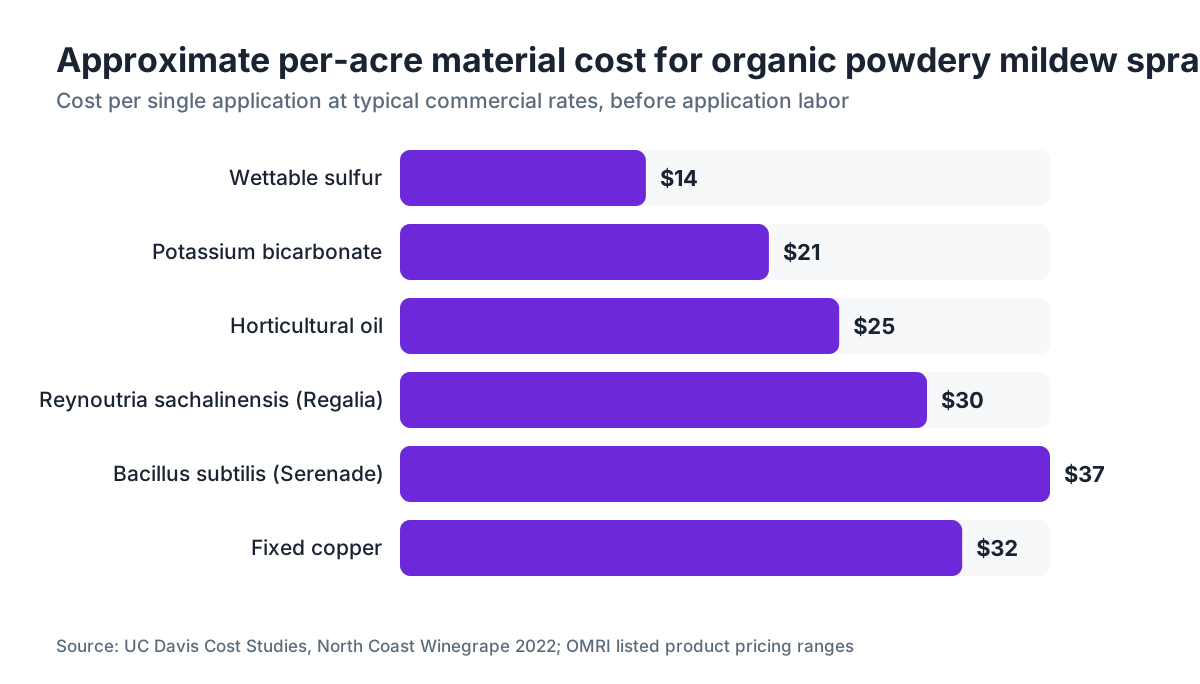
Costs swing with region, scale, and equipment, but university enterprise budgets give honest benchmarks. UC Davis publishes annual Winegrape Cost Studies by region. The 2022 North Coast study put total fungicide and spray material costs for an organic vineyard at roughly $300 to $600 per acre per season for a full powdery mildew program, depending on pressure and number of passes. A conventional sulfur-and-synthetic rotation ran $150 to $300 per acre. [7] The organic premium comes from more frequent applications and the higher per-acre cost of some approved materials.
Per-application material costs (rough ranges, prices vary by region and vendor):
| Material | Cost per acre per application |
|---|---|
| Wettable sulfur | $8 to $20 |
| Potassium bicarbonate | $12 to $30 |
| Narrow-range horticultural oil | $15 to $35 |
| Bacillus subtilis (Serenade) | $25 to $50 |
| Reynoutria sachalinensis (Regalia) | $20 to $40 |
| Copper (fixed) | $18 to $45 |
Add application costs (tractor time, labor, water) of $20 to $40 per acre per pass for most California and Pacific Northwest operations, and $30 to $60 in higher-labor-cost regions. A high-pressure season with 10 to 14 applications at $40 material plus $30 application per pass runs $700 to $1,000 per acre in total. That is the honest range for a Pacific Coast vineyard with serious disease pressure.
For small vineyards using hand spraying or ATV-mounted gear, material costs are similar but application costs can run lower. Sulfur's low price makes it the clear economic pick as the backbone material.
Frequently asked questions
Can I use regular baking soda (sodium bicarbonate) as an organic fungicide in my certified vineyard?
Sodium bicarbonate is NOP-permitted as a fungicide, but most certifiers discourage routine vineyard use because sodium accumulates in soil over time and degrades structure. Potassium bicarbonate (KHCO3) does the same job without the sodium problem and has better OMRI listed formulations. Use potassium bicarbonate instead. Cornell University extension specifically advises against routine sodium bicarbonate use in vineyards.
How soon before harvest can I apply sulfur in an organic vineyard?
Most wettable sulfur labels carry a zero pre-harvest interval, so you can apply up to the day of harvest. But excess sulfur residue on fruit can cause off-flavors in wine, especially hydrogen sulfide (H2S) during fermentation. Most winemakers prefer no sulfur applications within 30 to 60 days of harvest on fruit destined for wine. Verify the PHI on your specific product label.
What temperature is too hot to spray sulfur on grapevines?
Elemental sulfur becomes phytotoxic above 90 to 95 degrees Fahrenheit, depending on variety and formulation. Thin-skinned varieties like Pinot Gris or Concord can burn at 85 degrees. Apply sulfur in early morning when temperatures are below 85 degrees and rising. If the forecast high tops 95 degrees, skip the sulfur and use potassium bicarbonate or a biological instead.
Can I tank-mix sulfur and potassium bicarbonate together?
No. The alkaline pH of bicarbonate degrades sulfur and the combination can burn tissue. Apply them on separate passes, at least 24 to 48 hours apart. This is one of the more common mistakes in organic mildew programs. Rotate them on alternating applications rather than combining them in one tank.
Does Serenade (Bacillus subtilis) actually work on grape powdery mildew?
Yes, with caveats. Cornell trials found Serenade at 7-day intervals cut powdery mildew severity by 40 to 60 percent in moderate-pressure seasons, dropping to 20 to 35 percent in high pressure. It works best as a rotation partner with sulfur, not as a standalone primary material. Apply preventively. It does little on a heavily infected canopy, and it earns its keep during heat events when sulfur phytotoxicity risk is high.
Is JMS Stylet-Oil OMRI listed for use in certified organic vineyards?
JMS Stylet-Oil is OMRI listed and EPA registered for certified organic production. It is a highly refined paraffinic mineral oil. At 1 to 2 percent it provides good contact activity against powdery mildew conidia. Do not apply it within two weeks of a sulfur application. Check the current OMRI database at omri.org to confirm listing status before purchase, since registrations change.
How does the Gubler-Thomas Powdery Mildew Risk Index help organic spray timing?
The Gubler-Thomas risk index, developed at UC Davis, uses overnight minimum temperatures to predict whether conditions favor powdery mildew. Three straight nights above 50 degrees Fahrenheit during the susceptible period signals high risk and triggers a 7-day interval. The model is free through UC IPM online. It is one of the most practical timing tools available and works for organic and conventional programs alike.
Does Regalia (Reynoutria sachalinensis) need to be applied before infection to work?
Yes. Regalia induces systemic acquired resistance in the plant, priming its natural defenses. It has no direct contact fungicidal activity on established mildew colonies. Apply it preventively, starting at early shoot growth and continuing on a 7 to 10 day interval. Spraying Regalia on a vineyard already showing significant symptoms accomplishes little. It works as a rotation partner in a preventive program.
Do organic spray materials for powdery mildew require EPA Worker Protection Standard compliance?
Yes. The EPA Worker Protection Standard under 40 CFR Part 170 applies to all agricultural pesticides, OMRI listed materials included. You must post re-entry intervals, provide the required PPE, and deliver annual pesticide safety training. REIs for common organic materials run from 4 hours (bicarbonate, biologicals) to 24 hours (most sulfur formulations). Verify the REI on each product label, not the active ingredient category.
How do I know if an adjuvant or spreader-sticker is approved for use with organic spray materials?
Adjuvants must be NOP-compliant, even more so than your primary fungicide. Petroleum-based spreader-stickers or synthetic surfactants that are not on the National List can put your certification at risk even when the primary material is OMRI listed. Use OMRI listed adjuvants (several silica-based and plant-oil-based options exist) or ask your certifier for their approved list. When in doubt, use no adjuvant rather than a non-approved one.
What varieties of grapes are most susceptible to powdery mildew and need the most aggressive organic program?
Highly susceptible vinifera varieties include Chardonnay, Cabernet Franc, Pinot Noir, Zinfandel, and Merlot. These need tight 7-day intervals from flag shoot through bunch closure in high-pressure regions. Syrah, Grenache, and Petite Sirah are moderately susceptible. Many French-American hybrids like Marquette and La Crescent carry partial resistance and may tolerate 10 to 14 day intervals in moderate conditions. Know your variety's rating before setting your interval.
How do I record organic spray applications to satisfy my certifier at audit time?
Your certifier needs records showing application date, product name and EPA registration number, rate applied, block identifier, and applicator name. Records must be kept at least five years under USDA NOP requirements at 7 CFR 205.103. Paper spray logs work but invite transcription errors and are slow to audit. Digital spray logging tied to your organic system plan is faster and produces the summary reports certifiers ask for.
Can I use copper fungicide primarily for powdery mildew control in my organic vineyard?
Copper is a weak powdery mildew material next to sulfur or bicarbonate and is better suited to downy mildew. Using it primarily for powdery mildew wastes your annual copper budget, since NOP guidance caps metallic copper at roughly 3.2 pounds per acre per year. Reserve copper for mixed-disease situations where powdery and downy mildew need control at the same time, and keep sulfur as your primary powdery mildew material.
Does canopy management actually reduce powdery mildew enough to reduce spray applications?
Yes, meaningfully. WSU research shows open canopies with good air circulation stretch the effective spray interval by 2 to 3 days in moderate-pressure conditions. Shoot thinning, cluster-zone leaf removal, and hedging drop humidity and improve spray penetration. In a dense, unmanaged canopy, even tight intervals will not deliver adequate coverage. Canopy management does not replace spraying, but it makes every application work harder.
Sources
- UC IPM, University of California, Grape Powdery Mildew Risk Index and Management Guidelines: Sulfur established as primary preventive tool for organic powdery mildew programs; Gubler-Thomas Risk Index timing guidance; narrow-range oil rotation efficacy data
- Cornell University, New York and Pennsylvania Pest Management Guidelines for Grapes: 7-day sulfur interval during bloom; Bacillus subtilis efficacy range of 40-60% in moderate seasons; sodium bicarbonate soil sodium concerns; potassium bicarbonate rotation guidance
- USDA National Organic Program, 7 CFR Part 205: NOP National List of Allowed and Prohibited Substances; copper limits of 8 lb metallic copper per hectare per year; materials must comply with 7 CFR 205.601
- Organic Materials Review Institute (OMRI), OMRI Products List: OMRI listing is product-specific, not ingredient-specific; database for verifying certified organic product status
- Washington State University Extension, Organic Viticulture and Powdery Mildew Management: Potassium bicarbonate at 2.5-5 lb/acre gave control comparable to conventional fungicides in moderate-pressure years; canopy management extends effective spray interval by 2-3 days
- EPA, Worker Protection Standard, 40 CFR Part 170: WPS applies to all agricultural pesticides including OMRI listed materials; amended 2015, effective January 2, 2017; annual training and REI posting requirements
- UC Davis Agricultural and Resource Economics, Winegrape Cost Studies, North Coast 2022: Organic vineyard fungicide and spray material costs estimated at $300-$600 per acre per season for full powdery mildew program; conventional program $150-$300 per acre
- UC Davis, Gubler et al., Powdery Mildew Risk Index for Grapes, Plant Disease journal, 1999: Primary publication establishing the Gubler-Thomas Powdery Mildew Risk Index based on degree-day modeling of overnight temperatures for spray timing
- USDA NOP, 7 CFR 205.103, Recordkeeping Requirements: Certified organic operations must keep records documenting compliance for at least five years
- UC IPM, Grapes: Powdery Mildew (Erysiphe necator), Pest Management Guidelines: E. necator overwinters as chasmothecia and mycelium in dormant buds; primary infections occur at or after 50 percent budbreak between 50 and 86 degrees Fahrenheit; disease cycles every 5-7 days
Last updated 2026-07-09