NOP compliant spray materials approved for certified organic grape growing

TL;DR
- Under the USDA National Organic Program, vineyard sprays must come from the allowed and restricted substances list in 7 CFR Part 205.
- Copper, sulfur, mineral oils, kaolin clay, and certain biological fungicides and insecticides are commonly approved.
- Synthetic pesticides, most adjuvants, and materials not reviewed by your certifier are prohibited.
- Every application must be documented and available for inspection.
What does the NOP actually say about spray materials in vineyards?
The core rule is in 7 CFR Part 205, Subpart G, the National List of Allowed and Prohibited Substances. The regulation sorts materials into three buckets: allowed synthetics (a short list), prohibited naturals (a shorter one), and everything else that must pass a criteria test before your certifier approves it. The default is that synthetic substances are prohibited and non-synthetic substances are allowed, unless the National List says otherwise. [1]
Here is the practical effect for a vineyard manager. You cannot grab an OMRI-Listed product off the shelf and spray it the same afternoon. You need your certifier's sign-off before using any new material, and you need to document every application with the product name, rate, target pest, and date. That paperwork is what an audit actually reviews.
The National Organic Program's guidance document on crop inputs (NOP 5033) spells out the review criteria for synthetic materials: they must not harm human health or the environment, must be consistent with organic farming, and there must be no available natural alternative. Your certifier applies those criteria, not you. [1]
The statute language in 7 CFR 205.601 lists allowed synthetic substances for crop production. The section specifically states that "copper-based materials" and "elemental sulfur" are allowed when used "in a manner that minimizes accumulation of copper in the soil." That phrasing matters because copper accumulation has become a real compliance issue in wine regions with long organic histories. [1]
Which fungicides are allowed for organic vineyard disease control?
Fungal disease is the biggest spray challenge in organic vineyards, especially powdery mildew (Erysiphe necator) and downy mildew (Plasmopara viticola). Several effective materials sit on the National List, so the toolbox is real.
Sulfur is the backbone of organic fungicide programs everywhere grapes are grown. Wettable sulfur, dust formulations, and sulfur in combination products are all NOP-compliant provided the specific formulation has been reviewed. Cornell's viticulture extension recommends a 7 to 10-day sulfur program from pre-bloom through veraison for powdery mildew in humid climates. [2] Sulfur carries phytotoxicity risk above roughly 90°F (32°C), so spray timing matters.
Copper products (copper hydroxide, copper sulfate, Bordeaux mixture, copper octanoate) are allowed under 7 CFR 205.601 but carry the "minimizes accumulation" requirement. The EU has capped copper use at 28 kg per hectare over 7 years (about 4 kg/ha/year), and while the USDA NOP has no equivalent numeric cap in federal regulation, many certifiers have started asking growers to track cumulative copper loads. Some California certifiers now require a soil copper baseline at certification. [1][3]
Potassium bicarbonate (sold under brand names like Kaligreen and MilStop) is allowed as a non-synthetic material and works reasonably well against powdery mildew at 2.5 to 5 lb per 100 gallons. UC Davis Cooperative Extension considers it a useful rotational partner with sulfur. [3]
Biological fungicides based on Bacillus subtilis (Serenade, Rhapsody), Bacillus amyloliquefaciens (Double Nickel), Trichoderma species, and Reynoutria sachalinensis (Regalia) are OMRI-Listed and NOP-compliant. Their efficacy against downy mildew and botrytis in grapes is moderate at best, and in wet years they will not carry your program alone. Think of them as tools that fit between sulfur applications.
Fixed copper combined with lime (Bordeaux mixture) is the classic. It stays effective against downy mildew and gets heavy use in Europe and California. Mix it on-site and use it within a few hours for best results. The traditional 8-8-100 ratio (8 lb copper sulfate, 8 lb hydrated lime, 100 gallons water) can be diluted a lot without losing much efficacy in light disease pressure years.
For a side-by-side of the main organic fungicide options, see the table in the next section.
How do copper and sulfur compare to synthetic fungicide options for powdery mildew?
Here is where honest comparison earns its keep. Organic fungicides require more applications and tighter timing than the best synthetic options. That is not a knock on organics. It is the operating reality every grower should plan around.
| Material | Target disease | Mode of action | Typical interval | OMRI / NOP status |
|---|---|---|---|---|
| Wettable sulfur | Powdery mildew | Vapor-phase contact | 7-14 days | Allowed [1] |
| Copper hydroxide | Downy mildew | Multi-site contact | 7-14 days | Allowed [1] |
| Bordeaux mixture | Downy mildew, botrytis | Multi-site contact | 10-14 days | Allowed [1] |
| Potassium bicarbonate | Powdery mildew | Contact, disrupts cell membrane | 7 days | Allowed (non-synthetic) |
| Bacillus subtilis | Powdery mildew, botrytis | Competitive exclusion | 5-7 days | OMRI Listed |
| Regalia (Reynoutria extract) | Multiple | SAR inducer | 7 days | OMRI Listed |
| Synthetic DMI (e.g., tebuconazole) | Powdery mildew | Ergosterol inhibitor | 10-21 days | Prohibited |
| Synthetic QoI (e.g., azoxystrobin) | Downy mildew | Mitochondrial respiration | 14 days | Prohibited |
WSU's Pacific Northwest Pest Management Handbooks note that organic programs typically require 30 to 40 percent more spray passes than conventional programs in high-pressure years. [4] Budget for that in your labor and equipment planning.
One honest caveat: nobody has great data on organic versus conventional efficacy specifically for Vitis vinifera under varying climate scenarios. The closest controlled studies come from Swiss and German research stations and from UC Davis trial blocks. [3] Results swing hard by cultivar (hybrid varieties with natural disease resistance cut applications substantially) and by year.
What insecticides and miticides are NOP-compliant for grape pests?
Insect pressure in organic vineyards usually ranks below fungal disease, but leafhoppers, mealybugs, vine mealybug (Planococcus ficus), spider mites, and grape berry moth all need a management plan.
Kaolin clay (Surround WP) is allowed under 7 CFR 205.601 and creates a physical barrier that interferes with insect feeding and egg-laying. It works against leafhoppers and has shown promise against grape berry moth in eastern vineyards. [5] The main downside is a visible white residue on fruit that needs cleaning before harvest.
Spinosad (Entrust SC) is a fermentation-derived material from Saccharopolyspora spinosa and sits on the National List as an allowed synthetic with restrictions: it is prohibited in aquatic insect management contexts but allowed for most vineyard pests. [1] For organic growers, Entrust SC is the go-to for grape berry moth and western flower thrips. Resistance management matters here. Rotate it with other modes of action.
Insecticidal soaps and narrow-range (horticultural) mineral oils are allowed for soft-bodied insects and mites. Oils earn their keep on mealybug egg mass and crawler management during dormancy.
Pyrethrin (from Pyganic) is allowed with the restriction that it must be combined with a synergist not derived from petroleum. Most commercial pyrethrin formulations use piperonyl butoxide as a synergist. That compound is a synthetic and is allowed on the National List for this purpose. [1] Pyrethrin breaks down quickly in sunlight, which limits residue risk but also limits residual control.
Neem-based materials (azadirachtin, clarified hydrophobic extract of neem oil) are OMRI-Listed. Azadirachtin (Aza-Direct, Neemix) works as an insect growth regulator and feeding deterrent. Straight neem oil is allowed for insect and disease management, but check your certifier's specific stance on any formulation with emulsifiers.
For spider mites specifically, the biological predatory mite Galendromus occidentalis (western predatory mite) is an inoculative biological control strategy rather than a spray, but it is worth knowing as part of an integrated organic approach. UC Davis IPM guidelines cover release timing and rates. [3]
Are OMRI-Listed products automatically approved under the NOP?
No. This is one of the most common mistakes organic growers make.
OMRI (Organic Materials Review Institute) is a private, nonprofit organization that reviews products against NOP standards and publishes a list of materials it considers compliant. OMRI listing is useful shorthand, but it is not a federal approval. Your certifying agent makes the final call on every material you use. [6]
Some certifiers accept OMRI listing as sufficient documentation. Others require their own internal review. A few pile on extra restrictions beyond what OMRI covers, particularly around adjuvants, spreader-stickers, and tank-mix partners. If you buy a new product and it is OMRI-Listed but your certifier has not seen it before, call them before you spray. That call takes five minutes. A certification violation takes months to resolve.
The practical workflow is: (1) check OMRI, (2) get written approval from your certifier before first use, (3) keep that approval letter in your records. If you use a farm management platform like VitiScribe to track spray records, you can attach that certifier approval document directly to the product entry so it is available during an audit without scrambling.
EPA registration is also required for any pesticide, organic or not, used in a commercial vineyard. OMRI listing does not substitute for an EPA registration number on the label. [7]
What are the record-keeping requirements for organic vineyard sprays?
Under 7 CFR 205.103, certified organic operations must keep records for five years beyond their creation. [1] For spray records, that means the product name and EPA registration number, the application date, the rate and volume applied, the target pest or disease, the field or block identifier, and who made the application.
Your certifier will review these records at every annual inspection and may request them at any time. Gaps in spray records, or records that do not match what you report on your Organic System Plan update, are the most common reason growers receive compliance notices.
There is no single federally-mandated format for the records. What matters is completeness and accessibility. Many growers use paper field journals and transcribe to a spreadsheet. Others use purpose-built vineyard record platforms. Either works as long as the data is there and legible.
One thing that catches people: the records must include any material applied, more than pesticides alone. If you applied a foliar nutrient that contains copper as a minor element, that goes in the spray log too. Certifiers are watching cumulative copper loads now, and the only way to prove compliance is a complete record.
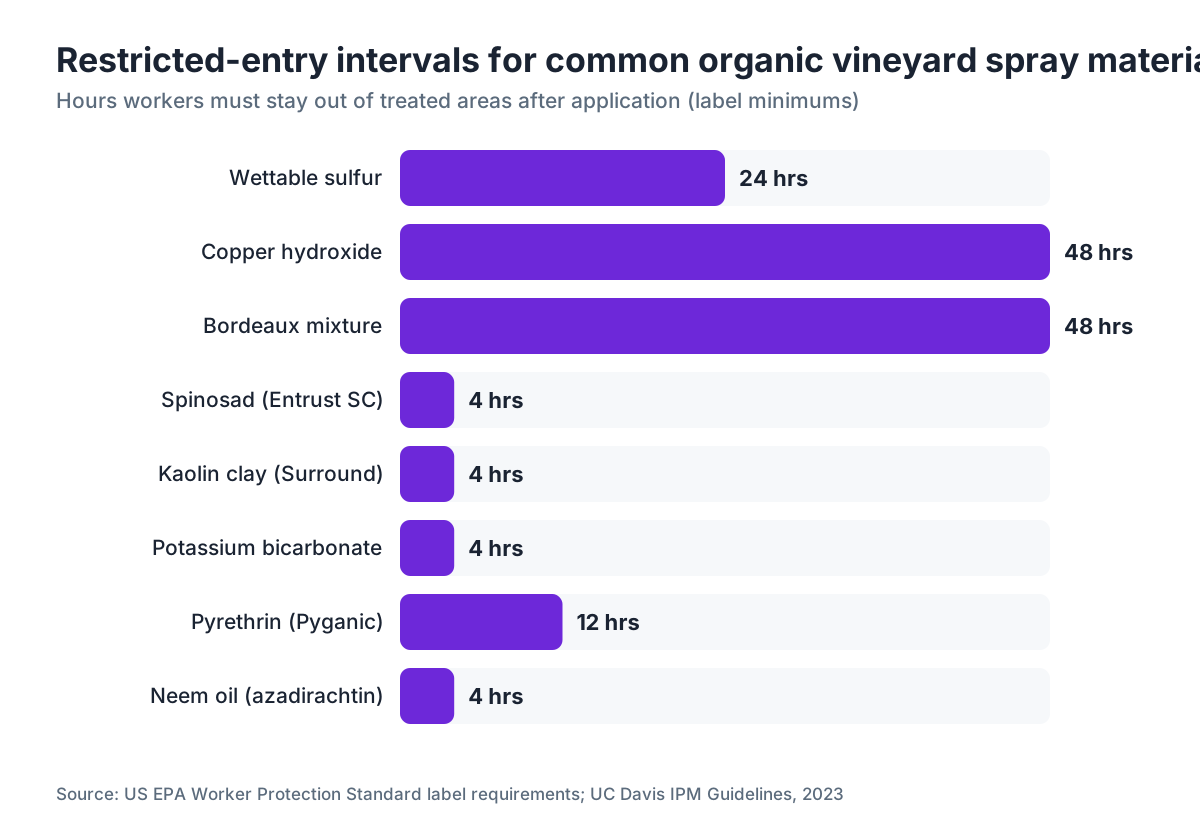
The EPA Worker Protection Standard (WPS), revised in 2015, adds a parallel set of requirements: application records must include the pesticide product name, EPA registration number, active ingredient(s), application date, location description, and the restricted-entry interval (REI). Most organic vineyard materials have short REIs (sulfur is typically 24 hours, copper products range from 24 to 48 hours), but the WPS log must still be kept for 2 years and posted at the central display location. [7]
How do I handle adjuvants, spreader-stickers, and tank-mix partners under the NOP?
Adjuvants are where organic growers run into trouble most often. The NOP has no single approved list for adjuvants. Instead, 7 CFR 205.601 allows a few specific synthetic adjuvants (such as aqueous potassium silicate) and otherwise requires that adjuvants be non-synthetic or specifically listed. [1]
The practical problem is that most commercial spreader-stickers and sticking agents contain petroleum-derived compounds that are prohibited synthetics. Read the full ingredient list, more than the active ingredient on the label. If an adjuvant contains polyethylene glycol, petroleum distillates, or most synthetic polymers, it is probably prohibited.
OMRI keeps a separate listing category for adjuvants and tank-mix partners. Silicone-based spreaders are generally prohibited. Yucca extract-based surfactants (such as AG-MOS) are OMRI-Listed and widely used. Refined plant oils used as surfactants may be acceptable depending on formulation.
The honest answer is that adjuvant compliance is genuinely murky. The certifier I would trust most on this question is one who has reviewed your specific tank-mix combination in writing. Ask that question before the spray season, not during it.
What materials are prohibited even though they seem natural or low-risk?
The prohibited naturals list in 7 CFR 205.602 includes strychnine, arsenic, lead salts, and tobacco dust. None of those are likely temptations in a modern vineyard program. The real landmines are different.
Rotenone sat on the allowed list for years and came off in 2017. It is now prohibited. Old stock in your barn is a compliance issue.
Copper sulfate as a soil treatment (for drainage tile cleaning and similar uses) is different from copper sulfate as a foliar fungicide. How you apply it and what you put in your records matters.
Bordeaux mixture made with synthetic lime is a gray area. Use natural limestone-derived hydrated lime, not industrial-grade calcium hydroxide with synthetic additives.
Chlorine bleach (sodium hypochlorite) is allowed for equipment sanitizing at 200 ppm or below without post-application rinsing, or at any rate if rinsed. [1] But if you add it to a tank mix for disease suppression, your certifier will want documentation.
Compost teas and fermented plant extracts applied as pest deterrents are generally allowed as non-synthetic, but some certifiers want to review the specific preparation method. If you're brewing a compost tea with added nutrients, those nutrients need to be NOP-compliant too.
WSU Extension's organic crop production guides have a good walkthrough of common misconceptions about "natural" materials and organic compliance. [4]
How does the transition period affect what sprays I can use?
The NOP requires a 36-month transition period before land can be certified organic. [1] During that window, you must follow organic practices, including using only NOP-compliant spray materials, even though you are not yet certified and cannot market your grapes as organic.
This matters for spray records because your certifier will ask for three years of records at initial certification. If you applied a prohibited synthetic during month 18 of your transition because "the certification was still years away anyway," that blocks your certification until 36 months have passed since that application.
Some growers transition their vineyards in blocks rather than all at once. That is allowed, but you need clear block-level spray records to demonstrate which acres have completed the 36-month period. A spray log that does not identify specific blocks will not satisfy a certifier reviewing a partial-vineyard certification.
For a broader look at what vineyard operations look like once you're certified, the vineyard resource section covers field operation fundamentals that apply across conventional and organic systems.
What does a compliant organic spray program actually look like week by week?
A real organic vineyard spray program is not fundamentally different in structure from a conventional IPM program. It differs in material choices and application frequency. Here is a representative schedule for a mildew-susceptible vinifera variety in a warm, semi-arid region (think central California or the Paso Robles wineries area), where powdery mildew is the primary threat and downy mildew pressure is lower:
Dormant season: Narrow-range mineral oil at bud swell for scale and mealybug egg masses. One copper application after pruning wounds are visible.
Pre-bloom (2-5 inch shoot): Sulfur starts. 7-day intervals. Potassium bicarbonate alternated with sulfur if temperatures trend above 85°F.
Bloom through fruit set: The most critical window. Sulfur every 7 days, skip within 2-3 days of bloom opening to protect bees and avoid phytotoxicity. Kaolin clay application if leafhopper pressure is building.
Post-fruit set through veraison: Continue sulfur program. Add Bacillus subtilis or Regalia in rotation if botrytis risk increases. Spinosad (Entrust) if grape berry moth or thrips threshold is reached.
Post-veraison through harvest: Reduce sulfur frequency as berry expansion slows but hold coverage for late-season mildew. Last sulfur application typically no closer than 14-21 days before harvest to manage residues (check your label and buyer requirements).
Post-harvest: One copper application for downy mildew and bacterial canker prevention if fall moisture is likely.
This is a skeleton, not a prescription. Disease models like UC IPM's Powdery Mildew Index and the UC Davis Grape Powdery Mildew Risk Index give much better timing guidance than a calendar alone. [3] Your actual materials, rates, and intervals need to be in your Organic System Plan and reviewed by your certifier.
How do I find and verify which specific products are approved before I buy them?
Start with three resources: the OMRI Products List (omri.org), your state's department of agriculture organic program resources, and your specific certifying agent's materials list.
OMRI's online search tool lets you filter by crop type, pest target, and material type. It is free and updated regularly. [6] Washington State University's WSU Extension publishes a Pacific Northwest Organic Crop Production guide with a materials table that cross-references OMRI status and NOP compliance. [4]
For EPA registration lookups, the National Pesticide Information Retrieval System (NPIRS) at Purdue University lets you search by active ingredient or product name and confirm that an EPA registration number is current. [8]
Cornell's New York State IPM Program publishes organic grape production guides with materials tables that carry both efficacy ratings and compliance status. [2] These earn their keep for eastern growers dealing with both powdery and downy mildew pressure.
Once you have a product candidate, email your certifier the product name, EPA registration number, and OMRI listing (if applicable) before purchase. Most certifiers respond within a few business days. Keep their written response. When you're running multiple blocks across a season with varying disease programs, a spray records platform like VitiScribe lets you flag each product as certifier-approved and attach that documentation so it never goes missing before an inspection.
One thing worth knowing: the USDA's Agricultural Marketing Service (AMS) maintains a National Organic Program page at ams.usda.gov with the current version of 7 CFR 205 and guidance documents. Check it once a year because the National List does get amended, and a material that was allowed last season can be restricted or removed. [9]
Frequently asked questions
Can I use copper sulfate in my organic vineyard without a copper limit?
The USDA NOP allows copper under 7 CFR 205.601 but requires that use "minimizes accumulation of copper in the soil." There is no federal numeric cap, but many certifiers now require soil copper monitoring and may restrict use if levels are elevated. The EU caps copper at 28 kg/ha over 7 years. Track your cumulative applications from day one.
Is spinosad allowed in certified organic vineyards?
Yes. Spinosad is on the NOP National List as an allowed synthetic substance under 7 CFR 205.601. The commercial formulation Entrust SC is OMRI-Listed. It is particularly effective against grape berry moth and thrips. Rotate it with other modes of action to slow resistance development. Confirm with your certifier before first use.
Does OMRI listing mean a product is approved by the USDA?
No. OMRI is a private nonprofit that reviews products against NOP standards, but listing is not a federal approval. Your certifying agent makes the final determination. Many certifiers accept OMRI listing as adequate documentation; others require their own review. Never use a new product in a certified field without written approval from your certifier first.
How many years of spray records do I need to keep for NOP certification?
Five years, per 7 CFR 205.103. Your certifier will review spray records at every annual inspection and can request them at any time. Records must include product name, EPA registration number, application date, rate, target pest, and the block or field location. The EPA Worker Protection Standard independently requires application records for two years.
What is the transition period for converting a vineyard to certified organic?
36 months from the last application of a prohibited substance, per 7 CFR 205.202. During transition you must follow organic practices and use only NOP-compliant materials, but you cannot market grapes as organic until certification is granted. Your certifier will review three years of records at initial certification, so start keeping compliant records immediately.
Can I use neem oil in my organic vineyard?
Generally yes. Azadirachtin and clarified hydrophobic neem oil extracts are OMRI-Listed and NOP-compliant. Straight cold-pressed neem oil is allowed as a non-synthetic material. Check that any emulsifiers or surfactants in the formulation are also NOP-compliant. Confirm with your certifier, particularly for any blended formulation with added ingredients.
Is kaolin clay (Surround WP) approved for organic grape growing?
Yes. Kaolin clay is explicitly listed in 7 CFR 205.601 as an allowed synthetic substance for insect management. Surround WP is OMRI-Listed. It works against leafhoppers and grape berry moth. The main drawback is visible white residue on fruit at harvest, which may require washing before delivery to the winery.
What happens if I accidentally use a prohibited material in my certified organic vineyard?
You must report it to your certifier immediately. Depending on the substance and circumstances, the certifier may require a new 36-month transition period for the affected field, suspend certification for those blocks, or in cases of willful violation, suspend your full certification. Accidental contamination from a neighbor's application is treated differently from intentional use; document everything and contact your certifier in writing.
Are biological fungicides like Serenade effective enough to replace sulfur in organic vineyards?
Not as a standalone program for powdery mildew-susceptible vinifera varieties. Bacillus subtilis products like Serenade provide moderate suppression and work best as rotational partners with sulfur, not replacements for it. In high-pressure years in humid climates, relying on biologicals alone typically results in unacceptable disease levels. Cornell's extension program recommends using them to stretch sulfur intervals, not eliminate them.
Can I use potassium bicarbonate instead of sulfur for powdery mildew?
Potassium bicarbonate is NOP-compliant and provides meaningful control of powdery mildew, particularly as a curative treatment for early infections. At 2.5 to 5 lb per 100 gallons, it works well as an alternate-spray partner with sulfur, especially during heat events when sulfur phytotoxicity risk increases above 90°F. It does not replace a full sulfur program but usefully extends it.
What adjuvants and spreader-stickers are allowed in organic vineyards?
Most petroleum-derived synthetic adjuvants are prohibited. Yucca extract-based surfactants, plant oil-based spreaders, and aqueous potassium silicate are generally NOP-compliant. OMRI maintains a separate adjuvant listing category. Always check the full ingredient list, more than the active ingredient, and get certifier approval before adding any adjuvant to a tank mix.
How close to harvest can I apply sulfur in an organic vineyard?
The label is the legal minimum, but sulfur residue and off-flavors in wine are a real concern. Many winemakers and buyers request no sulfur applications within 14 to 21 days of harvest. Some certified producers extend that to 30 days for premium fruit. Check your label REI first, then have that conversation with your winery buyer well before harvest. Your certifier does not set this limit; it is a commercial and quality decision.
Does the EPA Worker Protection Standard apply to organic vineyard spray applications?
Yes. The WPS applies to all pesticide applications in agricultural settings regardless of organic certification status. The 2015 revised WPS requires central posting of application records including product name, EPA number, active ingredients, application date, location, and restricted-entry interval. Records must be kept for two years. Most organic vineyard materials have REIs of 4 to 48 hours. Details at epa.gov/pesticide-worker-safety.
Where can I find a current list of approved organic spray materials for grapes?
Start with OMRI's products list at omri.org, filtered by crop. Cross-reference with 7 CFR 205.601 (the NOP National List) at ecfr.gov. Cornell's New York State IPM program and UC Davis Cooperative Extension both publish grape-specific organic materials tables updated annually. Your certifying agent's approved materials list supersedes all of these for your specific operation.
Sources
- USDA Electronic Code of Federal Regulations, 7 CFR Part 205 National Organic Program: National List of Allowed and Prohibited Substances including copper, sulfur, spinosad, kaolin clay; 5-year record-keeping requirement; 36-month transition period; criteria for synthetic material review
- Cornell University Cooperative Extension, New York State IPM Program, Organic Grape Production: 7 to 10-day sulfur program recommendation for powdery mildew in humid climates; organic materials efficacy ratings for eastern viticulture
- UC Davis Cooperative Extension, UC IPM Grape Pest Management Guidelines: Potassium bicarbonate as rotational partner with sulfur; UC IPM Powdery Mildew Risk Index; predatory mite biological control recommendations; organic vs conventional efficacy data from California trial blocks
- Washington State University Extension, Pacific Northwest Pest Management Handbooks: Organic programs require 30 to 40 percent more spray passes than conventional programs in high-pressure years; common misconceptions about natural materials and organic compliance
- USDA Agricultural Research Service, Kaolin Clay for Insect Management in Vineyards: Kaolin clay (Surround WP) effectiveness against leafhoppers and grape berry moth; physical barrier mode of action
- Organic Materials Review Institute (OMRI), OMRI Products List: OMRI listing process and status as private nonprofit review, not federal approval; adjuvant listing category; searchable product database
- US EPA, Revised Worker Protection Standard for Agricultural Pesticides: 2015 WPS requirements for application records including product name, EPA number, REI; records must be kept 2 years and posted at central display location; applies regardless of organic certification
- Purdue University, National Pesticide Information Retrieval System (NPIRS): EPA registration number lookup for pesticide products including organic materials
- USDA Agricultural Marketing Service, National Organic Program: Current NOP regulations, guidance documents including NOP 5033 on crop inputs, and National List amendment history
- USDA AMS, NOP Guidance Document 5033: Crop and Wild Crop Production: Review criteria for synthetic materials: must not harm human health or environment, must be consistent with organic farming, no available natural alternative
Last updated 2026-07-09