Grape powdery mildew spray programs for large production vineyards
TL;DR
- Powdery mildew (Erysiphe necator) is the top fungal threat in commercial vineyards.
- Large operations need a calendar-timed rotation of DMI, QoI, and SDHI fungicides starting at bud swell, on 7 to 14 day intervals through bloom, stretching to 14 to 21 days post-veraison.
- Skipping the early window costs more in catch-up sprays than a full season program.
- Resistance management and EPA Worker Protection Standard records are non-negotiable at scale.
Why does powdery mildew hit large vineyards harder than small ones?
Scale amplifies every mistake. A small grower who misses a spray window loses a few rows. A 500-acre operation that gets caught flat-footed during bloom can write off 30 to 80% of a block's crop in a single infection period, because Erysiphe necator spreads exponentially once colonies establish on young tissue [1].
The biology is worth understanding. Unlike most fungi, E. necator doesn't need free water to germinate. It thrives in warm, dry weather with moderate humidity, exactly the conditions that look safe to a crop scout trained to worry about Botrytis. Spores release above 50 F (10 C), germinate best between 68 and 77 F (20 to 25 C), and can complete a full infection cycle in 5 to 7 days under favorable conditions [1]. A large vineyard spanning multiple microclimates or elevations may have blocks cycling through peak-risk conditions at different times, which means a single-date spray decision almost never protects the whole property.
The other pressure unique to large operations is logistics. When you're managing 10 spray rigs, a contract crew, and multiple blocks of different varieties at different growth stages, the program has to be systematic enough that no block slips. That's where most commercial losses actually happen. Not from a wrong fungicide choice, but from a timing gap caused by equipment downtime, a closed weather window, or sloppy record-keeping.
When should you start spraying for powdery mildew?
Start at bud swell (BBCH 05-07), before you can see any disease. That's the guidance from UC Davis and most extension programs, and it's not negotiable in a commercial block [1][2]. It feels wasteful in a year that looks clean. It isn't. Powdery mildew overwinters as cleistothecia in bark crevices and as mycelium in dormant buds, so the inoculum is already in your vineyard. Primary ascospore release begins when cumulative heat units after January 1 reach roughly 150 to 200 degree-days (base 50 F) [2]. That timing often lines up with early shoot growth, which is exactly when you need protection in place.
For large operations, "start at bud swell" carries a practical wrinkle: you can't spray 1,000 acres in a day. Most commercial programs prioritize blocks in this order. High-risk varieties first (Chardonnay, Cabernet Franc, Gewurztraminer), then blocks with a history of early infection, then low-susceptibility varieties like Cabernet Sauvignon and Merlot. Write that priority list down. Don't keep it in the vineyard manager's head.
The stretch from 2 to 4 inches of shoot growth through two weeks post-bloom is the protection window that matters most. Cornell's IPM program describes the pre-bloom to two-weeks-post-bloom period as the time when berries are most susceptible to infection [3]. Letting an interval drift to 18 or 20 days here in a warm year is where large-operation losses happen.
After berry set, risk drops off. Berries become resistant to infection once they hit roughly 8 Brix, about 3 to 4 weeks after bloom [1]. You're still protecting leaves and rachises, and late-season leaf infections load up next year's inoculum, but the urgency eases.
Which fungicide classes work, and how do you rotate them to prevent resistance?
Five main fungicide classes are used commercially against grape powdery mildew in the U.S., and resistance has already compromised two of them across large regions [4].
| FRAC Group | Chemistry | Common Active Ingredients | Resistance Risk |
|---|---|---|---|
| 3 (DMI) | Sterol inhibitors | Myclobutanil, tebuconazole | Moderate; documented resistance in CA and OR [4] |
| 11 (QoI) | Strobilurins | Azoxystrobin, trifloxystrobin | High; widespread resistance in many U.S. wine regions [4] |
| 7 (SDHI) | Succinate dehydrogenase inhibitors | Fluopyram, fluxapyroxad | Moderate and increasing |
| U8 | Quinoxyfen | Quinoxyfen | Low to moderate |
| M (multi-site) | Sulfur, copper, oils | Elemental sulfur, neem oil | Very low; non-specific mode of action |
Elemental sulfur is still the backbone of most large-operation programs. It's cheap (roughly $1.50 to $4.00 per acre per application depending on formulation and rate), carries essentially zero resistance risk, and is OMRI-listed for organic programs [9]. The catch: sulfur volatilizes above 90 to 95 F and can burn foliage, especially on sensitive varieties like Concord, Riesling, and some Pinot Noir clones. Check the label and your variety list before scheduling sulfur on a hot forecast day.
For a conventional large-operation rotation, WSU Extension's grape guidance is to open with a protectant (sulfur or oil) at bud swell, then rotate DMI, SDHI, and QoI chemistry through the bloom window, never applying the same FRAC group in two consecutive sprays [10]. This isn't just good hygiene. It's what keeps you from losing an entire chemistry class in your region. The QoI strobilurins are already compromised across California's North Coast and parts of Oregon, and growers who leaned hard on azoxystrobin in the mid-2000s paid for it [4].
A workable 8-spray rotation for a large conventional program: sulfur, DMI, sulfur, SDHI, sulfur, QoI, sulfur, DMI. That keeps a multi-site material in every other slot as a resistance buffer. Post-veraison, dropping back to sulfur or potassium bicarbonate is usually enough and saves the premium chemistries for when berry infection risk is actually high.
What spray intervals and rates work at commercial scale?
Intervals track weather, not the calendar. The general commercial standard runs 7 to 10 days from pre-bloom through two weeks post-bloom in warm weather (above 70 F, humidity cycling), 10 to 14 days in cooler conditions, and 14 to 21 days post-veraison [1][2]. Large operations pushing 10,000-plus gallons of spray volume per day need weather-triggered flexibility built into the plan, not rigid calendar dates locked in during the winter.
Rate matters as much as timing. Sulfur applied below 3 lbs per acre gives weak suppression and may select for tolerant populations faster than a full rate would. Most wettable sulfur labels call for 3 to 6 lbs per acre per application. For systemics like myclobutanil or fluopyram, follow label rates exactly. Cutting rates is both ineffective and a fast track to resistance.
Canopy penetration is the big challenge at scale. An airblast sprayer calibrated for a 12-foot canopy at 50 to 60 gallons per acre can leave the interior of a dense, vigorous canopy undertreated. WSU research found that canopy density strongly affects fungicide deposition, and blocks with heavy shoot density benefit from pre-spray shoot thinning as much as from fungicide selection [10]. If your program looks solid on paper but you're still finding interior cluster infections, look at the canopy before you blame the chemistry.
For operations using contract spray services, your contract needs to specify the details: application timing windows (more than dates), water volume per acre, spray pressure for your canopy type, and documentation requirements. A contract that says "apply fungicide" and nothing else leaves you exposed both legally and agronomically.
How do weather-based disease models improve a large operation's spray timing?
Disease forecasting models have been around since the 1980s, and for large operations they earn their keep. The UC Davis Powdery Mildew Risk Index, developed by Doug Gubler, scores daily risk based on temperature during the infection period [2]. The logic is simple. Consecutive hours above 70 F with no rain suppress mildew, while temperatures between 70 and 85 F with moderate humidity accelerate it. The model builds a risk score, and UC farm advisors recommend intervals based on accumulated risk instead of fixed calendar dates.
WSU's Decision Aid System (DAS) does the same job for Pacific Northwest growers, folding in temperature, humidity, and variety susceptibility to recommend timing [10]. The practical payoff for a large operation: on a 10-day cool, dry stretch you can safely stretch intervals on lower-priority blocks and conserve resources, while a warm, humid week tightens intervals on the high-risk blocks. That kind of dynamic scheduling saves 1 to 2 sprays per season in years with dry early summers. At commercial acreage, that's real money.
Neither model replaces scouting. Models predict infection risk. They can't tell you what inoculum is actually present. Scout every week through the critical window, even in low-risk weather, because localized hotspots (old vines with heavy bark, poorly pruned blocks full of cane debris) hold infection pressure even when ambient conditions look benign.
What does a season-long spray program actually cost per acre?
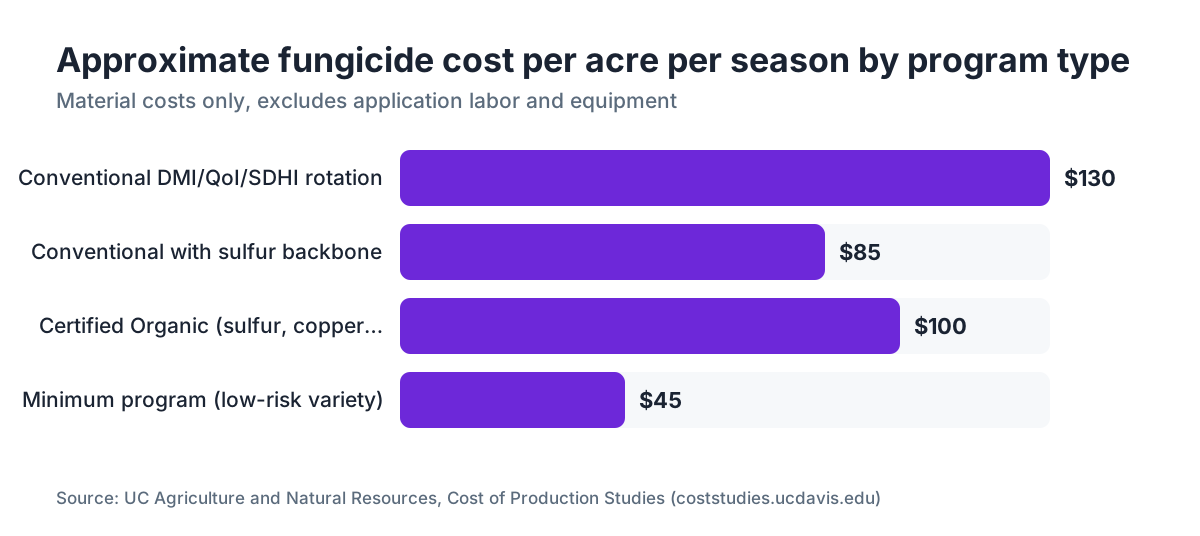
Honest cost figures are hard to pin down because they swing with region, labor market, fungicide prices, and application method. Based on UC Cooperative Extension cost-of-production studies, total fungicide and application costs for powdery mildew management in California wine grapes run roughly $150 to $350 per acre per season for a conventional program [6]. Organic programs built on sulfur and copper often run $100 to $200 per acre in materials, but more in labor, since intervals tend to be tighter and rain forces reapplication.
| Program Type | Approx. Material Cost/Acre | Sprays/Season | Notes |
|---|---|---|---|
| Conventional (DMI/QoI/SDHI rotation) | $80-$180 | 8-12 | Premium synthetics in critical window |
| Conventional with sulfur backbone | $50-$120 | 10-14 | Sulfur every other spray cuts cost |
| Certified Organic | $60-$140 | 10-16 | Sulfur, copper, OMRI oils; tighter intervals |
| Minimum program (low-risk variety, cool climate) | $30-$60 | 5-7 | High-risk years force emergency escalation |
These numbers exclude equipment, labor, and record-keeping time. For operations running their own rigs, add $8 to $18 per acre per application in equipment and operator costs. For contract spraying, rates vary widely, but $20 to $40 per acre per application is a fair expectation in most California and Pacific Northwest markets.
The most expensive program is a reactive one. Wait until you see disease, then try to suppress it. Eradicant DMI applications can knock back established colonies, but you're paying for extra sprays, often at higher rates, and the yield loss on infected clusters is already locked in. UC Cooperative Extension cost studies out of Napa Valley consistently show that preventive programs at $200 to $300 per acre recover more in crop value than they cost, even in low-pressure years [6].
What EPA Worker Protection Standard requirements apply to vineyard spray programs?
The EPA Worker Protection Standard (WPS), updated in 2015 and effective January 2017, applies to every agricultural pesticide application where workers may be exposed [7]. For large vineyards, that translates to several concrete requirements that turn up in compliance audits.
First, Restricted Entry Intervals (REIs) must be posted and enforced. Most fungicides in grape mildew programs carry REIs of 4 to 24 hours, and several SDHI and DMI materials sit at the 12 to 24 hour end. The REI is on the product label, and the label is the law. Workers can't enter treated areas until the REI expires, and you need a system to communicate that to every crew member, including Spanish-language communication for Spanish-speaking crews [7].
Second, larger operations must maintain a central pesticide safety information display with specific posted materials: the WPS safety information, emergency medical facility information, and application records. Most compliance failures in vineyards don't come from growers cutting corners. They come from records that weren't maintained consistently or weren't accessible to workers.
Third, Personal Protective Equipment (PPE) requirements vary by product. Sulfur usually calls for coveralls and eye protection. Many DMI and SDHI fungicides require chemical-resistant gloves, coveralls, protective eyewear, and a respirator during mixing and loading. The label lists the minimum PPE. Your operation has to provide it and document that workers were trained to use it.
EPA guidance is blunt on this point: "Handlers must wear the personal protective equipment the pesticide product labeling requires for the task being performed" [7]. That's not optional language. Agriculture departments in California, Washington, and Oregon all run WPS compliance audits, and large operations are higher-priority targets.
Keeping spray records that satisfy both WPS and state reporting by hand is where large operations pile up the most compliance risk. A vineyard operations platform like VitiScribe can generate WPS-compliant application records straight from your spray log entries, which is genuinely useful when you're running 50-plus spray events per season.
How do you handle fungicide resistance when it's already showing up in your vineyard?
If you're seeing mildew colonies despite timely applications of a specific chemistry, resistance is the first hypothesis to test. The diagnostic step is simple. Switch to a different FRAC group, with a known-effective multi-site material like sulfur as the backbone, and watch whether colony expansion stops. If sulfur plus a different systemic shuts down the outbreak, you have a resistance problem with the original chemistry, not a timing or coverage problem.
Once you've confirmed it, the fix is direct: retire that FRAC group from your program for at least 2 to 3 seasons. Some growers try to reduce rates and "stretch" a compromised chemistry. That accelerates selection. Pull it out, substitute FRAC groups still effective in your region, and lean harder on multi-site materials.
The Fungicide Resistance Action Committee (FRAC) maintains current resistance risk ratings by chemistry class and crop, updated annually [4]. It's a genuinely useful planning tool. For grape powdery mildew, the QoI strobilurins carry high resistance risk globally, DMIs sit at moderate risk, and SDHIs are moderate and climbing. That profile should shape how you ration applications of each class.
Some large operations now use synthetics only in the critical bloom window (3 to 4 applications) and return to sulfur for the rest of the season. This preserves the synthetic chemistry for when you need maximum efficacy and cuts selection pressure. It's a sound strategy, though in high-inoculum years in warm climates you may need more synthetic applications than that.
What records do large production vineyards need to keep for spray programs?
California requires commercial pesticide applicators, including growers applying to their own crops, to file Pesticide Use Reports (PURs) with their county agricultural commissioner within 7 days of application [8]. Washington and Oregon have similar state-level reporting. At minimum, each report includes operator name, location (APN or address), crop, pest targeted, product name and EPA registration number, rate, total product used, acreage treated, and date of application.
Beyond state reporting, your spray records need to satisfy EPA WPS requirements (posted records accessible to workers), any third-party audit standards your buyers require (SIP Certified, LODI Rules, and similar programs), and your own liability documentation in case of a drift complaint or residue issue.
For a large operation logging 50 to 200 spray events per season across multiple blocks and applicators, paper is a compliance liability. The realistic failure mode isn't falsification. It's a gap from a busy day when the crew lead forgot to fill out the form, handwriting nobody can read, or a product EPA number copied wrong. Whatever system you use has to be fast enough that applicators actually use it in the field.
VitiScribe is built for this workflow. It generates PUR-ready records from mobile entries at the time of application and stores them in a searchable archive. If a county inspector shows up or a buyer asks for three years of spray history, it's a few clicks instead of a box of binders. At 50-plus spray events per season, the time savings alone justify it, before you count the reduced compliance risk.
Oregon Tilth, CCOF, and other organic certifiers require organic operations to document every input used, including OMRI-listed materials. Organic spray records need the same core data as conventional records, plus proof the material was certified organic and that the certifier approved its use for your program.
Are there differences in spray programs by variety susceptibility?
Yes, and ignoring them is expensive. Variety susceptibility to E. necator spans a wide range, and on a large operation with a mixed planting, a one-size-fits-all program either oversprays low-risk blocks or underprotects high-risk ones.
High susceptibility (tighten intervals, prioritize early season): Chardonnay, Cabernet Franc, Riesling, Gewurztraminer, some Pinot Noir clones, Muscat. These need the full 7 to 10 day interval through bloom in warm years.
Moderate susceptibility: Merlot, Sauvignon Blanc, Zinfandel. Standard 10 to 14 day intervals usually hold except in the critical bloom window.
Lower susceptibility: Cabernet Sauvignon, Grenache, Syrah. Often manageable on 14-day intervals except in high-pressure years, with a sulfur-dominant program.
Some newer hybrids bred for disease resistance (Marquette, Frontenac, Aromella) carry partial resistance from wild Vitis species. "Partial" doesn't mean immune. Cornell's grape breeding program has documented that even resistant varieties show powdery mildew under high inoculum pressure and should still get at least a minimal fungicide program [3].
Variety-specific scheduling matters most for large operations because it lets you triage during equipment downtime or a tight weather window. If you can only spray 60% of the property on a given day, knowing which blocks are highest risk by variety and growth stage decides where the rig goes.
How do you integrate cover crops and canopy management with the spray program?
This is where agronomy and the spray program collide most directly. Dense, poorly managed canopies are the single biggest reason spray programs underperform on otherwise well-run properties. You can have the right chemistry, the right timing, and the right equipment, and still find cluster infections because the spray never reached the fruit zone.
Shoot positioning (VSP training) improves coverage by presenting a uniform canopy cross-section to airblast sprayers. Hedging before bloom, and shoot thinning in vigorous blocks, both measurably improve deposition on rachises and young berries. WSU research found that fruit-zone leaf removal before bloom cut powdery mildew severity on berries by 30 to 50% in comparison trials, independent of the fungicide program [10]. That's a reduction you can't buy with chemistry alone.
Cover crops affect disease management indirectly. Dense covers in humid climates hold moisture in the vine-row microclimate, raising humidity and stretching infection periods. In California's Central Valley or eastern Washington, that's rarely a problem. In maritime zones (Carneros, Sonoma Coast, Willamette Valley), mowing covers hard through the critical infection window to open up air circulation makes more difference than most growers expect.
The broad point: the spray program lives inside a whole-canopy system. A vineyard that's over-vigorous, poorly trellised, or carrying a compressed fruit zone will spend twice as much on fungicides and still lose to a well-managed block running a simpler program. You can read more about the agronomics of vineyard management that sit underneath effective disease control.
What are the best university and extension resources for powdery mildew spray programs?
Three university programs carry the strongest evidence base and the most current guidance for commercial U.S. operations.
UC Davis and UC Cooperative Extension produce the UC IPM Pest Management Guidelines for Grapes, updated annually, with dedicated sections on powdery mildew fungicide timing, resistance management, and organic alternatives [1][2]. It's the most widely cited reference for California operations and the right starting point for any serious program review.
Cornell's New York State IPM Program publishes the grape IPM guidance for the eastern U.S., covering the higher humidity and different variety mix common to New York, Pennsylvania, and the Midwest [3]. East of the Rockies, Cornell's guidance beats UC Davis on some questions, particularly hybrid varieties and disease pressure modeling.
WSU's viticulture and enology program covers the Pacific Northwest and includes specific guidance for Riesling and Pinot Gris under Willamette Valley and Columbia Valley conditions [10]. Their work on canopy management and spray deposition is especially useful for large operations trying to tighten program efficiency.
Beyond extension, the California Department of Pesticide Regulation publishes annual pesticide use data, including grape fungicide applications, which helps in reading regional resistance patterns [8]. The FRAC website publishes mode-of-action codes and resistance risk assessments every year and is a required reference for building rotations [4].
For wine regions like Paso Robles wineries and South Coast winery operations in Southern California, the UC Cooperative Extension farm advisors assigned to those regions are worth calling directly. Local variety mix and climate push management priorities somewhere different from North Coast programs.
Frequently asked questions
How many spray applications per season does a large commercial vineyard typically need for powdery mildew?
Most commercial programs in California and the Pacific Northwest apply 8 to 14 fungicide treatments per season. High-risk blocks and susceptible varieties like Chardonnay or Cabernet Franc in warm years need the top of that range. Low-susceptibility varieties in cooler climates can run at 6 to 8 applications. Fewer than 6 applications in a warm year on a susceptible variety is usually not enough for commercial production.
What is the most effective fungicide for grape powdery mildew?
No single fungicide is 'most effective' across all conditions. The strongest systemic options are DMI fungicides (myclobutanil, tebuconazole) and SDHI fungicides (fluopyram, fluxapyroxad), which give both protective and eradicant activity. Sulfur stays the backbone of most programs for its reliability and near-zero resistance risk. The point is rotating FRAC groups to prevent resistance buildup, not chasing one product.
Can you use sulfur all season and skip the synthetic fungicides?
In many regions a sulfur-only program is feasible but riskier. Sulfur works as a protectant but has no eradicant activity on established colonies, so timing has to be tighter (7 to 10 day intervals through bloom). It's phytotoxic above 90 to 95 F, which limits summer use. For certified organic programs it's essentially the only option with strong evidence behind it. For conventional programs, sulfur as the backbone with synthetics in the bloom window is the better tradeoff.
How do I know if I have fungicide resistance in my vineyard?
The main signal is continued disease development after timely applications of a specific product at label rate, with no obvious coverage or timing failure. The diagnostic step is switching to a different FRAC group alongside a known-effective multi-site material (sulfur) and watching whether disease progression stops. If it does, the original chemistry has likely lost efficacy in your vineyard. UC Cooperative Extension can help with more formal resistance testing in California.
What are the REI requirements for common powdery mildew fungicides?
Restricted Entry Intervals vary by product. Elemental sulfur typically carries a 24-hour REI. Myclobutanil (DMI) is usually 24 hours. Azoxystrobin (QoI) is commonly 4 hours. Fluopyram (SDHI) runs 12 to 24 hours depending on formulation and application method. Always check the specific product label, which is the legal standard. REIs must be posted and communicated to workers under the EPA Worker Protection Standard.
How early in the season should powdery mildew sprays start?
UC Davis and most extension programs recommend starting at bud swell (BBCH 05-07), before any visible disease. Primary ascospore release begins at roughly 150 to 200 degree-days base 50 F accumulated after January 1, which usually coincides with early shoot growth. Starting late, even by 10 days in a warm year, leaves the first infection period unprotected. Large operations should prioritize high-susceptibility varieties and blocks with disease history in the first spray sequence.
Does leaf removal help control powdery mildew on clusters?
Yes, substantially. WSU research documented 30 to 50% reductions in berry infection severity from pre-bloom leaf removal in the fruit zone, independent of the fungicide program. The mechanism is better spray coverage and air circulation. On a large operation, mechanical leaf removal before bloom is one of the highest-return practices you can add to a spray program, particularly in vigorous blocks where canopy density limits fungicide penetration.
What does powdery mildew cost in yield and quality losses if left unchecked?
Losses range from 10% to over 80% of crop value depending on timing and severity. Early-season infection of young berries causes cracking and russeting that renders clusters unmarketable in premium markets. Late-season infections cause off-aromas that hurt wine quality. UC Cooperative Extension cost studies consistently show that preventive fungicide programs at $150 to $350 per acre recover far more value than they cost, even in low-pressure years.
Are there organic-approved materials beyond sulfur for large-scale powdery mildew programs?
Yes. OMRI-listed options include potassium bicarbonate (disrupts fungal cell walls on contact), neem oil, and some plant extract products. Potassium bicarbonate at 2 to 3 lbs per acre has shown efficacy comparable to sulfur in some UC trials. These materials are generally weaker than synthetic fungicides but useful in rotation. All carry short REIs and work with conventional spray equipment. Check current CCOF or Oregon Tilth guidelines for your program's approved inputs.
How do California Pesticide Use Reporting requirements apply to vineyard spray programs?
California requires commercial pesticide applicators, including growers applying to their own crops, to file Pesticide Use Reports with the county agricultural commissioner within 7 days of each application. Reports must include operator name, site location, crop, pest targeted, product name and EPA registration number, application rate, total product used, and acreage treated. Failure to report is a violation subject to fines. Large operations with high spray frequency need a reliable system for capturing this data consistently.
What spray equipment settings improve fungicide deposition in a large vineyard canopy?
Airblast sprayer output calibrated to canopy volume, not flat acreage, improves deposition a lot. A standard setting for a 12-foot VSP canopy runs 50 to 75 gallons per acre at moderate pressure. For denser or taller canopies, 75 to 100 gallons per acre improves interior penetration. Boom speed matters: faster passes at the same output volume mean finer droplets, more drift, and worse deposition. Calibrate sprayers at the start of each season and after any component change.
What FRAC groups should I avoid using consecutively in a rotation?
Never apply the same FRAC group in back-to-back applications. The highest-risk groups for resistance in grape powdery mildew are FRAC 11 (QoI strobilurins) and FRAC 3 (DMI sterol inhibitors). A safe rotation always places a multi-site material (FRAC M, sulfur) between applications of any single-site systemic. The FRAC website publishes annual mode-of-action tables and resistance risk ratings for grape powdery mildew, and it's worth reviewing before building each season's program.
How do I adjust spray intervals when weather models show high infection risk?
When the UC Davis Powdery Mildew Risk Index or WSU's DAS shows elevated risk, shorten intervals to 7 days on high-susceptibility blocks and switch from a protectant-only application to a systemic with eradicant activity (DMI or SDHI). Drop back to 10 to 14 day intervals and sulfur-dominant applications when the model shows low risk for 5-plus consecutive days. In practice this saves 1 to 2 sprays per season in dry summers without giving up protection.
Do new disease-resistant grape varieties eliminate the need for a spray program?
No, though they cut it substantially. Cornell's breeding program documented that even varieties with partial resistance from wild Vitis genetics show powdery mildew under high inoculum pressure. Most disease-resistant varieties in commercial production still need 3 to 6 fungicide applications per season, roughly half a conventional program. The economic case for resistant varieties is real in high-cost labor markets, but they don't replace a spray program, and they carry the same WPS record-keeping as conventional varieties.
Sources
- UC IPM, University of California, Pest Management Guidelines: Grapes, Powdery Mildew: E. necator spores germinate best at 68-77 F, complete an infection cycle in 5-7 days under favorable conditions, and berries become resistant at approximately 8 Brix
- UC Cooperative Extension, Gubler-Thomas Powdery Mildew Risk Index guidance: Primary ascospore release begins at roughly 150-200 degree-days base 50 F; early-season sulfur is recommended starting at bud swell
- Cornell University, New York State IPM Program, Grape IPM guidance: Pre-bloom to two weeks post-bloom is the period when berries are most susceptible to infection; disease-resistant varieties still show mildew under high inoculum pressure
- FRAC (Fungicide Resistance Action Committee), Mode of Action Classification and Resistance Risk: QoI strobilurins carry high resistance risk globally; DMI sterol inhibitors are moderate risk with documented resistance in California and Oregon
- U.S. EPA, Agricultural Worker Protection Standard: The WPS was updated in 2015 and became effective January 2017, applying to agricultural pesticide applications where workers may be exposed
- UC Agriculture and Natural Resources, Sample Costs to Establish a Vineyard and Produce Wine Grapes: Total fungicide and application costs for powdery mildew management in California wine grapes run approximately $150-$350 per acre per season for a conventional program
- U.S. EPA, Agricultural Worker Protection Standard, PPE and handler requirements: Handlers must wear the PPE the pesticide product labeling requires; large operations must maintain central pesticide safety information displays
- California Department of Pesticide Regulation, Pesticide Use Reporting: California requires commercial pesticide applicators to file Pesticide Use Reports with the county agricultural commissioner within 7 days of application
- OMRI (Organic Materials Review Institute), Listed Products Database: Elemental sulfur, potassium bicarbonate, and neem oil are OMRI-listed for use in certified organic grape production
- Washington State University Viticulture and Enology: Canopy density strongly affects fungicide deposition; pre-bloom fruit-zone leaf removal reduced powdery mildew severity on berries by 30-50% in WSU comparison trials, and DAS integrates temperature, humidity, and variety susceptibility to recommend spray timing
Last updated 2026-07-09