PCA signature requirements on restricted use pesticide records

TL;DR
- In California, any restricted use pesticide (RUP) application on a commercial agricultural operation must be authorized by a written recommendation signed by a licensed Pest Control Adviser (PCA).
- That recommendation must accompany or precede the application, and the operator must keep the signed record for two years.
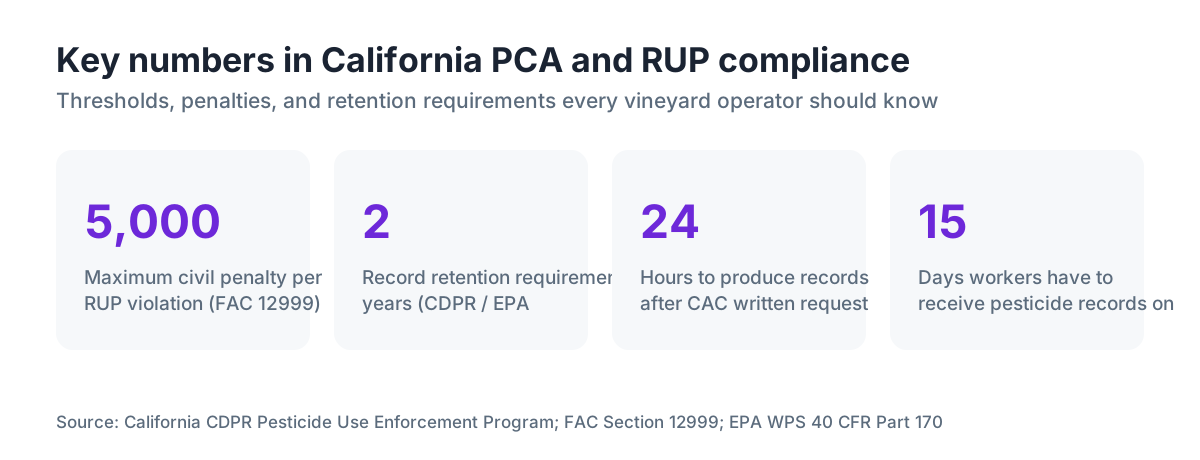
- Failure to comply risks fines up to $5,000 per violation under California Food and Agricultural Code Section 12999.
What is a PCA, and why do their signatures matter on RUP records?
A Pest Control Adviser (PCA) is a California-licensed professional authorized to recommend pesticide use on commercial agricultural sites. The license is issued by the California Department of Pesticide Regulation (CDPR) under Food and Agricultural Code (FAC) Section 11400 et seq. [1] Without a valid PCA license, nobody can legally write a pesticide recommendation for a commercial operation in California.
The signature on a pesticide use recommendation is not a formality. It is the PCA's legal attestation that they inspected the site within a reasonable time before the recommendation, evaluated the pest problem, and decided the proposed treatment is justified. That signature also creates accountability. If an application causes a drift incident, a worker injury, or a residue violation, the signed recommendation is one of the first documents regulators pull.
For vineyard managers and winery farm operators, this matters in a concrete way. An unsigned or backdated recommendation is treated as no recommendation at all. Applications made without a valid signed PCA recommendation for a restricted use pesticide are unlawful even if the product went on perfectly. The County Agricultural Commissioner (CAC) enforces this at the county level, and penalties stack per application, not per season.
Other states have their own versions. Washington requires licensed private applicators or certified advisers for RUP use under WAC 16-228 [2], and Cornell Cooperative Extension notes that New York imposes similar written-recommendation requirements for certain RUP categories on commercial farms. [3] This article focuses on California because it has the most detailed signature-and-recordkeeping rules in the country, but the underlying logic travels.
Which pesticide records actually require a PCA signature in California?
Any written recommendation for a restricted use pesticide applied to a commercial agricultural site needs a PCA signature. That is the short answer. The specifics matter more.
CDPR defines a pesticide use recommendation as any written advice to use a pesticide directed to a grower or farm operator. [1] Under CCR Title 3, Section 6556, the recommendation must include:
- The PCA's name, license number, and signature
- The date of the recommendation
- The specific pest(s) targeted
- The pesticide product name and EPA registration number
- The site of application (field or block identification)
- The application rate and any required restricted entry intervals (REIs)
Not every pesticide record needs a PCA signature. General use pesticides (those not classified as restricted use by the EPA or by California under FAC 14006) can go on without a PCA recommendation, though you still keep spray records. The PCA signature requirement kicks in when the product carries the "Restricted Use Pesticide" designation on its federal label, or when CDPR has added a California-specific restricted material classification. [8]
Some materials are restricted in California but not federally. Chlorpyrifos, for instance, has a California restricted material designation that goes beyond its federal RUP status. [10] When in doubt, check both the federal label and CDPR's restricted materials list for your county, because county commissioners can add local restrictions on top of state ones.
For vineyards, the products that most often trigger PCA signature requirements include certain organophosphates, some fungicides with restricted status in specific counties, and fumigants. Methyl bromide and chloropicrin for pre-plant fumigation are the most heavily documented.
What are the recordkeeping timelines and retention rules for signed RUP records?
California law requires that pesticide use records be kept for two years from the date of application. [1] That covers the signed PCA recommendation, the operator's own application record, and any related inspection notes. The County Agricultural Commissioner can request these records at any time during that two-year window, and you must produce them within 24 hours of a written request under FAC 12999.
The signed PCA recommendation has to be in the operator's possession before or at the time of application, not after. This trips up a lot of operations that work on a handshake with their PCA and collect paperwork later. If an inspector shows up during or right after an application and there is no signed recommendation on site, that is a violation on the books no matter what the PCA planned to sign the next day.
Applications also get reported to the CAC. The pesticide use report submitted to the county is a separate document from the PCA's recommendation, but both are part of the compliance picture. The use report deadline is the last working day of the month following the month of application for most materials, though some counties want more frequent reporting. [4]
Here is a practical point that UC Cooperative Extension farm advisors make in their training: keep a copy of the signed recommendation physically in the field records folder for each block, not only in a central office file. Inspectors running WPS audits or CAC compliance checks in the vineyard do not always wait for you to drive back to the office.
For operations using software to track spray records, signed recommendations need to be attached as scanned documents or stored in a system that timestamps receipt. Paper or digital, the burden of proof sits with the operator.
How does the PCA conduct the required site inspection before signing?
The site inspection requirement is written into CCR Title 3, Section 6556, and it is not optional. Before signing, the PCA must physically inspect the property or have done so "within a reasonable time prior to making the recommendation." [1] CDPR reads "reasonable time" as site-and-pest-specific. For a fast-moving pest like leafhoppers or a botrytis pressure window during a humid stretch, a week-old inspection may not hold up. For a soil fumigation recommendation on bare ground, a few weeks is easier to defend.
The inspection note does not need to be a long document. It does need to exist. Best practice, per UC Cooperative Extension's IPM materials, is a dated field scouting record with pest counts or disease ratings that justify the treatment threshold decision. [5] That scouting record is what a PCA points to when a county investigator asks why they signed.
For managers who hire a PCA on retainer, the real question is how often those visits actually happen. A PCA signing recommendations off phone calls and grower-reported counts is skating on thin ice. If that recommendation gets challenged later, the missing inspection record is a serious problem for the PCA and the operator both.
WSU Extension's pesticide safety materials make the same point for Washington operations. The written record of the advisory visit is what turns a PCA's professional judgment into a document that survives an inspection. [2]
What happens if a RUP application is made without a signed PCA recommendation?
The penalties are real and they are not small. Under FAC Section 12999, civil penalties for pesticide law violations in California run up to $5,000 per violation. [1] Each application without a valid signed recommendation counts as a separate violation. An operation that puts an RUP across 40 acres in four passes, none of them covered by a signed recommendation, is looking at four violations.
Criminal penalties exist too. FAC 12995 provides for misdemeanor charges for willful violations, which can mean fines and, in extreme cases, jail time. In practice, first-time administrative violations with no harm usually get warning letters or modest civil penalties. Repeat violations, or cases with worker injury, water contamination, or drift complaints, escalate fast.
The County Agricultural Commissioner is the primary enforcement point. CAC inspectors can run surprise compliance inspections of pesticide records. Find records missing or recommendations unsigned, and they refer the matter to CDPR's enforcement division. CDPR publishes annual enforcement reports, and operations with RUP violations appear by name. [4]
Worker Protection Standard (WPS) inspections by the EPA or state can also surface recordkeeping failures. The WPS, codified at 40 CFR Part 170, requires that handlers have access to pesticide safety information and that application records be available to workers on request. [6] An unsigned or absent PCA recommendation opens a chain of recordkeeping gaps that can turn up in a WPS audit even when that audit started somewhere else.
Does a PCA signature requirement apply to private applicators or only commercial operators?
This confuses people constantly. In California, the PCA signature requirement applies to commercial agricultural use, meaning any pesticide application on land used to produce an agricultural commodity, including wine grapes, table grapes, and row crops. It does not apply to personal or residential use.
A private applicator in California is an owner, operator, or employee of an agricultural operation who applies pesticides on their own land or land they are responsible for. Private applicators can get a license to buy and apply certain RUPs without going through a PCA, but California draws this narrower than many other states. For most restricted materials, even on your own land, a valid PCA recommendation is still legally required before application. [1]
The distinction bites hardest for small family vineyards. A third-generation grower who has mixed and applied their own sulfur and copper for decades might assume a private applicator exemption covers everything. For general use materials, that is largely true. The moment they move to a product classified as a California restricted material, such as certain insecticides or fumigants, the PCA recommendation requirement applies whether they are spraying it themselves or not.
For a fuller look at how vineyard compliance obligations layer together, see the operations overview at vineyard.
How does a PCA recommendation differ from a pesticide use report, and which needs the signature?
These two documents are related but separate, and mixing them up is one of the most common compliance mistakes.
The PCA recommendation is the document the PCA produces before the application. It holds the licensed adviser's professional judgment: what pest, what product, what rate, and why. The PCA's signature goes on this document. [1]
The pesticide use report is what the operator submits to the County Agricultural Commissioner after the application. It records what actually went on: the date, the site, the product, the amount used, the applicator's name, and the PCA's license number. The report does not require the PCA's physical signature, but it must reference the PCA by name and license number. [4]
Here is where the distinction has teeth. If your use report lists a PCA who never wrote a signed recommendation, you have just documented a violation in the paperwork you handed the county. Regulators cross-reference these records. A use report citing PCA license number X, paired with no signed recommendation from that PCA in your files, is a clean paper trail to a penalty.
The spray record the operator keeps for their own files is a third document. It usually mirrors the use report but may carry extra field notes. Under FAC 12999, the operator's own records must be kept for two years and available on request.
| Document | Who Creates It | Signature Required | Retention | Submitted To |
|---|---|---|---|---|
| PCA Recommendation | Licensed PCA | Yes (PCA's signature) | 2 years | Kept by operator |
| Pesticide Use Report (PUR) | Operator | No (PCA license # listed) | 2 years | County Ag Commissioner |
| Operator Spray Record | Operator | No | 2 years | Kept on site |
Can a PCA sign a recommendation electronically, or does it need to be a wet signature?
California has moved toward accepting electronic signatures for agricultural documents. CDPR guidance confirms that electronic signatures meeting the California Uniform Electronic Transactions Act (UETA, Civil Code Section 1633.1 et seq.) are acceptable for pesticide use recommendations. [1] The signature has to be attributable to the PCA, created at a specific date and time, and stored so it cannot be altered after signing.
In practice, a PCA using a PDF signing tool like DocuSign, Adobe Acrobat Sign, or a farm-management platform that captures a timestamped e-signature is likely compliant. A PCA typing their name at the bottom of an email is probably not, because there is no reliable authentication or tamper protection.
This is one place where digital record-keeping earns its keep. A platform that generates a timestamped, locked recommendation with the PCA's authenticated signature, attached to a specific field and application record, builds a stronger audit trail than a folder of hand-signed papers that could get misfiled or backdated.
VitiScribe's spray record module, for example, supports attached signed recommendation documents with upload timestamps, which makes it easy to show that the recommendation preceded the application during a CAC records inspection.
County Agricultural Commissioners are the local enforcement body, and a few counties have historically been more conservative about electronic records. Check with your county commissioner's office if you have any doubt about local practice.
What information must appear on a valid PCA recommendation for it to be legally complete?
CCR Title 3, Section 6556 spells out the required elements. A PCA recommendation for a restricted use pesticide must include all of the following: [1]
- The PCA's name, license number, and signature
- The date the recommendation is made
- The name and address of the person receiving the recommendation (the grower or operator)
- The location of the property to be treated (county, township/range/section, or a map reference)
- The crop or site to be treated
- The pest(s) to be controlled
- The pesticide product name and EPA registration number
- The rate of application
- Any specific application instructions, including REIs and preharvest intervals (PHIs) where applicable
- The basis for the recommendation, meaning the scouting or inspection findings that justify treatment
Any of these missing can make the recommendation invalid. County inspectors pay particular attention to the pest identification and justification section. A recommendation that says only "apply Product X at Y rate to Field Z," with no explanation of the pest pressure observed, is hard to defend as legitimate professional judgment.
UC Cooperative Extension's integrated pest management (IPM) materials for vineyards note that economic threshold documentation, meaning the pest count or disease rating that triggered the recommendation, is what separates a well-prepared PCA from one rubber-stamping applications. [5] That detail protects the operator too, because it shows regulators the treatment came from real field conditions.
How do PCA signature requirements interact with the EPA Worker Protection Standard?
The EPA's Worker Protection Standard (WPS), codified at 40 CFR Part 170 and updated in 2015, sets requirements for protecting agricultural workers and pesticide handlers from pesticide exposure. [6] It is a federal rule that California enforces through CDPR and the county commissioners.
The WPS itself does not require a PCA signature. What it requires is that application and hazard information reach workers and handlers, and that REIs and PPE requirements get communicated. Here is where the two systems connect. The signed PCA recommendation is usually the document that establishes the REI for a given application. No signed recommendation means no formal REI documentation, which creates a WPS gap on top of the PCA-law violation.
The 2015 WPS revision strengthened requirements around application exclusion zones (AEZs) and record access. Under the current rule, "agricultural employers must keep records of all pesticide applications for two years and make them available to workers and their designated representatives within 15 days of a request." [6] That two-year retention matches California's FAC requirement, so operators run one clock, not two.
For vineyards with H-2A workers or large seasonal crews, WPS compliance gets inspected more often, because OSHA and EPA have both flagged labor-intensive agricultural operations as a priority for inspection resources. Clean, complete, signed PCA recommendations on file are one of the fastest ways to show baseline compliance during a WPS inspection.
What are the most common PCA signature compliance mistakes vineyard operators make?
Here they are, ranked by how often they show up in county enforcement records and extension adviser conversations.
The most common failure is the retroactive recommendation. The application happens, then the PCA signs the paperwork days or weeks later. Even if the PCA was consulted by phone beforehand, a recommendation dated after the spray date is a red flag. CDPR investigators compare the recommendation date against the application date in the use report, and mismatches trigger follow-up.
Second: incomplete block identification. The recommendation says "vineyard" or "north block" without enough detail to match a specific parcel or APN. When the CAC tries to cross-reference the use report to the signed recommendation, the location mismatch creates an auditing problem.
Third: expired PCA license. PCA licenses in California renew annually with continuing education requirements. An application authorized by a recommendation from a PCA whose license lapsed, even by a few weeks, is unauthorized. Confirm your PCA's license status on CDPR's license lookup portal before each season. [4]
Fourth: recommending without inspecting. A PCA who signs off the grower's verbal description of the problem, with no site visit, is violating their own licensing requirements. If that surfaces in an investigation, the recommendation is invalid and the operator is unprotected.
Fifth: missing product registration numbers on the recommendation. This sounds minor. It is not, because the EPA registration number is how regulators verify that the product used matched the product recommended. Substitutions, even of similar products, require a new or amended recommendation.
Keeping records organized by block and by application date, with the signed recommendation attached to each spray event, is the single best way to avoid all five. Software built for vineyard spray records can automate that linkage. VitiScribe's free trial gives you a structure where recommendations, use reports, and spray events are linked from day one.
How do PCA requirements differ between California, Washington, and other wine-producing states?
California runs the strictest PCA signature regime in the country by most measures. The requirement that a licensed PCA provide a signed written recommendation before any RUP application on a commercial agricultural site is unique in its specificity. [1]
Washington requires licensed applicators for RUP use but frames it differently. Under WAC 16-228, commercial applicators must be licensed, and private applicators on their own land can buy and apply most RUPs without a third-party adviser recommendation, though they still keep application records. [2] There is no Washington equivalent of California's mandatory third-party PCA recommendation for growers applying on their own land.
Oregon's Department of Agriculture requires pesticide applicator licensing and recordkeeping for RUPs but does not mandate an independent licensed adviser recommendation for growers on their own property. Records get kept for two years, matching California's retention period.
New York, per Cornell Cooperative Extension guidance, requires certified pesticide applicators to handle RUP applications on commercial farms, but the written recommendation requirement ties to the pesticide label and specific restricted use categories rather than applying to all RUPs universally. [3]
For operations with vineyards in more than one state, the safest move is to apply California's standards everywhere. It is the most demanding baseline, so compliance in California generally means compliance in the other states by default.
| State | PCA/Adviser Signature Required | Retention Period | Enforcing Body |
|---|---|---|---|
| California | Yes, for all RUPs on commercial ag | 2 years | County Ag Commissioner / CDPR |
| Washington | No mandatory 3rd-party adviser | 2 years | WA Dept. of Agriculture |
| Oregon | No mandatory 3rd-party adviser | 2 years | OR Dept. of Agriculture |
| New York | Label/category dependent | 3 years | NY Dept. of Agriculture & Markets |
Frequently asked questions
Does every pesticide application in a California vineyard need a PCA signature?
No. Only applications of restricted use pesticides on commercial agricultural sites require a signed PCA recommendation. General use pesticides can be applied without a PCA recommendation, though you still keep a spray record. If a product carries either a federal RUP classification or a California restricted material designation, a signed PCA recommendation is legally required before application.
How long does a PCA have to sign the recommendation before an application?
The signed recommendation must be in the operator's hands before or at the time of application. There is no minimum lead time written into the statute, but the PCA must have inspected the site within a reasonable time before signing. A recommendation signed the same morning as the application is fine legally. A recommendation signed after the application is a violation, regardless of when the PCA was verbally consulted.
Can a vineyard owner act as their own PCA to avoid hiring one?
Only if they hold a current California PCA license. The license requires passing a written examination, demonstrating qualifying experience, and completing annual continuing education. A grower with an active PCA license can write their own recommendations. Without that license, they cannot legally sign a recommendation for an RUP application on their own operation, and hiring a licensed PCA is required.
What is the fine for applying a restricted use pesticide without a signed PCA recommendation in California?
Civil penalties under California Food and Agricultural Code Section 12999 can reach up to $5,000 per violation. Each separate application without a valid signed recommendation is a separate violation. First-time administrative violations with no resulting harm often get warning letters, but repeat violations or cases involving worker exposure or environmental damage escalate to larger fines and possible criminal referral.
Does the PCA need to be physically present during the application itself?
No. The PCA's obligation is to inspect the site before making the recommendation, not to supervise the actual application. Once the signed recommendation is issued and the operator follows its instructions, the PCA's on-site presence is not required. The operator, or their licensed pesticide handler, is responsible for the application in compliance with the label and the recommendation.
How do I verify that my PCA's license is currently active?
CDPR maintains a public license lookup database where you can search by name or license number to confirm current active status. PCA licenses in California expire annually and require continuing education for renewal. Confirming license status at the start of each season, and again mid-season if applications run long, is a simple step that protects you from having recommendations from a lapsed licensee.
Can one PCA recommendation cover multiple applications of the same product?
Yes, in most cases. A PCA recommendation can authorize repeated applications of the same product at the same site for a defined period, provided the pest pressure justifying treatment is ongoing and the PCA's inspection basis still applies. Open-ended or standing recommendations used season after season without a current inspection are legally questionable and are a common target during compliance audits.
Do I need to submit the signed PCA recommendation to the county, or just keep it on file?
You keep it on file. The document submitted to the County Agricultural Commissioner is the pesticide use report, not the PCA recommendation itself. The use report references the PCA's name and license number. The signed recommendation stays in your records and must be produced within 24 hours if the CAC requests it during an inspection. Both documents must be retained for two years.
What happens if my PCA is unavailable and I have an urgent pest situation requiring an RUP?
The law has no emergency exception for unavailability. Your options are to wait until the PCA can inspect and sign, to identify a backup PCA who can conduct a site visit and sign on short notice, or to switch to a general use pesticide that does not require a recommendation. Planning ahead with a backup PCA contact is the only reliable solution to this scenario.
Are electronic or digital PCA signatures legally valid in California?
Yes, provided they meet the California Uniform Electronic Transactions Act requirements. The signature must be attributable to the PCA, timestamped, and stored in a tamper-evident format. A PCA typing their name in an email body is probably not sufficient. A timestamped, authenticated signature through a dedicated e-signature platform or farm management software that locks the document after signing is considered compliant by CDPR guidance.
What records does a PCA need to keep on their own end?
PCAs must keep copies of all recommendations they issue for at least two years under California law. They are also subject to inspection by CDPR and county commissioners. A PCA who cannot produce the recommendations they have signed, or whose records show signed recommendations with no contemporaneous scouting notes, faces separate licensing and enforcement exposure independent of any issue with the grower.
Do PCA signature requirements apply to organic vineyards using OMRI-listed materials?
OMRI-listed materials are generally general use pesticides and do not require a PCA recommendation. However, some materials used in organic production, such as certain copper compounds, carry restricted use classifications in specific California counties. If a material is county-restricted regardless of its organic status, the PCA recommendation requirement applies. Always check the county's restricted materials list for the specific product.
How does the PCA requirement apply to contract farm management or vineyard management companies?
The PCA recommendation requirement attaches to the commercial agricultural operation, not to who physically makes the application. If a vineyard management company applies RUPs on a client's land under a contract farming arrangement, a signed PCA recommendation is still required before each RUP application. The management company cannot use their own in-house applicators to bypass the PCA signature requirement.
Sources
- California Department of Pesticide Regulation, Pesticide Use Enforcement Program Standards Compendium: PCA license requirements, signed recommendation mandate, CCR Title 3 Section 6556 required elements, and FAC Section 12999 penalty provisions up to $5,000 per violation
- Washington State University Extension, Pesticide Safety Education Program: Washington requires licensed applicators for RUP use under WAC 16-228; the written record of the advisory visit converts professional judgment into a defensible document
- Cornell Cooperative Extension, Pesticide Certification and Recertification Program: New York requires certified pesticide applicators for RUP applications on commercial farms; written recommendation requirements are label- and category-dependent rather than universal
- California Department of Pesticide Regulation, Pesticide Use Reporting (PUR) program: Pesticide use reports must be submitted to the County Agricultural Commissioner by the last working day of the month following the month of application; CDPR publishes annual enforcement reports naming violators; PCA license lookup is available through CDPR
- UC Cooperative Extension, UC IPM Program, Integrated Pest Management for Vineyards: Economic threshold documentation and contemporaneous scouting records are best practice for PCA recommendations; UC PCA training materials emphasize that field inspection notes justify treatment decisions
- U.S. EPA, Agricultural Worker Protection Standard (WPS), 40 CFR Part 170: The 2015 WPS revision requires agricultural employers to keep pesticide application records for two years and make them available to workers and their designated representatives within 15 days of a request
- California Food and Agricultural Code, Section 11400 et seq., PCA licensing requirements: PCA licenses in California are issued by CDPR under FAC Section 11400 et seq.; PCA must be licensed to legally write pesticide recommendations for commercial agricultural operations
- California Food and Agricultural Code, Section 14006, restricted materials definition: FAC Section 14006 defines restricted materials as pesticides that pose hazards beyond what the label warnings address, subject to additional state and county restrictions beyond federal RUP classification
- UC Davis Department of Viticulture and Enology: UC Davis viticulture extension materials address vineyard spray record organization and PCA documentation best practices for California grape growers
- California Department of Pesticide Regulation, Chlorpyrifos Restricted Material Information: Chlorpyrifos carries a California restricted material designation that imposes requirements beyond its federal RUP status, requiring a county permit and signed PCA recommendation before use
Last updated 2026-07-11