How to read pesticide label use rate ranges for vineyards

TL;DR
- Pesticide labels list a rate range because pest pressure, growth stage, and weather all move around.
- The law is simple: stay between the printed minimum and maximum.
- Where you land inside that range depends on canopy density, pest severity, and resistance history.
- Go above the maximum and you have a federal violation.
- Go below the minimum and you often get poor control plus wasted money.
Why do pesticide labels give a range instead of one fixed rate?
The range exists because no two sprays are the same. A 5-acre hillside block at early shoot growth carries a fraction of the leaf surface it will hold at canopy closure, and a lone powdery mildew flag shoot is a different problem than sporulating colonies on fruit. The registrant's agronomist, working with EPA reviewers, sets the minimum as the lowest dose that works under favorable conditions and the maximum as the highest dose shown safe to the crop, the environment, and the applicator under the hardest conditions. [1]
Every number on that label came out of data submitted to EPA during registration. The agency reviews efficacy data, residue data, environmental fate studies, and re-entry studies before it approves any use pattern. [1] So the range is not a suggestion. It is a legal boundary with data behind both ends.
Canopy architecture drives most of the rate call in a vineyard. A sprawling, barely hedged VSP block with dense foliage needs more product to put the same deposit on interior leaves than a tight, vertically trained block that lets air and spray move through. That is the real reason labels tie the top of the range to dense canopy or heavy pressure language.
What does the law actually say about staying within label rates?
The Federal Insecticide, Fungicide, and Rodenticide Act (FIFRA) makes it a federal violation to apply a pesticide above the rate the label specifies. The statutory language at FIFRA Section 12(a)(2)(G) makes it unlawful "to use any registered pesticide in a manner inconsistent with its labeling." [2] Exceeding the maximum rate lands squarely inside that prohibition.
Going below the minimum is not a FIFRA violation in the same explicit way, but it still bites. Some labels, especially fungicides carrying resistance management language, set a minimum effective dose precisely because underdosing selects for resistance. [3] UC IPM guidance out of UC Davis flags fungicide programs that run below the effective threshold as a known route to resistance in Botrytis and powdery mildew populations in California vineyards. [3]
State rules stack on top of FIFRA. California's Department of Pesticide Regulation requires agricultural use records to document both the actual rate applied and the label rate, which makes it trivial for an inspector to line up the two. [4] Washington runs similar record-keeping through WSDA, and New York does through DEC. If your records show you routinely applied outside the label range, that is an audit flag whether or not anything went wrong.
Here is the nuance that trips people up. Some labels list a rate per acre and, separately, a rate per 100 gallons of spray mix. Those two numbers are not interchangeable. Spray at 50 gallons per acre and your per-100-gallon math and your per-acre math split apart, and the per-acre number is the one FIFRA cares about. [1]
How do you choose the right rate within the label's range?
The honest answer: it comes down to four things. Canopy density, pest or disease pressure at the moment you spray, the product's mode of action and how it moves in the plant, and whether you're in a resistance-sensitive spot.
Canopy density is the steadiest factor in a vineyard. WSU Extension recommends calculating dilute volume (the gallons per acre needed to wet all leaf surface to near run-off), then scaling concentrate sprays from there. [5] When your actual volume runs well below dilute, moving toward the top of the rate range makes up for the thinner coverage per acre.
Pest pressure is the second lever. Starting a powdery mildew program in clean conditions, the low end is often plenty, especially for protectants. Spraying a curative product into an established infection, or when the UC IPM grape powdery mildew risk model shows high-risk weather, the high end earns its keep. [3]
Mode of action matters because it sets how far the product reaches. A pure contact material like sulfur needs enough rate to coat every surface the pathogen touches. A systemic DMI (Group 3) moves inside the tissue, so lower rates can work when your timing is sharp, though the label maximum still caps what's legal. [6]
Resistance management is the fourth factor, and it cuts both ways. FRAC guidance for Group 11 (QoI/strobilurin) fungicides says to apply at the full recommended rate to minimize survival of partially resistant individuals. [6] Cutting the rate or splitting the application on a resistance-prone chemistry works against you. On materials where resistance is a smaller worry, the midpoint is a fine default when conditions are moderate.
A practical starting framework:
| Condition | Suggested rate position |
|---|---|
| Clean block, protectant timing, open canopy | Low end of range |
| Moderate pressure, standard canopy | Midrange |
| Dense canopy or concentrate spray well below dilute volume | Upper midrange |
| Active infection, curative application | High end or maximum |
| Resistance-prone chemistry (Group 11, Group 7) | Full recommended rate per FRAC guidance |
None of this beats the label. If conditions push you past the printed maximum, you don't get to exceed it. Reapply sooner, tighten your timing, or rotate modes of action.
What is the difference between per-acre rate and per-100-gallon rate on a label?
Per-acre rate is the total amount of product (or active ingredient) put on one acre, no matter how much water you run. Per-100-gallon rate tells you how much product to add to each 100 gallons in the tank. Those two only match when your spray volume is exactly 100 gallons per acre. This is one of the most common mix-ups in vineyard spray records.
Modern airblast application in vineyards commonly runs 30 to 100 gallons per acre depending on your rig, canopy, and target. [5] At 50 gallons per acre, if you mix at the per-100-gallon rate on the label, you're putting down half the per-acre rate. That can drop you below the label minimum without you noticing.
The EPA label format requires any product sold for agricultural use to state the rate in a way that lets you calculate per-acre loading. [1] When a label gives only a per-100-gallon rate, hunt for supplemental language setting a minimum or maximum spray volume. If there's none and you're spraying at an odd volume, call the manufacturer's technical line before you spray. They'll clarify, because that question hits their regulatory exposure too.
Log both numbers on every spray record: the per-acre rate you actually applied and the spray volume per acre. That pair lets anyone, including you two years from now, rebuild whether you stayed inside label bounds.
Can you mix two products and still stay within label rates for each?
Yes, but each product's label rate stands on its own. Tank-mixing a sulfur fungicide with a captan fungicide does not let you use half the rate of each. Both have to land inside their own label ranges unless one label explicitly addresses reduced rates in a tank mix. [1]
Some labels do carry tank-mix adjustments. A label might say "when mixed with a sterol inhibitor, reduce rate to X." That language was evaluated and is part of the legal labeling. Rate reductions you decide on your own, with no label backing, are not covered.
The Cornell Pest Management Guidelines for Grapes cover tank-mix compatibility and resistance rotation for New York vineyards. [7] WSU's Viticulture and Enology extension does the same for the Pacific Northwest. [5] Neither one blesses rate reduction in a tank mix unless the label allows it.
Phytotoxicity is the other reason to watch combined rates. Sulfur plus oil above certain temperatures and concentrations burns leaves and berries. The individual labels flag it, but the interaction multiplies rather than adds, which is exactly why "read both labels" is the standard advice before any mix.
How do restricted-entry intervals change with rate?
Short version: they usually don't. The restricted-entry interval (REI) on the label is set for the maximum application rate, and it does not shorten just because you applied at the minimum. This is where EPA's Worker Protection Standard (WPS), codified at 40 CFR Part 170, comes in. It sets the minimum REIs that handlers and workers must observe after an application to an agricultural establishment. [8]
EPA's Worker Protection Standard guidance states that the REI "must be listed on the product labeling," and workers cannot enter treated areas during the REI without specified personal protective equipment. [8] Some labels do list a range of REIs tied to rate, but that's the exception. If your label says "REI: 24 hours" with no rate-linked language, that 24 hours holds whether you sprayed 4 oz/acre or 8 oz/acre.
For any vineyard with employees, this is a daily operational fact. Harvest crews, canopy workers, and irrigation crews all need to know the REI of the most recent application in each block. Record the date, the product, the rate, and the REI, and post it where WPS requires. California's DPR has posting rules under its state WPS regulations that run slightly past the federal minimums. [4]
Keeping those records accurate and easy to pull is where a tool like VitiScribe earns its keep. Rate, REI, and block-level application history in one place takes the guesswork out of when a crew can safely re-enter.
What do "per season" or "per year" limits mean on a label?
Many labels cap the number of applications per season or the total amount of product per acre per year or per crop cycle. Two reasons: resistance management, and environmental loading caps that come out of EPA risk modeling. [1] These limits are as binding as the rate range itself.
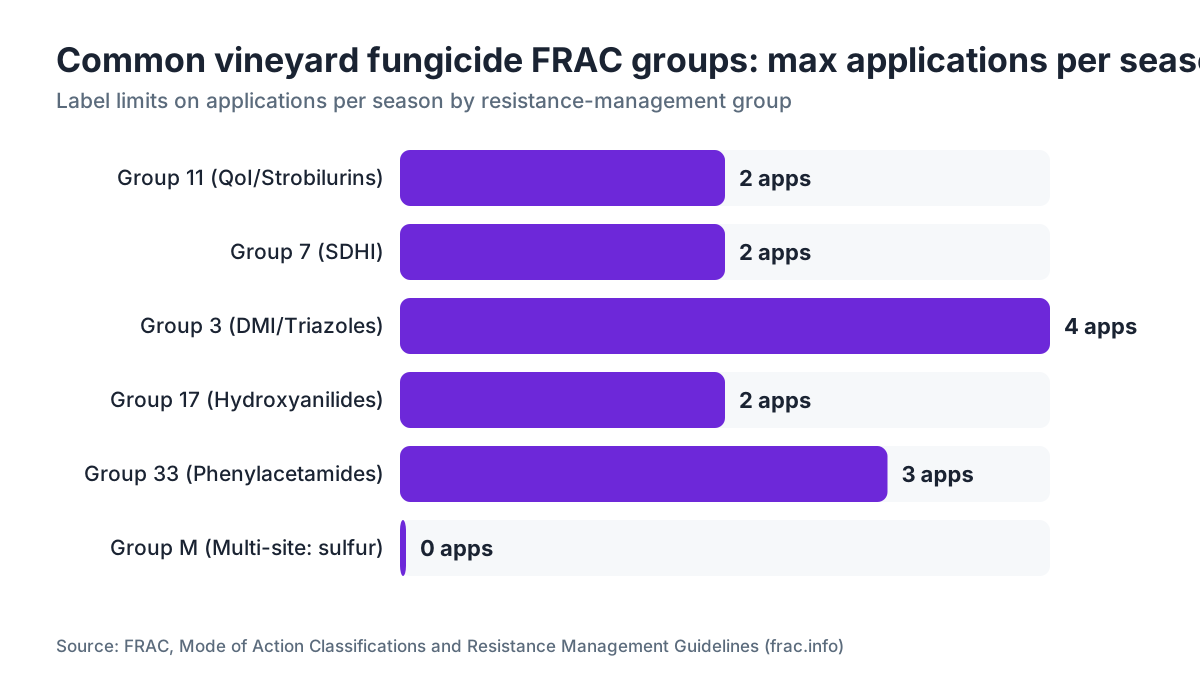
For vineyard fungicides, per-season limits often read as a maximum number of applications for a mode of action group. A QoI (strobilurin) label might say "do not make more than 2 applications per season." That's two applications total in a 12-month period, regardless of rate, regardless of whether you switched to a different strobilurin brand. FRAC group membership, not the trade name, is what counts for resistance management. [6]
Neonicotinoid insecticides used against leafhoppers or mealybugs often carry a pounds-of-active-ingredient-per-acre-per-year cap. Some imidacloprid labels cap total applications at 0.5 lb AI/acre/year. At a label rate of 7 oz product per acre, that math is easy to run application by application, but you have to actually run it. A block that gets two targeted sprays plus a systemic soil treatment can hit the annual cap sooner than you'd guess.
Log every application against the annual cap when you make it, not at season end. Basic record hygiene, sure. It also keeps you from planning a rotation program that quietly runs out of legal applications of a chemistry in July.
How does the EPA pesticide label review process set the rate range?
When a manufacturer registers a pesticide, or adds a new use site, they submit a package to EPA's Office of Pesticide Programs that includes efficacy data, residue data, environmental fate studies, and toxicology studies. [1] The final rate range reflects two boundaries: the lowest rate where efficacy data showed control (the minimum) and the highest rate where the safety studies showed acceptable risk (the maximum).
For food-use pesticides, which is every wine grape application, EPA sets a tolerance (a maximum residue level) for each registered food use. That tolerance is tied to the maximum application rate and the pre-harvest interval. [1] Apply above the label maximum and the residue could push past the tolerance, which is a food safety violation separate from the FIFRA application violation. Two problems from one mistake.
EPA's review does not account for every canopy density and sprayer setup in every growing region. That gap is why extension programs like UC Cooperative Extension and Cornell's IPM program publish rate guidance that translates generic label language into local terms. [3][7] Those recommendations sit at or below the label maximum and rest on regional efficacy trials. They aren't legally binding, but they are the best regional science available for picking a rate inside legal bounds.
What records do you need to keep to prove you used the label rate?
Federal law requires certified private applicators of restricted-use pesticides to keep records for two years. [9] California's Food and Agricultural Code goes further, requiring all agricultural pesticide applications, not only restricted-use ones, to be reported to the county agricultural commissioner, typically monthly. [4] Washington's WSDA runs similar agricultural use reporting. [10]
A spray record that holds up in an audit needs, at minimum: the product name and EPA registration number, the application date and time, the block or field ID, the total area treated, the amount of product used, the rate per acre, and the applicator's name. Add spray volume per acre, water source, and weather at application, and the record becomes genuinely useful for your own troubleshooting later.
California spells out the required elements of a pesticide use report under Food and Agricultural Code Section 6624, including the operator site ID, product name, EPA registration number, pest treated, amount applied, and acreage treated. [4] Line that list up against a typical paper spray log and most growers are already capturing it. The trouble is almost always retrieval: finding last season's records for a DPR audit or answering a pre-harvest interval question fast.
For a vineyard with more than a few blocks and 15 to 20 applications per block per season, digital record-keeping cuts audit prep dramatically. VitiScribe is one purpose-built option that ties spray records to block maps and REI tracking, though any system that produces complete, retrievable records satisfies the law.
How do you interpret label language like "use higher rates for heavy infestations"?
It reads like permission to freelance. It isn't. The higher rates it points to are still inside the printed minimum-maximum range. The phrase tells you where within the legal range to land, not that you can go past the stated maximum.
Heavy infestation language shows up most on insecticide labels. A pyrethroid used against western grapeleaf skeletonizer or grape mealybug might list "4-8 fl oz/acre; use higher rates when pest populations are high." The 8 fl oz is the ceiling. So: scout and find low populations, 4 to 6 oz is likely enough; find high populations, 6 to 8 oz. It does not mean 10 oz because the population is really, really high.
Some labels go further and define heavy or light in scouting terms, referencing treatment thresholds. When that language exists, use it. Calling "heavy" a specific pest count per leaf or cluster is far more defensible than a gut call made with no scouting records behind it. The UC IPM website keeps action thresholds for major California vineyard pests that line up with label language of this kind. [3]
Here's the practical test when you're unsure whether your conditions earn the top of the range: would a reasonable agronomist looking at your scouting records agree pressure was elevated? If yes, file those scouting records alongside the spray record. They justify the rate choice and cover you if the application ever gets questioned.
What are the most common label-reading mistakes vineyard managers make?
First mistake: confusing the product rate with the active ingredient rate. Labels often give both. See "apply 4 oz of product (containing 0.5 lb AI/gallon)" and the AI loading at 4 oz is 0.5 lb AI/gallon times (4/128 gallons), or about 0.0156 lb AI per acre. That number matters for annual cap tracking and residue math. Use the product rate for one comparison and the AI rate for another in your records and you've built an auditable inconsistency.
Second: ignoring adjuvant language. Plenty of labels say "do not add adjuvants unless..." or "adding a spreading-sticking agent may allow a rate reduction to..." That language is regulatory. An adjuvant that changes coverage can change what's needed for control, and some labels build that into the rate table. Skip it and you may over-apply, or mix something incompatible.
Third: running the same rate across blocks with wildly different canopy volumes. A young-vine block at 20% canopy fill and a mature block at full closure should not always get the same rate. The label range exists partly to handle that spread. Some vineyard fungicide labels reference dilute spray calibration for exactly this reason, because canopy-adjusted application is what's expected. [5]
Fourth: not checking whether the label in your hand is current. EPA re-registers pesticides on a cycle, and rates, pre-harvest intervals, and use restrictions change. The label in your file from three seasons back may not match what's registered now. Apply against a current label every time, and store a copy of the exact version you sprayed under with the spray record.
Frequently asked questions
Is it a federal violation to apply a pesticide above the label's maximum rate?
Yes. FIFRA Section 12(a)(2)(G) makes it unlawful to use any registered pesticide in a manner inconsistent with its labeling, and applying above the stated maximum is inconsistent by definition. Civil penalties for commercial applicators can reach into the tens of thousands of dollars per violation under EPA enforcement, and the amounts adjust for inflation. State penalties stack on top of the federal ones.
Can I apply below the minimum label rate to save money?
Applying below the minimum is not an explicit FIFRA violation the way exceeding the maximum is, but it creates other problems. You risk inadequate control, and for fungicides with resistance management language, underdosing can speed resistance. Some labels also state that efficacy claims only apply at or above the minimum rate, which weakens any product liability position if control fails.
How do I calculate per-acre rate when my spray volume is not 100 gallons per acre?
Multiply the per-100-gallon label rate by your actual spray volume in gallons per acre, then divide by 100. Example: label says 8 oz per 100 gallons, you spray at 50 gallons per acre. That gives (8 x 50) / 100 = 4 oz per acre. Compare that result to the per-acre range on the label to confirm it falls within bounds before you spray.
Does the REI get shorter if I apply at a lower rate within the range?
Not automatically. The REI printed on the label is set for the maximum application rate. Unless the label explicitly lists different REIs for different rate levels, you observe the full REI no matter what rate you applied. Always check the label for rate-linked REI language. When in doubt, treat the full printed REI as non-negotiable.
What does it mean when a label says 'do not exceed X applications per season'?
You cannot make more than that number of applications in a single growing season or calendar year, as the label defines it. For fungicide resistance management, this limit often applies to the entire FRAC group, not one product name. Two strobilurin products from different manufacturers both count toward the same limit because they share a mode of action.
How do canopy density and spray volume affect which rate within the range I should use?
Dense canopies and lower spray volumes both cut deposit per unit of leaf surface, which pushes the right rate toward the top of the label range. WSU Extension recommends calibrating to dilute volume as a baseline and scaling concentrate rates proportionally. An open-canopy, vertically trained block at dilute volume can often perform well at the low to mid end of the range.
Are university extension recommendations legally binding for rate selection?
No. UC, Cornell, and WSU extension guidelines are research-based regional recommendations, not regulations. They help a lot when you're deciding where inside the label range to land, and they often reflect local efficacy trial data. But the label is the legal document. If extension recommends 6 oz and your label maximum is 5 oz, you stay at 5 oz.
What records do I need to keep to show I applied within the label rate?
At minimum: product name, EPA registration number, application date, block ID, acres treated, amount of product used, and rate per acre. California requires monthly reporting to the county ag commissioner. Federal law requires certified private applicators to keep restricted-use pesticide records for two years. Add spray volume per acre and weather conditions to make the record more defensible.
Does 'heavy infestation' language on a label let me go above the stated maximum?
No. 'Use higher rates for heavy infestations' means move toward the upper end of the printed range, not above it. The maximum on the label is the legal ceiling regardless of pest pressure. If the maximum rate isn't controlling a severe infestation, your options are switching modes of action, shortening the spray interval, or calling your local extension agent for guidance.
How do tank mixes affect the legal use rate for each product?
Each product's label rate applies independently. Combining two fungicides does not let you halve either product's rate unless one of the labels explicitly permits reduced rates in combination. Some labels do carry tank-mix rate adjustments. If yours doesn't, both products must be applied within their own label ranges.
Can I use an older label version I have on file if the product was re-registered with a new label?
No. You apply under the current, registered label. When EPA approves a label change, the new label replaces the old one. Applying under an outdated label with a different maximum rate than the current label can put you out of compliance even if you followed what you had on file. Download a current label from the manufacturer or a database like CDMS or Greenbook before each season.
How do annual active ingredient caps on insecticides affect my spray program planning?
Some insecticide labels, particularly neonicotinoids, cap total active ingredient per acre per year. You need to track cumulative AI loading across all applications in a block, more than individual event rates. Hitting the cap mid-season means you cannot legally apply that product again until the next calendar year, regardless of pest pressure. Plan your chemistry rotation around that ceiling from the season's start.
Sources
- EPA Office of Pesticide Programs, Label Review Manual: EPA sets pesticide label rate ranges based on efficacy and safety data submitted by registrants; per-acre rates are the compliance standard
- FIFRA Section 12(a)(2)(G), US Code Title 7, Chapter 6: It is unlawful under FIFRA to use any registered pesticide in a manner inconsistent with its labeling, including exceeding the stated rate
- UC IPM, UC Davis, Grape Powdery Mildew Management: UC Davis IPM guidance notes that underdosing fungicides is a recognized pathway to resistance in Botrytis and powdery mildew populations in California vineyards
- California Department of Pesticide Regulation, Pesticide Use Reporting: California requires agricultural pesticide use records to document rate applied vs label rate, reportable to county agricultural commissioner
- WSU Extension, Viticulture and Enology, Pesticide Application in Vineyards: WSU Extension recommends calibrating spray volume to dilute volume and scaling concentrate rates proportionally; spray volumes in vineyards commonly run 30-100 gallons per acre
- Fungicide Resistance Action Committee (FRAC), Mode of Action Classifications and Resistance Management Guidelines: FRAC guidance for Group 11 QoI fungicides recommends applying at the full recommended rate to minimize survival of partially resistant individuals
- Cornell Cooperative Extension, Cornell Pest Management Guidelines for Grapes: Cornell guidelines cover tank-mix compatibility and resistance rotation for New York vineyards; rate reductions in tank mixes require explicit label authorization
- EPA Worker Protection Standard, 40 CFR Part 170: The WPS requires the REI to be listed on product labeling and prohibits worker entry during the REI without specified PPE; the REI is set for the maximum application rate
- EPA, Pesticide Record-Keeping Requirements for Certified Private Applicators: Federal law requires certified private applicators to keep restricted-use pesticide application records for two years
- Washington State Department of Agriculture, Pesticide Management Division: WSDA requires agricultural pesticide use reporting for Washington state growers similar to California's requirements
- UC Agriculture and Natural Resources, Cooperative Extension Viticulture Program: UC Cooperative Extension publishes regional rate guidance for California vineyard pesticide programs grounded in local efficacy trials
Last updated 2026-07-10