Pre-harvest interval tracking spreadsheet for vineyard pesticide records

TL;DR
- A pre-harvest interval (PHI) tracking spreadsheet logs every pesticide application date, product, and PHI so you know the earliest legal harvest date for each block.
- Federal law requires written pesticide records; a purpose-built spreadsheet prevents harvest violations, satisfies state ag department audits, and takes under 10 minutes per application to maintain.
What is a pre-harvest interval and why does it matter for wine grapes?
A pre-harvest interval is the minimum number of days that must pass between the last application of a pesticide and harvest of the treated crop. That number lives on the pesticide label, and the label is the law. Spray a fungicide with a 14-day PHI on August 1 and your earliest legal harvest date is August 15. Miss it by one day and you have a federal pesticide violation.
For wine grapes the risk runs two ways. You can face civil penalties under the Federal Insecticide, Fungicide, and Rodenticide Act (FIFRA) for harvesting inside the PHI [1]. You also risk a residue violation if a winery or buyer tests the fruit and finds a pesticide above the EPA tolerance for that compound [2]. Buyers have dropped growers over exactly this. It is not hypothetical.
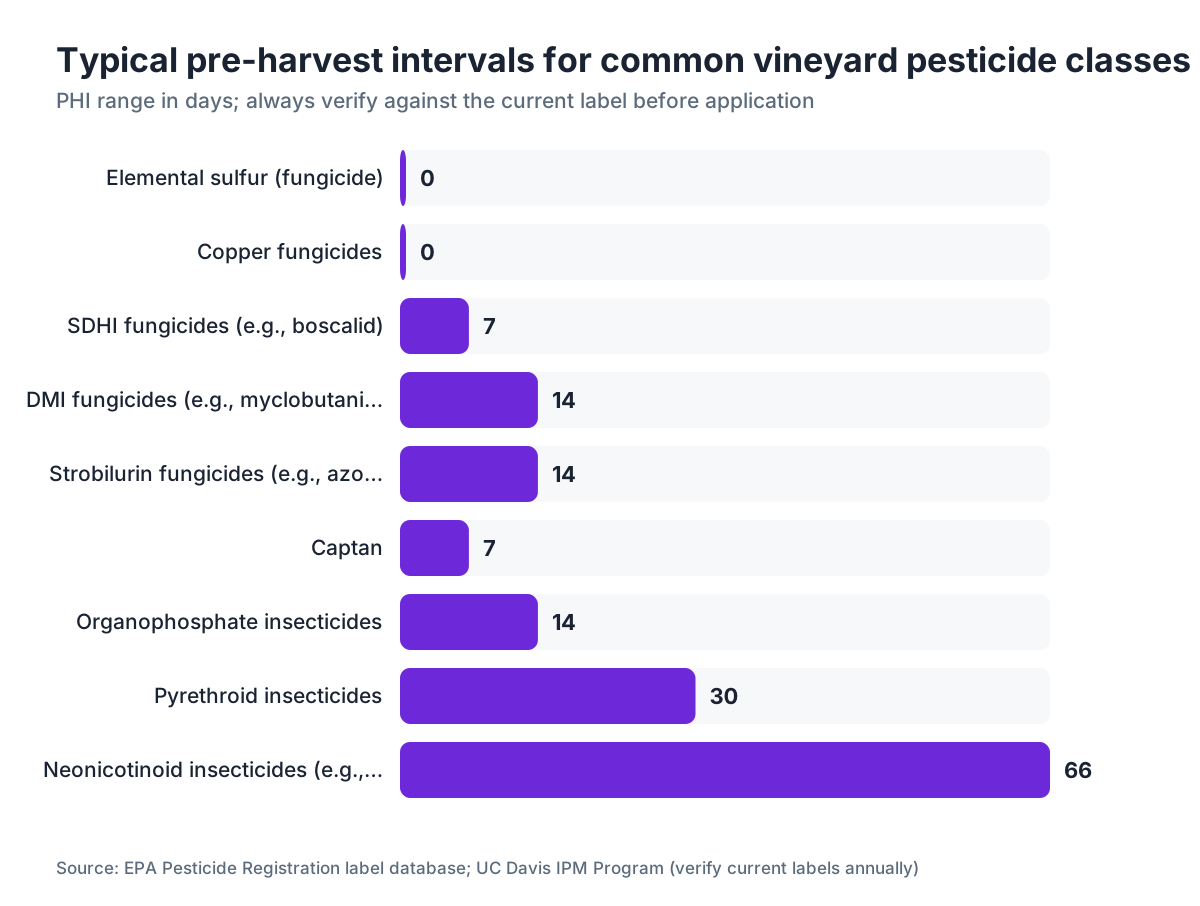
PHIs for common vineyard materials run from zero days (some certified organic sulfur products) to 66 days (certain systemic insecticides). A single block might get four or five different products in a season, each carrying its own PHI. The spreadsheet's job is to track all of them at once and always surface the latest clearance date as the controlling harvest restriction.
What federal and state laws require vineyard pesticide application records?
FIFRA Section 8 requires certified applicators to keep records of restricted-use pesticide (RUP) applications for two years [1]. Each record needs the product name and EPA registration number, the application date, the crop treated, the location, the total amount applied, and the applicator's name and certification number.
The EPA Worker Protection Standard (WPS), last revised in 2015, adds a separate recordkeeping layer for agricultural employers. Under 40 CFR Part 170, you must keep application information in a form that lets any worker or handler find the product details within 30 minutes [3]. WPS also requires central posting to include the end of the restricted-entry interval (REI), which is distinct from but often confused with the PHI. REI governs when workers can re-enter a treated area. PHI governs when you can harvest.
State rules stack on top of the federal floor. California requires that all pesticide applications, RUP or not, be reported to the county agricultural commissioner within one month of application under the California Food and Agriculture Code [4]. Washington requires pesticide application records under the Washington Pesticide Application Act, plus extra records for Pesticide Management Plans in water-sensitive areas [5]. Cornell Cooperative Extension notes New York records must be held for three years for commercial applicators, a year longer than the federal minimum [6].
Here is the practical upshot. Your spreadsheet has to satisfy at least three overlapping systems at once: federal RUP records, WPS posting, and your state ag department. Design it to meet the strictest requirement and the rest fall into place automatically.
What columns should a PHI tracking spreadsheet include?
Most growers under-design their spreadsheet in spring and then spend August scrambling to backfill data they never captured. Here is every column you actually need, in a left-to-right order that reads cleanly:
| Column | What to enter | Why it matters |
|---|---|---|
| Block/APN | Vineyard block ID or parcel number | Links record to a specific harvest unit |
| Application date | MM/DD/YYYY | Starting point for all interval math |
| Product name | Full label name | Ties to registration and tolerance data |
| EPA reg. number | e.g., 62719-XXX | Required for RUP records; confirms a legal product |
| Active ingredient(s) | e.g., myclobutanil | Needed for MRL and tolerance lookups |
| Formulation (rate applied) | oz/ac or lbs/ac | Required for FIFRA records |
| Total area treated (acres) | Numeric | Required for FIFRA records |
| PHI (days) | From current label | The core interval |
| REI (hours) | From current label | WPS central posting requirement |
| Earliest harvest date | =Application date + PHI | Auto-calculated; the column you check in August |
| REI end date/time | =Application date + (REI/24) | WPS posting requirement |
| Applicator name | Full name | FIFRA requirement |
| Applicator cert. # | State cert. number | Required for RUP applications |
| RUP? (Y/N) | Binary flag | Triggers the FIFRA 2-year retention clock |
| Notes | Equipment, spray volume, wind, temp | Not legally required but useful for efficacy review |
The earliest harvest date column earns its keep every season. Sort or filter by it as harvest approaches and it tells you which blocks are legally clear and which are not, in seconds. Every other column exists to survive a records inspection.
Most templates skip one thing worth adding: a "Controlling PHI date" cell at the block level that pulls the MAX of all earliest harvest dates for that block across the whole season. That single cell answers the only question that matters, which is "can I pick this block?" A formula like =MAXIFS(earliest_harvest_col, block_col, "Block_A") does it in Excel or Google Sheets.
How do you calculate earliest harvest date from an application date and PHI?
The math is simple, but the direction of counting matters and gets people in trouble. Read your specific label, because the counting convention varies. Most grape labels say "do not harvest within X days of last application," which means an August 1 application with a 7-day PHI clears on August 8 as the first allowable harvest day.
In a spreadsheet the cleanest formula is =A2+B2, where A2 is the application date formatted as a real date and B2 is the PHI in days. The result is the date the PHI expires, and the first legal harvest day if the label uses "within X days" language. Test it against a known example before you trust it across a whole season.
Fractional-day PHIs exist but are rare in viticulture. You will mostly see whole numbers. REIs come in hours instead (4, 12, 24, and 48 are common), so convert those to fractional days before adding them to the application timestamp if you want a precise re-entry datetime.
When several applications hit the same block, the controlling harvest date is the latest earliest-harvest-date among them. A conditional format rule that turns any earliest harvest date red when it falls after the planned harvest date takes five minutes to build and pays you back every August. That red cell is a warning you cannot miss.
Where can I find free PHI tracking templates from extension programs?
UC Davis Cooperative Extension publishes pesticide use record templates built for California growers through its Integrated Pest Management program [7]. The UC IPM program keeps current versions at ipm.ucanr.edu, and the templates carry most FIFRA-required fields, though you will add a dedicated PHI column yourself.
Washington State University Extension publishes spray record worksheets through its Tree Fruit and Viticulture programs with PHI columns already built in [5]. The WSU Viticulture and Enology program at wine.wsu.edu is a reliable first stop for Pacific Northwest growers.
Cornell Cooperative Extension's program at Geneva has pesticide record templates aimed at New York's three-year retention rule, and its pest management guidelines include PHI tables for common materials [6].
All of these share one honest limit: they are static forms. You get a table and you do the math. None of them calculate earliest harvest dates or flag a block that sits inside a PHI on a given date. For a small operation running fewer than 10 blocks, that is fine. For larger operations, or anyone juggling multiple varieties with staggered harvest dates, convert a static template into a live spreadsheet with formula columns, or move to purpose-built vineyard compliance software.
Running Google Sheets? Download the UC Davis template, import it, and add the formula columns from the section above in an afternoon. That hybrid gets you extension-vetted field names plus calculated harvest dates, and it costs nothing.
How do you set up a vineyard PHI spreadsheet in Excel or Google Sheets?
Start with one row per application, not one row per block. That is the mistake that sinks most spreadsheets. A block-per-row layout forces you to cram multiple application dates into a single cell, and date math becomes impossible.
Sheet 1: Application Log. Every application gets its own row. Columns follow the table above. Freeze the top row, lock the headers, and put data validation on the RUP column so it only accepts Y or N. Format date columns as dates, never as text, or your interval formulas fail silently and you never notice.
Sheet 2: Block Summary. One row per block, using MAXIFS (or MAXIF in older Excel) to pull the controlling harvest date from Sheet 1. Show planned harvest date, days remaining until PHI clearance, and a red/green flag. This is the sheet you open during harvest week.
Sheet 3: REI Log. Keep it separate because the audience is different. WPS requires workers have access to REI information within 30 minutes [3]. A dedicated sheet your field supervisor can print or pull up on a phone meets that cleaner than hunting through application rows.
Build a Products lookup table too (Sheet 4 or a named range) with one row per registered product, including label PHI, label REI, EPA reg number, and RUP classification. Reference it from your Application Log with VLOOKUP or XLOOKUP so PHI and REI auto-populate when you type the product name. This kills transcription errors, and a label PHI change only has to be updated in one place.
Back up the file after every entry. Seriously. A season of spray records lost to a corrupted file or a stolen laptop is a compliance disaster you cannot undo. Google Sheets auto-saves to Drive. For Excel, set up OneDrive sync or a weekly export to a second location.
What PHI values do common vineyard pesticides have?
PHI values come from the current label, and labels change between seasons when EPA re-registers products. Verify against the label in your hand, not a table off the internet, including this one. A general sense of the range still helps with seasonal planning.
| Product class | Example active ingredients | Typical PHI range |
|---|---|---|
| Elemental sulfur (fungicide) | Sulfur | 0 days |
| Copper fungicides | Copper hydroxide, copper sulfate | 0 days (most formulations) |
| DMI fungicides | Myclobutanil, tebuconazole | 7-14 days |
| SDHI fungicides | Boscalid, fluxapyroxad | 0-7 days |
| Strobilurin fungicides | Azoxystrobin, trifloxystrobin | 0-14 days |
| Systemic insecticides (neonicotinoids) | Imidacloprid, thiamethoxam | 30-66 days |
| Pyrethroid insecticides | Bifenthrin, zeta-cypermethrin | 7-30 days |
| Organophosphate insecticides | Phosmet, malathion | 3-14 days |
| Kaolin clay | Kaolin | 0 days |
| Captan | Captan | 7 days |
That 66-day figure comes from certain imidacloprid labels for grapes. It is the longest common PHI in vineyard use, and it means a late-June application on early-harvest varieties can block legal harvest entirely [2]. This is not an edge case. Growers using systemic insecticides for grape leafhopper or mealybug have to plan those sprays against a hard cutoff worked backward from their earliest expected harvest.
Organic growers are not off the hook. OMRI-listed products can carry PHIs, and state organic programs may demand the same application records as conventional programs [9]. Sulfur runs a 0-day PHI, but copper can require a 7-day interval on some labels. Check each label on its own.
How does the EPA Worker Protection Standard affect your spray records?
WPS is a separate regulatory framework from FIFRA RUP recordkeeping, but it draws on the same application data. Under 40 CFR Part 170, agricultural employers must post specific pesticide application information at a central location workers and handlers can reach without asking a supervisor [3]. That posting stays up for 30 days after the application or until the REI expires, whichever is later.
WPS requires the posting to carry the product name, EPA registration number, active ingredient, location and description of the treated area, the date and time the application ends, and the REI. PHI is not a WPS posting element. It is a FIFRA label compliance requirement. Your records system has to track both, and conflating them is a common audit problem.
The 2015 WPS revisions strengthened anti-retaliation protections and clarified that central posting must be in a language the workers understand [3]. If your crew is mostly Spanish-speaking, your REI postings need to be in Spanish. UC Davis IPM offers Spanish-language versions of key forms [7].
For your spreadsheet, the integration point is the REI End Date/Time column. Keep it in Sheet 3 (REI Log) with a clear printable format, and make sure whoever runs the field crews checks it before assigning workers to a treated block. A vine-training crew entering a block 10 hours after an application with a 12-hour REI is a WPS violation, a health hazard, and a recordable event, no matter what you intended.
How should you organize PHI records for multi-block vineyards with different harvest dates?
This is where spreadsheet design either earns its keep or falls apart. The core problem: a single vineyard might pick Chardonnay in late August, Cabernet in October, and a late-harvest Zinfandel in November. Every variety has its own window. A July insecticide might clear the PHI before Chardonnay harvest and still be controlling for Cabernet.
The Block Summary sheet handles this head-on. Each row shows block ID, variety, planned harvest date, the max PHI clearance date from all applications, and the buffer in days between clearance and planned harvest. A negative buffer means a conflict to resolve before you can pick legally.
For operations with a lot of blocks, a Gantt-style view beats a table. Map each block's application dates and PHI windows as horizontal bars on a timeline, with the planned harvest date as a vertical line. Any bar crossing that line is a problem. You can build a rough version in Excel with a stacked bar chart from start dates and durations. It is tedious to set up and fast to read during harvest planning.
VitiScribe builds this multi-block PHI view into its compliance dashboard so the Gantt logic runs automatically instead of by hand, which helps vineyards managing more than about 15 blocks. For smaller operations, the manual spreadsheet works fine and costs nothing.
One more structural tip. Archive each season's full application log as a separate tab or file the day after harvest ends. Do not overwrite it with next season. FIFRA requires two-year retention for RUP records, some states require three, and if you ever face an enforcement action or buyer dispute you want records that cannot be changed by accident.
What are common mistakes growers make with PHI spreadsheets?
The most expensive mistake is treating the spreadsheet as post-harvest paperwork instead of a real-time decision tool. If the sheet is not current when you are making spray calls in July, it is not doing its job.
Using the wrong label year is the second most common problem. PHIs change when EPA re-registers products. A DMI fungicide you have run for 10 years may have had its grape PHI revised in a label update you never saw. Cornell Extension recommends pulling the current label from the National Pesticide Information Retrieval System or the manufacturer's label database before each season, not from your own files [6].
Mixing REI and PHI. Workers have been sent into fields too early because a supervisor read the PHI ("7 days") when they should have read the REI ("12 hours"). Keep them in clearly labeled columns that cannot be swapped.
Missing the latest application when multiple materials go on the same day or in the same week. Tank-mix two products with different PHIs and the controlling PHI is the longer one. Log each product as its own row tied to the same application event so MAXIFS catches both.
Locking edit access and then losing the password. Your records need to be verifiable and still editable when you catch an entry error. Keep a read-only export for compliance and an editable working copy. Same file discipline, different job.
How do you handle PHI records during a state or county pesticide inspection?
State ag inspectors usually want application records on demand or within a short window (California county ag commissioners can request records under the California Food and Agriculture Code, and most counties treat "immediate" as within the business day) [4]. Being able to pull your spreadsheet on a phone or tablet in the field, rather than a desktop back at the office, is a real advantage during an inspection.
Inspectors typically check completeness of required fields (EPA reg number, application date, and applicator certification number for RUPs above all), whether records were kept within the legal timeframe after application, and whether they are legible and unaltered. A clean spreadsheet with locked formula cells and a visible edit history (Google Sheets keeps this automatically) reads as credible and is easy to walk through.
Catch a gap or an error? Do not alter the record. Add a correction row below the original with the corrected data, the date of the correction, and a note explaining what happened. Altered records turn a compliance issue into an enforcement issue.
If your state runs online pesticide reporting (California's system feeds county reports), your spreadsheet can be your working document and the county report your official submission. Keep both. They should match.
Bring a printed Block Summary to pre-harvest walk-throughs with buyers or certifiers. It answers the "are we clear to pick?" question in one page and reads as the mark of an operation that knows its records.
Frequently asked questions
How long do I have to keep vineyard pesticide application records?
Federal FIFRA law requires two years of records for restricted-use pesticide applications. Several states require longer: New York requires three years for commercial applicators. California requires pesticide use reports monthly, retained by the county ag commissioner. Check your state's ag department rules, then keep records for the longer of the two requirements. When in doubt, keep five years.
Do I need to track PHI for general-use pesticides or only restricted-use products?
PHI tracking applies to every product with a stated PHI on its label, regardless of restricted-use status. Many common general-use fungicides and insecticides carry PHIs. FIFRA's written recordkeeping technically covers only RUPs, but state laws often require records for all applications. For compliance, track everything with a PHI, full stop.
What is the difference between a PHI and a restricted-entry interval (REI)?
PHI is the minimum days between last application and harvest, protecting the consumer and meeting food safety tolerances. REI is the minimum time before workers can re-enter a treated area without protective equipment, protecting the worker. They come from different parts of the label and are enforced under different regulations. PHI is a FIFRA label requirement; REI compliance is governed primarily by EPA's Worker Protection Standard, 40 CFR Part 170.
Can I use a single spreadsheet for the whole vineyard or do I need separate files per block?
One file works, and it is better practice. A single file with an Application Log (one row per application) and a Block Summary (one row per block with MAXIFS formulas) gives you cross-block visibility you cannot get from separate files. Use block ID as the key column and filter by it for a block-specific view.
What happens if I accidentally harvest within the PHI?
Harvesting within the PHI violates the pesticide label, which carries civil penalties under FIFRA Section 12. Penalties can reach $5,500 per violation per day for commercial applicators. Beyond the legal risk, the fruit may carry residues above EPA tolerances, which can trigger rejection at the crush pad and, for certifications like SIP or organic, loss of certification status.
Does my organic vineyard still need to track PHIs?
Yes. OMRI-listed and certified organic pesticides can still carry PHIs. Copper fungicides, certain biological controls, and some approved insecticides have stated PHIs you must honor. Your organic certifier will typically require the same application records as a conventional operation. The National Organic Program does not waive pesticide label requirements.
How do I find the correct PHI for a product when labels conflict between the paper label and online sources?
The physical label on the product you purchased is the legally binding document. Online labels are often current, but a supplier may have older stock with an older label. The National Pesticide Information Retrieval System (NPIRS) and the manufacturer's label portal are the best online sources. If there is any doubt, call the manufacturer's technical line and record the answer in your files.
What is the minimum PHI information required for the EPA Worker Protection Standard central posting?
WPS central posting under 40 CFR Part 170 requires product name, EPA registration number, active ingredient, location of treated area, application end date and time, and the restricted-entry interval (REI). PHI is not a required WPS posting element, but it must appear in your FIFRA application records. Many growers post both together as a practical matter.
How do I handle PHI when I tank-mix two products with different intervals?
Log each product as a separate row in your application log, both tied to the same date and block. The controlling harvest date for that event is the longer of the two PHIs. Your Block Summary formula (MAXIFS across all rows for that block) returns the later date automatically if you structure the rows right. Never average the PHIs or use only the shorter one.
Are there free vineyard PHI spreadsheet templates I can download?
UC Davis IPM (ipm.ucanr.edu) and WSU Extension (wine.wsu.edu) both publish free pesticide record templates you can adapt. Cornell Cooperative Extension has New York-specific versions. None auto-calculate harvest dates out of the box, but you can add formula columns following the structure in this article. The EPA also provides a sample pesticide record-keeping form through its pesticides pages.
How often should I update my PHI tracking spreadsheet during the season?
Enter each application within 24 hours of finishing. Wait longer and you are relying on memory for rate and area applied, which introduces errors. In California you are legally required to submit pesticide use reports within one month of application, but your internal records should be current daily during active spray seasons. Set a calendar reminder tied to each spray event.
Can I use Google Sheets instead of Excel for vineyard pesticide records?
Yes, and Google Sheets has real compliance advantages: automatic version history, cloud backup, and easy sharing with PCAs or consultants without emailing files. The MAXIFS function works identically to Excel. The main limitation is offline access in the vineyard, so download a local copy before walking blocks where there is no cell signal.
What do I do if I lose my pesticide application records?
Contact your state ag department right away. For RUP purchases, your licensed pesticide dealer keeps purchase records that help reconstruct what you bought and when. Your PCA or CCA may have copies of spray recommendations. Missing records during an inspection are treated as a compliance violation, so proactive disclosure and reconstruction beat silence.
Do cover crop or soil amendment applications need to be in the PHI spreadsheet?
Cover crop herbicides and soil fumigants applied between vine rows or under the vine do not carry a grape PHI because they are not applied to the crop canopy or fruit. They still require FIFRA records if they are RUPs, and WPS REI posting if workers enter the treated area. Keep them in a separate log tab rather than mixing them with canopy application records.
Sources
- EPA, FIFRA Section 8 Recordkeeping Requirements for Certified Applicators: FIFRA Section 8 requires certified applicators to keep restricted-use pesticide application records for two years, including product name, EPA registration number, application date, location, amount applied, and applicator certification number.
- EPA, Pesticide Tolerances and Maximum Residue Limits: Pesticide residues in or on food must not exceed EPA-established tolerances; violations can occur when fruit is harvested within the PHI, leading to residues above legal limits.
- EPA, Worker Protection Standard, 40 CFR Part 170: The WPS requires agricultural employers to post pesticide application information at a central location accessible to workers and handlers within 30 minutes, including product name, EPA reg. number, active ingredient, treated area, application end time, and REI.
- California Department of Pesticide Regulation, Pesticide Use Reporting: California requires all pesticide applications (RUP and general use) to be reported to the county agricultural commissioner within one month of application under the California Food and Agriculture Code.
- Washington State University Extension, Viticulture and Enology Program: WSU Extension publishes spray record worksheets for Washington vineyards that include pre-harvest interval columns; Washington State also requires pesticide application records under the Washington Pesticide Application Act.
- Cornell Cooperative Extension, New York State Integrated Pest Management Program: New York state requires commercial pesticide applicators to retain records for three years; Cornell Extension recommends verifying PHI values against current labels each season via the National Pesticide Information Retrieval System.
- UC Davis, UC IPM Program, Pesticide Use Records and Templates: UC Davis IPM publishes pesticide use record templates for California growers, including Spanish-language versions for WPS central posting requirements; templates include FIFRA-required fields for RUP recordkeeping.
- EPA, Pesticide Registration, Label Requirements: The pesticide label is a legally binding document under FIFRA; the pre-harvest interval printed on the label governs the minimum days between last application and harvest, and harvesting within the PHI constitutes a label violation.
- USDA National Organic Program, Pesticide Application Requirements: National Organic Program rules do not waive pesticide label PHI requirements; certified organic growers must honor stated PHIs on OMRI-listed materials and maintain application records consistent with their certifier's requirements.
- National Pesticide Information Center, Understanding Pesticide Labels: The National Pesticide Information Center explains the legal distinction between PHI (days before harvest) and REI (hours before re-entry), and recommends using the label in hand rather than online summaries to confirm current interval values.
Last updated 2026-07-09