Recording fertilizer applications in vineyard nutrient management plans

TL;DR
- Vineyard nutrient management plans require you to log the date, product name, EPA registration or fertilizer registration number, application rate, target block, equipment used, and who applied it.
- Most states with water-quality rules add soil and tissue test results, nitrogen loading calculations, and annual summary reports.
- Missing records can trigger permit violations and fines up to $10,000 per day.
What is a vineyard nutrient management plan, and who needs one?
A nutrient management plan (NMP) is a written system that ties your fertilizer and soil amendment decisions to actual soil and plant data, tracks every application, and documents that you're not over-loading nitrogen or phosphorus into waterways. Put plainly: it's proof your fertilizer decisions come from agronomic need, not habit.
Who needs one depends on where you farm. In states with National Pollutant Discharge Elimination System (NPDES) agricultural general permits, vineyards above a certain acreage or in sensitive watersheds have to keep an NMP on file [1]. California's Irrigated Lands Regulatory Program, run by the State Water Resources Control Board, requires growers in most agricultural water quality coalitions to hold nutrient management documentation and file annual reports [2]. New York's Agricultural Environmental Management (AEM) program offers cost-share money tied to NMP development [3]. Washington State's Department of Agriculture runs similar voluntary and required programs, depending on whether you sit inside a designated nitrate-vulnerable groundwater area [4].
Even if your state doesn't legally require one, your crop insurance, your bank's ag loan covenant, or a sustainability certification like LIVE or Certified California Sustainable Winegrowing may demand the paperwork. The record-keeping habits are identical no matter who's asking.
Small vineyards, say under 10 acres, often fly under the formal regulatory radar. That doesn't mean records stop mattering. An audit from a coalition or a neighbor's runoff complaint can bring scrutiny fast, and reconstructing two years of applications from memory is a miserable way to spend a week. Build the system before you need it.
What information must you record for each fertilizer application?
This is the core of the job, and the list runs longer than most people expect when they start. Here's what a complete fertilizer application record holds:
| Field | What to capture | Why it matters |
|---|---|---|
| Date and time | Exact date; time if irrigation-applied | Tracks weather windows, runoff risk |
| Block or field ID | Your vineyard block map designation | Links back to soil test and crop data |
| Product name | Full label name | Ties to label compliance |
| Manufacturer | Company on the label | For traceability |
| Registration number | State fertilizer reg. or EPA reg. if applicable | Required for pesticide-fertilizer combos |
| Formulation | Liquid, granular, fertigated, foliar | Affects rate calculation |
| Nutrient analysis | N-P-K and any secondary/micro | For loading calculations |
| Application rate | Per acre, per vine, or per gallon of water | Core of the NMP math |
| Total product applied | Gallons or pounds per block | Audit verification |
| Total nutrient applied | Lbs of N (and P, K if tracked) per acre | The number regulators care about most |
| Method of application | Ground rig, fertigation, foliar spray | Affects drift and runoff risk |
| Equipment used | Spreader ID or injector unit | Equipment calibration records tie here |
| Applicator name | Who operated the equipment | Worker Protection Standard requirement [5] |
| Irrigation amount | If fertigated: run time and flow rate | Needed for leaching calculations |
| Soil and tissue test basis | Which test justified this application | The agronomic justification |
| Weather conditions | Wind speed, temperature, rain forecast | Matters for foliar and spray-applied |
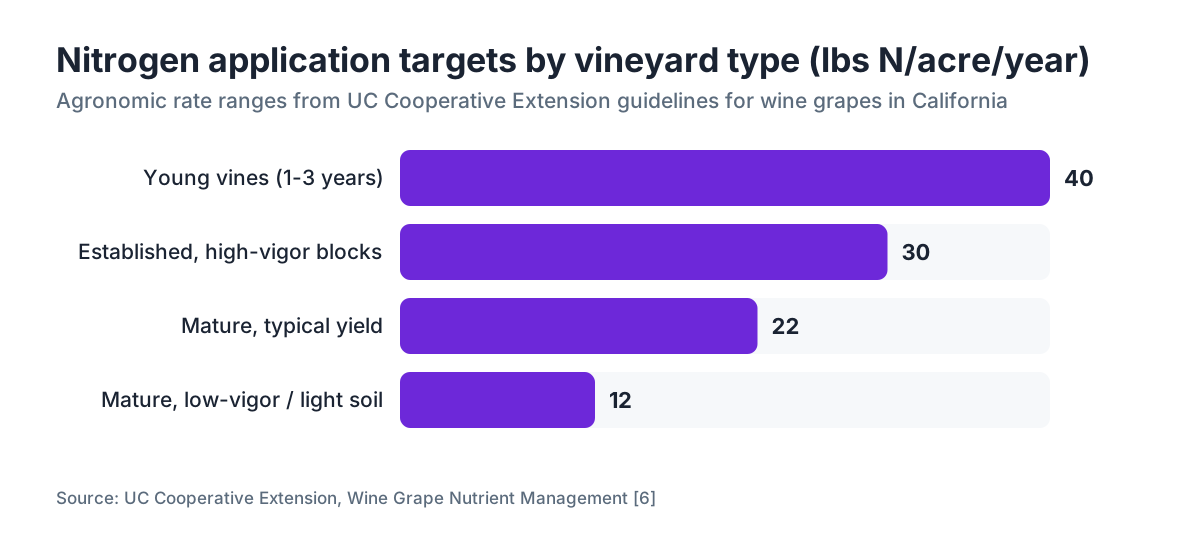
The nitrogen pounds-per-acre column is the one regulators go straight to. UC Cooperative Extension recommends California wine grape vineyards target roughly 10 to 40 lbs of total nitrogen per acre per year depending on vine size, rootstock, and yield goals, with most mature vineyards needing 20 to 30 lbs N/acre [6]. If your records show 90 lbs N/acre with no tissue test behind it, that's a problem in a regulated watershed.
Foliar applications get their own line. The rate is expressed differently (usually oz or fl oz of product per 100 gallons of water, then gallons of solution per acre), and the nutrient contribution to the soil is usually tiny but still needs tracking if you're doing regulatory reporting.
How do soil and tissue tests connect to your fertilizer records?
Records without a test basis are just a list of products you bought. The agronomic justification is what turns a shopping receipt into a nutrient management plan.
Run soil tests before you set the annual fertilizer program. The standard in most wine grape regions is to sample by block, at two depths (0-12 inches and 12-24 inches for nitrogen, since nitrate moves down), in the fall after harvest or in early spring before bloom. Your records should carry the lab name, sample date, sample ID, and the lab report itself, filed next to the application log for that season [6].
Tissue testing, usually petiole sampling at bloom (opposite basal leaves from a cluster) and again at veraison, gives you in-season correction data. Cornell Cooperative Extension's viticulture guidelines name bloom-time petiole sampling as the primary diagnostic tool for nitrogen, potassium, and boron status in New York vineyards [3]. If a veraison petiole shows potassium deficiency, you document the test result, the decision to apply, and the application itself in the same record set. That chain is what an auditor wants to see.
Attach the lab report PDF or scan straight to the season's records. Paper log? Staple it to the front of the binder. Digital? Link the file to the block and season. Either way, the test and the application it drove need to turn up together in under two minutes.
What are the nitrogen loading calculation requirements?
Several state programs make growers calculate and document a nitrogen budget: total nitrogen applied, minus estimated crop uptake, minus estimated nitrogen from organic matter mineralization. The leftover is what's free to leach.
California's Irrigated Lands Program asks coalition members to track total nitrogen applied per field per year and compare it against a crop nitrogen requirement estimate [2]. The State Water Board's Nitrate Control Program, now covering much of the Central Valley and parts of the Central Coast, requires growers to show that applications don't consistently run past agronomic rates [2].
Washington State University Extension publishes nitrogen rate guidelines for wine grapes running 20 to 60 lbs N/acre a year depending on vigor and yield, with lower rates for mature vineyards on light soils where leaching risk is high [4].
The math is simple arithmetic. The trap is missing a source. You have to gather every nitrogen input: synthetic fertilizers, organic amendments (compost N content is variable, typically 0.5 to 2.5% total N by weight, with roughly 10 to 15% mineralizing in year one [6]), fertigation through drip, and even cover crop termination if you incorporate a legume. The classic mistake is logging synthetic fertilizer with care and forgetting the ton of compost spread in February handed the block roughly 20 lbs of available N per acre.
Once you've summed the sources, your records should stack that number against your crop need estimate and note any planned corrective action if you're over. That's your annual nitrogen balance summary, and it's what most coalition reporting templates ask for.
How long do you need to keep vineyard fertilizer records?
Retention rules vary by program and state, but the floor most practitioners work to is five years.
California's Irrigated Lands Regulatory Program requires growers to keep farm evaluation and water quality documentation for at least five years [2]. Federal NPDES general permit conditions for agricultural operations generally require records to be available for inspection for at least three years from the date of the activity, per 40 CFR Part 122 [1]. New York's AEM program recommends holding NMP documentation for at least five years to cover audit cycles [3].
If you're in a regulated watershed with a nutrient TMDL (Total Maximum Daily Load), your regional water board may demand longer. Read your specific permit conditions instead of assuming the minimums apply.
Seven years is the safer call in practice, since multi-year soil nitrate trends matter for demonstrating agronomic justification. Storage costs almost nothing, even paper binders. Reconstructing records mid-enforcement costs a lot.
What format do the records need to be in, paper or digital?
Most programs take either format, as long as records are legible, dated, and retrievable on request. The EPA Worker Protection Standard, which governs pesticide-fertilizer combinations and some foliar nutritional sprays classified as pesticides, requires application records be kept in a form you can hand an inspector on demand [5].
Paper binders organized by block and season work fine for small operations. One three-ring binder per growing season, tabbed by block, soil test reports up front, application log sheets behind each tab. That system survives field conditions and inspector visits.
Digital is faster for pulling annual summaries and nitrogen totals. A spreadsheet template that auto-sums pounds of N applied per block per season handles the math that trips people up on paper. For something purpose-built, VitiScribe structures block-level application logs to export in the format California coalition reporting templates expect, which saves several hours per reporting cycle.
One thing matters no matter the format: back it up. A barn fire takes out paper. A laptop drive fails. Cloud backup or off-site paper copies are cheap insurance.
Do organic fertilizers and compost need to be recorded the same way?
Yes, and in some ways they need more documentation, because the nutrient content moves around.
For compost, you need the certificate of analysis (COA) from the composting facility showing N-P-K content, moisture percentage, and ideally carbon-to-nitrogen ratio. From the COA you calculate total nutrient applied per acre, then estimate plant-available nitrogen in year one using standard mineralization fractions. UC Cooperative Extension guidance for organic amendments suggests using 10 to 20% of total nitrogen as the first-year plant-available fraction for finished compost, with the rest mineralizing over later years [6].
For cover crop residue you're incorporating, you document the species mix, estimated biomass (strip weights get you close), and the nitrogen fixation credit for any legumes. This is imprecise, and it's honest to note that in your records as an estimate with the method you used.
For fish emulsion, feather meal, blood meal, and other liquid or dry organics, the same fields apply as for synthetic fertilizers: product name, manufacturer, N-P-K from the label, rate applied, date, block, applicator. Record the OMRI listing number for OMRI-listed products if you're operating under a certified organic program, because your certifier will ask.
The National Organic Program (NOP) requires organic operations to keep records sufficient to demonstrate compliance with NOP regulations for at least five years [7]. Certified organic and using a soil amendment? Your records have to satisfy both your certifier and any state water quality program you're enrolled in.
What happens if your fertilizer records are incomplete during an inspection?
Consequences run from a warning letter to permit suspension to civil fines, depending on the program and how far off your records are.
In California, coalition members who fail to keep adequate farm water quality documentation can be kicked to the Regional Water Quality Control Board for individual permit requirements, which are far more onerous than coalition membership [2]. Civil fines under California's Porter-Cologne Water Quality Control Act can reach $10,000 per day per violation for serious or repeated non-compliance [8].
For NPDES-permitted operations, the EPA can issue compliance orders and assess administrative penalties starting at $10,000 per violation per day under Clean Water Act Section 309, with court-imposed civil penalties up to $25,000 per day [9].
An incomplete record isn't automatically a violation. A first inspection turning up missing dates or thin product information usually results in a notice of deficiency and a 30-to-90-day correction window. A pattern of missing records, especially for nitrogen-heavy applications in a regulated watershed, gets treated much harder.
Here's the practical lesson. A record with some gaps beats no record at all. If you missed logging an application at the time, reconstruct it as accurately as you can from receipts, invoices, and memory, and note in the record that it's a reconstruction with the date you created it. Auditors read reconstructed records as evidence of good faith.
How do you structure a vineyard block map for your NMP records?
Your block map is the backbone of the whole system. Without consistent block IDs, the application log doesn't connect to the soil tests, and the soil tests don't connect to the annual nitrogen summary.
The simplest approach is a numbered or named block system built on your actual field layout, with a map (a hand-drawn one is fine) showing block boundaries, acreage, variety, rootstock, and row orientation. Every record, whether soil test, tissue test, irrigation log, or fertilizer application, points to the same block ID.
Most regional NMP templates ask for block acreage to the nearest 0.1 acre. If your blocks are irregular, measure with GPS or GIS instead of eyeballing it. An error in acreage flows into every rate-per-acre calculation downstream.
Got multiple irrigation zones inside a single variety block? You may need to split them for fertigation records, since the nitrogen applied through each zone can differ. Designate sub-blocks (Block 3A and 3B, say) and keep the records separate.
For vineyards with more than a handful of blocks, a simple GIS layer in Google Earth or a farm mapping app like Google My Maps or AgWorld is worth the hour it takes to set up. Print a clean block map for your binder and reference it during inspections without flipping through a stack of documents.
How do nutrient management records connect to water quality reporting?
In regulated watersheds, your fertilizer records are the main evidence you submit (or make available for inspection) to show your operation isn't dumping excess nitrate or phosphorus into groundwater or surface water.
California's Central Valley Regional Water Quality Control Board Waste Discharge Requirements for irrigated lands make growers track nitrogen applied and nitrogen removed in crop, report annually through coalition templates, and document any significant exceedance of agronomic nitrogen rates with a corrective action plan [2]. The State Water Board's 2018 Nitrate Control Program Policy requires agricultural operations in priority nitrate groundwater areas to complete nitrogen management plans and annual nitrogen balance reports on timelines that vary by area [2].
Washington's Department of Ecology carries similar requirements for agricultural operations in designated groundwater management areas, with recordkeeping and reporting tied to irrigation water use as well as nutrient applications [4].
Cornell Cooperative Extension's nutrient management resources for New York note that water quality compliance in the Lake Ontario and Finger Lakes watersheds increasingly ties crop nutrient management to permit conditions for operations above threshold sizes [3].
The connection is direct. A well-kept fertilizer application log, paired with soil and tissue test records, is your defense against an over-application allegation. Without records, you can't demonstrate agronomic justification, and the burden of proof in most state enforcement systems sits with the grower.
If you manage a vineyard in a sensitive watershed and haven't connected your application logs to your coalition reporting template yet, that's the highest-priority gap to close before your next reporting deadline.
What record-keeping tools actually work in the field?
The best system is the one you'll actually use on the day of the application, not the one you'll reconstruct from invoices two weeks later.
For small operations with one or two people handling applications, a waterproof field notebook with a standard form printed on the inside cover works well. Write the log at the equipment while the tank drains or the granular spreader gets cleaned. Then transfer it to your master binder or spreadsheet that evening.
Pre-printed field record cards, laminated and kept in the tractor cab or equipment shed, cut the mental load. Design a card that matches your NMP template fields exactly, and you're filling in the same columns every time. Transcription errors drop.
Mobile apps built for agricultural record-keeping let you enter data at the point of application with GPS location stamping. Those coordinates help if your block map IDs ever come into question. Several regional extension programs publish their own templates: WSU Extension puts out a vineyard nutrient management workbook [4], and UC Cooperative Extension offers a farm water quality management guide with sample record forms [6].
For operations running more than 20 blocks or multiple farms, a purpose-built platform that links soil tests, application logs, and reporting exports in one place saves enough time each year to cover the subscription cost. VitiScribe is built specifically for vineyard operations and structures records to match coalition reporting formats used in California and other western states.
Whatever system you pick, test it before the season starts. Run a mock application record from field entry through to annual summary and make sure nothing falls through the cracks.
Frequently asked questions
Do I need a certified crop advisor to write my vineyard nutrient management plan?
Not in every state, but it helps. California's Irrigated Lands Program doesn't require a certified crop advisor (CCA) signature on NMPs for most coalition members, though some coalitions recommend it. New York's AEM program encourages working with a certified advisor for formal NMP development. In a state with NPDES permit requirements tied to your operation size, check your permit conditions, since some require a qualified professional to prepare or review the plan.
What's the difference between a nutrient management plan and a farm water quality management plan?
A nutrient management plan focuses on fertilizer and soil amendment decisions, rates, and records. A farm water quality management plan is broader and covers erosion control, irrigation efficiency, pesticide management, and other runoff risks alongside nutrients. In California, the Irrigated Lands Program farm evaluation covers both. In practice, your fertilizer application records are a subset of the broader farm plan documentation.
Can I use fertigation records from my irrigation controller as my official application log?
Controller data (run times, flow rates, injection rates) supports your log but usually can't replace it on its own. You still record the product name, nutrient analysis, calculated total nutrient applied per acre, and applicator name in a format that ties to your block map. Pull the controller data, attach it as supporting documentation, then complete the standard application record fields from it.
How do I record a foliar zinc or boron application for my NMP?
Record it the same way as any other fertilizer application: date, block, product name, N-P-K and micronutrient analysis from the label, rate in oz per 100 gallons and gallons of solution per acre, total product applied, method (airblast sprayer), equipment ID, and applicator name. The contribution to soil nutrient loading is usually negligible for foliar micros, but you still note it for completeness. If the product contains any restricted-use components, it falls under Worker Protection Standard records too.
Does cover crop termination count as a fertilizer application I have to document?
If you're mowing and leaving the residue or flail-mowing, estimate the nitrogen contribution in your annual nitrogen balance, but it's typically not logged as a formal application. If you incorporate biomass by tillage, document the date, the species mix, an estimated biomass per acre, and the nitrogen credit you're claiming. Your NMP's nitrogen budget section should account for it even if it doesn't appear on your application log the way purchased fertilizers do.
How do I handle a pesticide that also contains nitrogen or other nutrients, like some copper fungicide formulations?
Products classified as pesticides are governed by their pesticide label and EPA registration, not fertilizer registration. Record them in your pesticide application log under the EPA registration number. To credit the minor nutrient contribution, note it in your annual nutrient budget, but the primary record lives in your pesticide log. Under the Worker Protection Standard, pesticide records must include the product name, EPA registration number, active ingredient, location, date, time, and method of application.
What soil testing frequency does a vineyard NMP actually require?
Most state programs don't mandate a specific frequency, but the general professional standard is once every three to four years for a full baseline panel (N, P, K, pH, organic matter, micronutrients) and annually for soil nitrate if you're in a regulated watershed or applying significant nitrogen. Tissue testing at bloom is annual. Check your coalition's or permit's specific requirements, since some California coalitions ask for soil test data attached to your NMP on a defined schedule.
Are there federal record-keeping requirements for fertilizer applications on farms?
The federal government has no universal farm fertilizer record-keeping mandate. Federal requirements come in through NPDES permits (Clean Water Act) for operations that discharge to waterways, through the National Organic Program for certified organic growers, and through the Worker Protection Standard for pesticide-fertilizer combinations. The bulk of record-keeping rules come from state programs. Check your state's department of agriculture and environmental quality agency for what applies to your operation size and watershed.
How do I calculate pounds of nitrogen applied per acre from a liquid fertilizer like 10-34-0?
Multiply the gallons applied per acre by the weight per gallon of the product, then multiply by the nitrogen percentage. For 10-34-0, weight is roughly 11.7 lbs per gallon. At 2 gallons per acre: 2 x 11.7 x 0.10 = 2.34 lbs N per acre. Always use the actual product weight per gallon from the label or SDS, since it varies by formulation. Your annual N total is the sum of this calculation across all nitrogen sources for the season.
What's the best way to organize NMP records for a multi-block vineyard with different varieties?
Use a single master block map as your index, with each block assigned a consistent ID used across all record types. Keep a binder or digital folder per season, with sections per block holding: soil test, tissue test, and application log in chronological order. At season's end, complete an annual nitrogen summary sheet per block, then a farm-total summary for reporting. Pre-labeled divider tabs organized by block ID make audits take minutes instead of hours.
Do I need to record fertilizer applications made by a contract applicator?
Yes. The grower is responsible for keeping records for all applications on the property, regardless of who made them. When hiring a contract applicator, require them to hand you a written application record at the time of service covering all required fields: date, product, rate, block, and their name. Attach that document to your NMP file for the season. Don't assume the contractor filed it; the compliance obligation sits with you as the landowner or permit holder.
How do nutrient management records affect a winery sustainability certification?
Programs like Certified California Sustainable Winegrowing (CCSWG) and LIVE Certified include nutrient management as a scored practice area. Auditors look for evidence that fertilizer decisions come from soil and tissue tests, that nitrogen applications stay within agronomic rates, and that records document the connection between testing and application. A well-kept NMP log and test history typically earns full credit in the nutrient management section and cuts audit interview time.
Can I use a general farm record-keeping app, or do I need vineyard-specific software?
A general farm app works if it captures all required fields and exports summaries by block and nutrient. The catch is that most general apps aren't pre-formatted for state coalition reporting templates, so you'll spend time reformatting exports. Vineyard-specific tools have block management, variety and rootstock fields, and export formats already structured for wine grape operations. For fewer than five blocks, a well-designed spreadsheet is often enough and free.
Sources
- U.S. EPA, National Pollutant Discharge Elimination System (NPDES) program overview: Federal NPDES permit conditions require records to be available for inspection for at least three years from the date of the regulated activity under 40 CFR Part 122.
- California State Water Resources Control Board, Irrigated Lands Regulatory Program: California's Irrigated Lands Regulatory Program requires coalition members to track nitrogen applied, report annually, and retain farm evaluation documentation for at least five years; the 2018 Nitrate Control Program Policy requires nitrogen management plans in priority nitrate groundwater areas.
- Cornell Cooperative Extension, Viticulture and Enology Program: Cornell Cooperative Extension viticulture guidelines specify bloom-time petiole sampling as the primary diagnostic tool for nitrogen, potassium, and boron status in New York vineyards, and the AEM program recommends retaining NMP documentation for at least five years.
- Washington State University Extension, Wine Grape Production resources: WSU Extension publishes nitrogen rate guidelines for wine grapes ranging from 20 to 60 lbs N/acre annually depending on vigor and yield, with lower rates for established vineyards on light soils with high leaching risk.
- U.S. EPA, Agricultural Worker Protection Standard (WPS): The EPA Worker Protection Standard requires that pesticide application records include product name, EPA registration number, active ingredient, location, date, time, method, and applicator name, and be available for inspection on demand.
- UC Agriculture and Natural Resources, Wine Grape Nutrient Management publications: UC Cooperative Extension recommends wine grape vineyards target 10 to 40 lbs total nitrogen per acre per year depending on vine size and yield, with mature vineyards typically needing 20 to 30 lbs N/acre; finished compost first-year plant-available nitrogen fraction is estimated at 10 to 20% of total nitrogen.
- USDA Agricultural Marketing Service, National Organic Program: The National Organic Program requires certified organic operations to maintain records sufficient to demonstrate compliance with NOP regulations for at least five years.
- California State Water Resources Control Board, Water Quality Enforcement (Porter-Cologne Act): Civil fines under California's Porter-Cologne Water Quality Control Act can reach $10,000 per day per violation for serious or repeated non-compliance with waste discharge requirements.
- U.S. EPA, Enforcement (Clean Water Act Section 309 authorities): Under Clean Water Act Section 309, EPA can assess administrative penalties starting at $10,000 per violation per day, with court-imposed civil penalties for NPDES permit violations.
Last updated 2026-07-11