How to build a vineyard nutrient management plan from scratch

TL;DR
- A vineyard nutrient management plan starts with soil and petiole tissue tests, sets yield-based nutrient targets, schedules applications against vine phenology, and documents everything for regulatory compliance.
- Most plans need updating every 1-3 years.
- You can build a working first draft in a single growing season using extension guidelines from UC Davis, Cornell, or WSU.
What is a vineyard nutrient management plan and why do you need one?
A nutrient management plan is a written document that ties what you apply to your vines back to what the soil and plant tissue actually need. It sets application rates, timing windows, and recordkeeping rules. That's the whole thing. No mystery.
Why bother formalizing it? Three reasons. First, you stop guessing and wasting money on inputs the vine doesn't need. Second, if you're in a region with nitrate-sensitive groundwater or you operate under a conditional use permit, you may legally be required to have one. California's irrigated lands regulatory program, for example, requires growers in many watersheds to document nitrogen applied versus nitrogen removed [1]. Third, if you ever sell fruit to a winery with a sustainability or third-party audit requirement, a written plan is what the auditor asks for first.
Small operations often skip this because it sounds like bureaucratic overhead. It isn't, or it doesn't have to be. A functional plan for a 10-acre block fits on four pages. The goal is a document you actually use in the field, not a binder that lives in a drawer.
What soil and tissue tests do you need before writing anything?
You cannot write a defensible plan without baseline data. The two tests you need are a soil test and a petiole (or whole-leaf) tissue test. They answer different questions. The soil test tells you what nutrients are present and available in the rooting zone. The tissue test tells you what the vine is actually taking up.
For soil testing, sample to at least 24 inches, and ideally to 36 inches, because grapevine roots feed deep. Take separate samples for topsoil (0-12 in) and subsoil (12-36 in). WSU Extension recommends a minimum of one composite sample per distinct soil type or management zone, with each composite made from 15-20 individual cores [2]. Send samples to a lab that reports pH, organic matter, CEC, and the full macro and micronutrient panel including boron, zinc, and iron. Deficiencies in those three are more common than most growers expect.
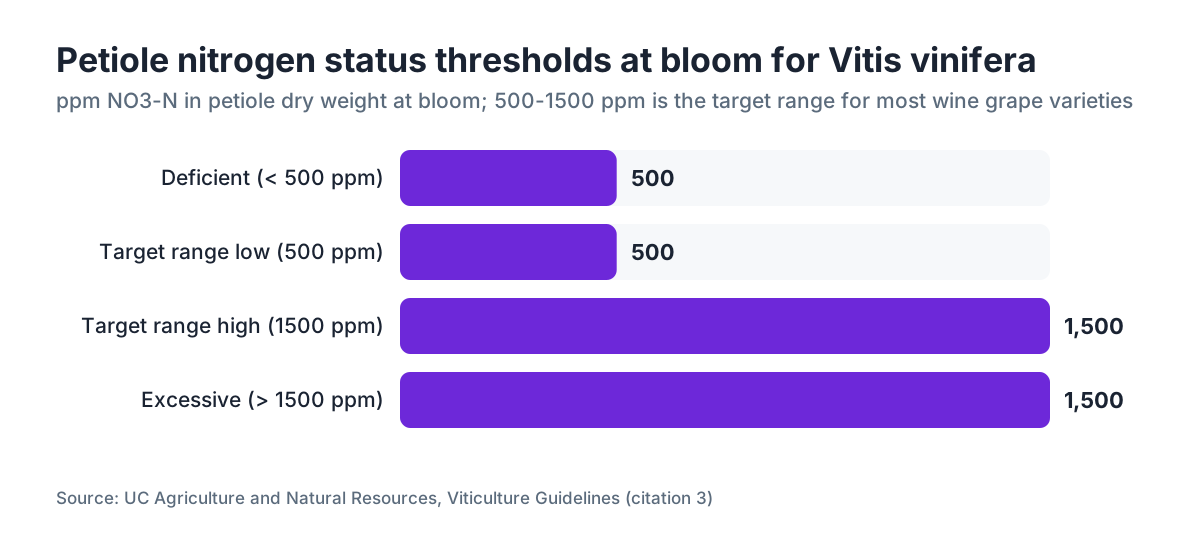
For tissue testing, the standard in most North American wine regions is petiole sampling at bloom (opposite the basal cluster) and again at veraison. UC Davis viticulture guidelines use bloom-time petiole nitrate-N as the primary nitrogen status indicator, with a target range of 500-1500 ppm NO3-N for most Vitis vinifera varieties [3]. Below 500 ppm at bloom suggests N deficiency. Above 1500 ppm suggests you may have over-applied. Collect 60-100 petioles per block, always from the same leaf position, and ship them on ice the same day.
Run both tests before your first plan year, then run tissue tests every year and soil tests every 2-3 years. That cadence balances cost against useful data.
How do you set nutrient targets for your specific vineyard?
Target-setting is where the plan becomes yours rather than a generic template. You're working from three inputs: your soil test results, your tissue test results, and your yield history.
Start with nitrogen because it drives vine vigor and draws the most regulatory scrutiny. A common rule of thumb, cited in Cornell Cooperative Extension viticulture guidelines, is that grapevines remove roughly 5-8 lbs of nitrogen per ton of fruit harvested, plus whatever is retained in permanent vine structure and lost to cover crop competition [4]. So a block averaging 4 tons per acre needs somewhere between 20 and 32 lbs N per acre per year from all sources, including irrigation water, organic matter mineralization, and applied fertilizers. That range is wide on purpose. Your soil's organic matter level, your irrigation source's nitrate load, and your cover crop species all shift where you land within it.
For phosphorus and potassium, grapevines ask less than annual crops do. But potassium deficiency is the most common major nutrient problem in California wine grapes, and it hits berry color and acid balance [3]. If your soil test shows exchangeable K below 150 ppm in the top 12 inches, plan a soil application. Foliar K at veraison is an option if you've been caught short, but it's a band-aid, not a fix.
Micronutrients like boron, zinc, and iron belong in the plan's notes section with trigger thresholds, not calendar applications. Apply only when tissue or soil data confirms a deficiency. Boron on vines that aren't deficient can push you into toxicity range fast, especially on sandy soils.
A simple table keeps your targets straight.
| Nutrient | Soil Test Threshold (deficient) | Tissue Test Threshold (deficient at bloom) | Typical Application Rate |
|---|---|---|---|
| Nitrogen | < 0.1% organic matter proxy | < 500 ppm petiole NO3-N | 20-40 lbs N/ac/yr |
| Potassium | < 150 ppm exch. K | < 1.5% DW petiole K | 40-100 lbs K2O/ac |
| Phosphorus | < 15 ppm Olsen P | < 0.1% DW petiole P | 20-50 lbs P2O5/ac |
| Boron | < 0.5 ppm | < 25 ppm DW petiole B | 0.5-1.0 lb B/ac foliar |
| Zinc | < 0.5 ppm DTPA | < 15 ppm DW petiole Zn | 0.5-1.5 lbs Zn/ac foliar |
Thresholds above come from UC Cooperative Extension and Cornell guidelines [3][4]. Always check your specific tissue lab's reference ranges, because some labs calibrate their critical values differently.
How do you time nutrient applications to the vine's growth cycle?
Timing matters as much as rate. Vines move through distinct phenological stages, and their nutrient uptake changes hard across those stages.
Nitrogen uptake peaks between bud break and bloom, then again briefly around veraison. The classic split-application approach for fertigated vineyards delivers 60-70% of the seasonal N budget between bud break and fruit set, then holds off through berry development to avoid pushing excessive canopy growth late, then applies the remaining 30-40% at or just after veraison to build reserves before dormancy. For dry-fertilized vineyards, one pre-budbreak soil application (February to March in most regions) plus one post-harvest application works for most blocks.
Potassium applied as a soil amendment needs time to move into the root zone, so fall or early spring applications beat a summer scramble. If you fertigate, split K applications are fine and give you flexibility.
Boron, if needed, works best as a foliar at pre-bloom (two-leaf stage to early bunch elongation) because it directly supports pollen viability. Zinc foliar is most effective at bud swell to two-inch shoot stage.
Document your planned timing windows in the plan, more than the rates. When something goes wrong with fruit set or berry development, being able to look back and confirm when you actually applied versus when you planned to is how you diagnose the problem the next year.
What application methods work best and how do you choose between them?
You have four practical delivery options: dry broadcast, dry banded, fertigation through drip or micro-sprinkler, and foliar spray. Each has a real place in a plan.
Dry broadcast is the simplest and works well for phosphorus and potassium corrections, which need to build in the soil over time anyway. The catch is that surface-applied nutrients move down slowly, so you may wait one to two seasons before you see full uptake in deeper-rooted vines.
Fertigation is the most precise option for nitrogen. You can split applications finely, track your rate per irrigation event, and keep records without much effort. It needs a working injection system and clean water to avoid clogging emitters. If you're already running a solid drip system, there's almost no reason not to fertigate your N.
Foliar applications are fast and sidestep soil chemistry problems like pH-induced tie-up of zinc and iron. They aren't a substitute for adequate soil nutrition, but for correcting a micronutrient deficiency mid-season, they're your best tool. Keep foliar N modest, generally below 5 lbs actual N per application, to avoid burning foliage.
Whatever method you pick, your plan needs to name the product, the rate in pounds of actual nutrient (not pounds of product), the timing, and the application equipment. That specificity matters for your own consistency and for any audit or regulatory review.
For growers keeping field records digitally, platforms like VitiScribe can log fertigation events against block IDs and generate the application summaries you'd need for a state watershed program or a SIP (Sustainability in Practice) audit. That cuts the paperwork of maintaining a nutrient plan by a lot.
What do state and federal regulations require from a vineyard nutrient plan?
Requirements vary by state, watershed, and operation size, but a few federal rules apply broadly.
The EPA's Worker Protection Standard (WPS) doesn't regulate nutrient applications directly. It does require that pesticide applications (including some materials that double as foliar fertilizers, like copper sulfate) be documented with specific fields: crop, product, EPA registration number, date, and applicator [5]. If your nutrient plan includes any WPS-covered material, those records have to be kept for at least two years and be accessible to workers.
In California, growers in the Central Coast and Central Valley who apply nitrogen above a set threshold fall under the State Water Resources Control Board's agricultural nitrogen management requirements in the Irrigated Lands Regulatory Program. In practice, this means tracking nitrogen applied and removed in harvested fruit, and being able to show your plan is based on agronomic need [1].
Washington State's nutrient management requirements run mainly through NRCS and local conservation districts, especially for operations taking cost-share funds. WSU Extension publishes a detailed guide keyed to NRCS practice standard 590 (Nutrient Management), which sets the structure most formal plans in the state follow [2].
Cornell's Extension viticulture team has produced resources for New York's agricultural environmental management (AEM) program, which uses nutrient management planning as a tier in its farm assessment framework [4].
If you're not sure what applies to you, the fastest path is to call your local NRCS office or county farm bureau. They can tell you whether any regulatory program covers your acreage, and in many cases they'll cost-share the planning work itself.
How do you document applications and track nutrient budgets over time?
Documentation is what separates a plan you wrote from a plan you actually followed. The minimum records a working plan needs: date of application, block or field ID, product name and formulation, pounds of actual nutrient applied per acre, application method, applicator name, and weather conditions at time of application (relevant if you're foliar spraying).
For nitrogen, track your seasonal N budget as a running total and compare it to your target at season's end. If you applied 45 lbs N per acre against a 30 lb target, next year's plan needs to explain why, whether it was a yield adjustment, a deficiency correction, or a plain error.
A simple spreadsheet works. A paper field log works. What doesn't work is reconstructing applications from fertilizer purchase receipts at audit time, which is the most common failure mode for small operations.
Post-season, lay your application records next to your tissue test results from that season. Did bloom petiole N come in above your target range despite a conservative application rate? Your irrigation water may carry more nitrate than you realized. Below target despite what felt like adequate applications? Your soil may be immobilizing more N than expected, or a cover crop is competing harder than you thought. These comparisons are the whole point of keeping records. They make next year's plan smarter.
How often should you update the plan and what triggers a revision?
At minimum, review and re-sign your plan every year. Update the actual content when any of these happen: you change your yield target by more than 0.5 tons per acre, you change irrigation infrastructure, you change your cover crop species, you get soil or tissue results outside your established ranges, or you change ownership or management structure.
A three-year cycle for full soil sampling, with annual tissue testing, is the cadence most extension programs use and what NRCS practice standard 590 typically requires for cost-share compliance [2]. Some growers run soil tests every five years on stable, well-understood blocks, which is defensible if your tissue data stays flat. Going past five years is hard to justify to an auditor.
When you update, keep the prior version. Regulatory programs generally want to see your plan's history, more than where you stand today. A file folder or a digital record with dated versions covers this without any special system.
What does a first-year nutrient management plan actually look like?
Here's the functional, bare-minimum first-year plan. This isn't a template. It's a description of the content that needs to be there.
Page one: property information (operation name, address, APN or parcel number), a map showing block boundaries and soil types, and the signature of the plan's author with date.
Page two: soil and tissue test results from the most recent sampling, with the lab name, sample date, and sample depth noted. No tissue data yet because it's your first season? Note that and commit to a sampling date.
Page three: nutrient targets by block, listed as pounds of actual nutrient per acre per year, with the agronomic basis stated (yield goal, test result, or extension recommendation). This is where you cite your source, whether it's a UC Cooperative Extension publication, a Cornell guideline, or a consultant recommendation.
Page four: application schedule showing the planned product, rate, timing (phenological stage or calendar window), and method for each nutrient in each block.
Page five onward: blank application log pages (or a reference to your digital recordkeeping system) for recording actual applications as they happen.
That's it for year one. It doesn't have to be pretty. It has to be accurate, dated, and used.
For operations running multiple blocks or juggling compliance with a watershed program, VitiScribe lets you log nutrient applications block by block and pull seasonal summaries without building your own spreadsheet system. That matters most when you have 10 or more distinct blocks and the per-block record trail gets tedious to keep up by hand.
How do cover crops and organic amendments factor into your nitrogen budget?
Cover crops complicate nitrogen accounting more than most growers expect, and in both directions.
A legume cover crop (vetch, bell bean, clover) can fix 50-150 lbs of atmospheric nitrogen per acre per year depending on species, seeding rate, soil moisture, and termination timing [6]. If you're growing a legume mix and terminating it with a mow or tillage pass at early bloom, a big share of that fixed N mineralizes into plant-available form over the summer. Ignore this in your nitrogen budget and you're almost certainly over-applying from purchased fertilizer.
A grass-dominant cover crop (rye, oat, fescue) does the opposite. Grasses run a wide carbon-to-nitrogen ratio, and as they break down they temporarily tie up mineral N from the soil. That can suppress vine N uptake if you're not accounting for it, especially in the first six to eight weeks after incorporation.
Compost and manure carry real N loads too. A typical yard-waste compost at 3 tons per acre delivers roughly 30-60 lbs of total N, of which maybe 10-20% mineralizes in the first growing season [6]. The rest is slow-release carry-over. Your plan should note compost applications with the product's analysis (request a certificate of analysis from your supplier) and apply a conservative mineralization rate.
Washington State University Extension publishes specific guidance on estimating cover crop N credits for Pacific Northwest viticulture, and UC Cooperative Extension has comparable guides for California conditions [2][3]. Use the guide written for your region's soil temperatures and rainfall, because mineralization rates differ a lot between, say, the Willamette Valley and the Central Valley.
What common mistakes do growers make when writing their first nutrient plan?
The biggest mistake is writing the plan to match what you've already been doing instead of what the data says you should do. A plan that just ratifies existing practices with no baseline soil or tissue data isn't a management plan. It's a retrospective diary, and it won't help you improve or satisfy an auditor.
Second most common: setting a single nutrient target for the whole ranch without accounting for block-level variation. A block on shallow sandy loam and a block on deep clay loam have completely different potassium availability and nitrogen retention profiles. Treat them the same and you waste money on one while starving the other.
Third: confusing product pounds with nutrient pounds. A 50-lb bag of 16-4-8 fertilizer contains 8 lbs of actual N (16% of 50), 2 lbs of actual P2O5, and 4 lbs of actual K2O. Your plan should always express rates in actual nutrient pounds, then convert to product pounds for purchasing. Mixing these up is how growers accidentally apply double their intended rate.
Fourth: ignoring irrigation water quality. In many wine regions, irrigation water from surface or groundwater sources carries measurable nitrate, sometimes enough to supply a meaningful slice of your annual N budget. Run 24 inches of irrigation per season with water that tests at 10 ppm NO3-N, and that's roughly 5 lbs of N per acre per year you didn't pay for from a bag [7]. Get your irrigation water tested at least once. It's a $20-30 test and most growers never bother.
Frequently asked questions
How much does it cost to get soil and tissue tests done for a vineyard?
A standard soil test panel (pH, organic matter, macro and micronutrients) runs roughly $25-60 per sample at most commercial ag labs. A petiole tissue test runs $20-45 per sample. For a 20-acre vineyard with two distinct soil types, figure $150-300 for a complete baseline sampling including both soil depths and one tissue pull. UC Cooperative Extension keeps a list of accredited labs by state.
Do I need a certified crop adviser (CCA) to write a vineyard nutrient plan?
In most states you don't legally need a CCA unless your operation falls under a specific regulatory program that requires a licensed preparer. California's Irrigated Lands Regulatory Program lets growers self-certify a nitrogen management plan in many watershed groups. That said, a CCA who knows your region and variety can catch problems you'd miss in a first draft, and their fee ($500-1,500 for a small operation plan) often pays for itself in avoided over-applications.
What's the difference between a nutrient management plan and a fertilizer program?
A fertilizer program is the list of products, rates, and timing you plan to use. A nutrient management plan includes that program but also documents your baseline data (soil and tissue tests), your yield-based targets, your regulatory compliance rationale, and your application records. The plan is the whole system. The fertilizer program is one piece of it.
How do I account for nitrogen already in my irrigation water?
Get your irrigation water tested for nitrate-N (reported as ppm NO3-N). Multiply ppm by 0.226 to get lbs of actual N per acre-inch of water applied. Multiply that by your seasonal inches of irrigation. Subtract the result from your planned fertilizer N budget. At 10 ppm NO3-N and 24 acre-inches of irrigation, you're getting about 5.4 lbs of free N per acre, worth accounting for.
Can I use the same nutrient plan across different varieties on the same ranch?
Variety differences in nutrient demand are real but usually secondary to soil and rootstock differences. You can use one plan structure with block-level adjustments rather than a completely separate plan per variety. The main variety-driven adjustment is N rate: high-vigor varieties or blocks on vigorous rootstocks like 110R or 140Ru typically need 20-30% less applied N to avoid excessive vegetative growth compared to low-vigor plantings.
What records do I need to keep and for how long?
Under the EPA Worker Protection Standard, pesticide application records (which includes some dual-use fertilizer/pesticide products) must be kept for two years [5]. California's Irrigated Lands Regulatory Program requires nitrogen application records for at least three years. As a practical matter, keep everything for five years. Store soil test reports, tissue test reports, product receipts, and your application log together, either in a physical file or a digital system.
How do potassium deficiency symptoms show up in grapevines and what does the plan do about it?
Potassium deficiency shows up as marginal leaf scorch (necrotic edges) on older leaves in mid-summer, reduced berry color in red varieties, and lower titratable acidity at harvest. If tissue tests at bloom show petiole K below about 1.5% dry weight, build a soil K application into that block's next-season plan. Exchangeable K below 150 ppm in soil tests also triggers a soil amendment, typically potassium sulfate at 100-200 lbs per acre.
How does a nutrient management plan interact with organic certification?
Organic certification under the USDA National Organic Program requires that all materials used are on the approved materials list (OMRI-listed or NOP-compliant). Your nutrient plan under organic management must specify only approved inputs. Synthetic nitrogen sources like urea or ammonium nitrate are prohibited. Approved N sources include compost, blood meal, feather meal, and fish emulsion. The plan structure is identical; only the allowed products change.
What extension resources are actually worth reading before writing a plan?
Three are genuinely worth your time. UC Cooperative Extension's 'Nutrient Management Guidelines for Wine Grapes' (available through the UC Agriculture and Natural Resources catalog) covers California conditions in practical detail. Cornell Cooperative Extension's viticulture team publishes guides specific to cool-climate regions and New York's AEM program. WSU Extension's 'Nutrient Management Guide for Grapes' covers Pacific Northwest conditions and follows NRCS practice standard 590.
How do I handle nutrient planning for a newly planted vineyard versus an established block?
New plantings have different priorities than mature blocks. In year one and two, the focus is on phosphorus for root establishment, zinc and boron for early shoot development, and modest N to support canopy growth without driving excessive vigor. Potassium corrections from pre-plant soil amendments are much more effective than trying to fix K after the vine's root system is established. Build a year-by-year phased plan for the establishment period rather than applying your standard mature-vine rates.
Does a vineyard nutrient management plan help with sustainability certifications?
Yes, directly. California's Sustainability in Practice (SIP) certification, the CSWA's California Sustainable Winegrowing Program, and Lodi Rules all include nutrient management as a scored practice in their audit frameworks. Having a written, data-backed plan with application records is typically worth significant points in each program's scoring. A plan built for regulatory compliance usually covers 80-90% of what sustainability auditors want to see.
What should I do if my tissue tests come back deficient mid-season when I can't do a soil application?
Mid-season deficiencies caught in tissue tests get addressed with foliar applications. Nitrogen foliar (urea solution at 5-10 lbs actual N per acre) can correct mild in-season N shortfalls. Zinc and boron foliars are most effective early in the season but still have some utility through veraison. Iron chlorosis mid-season is harder: foliar iron chelates (EDDHA form) can green up leaves temporarily, but fixing iron chlorosis durably requires a soil pH correction or rootstock change over the longer term.
Sources
- California State Water Resources Control Board, Irrigated Lands Regulatory Program: California's Irrigated Lands Regulatory Program requires growers in many watersheds to document nitrogen applied versus nitrogen removed in harvested crops.
- Washington State University Extension, Nutrient Management Guide for Grapes: WSU Extension recommends a minimum of one composite soil sample per distinct soil type or management zone, each made from 15-20 individual cores, and references NRCS practice standard 590 for formal plan structure.
- University of California Agriculture and Natural Resources, Viticulture Research and Extension: UC Davis viticulture guidelines use bloom-time petiole nitrate-N as the primary nitrogen status indicator, with a target range of 500-1500 ppm NO3-N for most Vitis vinifera varieties; potassium deficiency is identified as the most common major nutrient problem in California wine grapes.
- Cornell Cooperative Extension, Viticulture and Enology (Cornell AgriTech): Cornell Cooperative Extension viticulture guidelines cite 5-8 lbs of nitrogen removed per ton of fruit harvested as a basis for annual N budget calculations.
- U.S. EPA, Agricultural Worker Protection Standard (WPS): The EPA Worker Protection Standard requires pesticide application records including crop, product, EPA registration number, date, and applicator to be kept for at least two years and be accessible to workers.
- UC Cooperative Extension, Irrigation Water Quality for Agriculture: Multiplying ppm NO3-N by 0.226 converts irrigation water nitrate concentration to lbs of actual N per acre-inch applied; irrigation water nitrate can supply a meaningful fraction of annual vine N budget.
- USDA Agricultural Research Service, Cover Crop Nitrogen Contributions: Legume cover crop nitrogen fixation rates of 50-150 lbs N per acre per year are supported by USDA ARS research on field legume species.
- USDA National Organic Program, Allowed and Prohibited Substances: Organic certification under the USDA National Organic Program prohibits synthetic nitrogen sources such as urea and ammonium nitrate; approved sources include compost, blood meal, feather meal, and fish emulsion.
- California Sustainable Winegrowing Alliance, SIP Certified Program: California's Sustainability in Practice (SIP) certification includes nutrient management as a scored practice and requires a written, data-backed plan with application records.
Last updated 2026-07-11