Rootstock susceptibility notes in vineyard management records

TL;DR
- Rootstock susceptibility notes belong in every block-level vineyard record.
- They track known weaknesses to phylloxera biotypes, nematodes, soil pathogens, drought, and salt, and they shape spray schedules, irrigation, and replanting choices.
- Skip them and a new manager inherits a block with no idea why certain rows fail or which rootstock problem is quietly spreading through the vineyard.
Why do rootstock susceptibility notes matter in vineyard records?
Most vineyard managers track what they planted and when. Very few record why a rootstock might fail. That gap turns into a real problem the moment a block starts underperforming, a new pest pressure shows up, or someone other than the person who made the original planting call has to run the block.
Rootstock susceptibility notes connect a planting decision made fifteen years ago to the vine in front of you today. They tell you the 5C Teleki in block 7 is moderately susceptible to root-knot nematode, that the AXR#1 planted before 1990 is broadly susceptible to phylloxera biotype B [1], and that the 1103 Paulsen on the dry-farmed hillside handles drought fine but sulks with wet feet in a heavy rain year.
Without that context, a new hire or a consulting viticulturist walks into a block cold. With it, they spend their time managing instead of diagnosing.
There is a compliance angle too. The EPA Worker Protection Standard requires pesticide application records to carry site-specific information, and many state ag departments require vineyard spray records to trace back to block-level characteristics [2]. A rootstock susceptibility note tied to a block record strengthens that trail. It documents why you picked a particular fungicide rate, nematicide rotation, or irrigation regime, and that reasoning can matter during an inspection.
What rootstock characteristics should you actually record?
Keep it actionable. A note that just says "moderate nematode resistance" does almost nothing without context. The useful version names the nematode species, the rootstock, the source of the rating, and any site-specific observations.
Here are the categories worth capturing for every block:
Phylloxera biotype tolerance. Note which biotype the rootstock is rated against. AXR#1 was considered resistant to phylloxera biotype A but proved susceptible to biotype B, the dominant biotype in California [1]. If you have any AXR#1 left standing, that note is non-negotiable.
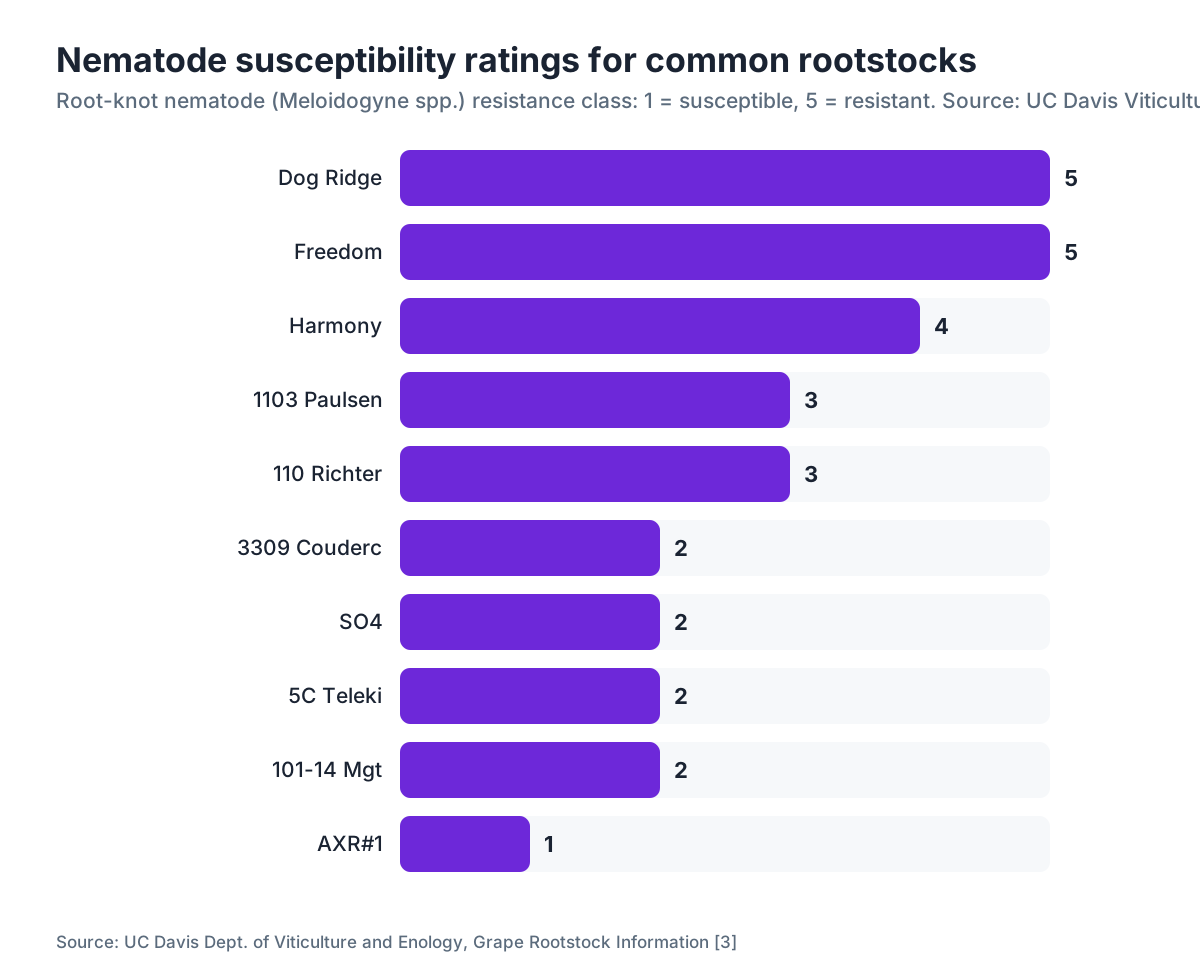
Nematode resistance. Root-knot nematode (Meloidogyne spp.) and dagger nematode (Xiphinema index, which vectors grapevine fanleaf virus) are the two that most directly drive rootstock selection. UC Davis publishes resistance ratings for common rootstocks. Dog Ridge and Freedom resist root-knot nematode well; SO4 and 5C Teleki are more susceptible [3].
Soil-borne pathogen tolerance. Armillaria (oak root fungus) and Phytophthora are worth noting where they're known or suspected. No commercial rootstock is immune to Armillaria, but some show more tolerance than others.
Abiotic stress tolerance. Drought tolerance, wet-soil tolerance, salinity tolerance, and lime-induced chlorosis susceptibility all live here. 110R and 1103 Paulsen handle dry conditions well. Riparia Gloire struggles with drought and lime. 420A is lime-tolerant. These are agronomic facts, not opinions, and recording them ties your irrigation and fertilization to documented rootstock physiology [4].
Vigor. High-vigor rootstocks like Ramsey (Salt Creek) or Dog Ridge can push a scion into runaway vegetative growth on fertile, irrigated sites. If you've had to fight that, note it.
Observed field performance. This is the part no published table gives you. If the 3309C in block 12 has shown early-season yellowing three years running, write it down with a date. That observation, sitting next to the published ratings, is what turns a hunch into a diagnosis.
What are the phylloxera susceptibility ratings for common rootstocks?
Phylloxera is the reason rootstocks exist at all. Getting the ratings right in your records is not a formality.
The table below summarizes published phylloxera susceptibility data for rootstocks commonly planted in the western U.S. Ratings come from UC Cooperative Extension and Washington State University Extension publications [1][5].
| Rootstock | Phylloxera biotype A | Phylloxera biotype B | Notes |
|---|---|---|---|
| AXR#1 | Resistant | Susceptible | Widespread failure in CA in 1980s-90s [1] |
| SO4 | Resistant | Resistant | Widely planted in CA |
| 5C Teleki | Resistant | Resistant | Common in PNW |
| 3309 Couderc | Resistant | Resistant | Common in cool climates |
| 101-14 Mgt | Resistant | Resistant | Vigorous in wet soils |
| 110 Richter | Resistant | Resistant | Drought-tolerant sites |
| 1103 Paulsen | Resistant | Resistant | Deep-rooted, dry sites |
| 140 Ruggeri | Resistant | Resistant | High lime tolerance |
| Dog Ridge | Resistant | Resistant | Very high nematode resistance |
| Own-rooted vinifera | Susceptible | Susceptible | No protection |
The AXR#1 collapse is the most documented rootstock failure in U.S. viticulture history. Phylloxera biotype B overcame AXR#1's resistance and forced the replanting of an estimated 25,000 acres in Napa and Sonoma counties during the 1990s [1]. If you have any own-rooted blocks or any AXR#1 remaining, that note belongs at the top of every block record.
Biotype B has since turned up in Oregon and Washington as well [5]. Your notes should reflect which biotype has been confirmed in your county, more than which biotypes exist in the literature.
How do nematode resistance ratings work and where do you find them?
Nematode resistance in rootstocks is not binary. It shifts with nematode species, soil population density, and soil texture. A rootstock rated resistant to Meloidogyne incognita can still show damage at very high populations or in sandy, warm soils that favor nematode activity.
The UC Davis Department of Viticulture and Enology publishes rootstock nematode resistance ratings in its Grape Rootstock Information document, one of the most cited resources in U.S. viticulture [3]. The ratings run from susceptible to resistant with intermediate categories, and they cover root-knot nematode (Meloidogyne spp.), ring nematode (Criconemella xenoplax), and dagger nematode (Xiphinema index).
For block records, the minimum useful entry reads like this: "Rootstock: 5C Teleki. Root-knot nematode resistance: low-moderate (UC Davis rating). Pre-plant soil sample 2019: 140 Meloidogyne spp. per 500 cc soil. Annual monitoring recommended."
That single line hands the next manager three things: the published baseline, the actual soil population at planting, and a directive. UC Davis extension guidance recommends re-evaluating nematode pressure every three to five years, because populations shift with irrigation and cover crop management [3].
Washington State University Extension publishes similar ratings for PNW rootstocks, with attention to species like Pratylenchus penetrans (lesion nematode) that show up more in the Pacific Northwest than in California [5].
How should rootstock susceptibility notes be structured in block records?
Structure matters because records get searched, audited, and handed off. A susceptibility note buried in a PDF attachment nobody can find does almost no work.
The format that actually functions ties the note directly to the block identifier. Spreadsheet, farm management platform, or paper binder, the block ID is the key, and every susceptibility category gets its own field instead of a paragraph of prose.
A workable block-level record for rootstock susceptibility includes:
- Block ID and acreage
- Rootstock variety (with certified source and year planted)
- Phylloxera susceptibility: biotype A rating, biotype B rating, source of rating, date confirmed
- Nematode susceptibility: species, rating, source, pre-plant soil test result and date
- Abiotic stress notes: drought tolerance class, salinity threshold, lime tolerance (with source)
- Observed field anomalies: date, symptom, row or vine numbers affected
- Replanting flag: yes/no, reason, target date
Tools like VitiScribe are built around exactly this block-level structure, which makes it easier to tie susceptibility records to spray decisions and generate the documentation a state ag department or GAP auditor wants to see.
The discipline that matters most is separating published ratings from field observations. Both belong in the record, but they carry different evidentiary weight. A published UC Davis resistance rating is a general guide. A field observation of nematode-associated vine decline in rows 14-22 of block 5 across two consecutive seasons is site-specific evidence that something is happening right there.
What does the EPA Worker Protection Standard require for vineyard block records?
The WPS doesn't require rootstock susceptibility notes by name. It does require pesticide application records detailed enough to show why an application was made, what site conditions existed, and who was responsible [2]. A note that links a nematicide application to a documented nematode problem in a specific block is the kind of record that makes an inspection go smoothly.
Under the WPS (40 CFR Part 170, revised in 2015), agricultural employers must keep application-specific records including the product name, EPA registration number, active ingredient, application location, date and time, and the name of the certified applicator [2]. Site-specific block characteristics aren't explicitly required, but they're the logical foundation for the application decision.
Several states go further. California's DPR requires pesticide use reports that link every restricted-materials application to a site identifier [10]. That site identifier, in a well-built record system, maps to your block record, which carries your rootstock susceptibility notes. The chain runs from the susceptibility problem to the treatment decision to the report. Break any link and you've left a gap that a county agricultural commissioner's office will notice.
Cornell Cooperative Extension has published a WPS compliance guide for grape growers that recommends keeping block-level records covering soil type, pest history, and site characteristics, all of which rootstock susceptibility notes address [6].
How often should you update rootstock susceptibility notes?
Published resistance ratings change slowly. A UC Davis or WSU rating for a given rootstock-pest pairing might hold for a decade before new research moves it. Your field observations are different. Update those annually, at minimum after each season's scouting.
The practical rhythm is simple. Review published ratings every three to five years, or whenever a major extension publication updates. Update field observations at the end of every growing season. Flag any block showing new symptoms right away, not at year-end.
Pest populations move. A block with no economically significant nematode pressure at planting can cross the damage threshold within ten years if irrigation practices change, if a cover crop introduces organic matter that favors nematode reproduction, or if a neighboring block gets fumigated and pushes nematodes your way. Soil temperature and vine age also change how visible the damage gets.
For phylloxera, the update trigger is usually external: a confirmed detection of a new biotype in your county, a change in California DPR or Oregon Department of Agriculture guidance, or visible vine decline that a soil sample or root inspection traces to phylloxera. At that point, the susceptibility note in your block record becomes your documentation that you knew, or should have known, about the risk.
One honest limitation. Nobody has great data on exactly how fast biotype B spreads through a commercial vineyard once it's established. The closest published estimates put the lag between establishment and visible decline at five to twelve years in AXR#1 blocks [1], which is a big part of why proactive record-keeping beats reactive documentation.
How do rootstock susceptibility records support replanting decisions?
Replanting is the most expensive decision a vineyard makes. Rootstock susceptibility records turn that decision from a guess into a plan you can defend.
When vine performance declines, the suspect list is long: virus load, water stress, nutrient deficiency, trunk disease, or rootstock failure. A block record with historical susceptibility notes, soil test results, and field observations lets you rule out causes one at a time instead of replanting and praying the new rootstock dodges the same problem.
Say your block record shows SO4 rootstock, a nematode-susceptible rating, a pre-plant soil sample with high Meloidogyne populations, no pre-plant fumigation, and progressive vine decline starting in the rows with lighter soil. Now you have a story. That story drives the replant choice: probably Dog Ridge or Freedom under a clean-up fumigation program, with a post-plant monitoring protocol.
Without the record, you're guessing. With it, you're managing.
The money is real. UC Cooperative Extension's 2023 cost study for Napa County estimated vineyard establishment at roughly $85,000 to $120,000 per acre for a full replant, depending on land preparation, trellis system, and vine costs [7]. A rootstock choice that fails again because nobody recorded the nematode pressure from the first planting is an avoidable disaster at that price.
Replant records should carry forward the susceptibility notes from the prior planting, with a line on what changed: different rootstock, pre-plant fumigation, cover crop rotation. That builds a record that runs across plantings, which is exactly what a future block manager will need.
What rootstock traits are most commonly misrecorded or left out of vineyard records?
In practice, these are the entries that go missing most often:
The source of the resistance rating. "Good nematode resistance" means nothing if you don't know whether it came from a UC Davis publication, a nursery salesperson, or a neighbor over the fence. Write down the source and the year.
The biotype for phylloxera resistance. Plenty of older records just say "phylloxera resistant" without naming the biotype. After the AXR#1 collapse, that omission is inexcusable.
Field observations with specific locations. "Some vines look weak" is useless. "Rows 8-14, block 3, showing early-season chlorosis and small berry size for third consecutive season; leaf analysis pending" is actionable.
The date of the observation. Undated notes are almost worthless for tracking progression.
Abiotic stress data. Drought and salinity tolerance get left off block records all the time, even though they drive irrigation scheduling and fertilization directly.
Rootstock certified source documentation. Knowing the plant material came from a certified nursery instead of a cuttings exchange matters for virus load and variety verification. UC Davis Foundation Plant Services certifies grape planting material, and that certification should appear in your block record [8].
Where can you find reliable rootstock susceptibility data?
The three most authoritative sources for U.S. commercial viticulture are UC Davis, Cornell Cooperative Extension, and Washington State University Extension. Each publishes rootstock guides tuned to its regional pest profile.
UC Davis Viticulture and Enology's rootstock resources cover phylloxera, nematodes, soil characteristics, and abiotic stress for California conditions [3][4]. Its Foundation Plant Services program is the source for certified, tested planting material, and its publications are the most frequently cited in California DPR proceedings [8].
Cornell Cooperative Extension covers rootstocks relevant to the Northeast, including cold-injury resistance and tolerance to the higher-organic-matter soils common in New York and Pennsylvania [6]. Its viticulture resources are useful for documenting ringspot virus vectors, where Xiphinema americanum is the relevant species rather than X. index.
WSU Extension covers Pacific Northwest conditions, including Pratylenchus penetrans tolerance and cold-hardiness ratings for rootstocks used in eastern Washington and Oregon [5].
The most current peer-reviewed summaries run in the American Journal of Enology and Viticulture, which publishes rootstock trial data from university programs across the country [9]. For a specific numeric rating, go back to the primary publication rather than a secondary summary. Summaries tend to flatten the nuance.
For regulatory context, the EPA's WPS page and your state's department of agriculture website are the right starting points for what site-specific documentation a pesticide application requires [2].
When you build out block records in a platform like VitiScribe, link directly to the publication behind each rating. It saves real time during audits. A citation in the record is worth more than a number with no provenance behind it.
What's a practical template for rootstock susceptibility notes?
Here's a working template you can adapt. It's not the only format that works, but every field in it earns its place.
Block Rootstock Susceptibility Record
Block ID: _____________ Acres: _____
Rootstock variety: _____________ Year planted: _____
Certified source: _____________ (nursery + cert program)
Biotic Stress Susceptibility
| Pest / Pathogen | Rating | Source | Date Confirmed |
|---|---|---|---|
| Phylloxera biotype A | |||
| Phylloxera biotype B | |||
| Root-knot nematode (Meloidogyne spp.) | |||
| Dagger nematode (Xiphinema index) | |||
| Ring nematode | |||
| Armillaria | |||
| Phytophthora |
Abiotic Stress Tolerance
| Factor | Rating / Threshold | Source |
|---|---|---|
| Drought tolerance | ||
| Wet-soil tolerance | ||
| Salinity threshold (EC, dS/m) | ||
| Lime tolerance | ||
| Vigor class |
Pre-plant Soil Data
Sample date: _____ Lab: _____
Meloidogyne count (per 500 cc soil): _____
Xiphinema count: _____
Pre-plant fumigation: Yes / No. Product: _____ Date: _____
Field Observations (update annually)
Date | Observation | Rows / vines | Action taken
___ | ___ | ___ | ___
Replanting Flag
Status: Active / Watch / Scheduled replant
Replant target date: _____ Reason: _____
Proposed replacement rootstock: _____ Rationale: _____
This format works on paper, in a spreadsheet, or as the data model for a digital record system. The goal is that anyone picking it up cold understands what the block is, what its known weaknesses are, and what's actually been seen in the dirt.
Frequently asked questions
Do I legally have to keep rootstock susceptibility notes in my vineyard records?
No federal law requires rootstock susceptibility notes by name. But the EPA Worker Protection Standard requires pesticide application records that document site conditions, and California DPR's pesticide use reporting system links applications to site identifiers. States with restricted-materials permits often require documented justification for applications, which susceptibility notes support directly. They're not mandated on their own, but they're what makes your other required records defensible.
What is AXR#1 and why does it come up so often in rootstock records?
AXR#1 (Aramon x Rupestris Ganzin #1) was widely planted in California from the 1960s through the late 1980s because it was productive and compatible with many Vitis vinifera varieties. It proved susceptible to phylloxera biotype B, which spread through Napa and Sonoma vineyards starting in the 1980s and forced an estimated 25,000 acres of replanting. If any AXR#1 remains in your blocks, that susceptibility should be the first line in the block record.
How do I find out what rootstock is in a block if nobody recorded it?
Start with nursery invoices, historical maps, or previous owner records. If those are gone, UC Davis Foundation Plant Services and some commercial labs offer DNA-based rootstock identification from vine tissue. An experienced viticulturist can sometimes make a confident field ID from growth habit, leaf shape, and root sampling. It's slow and imperfect, but it beats leaving the field blank in your record.
What's the difference between resistance and tolerance in rootstock susceptibility ratings?
Resistance means the rootstock actively inhibits pest reproduction or pathogen establishment, usually through a genetic mechanism. Tolerance means the vine carries the pest or pathogen but shows little damage at typical field populations. The distinction matters because a tolerant rootstock can still harbor and pass a pest to adjacent vines or an incoming crop rotation. Always note which term the source uses, because researchers aren't consistent about it.
How do salinity tolerance ratings translate into irrigation management decisions?
Rootstock salinity tolerance is usually given as a threshold electrical conductivity (EC) in the saturation extract, measured in decisiemens per meter (dS/m). Dog Ridge tolerates soil EC up to roughly 8-10 dS/m; SO4 is more sensitive, with yield impacts starting around 4-5 dS/m. If your irrigation water or soil sits above your rootstock's threshold, document that in the block record alongside your leaching fraction decisions. UC Davis extension publications give these thresholds for common rootstocks.
Can rootstock susceptibility to fanleaf virus be controlled through rootstock selection?
Partially. Grapevine fanleaf virus is transmitted by dagger nematode (Xiphinema index), and some rootstocks show lower X. index reproduction, which slows but doesn't stop virus spread. No commercial rootstock is immune to GFLV infection once X. index populations are established. The most reliable control is pre-plant soil fumigation plus a multi-year fallow. Document any GFLV-positive test results in your block record next to the rootstock's X. index tolerance rating.
How does rootstock vigor affect spray program decisions?
High-vigor rootstocks like Ramsey or Dog Ridge push dense canopy growth, which cuts spray penetration and raises powdery mildew and botrytis pressure. If your block record notes a high-vigor rootstock, your spray program should document the canopy response: shoot positioning frequency, leaf pulling timing, and any adjusted spray volume or interval. Recording the link between vigor and spray decisions gives you an auditable reason for rates that might otherwise look off.
What should I do when published resistance ratings conflict between UC Davis and WSU Extension?
Record both ratings and note the discrepancy. Resistance ratings are population and environment-specific. A rootstock's performance against Meloidogyne incognita in the San Joaquin Valley can differ from its performance against M. hapla in eastern Washington, because the species, soil temperature, and nematode genetics are all different. When ratings conflict, weight the source closest to your site geographically and climatically, and flag the block for direct soil monitoring instead of relying on the published number alone.
How do I document rootstock susceptibility for a block with mixed rootstocks?
Create a separate susceptibility record for each rootstock present, tied to the specific rows or sub-blocks where each is planted. Mixed-rootstock blocks are common in older vineyards where replanting happened row by row. The record should map which rootstock sits where, because a nematode problem in the SO4 rows might not touch the adjacent 110R rows the same way, and your soil sampling plan needs to reflect that.
What role do cover crops play in rootstock susceptibility management, and should that go in the record too?
Yes, cover crops belong in the block record next to rootstock susceptibility notes. Some cover crop species host Meloidogyne spp. and can build nematode populations even while the rootstock is dormant. Cereal rye and sudangrass are generally nematode-suppressive; legumes can host root-knot nematode depending on the species. Recording your cover crop rotation alongside the rootstock's nematode rating lets you catch practices working against each other.
How often should I run soil nematode samples in a block with a susceptible rootstock?
UC Davis recommends annual sampling for blocks with known nematode pressure or susceptible rootstocks, taken in late fall when populations concentrate near the root zone. For blocks with resistant rootstocks and no nematode history, every three to five years is reasonable. After any replant or soil fumigation, sample in years one, three, and five post-plant to track population recovery. Record every sample date, lab, and result in the block file.
Is there a standardized national rating system for rootstock resistance across all pest types?
No. The U.S. has no single national rootstock rating system. UC Davis, Cornell, and WSU each publish their own scales using different terminology and numbers. The closest thing to a national reference is research published in the American Journal of Enology and Viticulture, and even that synthesizes studies run with different methods. When building block records, always note which institution's scale you're using, because a rating of '3 out of 5' means nothing without the scale behind it.
What happens to rootstock susceptibility records during a vineyard sale or lease transfer?
They should transfer with the property as part of the vineyard's operational file. In practice many don't, which is exactly why the AXR#1 problem caught so many incoming managers off-guard. If you're buying or leasing a vineyard, insist on block records with planting histories and any known susceptibility or pest detection data as a due-diligence item. If those records don't exist, budget for soil sampling and DNA-based rootstock identification before you make any replanting decisions.
Sources
- UC Cooperative Extension, 'Phylloxera: A New Strain Attacks California Grapevines', ANR Publication: AXR#1 was susceptible to phylloxera biotype B, forcing replanting of an estimated 25,000 acres in Napa and Sonoma counties in the 1990s
- U.S. EPA, Agricultural Worker Protection Standard (WPS), 40 CFR Part 170: WPS requires pesticide application records to document site-specific information including applicator name, location, product, and date
- UC Davis Department of Viticulture and Enology, Grape Rootstock Information: UC Davis publishes nematode resistance ratings for common rootstocks, including Meloidogyne spp. and Xiphinema index, and recommends re-evaluating nematode pressure every three to five years
- UC Agriculture and Natural Resources, 'Rootstocks for California Viticulture': Abiotic stress tolerance ratings including drought, salinity, and lime tolerance are published for commonly planted California rootstocks
- Washington State University Viticulture and Enology Extension: WSU Extension publishes rootstock resistance and cold-hardiness ratings for Pacific Northwest conditions, including Pratylenchus penetrans tolerance, and biotype B phylloxera has been detected in Oregon and Washington
- Cornell Cooperative Extension, Viticulture Program, WPS Compliance Guide for Grape Growers: Cornell Cooperative Extension recommends keeping block-level records including soil type, pest history, and site characteristics to support WPS compliance
- UC Cooperative Extension, 'Sample Costs to Establish a Vineyard and Produce Winegrapes, Napa County 2023': UC Cooperative Extension estimated full vineyard establishment costs in Napa Valley at approximately $85,000 to $120,000 per acre in 2023
- UC Davis Foundation Plant Services, Grape Program: UC Davis Foundation Plant Services certifies grape planting material for variety trueness and virus status; certification documentation should be included in vineyard block records
- American Journal of Enology and Viticulture, Rootstock Trial Publications: Peer-reviewed rootstock trial data including resistance ratings and field performance across U.S. viticulture regions is published in AJEV
- California Department of Pesticide Regulation, Pesticide Use Reporting: California DPR requires pesticide use reports for restricted materials applications, linking each application to a site identifier that should map to block-level vineyard records
Last updated 2026-07-09