Scouting log templates for vineyard pest monitoring and IPM compliance

TL;DR
- A vineyard scouting log records pest species, counts, location, growth stage, and the scout's name on every field visit.
- Regulators and certifiers expect logs that show you crossed an economic threshold before spraying.
- UC IPM, Cornell, and WSU all publish free templates.
- The minimum viable log fits on one page per block, and it should tie directly to your spray record.
What is a vineyard scouting log and why do regulators care about it?
A scouting log is a dated field record. It captures who walked which block, what pest or disease they found, how many they counted, and what the crop stage was at the time. That's the core. Nothing fancy.
Regulators care because IPM, integrated pest management, is built on the idea that you spray when evidence says you need to, not on a calendar. The EPA's National Roadmap for Integrated Pest Management describes IPM as using "current information on the life cycles of pests and their interaction with the environment" to manage pest damage [1]. A scouting log is the paper trail proving that information actually existed before you made an application decision.
For USDA organic certification, the National Organic Program requires that your Organic System Plan describe your approach to pest management. Auditors routinely ask for scouting records to verify you aren't defaulting to preventive chemical applications [2]. Without logs, you're telling a story you can't prove.
State agencies tie into this too. California's Department of Pesticide Regulation requires pest control advisors who make written recommendations to base them on field inspections, and those inspection notes are subject to audit for three years [3]. Even growers who write their own restricted-material permits are expected to show the field conditions that justified them.
Here's the point. The log isn't just an internal management tool. It's the documentation layer that sits under every spray record you'll ever need to defend.
What fields does a defensible scouting log template need to include?
There's a minimum set of fields that makes a log useful for both management decisions and compliance audits. Skip any one of them and you'll wish you hadn't.
| Field | Why it matters | Format tip |
|---|---|---|
| Date and time | Timing links scouting to phenology | MM/DD/YYYY + 24-hr time |
| Scout name | EPA WPS requires identified responsible parties | Printed name + signature line |
| Block/vineyard ID | Must match your spray record block codes | Consistent nomenclature |
| Vine growth stage (BBCH) | Thresholds are stage-specific | Use BBCH 00-99 scale |
| Pest or disease target | One line per pest observed | Latin name + common name |
| Count method | Percent infestation, per-vine count, beat tray | Write out the method used |
| Count result | Actual number or percentage found | Numeric, not "low" or "high" |
| Economic/action threshold | The threshold for that pest at that stage | Cite source (e.g., UC IPM) |
| Decision made | Spray, monitor again, no action | One of three choices |
| Next scouting date | Closes the loop | Required for certification audits |
Standardize on the BBCH scale for grapevine phenology. UC IPM, Cornell, and WSU all use it, so threshold tables published by any of those programs will line up with your records without translation [4].
One field people consistently skip: the count method. Writing "15% shoot infestation" means nothing if an auditor can't tell whether you sampled 10 vines or 100. Method goes on the log.
If you're managing under the EPA Worker Protection Standard, the scout's name on the log matters for a second reason. The WPS requires that anyone handling pesticides or entering treated areas be identified in your records [5]. Keeping scout names consistent with your training records closes that loop without extra work.
Where can I download a free vineyard scouting log template?
Three university extension programs publish scouting resources worth using directly or adapting. All of them post their material as free PDFs.
The UC IPM Grape Pest Management Guidelines, run through UC Agriculture and Natural Resources, publish pest-specific monitoring forms for leafhoppers, mealybug, spider mites, Botrytis, and powdery mildew. Each one comes with the sampling method and threshold baked in [6]. These are the most detailed and the most California-specific.
Cornell University's New York State IPM program covers the Northeast. Their vineyard scouting forms address grape berry moth, downy mildew, and phylloxera alongside the standard leafhopper and spider mite work. Cornell's forms include a useful "cumulative degree-day" column that ties pest timing to actual weather rather than calendar date [7].
Washington State University Extension has scouting guides aimed at Pacific Northwest conditions. WSU's materials are particularly strong on Willamette mite and grape mealybug, because those are economically significant in the Columbia Valley [8].
The honest limitation: none of these programs produce a single universal form that works for every region, every pest, and every certification scheme. You'll almost certainly need to combine columns from two sources to get what you need. That's fine. Build one master template, test it for one full season, then lock it in.
A quick practical note. If you use paper logs in the field and transcribe to a spreadsheet later, keep both. Auditors sometimes ask for originals.
How do scouting logs connect to economic action thresholds in IPM?
The action threshold is the number that turns a scouting observation into a management decision. Without it on your log, you have data but no decision framework, and that's the gap auditors find most often.
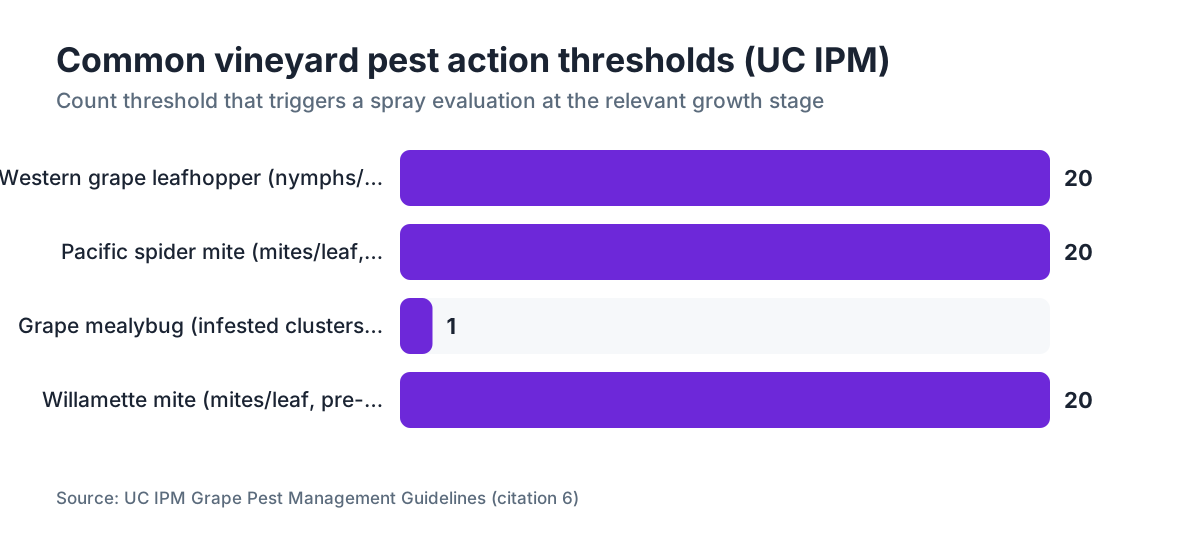
Thresholds are pest-specific and usually growth-stage-specific. A few examples from UC IPM guidelines [6]:
| Pest | Growth stage | Action threshold |
|---|---|---|
| Western grape leafhopper | Pre-bloom | 20 nymphs per leaf (50-leaf sample) |
| Pacific spider mite | Post-bloom | 20 mites per leaf on 50% of sampled leaves |
| Grape mealybug | Fruit set to harvest | 1 infested cluster per 100 clusters |
| Powdery mildew | 5-inch shoot to bloom | First visual symptom in susceptible blocks |
These numbers come from economic injury research, the level at which the cost of control equals the value of crop loss prevented. They aren't guesses. But they aren't universal either. A threshold developed for wine grapes in the San Joaquin Valley may be too aggressive or too conservative for Willamette Valley Pinot Noir, where buyers have tighter tolerances for cosmetic defects.
The practical advice: put the threshold source on your log. Write "UC IPM, 2023" or "WSU EB1928" next to the threshold number. When an auditor asks why you sprayed on a given date, you point to the log showing the count exceeded a published threshold. That beats pointing to your gut.
For organic operations, threshold documentation matters even more, because the National Organic Program requires that prohibited substances be used only as a last resort after documented non-chemical interventions have been considered [2]. Showing count-over-threshold justifies why you escalated.
How often should I scout, and how do I record the schedule?
Frequency depends on the pest and the season. There's no single right answer, but extension programs give workable starting points.
For most fungal diseases (powdery mildew, Botrytis, downy mildew), weekly scouting from bud break through veraison is the standard baseline [6]. During high-pressure periods, which usually means bloom, you can drop to every five days. After veraison for most Botrytis-susceptible varieties, twice weekly isn't overkill if the weather is right.
For insect pests, grape berry moth monitoring typically runs on a degree-day model. Cornell recommends degree-day trapping checks every three to four days during active flight periods, with weekly checks otherwise [7]. Leafhopper nymph counts are most useful at two specific windows: pre-bloom and pre-harvest, because those map to the economic thresholds.
Your log template should include a "next scheduled scouting date" field. This does three things. It closes the monitoring loop. It shows an auditor you had an active program instead of a single log entry the week before every spray. And it forces you or your crew to actually go back.
For multi-block operations, a simple scheduling matrix on a separate sheet works well. List all blocks down one axis, calendar weeks across the other, and check off as scouting gets done. That matrix isn't an official form required by any program I'm aware of, but it's a useful internal tool and it satisfies the spirit of the "documented monitoring plan" that organic certifiers look for.
How does EPA Worker Protection Standard compliance connect to scouting records?
The WPS isn't primarily about scouting logs, but it intersects with them in two ways growers miss.
First, entry restrictions. Under the 2015 revised WPS, workers cannot enter a treated area during the restricted-entry interval (REI) without specific PPE and employer authorization [5]. Scouts who enter blocks after a spray application are subject to these rules. The EPA requires that workers be notified of pesticide applications made to their work area [5]. If your scout walks a block 24 hours after a copper application with a 48-hour REI, that's a violation unless you have the training and notification records to prove the scout knew. Your scouting log, showing the entry date and the scout's name, gets compared against your spray record's application date and REI by any DPR auditor who pulls both files.
Second, training documentation. WPS requires annual pesticide safety training for agricultural workers and handlers [5]. Scouts count as workers. Your roster of trained personnel should include anyone whose name appears on a scouting log. Keeping scout names consistent between training records and field logs makes this audit-proof.
The workaround most operations use is a simple column on the scouting log: "Post-spray re-entry status checked: yes/no." It takes two seconds to fill in and it shows the auditor that someone thought about it.
What's the difference between a scouting log and a spray record, and do I need both?
Yes, you need both. They're different documents with different legal requirements.
A spray record captures what you applied: product name and EPA registration number, rate, total volume, applicator, block, date, and equipment. California requires pesticide use reports to be filed with the county agricultural commissioner within one month of application [3]. Federal restricted-use pesticide records must be kept for two years under FIFRA [9]. Most states add their own retention requirements on top of that.
A scouting log captures why you applied, or why you chose not to. It's the decision input, not the decision output. No federal law mandates a scouting log the way FIFRA mandates pesticide use records. But for USDA organic certification, third-party sustainability audits (SIP, Fish Friendly Farming, Lodi Rules), and any state IPM incentive program, the scouting log is the required proof that your pest management decisions were evidence-based.
Link the two documents explicitly. Put a spray record reference number (or application date and product) in the "decision made" field of your scouting log when you decide to spray. Put the scouting log date in the "reason for application" field of your spray record. This cross-reference takes fifteen seconds and makes both documents far easier to audit.
For record-keeping systems that handle both in one place, VitiScribe is worth a look. It was built for this kind of vineyard compliance documentation, linking scouting observations directly to spray records so you're not maintaining two separate paper trails.
How should I structure a scouting log for multi-block or multi-variety vineyards?
Multi-block vineyards need a consistent block identification system before anything else. If your scouting log says "North Block" and your spray record says "Block 4A," you have an audit problem even if they refer to the same vines.
The simplest structure is one log sheet per block per scouting visit. This sounds like more paper, but it avoids the confusion of trying to squeeze five blocks onto one form. Each sheet gets a block ID at the top that matches your vineyard map and your spray record. File them in block order, not date order, so you can pull all records for a single block during an audit without sorting.
For variety-specific threshold adjustments, add a variety field to the header of the log. Certain Botrytis-susceptible varieties (Pinot Gris, Gewurztraminer) justify earlier intervention than Cabernet Sauvignon. If your threshold differs from the published default, note the reason. "Adjusted threshold per UC IPM recommendation for tight-clustered varieties" is enough.
For large operations with multiple scouts, a crew scouting version beats individual sheets. Use a grid format where rows are individual vines (or sample points) and columns are the pest targets. Each scout initials their rows. This keeps a single document per block while still identifying who sampled which vines, which matters for both data quality and WPS records.
If you're scouting an established vineyard operation with mixed ownership or multiple leases, keep separate log sets for each legal parcel. Certifiers and DPR auditors work by APN or permit number, and combining records across parcels creates confusion that looks like poor record-keeping even when the underlying management is solid.
What are the most common mistakes in vineyard scouting logs that fail audits?
After reviewing what extension services flag as recurring compliance gaps, the same issues come up over and over.
Missing count method. Writing "high leafhopper pressure" instead of "23 nymphs per leaf, 50-leaf sample, 60% of leaves above threshold" is the single most common problem. A qualitative description can't be compared to a quantitative threshold.
Inconsistent block codes. Block "NE-Cab" in the scouting log doesn't match "Cab Franc North" in the spray record. This looks like two separate parcels to an auditor.
Gaps in dates. A log that shows scouting on May 1, then jumps to June 15, with a spray record on May 28 in between, is a problem. The auditor asks: what did you see on May 25 that justified spraying three days later? If the log doesn't answer that, the application looks unjustified.
No threshold listed. The count is there, the decision is there, but there's no documented standard the count was compared against. Easy fix: add a threshold column with a source citation.
Stale templates. Using a 2008 UC IPM threshold that was revised in 2019 doesn't necessarily make your management wrong, but it does make your paperwork look sloppy. Check your threshold sources against current extension publications at least every two years.
Scouting logs signed by someone who isn't in the training records. If the name on the log doesn't appear on your WPS training roster, an inspector will ask questions. Cross-check annually.
How do I adapt a scouting log template for organic or sustainability certification requirements?
Organic certification under the National Organic Program adds two demands to your scouting documentation beyond the baseline IPM log.
First, you need to show that non-chemical interventions were considered before any material application, even OMRI-listed materials [2]. Add a field to your log: "Non-chemical interventions considered." Options might be "canopy management to improve air circulation (Botrytis)," "mating disruption pheromones (grape berry moth)," or "no viable non-chemical option at this threshold level." One line is enough. It shows the certifier you went through the decision process.
Second, your certifier will often want to see that scouting was conducted by a qualified person. The NOP doesn't define this precisely, but a written note that the scout completed UC IPM's online training or attended a pest ID workshop satisfies most certifiers.
For third-party sustainability programs, requirements vary. Lodi Rules for Sustainable Winegrowing (a California program with published standards) requires documented pest monitoring as a scored practice in its workbook [10]. Fish Friendly Farming requires pest monitoring records as part of its land use certification. SIP Certified (Sustainability in Practice) includes a pest management documentation section in its annual audit. In each case, your scouting log is the primary evidence for those sections.
If you're chasing multiple certifications at once, build one master log template that satisfies all of them rather than maintaining separate forms. A one-hour review of the requirements across your applicable programs shows you where the fields overlap.
How should scouting log records be stored and for how long?
Federal law is clear for spray records: FIFRA requires records of restricted-use pesticide applications to be kept for two years [9]. California DPR extends this to three years for pesticide use reports [3].
For scouting logs, there's no federal retention mandate because they aren't required by federal statute. But the practical answer is simple: keep them as long as you keep the corresponding spray records, plus one year. If a pesticide application is ever questioned, the scouting log that justified it needs to be available at the same time.
For organic certification, the NOP requires that your operation's records be retained for five years [2]. Your scouting logs are part of those records. Five years is your floor.
Storage format matters for audits. Paper logs need to be organized so you can retrieve all records for a specific block, a specific pest, or a specific date range within a reasonable time. An auditor who has to wait while you sort through a box of loose papers will note that in their report. A simple three-ring binder per year, organized by block, works fine.
Digital storage is fine if you have a backup system. Cloud-based record-keeping platforms like VitiScribe keep scouting observations linked to spray records with automatic date stamping, which addresses the gap-in-dates problem described earlier. Whatever system you use, make sure you can export records in a format an auditor can read without special software.
Can I build my own scouting log template, and what should I start from?
Yes, and honestly, building your own often beats using a generic template unchanged. Your block names, your target pests, your thresholds for your region, and your certification requirements should all be baked in from the start.
Here's a practical starting point. Take the UC IPM Grape Pest Management Guidelines for your region, note every pest target listed for your crop, and write them into a pest column on a blank spreadsheet [6]. Then pull the action threshold for each pest from the same source. That gives you the core monitoring content.
Next, add the administrative fields: date, scout name, block ID, BBCH growth stage, count method, count result, decision made, next scouting date. These are the same regardless of region or certification.
If you're organic or pursuing Lodi Rules or SIP certification, add the non-chemical interventions field and a materials applied field (linking to your spray record).
Test it in the field for four to six weeks. You'll find some fields are too small, some pest columns never get used, and some you need aren't there. Revise once after that first season, then standardize. Changing your form mid-season creates continuity problems for audits.
For the actual format, a half-page per block per visit (front and back of a 5x8 card or a half-sheet) is more practical in the field than a full 8.5x11 page on a clipboard. A scout wrestling a clipboard through a trellis is an occupational hazard. Smaller forms get filled out more reliably.
Frequently asked questions
Is a vineyard scouting log legally required by the EPA?
No federal law mandates a scouting log the way FIFRA mandates pesticide use records. But if you hold a USDA organic certificate, your certifier requires them as part of your Organic System Plan documentation. State IPM programs and sustainability certifications (Lodi Rules, SIP, Fish Friendly Farming) also require documented monitoring. And any written recommendation from a licensed PCA in California must be based on a documented field inspection, which functions as a scouting record.
What's the minimum a scouting log needs for organic certification audits?
At minimum: date, scout name, block ID, pest target, count result with method, documented threshold the count was compared against, decision made, and a note that non-chemical options were considered before any material application. The NOP doesn't specify exact fields, but certifiers expect to see that your pest management decisions were based on field data, not a spray calendar. Five years of records must be available on request.
How do action thresholds differ between UC IPM, Cornell, and WSU extension programs?
They differ by region and pest complex. UC IPM thresholds are calibrated for California conditions, varieties, and the pest species most common there, especially western grape leafhopper and Pacific spider mite. Cornell thresholds reflect northeastern pest pressure, particularly grape berry moth and downy mildew. WSU addresses Pacific Northwest pests including Willamette mite and grape mealybug. Using the wrong region's threshold can lead to under- or over-treatment. Match your extension source to your geography.
Can a scout who isn't a licensed PCA fill out a scouting log?
Yes. Scouting is observation, not recommendation. In California, a PCA license is required to make written pesticide recommendations, not to collect field data. Scouts just need to be trained under the EPA Worker Protection Standard as agricultural workers. Their names should appear on your WPS training roster. If a scout's observations lead to a spray decision, that decision should be reviewed and signed off by whoever holds PCA authority for your operation.
How do I record a zero-count scouting visit, and does it matter for compliance?
Record it as a zero, not a blank. Write "0 mites per leaf, 50-leaf sample" rather than leaving the count field empty. Blank fields look like missing data to auditors. Zero counts are data. Zero-count visits are especially important to document before bloom and at harvest, because they show your program was active during high-value windows even when pressure was low. A pattern of zeroes followed by a spray is a red flag; zeroes throughout a season are evidence of good cultural management.
What's a BBCH scale and do I have to use it on scouting logs?
The BBCH scale is a numeric phenological staging system for crops, running from 00 (dormancy) to 99 (harvest). For grapevines, it's the standard used by UC IPM, Cornell, and WSU extension programs, so all published thresholds reference BBCH stages. You don't have to use it, but if your log says 'pre-bloom' and the threshold table says 'BBCH 55-65,' someone has to translate. Using BBCH codes eliminates that ambiguity. The UC ANR grapevine phenology guide explains the scale.
How do I handle scouting records when I contract out to a PCA or crop consultant?
Your crop consultant's inspection notes are their records, but you should request copies for your own files. For organic certification, NOP auditors want records in your possession, more than available on request from a third party. Ask your PCA to provide a copy of every field inspection report at the time of the visit. File it under the same block and date system as your internal scouting logs. Certification aside, having your own copy protects you if you ever change consultants.
Are there mobile apps for vineyard scouting logs that produce compliant records?
Several apps exist, including crop-scouting tools and various commodity-specific platforms. The key question isn't whether they're mobile but whether they export records in a format auditors can read, include time stamps, preserve scout identity, and let you link observations to spray records. Whatever app you use, verify you can produce a complete printed or PDF record per block per date. Some apps lock your data behind subscription walls, which creates problems if you switch platforms mid-certification cycle.
How far back do I need to keep vineyard scouting logs for a DPR audit in California?
California DPR retains the right to audit pesticide use records for three years after the application date. For organic certification, the NOP requires five years. For scouting logs specifically, no California statute sets a retention period, but keeping them for the same five years as your organic records (or three years minimum) is the practical standard. DPR auditors pull spray records first, then may ask for the monitoring data that justified them. Having both available for the same period avoids gaps.
What's the best way to connect scouting logs to spray records for an audit trail?
Cross-reference by block ID and date. In your scouting log, add a field 'Application initiated: Y/N, Spray Record Ref #.' In your spray record, add a field 'Scouting log date that triggered this application.' When the two documents reference each other, an auditor can pull one and immediately find the other. This takes seconds per record and makes the decision logic transparent. If you use a digital system, a linked record structure handles this automatically.
Do I need separate scouting logs for beneficial insects, or is that typically part of the pest log?
Most extension-recommended forms include a column for natural enemies alongside pest counts. This matters because one core principle of IPM is evaluating the predator-prey ratio before making a control decision. If you're seeing 15 leafhopper nymphs per leaf alongside high numbers of Anagrus wasps, the spray decision differs from a scenario with no beneficials present. UC IPM guidelines include natural enemy assessment in their monitoring protocols. Add a beneficials column to your template.
How do trap catches for grape berry moth get recorded in a scouting log?
Pheromone trap catches are recorded separately from vine-level counts but should be part of the same logging system. Record trap ID, location, catch date, and number of moths caught per trap per day. Cornell's grape berry moth degree-day model uses these counts alongside weather data to time sprays. Your scouting log for vine-level cluster damage is a separate entry from the trap catch log, but both should reference the same block ID so you can correlate catch pressure with actual damage levels.
What happens if my scouting log shows I sprayed below the action threshold?
It depends on your certification status and the material used. For organic operations, spraying below threshold with a restricted material is a compliance risk, since NOP requires documented justification for any intervention. Write a note explaining the reasoning, such as susceptible variety at high-risk growth stage, weather forecast for a prolonged wet period, or buyer specification. For conventional operations, below-threshold sprays are legal but undermine the economic argument for the application. Documenting the rationale protects you either way.
Sources
- EPA, Integrated Pest Management (IPM) Principles: IPM programs use current information on the life cycles of pests and their interaction with the environment to manage pest damage
- USDA Agricultural Marketing Service, National Organic Program: NOP requires Organic System Plan documentation including pest management approach; records must be retained for five years; prohibited substances used only as last resort after non-chemical options considered
- California Department of Pesticide Regulation, Pesticide Use Reporting: California requires PCA written recommendations to be based on field inspections subject to audit; pesticide use reports filed within one month; records retained three years
- UC Agriculture and Natural Resources (grapevine phenology and BBCH staging): UC programs use the BBCH 00-99 phenological scale for grapevine staging; thresholds in UC IPM guidelines reference BBCH stages
- EPA, Agricultural Worker Protection Standard (WPS): WPS requires workers be informed of pesticide applications in their work area; annual safety training required for agricultural workers; restricted-entry intervals enforced; workers and handlers must be identified in records
- UC IPM, Grape Pest Management Guidelines: UC IPM publishes pest-specific monitoring forms and action thresholds for California vineyards including western grape leafhopper (20 nymphs/leaf), Pacific spider mite, grape mealybug, powdery mildew, and Botrytis
- New York State Integrated Pest Management, Cornell University: Cornell IPM covers grape berry moth degree-day model, downy mildew, and northeastern pest complex; recommends trap checks every 3-4 days during active flight periods
- Washington State University Extension: WSU Extension covers Pacific Northwest vineyard pest management including Willamette mite and grape mealybug monitoring specific to Columbia Valley conditions
- USDA / EPA, Federal Pesticide Recordkeeping Program: Federal law requires records of restricted-use pesticide applications to be maintained for two years after the date of application
- Lodi Winegrape Commission, Lodi Rules for Sustainable Winegrowing: Lodi Rules requires documented pest monitoring as a scored practice in the certification workbook; pest management documentation section evaluated during annual audit
Last updated 2026-07-10