Digital spray record apps that integrate with vineyard compliance systems

TL;DR
- Digital spray record apps replace paper logs.
- Linked to state ag portals and EPA Worker Protection Standard systems, they cut audit prep from days to hours.
- The best ones capture applicator license numbers, restricted-entry intervals, EPA registration numbers, and wind speed at application, then export in formats state inspectors actually accept.
- A small vineyard pays $15 to $80 per month.
What do vineyard spray record apps actually need to track?
Every state following the federal pesticide recordkeeping framework wants the same core data for any restricted-use application: product name and EPA registration number, crop and field location, date and time, application rate and total amount used, the applicator's name and license number, and the weather at application. [1] That's the federal floor. California, Washington, and New York stack more on top.
California's Department of Pesticide Regulation wants pesticide use reports filed monthly with the county agricultural commissioner, and each report has to carry the site ID from the county's parcel records. [2] Washington State Department of Agriculture runs its own Notice of Intent system for certain restricted-use products applied near sensitive areas. [3] New York keeps records for three years minimum. If your app doesn't know which state you're in and adjust, you'll be re-entering data by hand no matter how clean the interface looks.
Beyond the legal minimums, a good app captures pre-harvest intervals (PHIs) per label, restricted-entry intervals (REIs) under the EPA Worker Protection Standard, the spray equipment used, water volume per acre, the adjuvants added, and the GPS boundary of the block sprayed. PHI and REI aren't just compliance boxes. They're the two fields most likely to catch a problem before it turns into a violation or a hurt worker.
Here's the thing most people miss. The app needs to store the pesticide label version in effect on the day you sprayed, more than the product name. Labels change. Registrations get amended. Get audited two years from now, and the inspector wants the label that governed your use on that specific date.
How do these apps connect to state compliance and reporting systems?
There are three connection models, and they're not equally useful. Export-only, direct API, and integration through a farm management platform.
Export-only is the most common. The app builds a PDF or CSV in your state's required format, and you upload or mail it yourself. It works fine, but you're still logging into the state portal. CalPUR, California's Pesticide Use Reporting system, takes electronic submission, and several apps generate the exact XML or flat file CalPUR expects. [2] That saves real time.
Direct API integration pushes records to the state system automatically or with one confirmation click. It's rare in 2026 because most state ag department IT wasn't built with open APIs in mind. Washington's WSDA and Oregon's ODA both run online submission portals, but true two-way API connections are still the exception. [3]
The third model plugs into a farm management platform like Granular, AgWorld, or Conservis, which then handles the state reporting leg. Fine for larger operations or grower groups already on those platforms. It adds cost and another system to babysit.
For most small vineyard operators, the honest answer is simple. Find an app that generates a correctly formatted export file for your state and makes it easy to review before you submit. That's 90 percent of the battle. The fully automated push-to-portal dream exists in a few places today, but the export-and-review workflow is reliable and auditor-accepted everywhere I've seen it run.
Cornell Cooperative Extension's crop and pest management resources for New York growers confirm digital records are acceptable for state DEC audits as long as they hold all required fields and can be printed or exported on demand. [4] WSU Extension has said the same for Washington growers. [5]
What does EPA Worker Protection Standard compliance require from a spray recordkeeping system?
The EPA's Worker Protection Standard, revised most recently in 2015 and enforced under 40 CFR Part 170, requires agricultural employers to keep records of any pesticide application where workers or handlers may be in the treated area. [6] The record has to include the product name, EPA registration number, location, date, time, and REI. You keep those records two years and hand them to workers or their representatives on request within 15 days.
The WPS rule puts it plainly: "The agricultural employer must maintain pesticide application and hazard information records." [6] Obvious enough. The operational catch is that your spray record system and your worker notification system have to talk to each other. Log a spray with a 24-hour REI, and something in your operation has to keep workers out of that block until the REI clears, with a record that the notification happened.
Some apps generate an automated block-closure notice you can post on the central posting board, physical or digital, that WPS requires. Others just export the data and leave notification to you. That gap bites during an EPA or state inspection.
UC Davis Integrated Pest Management publishes detailed guidance on structuring WPS-compliant records, including the split between worker entry restrictions and early-entry PPE requirements. [7] Their recordkeeping templates are a good yardstick for whether an app's fields actually cover the regulation. If an app can't record whether early-entry conditions applied and what PPE was required, it isn't fully WPS-compliant out of the box.
Which apps are commonly used by vineyard managers in 2025 and 2026?
A handful of platforms come up over and over in vineyard operations, and each has real tradeoffs.
Agrian is probably the most widely used in California wine country. It pairs a product database with spray logging and links to the Agrian label library, so you're working from current labels. California PUR export is built in. The interface is busier than some growers want, and pricing runs toward the top of the category.
Vineyard Team's SIP (Sustainability in Practice) program ties sustainability certification to spray records, handy if you're already in a certification program and want one system for both. [8] It isn't a standalone app, but the integration is clean.
Precision Planting's FieldView and John Deere Operations Center both handle spray records if you already live in those ecosystems for equipment telematics. For vineyard-scale operations with GPS-guided sprayers, that's efficient. For a 15-acre family operation with one spray rig and a clipboard, it's overkill.
AgWorld, popular in the Pacific Northwest and gaining ground in California, has a solid applicator license verification feature and produces Washington Pesticide Application Records in the format WSDA expects. [3]
For smaller operations trying to keep costs down and compliance tight, simpler purpose-built tools exist, including VitiScribe, which is built for vineyard compliance and field operations. It handles WPS fields, PHI/REI tracking, and state export formats without forcing you to also buy an enterprise farm management platform.
Nobody has good independent comparative data on user satisfaction across these platforms. The closest thing is UC Davis ag tech buyer surveys, but those skew toward larger row-crop operations. Ask other vineyard managers in your appellation what they actually use. Regional support and whether your county ag commissioner can open the export file matter as much as any feature list.
How much do vineyard spray record apps cost?
A small vineyard pays $15 to $80 per month. Price depends mostly on whether you're buying a standalone spray record app or a full farm management platform with spray records as one module.
| Product type | Typical monthly cost | Notes |
|---|---|---|
| Basic spray log app (mobile-first) | $15 to $35/month | Limited state integration, manual export |
| Mid-tier vineyard/farm app | $40 to $80/month | State export, product database, WPS fields |
| Enterprise farm management platform | $150 to $500+/month | Multi-block, equipment telematics, ERP integrations |
| Sustainability certification platforms | Bundled with cert fee | Varies by program |
The free tiers that exist mostly skip state-specific export formats and PHI/REI tracking. They keep you organized. They probably won't survive a state audit on their own.
For a vineyard under 50 acres, the $40 to $80 range gets you what you actually need. The math is blunt. A single California pesticide use violation can run $1,000 to $5,000 under Food and Agriculture Code Section 12999. [9] Dodge one problem in five years and even the pricier tools have paid for themselves.
Setup costs are real too. Loading your block maps, crop types, and equipment IDs takes a few hours up front. Budget for it.
What should a vineyard manager look for when evaluating a spray record app?
Start with your state's required data fields, not the app's marketing page. Pull the actual pesticide use report form your county or state uses and confirm every field on it can be filled from the app's data. If there's a field for permit number or site type that your state requires and the app can't capture it, you'll be typing it by hand every month forever.
Next, check the product database. A good app connects to the National Pesticide Information Center or a commercial label database, so you pick a product and the EPA registration number, signal word, REI, and PHI pre-populate. [10] Typing those off a physical label is how transcription errors happen, and transcription errors are how violations happen.
Applicator license management matters more than most demos let on. If you use a licensed PCA (Pest Control Adviser) or a licensed applicator, their license number has to land on the record, and the app should flag an expired license. Some apps pull from state license databases and warn you. That's worth paying for.
GPS block boundaries are close to standard now, and worth having. They let you prove which block was treated and which wasn't, which matters the day a drift complaint lands or someone questions your buffer zone compliance.
Ask about offline functionality. Vineyards aren't always in cell range. If the app needs a live connection to log a spray, your applicator falls back to paper and enters it later, which kills most of the point.
How do spray record apps handle organic certification recordkeeping?
Organic certification under the USDA National Organic Program wants a different set of records than conventional spray logs. You aren't logging restricted-use pesticides the same way, but you still document every input applied to the vineyard, the source and composition of each material, and each product's certifier approval status. [11]
Some apps have an organic mode or an organic-approved product flag. The app should filter your product list to show only OMRI-listed materials or materials your specific certifier approved. The Organic Materials Review Institute keeps a publicly searchable database that some apps pull from. [12]
For organic growers, the bigger win is integration with your certifier's Organic System Plan (OSP) documentation. A few platforms feed spray record exports straight into the annual update your certifier requires. That's a genuine time saver in spring, when you're trying to recertify and do every other vineyard task at the same time.
Certification audits under NOP call for three years of records. Whatever system you use, make sure it stores historical data and exports multi-year summaries, more than the current season.
Can spray record apps reduce labor time spent on compliance paperwork?
Yes, and the gains scale with how bad your current system is.
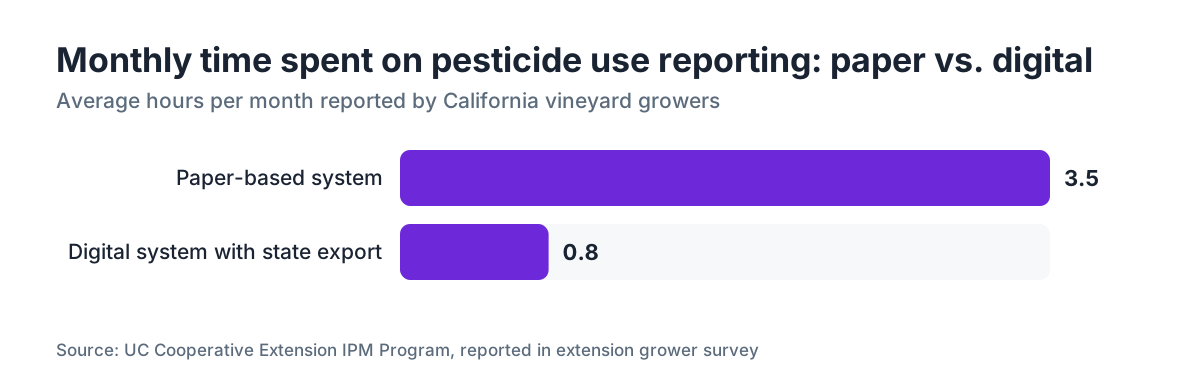
A manager keeping paper spray records and then re-typing them into a county PUR submission is entering the same data twice, plus storing paper for the three-year minimum. A UC Cooperative Extension grower survey found California growers spent an average of 3.5 hours per month on pesticide use reporting under a paper-based system. [7] Digital systems that auto-populate state forms and export directly dropped that to under one hour in the same group.
The bigger savings show up at audit time. Walking into a county ag commissioner audit with three years of records in a searchable, filterable digital system beats hauling in boxes of paper spray sheets. An auditor asks for every application of a specific product across all years, and you generate that report in seconds instead of hours.
Onboarding is the tradeoff. Loading your block map, registering equipment, and entering applicator credentials takes a few hours the first time. Switch apps and you pay that cost again. Pick something you'll stick with for at least three years.
What are the risks of using a spray record app that doesn't integrate with compliance systems?
The main risk is running two parallel systems: the app, and whatever you actually do to satisfy your state or federal requirement. That doubles the odds of a discrepancy, and discrepancies are what draw closer scrutiny in an audit.
Second risk is data format mismatch. If your app exports in a format your county ag commissioner won't accept for electronic submission, you're printing and mailing or re-typing into their portal. Neither is the future anybody promised.
Third, less obvious: apps that fall behind on label database updates can show you an outdated REI or PHI. Apply a product at a rate that was legal under an old label but not the current one, and the app didn't protect you even though you used it in good faith. Check how often the product database updates and who maintains it.
Data portability is a real concern. If your vendor folds or jacks up prices, can you export your historical records in a format usable outside their platform? Three-year retention means you need those records even after you stop paying. Ask this before you sign up, not after.
How do spray records connect to vineyard sustainability certifications?
Sustainability programs in wine country, including California's SIP Certified, LIVE (Low Input Viticulture and Enology) in Oregon and Washington, and Lodi Rules, all want applicants to document spray inputs for the annual audit. [8] Most ask for the same data as state PUR reporting, plus context like IPM decision notes and why you chose a spray over an alternative.
If your app captures that context, a field note or a scouting record linked to the spray event, you use the same records for state compliance and certification. If it only holds the minimum legal fields, you'll be filling the gaps by hand at certification time.
The overlap between WPS records, state PUR records, and sustainability certification records is probably 80 percent or more. Pick the right tool and you aren't maintaining three separate systems. You maintain one core dataset and generate different views for different audiences.
That's exactly what purpose-built vineyard compliance tools, including VitiScribe, are for. One place to capture field data that satisfies regulators, certifiers, and your own operational records without entering anything twice.
Manage blocks across Paso Robles wineries territory or other large California appellations where buyers increasingly expect sustainability certification, and this integration turns into a competitive question, not only an operational one.
What questions should you ask a vendor before buying a spray record app?
These are the questions that separate useful tools from pretty interfaces.
First: which states' pesticide use reporting formats does your export support, and when were those formats last updated? State forms change. A vendor who can't answer precisely isn't staying current.
Second: how do you handle EPA registration number updates and label revisions? Who maintains the product database, and how often?
Third: does the app work offline, and how does it sync when the connection comes back? What happens to a record if sync fails?
Fourth: what happens to my data if I cancel? Can I export all historical records in a standard format like CSV, PDF, or XML?
Fifth: how do you handle multiple applicators with different license numbers and certifications? If a licensed PCA writes the recommendation and a licensed applicator does the work, can you capture both on one record correctly?
Sixth: do you have current customers in my state using this for compliance, and can you connect me with one? A vendor who can't produce a reference in your state for regulatory export is a risk.
Seventh: what's your uptime and data backup policy? Compliance records are not something you want to lose to a server crash.
Frequently asked questions
Are digital spray records legally accepted by California's county agricultural commissioners?
Yes. California DPR and county ag commissioners accept electronic pesticide use records as long as they contain all required data fields and can be printed or provided electronically on request. The county may have a preferred submission format. Check with your specific county commissioner's office, because a few counties still prefer or require paper submission for smaller operators.
How long do I have to keep vineyard spray records under federal law?
Federal law under FIFRA requires restricted-use pesticide records for two years. The EPA Worker Protection Standard requires application and hazard information records for two years as well. Some states require three. California, New York, and Oregon all have three-year minimums. Follow whichever requirement is longer, which in most wine regions means three years.
Do spray record apps track pre-harvest intervals automatically?
The better ones do. Select a product from an integrated label database and the app populates the PHI from the current registered label. You enter your expected harvest date, and the app flags a planned application that would fall inside the PHI window. It's one of the more useful safety features and a good reason to use an app with a maintained product database instead of a spreadsheet.
What EPA registration number format do I need to log for pesticide records?
EPA registration numbers follow the format XXXXX-XXXXX (registrant number, hyphen, product number, sometimes a third suffix for formulation). Both numbers together are required on federal and state spray records. The full number appears on the label's front panel. Apps with product databases pre-populate this when you select the product by name, which kills a common transcription error.
Can a spray record app handle organic vineyard inputs as well as conventional pesticides?
Some can. You want an app that flags OMRI-listed materials or lets you tag products as certified organic-approved. Not all do this well. If organic certification is part of your operation, ask vendors specifically about NOP recordkeeping support, certifier-specific product approval filters, and whether the app can build the input summary your certifier requires for OSP annual updates.
What happens if I apply a pesticide and forget to log it immediately, then enter it later?
Late entries are legally touchy in California, where PUR requires submission within one month of the application month. Federal WPS records should reflect actual application time and date. Most apps timestamp when a record was created and keep a separate field for actual application date and time, which creates an audit trail showing the late entry. Log late rather than never, but make it your habit to log at the spray rig.
Do I need a separate app for tracking worker training under WPS, or can the spray record app handle that?
Most spray record apps don't handle WPS worker training records. Worker safety training, central posting board records, and emergency medical information requirements under 40 CFR Part 170 are generally tracked separately. A few broader farm compliance platforms include both. If your vineyard employs seasonal workers, you may need two systems or one platform that explicitly covers full WPS scope, not only application records.
How do spray record apps handle spray drift complaints or neighbor disputes?
A well-kept digital record helps a lot. GPS-bounded block records, logged wind speed and direction at application, and time-stamped entries give you documented evidence of what was applied, where, and under what conditions. Apps that pull weather station data are especially useful for drift disputes. The data doesn't guarantee legal protection, but it gives you a factual baseline paper records rarely provide.
What's the difference between a PCA recommendation record and a spray application record?
A PCA (Pest Control Adviser) recommendation is the written recommendation required by California law before most pesticide applications, prepared by a licensed PCA. A spray application record is the record of what was actually applied, by whom, and when. They're related but separate documents. Some apps link them by attaching the PCA recommendation to the application record, which is ideal. California requires both, and they must agree with each other.
Can vineyard spray apps integrate with GPS tractor or sprayer telematics?
Some can, through integrations with John Deere Operations Center, Trimble, or Raven. These connections auto-populate spray start and end times, the GPS track of the equipment, and sometimes flow rate data from the sprayer's controller. It's most practical for vineyards with newer, connected equipment. For older spray rigs, the manual entry workflow in a well-designed app still beats paper without any hardware investment.
Is there a free vineyard spray record app that meets compliance requirements?
Free apps exist, but most don't maintain the product label databases or state-specific export formats needed for full compliance. UC Davis and some state extension services offer downloadable spreadsheet templates that are free and compliant when filled out correctly. Those work for small operations comfortable with spreadsheets, but they skip PHI/REI alerts, GPS integration, and automated state-format exports. The free option is a starting point, not a long-term answer.
How do Washington State vineyards submit pesticide use records differently than California?
Washington does not require monthly pesticide use reporting to the state the way California does for all growers. Washington's WSDA regulates certain applications near sensitive areas through Notice of Intent requirements, and Pest Management Consulting agreements carry their own documentation rules. Applicators must keep records two years under state law. WSU Extension has current guidance on Washington-specific recordkeeping requirements for vineyard operators.
What data fields does a spray record need for a USDA organic certification audit?
For NOP audits you need the product name, formulation, manufacturer, OMRI listing or certifier approval status, the block or field applied, date, rate, and the reason for application (documented pest or disease pressure). You also have to show no prohibited substances were used during the transition or certified period. Your certifier may have a specific form, but a digital export showing all these fields from your spray app is generally accepted.
Sources
- EPA, Pesticide Registration and Recordkeeping Requirements (FIFRA Section 8): Federal FIFRA recordkeeping requirements for restricted-use pesticides including required data fields and two-year retention minimum
- California Department of Pesticide Regulation, Pesticide Use Reporting: California requires monthly pesticide use reports submitted to county agricultural commissioners, including site ID and EPA registration numbers
- Washington State Department of Agriculture, Pesticide Program: Washington regulates certain restricted-use applications near sensitive areas through Notice of Intent requirements and generates Washington Pesticide Application Records
- Cornell Cooperative Extension, Integrated Crop and Pest Management: Digital pesticide records are acceptable for New York DEC audits when they contain all required fields and can be printed or exported on demand
- Washington State University Extension: WSU Extension provides guidance confirming digital pesticide records are acceptable for Washington growers when they contain all required fields
- EPA, Agricultural Worker Protection Standard, 40 CFR Part 170: WPS requires records of pesticide applications including product name, EPA registration number, location, date, time, and REI, retained for two years and available to workers within 15 days on request
- University of California Statewide Integrated Pest Management Program (UC IPM): UC IPM guidance on WPS-compliant recordkeeping and UC Cooperative Extension grower survey data on time spent on pesticide use reporting
- Vineyard Team, SIP Certified (Sustainability in Practice): SIP Certified and other sustainability programs require applicants to document spray inputs and IPM decision-making for annual certification audits
- California Food and Agriculture Code Section 12999: California pesticide violations can carry penalties from $1,000 to $5,000 per violation under Food and Agriculture Code Section 12999
- National Pesticide Information Center, Oregon State University and EPA: NPIC maintains pesticide product information including EPA registration numbers, labels, and safety data that integrated app databases draw from
- USDA Agricultural Marketing Service, National Organic Program: NOP requires organic growers to document all inputs applied, including source and composition, and certifier approval status, with three-year record retention for audits
- Organic Materials Review Institute (OMRI): OMRI maintains a publicly searchable database of materials approved for organic production that spray record apps may integrate with to filter approved inputs
Last updated 2026-07-09