SDS binder organization for vineyard chemical storage compliance
TL;DR
- A vineyard SDS binder holds a current Safety Data Sheet for every pesticide and chemical on site, organized so any worker or emergency responder finds a specific sheet in under five minutes.
- OSHA HazCom 2012 (29 CFR 1910.1200) and the EPA Worker Protection Standard (40 CFR Part 170) both require it.
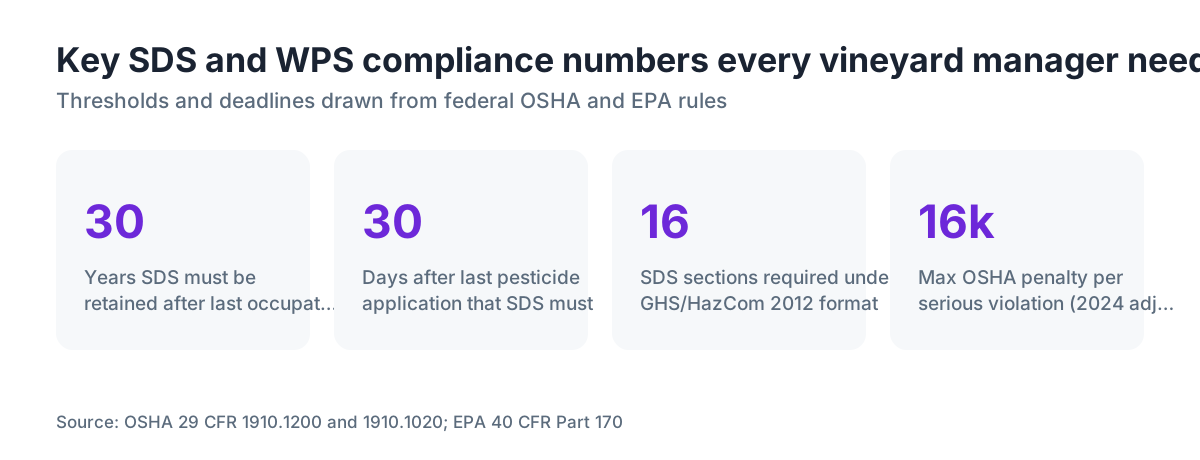
- Keep binders accessible during all work hours and retain sheets for at least 30 years for any chemical with occupational exposure.
What is an SDS binder and why does a vineyard legally need one?
A Safety Data Sheet (SDS) is a standardized 16-section document that tells workers what a chemical is, what it does to the body, how to handle it, and what to do in an emergency. Every chemical manufacturer has to produce one under OSHA's Hazard Communication Standard, commonly called HazCom 2012 [1]. An SDS binder is the organized collection of those sheets for every product on your property.
For vineyard managers, the legal obligation comes from two directions at once. OSHA's HazCom rule (29 CFR 1910.1200) applies to agricultural employers with any employees who could be exposed to hazardous chemicals [1]. The EPA Worker Protection Standard (40 CFR Part 170, revised 2015) adds a separate but parallel requirement for pesticide-handling operations, which describes almost everything you spray from bud break to harvest [2]. If you have employees, you are almost certainly covered by both. A small family vineyard with zero non-family employees is one of the few situations where you might get a narrow exemption, though state rules often fill that gap anyway.
The stakes are real. An OSHA inspection triggered by a worker complaint can bring serious-violation penalties starting around $16,131 per violation as of the 2024 adjustment, and willful violations go much higher [3]. If a worker is poisoned or injured and you can't produce an SDS for the chemical involved, your liability exposure is large. The binder isn't paperwork theater. It's the document that tells the emergency room doctor what antidote to consider.
Which chemicals need an SDS in the vineyard binder?
Anything with a hazard label goes in the binder. That includes pesticides (fungicides, insecticides, herbicides, miticides), adjuvants, fertilizers classified as hazardous (anhydrous ammonia is the common one, though most liquid fertilizers used in vineyards are borderline), cleaning chemicals in the winery or equipment shed, and fuel additives if stored in quantity.
Pesticides get extra attention because of the WPS overlap. Under WPS, every pesticide product used in the previous 30 days must have its SDS available to agricultural workers and handlers [2]. (The rule still refers to the older term "MSDS" in some sections, but a current GHS-formatted SDS satisfies it.) This 30-day rolling window is stricter than many managers realize. Spray a sulfur fungicide on Tuesday, and its SDS has to stay accessible through at least 30 days after the last application, more than through the day you sprayed.
Some products don't require an SDS: food, drugs, and cosmetics used by employees for personal consumption; consumer products used in the same way and same amounts a household consumer would use them; and wood or wood products (not treated wood). Irrigation water on its own doesn't require one either. When in doubt, keep the sheet. The burden of one extra sheet is zero.
Here's a quick reference for common vineyard chemical categories:
| Chemical Category | SDS Required? | Notes |
|---|---|---|
| Registered pesticides (FIFRA) | Yes | Also WPS-covered |
| Sulfur, copper-based fungicides | Yes | Even "organic" products |
| Adjuvants / surfactants | Yes | Often overlooked |
| Liquid fertilizers (N, K, P) | Usually yes | Check SDS from supplier |
| Anhydrous ammonia | Yes | PSM threshold may also apply |
| Diesel / gasoline | Yes | OSHA Flammable Liquids |
| Winery cleaning acids/caustics | Yes | High priority for training |
| Potable water | No | N/A |
What format does an SDS have to be in, and is a digital binder legal?
OSHA's HazCom 2012 standard adopted the Globally Harmonized System (GHS) format, which requires every SDS to follow a standard 16-section structure [1]. Section 1 is product identification, Section 2 covers hazards, Section 8 lists exposure controls and PPE, Section 11 is toxicology, and so on down the sheet. Documents produced before the June 2015 compliance deadline may still carry the older MSDS layout. If you find one in your binder, replace it. Manufacturers have to supply current GHS-formatted sheets, and you can pull them from the manufacturer's website or the CDMS and NPIC databases.
Digital binders are legal under OSHA HazCom, with conditions [1]. The rule says an SDS must be "readily accessible to employees during each work shift when they are in their work area(s)." OSHA reads that to permit electronic access, but there's a hard catch. If the system goes down, or if workers don't have fast, reliable access to a computer or tablet in the field, you have a problem. A crew working the far end of a block on a hot afternoon isn't walking back to the shop to find a tablet. OSHA field enforcement guidance looks for immediate, barrier-free access.
Here's what most experienced vineyard managers land on: keep a physical binder as the primary system, use digital as a backup. UC Davis's agricultural health and safety resources recommend field crews have physical access to SDS documents at or near where chemicals are stored and applied [4]. WSU Extension makes a similar recommendation in its pesticide safety materials [5]. A physical binder in the chemical storage shed, plus a laminated quick-reference card in each spray rig, is a setup you can defend to an inspector.
How should you tab and organize the binder for fast inspection access?
No single tab structure is federally mandated. The law requires that employees find a specific SDS fast and without barriers. An inspection is basically a speed test: can you or a worker locate the sheet for a given product in a minute or two? If not, you're at risk, whether or not the sheets technically exist somewhere in the stack.
Here's a system that works for most operations running 20 to 60 products.
Tab 1: Master product index. A single alphabetical list of every product in the binder, with the tab letter or number where its SDS lives. Print it on bright paper, put it inside the front cover, and laminate it. This is the first thing an inspector or emergency responder reaches for.
Tabs 2 onward: Chemicals grouped by use category. Group by Fungicides and Bactericides, Insecticides and Miticides, Herbicides, Fertilizers and Soil Amendments, Equipment and Cleaning Chemicals, Fuels and Lubricants. Within each category, alphabetical by product name is fine.
For larger operations with 60-plus products, consider alphabetical organization across the whole binder (A through Z tabs) with a category column in the master index. Category grouping works better where workers are trained by task type. The person running the sprayer needs fungicides and insecticides; the person doing post-harvest sanitation needs the cleaning chemicals.
A few physical details matter more than they seem:
- Use a 3-ring binder, minimum 3-inch spine, with a clear front pocket for the index sheet.
- Put the binder in a weatherproof spot inside the chemical storage area, on a dedicated hook or shelf at eye level.
- Label the spine and front cover with the location name and year.
- Don't laminate the individual sheets. You need to swap them out when updates come in.
Date-stamp every sheet when you add it. Write the insertion date in pencil in the top corner. When a manufacturer sends an updated SDS, replace the old one the same day and file the old sheet in an archive, because that 30-year retention clock is running [1].
What are the SDS retention rules for vineyard chemicals?
This is where a lot of operations get caught. OSHA's HazCom standard requires that SDS records be kept for at least 30 years for any chemical to which employees were occupationally exposed [1]. The 30-year rule comes from OSHA's Access to Employee Exposure and Medical Records standard (29 CFR 1910.1020), written to account for the long latency of diseases like occupational cancer [6].
For a vineyard, that means this: spray a product in 2015, discontinue it in 2020, sell the land in 2025, and you still owe that SDS to any former employee who asks for it until 2045. The obligation follows the employer, not the property.
The practical path:
- Keep current-year SDS sheets in the active binder.
- Move previous-year sheets for discontinued products to a labeled archive binder or fireproof file box, organized by year.
- Scan and back up a digital copy of everything archived. Storage is cheap. Reconstruction isn't.
- When you close or sell the business, 29 CFR 1910.1020 requires you to transfer records to the new owner, notify your employees, or in some cases notify NIOSH [6].
The EPA WPS 30-day rule is separate and shorter. The SDS for any pesticide applied in the last 30 days must be immediately accessible to workers and handlers [2]. That's a rolling current-use rule, not a long-term retention rule. Meet both by keeping everything in the active binder through the season, then archiving at season end.
What does the EPA Worker Protection Standard specifically require for SDS access?
The WPS (40 CFR Part 170), last substantially revised in November 2015, is the primary federal rule governing pesticide safety for agricultural workers [2]. Under it, employers must make the SDS for any pesticide applied in the past 30 days available to workers and handlers before they enter a treated area or handle the product. The rule also bars employers from discouraging or preventing workers from getting that information.
The revised WPS requires the agricultural employer to make available "the safety data sheet for any pesticide product that has been applied in the last 30 days" to any worker, handler, or their designated representative [2].
Three access requirements are easy to miss:
- Workers must be told where the binder is and that they have the right to see it. This happens as part of the annual WPS safety training. The central display board that WPS also requires should carry this information.
- The information must be accessible during all work hours, not only when a supervisor is present. A locked binder, or one that lives in the manager's office, fails this.
- Workers can name a representative (a family member, union rep, or other advocate) to receive the information for them. You cannot refuse that request.
Cornell's New York State Integrated Pest Management program publishes WPS compliance checklists that break these access requirements into plain terms for farm operators [7]. WSU Extension's Pesticide Safety Education Program covers the same ground with specifics for Washington State, whose rules often go past the federal baseline [5].
How do you handle SDS updates and manufacturer-supplied revisions?
SDS documents change. Manufacturers revise them when toxicology data is updated, when EPA re-registers a product with new restrictions, or when the GHS hazard classification for an ingredient shifts. Under HazCom, manufacturers have to update an SDS within three months of getting new and significant hazard information, and they must send the updated sheet to distributors [1]. Getting it into your binder is on you.
There's no automatic alert for most vineyard managers. Set a calendar reminder each year, usually in January before the season starts, to check manufacturer websites or the CDMS (Crop Data Management Systems) database for the current SDS on every product you plan to use. CDMS at cdms.net holds a large database of current agricultural product labels and SDS documents. Greenbook is a similar resource.
When a revised SDS arrives:
- Pull the old sheet immediately.
- Insert the new one.
- Write the new insertion date on it.
- File the old one in your archive with a note like "superseded [date]."
Never throw away a superseded SDS. That old sheet is part of your exposure record for the period it was current. If a worker claims a health injury from a chemical used in 2019, you may need the 2019-era SDS to show what hazards were communicated at the time.
If a manufacturer discontinues a product and stops hosting the SDS online, download and save a PDF right away. Don't assume it'll always be findable. Some registrants withdraw products and take their documentation with them.
What should the chemical storage area look like to pass a compliance inspection?
SDS access and chemical storage get evaluated together during most farm inspections, whether by OSHA, the EPA WPS enforcement arm (often delegated to state departments of agriculture), or the county agricultural commissioner. Here's what inspectors look for when they walk into a vineyard chemical shed.
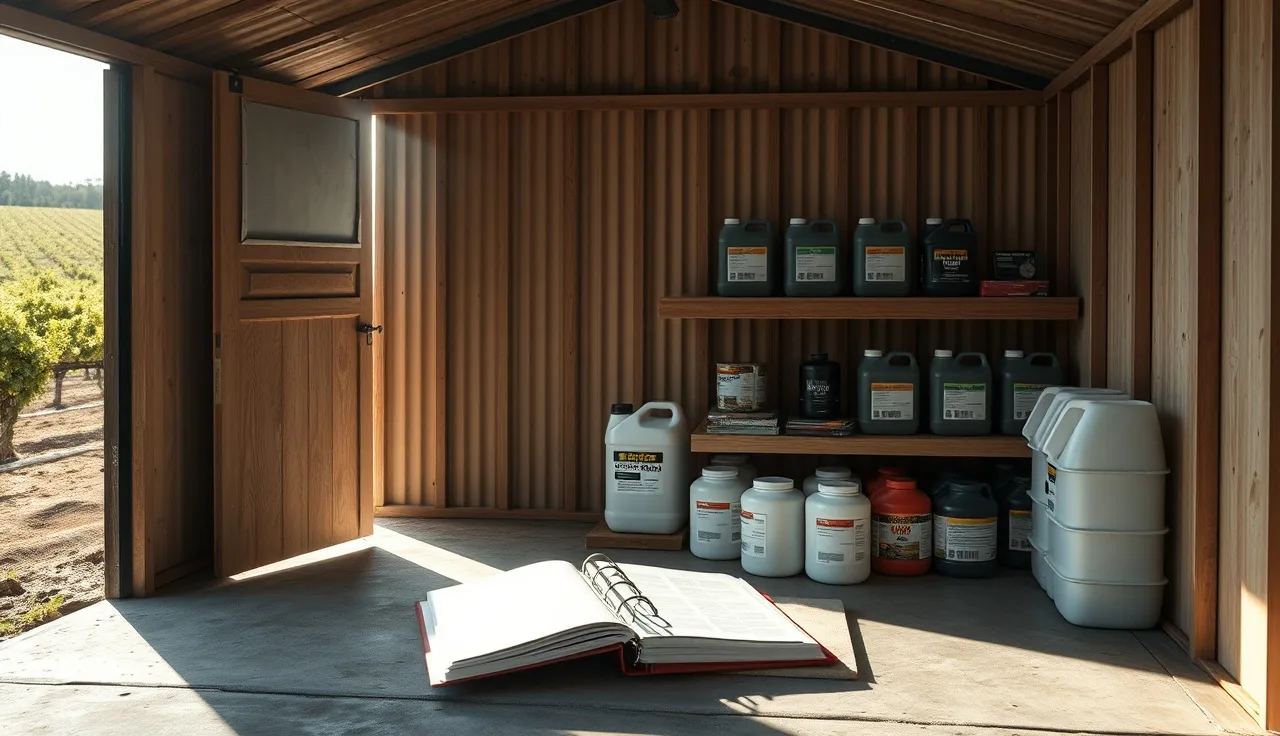
The SDS binder should be visible immediately, not buried under hoses or locked in a cabinet. Mount a binder holder on the wall next to the door at eye level. That's the right instinct. Label the spine clearly.
The WPS central display board (a separate requirement) must be posted where all workers can reach it, and must include the name, address, and phone number of a health care provider or emergency medical facility; the location of the SDS binder; and the EPA-required WPS pesticide safety poster [2]. That poster must be the 2018 or newer version now that the revised WPS is in full effect.
Chemical containers in storage must be in good condition with original labels intact, kept away from food and feed, sitting on secondary containment (a bermed pad or containment shelving) for liquids, and in a locked area when workers aren't present. The SDS for everything in storage must be in the binder. A container in the shed with no SDS in the binder is a direct violation.
Some state departments of agriculture run annual facility inspections of licensed pest control operations, and many counties have Certified Crop Adviser programs that include voluntary compliance reviews. A pre-season walk-through with your county farm advisor costs nothing and often surfaces gaps before they turn into citations.
For managers at larger operations keeping SDS records, application logs, and re-entry interval tracking in one place, a platform like VitiScribe can connect the chemical inventory to the document archive so records stay current as you update your program season to season.
How do you train workers on SDS access, and what documentation do you need?
Having a binder isn't enough. OSHA HazCom requires that employees be trained on how to access and read SDS documents, and the training must be documented [1]. The EPA WPS requires annual safety training for all agricultural workers and handlers who work in pesticide-treated areas, and that training must cover where the SDS information is and how to read it [2].
The training doesn't have to be elaborate. It has to be real. Walk the chemical storage area, show how to find a product in the binder, and explain SDS sections 2 (hazards), 4 (first aid), 8 (PPE), and 11 (toxicology). Do it in the worker's primary language. Under the WPS, information must be communicated in a language the worker understands [2].
What to document:
- Date of training.
- Names of employees trained (signed, if possible).
- Trainer's name and qualification.
- Topics covered.
- Language of training.
Keep these records at least three years. Some states require longer. California requires pesticide safety training records be kept for two years under Title 3 CCR Section 6724, but hold them longer given the 30-year exposure-record framework overall.
UC Davis's Western Center for Agricultural Health and Safety produces Spanish-language WPS training materials that are free and public [4]. WSU Extension has bilingual materials for the Pacific Northwest workforce [5]. Using these does two things: it saves prep time, and it shows you used credible, standards-based content, which matters if an enforcement case ever comes up.
What common SDS binder mistakes cause vineyard compliance failures?
After any OSHA or state ag inspection round, the same gaps show up over and over. Here are the ones that actually generate citations.
Missing SDS for a product that's in the shed. The most common finding. Someone bought a new herbicide mid-season, used it, and never added the SDS. Good rule: no new product goes into the shed until its SDS is in the binder.
Outdated SDS format. Pre-2015 MSDS documents don't meet the GHS 16-section standard. Inspectors know the old format on sight.
Binder is inaccessible. Locked, buried, or in the manager's office instead of the storage area. Workers can't reach it without asking permission. That's a failure of the access requirement.
No master index. Without an index, finding a specific product means leafing through the whole binder. Inspectors read that as a practical access barrier.
Binder doesn't cover all use categories. A binder with only pesticides but no winery cleaning chemicals, or one covering field operations but not the fuel shed. Each storage location may need its own binder or a clear cross-reference.
WPS central display board doesn't reference the SDS location. The binder exists but isn't mentioned on the posted WPS notice, so workers aren't told where it is. That fails the WPS separately from HazCom.
No training records. The binder is perfect, but there's no documentation that workers were trained on how to use it. Training without records counts as no training in an enforcement file.
For managers running multi-site vineyard operations, keeping binder standards consistent across locations is genuinely hard without a shared system. A central template with site-specific inserts keeps the structure the same while allowing for location-specific chemical inventories.
Are there additional state-level SDS rules that go beyond federal requirements?
Yes, frequently. California, Washington, Oregon, and New York all have agricultural worker safety regulations that add to the federal baseline, and state pesticide regulators (like California's DPR) sometimes impose more specific SDS and recordkeeping requirements.
California is the most demanding. The California Department of Pesticide Regulation's pesticide use reporting system requires licensed applicators to report every application, and the related recordkeeping requirements interact with SDS obligations in ways that go past federal HazCom [8]. California also requires restricted-use pesticide records be kept for two years under CCR Title 3, and that workers be given information from the pesticide label and SDS before application, not only on request.
Washington State has its own agricultural worker safety rule (Chapter 296-307 WAC) that parallels federal WPS but adds notification and record-access requirements [9]. WSU Extension's Pesticide Safety Education Program is the primary resource for Washington growers working through state-specific rules [5].
New York requires compliance with WPS and adds DEC-administered pesticide registration and recordkeeping rules. Cornell's NYSIPM program publishes state-specific compliance guides [7].
Look up your own state's department of agriculture or department of labor rules, not only the federal ones. If you're in California, the CDFA and DPR sites are your starting point [8]. If you're in Washington, the WSDA and L&I sites cover both the agricultural safety and pesticide sides [9]. Don't assume federal compliance equals state compliance. It often doesn't.
Frequently asked questions
How many SDS binders does a vineyard need?
At minimum, one binder in each chemical storage area during all work hours. If you have a field chemical shed and a separate winery chemical storage area, each needs its own binder covering the products stored there. Some operations also keep a reduced binder or laminated quick-reference in each spray rig for the 30-day active-use chemicals. There's no cap on how many you have; the legal floor is one accessible binder per storage location.
Does an SDS binder need to be in Spanish for Spanish-speaking workers?
OSHA HazCom requires hazard information be communicated so workers understand it, and the EPA WPS requires pesticide safety training in the worker's language. In practice, training and verbal communication must be in the worker's primary language. The SDS itself can stay in English, since it's a manufacturer document, but the explanation of how to read it and find key sections must cross the language barrier during training.
Can I use a digital SDS app instead of a paper binder?
Yes, with conditions. OSHA allows electronic SDS access if employees can reach it immediately during their shift with no barriers. In a vineyard, that means reliable internet or downloaded offline access at the point of work. If the app requires a login only the manager knows, or if the device lives in the office while workers are in the field, you fail the access test. Most experienced managers keep a physical binder as the primary and use digital as a backup.
How long do I have to keep old SDS sheets after I stop using a chemical?
OSHA's standard at 29 CFR 1910.1020 requires employee exposure records, including SDS documents for chemicals to which employees were exposed, to be kept for 30 years. That period starts from the date of last occupational exposure, not from when you discontinued the product. Archive superseded and discontinued sheets in a separate file rather than tossing them. Scan and store a digital backup.
What happens during a WPS inspection of the SDS binder?
Inspectors, often from the state department of agriculture, will ask to see the binder and typically ask a worker (not the manager) to locate the SDS for a specific product. They check that the binder is in the chemical storage area, that it's accessible without requesting permission, that it covers products applied in the last 30 days, and that the WPS central display board references its location. Missing or outdated sheets and inaccessible binders are the most common findings.
Do I need an SDS for organic or OMRI-listed pesticides?
Yes. OMRI listing means a product is approved for use in certified organic production; it doesn't mean the product is hazard-free or exempt from HazCom and WPS SDS requirements. Copper fungicides, lime sulfur, and spinosad all have SDS documents and all must be in your binder if you're using them. Get the SDS from the manufacturer's website or the CDMS database before first use.
Where do I get SDS sheets if a manufacturer doesn't send one?
Manufacturers are legally required to provide an SDS with every shipment and to make the current version available on request. You can download most agricultural product SDS documents from the CDMS database (cdms.net), Greenbook, or manufacturer websites. For older or discontinued products, the National Pesticide Information Center or the EPA's pesticide registration database may have historical SDS documents. If a manufacturer refuses to supply one, that's a HazCom violation on their part, and you can report it to OSHA.
Is there a required SDS section that tells me what PPE workers need?
Section 8 of the GHS-formatted SDS covers exposure controls and personal protective equipment. It lists recommended respiratory protection, glove types, eye protection, and body protection for routine handling. Note that Section 8 reflects the manufacturer's general guidance; the pesticide label's PPE requirements are legally binding under FIFRA and may be stricter than what Section 8 shows. Follow the label first, and treat Section 8 as supplemental.
Do fertilizers and soil amendments need to be in the SDS binder?
It depends on the hazard classification of the specific product. Anhydrous ammonia is clearly hazardous and requires an SDS. Most liquid fertilizers (nitrogen solutions, phosphate blends) are classified as hazardous materials under HazCom and should be included. Dry lime and gypsum are generally not OSHA hazardous materials, though they may still have SDS sheets available. When in doubt, include the sheet. The cost of an extra page is nothing.
What is the WPS central display board, and how does it connect to the SDS binder?
The WPS central display board is a posted notice required at each agricultural establishment under 40 CFR Part 170. It must include the EPA pesticide safety poster, the name and phone number of an emergency medical provider, and the location of SDS documents for pesticides used in the past 30 days. The board and the binder work together: the board tells workers where the binder is; the binder holds the actual SDS documents they have a right to see.
How often should I audit my SDS binder?
Do a full audit twice a year: once in early spring before your first spray application, and once in late fall after harvest. Spring audit: verify every product you plan to use is in the binder with a current GHS-formatted SDS. Fall audit: move discontinued products to the archive, add any mid-season additions, and confirm all sheets are the most current version from the manufacturer. Any mid-season new product purchase should trigger an immediate single-product update.
Can a farm labor contractor be responsible for the SDS binder instead of the vineyard owner?
Under the WPS, the agricultural employer, meaning the owner or operator of the establishment, bears primary responsibility for SDS access. If you use a farm labor contractor (FLC), both you and the FLC may share employer obligations, but you cannot fully transfer the duty to make SDS documents accessible. The binder must be on the property and accessible to workers regardless of who employs them. Put responsibilities in writing with any FLC, but don't assume they cover your WPS exposure.
What's the difference between an MSDS and an SDS, and do old MSDS sheets still count?
MSDS (Material Safety Data Sheet) is the older format with a variable section structure. SDS (Safety Data Sheet) is the current GHS-standardized 16-section format required under OSHA HazCom 2012, with full compliance required by June 2016. Old MSDS sheets don't meet current requirements. If you have a pre-2016 MSDS in your binder, replace it with the current GHS SDS from the manufacturer. Keep the old MSDS in your archive as part of the historical exposure record.
Sources
- OSHA, Hazard Communication Standard (29 CFR 1910.1200): Employers must maintain SDS for all hazardous chemicals, ensure employee access during work shifts, and retain exposure records including SDS for 30 years under 29 CFR 1910.1020.
- EPA, Worker Protection Standard (40 CFR Part 170): Agricultural employers must make the SDS for any pesticide applied in the last 30 days available to workers and handlers; the WPS central display board must reference SDS location.
- OSHA, Penalties for OSHA Violations: OSHA maximum penalties for serious violations are adjusted annually; as of the 2024 adjustment, serious violations start at $16,131 per violation.
- UC Davis Western Center for Agricultural Health and Safety: UC Davis agricultural safety resources recommend physical SDS access at or near the chemical storage and application area; Spanish-language WPS training materials are publicly available.
- Washington State University Extension, Pesticide Safety Education Program: WSU Extension Pesticide Safety Education Program covers WPS SDS access obligations and state-specific Washington requirements, including bilingual training materials.
- OSHA, Access to Employee Exposure and Medical Records (29 CFR 1910.1020): 29 CFR 1910.1020 requires SDS and exposure records for hazardous chemicals to be retained for 30 years; employers who cease business must transfer records to the new owner or notify NIOSH.
- Cornell University, New York State Integrated Pest Management Program: Cornell NYSIPM publishes WPS compliance checklists for farm operators covering SDS access requirements and New York State-specific pesticide regulations.
- California Department of Pesticide Regulation: California DPR pesticide use reporting system requires licensed applicators to report every application; restricted-use pesticide records must be kept for two years under CCR Title 3.
- Washington State Department of Labor and Industries: Washington's agricultural worker safety rule (Chapter 296-307 WAC) parallels federal WPS and adds notification and record-access requirements administered through L&I.
- OSHA, Hazard Communication Globally Harmonized System (GHS): OSHA HazCom 2012 adopted the GHS 16-section SDS format; full compliance with the new SDS format was required by June 2016 for chemical manufacturers and employers.
- National Pesticide Information Center (NPIC): NPIC maintains resources for locating SDS documents for pesticide products, including older and discontinued materials.
Last updated 2026-07-10