Eyewash station inspection and maintenance log for vineyard chemical storage
TL;DR
- OSHA requires eyewash stations wherever workers can hit their eyes with corrosive chemicals, plus weekly activation tests with written records.
- Portable gravity-fed units need weekly water changes and flushing.
- Your log needs date, inspector name, flow check, temperature, and corrective action notes.
- A blank log is a citable violation under 29 CFR 1910.151(c).
Why does a vineyard chemical storage area need an eyewash station?
A vineyard chem shed is full of things that blind people. Sulfur dust, copper fungicides, concentrated acids for pH adjustment, caustic sanitizers, and the pesticides themselves. Any of those can do permanent eye damage in seconds, before a worker can even get to a sink.
OSHA's medical services and first aid standard, 29 CFR 1910.151(c), states: "Where the eyes or body of any person may be exposed to injurious corrosive materials, suitable facilities for quick drenching or flushing of the eyes and body shall be provided within the work area for immediate emergency use." [1] That language is not limited to factories. Cal/OSHA, Washington L&I, and other state-plan agencies apply the same rule to farms.
The EPA Worker Protection Standard (WPS), rewritten in 2015, adds a second layer for pesticide work. Under 40 CFR Part 170, employers must supply decontamination water including eye-flushing water whenever workers handle pesticides or do early-entry tasks in areas under a restricted-entry interval. [2] For most vineyards that covers the spray crew, the fungicide applicators, and whoever restocks the shed. All of them need flushing water on hand, and you need paper proving the equipment works.
The stakes are physical, more than legal. An eyewash that sat untouched for six months delivers water that's stagnant, scalding in July, or growing something. None of that helps the person who just caught sulfur drift in both eyes. Federal data backs the point: a NIOSH review of occupational chemical eye injuries found inadequate first-aid equipment was a contributing factor in a large share of cases that cost workers lost days. [3]
What does OSHA actually require for eyewash stations at agricultural worksites?
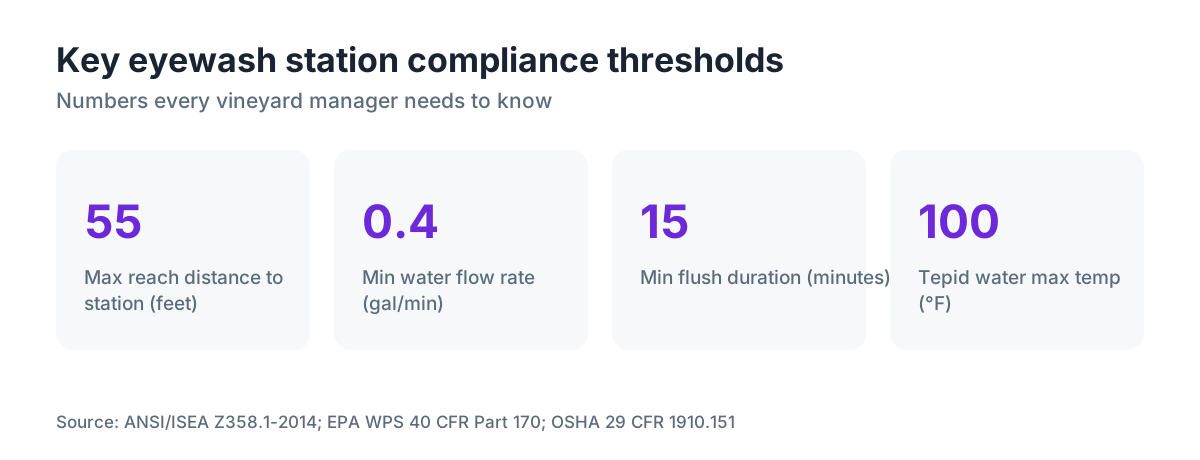
OSHA enforces the general first-aid rule, but the technical specs come from ANSI/ISEA Z358.1-2014, the industry standard OSHA treats as the yardstick for 29 CFR 1910.151(c). [4] Here's what that means in practice:
- Plumbed (self-contained) stations must sit close enough that a worker reaches them within 10 seconds, roughly 55 feet, from the hazard.
- The unit delivers at least 0.4 gallons per minute for 15 minutes at tepid water, defined as 60 to 100 degrees Fahrenheit.
- Plumbed stations get activated weekly to flush stagnant water out of the supply line and confirm they run.
- Portable gravity-fed units get their water changed at the manufacturer's interval, usually weekly, and flushed weekly.
- A written test record is not spelled out in the ANSI text itself. But OSHA inspection practice, and most state-plan enforcement, reads a missing record as proof the test never happened. [4]
Small farms get a partial pass on OSHA. Agricultural employers with fewer than 11 employees, and no fatality or catastrophe in the prior year, are exempt from OSHA programmed inspections. The EPA WPS decontamination rules apply anyway, no matter how many people you employ. [2] A family-run vineyard that falls outside OSHA's inspection reach still needs a working, documented eyewash at its pesticide storage area under federal law.
California deserves its own paragraph. Cal/OSHA Title 8 Section 3457 covers agricultural operations and points back to ANSI Z358.1. The California Department of Pesticide Regulation (CDPR) enforces the WPS decontamination requirements as the state lead agency. Farm in California and you're under two overlapping systems at once. Your inspection log is evidence for both. [5]
How often should you inspect and flush eyewash stations in a vineyard setting?
Weekly flushing is the floor, not a suggestion. Every week someone activates the unit, runs it at least one minute (some manufacturers want three), confirms the flow, and writes it down. If you have a plumbed station, that's not optional. Portable units get the same weekly treatment plus a water change.
Monthly, do something deeper. Spray intensity, heat, and who's on the crew all shift month to month. A monthly check covers water temperature, nozzle condition, dust caps, signage, and path clearance, the stuff a fast weekly flush skips right past.
Once a year, run a full inspection against the ANSI spec: measured flow rate, measured temperature, verified reach distance, correct mounting height, and a look at every mechanical part. For plumbed stations that includes confirming supply pressure. For portable units it means checking the tank for sediment, algae, and liner condition. A lot of vineyard managers schedule this in late winter, before spray season kicks off, which is smart timing.
Heat is the portable unit's enemy. WSU Extension's pesticide safety program points out that seasonal temperature swings hit portable units hard, because water can run near-freezing in the morning and climb past 100 degrees in a closed shed by afternoon. [6] If your portable eyewash lives in an unventilated chem shed in August, check the temperature weekly, not monthly. Water above 100 degrees can make some chemical burns worse.
The table below lays out the intervals and what to check at each one.
What fields belong in an eyewash station inspection log?
A good log is one an OSHA compliance officer or a DPR inspector can pick up, read in two minutes, and see that real people did real checks on real dates. Here are the fields it needs:
| Field | Why it matters |
|---|---|
| Date of inspection | Establishes the weekly/monthly cadence |
| Inspector name (printed) | Identifies who is accountable |
| Inspector signature | Confirms the entry is not filled in after the fact |
| Station ID or location | Essential if you have more than one unit |
| Unit type (plumbed / portable) | Different standards apply |
| Water flow confirmed (Y/N) | Core ANSI Z358.1 check |
| Water temperature (°F or range) | Tepid range is 60-100°F per ANSI Z358.1 |
| Duration of flush (minutes) | Minimum 1 minute for stagnant water clearing |
| Nozzle / spray pattern (Y/N) | Are both nozzles clear and spraying upward? |
| Dust caps / covers present (Y/N) | Protects nozzles from contamination between uses |
| Path clear to station (Y/N) | 10-second / 55-foot reach requirement |
| Signage visible (Y/N) | ANSI requires the station to be marked |
| Corrective action needed (Y/N) | Triggers a follow-up line |
| Corrective action taken and date | Closes the loop; critical for audits |
| Next scheduled inspection date | Keeps the cadence visible |
For portable units, add three more:
- Water change date
- Additive or preservative used (some owners add a small amount of sodium hypochlorite per manufacturer instructions to hold back microbial growth; note the product and concentration)
- Tank condition (cloudy, sediment, odor)
Don't over-build the form. A one-page log with those columns, printed front and back, covers a full quarter of weekly checks. Paper binders in the chem shed work fine. So do digital records, and some vineyard managers run tablet-based systems like VitiScribe to keep spray records, WPS documentation, and equipment logs together, which cuts down audit prep.
How do you write corrective actions in the log?
This is where most logs fall apart. An inspector sees a checked box reading "corrective action needed: yes," and the next line is blank. That's worse than no log at all, because it proves you spotted a problem and did nothing about it.
Write the correction as a full sentence with a date. Something like: "2025-05-14: Nozzle cap missing on left head. Ordered replacement from Haws, cap installed 2025-05-16 by J. Morales." That entry tells the whole story. Who, what, when, done by when.
If a nozzle is clogged, note whether you pulled the station out of service and what backup decontamination water you gave workers in the meantime. WPS requires workers to have access to decontamination water at all times during pesticide handling. [2] Pull a portable unit for cleaning and the log should show you set out backup water and told the crew.
Temperature failures pile up in summer. If your portable eyewash reads 110 degrees in July, note it, note that you moved the unit to shade or wrapped the tank in insulation, and recheck the next day. Don't skip an entry because the problem feels small. Minor problems documented and fixed read like a well-run operation. Problems that only surface after an injury read like negligence.
Where should the eyewash station be located in a vineyard chemical storage area?
Start with the 10-second, 55-foot rule from ANSI Z358.1. [4] For a chem shed, that usually puts the eyewash just inside the door or on the exterior wall right outside it. Put it on the path from the mixing bench toward fresh air, not in a corner behind stacked pallets.
The station has to be on the same level as the hazard. No stairs. A person with chemicals in both eyes can't safely handle steps.
Signage is required. The ANSI standard calls for a green sign with the eyewash symbol, and most jurisdictions accept the ISO 7010 W011 symbol. The sign has to be visible from where people actually handle chemicals, more than from the station itself.
Light matters too. If the shed is dark, the eyewash needs to be lit or placed where emergency lighting reaches it. Obvious in theory, but chem sheds are usually the last building on the property to get decent lighting.
If you mix tank loads at remote field stations, you also need portable decontamination water at the mixing site. WPS requires at least one gallon of water per worker for eye flushing during field pesticide applications. [2] That's separate from your fixed eyewash at the storage area, and it belongs in your pesticide application records too.
What are the differences between plumbed and portable eyewash stations for vineyard use?
Most vineyards run portable gravity-fed units because chem sheds rarely have plumbing. That's fine, as long as you know the tradeoffs.
| Feature | Plumbed station | Portable gravity-fed unit |
|---|---|---|
| Water supply | Continuous (municipal or well line) | Limited by tank capacity (typically 9-32 gallons) |
| 15-minute flush capacity | Automatic if pressure is adequate | Must verify tank volume meets 0.4 gpm x 15 min = 6 gallons minimum |
| Temperature control | Often needs tempering valve to reach 60-100°F | Relies on ambient; requires shade/insulation in summer |
| Weekly maintenance | Flush line 1 min; check flow | Change water; check for microbial growth; verify volume |
| Microbial risk | Lower (flowing supply) | Higher (standing water) |
| Cost range | $300-$1,500 installed | $100-$600 for the unit |
| Best fit | Fixed chem storage with plumbing nearby | Remote chem sheds, mixing stations, field use |
Those cost figures are general market ranges as of 2025. Actual prices swing by supplier, region, and whether installation labor is in the quote. Get it in writing.
Here's the trap a lot of managers walk into: a portable unit with a 9-gallon tank delivers only 9 gallons before it runs dry. At 0.4 gallons per minute that's about 22 minutes, which technically clears the 15-minute requirement but leaves almost no margin. A 16-gallon or larger unit gives you real buffer. WSU Extension recommends confirming tank capacity meets the full 15-minute flow standard before you buy. [6]
My honest take: if a chem shed has even minimal plumbing access, run a line and install a plumbed unit with a tempering valve. The water-change chore on portable units is constant, and in a busy season it's easy to let a week slip. A plumbed unit doesn't forget.
How does an eyewash inspection log connect to your WPS and pesticide records?
The EPA Worker Protection Standard requires employers to keep records of decontamination supplies and training. [2] Your eyewash log is part of that stack. An EPA WPS audit or a state DPR inspection usually asks to see three things:
- Pesticide application records (including re-entry intervals)
- Worker training records (annual WPS training)
- Evidence that decontamination supplies were available and working
The eyewash log is your evidence for item 3. Weekly entries with temperature and flow confirmed across the whole spray season show an employer who takes this seriously. A blank binder shows a violation.
UC Davis Agricultural and Natural Resources safety guidance recommends keeping WPS decontamination documentation and equipment maintenance records together, in the same binder or system, so an inspector can see the exposure risk (from application records) and the mitigation (from equipment logs) side by side. [7]
Cornell's agricultural workforce safety resources make a related point: the log exists to build a paper trail that protects both the worker and the employer if an exposure happens and litigation follows. [8] A dated, signed log showing the station worked and was reachable before the incident is a real defense. A missing log is a hole in your case.
Run a digital system like VitiScribe for spray records and WPS documentation, and it's worth parking the eyewash logs there too, so your whole audit package lives in one place instead of split between a paper binder and a spreadsheet.
What does a good weekly eyewash inspection actually look like, step by step?
This is the part that matters on a Tuesday morning. Here's a thorough weekly check for a portable unit in a vineyard chem shed. It takes about five minutes.
Step 1: Check the access path before you open the shed door. Anything blocking the route from the mixing bench to the station? Pallets, hoses, empty jugs? Clear it, note it in the log.
Step 2: Open the dust caps on both nozzle heads and set them somewhere clean.
Step 3: Activate the unit. On a push-handle portable, push the handle and let it lock open. On a foot-pedal plumbed unit, step on the pedal. Time a full minute.
Step 4: While it runs, watch the spray pattern. Both heads should spray upward and outward, even and symmetric, a gentle low-pressure flow, not a sharp jet. A clogged or sideways nozzle goes in the corrective action column.
Step 5: Check the water temperature. You don't need a thermometer every week. On a hot day, run your wrist under the flow. If it feels hot, it's probably over 100 degrees. Note it. On a cold morning, if it feels like ice, note that too.
Step 6: After one minute, shut it off. Dry the nozzle heads, replace the dust caps.
Step 7: For portable units, check the tank level. If you changed the water this week, log the change date. If the water looks cloudy or smells off, change it now and note the issue.
Step 8: Fill in the log. Every field. Sign it.
Five minutes, total. The alternative: a worker gets acid-drenched and the station doesn't work. Five minutes is a fair trade.
What common violations do OSHA and DPR inspectors find during vineyard chemical storage inspections?
The findings at vineyard and agricultural chemical storage inspections repeat themselves across state agencies and OSHA regions:
- No eyewash station at all. Still common at smaller operations.
- Station present but access blocked by pallets, equipment, or locked doors.
- Station accessible but never flushed or documented. The unit looks new, the log is empty.
- Portable unit with water untouched for months. Visible algae or sediment, a health hazard on its own.
- Water temperature out of range, usually too hot in a summer shed.
- Signage missing or faded. The station exists but workers can't find it fast.
- Station too far from the hazard, past 55 feet or blocked by stairs or doors.
- Tank too small to deliver 15 minutes of flushing flow.
California DPR's county agricultural commissioner inspections often cite decontamination water deficiencies among the top WPS findings. CDPR's annual enforcement reporting has listed pesticide handler exposure and decontamination violations among the most common findings statewide. [5]
The fixes are cheap. A sign runs under $10. Moving the unit costs nothing. Changing water costs five minutes. A log sheet costs a piece of paper. Compare that to the penalty: a serious WPS violation can reach $10,654 per violation per day under current EPA penalty policy, and repeat violations can double. [11] Suddenly the $10 sign looks like a bargain.
How long should you keep eyewash inspection logs, and who can ask to see them?
Keep them five years. OSHA doesn't set a retention period specifically for eyewash records, but its recordkeeping rule at 29 CFR 1904 requires injury and illness records to be kept five years. [9] Treating eyewash maintenance logs the same way is reasonable and matches how most compliance folks handle it.
EPA WPS pesticide application records must be kept two years, and many operators keep all WPS-related records, decontamination equipment logs included, for the same stretch. [2]
California has its own clock. CDPR requires pesticide use reports to be retained for two years, and county agricultural commissioners can request related records, including safety equipment documentation, during routine compliance inspections. [5]
Who can ask to see your logs:
- Federal OSHA compliance officers (employers under federal OSHA jurisdiction)
- State OSHA equivalents (Cal/OSHA, Washington L&I, Oregon OSHA, and others)
- EPA inspectors running WPS audits
- State DPR or county agricultural commissioners
- An attorney representing an injured worker in civil litigation
Format matters less than completeness. A dated binder in the chem shed is fine. A digital file with a clear naming convention is fine. What counts is that the records are complete, legible, and signed by a real person on the actual inspection date.
Frequently asked questions
Does OSHA require a written log for eyewash station inspections, or just the inspections themselves?
ANSI Z358.1-2014, which OSHA treats as the compliance standard for 29 CFR 1910.151(c), requires weekly activation but doesn't spell out a written log in its text. OSHA enforcement practice, though, treats the absence of records as evidence the inspections never happened. A written log is the only practical way to prove compliance, so keep one.
Can a 5-gallon portable eyewash station meet OSHA requirements at a vineyard chem shed?
Probably not. ANSI Z358.1 requires at least 0.4 gallons per minute for 15 continuous minutes, which means a minimum of 6 gallons of usable water. A 5-gallon unit runs dry in about 12.5 minutes at that flow. Most inspectors and manufacturers push for a 9-gallon minimum, and a 16-gallon unit gives you a real margin.
How close does an eyewash station need to be to the chemical mixing area?
ANSI Z358.1 specifies the station must be reachable within 10 seconds of travel from the hazard, which works out to roughly 55 feet on a level, unobstructed path. No stairs, no locked doors, no obstacles between the work area and the station. If your chem shed is bigger than that, you may need two units.
What water temperature is required for an eyewash station?
ANSI Z358.1 specifies tepid water, defined as 60 to 100 degrees Fahrenheit. In a hot equipment shed in summer, a portable unit can easily blow past 100. If the water feels hot to your wrist, it's likely too warm and can worsen some chemical burns. Move the unit to shade, insulate the tank, or add a tempering valve on a plumbed unit.
Does EPA's Worker Protection Standard require an eyewash station specifically, or just water?
The WPS at 40 CFR Part 170 requires at least one gallon of water per worker for eye flushing at pesticide handling areas, plus additional decontamination water. It doesn't require a formal ANSI-compliant eyewash unit for field situations, but a fixed pesticide storage area needs one. OSHA's 29 CFR 1910.151(c) covers that fixed-station requirement.
How often should the water in a portable eyewash station be changed?
Most manufacturers specify weekly water changes for portable gravity-fed units. If you add an antimicrobial additive (some manufacturers supply one; follow their instructions exactly), some units stretch to bi-weekly or monthly. Check your unit's manual for the interval. Water that looks cloudy, smells off, or shows sediment gets changed right away, schedule or no schedule.
What happens if a vineyard worker is injured and the eyewash log is missing or incomplete?
In a workers' compensation or civil liability case, a missing log makes it much harder to show the station was working and reachable. Courts and regulators can read absent documentation as evidence of absent safety practice. A complete, signed log showing the station was inspected and functional before the incident is a real factual defense for the employer.
Do small vineyards with fewer than 11 employees need to follow OSHA eyewash rules?
Small farms with fewer than 11 employees are exempt from OSHA programmed inspections, but EPA's Worker Protection Standard applies to all agricultural employers regardless of size once pesticides are in use. WPS requires decontamination water and equipment documentation. Most state DPR programs enforce WPS independent of farm size, so the practical requirement reaches nearly everyone.
What is the penalty for not having a working eyewash station at a pesticide storage area?
Under EPA WPS, civil penalties for serious violations can reach $10,654 per violation per day under current penalty policy. Repeat violations can double that. State penalties vary, and California DPR can assess administrative penalties for decontamination deficiencies on its own. Beyond fines, an employer with no working eyewash after an injury faces heavy civil liability.
Can I use a garden hose as an eyewash station in a vineyard chemical storage area?
A standard garden hose doesn't meet ANSI Z358.1 because it can't deliver a controlled tepid-water flow to both eyes at once at the specified rate. A hose can serve as supplemental decontamination water for body rinsing under WPS, but it's no substitute for a compliant eyewash station at a fixed chemical storage and mixing area.
What should go on an eyewash station inspection log for an annual inspection?
The annual inspection goes past the weekly checklist. Measure and record actual flow rate (gallons per minute), verify the station is within 55 feet of the hazard, check mounting height (nozzles 33-45 inches off the floor per ANSI Z358.1), inspect all mechanical parts for corrosion or wear, verify signage condition, and confirm the water source sustains 15 minutes of flow. Document every finding and the corrective action taken.
How do I document an eyewash station that was out of service for repairs?
Note the out-of-service date, the reason, and what temporary decontamination water you provided while the unit was down (WPS still requires access to flushing water). Record the repair, who did it, and the date the unit went back into service. Sign both the out-of-service and the return-to-service entries.
Where can I get a free eyewash station inspection log template?
WSU Extension, UC Davis Agricultural and Natural Resources, and Cornell's agricultural workforce program all publish free WPS compliance resources that include or reference decontamination equipment checklists. OSHA's website also has general first-aid equipment material. Whatever template you use, customize it with your station locations, unit types, and the ANSI Z358.1 required data fields.
Does a winery tasting room or production facility need an eyewash station?
Yes, if workers handle hazardous chemicals, which includes sulfur dioxide, citric acid, caustic cleaning agents, and pesticide-treated equipment. OSHA 29 CFR 1910.151(c) applies to winery production areas. The standard is the same: a compliant eyewash station within 10 seconds of the hazard, flushed weekly, with documented inspections. Small wineries often miss this in the cellar and bottling areas.
Sources
- OSHA, 29 CFR 1910.151 Medical Services and First Aid: OSHA requires suitable eye and body flushing facilities within the work area wherever employees may be exposed to injurious corrosive materials.
- EPA, Agricultural Worker Protection Standard (40 CFR Part 170): EPA WPS requires decontamination water including eye-flushing water for all pesticide handlers and early-entry workers, and requires employer documentation of decontamination supplies.
- NIOSH (CDC), Occupational eye injury data and prevention resources: NIOSH analysis found inadequate first-aid equipment was a contributing factor in a large share of work-related chemical eye injuries resulting in lost workdays.
- ANSI/ISEA Z358.1-2014, Emergency Eyewash and Shower Equipment Standard (International Safety Equipment Association): ANSI Z358.1 specifies: eyewash station reachable within 10 seconds and approximately 55 feet, delivering at least 0.4 gpm for 15 minutes at 60-100 degrees Fahrenheit tepid water, with weekly activation required.
- California Department of Pesticide Regulation, Enforcement and annual reporting: CDPR annual enforcement data has shown pesticide handler decontamination violations among the most common findings statewide; CDPR enforces WPS decontamination requirements as the state lead agency.
- WSU Extension, Urban IPM and Pesticide Safety Education Program: WSU Extension notes that in agricultural settings, seasonal temperature swings are particularly hazardous for portable eyewash units, and recommends verifying tank capacity meets the full 15-minute flow standard before purchasing.
- University of California Agriculture and Natural Resources, WPS compliance resources: UC ANR guidance recommends keeping WPS decontamination documentation and equipment maintenance records together to facilitate integrated compliance audit review.
- Cornell University, Agricultural Workforce Development: Cornell agricultural safety resources note that a dated, signed inspection log showing a station was working and accessible before an incident is a meaningful defense in litigation.
- OSHA, 29 CFR 1904 Recording and Reporting Occupational Injuries and Illnesses: OSHA 29 CFR 1904 requires injury and illness records be retained for five years, which is the standard practitioners apply to related safety equipment maintenance records.
- OSHA, Agricultural Operations Safety and Health Topics: OSHA applies 29 CFR 1910.151(c) to agricultural worksites; small farms with fewer than 11 employees are exempt from programmed OSHA inspections but EPA WPS applies regardless of farm size.
- EPA, Pesticides enforcement and civil penalty policy: EPA civil penalties for serious WPS violations can reach $10,654 per violation per day under current penalty policy; repeat violations can be doubled.
Last updated 2026-07-10