Soil amendment application records for vineyard nutrition management
TL;DR
- A vineyard soil amendment record needs eight things: product name, rate, date, location, application method, operator, total quantity, and the material's composition.
- Attach the soil or tissue test that justified it.
- Keep everything five years, which covers the longest common requirement (USDA organic).
- Complete records protect you when a nutrient management audit, a water-quality inspection, or a labor review shows up without warning.
What exactly counts as a soil amendment in a vineyard?
A soil amendment is any material you add to soil mainly to change its physical, chemical, or biological properties instead of feeding the vine directly. That definition is wider than most growers expect. Lime, gypsum, compost, biochar, elemental sulfur, and cover-crop mulch tilled under all qualify. So do the products that live in a regulatory gray zone: manure-based composts, worm castings, humic acid concentrates.
Fertilizers applied to the soil, as opposed to foliar sprays, usually land in a separate fertilizer log. The record-keeping logic is identical, though, and the two logs merge easily into one nutrition management document. The U.S. Composting Council separates amendments from fertilizers partly on N-P-K content, but California, Oregon, and Washington each write their own definitions into their commercial fertilizer laws, and those definitions don't always agree [1].
Here's the rule I use. If you're changing the soil matrix, record it as an amendment. If you're delivering a nutrient, record it as a fertilizer. If the product does both, record both. Nobody has ever been penalized for over-documenting.
Why do vineyard managers need application records at all?
Three separate pressures drive it, and they don't overlap neatly. Satisfy one and you've still got the other two to answer for.
Agronomic accountability comes first. Soil pH moves slowly. A single lime pass can shape vine performance for five or six years. If you didn't write down what went out, when, and where, you can't explain why Block 7 has drifted alkaline or why your petiole numbers keep sliding. UC Cooperative Extension has made this point for years: multi-year records are the only way to tell a soil management effect apart from a vintage effect [2].
Regulatory compliance is second. California's Irrigated Lands Regulatory Program, Washington's nutrient rules under the Clean Water Act, and USDA's National Organic Program all demand records of what you applied and how much. The NOP rule at 7 CFR 205.103 requires certified operations to keep records five years [3]. Certifying agents ask for them at every annual inspection.
Worker protection is third. Under the EPA Worker Protection Standard, restricted-use pesticides carry strict re-entry interval records. Some amendments, especially fumigants and certain sulfur-based acidifiers, hold pesticide registrations and fall under WPS documentation rules [4]. Missing those records is a compliance failure even when the application itself was flawless.
What information belongs in every soil amendment record?
Eight fields make a complete record. Drop any one and the record gets hard to use, both for an audit and for your own year-over-year math.
| Field | What to record | Example |
|---|---|---|
| Date | Actual application date | 2024-03-15 |
| Product name | Full commercial name, not a nickname | Hi-Cal Lime 60 |
| Active ingredient or material | Chemistry or composition | Calcium carbonate, 95% purity |
| Rate applied | Per acre, units explicit | 2 tons / acre |
| Total quantity | For the whole block or field | 14 tons |
| Location | Block ID, row range, or GPS boundary | Block 4A, Rows 1-48 |
| Application method | Broadcast, banded, injected, etc. | Broadcast, incorporated to 6 in |
| Operator | Name of person who applied | J. Morales |
Two more fields earn their place even when nobody requires them: the soil or tissue test that justified the application, and the product's lot number or delivery receipt number. The first ties your decision to data. The second gives you a paper trail if a product quality problem surfaces later.
WSU Extension's nutrient management guidance for wine grapes tells growers to attach test results to the application record instead of filing them off somewhere else [5]. Do that, and the record explains itself to anyone who reviews it two or three years on. Including you.
How long do you have to keep vineyard soil amendment records?
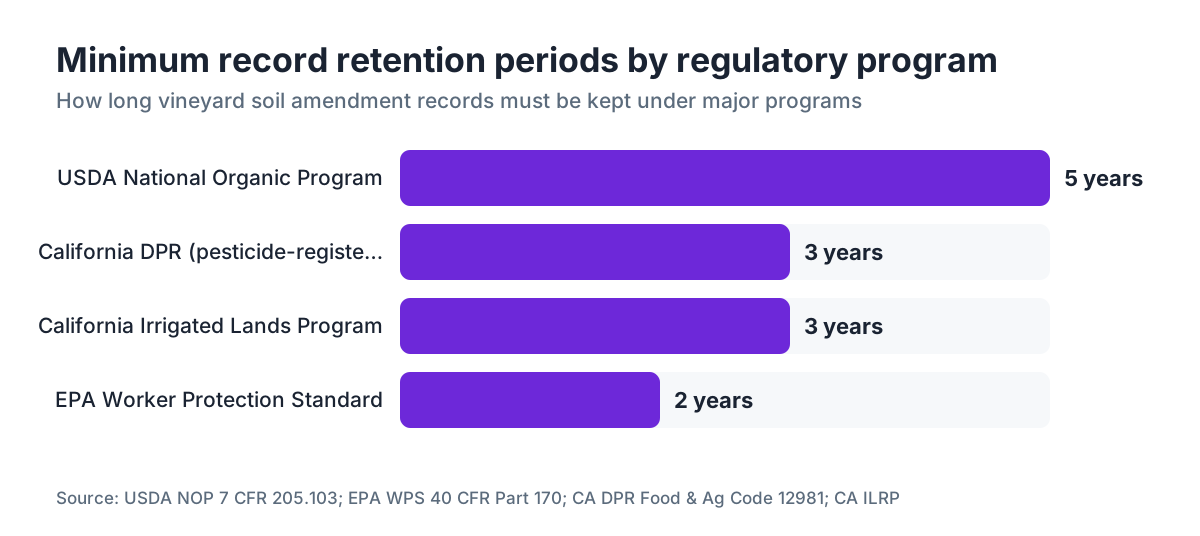
The retention period depends entirely on who's asking. The safe answer sits at the top of the range.
USDA National Organic Program: five years minimum, stated in 7 CFR 205.103. That's the longest common requirement, so a certified organic operation should just treat five years as the baseline for everything [3].
California Irrigated Lands Program: three years for most records, whether you file through a third-party coalition or hold an individual permit. Read your specific permit for anything longer.
EPA Worker Protection Standard: two years for any amendment carrying a pesticide registration, such as sulfur or certain fumigants. The WPS rule at 40 CFR Part 170 spells this out [4].
California pesticide use records: three years under Food and Agricultural Code Section 12981, enforced by the Department of Pesticide Regulation [6].
My advice is blunt: keep everything five years and don't waste an afternoon optimizing a retention schedule by product category. Storage costs almost nothing. A document request you can't fill costs real money.
How does organic certification change the record-keeping requirements?
Organic certification adds layers that conventional operations never touch. The certifying agent has to verify more than the fact that you applied an approved material. They need to confirm that every input appears on the National List at 7 CFR 205.601 through 205.606, and that no prohibited substance touched the certified ground for three years before your first certified harvest [3].
So your records have to show approval status, more than a product name. In practice that means keeping the label, the OMRI listing or your certifier's approval letter, and the application record together in one file.
Compost deserves its own attention. NOP requires compost used on organic ground to be produced at specific time and temperature combinations, spelled out at 7 CFR 205.203 [10]. If you buy compost from an outside supplier, you need the supplier's process records, more than the delivery invoice. Plenty of small vineyards learn this the hard way at their first inspection.
Cornell Cooperative Extension keeps a clear checklist for organic vineyard record-keeping that runs through amendment records in detail [7]. Download it and work through it once a year, before your inspection window opens.
What soil and tissue tests should drive your amendment decisions, and how do you record them?
The amendment record is only half the story. The test result that triggered the application is the other half, and it's the half that turns your files into something you can actually farm from.
For pH work, a soil test every two to three years is a reasonable baseline, keeping in mind that pH varies a lot inside a single block. UC Cooperative Extension suggests sampling the 0-12 inch and 12-24 inch zones separately when you're running a lime or sulfur program, because deep pH steers root distribution in ways a surface-only sample misses [11].
For calcium, magnesium, potassium, and boron, a bloom-time tissue test (petiole opposite the first bloom cluster) gives the most actionable read for the current season. Soil tests for those nutrients tell you what's present, not what's available. Record both, with sample date and lab name, and you've got the clearest picture of why you chose what you chose.
A test-informed record might read: "2024-04-02: Applied 1.5 tons/acre gypsum to Block 6. Based on 3/20/24 soil test (Waypoint Analytical, sample B6-24), calcium saturation 45%, magnesium saturation 22%. Target calcium elevation. Broadcast, no incorporation."
That one paragraph holds more useful information than a spreadsheet row with a product and a rate. Keep both. Neither one alone is complete.
What's the best format for keeping these records: paper, spreadsheet, or software?
All three can be compliant. None of them is compliant just by existing.
Paper is durable in the way that matters: a water-damaged phone can't take your 2019 records down with it. It's also miserable to search when an inspector wants every gypsum application across 14 blocks for the last three years. A tidy binder with a cover-sheet index beats a messy digital folder, but a searchable digital record beats both for day-to-day use.
Spreadsheets work fine under roughly 50 acres. The enemy is format drift. Let three people add rows over five years and you'll get mixed units, blank fields, and merged cells that break every filter you try to run. Lock the column headers on day one and protect the sheet structure.
Farm management software and vineyard-specific platforms auto-fill dates, pull in block geometry, and print compliance reports in the format your certifier or state agency wants. The cost is a subscription and a learning curve during a season when you have no spare hours. VitiScribe is built for vineyard field operations and links amendment records straight to block maps and spray logs, so you're not running three separate systems that don't talk to each other.
Whatever you pick, the record has to be legible and retrievable. A DPR audit or an organic inspection is a bad time to find out your records live in a Google Sheet only one former employee can open.
How do nutrient management plans connect to your amendment records?
A nutrient management plan (NMP) is a written strategy for meeting vine nutrition while keeping nutrients, mostly nitrogen and phosphorus, from moving off-site into surface water or groundwater. Several Western states require one above certain acreage thresholds. Even where it isn't required, the NMP is the document that gives your amendment records their context.
The plan usually sets target soil pH ranges, target tissue nutrient levels, rate limits based on crop uptake and soil holding capacity, and timing restrictions to cut leaching risk during dormant or rainy stretches.
Your application records then prove you followed it. Say the plan called for 1.5 tons/acre of lime and you put out 2. The record is where you note why: a follow-up pH test, a different product purity, a mistake. Honest records with a noted variance cause far less trouble in an audit than records that look like someone tidied them up after the fact.
WSU Extension publishes nutrient management guidelines for Washington wine grapes that carry N-P-K-S budgeting straight into rate targets [5]. UC Cooperative Extension farm advisors in Napa and Sonoma offer parallel guidance for California coastal conditions [2].
How do water-quality regulations affect what you record and when you apply?
Nitrogen is the main water-quality worry for most vineyards, though phosphorus and potassium matter where water tables run shallow or soils drain fast. If your vineyard sits in a regulated watershed, someone may review your records more than for completeness but for whether your timing and rates matched your permit conditions.
California's Central Valley Regional Water Quality Control Board requires irrigated ag land in regulated areas to keep a Farm Water Quality Management Plan and the records behind it. Applications of nitrogen-bearing amendments, including compost with meaningful N content, have to be logged with estimated nitrogen loading calculations [8].
Oregon's Agricultural Water Quality Management program runs similar provisions, especially in designated priority basins. The Oregon Department of Agriculture can request amendment records during a farm plan review [9].
So if you apply high-N compost ahead of a forecasted rain event, that call needs to be justified somewhere in your record or your plan. "Applied 2 tons/acre composted poultry manure (est. 2.5% N by weight, 60% first-year availability) on 3/10/24 ahead of a dry period, per NMP Section 4 spring timing window" is a record that tells a story. "Compost applied 3/10/24" is a record that raises questions.
What are the most common record-keeping mistakes vineyard managers make?
They cluster around a handful of patterns, and each one is worth naming out loud.
The most common is recording the order instead of the application. The delivery ticket says 12 tons of lime arrived April 3. Was it all applied that day? Over what area? At what rate? A delivery receipt is not an application record.
Second: logging the product name with no formulation or purity. "Lime" could mean ag lime at 67% calcium carbonate equivalent, or pelletized lime at 90% CCE with a polymer binder. The rate you need to hit a target pH change differs for each. Without the formulation, the record can't tell you whether the rate was right.
Third: leaving out the operator. If a contract crew spread the amendment and nobody wrote down who was on site, you can't verify the application method or answer a compliance question months later.
Fourth: filing soil tests and amendment records apart, then losing track of which test drove which application. This is the one that trips up organic inspections most. The certifier wants to see that your decisions were test-driven. Can't show the connection, and the documentation looks thin even when the decisions were sound.
For operations juggling records across many blocks and seasons, a platform like VitiScribe links these documents automatically, so the test result, the application record, and the block map all sit in one place.
How do you handle records for custom or blended soil amendments?
Custom blends show up constantly, especially when a grower works with a certified crop adviser to hit a specific calcium-to-magnesium ratio or to combine sulfur and gypsum in a single broadcast pass. The problem is that a blend often has no simple product name or label to lean on.
For a custom blend, record the blender or supplier name, each component and its percentage, the N-P-K and any other nutrient analysis of the finished blend (from a lab, not the blender's estimate), the rate applied, and the lot or batch number.
Making the blend on-farm, say mixing lime and elemental sulfur before broadcasting? Document the mixing ratio and the weight of each component loaded. This is where a weigh ticket or a scale printout from the spreader turns genuinely useful.
For organic operations, every component needs its own documented approval status. One non-compliant ingredient makes the whole blend non-compliant for certified ground. This bites people with compost blends that include sewage sludge-derived material, which NOP bans outright [10].
Can digital photos or GPS logs replace written records?
Photos and GPS data make excellent supplements. They don't replace a written record.
A geotagged photo of a spreader in Block 9 on a given date proves the equipment was there. It doesn't prove what product was loaded, at what rate, or over how many acres. A GPS track from a spreader controller shows coverage area and speed, and some variable-rate controllers log application rates by position. That data is worth keeping right next to the written record.
Some state agencies now accept electronic records from precision equipment as part of application documentation. California DPR has issued guidance on electronic record formats for pesticide use reports, and the same logic carries over to amendment records [6]. The electronic file still has to contain the same fields as a written record, more than movement data.
The safe move: treat GPS logs and field photos as supporting evidence that backs up your written record, never as the record itself. An auditor who finds both is a lot more confident than one who finds only one.
Frequently asked questions
Do I need to record soil amendments if I'm not certified organic?
Yes, for several reasons. If your vineyard sits in a regulated watershed, state water quality programs may require it. If you ever apply an amendment carrying a pesticide registration (elemental sulfur, certain fumigants), the EPA Worker Protection Standard and your state lead agency require records. And you need them to make good year-to-year decisions. Most experienced managers record everything regardless of certification status.
What's the difference between a soil amendment record and a pesticide use record?
A pesticide use record covers any product with a registered pesticide label, including some amendments like fumigants and certain sulfur products. A soil amendment record covers materials applied to change soil properties, organic matter, or nutrient availability. The two overlap. When an amendment also holds a pesticide registration, you meet the stricter pesticide requirement, which in California is three years under Food and Agricultural Code Section 12981.
How often should I test soil before deciding on amendments?
UC Cooperative Extension recommends soil testing every two to three years for established vineyards, more often if you're actively managing pH or correcting a real nutrient imbalance. Testing both the 0-12 inch and 12-24 inch zones matters for pH work, because deep acidity affects rooting patterns. Always test before your first lime or sulfur application, then again two to three years after to read the actual soil response.
Does compost from my own farm animals need the same documentation as purchased compost?
For organic certification, yes. NOP requires you to document the composting process, including time and temperature logs confirming the material reached thermophilic temperatures throughout the pile. Spreading raw or partly decomposed manure on certified ground can cost you your certification. For conventional operations the requirements are lighter, but you still need application records for nutrient management and water-quality compliance.
What records do I need to show my organic certifier at inspection?
Your certifier typically wants, at minimum: application records for every amendment and fertilizer applied during the certification period, the soil and tissue tests behind those applications, product labels and OMRI listings or approval letters for every input, and supplier invoices showing what you bought. Cornell Cooperative Extension's organic vineyard record-keeping checklist covers this in detail and is worth reviewing before your annual inspection window.
Can I keep soil amendment records in a smartphone app?
Yes, as long as the records export in a readable format and back up reliably. California DPR has issued guidance allowing electronic pesticide use records. Most certifying agents accept digital records that are complete and printable on request. The risk with phone-only storage is losing everything to a broken or lost device. Back up to a cloud service or export to a desktop regularly, ideally monthly during active application seasons.
Do soil amendment records need a licensed pest control adviser signature in California?
Not for most amendments. In California, a licensed pest control adviser recommendation is required for restricted-use pesticides, and some soil fumigants fall in that category. Lime, gypsum, compost, and most non-pesticidal amendments need no PCA recommendation or signature. If you're working under a certified crop adviser's nutrient management plan, though, having that adviser's name in the record is good practice even when it isn't legally required.
How do I record a soil amendment that was applied by a contractor rather than my own crew?
Get a written record from the contractor at the time of application, not weeks later. It should hold the date, product name and formulation, rate applied, area covered, and the operator's name. Keep a copy for your files. If the contractor runs GPS-enabled equipment, ask for the application data file. Don't assume the contractor's records cover your obligation. You're the operator of record, and the responsibility sits with you.
What happens if I miss recording an amendment application?
Reconstruct it as soon as you catch the gap. Use delivery receipts, invoices, equipment logs, and any photos to document what went out. Note in the record that you reconstructed it after the fact and why. A reconstructed record isn't ideal, but it beats a hole. For organic certification, an unrecorded application of a compliant material is a documentation deficiency. An unrecorded application of a non-compliant material is a certification violation. That difference matters enormously.
How do I calculate application rates for lime when the CCE percentage varies by product?
Multiply your target pure calcium carbonate rate by (100 divided by the product's CCE percentage). If your soil test calls for 1.5 tons of pure calcium carbonate equivalent and your ag lime runs 75% CCE, you need 2 tons of product per acre. Always record both the product CCE and the actual tons applied, more than one. WSU Extension's lime guidance walks through this math for Pacific Northwest conditions.
Do cover crop residues turned into the soil count as soil amendments that need to be recorded?
Technically yes, especially under NOP and in some state nutrient management programs. For organic certification, recording the species, biomass estimate, and incorporation date shows you're accounting for cover-crop nitrogen, which matters for your total N budget. For water-quality compliance, cover-crop N can be significant, and some plans require it documented. Most conventional growers still skip it, but the practice is shifting.
What's the best way to organize records across multiple vineyard blocks?
Block-based filing beats date-based filing for most vineyards. Whether you use paper binders or a digital system, organizing by block lets you pull the full history of one piece of ground fast. Within each block, sort chronologically. Attach soil and tissue tests to the amendment records from the same period. Past about 10 blocks, a digital system with search and filter saves real time during audit prep.
Are there specific record-keeping requirements for boron or other micronutrient applications?
No federal standard singles out boron for soil amendment records. But boron is unusual: the margin between deficiency and toxicity in grapevines is narrow, and cumulative applications matter more than any single one. Recording every boron application with rate and location lets you avoid a toxicity buildup, which is effectively irreversible on a vineyard timescale. WSU and UC Cooperative Extension both flag boron as a case where historical records carry direct agronomic value beyond compliance.
Sources
- California Department of Food and Agriculture, Commercial Fertilizing Materials Program: California's commercial fertilizer law defines soil amendments and fertilizers separately, with different registration and labeling requirements
- UC Agriculture and Natural Resources (UC Cooperative Extension): UC Cooperative Extension notes that multi-year records are needed to separate soil management effects from vintage effects and provides coastal California nutrient guidance
- USDA National Organic Program, 7 CFR Part 205: NOP rule 7 CFR 205.103 requires certified organic operations to maintain records for five years; 7 CFR 205.601 through 205.606 list allowed and prohibited substances
- EPA Worker Protection Standard, 40 CFR Part 170: The EPA Worker Protection Standard sets pesticide application and record retention requirements, including a two-year retention period for covered records
- Washington State University Extension, Nutrient Management for Wine Grapes: WSU Extension recommends attaching soil and tissue test results directly to amendment application records and provides N-P-K-S budgeting guidance for Washington wine grapes
- California Department of Pesticide Regulation, Pesticide Use Reporting: California Food and Agricultural Code Section 12981 requires pesticide use records to be retained for three years; CDPR has issued guidance allowing electronic record formats
- Cornell Cooperative Extension, Organic Grape Production Resources: Cornell Cooperative Extension provides a record-keeping checklist for organic vineyard operations covering amendment records, input approval documentation, and certifier inspection preparation
- California Central Valley Regional Water Quality Control Board: The Central Valley Regional Water Quality Control Board requires irrigated agricultural land in regulated areas to keep a Farm Water Quality Management Plan and to document nitrogen-loading calculations
- Oregon Department of Agriculture, Agricultural Water Quality Management Program: Oregon Department of Agriculture can request amendment application records as part of farm plan reviews in designated priority agricultural water quality management areas
- USDA National Organic Program, Compost Standards (7 CFR 205.203): NOP prohibits use of sewage sludge-derived materials on certified organic ground and requires compost to be produced under documented time and temperature conditions
- UC Agriculture and Natural Resources, Soil pH and Vineyard Management: UC Cooperative Extension recommends soil testing every two to three years for established vineyards and sampling the 0-12 inch and 12-24 inch zones separately when managing pH
Last updated 2026-07-10