How to record a soil fumigation application in vineyard replanting records
TL;DR
- Record every soil fumigation in a vineyard replant with the product name and EPA registration number, application rate, total acres treated, applicator license number, application date, and restricted-entry interval.
- Federal EPA Worker Protection Standard rules require you to keep the record at least two years.
- State pesticide use reporting laws add fields and shorter filing windows, and California wants three years.
What records are legally required for a soil fumigation application?
Federal law sets the floor, and it's lower than most states. Under EPA's Worker Protection Standard (40 CFR Part 170) and the FIFRA pesticide recordkeeping rules (40 CFR Part 171), any commercial pesticide application has to be documented and the record kept for at least two years [1]. Soil fumigants are Restricted Use Pesticides (RUPs), so they trigger extra logging at both the federal and state level.
The minimum federal fields are the product name and EPA registration number, the active ingredient, application date and time, location (a field name or identifier), total area treated, application rate per acre, total product used, the name and license number of the certified applicator, and the restricted-entry interval (REI) printed on the label [1][2].
That's the floor. California, Washington, Oregon, and most other wine states stack their own pesticide use reporting on top. In California, county agricultural commissioners require a Pesticide Use Report (PUR) within 30 days of application, and the fields run deeper than the federal minimum: the legal description of the treated parcel (township, range, section), the commodity code, and the application method all have to be there [3]. Washington makes licensed applicators file similar reports with the state Department of Agriculture within a set window.
Hire a licensed pest control operator (PCO) to do the work and the legal duty to file the state PUR often shifts to them. You still need a copy in your vineyard file. Replant audits, bank covenants on ag loans, and certifiers reviewing an organic transition all want that fumigation record in the block's permanent history.
What information belongs on a soil fumigation record field by field?
Here's what a complete fumigation record looks like, field by field. Build this into whatever system you run, paper, spreadsheet, or software.
| Field | What to enter | Why it matters |
|---|---|---|
| Application date | Full date (MM/DD/YYYY) and start/end time | REI clock starts at application end |
| Product name | Exact label name (e.g., Telone II, Vapam HL) | Ties to EPA reg. number |
| EPA registration number | From the product label (e.g., 10182-95) | Required by 40 CFR 171 |
| Active ingredient(s) | e.g., 1,3-Dichloropropene; metam sodium | State PUR requires this |
| Applicator name | Full legal name | Links to license record |
| Applicator license number | State-issued RUP license | Required for all RUP applications |
| Application method | e.g., shank injection, drip line, surface seal | Affects REI and buffer rules |
| Rate applied | Gallons or pounds per acre | Verify against label max rate |
| Total product used | Gallons or pounds | Calculate from rate × acres |
| Total acres treated | To nearest 0.1 acre | PUR and label compliance |
| Treated block ID | Your internal block/vineyard name | Ties to replanting map |
| Legal parcel description | Township/Range/Section or APN | Required for county PUR (CA) [3] |
| Restricted-entry interval | Hours from label (e.g., 5 days for Telone II) | WPS posting requirement |
| Buffer zone distance | Feet (fumigant labels specify this) | Required on fumigant labels [2] |
| Wind speed and direction | mph and compass direction | Required on many fumigant labels |
| Soil temperature | Degrees F at application depth | Label efficacy requirement |
| Soil moisture | Estimated percent or "adequate/dry" | Affects fumigant movement |
| Tarp type and seal method | e.g., VIF tarp, hot-gas weld seams | Telone C35 label requires tarp documentation |
| Water source for injection (if applicable) | For drip-applied fumigants | Chemigation permit record |
| Signature | Certified applicator signature | Confirms accuracy |
Soil temperature and moisture aren't just agronomic notes. Many fumigant labels, including Telone II (1,3-D), set minimum soil temperatures (typically 50°F at 6-inch depth) and adequate moisture as conditions for application [2]. Recording those numbers at application time protects you if a county ag commissioner or EPA inspector asks whether you followed the label. Following the label is federal law, not a suggestion.
How does the EPA Worker Protection Standard apply to fumigation record-keeping?
The WPS (40 CFR Part 170) applies whenever workers or handlers could be exposed. At a fumigated replant site, the core obligations are posting pesticide safety information at the central display location, posting application-specific information (product name, location, REI, and the words "Do Not Enter") at every entry point to the treated block, and keeping that posting up until the REI expires [1].
The 2015 WPS revision took full effect in January 2017 and tightened these rules. Agricultural employers now have to keep pesticide application records for two years and hand them to workers on request within 15 days [1]. The older rule gave workers no access right at all.
Fumigants carry their own layer. EPA's soil fumigant label amendments added buffer zone requirements, application exclusion zones (AEZs), and mandatory monitoring for certain fumigants applied near populated areas. Your record has to capture the buffer distance the specific product label demands, and that number moves: chloropicrin-containing products carry different AEZ requirements than straight 1,3-D products [2].
EPA keeps a plain-language summary of WPS recordkeeping on its worker safety pages. Bookmark it. The agency updates it when label requirements change [1].
How do California's pesticide use reporting rules affect fumigation records?
California runs the strictest pesticide use reporting system in the country. The Department of Pesticide Regulation (DPR) requires all pesticide use, RUPs like fumigants included, to be reported monthly to the county agricultural commissioner (CAC) on the state's standardized Pesticide Use Report form [3]. That 30-day filing window is firm.
Soil fumigants add a step. California requires a Notice of Intent (NOI) to fumigate, filed with the CAC before application. The NOI has to include application dates, the treated parcel's legal description, the product and rate, and the applicator's name and license number. The CAC reviews it and can require operational changes (buffer distances, application time windows, posting) before signing off [3].
Your replant file should hold both the signed NOI and the completed PUR. The NOI is pre-application. The PUR is post-application. They're separate documents with different fields, and auditors treat them as separate compliance items.
DPR also maintains a publicly searchable pesticide use database. Your reported fumigation records land in that system and third parties can pull them. Worth knowing if you farm under a sustainability certification that scrutinizes fumigant use.
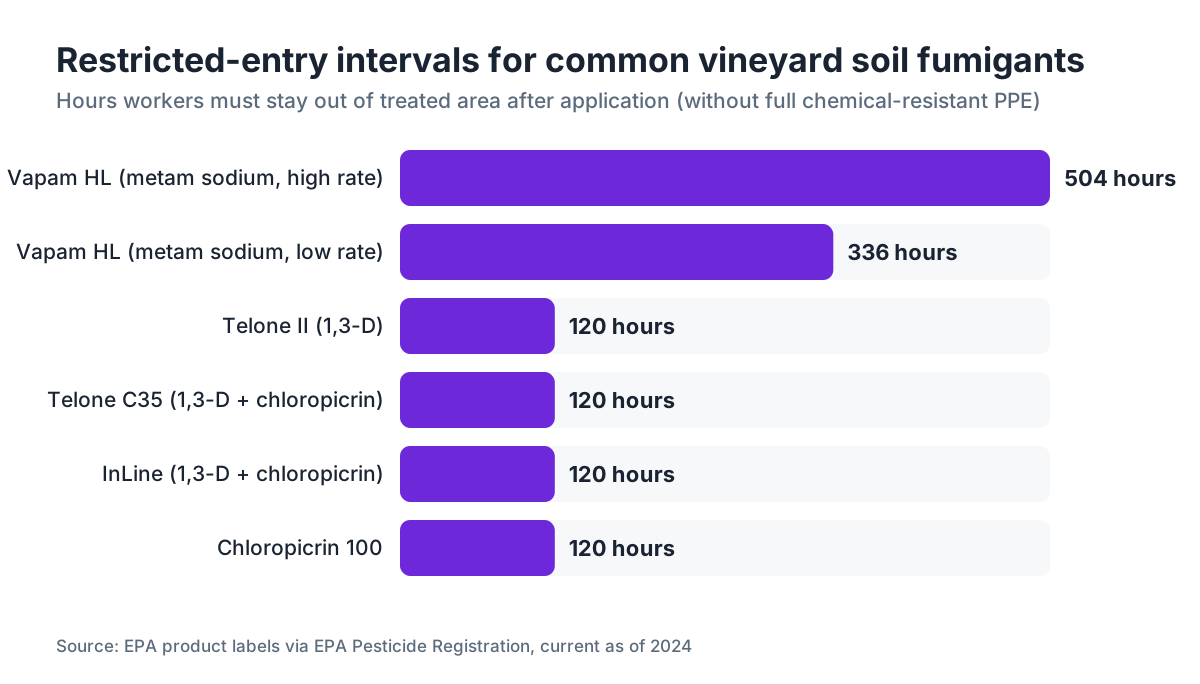
What are the restricted-entry interval rules for common vineyard fumigants?
The REI is the window after application when nobody enters the treated area without full chemical-resistant PPE. For the fumigants used in vineyard replants, those windows run long compared to almost any other pesticide category.
| Fumigant | Active Ingredient | REI (typical) | Application Method | Source |
|---|---|---|---|---|
| Telone II | 1,3-Dichloropropene (1,3-D) | 5 days (120 hours) | Shank injection | Telone II label [2] |
| Telone C35 | 1,3-D + chloropicrin | 5 days (120 hours) | Shank injection, tarp required | Telone C35 label |
| Vapam HL | Metam sodium | 14-21 days (varies by rate and method) | Drip, shank, or sprinkler | Vapam HL label |
| Chloropicrin 100 | Chloropicrin | 5 days | Shank injection, tarp required | Chloropicrin 100 label |
| InLine | 1,3-D + chloropicrin | 5 days | Drip injection | InLine label |
These REIs come straight off the product labels. Labels change between registration cycles, so verify the REI against the current label before you write it down. The National Pesticide Information Center (NPIC) at Oregon State keeps a label lookup tool for a quick check [5].
Your record must state the exact REI from the label in effect on the application date. Use an old figure after EPA revised the label and you have a compliance problem, even if your application predated the change. Keep a copy of the label as it read on application day. PDF it. Attach it to the record.
How should fumigation records fit into a vineyard replanting block history file?
A replant block has a life story: when the old vines came out, what the fumigation program was, when replanting happened, what rootstock and variety went in, and how the vines performed over time. Fumigation records belong as a permanent layer in that story, not as loose papers that get filed in a cabinet and forgotten.
Organize the block history file chronologically and tie it to a physical map or GPS polygon. Fumigation records slot between vine removal documentation and the replanting record. That sequence matters for three reasons:
- Organic certifiers (CCOF, Oregon Tilth, OCIA) have to verify that fumigant use happened before any organic transition clock started. The fumigation date in the block history is the anchor for that clock.
- Lenders and crop insurance underwriters sometimes ask for evidence that disease mitigation (Phytophthora, Armillaria, Agrobacterium) was handled before replanting. The fumigation record is that evidence.
- If a neighbor ever claims pesticide drift, your dated, field-verified record with wind speed and direction is your best defense.
For a small operation with 5 to 20 blocks, a well-built spreadsheet per block does the job. Each tab holds the block map reference, vine removal date, fumigation record, replanting date, and rootstock/variety data. The point is that fumigation and replanting live in the same file, not scattered across different systems.
Manage more than 20 blocks or work across multiple sites and a field operations platform that ties pesticide records to spatial block data starts to earn its keep. VitiScribe, for example, links fumigation entries to block polygons so your replant history assembles itself across seasons, which helps when you're pulling compliance documentation on short notice.
WSU Extension has published guidance on Pacific Northwest pest management and vineyard recordkeeping that's worth reading if you're setting this up from scratch [8].
What does a properly completed soil fumigation record look like in practice?
Here's a realistic example. A Cabernet block (Block 7, 3.4 acres, Napa Valley) had old-vine removal done in August. The grower contracted a licensed PCO to apply Telone II by shank injection in October, ahead of the rain window.
The finished record reads like this:
Application Date: October 14, 2024, 7:15 AM to 11:45 AM
Product: Telone II
EPA Reg. No.: 10182-95
Active Ingredient: 1,3-Dichloropropene (94.5%)
Applicator: [PCO company name], License No.: [state license number]
Location: Block 7, Vine Row Rd, [APN or parcel ID]
Legal Description: T5N R4W Section 14 (example)
Acres Treated: 3.4
Rate: 13.5 gallons per acre (label allows up to 21 gal/ac in California)
Total Product Used: 45.9 gallons
Application Method: Shank injection, 18-inch depth, 12-inch spacing
REI: 120 hours (5 days), expires October 19, 2024, 11:45 AM
Buffer Zone: 25 feet from field border (per current label)
Soil Temperature: 58°F at 6-inch depth
Soil Moisture: Adequate
Wind Speed: 4 mph from NW
Tarp: Not required for this product at this rate
WPS Posting: Applied at block entry, removed October 19, 2024
Applicator Signature: [signed]
That's a defensible record. It cites the label's allowed rate, documents the site conditions the label requires, and captures the whole WPS compliance chain.
One thing growers miss all the time: rate per acre has to match what's allowed in your state under the current label. Telone II carries different maximum rates in California versus Washington because state label amendments differ. Your record should show the rate as applied against the rate ceiling in your state's version of the label [2][3].
How long do you need to keep fumigation records?
Two years is the federal minimum under WPS and FIFRA recordkeeping rules [1]. Keep them longer than that.
California requires pesticide use records for three years from the date of application [3]. Washington requires two years. Oregon's Department of Agriculture requires three years for RUP use records. Check your state's number, because the floor moves around.
Organic certification needs a paper trail back to the start of the transition period, which runs 36 months before certification. Fumigate a block in year one of transition and that record has to survive until certification is granted, then several years beyond, because your certifier may re-verify the transition history at renewal.
For lenders and title work, keeping fumigation records permanently in the block's physical history file is just sensible. A block fumigated in 2018 might be sold or refinanced in 2030, and the buyer's due diligence team will want the replant history. Paper records get lost. Scanned PDFs stored off-site or in a cloud system make a far better long-term archive.
What are the most common mistakes in vineyard fumigation record-keeping?
Missing the state PUR deadline is the most common error I see. In California the 30-day window is strict and the county agricultural commissioner can issue violations for late filing. The fix is simple: put the PUR filing date on your calendar the moment the application ends.
Using the wrong rate field is second. Plenty of records list the rate the PCO quoted in the pre-application estimate instead of what actually went down. If the applicator adjusted rate on the fly for soil conditions, the record has to reflect the delivered rate, not the plan. Get the applicator's run sheets before you file.
Skipping the current label. The label is a legal document. Your record should name the specific label version (EPA registration number plus amendment date if any) and you should keep a PDF of that label with the record.
Leaving out buffer zone documentation. Post-2017 fumigant labels require buffer zones and in some cases require the grower to notify residents inside the buffer before application. No recorded buffer distance and no proof of notification means a compliance gap.
Mixing up the NOI and the PUR in California. The Notice of Intent is pre-application approval. The Pesticide Use Report is the post-application record. Different forms, different fields, different deadlines. Treating them as interchangeable causes trouble again and again.
And failing to link the fumigation record to the replanting record. These two events are joined in the block's regulatory history, especially for organic transition. File them together.
How do you record fumigation in a digital vineyard record system versus paper?
Paper works. It's worked for decades and it meets every legal requirement as long as you keep the records dry, legible, and retrievable for the full retention period. The trouble with paper in a replant context is that blocks pass through many hands over a 20-year vine cycle, and paper gets lost, misfiled, or destroyed.
A digital system needs to capture every field in the table above and produce a printable or exportable record that a county ag commissioner, EPA inspector, or certifier can read without special software. CSV export or PDF output is the practical minimum.
Spatial linking is where digital pulls ahead. Tie the fumigation record to the block's GPS polygon and you can pull up a map showing exactly which parcel got treated, with what product, on what date, without cross-referencing three files. That matters when your replant spreads across several disconnected parcels.
A platform like VitiScribe stores fumigation applications as dated entries linked to block polygons, so the replant history populates itself when you go to document the vine installation that follows. That link between fumigation and replanting records is what makes compliance documentation fast when you actually need it.
Whatever system you run, back it up. Cloud sync, email export, or a quarterly USB copy all work. The worst outcome is a dead hard drive six months before an organic certification inspection.
What do university extension programs say about fumigation record-keeping best practices?
UC extension guidance on vineyard replanting addresses fumigation in the context of replant disease management, and recommends documenting pre-plant fumigation as part of the block's permanent disease history [6]. The point they make: records of fumigant type, rate, and date inform future replanting decisions if replant disease pressure comes back.
WSU Extension covers fumigation recordkeeping in its Pacific Northwest pest management guides. They stress that Washington's Department of Agriculture requires licensed applicators to keep records accessible to enforcement personnel, and that growers who hire contractors still have to retain copies of the PCO's application records in their own files [8].
Cornell CALS covers pesticide recordkeeping for New York vineyards in its Integrated Pest Management resources, and treats the two-year federal retention minimum as a floor rather than a target. The recommendation is to hold records for the life of the block, given how much historical data helps replanting decisions [7].
All three programs agree on one thing: the applicator's license number has to appear in the record. That single field is the most commonly missing item in compliance inspections, and without it much of the record's legal value disappears [8].
Are there special record-keeping rules for buffer zones and neighboring properties?
Yes, and label requirements here have tightened hard since 2017. Under EPA's current soil fumigant label requirements, growers have to complete a Fumigant Management Plan (FMP) before application. The FMP covers buffer distances to sensitive sites (schools, residences, surface water) and the notification steps taken for people inside those buffers [2].
The FMP is itself a recordkeeping document. Complete it before application, keep it with your fumigation record, and make it available to the county agricultural commissioner on request in California [3]. EPA treats the FMP as a condition of registration for fumigants like Telone II, which means applying without one is technically an off-label application.
Buffer distances vary by product, rate, and application method. EPA's soil fumigant management pages provide buffer distance tables by scenario. For a shank-injected Telone II application at 13.5 gal/ac with a standard polyethylene tarp, the required buffer can run 25 to more than 100 feet depending on timing and proximity to sensitive receptors [2]. Record the exact distance your specific scenario requires, not a generic number.
Border a residential area, school, or licensed childcare facility and additional pre-application notifications may kick in under state law, beyond what the federal label demands. California carries some of the most detailed requirements, and the DPR website lists current notification rules by county [3].
Frequently asked questions
Does a fumigation record need to include the applicator's license number even if I hired a contractor?
Yes. The certified applicator's license number is a required field under 40 CFR Part 171 and nearly every state pesticide use reporting system. Even when you hire a pest control operator, you need a copy of their application record with that license number in your vineyard file. Someone else doing the work doesn't relieve you of the duty to retain the documentation. Ask for the run sheets before the contractor leaves.
How do I calculate total product used for the fumigation record?
Multiply the rate per acre by total acres treated. Telone II at 13.5 gallons per acre across 3.4 acres gives 45.9 gallons total. That figure should match the contractor's delivery receipt or run-sheet total within a reasonable variance. If the numbers don't match, resolve the discrepancy before filing, because auditors will compare them.
What is the minimum record retention period for fumigation applications in California vineyards?
Three years from the date of application under California law, versus two years under federal WPS rules. The state requirement wins where it's stricter. For organic transition, you may need the record for the full 36-month transition plus your certification cycle, which can push effective retention past six years. Store scanned PDFs off-site as backup.
Do I need to file a Notice of Intent before applying a soil fumigant in California?
Yes. In California an NOI has to be submitted to the county agricultural commissioner before a restricted-use fumigant application. The CAC reviews and approves it, sometimes with operational conditions attached. The NOI and the post-application Pesticide Use Report are separate documents with different deadlines. Your replant file should contain both. Missing the NOI is a violation even if the application itself was done right.
How does the restricted-entry interval affect my work schedule after fumigation?
Nobody enters the treated area during the REI without full chemical-resistant PPE. For Telone II that's 120 hours (5 days). For metam sodium products like Vapam HL it can run 14 to 21 days depending on rate and method. Your record has to show when the REI starts (end of application) and when it expires. WPS rules require you to post that information at block entry points for the whole interval.
What is a Fumigant Management Plan and does every fumigation need one?
A Fumigant Management Plan is a required pre-application document for soil fumigants covered under EPA's soil fumigant label amendments. It documents buffer zone distances to sensitive sites, notification steps for nearby residents or schools, and site-specific application parameters. It's a condition of the product registration, so applying without one is technically off-label use. Keep the completed plan with your fumigation record.
Can I record soil fumigation on a paper form or does it have to be digital?
Paper is legally acceptable under federal WPS and state pesticide use reporting requirements. The record has to be legible, complete, and retrievable for the full retention period. The practical risk with paper for replant records is loss over a 20-year block lifecycle. Scanning and storing PDFs off-site, in cloud storage or on a backup drive, is strongly recommended even if you fill out the original by hand.
What happens if I miss the 30-day California PUR filing deadline for fumigation?
The county agricultural commissioner can issue a Notice of Violation and impose civil penalties. California's DPR and county CACs actively audit pesticide use reports for completeness and timeliness. Late filing is one of the most common violations in vineyard operations. The fix is to calendar the PUR deadline the same day the application happens, not after the contractor's final invoice arrives.
Does fumigation before replanting affect organic certification timelines?
Yes, a lot. Organic certification requires a 36-month transition during which no prohibited substances are used. A soil fumigant applied before replanting restarts that clock or sets its starting point. The fumigation date in your block history is the anchor for the transition timeline. Your certifier will ask for that record during the transition review. Store it permanently in the block's history file.
What soil conditions must be recorded at the time of fumigation?
At minimum, soil temperature at application depth and an assessment of soil moisture. Many fumigant labels, Telone II included, set minimum soil temperatures (typically 50°F at 6-inch depth) as a condition of application. These measurements protect you in a compliance review by showing you met the label conditions. Some labels also require recording whether a tarp was used and the tarp type, which affects REI and buffer calculations.
Who is responsible for the fumigation record if I hire a pest control operator to do the application?
The licensed PCO carries primary responsibility for filing the state Pesticide Use Report, but you as the property operator are responsible for keeping a copy of the complete application record in your vineyard files. Don't assume the PCO's records will be accessible to you years later. Get a signed copy of the full record, including rate, acreage, and license number, before they leave, and file it with your block history.
What does the EPA Worker Protection Standard require for WPS postings during fumigant REIs?
Under 40 CFR Part 170, you post pesticide safety information at a central location and application-specific information at all entry points to the treated block. The posting must include the product name, treated location, REI end date and time, and the statement 'Do Not Enter.' It stays up until the REI expires. Keep a photo or dated note in your records showing when the posting went up and came down.
How do buffer zone requirements get recorded for a fumigation near a residential area?
Record the specific buffer distance your product label requires for your method and rate, the compass direction and distance to the nearest sensitive receptor (residence, school, surface water), and the notification steps you completed before application. In California and other states, pre-application notifications to residents inside the buffer may be legally required. Document those notifications by date and method (door hanger, certified mail, phone log) in your replant file.
Sources
- EPA, Worker Protection Standard for Agricultural Pesticides (40 CFR Part 170): WPS requires pesticide application records to be retained for at least two years and made available to workers upon request within 15 days under the 2015 revised rule.
- EPA, Soil Fumigant Pesticides: Mitigation Measures: Fumigant labels require Fumigant Management Plans, buffer zone distances, application exclusion zones, and soil temperature/moisture documentation as conditions of the product registration.
- California Department of Pesticide Regulation, Pesticide Use Reporting: California requires Pesticide Use Reports filed with the county agricultural commissioner within 30 days of application, including legal parcel description, commodity code, and method of application; records must be retained three years.
- National Pesticide Information Center (NPIC), Oregon State University: NPIC provides a pesticide label lookup tool for verifying current REIs and label amendment dates for restricted-use pesticides including soil fumigants.
- University of California Agriculture and Natural Resources, Vineyard Replanting and Replant Disease: UC extension recommends documenting pre-plant fumigation type, rate, and date as part of the block's permanent disease history to inform future replanting decisions.
- Cornell Cooperative Extension (Cornell CALS), Pesticide Recordkeeping for New York Vineyards: Cornell extension recommends retaining pesticide records for the life of the block, noting the two-year federal minimum is a floor, not a target, given the value of historical fumigation data for replanting.
- WSU Extension, Pacific Northwest Pest Management Guides: Wine Grapes: WSU extension guidance for Pacific Northwest viticulture emphasizes that the applicator's license number is the most commonly missing item in compliance inspections and its absence voids much of the record's legal utility.
- EPA, Telone II Pesticide Product Label (EPA Reg. No. 10182-95): Telone II label specifies a 120-hour (5-day) REI, minimum soil temperature of 50°F at 6-inch depth, and maximum application rates that differ by state due to state label amendments.
Last updated 2026-07-10