Veraison to harvest: how long it takes and what drives the timeline
TL;DR
- From veraison to harvest, most wine grape varieties take 45 to 70 days.
- Cool-climate and thick-skinned reds run longest.
- The exact window depends on variety, heat accumulation (growing degree days), water stress, crop load, and your target wine style.
- Brix, pH, titratable acidity, and berry tasting all factor into the final pick call.
What is veraison and why does it mark the clock?
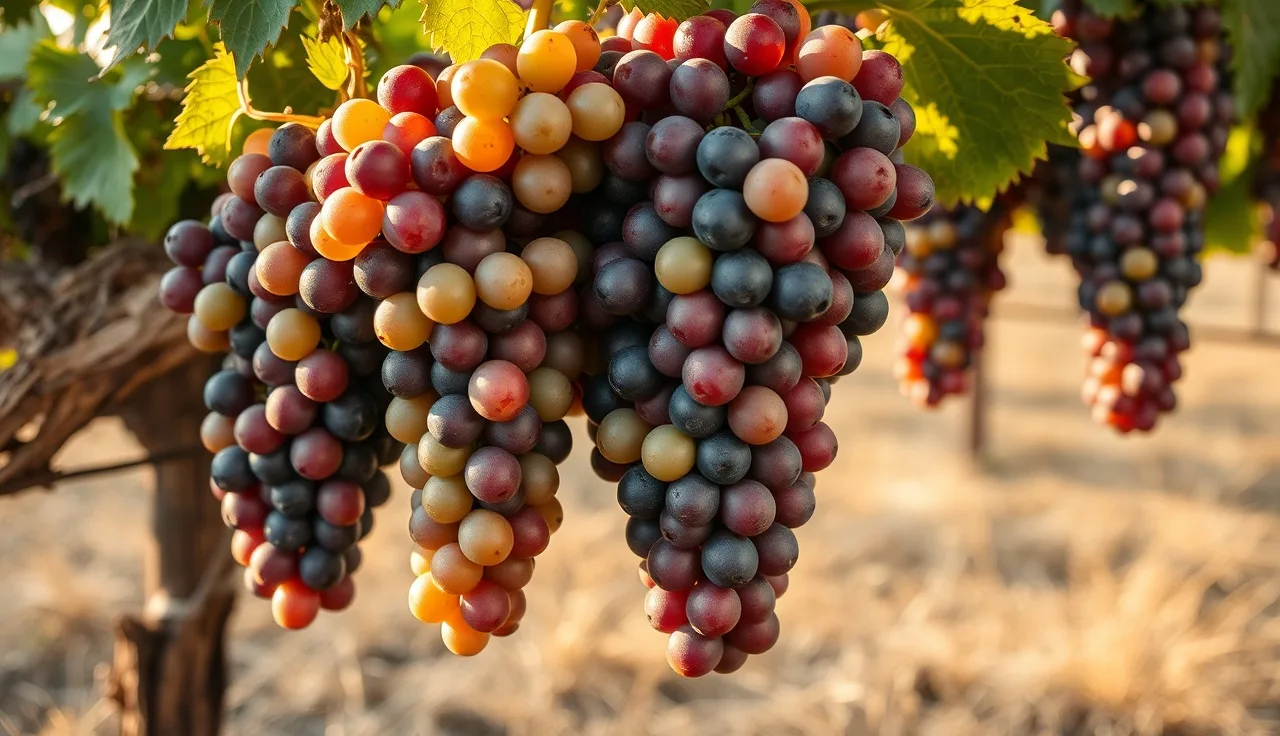
Veraison is the moment grapes shift from hard, green, and starchy to soft, colored, and sugar-accumulating. For red varieties, berries start turning red or blue-black. For whites, they go from opaque green to translucent gold or yellow-green. The vine's whole metabolic strategy flips here: it stops building chlorophyll and cellulose and starts loading sucrose into the berries from the leaves.
Growers treat veraison as the start of the harvest clock for a simple reason. Before veraison, berry size and seed development dominate. After it, sugar accumulation, acid degradation, and phenolic ripening take over, and those are the variables that decide wine quality. The vine has committed to a fruit-ripening program you can't reverse.
Veraison is rarely instantaneous across a block. Individual berries ripen on different schedules, clusters within the same row differ by days, and the two sides of the canopy can lag by a week or more. That spread matters for your harvest-readiness assessment, because a block that looks mostly veraised still has outliers at each end. UC Davis viticulture extension recommends tracking the percentage of berries that have changed color (50% veraison is a common benchmark for starting your countdown) rather than waiting for 100% [1].
Veraison also triggers the final spray-window decisions. Once berries soften, skin permeability climbs, and your pre-harvest intervals on late-season fungicides become live compliance checkpoints.
How long does it actually take from veraison to harvest?
The honest answer is 45 to 70 days for the vast majority of wine grapes. Most California warm-region reds land around 45 to 55 days. Cool-climate varieties or high-altitude sites stretch to 60 to 70 days [1][2]. Nobody hands you a guarantee, because heat, water, and site interact in ways that move the number every year.
Here's the data-shaped way to think about it. After veraison, Brix accumulates at roughly 0.2 to 0.5 Brix per day in warm conditions, slower in cool ones [2]. Say you're picking Chardonnay at 22 Brix and you measured 10 Brix at veraison. You need 12 more Brix. At 0.3 Brix per day that's 40 days; at 0.2 it's 60 days. Neither rate holds steady, and a heat spike in late August briefly speeds the curve before conditions normalize.
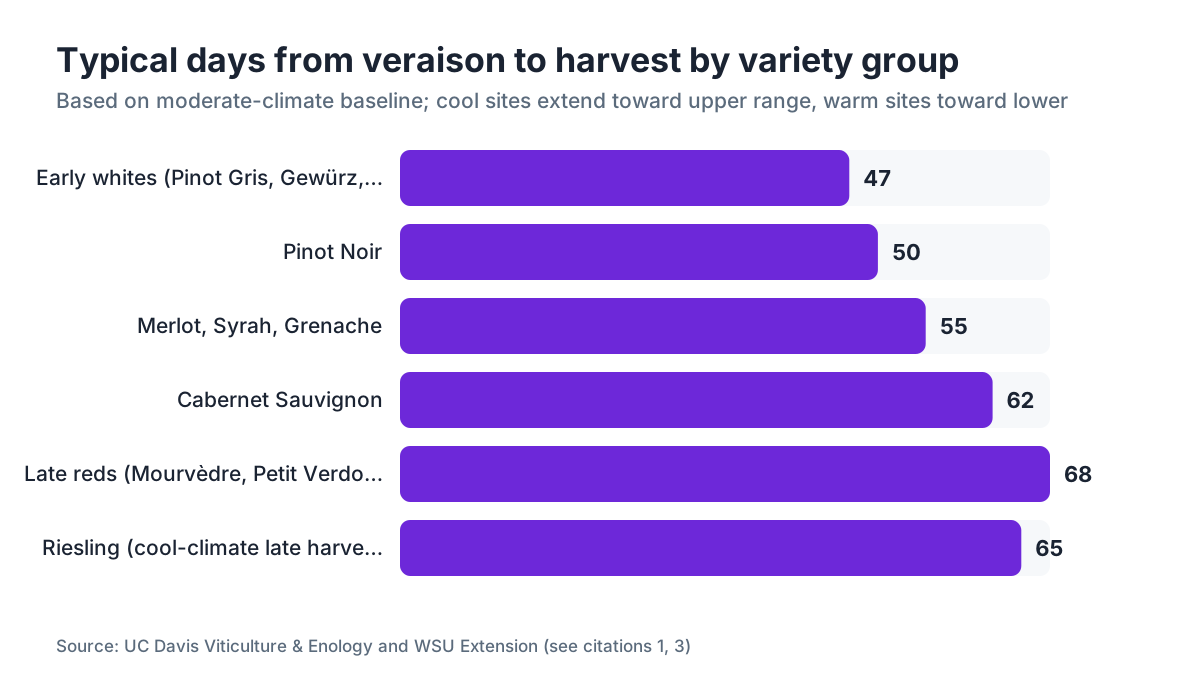
Variety is the biggest single predictor. Early-ripening varieties like Pinot Gris, Chardonnay, and Pinot Noir regularly come in 45 to 55 days after veraison in moderate climates. Late-ripening varieties like Cabernet Sauvignon, Mourvèdre, and Petit Verdot routinely need 55 to 70 days. In marginal cool climates those same late-ripeners can need every bit of the 70-day window to reach phenolic maturity, and some years they don't quite get there.
The table below shows typical ranges by variety grouping, based on extension research from WSU and UC Davis [1][3].
| Variety group | Typical veraison-to-harvest (days) | Notes |
|---|---|---|
| Early whites (Pinot Gris, Gewürztraminer, Muscat) | 42 to 52 | Often first to pick; watch acids closely |
| Pinot Noir | 45 to 55 | Cool sites extend toward 60; crop-load sensitive |
| Merlot, Syrah, Grenache | 50 to 60 | Mid-season; canopy management critical |
| Cabernet Sauvignon | 55 to 68 | Warm regions 55 to 60; cool regions 62 to 70 |
| Late reds (Mourvèdre, Petit Verdot, Tannat) | 62 to 75 | Need long, warm falls; frost risk on marginal sites |
| Riesling (cool climate) | 55 to 70 | Depends heavily on harvest style (dry vs. late harvest) |
How do growing degree days predict harvest timing after veraison?
Growing degree days (GDD) are the most reliable quantitative tool you have for predicting harvest from veraison. The standard wine grape base temperature is 50°F (10°C). You accumulate GDD by taking the daily mean temperature, subtracting 50, and summing the values. Negative days count as zero.
Research from WSU Extension shows most wine grape varieties require between 900 and 1,500 GDD after veraison to reach harvest-ready Brix, depending on variety and target style [3]. Early-ripening whites tend toward the low end; late-ripening reds like Cabernet need the high end. On a site averaging 65°F mean daily temperature (15 GDD per day), 1,200 GDD takes 80 days. On a warmer site averaging 75°F (25 GDD per day), the same accumulation happens in 48 days.
The practical value of GDD tracking is that it lets you compare seasons against each other. If your site was 200 GDD ahead of the 10-year average at veraison, you know harvest will run early unless something changes. Growers who keep GDD records going back five or more years can set reasonable picking windows before field readings, then refine with actual berry sampling. The GDD model isn't perfect. It doesn't capture diurnal range effects well, and it ignores soil moisture. It still beats calendar date alone by a wide margin.
For the math to work, you need consistent, accurate temperature data at the site level. Block-to-block microclimates in hillside vineyards can diverge by 100 GDD or more over a 60-day ripening window [3]. If you're managing multiple blocks with different aspects and elevations, a single weather station gives you fiction. Two or three dataloggers placed well give you block-level predictions you can act on.
What are the signs that grapes are ready to harvest?
No single measurement tells you the grapes are ready. The pick decision is a composite of chemistry, sensory signals, and winemaker target. Here are the main indicators and what they actually mean.
Brix measures dissolved solids, mostly sugar, by refractometer or hydrometer. At harvest, most dry table wines target 22 to 26 Brix, though some warm-region reds push into the high 20s. The refractometer is fast and cheap. The catch is that it measures total dissolved solids, more than sugar, so overripe or botrytis-affected fruit reads slightly high. For early-season tracking, a handheld refractometer reading is fine. As you close in on harvest, a lab must-weight reading on a composite sample gives you the number you'll actually put on the spray record and picking order.
pH and titratable acidity (TA) move opposite to sugar. As Brix rises, TA drops (malic acid is metabolized) and pH climbs. For most table wines, you want pH between 3.2 and 3.6 at pick, with TA around 5 to 8 g/L depending on style. A Cabernet at 26 Brix and pH 3.9 is overripe by most winemaker definitions. Cornell's extension viticulture program emphasizes that the Brix:TA ratio is often more predictive of wine quality than Brix alone [2].
Seed color is a field-ready phenolic maturity check. Green seeds carry harsh, extractable tannins. Seeds that have turned brown and taste nutty or woody rather than astringent are physiologically mature. Chewing seeds in the field costs nothing and tells you more about tannin readiness than lab chemistry does.
Berry flavor is the most underrated tool, and most growers use it too rarely. Tasting berries from multiple positions in the canopy (basal vs. apical clusters, sun-exposed vs. shaded) gives you a real-time sensory profile Brix can't replicate. If the fruit tastes vegetal or like green pepper, you're still waiting on methoxypyrazine breakdown regardless of what the refractometer says.
Skin texture changes too. Ripe skins slip off the pulp easily. Under-ripe skins grip. That test takes three seconds per berry and costs nothing.
How does water stress affect ripening speed between veraison and harvest?
Water stress after veraison is a tool more than a hazard. Mild to moderate water deficit post-veraison concentrates berry solutes (including sugar), slows berry expansion, and generally improves color and phenolics in red varieties [1]. Severe stress does the opposite. It shuts stomata, kills photosynthesis, and stalls sugar accumulation. The vine looks done but the fruit is just stuck.
The target post-veraison water status for most premium wine grape production is a midday stem water potential between -10 and -14 bars (mild-to-moderate stress). Sustained readings below -16 to -18 bars are where the bad outcomes start: premature shutdown, leaf burn, and sometimes early defoliation that exposes clusters to sunburn just as they're trying to finish [1].
For drip-irrigated vineyards, this means you don't zero out irrigation the moment veraison hits. You manage to a target. The growers who brag about running bone dry from veraison to harvest usually have deep-rooted old vines on heavy soils with real water-holding capacity. On young vines or sandy soils, that approach produces stuck ripening or shriveled fruit before you hit your Brix target.
Rain events after veraison are a different problem. A significant rain (above roughly 0.75 to 1 inch) in the 2 to 4 weeks before harvest can dilute sugar, spike TA temporarily, and split berries in thin-skinned varieties. Some of those effects reverse over the following week to 10 days as the vine equilibrates. Tracking Brix trends rather than single readings helps you tell a rain-dilution blip from a genuine ripening stall.
How does crop load influence time from veraison to harvest?
Heavy crop loads slow ripening. That's not controversial; it's well-documented physics. A vine carrying 15 tons per acre has vastly more berries competing for photosynthate than a vine thinned to 4 tons. The result is slower Brix accumulation, delayed phenolic maturity, and often lower fruit quality at whatever harvest date you choose.
WSU's viticulture extension research on crop load found that Washington State red varieties at 8 tons per acre and above consistently lagged 7 to 14 days in reaching target Brix compared to vines balanced to 4 to 6 tons per acre [3]. That's not a small difference. In a cool vintage, 10 extra days can be the difference between picking before a late-October frost and not getting the crop at all.
Green drop, or crop thinning at veraison, is controversial because you're spending money and labor after the growing season is already well advanced. But the research is consistent: thinning clusters at or just after 50% veraison to bring the remaining clusters to target load does speed ripening and improve uniformity. The caveat is that in a warm year with no frost risk, the ROI on expensive thinning labor is harder to justify.
Leaf removal in the fruit zone matters here too. Better sun exposure to clusters post-veraison speeds phenolic ripening and cuts disease pressure. Cornell's extension team recommends removing basal leaves on the morning-sun side for reds in humid climates to improve air circulation and light interception at once [2]. This isn't dramatic. It's incremental. But incremental gains across a 60-day ripening window compound.
What spray records and compliance requirements apply during this window?
The veraison-to-harvest window is the most legally sensitive spray period on the calendar. Pre-harvest intervals (PHIs) on pesticide labels are federal law under FIFRA, not suggestions. Using a material inside its PHI is an illegal pesticide application regardless of whether residues persist on the fruit. Your state department of agriculture can pull your applicator license for a PHI violation, and a winery can reject the fruit if it detects residues above the label tolerance.
Most late-season fungicides targeting botrytis (which becomes a real threat as skins soften post-veraison) carry PHIs from 0 to 14 days depending on the product. Captan has a 3-day PHI on grapes in most registrations. Myclobutanil (Rally) carries a 14-day PHI. Cyprodinil plus fludioxonil (Switch) is 7 days [7]. These numbers matter, because if you're making spray decisions 5 weeks before a probable harvest, you need to know which materials you can still use and which are off the table.
The EPA Worker Protection Standard (WPS) applies here as well. Any restricted-use pesticide or material with a restricted-entry interval (REI) requires that workers be notified, that appropriate PPE be provided, and that entry be restricted during the REI [4]. Scouting crews, berry samplers, and irrigation workers moving through blocks during or shortly after a spray application are covered. The WPS was revised in 2015 with updated training, recordkeeping, and handler requirements that remain in effect.
Your spray record during this window has to capture: product name and EPA registration number, application date, rate and total volume, target pest, and field/block identifier. California's DPR requires these records be kept for 3 years; most other major wine states set a 2-year minimum [5]. If you're sampling blocks for harvest-readiness decisions and someone needs to know what was sprayed 20 days ago, your records have to be there.
For vineyard managers juggling multiple blocks with overlapping PHI windows, this is exactly where a record-keeping system earns its keep. VitiScribe was built around this problem: tracking active materials by block, flagging approaching PHI dates, and keeping spray records exportable for compliance audits. You can try it free if this kind of PHI management is eating hours you don't have.
Across your vineyard operations, tying harvest-readiness tracking to your spray records in one system heads off the most common compliance failures.
How do you build a harvest sampling protocol for veraison to pick?
A written, repeatable sampling protocol is the difference between a defensible harvest date and a guess. Here's what a reasonable one looks like.
Start sampling at 50% veraison. At that point, Brix is too low to mean much numerically, but you're establishing a baseline and confirming your method before it counts. Sample the same 100 to 200 berries from the same locations in the block every time: same rows, same vine positions within rows, both sun and shade sides of the canopy, both basal and apical cluster positions. Consistency in sampling location matters more than total sample size.
Sample every 7 to 10 days in the early post-veraison period, then move to every 3 to 5 days in the final 2 to 3 weeks before anticipated harvest. Log Brix, pH, and TA every time. If you can only afford one lab measurement per week, make it pH; a pH above target is harder to correct in the winery than low Brix.
Track trends, not single readings. A Brix reading of 22.5 tells you almost nothing on its own. A 22.5 after three prior measurements of 21.0, 21.8, and 22.3 tells you the vine is still ripening at a healthy clip and you have more time. A 22.5 after 22.3, 22.4, and 22.5 tells you sugar accumulation has stalled and you need to decide.
Pull seed samples at every visit. Score them: percentage green vs. brown, plus a quick chew-test for astringency. Record the number. When seeds go from 40% brown to 80% brown in 10 days, you're in the final ripening push.
Share your data with the winemaker at every sampling. Harvest-date calls are better when the winemaker has watched the trend for six weeks instead of being handed one reading 48 hours before pick. It also protects you: if the winemaker wants to wait past what your data suggests is optimal, that conversation is on record.
How does climate and region change the veraison-to-harvest timeline?
Climate is the main reason the same variety can be picked in August in California's San Joaquin Valley and October in Germany's Mosel. Heat accumulation after veraison drives the gap.
In California's warmer AVAs, like the Central Valley and the warmer parts of Paso Robles, late-ripening reds can hit target Brix in 50 to 55 days post-veraison because post-veraison GDD accumulation is fast. In coastal or elevated California sites, like parts of Paso Robles wineries in the Willow Creek District, the diurnal range is so large (30 to 40°F swings) that mean daily temperatures stay moderate even when afternoon highs are hot, and the same variety might take 60 to 65 days.
In Washington State's Columbia Valley, the continental climate pairs warm afternoons with cold nights and very high diurnal ranges. That preserves acidity while still building heat, which is why Washington Cabernet often shows better acid balance than comparable California Cabernet picked at the same Brix. WSU research confirms that post-veraison diurnal range above 25°F correlates with higher retained malic acid at harvest compared to sites with smaller swings [3].
In humid eastern regions (Virginia, New York's Finger Lakes, parts of Oregon's Willamette Valley), disease pressure governs the countdown as much as ripening does. Botrytis and downy mildew can force early harvest on susceptible varieties regardless of Brix. Cornell's extension viticulture program notes that disease-driven harvest decisions in cool humid years effectively shorten the functional ripening window by 1 to 2 weeks compared to what chemistry alone would suggest [2].
Elevation adds another variable. Mountain vineyard sites cool down faster in the post-veraison period, which generally lengthens the ripening window. A mountain winery site at 2,000 feet might see the same variety take 10 to 12 additional days post-veraison compared to a valley-floor site a few miles away.
What can go wrong in the final weeks before harvest?
The six weeks after veraison have more ways to derail a vintage than the preceding four months combined.
Heat spikes can temporarily inflate Brix readings as berries shrivel and concentrate. A berry that's lost 15% of its water from a heat event reads higher Brix on your refractometer, but the actual sugar load hasn't changed. The winery wants sugar, not concentration. Tracking berry weight alongside Brix catches this: if Brix jumped 1.5 points in 3 days during a heat wave but berry weight also dropped hard, you're reading concentration, not ripening.
Botrytis bunch rot in wet conditions after veraison is self-explanatory in its danger. Affected berries rupture, juice bleeds into the bunch, and whole clusters can go from clean to rotted in 4 to 6 days in warm, humid weather. Fungicide timing relative to rain events and your remaining PHI window becomes emergency management. If botrytis pressure is high and you're within 14 days of anticipated harvest, your material options shrink fast.
Shatter (poor set leading to uneven berry size) from earlier in the season shows up as a problem now, because small shot berries and large normal berries ripen at different rates within the same cluster. You can end up with over-ripe small berries and under-ripe large berries at the same harvest date. Selective picking or whole-cluster sorting becomes the answer.
Bird and insect pressure ramps up as Brix climbs above roughly 18 to 20. Yellow jackets in particular can hollow out clusters in a matter of days once berries are sweet enough to attract them. This isn't a ripening-management issue, but it is a crop-loss issue that can force harvest earlier than chemistry dictates.
Frost risk in continental and high-elevation sites is the ultimate forcing function. If your 10-day forecast shows a frost event and you're at 22 Brix on Cabernet Franc that wants to be at 24, you pick at 22. All the precision sampling in the world doesn't matter if the crop freezes on the vine.
How do you keep accurate records from veraison through harvest for compliance?
Compliance record-keeping in the veraison-to-harvest window covers two distinct categories: pesticide application records and harvest records. They carry different legal requirements and serve different downstream users.
Pesticide application records must capture the specific materials applied, rates, volumes, application dates, target pests, and field identifiers. In California, these go to your county agricultural commissioner within 7 days of the application [5]. In other states, they're kept on-farm for the required period (usually 2 to 3 years) and available for inspection. If a winery asks for spray records before accepting fruit, these are the documents you hand over.
Harvest records capture picking date, block identifier, weight delivered, Brix at delivery, and sometimes variety and lot number. These records connect your field operations to the winery's crush records and, eventually, to AVA labeling compliance. If you're delivering to a winery that claims a specific AVA on the label, the fruit must meet the state's minimum percentage for that designation (85% in California) [6], and the paper trail starts with your harvest records.
Sampling logs from your veraison-to-harvest protocol have no specific legal requirement, but they're worth keeping. If a lot shows quality issues and the winemaker raises questions about harvest timing, your sampling logs showing the Brix, pH, and TA trend over 6 weeks are your defense. Date-stamped field records beat memory every time.
For operations running more than a few blocks with multiple varieties and overlapping PHI windows, tracking all this on paper or in a spreadsheet is genuinely error-prone. VitiScribe's spray record and harvest tracking tools were built for this period. This is the last mention of the software; the records system itself is the real point, whatever tool you use to keep it.
Frequently asked questions
How many days from veraison to harvest for Cabernet Sauvignon?
Cabernet Sauvignon typically runs 55 to 68 days from 50% veraison to harvest. Warm California regions like Napa's valley floor land at the short end, around 55 to 60 days. Cool or high-elevation sites, and continental climates like eastern Washington's higher-elevation blocks, regularly push 62 to 68 days. Cool vintages can stretch further. Track GDD accumulation rather than calendar date for the most reliable prediction.
What Brix should grapes be at veraison?
At 50% veraison, berry Brix is usually between 6 and 12, depending on variety and season. Chardonnay and other early-ripening whites often start in the 7 to 10 range. Late-ripening reds may start as low as 6. The exact number at veraison is less useful than the accumulation rate that follows: roughly 0.2 to 0.5 Brix per day in normal conditions, with variation driven by temperature and water status.
Can you speed up ripening after veraison?
Modestly. Crop thinning at veraison cuts competition for photosynthate and measurably speeds Brix accumulation, with WSU research showing 7 to 14 day gains in balanced vs. overcropped vines. Leaf removal in the fruit zone improves cluster microclimate and light exposure. Managing irrigation to hold mild stress (not severe) helps. What you cannot do is meaningfully change heat accumulation at the site level. Cool years are cool; viticulture manages within climate, not around it.
What happens if you harvest too early after veraison?
Early harvest produces wines with high TA, lower pH, and green or vegetal flavors from residual methoxypyrazines, especially in Cabernet Sauvignon and Sauvignon Blanc. Tannins in reds will be harsh because seeds are still green and extractable. Chaptalization (adding sugar) can correct low Brix in some regions, but adding sugar doesn't fix phenolic immaturity. The resulting wines usually need more winery intervention and often show less complexity at any stage.
What happens if you wait too long to harvest after veraison?
Overripe fruit delivers very high Brix (above 26 to 28), low acidity, elevated pH above 3.6, and often cooked or jammy flavors from volatile acidity development. Fermentations on high-Brix must run hotter and risk stuck fermentation. Structural integrity of clusters declines, raising botrytis and sour rot risk. In red varieties, overripe tannins shift texture in a way that's hard to predict and difficult to correct in the winery.
Does irrigation after veraison slow ripening?
Too much irrigation after veraison dilutes solutes, expands berry size, and slows Brix accumulation. Moderate irrigation to hold vine water status at mild stress (around -10 to -12 bars stem water potential) actually supports continued photosynthesis and steady ripening. The error is either extreme: irrigating heavily to prevent all stress, or cutting off entirely and inducing severe stress that shuts photosynthesis down. Track stem water potential readings more than soil moisture.
How do you sample grapes for Brix between veraison and harvest?
Collect 100 to 200 individual berries from multiple locations in the block: different rows, different vine positions, both sun and shade exposures, both basal and apical cluster positions. Crush the collected sample together and read Brix on a refractometer for field tracking, or send a juice sample to a lab for precise numbers within the final 3 weeks. Sample every 7 to 10 days early on, then every 3 to 5 days as harvest approaches.
What pre-harvest intervals (PHI) apply to fungicides used after veraison?
PHIs vary by product. Common examples on wine grapes: Switch (cyprodinil + fludioxonil) is 7 days, Rally (myclobutanil) is 14 days, captan is 3 days, and some biorationals like Serenade are 0 days. These are federal label requirements under FIFRA. Always check the current product label for the exact PHI, since registration details can change. PHI violations are illegal pesticide applications regardless of actual residue levels at harvest.
How does diurnal temperature range affect post-veraison ripening?
Large diurnal ranges (night-day swings above 25°F) slow malic acid degradation, preserving natural acidity at harvest even as Brix accumulates. This is why cool-night regions like coastal California and Washington's Columbia Valley tend to produce wines with better acid balance than consistently warm regions. Daytime heat drives photosynthesis and sugar loading; the cold nights slow the respiration that would otherwise burn off malic acid.
What records do I need to keep from veraison through harvest for compliance?
You need pesticide application records covering: product name, EPA registration number, application date, rate, total volume applied, target pest, and field/block ID. In California these go to the county ag commissioner within 7 days of application. Harvest records should capture picking date, block, variety, weight, and Brix at delivery. Most states require pesticide records kept for 2 to 3 years. Worker Protection Standard (WPS) training and notification records are also required for any REI-covered applications.
How does crop load affect how long ripening takes after veraison?
Heavier crop loads consistently delay ripening. WSU research found vines at 8 or more tons per acre lagged 7 to 14 days reaching target Brix compared to balanced vines at 4 to 6 tons per acre. The mechanism is simple: more berries compete for the same pool of photosynthate. Crop thinning at or just after 50% veraison can partly recover ripening speed, though the labor cost needs weighing against the vintage's heat trajectory.
What is the difference between sugar ripeness and phenolic ripeness, and do they happen at the same time?
Sugar ripeness (Brix target) and phenolic ripeness (seed color, skin texture, flavor maturity) don't always align. In hot years or with heavy crops, Brix can reach 25 while seeds are still partially green and tannins remain harsh. In cool years, phenolic ripeness can lag Brix accumulation significantly. Winemakers picking for phenolic maturity sometimes pick above or below their Brix target. Monitoring both Brix trends and seed color/chew tests together is the only reliable way to catch the divergence early.
How do humid eastern growing regions handle the veraison-to-harvest window differently?
In humid climates, disease pressure after veraison compresses the practical ripening window. Botrytis and downy mildew on softened berries can require harvest before chemistry is ideal. Cornell's viticulture extension emphasizes that disease-management spray programs with appropriate PHIs become as central to harvest timing as Brix tracking. Growers in these regions often pick earlier at lower Brix or accept yield loss from thinning to improve air circulation and delay disease onset.
Does the veraison-to-harvest window matter for late harvest or dessert wine styles?
Yes, and it extends the window considerably. Late harvest Riesling, Sauternes-style wines, and icewines intentionally stretch the post-veraison period to let botrytis develop or desiccation concentrate sugars well above normal table wine targets, sometimes above 40 Brix. This requires specific disease management to encourage botrytis (noble rot) rather than suppress it, and the risk of losing the crop to bad weather is genuinely high. The compliance and spray record implications are the same; PHIs still apply.
Sources
- Cornell Cooperative Extension, Viticulture and Enology Program: Brix:TA ratio as a quality predictor; leaf removal recommendations for humid climates; disease-driven harvest timing in cool wet vintages
- Washington State University Extension, Wine Grape Viticulture: GDD requirements of 900-1,500 post-veraison for harvest; crop load research showing 7-14 day ripening lag at 8+ tons/acre; diurnal range effects on malic acid retention
- EPA Worker Protection Standard for Agricultural Pesticides: Worker Protection Standard requirements for REI notification, PPE, and handler training applicable to post-veraison spray applications
- California Department of Pesticide Regulation, Pesticide Use Reporting: California requires pesticide application records submitted to county agricultural commissioner within 7 days and retained for 3 years
- Alcohol and Tobacco Tax and Trade Bureau (TTB), Appellation of Origin Regulations: 85% minimum fruit sourcing requirement from a named AVA for appellation designation on wine labels under 27 CFR Part 4
- UC ANR (University of California Agriculture and Natural Resources), Grape Pest Management: Pre-harvest interval requirements for fungicides used in wine grapes; captan PHI, myclobutanil PHI, and cyprodinil/fludioxonil PHI on grapes
- USDA National Agricultural Statistics Service, California Grape Crush Report: Harvest timing and Brix at delivery data for California wine grape varieties by region, used to establish typical harvest windows
- American Journal of Enology and Viticulture, Berry sampling and maturity assessment methods: Composite berry sampling methodology and Brix accumulation rates of 0.2-0.5 Brix per day under normal post-veraison conditions
- Wine Institute, California Wine Grape Varieties and Harvest Data: Varietal harvest timing data and typical Brix at harvest by variety grouping for California wine grapes
Last updated 2026-07-09