Veraison in grapes: what it is, when it happens, and what to do
TL;DR
- Veraison is the moment grapes shift from hard, green, and acidic to soft, colored, and sugar-accumulating.
- It happens 40 to 70 days before harvest depending on variety and climate.
- Recognizing it accurately tells you when to sharpen your thinning and irrigation decisions, start your Brix monitoring schedule, and alert your pick crew to get ready.
What is veraison in grapes, exactly?
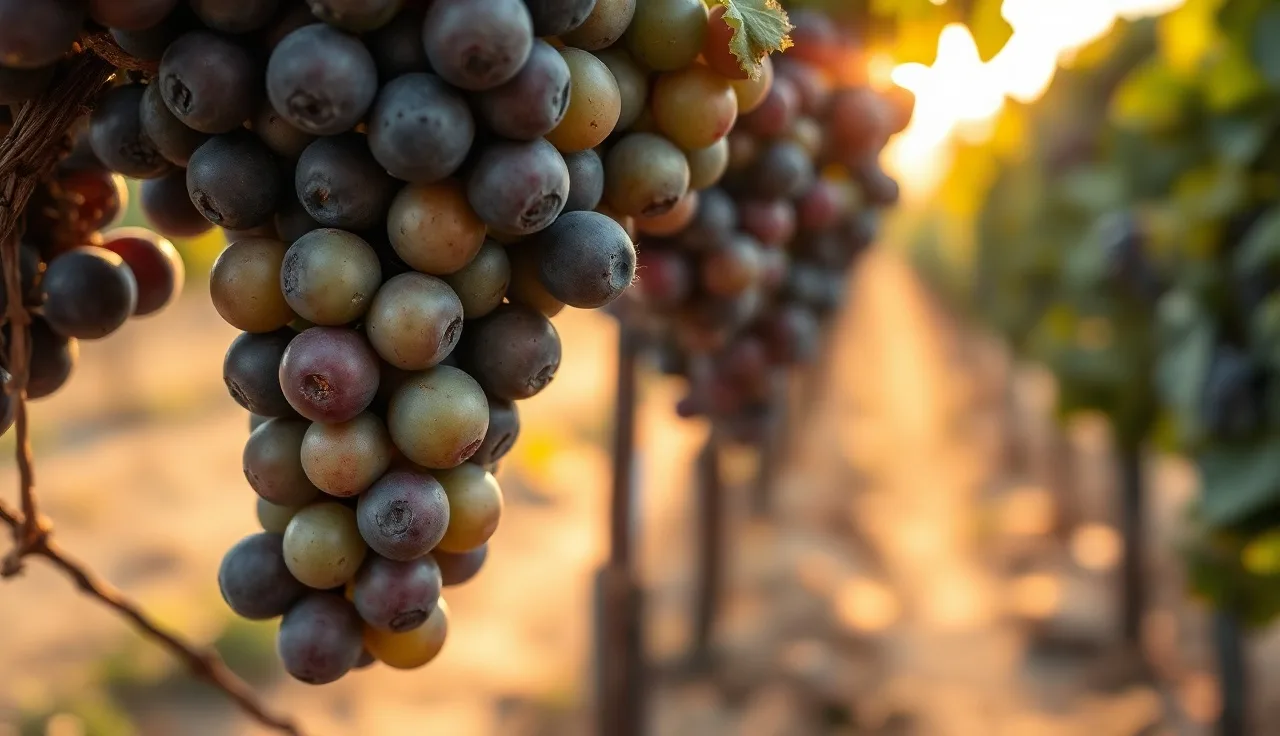
Veraison (from the French véraison, meaning the change of color in ripening fruit) is the onset of grape berry ripening. Before it, berries are green spheres running on photosynthesis, hard to the touch, loaded with malic acid, and almost entirely starchy. Then the switch flips and everything changes at once. Sugar starts moving in from the leaves through the phloem. Acids drop. Skins soften. In red varieties, anthocyanin pigments begin piling up fast in the outer cell layers.
UC Davis Viticulture & Enology defines veraison as "the transition from berry growth Stage II to Stage III," the moment the berry stops adding cell mass and starts adding soluble solids [1]. That language matters because it tells you veraison is not a single day. It's a window. In a uniform block the process runs 10 to 14 days. In an uneven block or a mixed-variety planting, you might see green clusters and fully colored clusters hanging side by side for three weeks.
For white varieties, the color change is subtle: skins shift from waxy, opaque green to a translucent yellow-green. Texture beats color as an indicator in Chardonnay or Sauvignon Blanc. Press a berry lightly between thumb and forefinger. Before veraison it resists. At veraison it gives.
Across California, early-ripening varieties like Pinot Noir usually hit veraison between late June and mid-July on warmer sites. In cooler regions like the Sonoma Coast or Willamette Valley, the same variety may not start until early August [2]. Your site's historical veraison date, even a rough five-year average, is one of the most useful numbers you can own.
What triggers veraison? The physiology behind the color change
The trigger is hormonal, not simply thermal. Abscisic acid (ABA) is the primary driver. When the berry reaches a threshold size and the seed embryos mature, ABA concentration inside the berry spikes, and that spike sets off the whole suite of ripening changes: softening, sugar import, color development, and acid metabolism [3].
Gibberellins, which suppress ripening, drop off at the same time. Ethylene may play a secondary part, though the research here is less settled than it is in climacteric fruits like tomatoes. A 2014 paper in the Journal of Experimental Botany found that ethylene signaling speeds anthocyanin accumulation after veraison starts but is probably not the primary inducer [3].
Temperature governs how fast you bank the growing degree days that push the vine toward veraison, but stress shifts the timing. Mild water deficit accelerates ABA synthesis and can pull veraison earlier. Severe deficit, or heavy crop load, can delay it or make it patchy. That's why regulated deficit irrigation in warm regions often aims for a controlled water stress period before veraison, then backs off once color change begins, to keep sugar accumulation from stalling in the critical 30 days that follow [4].
Nitrogen status matters too. Over-vigorous vines with dense canopies shade interior clusters, slow ABA accumulation, and hand you patchy, late veraison. This is one reason shoot positioning, hedging, and fruit-zone leaf removal before veraison pay off in ripening uniformity.
How long from veraison to harvest? The 40-to-70-day window explained
The number you'll hear most is "45 to 60 days from veraison to harvest." That's a fair midpoint, but the real range is wider. WSU Extension puts the window at roughly 30 to 70 days depending on variety, climate, and the style of wine being made [5]. Early-ripening varieties in warm climates sit at the short end. Late-ripening varieties in cool climates push toward or past the 70-day mark.
Growing degree days (GDD) are the better planning tool. Most varieties need somewhere between 1,800 and 2,200 GDD base 50°F across the full season from budbreak to harvest. The veraison-to-harvest stretch itself usually accounts for 400 to 700 GDD, depending on variety [1]. Tracking cumulative GDD on a simple spreadsheet, or in a field record platform like VitiScribe, lets you compare seasons and tighten your harvest-window estimates year over year.
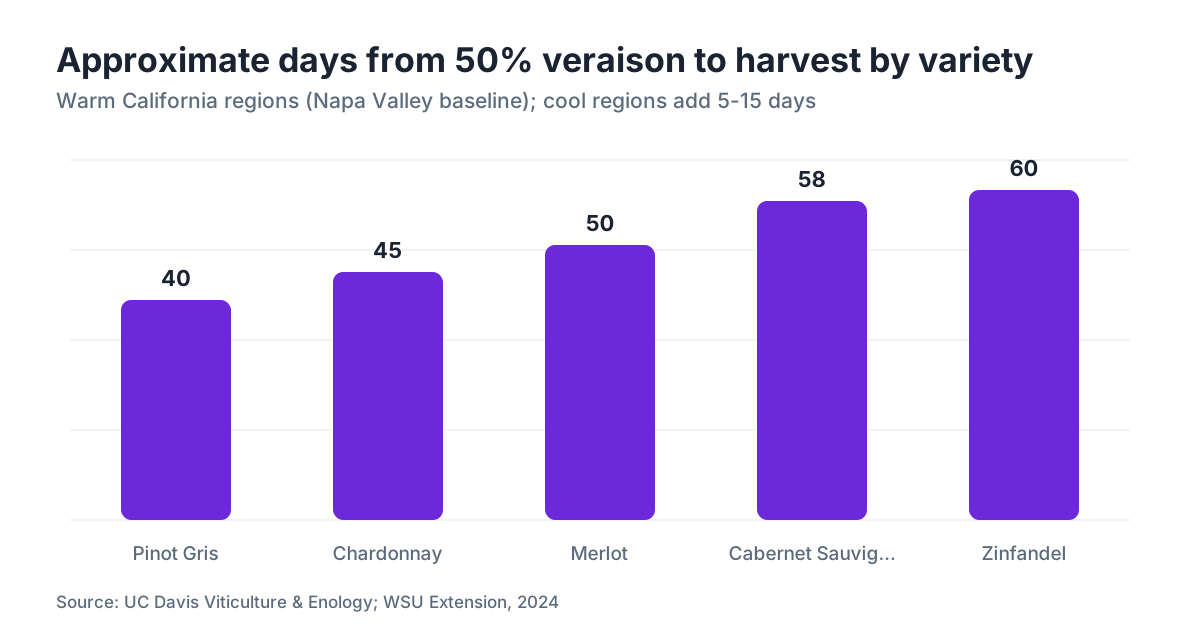
| Variety | Typical veraison (Napa Valley) | Approx. days to harvest | Style target Brix range |
|---|---|---|---|
| Pinot Gris | Late June to mid-July | 35-45 | 22-24 |
| Chardonnay | Early to mid-July | 40-50 | 22-24 |
| Merlot | Mid to late July | 45-55 | 24-26 |
| Cabernet Sauvignon | Late July to early August | 50-65 | 25-27 |
| Zinfandel | Late July | 50-70 | 26-28 |
These are rough Napa Valley averages and your site will differ. Cooler sites add 5 to 15 days across the board. The table is not a picking schedule. It's a prompt to start watching. Begin Brix sampling when you're about 30 days out from your historical harvest date, not when you hit a specific number.
One thing that wrecks planning: a hot spell in August can compress the veraison-to-harvest window by a week or more. Grapes don't care about your pick crew's vacation schedule. Build that contingency into your harvest communication early.
How do you identify veraison in the vineyard? What to look for row by row
Walk your vineyard every two or three days once you're within two weeks of your historical veraison date. The first sign in red varieties is a few berries per cluster with a faint pink or purple blush on the sun-exposed cheek. These early-change berries are not fully colored. They look water-logged and translucent next to their green neighbors. Within a few days that fraction grows.
A common field metric is "50 percent veraison," meaning half the berries in a given block have started color change. This is the date most growers record because it's repeatable and comparable across years. Cornell Cooperative Extension recommends tracking 50 percent veraison as a phenological benchmark alongside budbreak and bloom for exactly that reason [2].
White varieties need a different approach. Color shift is minimal and easy to miss on a quick walk-through. Test firmness instead: sample 20 berries per block, pressing each between your fingers. When half of them give noticeably, you're at veraison. You can also track soluble solids with a refractometer. Brix typically sits at 6 to 8 before veraison. At veraison it climbs through 10 to 12 and then takes off.
Block variability matters a lot here. South-facing rows often hit veraison three to five days before north-facing rows in the same block. Vine age, rootstock, and irrigation zone boundaries all create micro-variation. If your irrigation zones run independently, mark each zone separately in your records. A block-level average can hide sub-block differences that show up at harvest as uneven maturity.
Take a dated photo each time you scout. A shot of the same cluster position on the same vine every three days beats any written description when you're trying to reconstruct what happened six weeks later for your harvest notes or compliance records.
What vineyard tasks should happen right at or just before veraison?
Veraison is a deadline more than a milestone. Several management decisions lose most of their value if you wait until after it.
Green drop (cluster thinning) is the big one. Dropping clusters before veraison lets the vine redirect the resources that would have gone to removed fruit into what's left on the vine. After full veraison, sugar has already been divided up, and thinning late removes fruit without delivering the same ripening boost [1]. If you're going to thin, the two weeks before 50 percent veraison is your window.
Leaf removal in the fruit zone, if you haven't done it already, should happen now or just before veraison. The goal is air circulation and moderate direct light on clusters. The practical limit: aggressive leaf removal at or after full veraison in a hot climate can sunburn fruit that wasn't previously exposed. Pull one to two leaves per shoot, work the morning shade side first, and stop if canopy temperature spikes.
Irrigation decisions get sharp. The research consensus from UC Davis and USDA-ARS Kearney supports moving from regulated deficit irrigation to moderate replenishment around veraison in most warm-climate wine grape systems [4]. Leaving vines in severe stress through veraison and into ripening can shrink berries too far and slow color development in red varieties. Most protocols target soil moisture around 50 to 60 percent of field capacity in the fruit zone through the first 30 days after veraison.
Shoot hedging, if your canopy is still outgrowing its trellis, should be done before veraison if you can. Heading cuts after veraison spark lateral growth that shades clusters during the sugar-accumulation period.
Check your spray program. Many growers make a last fungicide application just before veraison, hitting the pre-bunch-closure window when Botrytis and powdery mildew are most likely to set up in the cluster interior. After 50 percent veraison, most products carry pre-harvest intervals (PHIs) that shrink your options and tighten your schedule. Review your product labels and your state's EPA Worker Protection Standard requirements, which set reentry intervals (REIs) by product signal word, typically 4 to 48 hours, and require you to post treated areas [6].
How does veraison timing affect spray records and regulatory compliance?
Post-veraison spray decisions are where a lot of small operations get into trouble. The pre-harvest interval on a fungicide or pesticide is counted backward from your actual harvest date. If you haven't recorded veraison dates, you're estimating harvest and therefore estimating PHI compliance.
California's Department of Pesticide Regulation (CDPR) requires growers to keep pesticide use records that include application date, product name, EPA registration number, site treated, acres or units treated, amount applied, and target pest [7]. Oregon and Washington run parallel requirements under their state departments of agriculture. A veraison date in your records ties your ripening timeline to your spray program and documents exactly how many days ran between your last application and harvest.
EPA's Worker Protection Standard (WPS) under 40 CFR Part 170 requires that workers and handlers get safety training, that REIs be communicated before entry, and that treated areas be posted with warning signs where the product label calls for it [6]. After veraison, with harvest labor moving through blocks for berry sampling, you need tighter control over who enters a block inside an REI. Most berry samplers are agricultural workers under WPS definitions, so training and notification rules apply.
The CDPR also enforces restricted-entry and early-entry personal protective equipment rules. After veraison, with Botrytis pressure high and spray windows narrowing, growers sometimes rush applications and skip the PPE documentation. That's where fines come from.
Record-keeping software that tags veraison date, spray application, product PHI, and the resulting harvest-eligibility date in one timeline saves real time here. VitiScribe's spray log module was built for exactly this connection, so you can see at a glance whether a pending application would push your PHI past your target pick date [8].
One compliance point people miss: if you sell grapes to a winery and that winery gets audited for pesticide residues, your spray records are what stands between you and a contract dispute. Keep them complete, keep them dated, and keep them for at least three years.
How does veraison differ across grape varieties and growing regions?
Veraison timing is one of the clearest reads on a variety's genetic calendar. Early-ripening varieties like Pinot Noir, Gewürztraminer, and Pinot Gris start veraison weeks before late-ripening varieties like Cabernet Sauvignon, Petit Verdot, or Mourvèdre, even when they're planted in the same block and farmed identically.
Within a variety, site climate is the biggest modifier. The same Cabernet Sauvignon clone on the Napa Valley floor may hit veraison in late July, while the same clone at a similar elevation in the Finger Lakes of New York might not start color change until mid-August, simply from accumulated heat units [2]. Nobody has precise comparative data across all regions, but the regional phenology data from UC Davis viticulture programs and Cornell's viticulture extension network gives baselines worth checking against your own records.
Climate change is shifting these baselines measurably. A 2019 analysis in Nature Climate Change found harvest dates across French wine regions advanced by an average of 2.6 days per decade between 1981 and 2007, driven mostly by warming spring and summer temperatures [9]. Veraison is moving on a similar track. If you've farmed the same vineyard for 20 years, your veraison date from 2005 is probably 10 to 14 days earlier now. Use the last five years as your planning baseline, not the last 20.
Rootstock can shift veraison by a few days either way. Some 1103 Paulsen and 140 Ruggeri rootstocks have been observed pushing veraison slightly later than 101-14 or 3309, likely from differences in vine vigor and water-use efficiency. Most of that research comes from European trials and doesn't translate cleanly to all California soils, but keep it in mind in blocks where timing variability is a problem.
How do you monitor sugar accumulation and acid levels from veraison to harvest?
Once you've marked 50 percent veraison, you're in the monitoring phase. The first two weeks are slow. Brix may only climb 0.5 to 1.0 per week. Around 30 days out, the rate picks up. In warm climates in late August, it's not unusual to see Brix jump 0.5 to 1.0 per day during a heat event.
The standard sampling protocol from UC Davis recommends collecting 100 berries per block per event, randomized across vines and cluster positions, then extracting juice for refractometer Brix plus lab titratable acidity (TA) and pH [1]. Many growers run 50 berries for routine weekly checks and bump to 100 inside two weeks of the target harvest window.
TA and pH move in predictable directions after veraison. Malic acid drops fast, sped up by warm nights. Tartaric acid holds steadier. Total TA usually falls from 12 to 18 g/L at veraison to 5 to 8 g/L at harvest in warm climates. pH rises inversely, from around 2.8 to 3.0 at veraison toward 3.3 to 3.6 at harvest for most table wine varieties.
Anthocyanin accumulation in red varieties peaks roughly 30 to 40 days after veraison and can actually decline if temperatures run extreme or harvest drags too long. Tannin polymerization, which affects mouthfeel, keeps going through the end of the season. This is why seed color and texture (green versus brown, crunchy versus chewy) are secondary harvest indicators many winemakers care about as much as Brix.
For growers at Paso Robles wineries or other warm inland regions, the compressed veraison-to-harvest window means higher sampling frequency, sometimes every two to three days in the final two weeks, not weekly.
What's the difference between veraison and full ripeness? When do grapes actually taste good?
Veraison starts ripening. It doesn't finish it. Obvious as that sounds, it confuses a lot of people newer to the vineyard.
At veraison, berries are still tart enough to pucker your face. Brix at 50 percent veraison usually runs 10 to 14 in most varieties. Tannins are harsh and green. Seeds are still pale. The berry is technically edible, but nobody would call it ripe.
Full physiological ripeness for most red wine varieties sits at 24 to 27 Brix, depending on style, with TA in the 5 to 7 g/L range, pH between 3.3 and 3.6, and seeds turned brown that release cleanly from the flesh. Getting there from veraison takes the 40 to 70 days described above.
Brix alone is an incomplete ripeness read, and the industry has known this for decades. Phenolic ripeness, flavor compound development, and seed tannin maturity don't always track in lockstep with sugar. A 2020 paper in the American Journal of Enology and Viticulture noted that "the relationship between sugar ripeness and phenolic or flavor maturity is highly site and vintage dependent" [10]. In practice, most experienced winery viticulturists use Brix as the scheduling trigger and sensory tasting plus seed evaluation as the confirmation.
The vineyard work during this post-veraison window, especially irrigation and canopy control, decides how well Brix and phenolic maturity line up by the time harvest arrives.
How does veraison affect bird, insect, and disease pressure on your vineyard?
Veraison is a broadcast signal to every pest in the region that fruit is getting sweet. Bird pressure jumps almost immediately once color change begins. Leafhoppers and grape berry moth are already established by veraison in most regions, and both get harder to manage as PHI windows tighten.
Botrytis cinerea (gray mold) is the disease risk that costs the most from veraison to harvest. The fungus infects berries through wounds and the stylar scar, and a compact cluster that traps moisture is a perfect home once berry skins soften. Cornell's IPM program for grapes ranks the pre-veraison bunch-closure spray timing as the highest-priority window for Botrytis control, precisely because access to the cluster interior closes off after that [11]. Miss the bunch-closure timing and you're managing Botrytis reactively from veraison onward.
Powdery mildew (Erysiphe necator) stays a concern through veraison, especially on berries. Berries become fully resistant to new powdery mildew infection at about 3 to 4 Brix after veraison, so the tail end of your mildew program should finish around the time veraison completes [11].
Sour rot, caused by a complex of bacteria and yeast, becomes relevant after veraison, mostly in years with rain or high humidity. Unlike Botrytis, sour rot has very limited chemical control options. Physical control, bird netting, and leaf removal for drying airflow are the main tools.
Spotted wing drosophila (Drosophila suzukii) goes after soft-skinned fruit at or after veraison. It's a bigger problem in cool, humid regions like the Pacific Northwest and the Finger Lakes. WSU Extension keeps current monitoring and spray guidance for SWD in wine grapes, and it pays to check before your first post-veraison spray decision [5].
Birds are a real economic threat in many regions. Netting is expensive, typically $500 to $1,500 per acre installed, but in high-value blocks with heavy bird pressure it often pencils out. The math is honest: if starlings hit 15 percent of your Pinot Noir at $3,000 per ton, it isn't complicated.
How should you record veraison in your vineyard logs for compliance and future planning?
A veraison entry in your vineyard log is worth more than most growers give it credit for. At minimum, record the date of first observed color change in each block, the date of 50 percent veraison by block, the estimated crop load per vine or per acre at that point, and current Brix from a quick refractometer sample.
Why the crop load note? Because it lets you look back in three years and see whether your light-crop years actually delivered the earlier harvest maturity you expected. Often they do. Sometimes they don't, and having the data tells you something real about your site.
On paper, a simple field notebook with columns for date, block ID, veraison stage (first color, 25%, 50%, 75%, 100%), Brix, notes, and initials does the job. You can backfill it into a spreadsheet at season's end. Farming more than about 20 acres, or selling fruit to multiple buyers, is where a digital system with date-stamped entries and block-level tagging saves real time at audit.
CDPR and most state agricultural departments can request pesticide use records going back three years [7]. Keeping your veraison dates in the same system as your spray records means you can instantly reconstruct the timeline from veraison through last application through harvest. That reconstruction is exactly what a winery buyer or a state inspector might ask for.
Log your veraison scouting photos too. A smartphone photo with GPS metadata and a timestamp is legally useful in a way memory is not. Attach it to the block record when you take it. Don't rely on your camera roll.
Frequently asked questions
What does veraison look like on red grapes vs. white grapes?
On red varieties, veraison shows as a pink or purple blush on individual berries, spreading across the cluster over 10 to 14 days. On white varieties like Chardonnay or Riesling, color change is subtle, a shift from opaque green to translucent yellow-green. Berry softness is the more reliable indicator for whites: at veraison, berries give slightly when pressed, where before they were firm and resistant.
Does veraison happen at the same time across a whole vineyard?
No, and expecting uniformity across a vineyard is one of the most common planning mistakes. South-facing rows, lower-vigor zones, and less-dense canopy areas typically hit veraison three to seven days before north-facing or higher-vigor zones in the same block. Different varieties can be weeks apart. Tracking veraison by block and irrigation zone separately is standard practice in any multi-variety or large-acreage operation.
How long from veraison to harvest for Cabernet Sauvignon?
Cabernet Sauvignon typically runs 50 to 65 days from 50 percent veraison to harvest in warm California regions like Napa or Paso Robles. In cooler regions or cooler vintages, this extends to 65 to 75 days. The growing-degree-day accumulation over that window matters more than calendar days. Tracking GDD base 50°F from veraison gives you a more reliable harvest estimate than counting days on a calendar.
Can you speed up veraison if it's running late?
Mild water stress before veraison can accelerate ABA production and pull veraison slightly earlier, typically by three to seven days in well-documented trials. Aggressive green drop before veraison reduces crop load, which can also advance timing modestly. There's no spray-on shortcut. Attempts to force ripening with aggressive deficit irrigation after veraison risk shrinking berries too severely and unbalancing the flavor profile.
What's the best way to track veraison dates for multiple vineyard blocks?
Record first color, 50 percent veraison, and full veraison by block, not by vineyard average. A simple field notebook works for small operations. For more than 15 to 20 acres, a digital log with block-level tagging and date-stamped photo attachments saves audit headaches. Connecting veraison dates to your spray records in the same system lets you verify PHI compliance at a glance, which matters when selling fruit to buyers with residue monitoring programs.
Should you irrigate more or less after veraison?
The consensus from UC Davis and USDA-ARS Kearney is to moderate, not eliminate, irrigation after veraison in warm climates. Severe deficit stress post-veraison can slow sugar accumulation and cause excessive berry shriveling. Most regulated deficit protocols aim for soil moisture around 50 to 60 percent of field capacity from veraison through harvest. In cool, dry regions with natural rainfall, irrigation after veraison may not be needed at all.
How does veraison timing connect to spray pre-harvest intervals?
Your veraison date tells you roughly when harvest will fall, which tells you the last possible application date for each registered product given its labeled PHI. If a fungicide carries a 21-day PHI and your estimated harvest is 50 days post-veraison, you have roughly a 29-day window from veraison for that application. Without a recorded veraison date, you're estimating harvest and therefore guessing PHI compliance. State DPR audits can request three years of records.
What spray applications are most important just before veraison?
The pre-bunch-closure timing just before or at early veraison is the last high-efficacy window for Botrytis and the final berry-targeting window for powdery mildew. Cornell IPM ranks this as the single most important Botrytis spray timing of the season. After full veraison, berry skins soften and cluster interiors close off, making spray penetration harder and PHI constraints tighter. Choose products with both Botrytis and mildew activity if possible to reduce spray passes.
Does veraison affect vine water needs?
Yes, significantly. Before veraison, vine water demand runs relatively high as canopy and berries are actively growing. At veraison, berry cell division stops and active growth slows. Water demand modulates somewhat. The risk shifts from growth limitation to ripening stall: too little water post-veraison can halt sugar accumulation, while too much can dilute flavors and invite Botrytis. Most RDI protocols use veraison as the inflection point for adjusting irrigation volume.
What Brix should grapes be at veraison?
At 50 percent veraison, most varieties run 8 to 12 Brix. Exact starting Brix depends on variety and season. The number itself matters less than the trajectory: once veraison is complete, you should see Brix climbing at least 0.5 per week in the first two weeks, accelerating to 0.5 to 1.0 per day or more during heat events in the final three weeks before harvest. If accumulation stalls, check for vine stress, disease, or irrigation issues.
How does climate change affect when veraison happens?
Veraison is advancing across most wine regions. A 2019 Nature Climate Change analysis found French harvest dates advanced 2.6 days per decade from 1981 to 2007, and veraison tracks similarly. If your planning baseline is 15 or 20 years of data, the average is no longer representative of current conditions. Use your last five years as the primary planning window, and expect continued advancement of 1 to 3 days per decade in most warm wine regions.
Is veraison the same as bloom?
No. Bloom is when flowers open and pollination occurs, typically in late spring, 50 to 80 days before veraison depending on variety and climate. Veraison comes later, marking the start of berry ripening after the fruit has already set and grown through two earlier development stages. The three phenological benchmarks most growers track are budbreak, bloom, and veraison, in that order through the season.
How does crop load at veraison affect wine quality?
High crop load at veraison correlates with slower, less complete ripening. Vines with excess fruit often show lower Brix, higher TA, and uneven cluster maturity at harvest. Green drop before veraison addresses this directly. After veraison, the benefit of thinning diminishes because sugar redistribution has already begun. The industry rule of thumb, though rough, is roughly 3 to 4 tons per acre for premium red wine varieties, with adjustments based on vine age and rootstock.
What worker protection rules apply to vineyard workers during the post-veraison period?
EPA Worker Protection Standard (40 CFR Part 170) applies to all agricultural workers in vineyards, including berry samplers and harvest scouts who enter treated areas. Reentry intervals from product labels must be posted and communicated before entry. Growers must provide WPS safety training, decontamination supplies, and emergency medical information. Post-veraison with frequent sampling crews and tighter spray windows is exactly when REI tracking and crew notification most commonly fall through the cracks.
Sources
- UC Davis Viticulture & Enology, Grape Berry Development: Veraison defined as transition from berry growth Stage II to Stage III; Brix, GDD, and cluster thinning timing guidance
- Cornell Cooperative Extension, Viticulture Program, Grape Phenology: 50 percent veraison as a recommended phenological benchmark; regional timing differences between warm and cool climates
- Journal of Experimental Botany, ABA and ethylene roles in veraison (2014): ABA as primary trigger of veraison; ethylene accelerates anthocyanin accumulation but is not primary inducer
- USDA-ARS Kearney Agricultural Research Center, Regulated Deficit Irrigation for Winegrapes: RDI protocols recommend moderate water replenishment at veraison; target 50-60% field capacity post-veraison
- Washington State University Extension, Wine Grape Varieties and Phenology: Veraison-to-harvest window of approximately 30 to 70 days depending on variety and climate; SWD monitoring guidance
- US EPA, Worker Protection Standard (40 CFR Part 170): WPS requires training, REI posting, decontamination, and emergency medical information for all agricultural workers including vineyard samplers
- California Department of Pesticide Regulation, Pesticide Use Reporting: CDPR requires pesticide use records including application date, product name, EPA registration number, site, acres, amount applied, target pest; three-year retention
- VitiScribe, Vineyard Compliance and Field Operations Platform: Spray log module connecting veraison date, PHI, and harvest-eligibility date in a single timeline view
- Nature Climate Change, Increasing occurrence of heat during grape harvest in France (2019): French harvest dates advanced by average 2.6 days per decade from 1981 to 2007 due to warming temperatures
- American Journal of Enology and Viticulture, Sugar and phenolic ripeness relationships (2020): Relationship between sugar ripeness and phenolic or flavor maturity is highly site and vintage dependent
- Cornell Cooperative Extension, Grape IPM: Disease Management: Pre-bunch-closure timing ranked as highest-priority Botrytis spray window; berries fully resistant to new powdery mildew at 3-4 Brix post-veraison
Last updated 2026-07-09