Grape vine pruning time: when to prune and how to get it right
TL;DR
- Prune grapevines in late dormancy, roughly January through March across most North American wine regions, aiming for 4 to 6 weeks before expected bud break.
- Prune too early and you raise frost damage risk.
- Prune too late and you burn stored vine energy.
- The exact window shifts with region, variety, and elevation.
- A growing-degree-day model or your own bud break history beats any calendar date.
When is the best time to prune grapevines?
Prune in late dormancy, after the worst cold of winter has passed but before the buds start to swell. That means January through March for most California, Pacific Northwest, and mid-Atlantic vineyards, and February through April for colder climates like upstate New York or the Finger Lakes. [1]
Why late and not early? Vines pruned right after leaf fall are exposed. Fresh cuts take the full brunt of winter, and in a hard cold snap the injury travels right up from the cut into the cane. Waiting lets the vine harden off, then you cut when the deep cold is mostly behind you.
The other boundary is bud swell. Once the buds green up, you're spending vine reserves on tissue you're about to cut off, and every bump to a swelling bud costs you a shoot. Cornell Cooperative Extension puts the target at "late winter to early spring, just before bud swell," which stays vague on purpose because the date moves every year. [1]
Managing a vineyard where frost hits in late March or April (think the Napa Valley floor, or the Willamette Valley)? Delaying pruning past the usual window is a real frost tool, not procrastination. That's strategy.
How does pruning time affect frost damage and vine health?
This is the tradeoff that defines dormant pruning across most North American wine regions. Prune early and you advance bud break by roughly 7 to 14 days compared to late-pruned vines in the same block, per research from Washington State University Extension. [2] Sounds fine until April hands you a 28°F night.
Delayed pruning works because the vine's carbohydrate reserves stay spread across all the retained canes. As long as the buds have more tissue to push through before they're exposed, bud break lags. Cut to the cordon or head and those reserves concentrate into fewer, more exposed buds, which move faster.
The frost math matters most in three places: valley-floor sites where cold air pools, regions with historically frequent late spring frosts (the Finger Lakes sees a frost event after May 1 in roughly one year of three, per NRCS historical records), and early-budding varieties like Chardonnay, Pinot Noir, and Merlot. [3] Syrah and Cabernet Sauvignon bud later and take early pruning better.
On the health side, heavy early pruning while carbohydrates are still moving causes "bleeding," the sap that weeps from cuts in spring. That's mostly cosmetic and doesn't hurt the vine. Wet-weather pruning is the real problem. Eutypa lata (the cause of Eutypa dieback) and Botryosphaeria species enter through fresh wounds, and infection risk spikes when you cut in rain. [4] UC Cooperative Extension recommends pruning at least 24 hours after rainfall and painting a wound protectant on any cut larger than your thumb on cordon wood. [4]
What is the ideal pruning window by U.S. wine region?
Timing swings hard by geography. A table shows it best.
| Region | Typical pruning window | Notes |
|---|---|---|
| Napa / Sonoma, CA | January, February | Delay to Feb in frost-prone areas |
| Paso Robles, CA | December, February | Mild winters allow earlier start |
| Willamette Valley, OR | February, March | Late frost events common; delay helps |
| Columbia Valley, WA | January, March | Cold snaps possible through Feb |
| Finger Lakes, NY | March, early April | Latest window; severe winters |
| Virginia / Mid-Atlantic | February, March | Eutypa pressure high; dry days matter |
| Texas Hill Country | December, February | Variable; watch bud swell closely |
| Southwestern Colorado | March, April | Elevation drives very late timing |
The paso robles wineries region is worth calling out. Warm, dry winters let growers start as early as December without much frost risk, and many spread the pruning workload over a longer stretch. Colder regions don't get that luxury.
In the Pacific Northwest, WSU Extension's viticulture team recommends tracking 50°F growing degree days after January 1 to model bud break for your specific site rather than trusting a calendar. [2] A degree-day model reads your actual winter temperatures, so it beats any regional average year to year. WSU's Viticulture and Enology program has published the GDD thresholds for major Pacific Northwest varieties if you want to run the numbers yourself. [2]
Does the pruning method (spur vs. cane) change the timing?
Not really. Spur pruning (cordon-trained vines like VSP Cabernet or Grenache) or cane pruning (head-trained and Guyot-style systems common with Pinot Noir and Chardonnay), the biological trigger is the same: dormant wood, past the worst cold, before bud swell.
What cane pruning changes is the labor timeline. It takes 2 to 4 times longer per vine than spur pruning depending on system complexity, because you're selecting, tying, and cutting renewal spurs in one pass. [5] If you've got 15 acres of cane-pruned Pinot and 60 days before bud break, work backward from your expected bud break date to size your crew. Starting late and running out of time is one of the most common operational mistakes in small vineyards.
Mechanical pre-pruning shifts the math too. Many larger operations run a mechanical hedger through in December or January to knock cane weight down, then hand-finish in late winter. That spreads labor, cuts the fatigue that leads to sloppy hand cuts, and still lands the final pass in the right biological window.
Using grape vine pruning video tutorials to train new crew? Make sure the video names its region, variety, and training system. A January Napa clip showing Cabernet spur pruning doesn't map onto a cane-pruned Riesling block in the Finger Lakes in March. The mechanics look alike. The timing and selection criteria differ enough to matter.
How do you know when bud break is coming so you can time the cut?
Bud break is what you're pacing yourself against, so you need a way to predict it. Three tools that actually work.
First, your own history. Farm the same site for three or more years and note bud break dates, and that record beats any model. Most sites have a fairly narrow 10 to 14 day window where bud break lands most years, shifted by how warm or cold the winter ran. A notebook or spreadsheet gets you there faster than software.
Second, degree-day accumulation. Cornell's Network for Environment and Weather Applications (NEWA) is a free online tool that tracks growing degree days at weather stations across the Northeast and projects bud break dates by variety. [6] WSU's AgWeatherNet does the same for Washington. [10] Both are free and both work.
Third, your eyes. Walk your blocks weekly starting mid-January in California, mid-February in colder regions. When the bud scales loosen and the tip starts to swell (what viticulturists call woolly bud, or Eichhorn-Lorenz stage 4), you have roughly 1 to 3 weeks before green tissue is exposed. That's your hard deadline to finish pruning.
No tool replaces walking the vine. Degree-day models are averages. Your specific block runs early or late on soil type, drainage, and microclimate.
What are the risks of pruning too early or too late?
Too early (right after leaf fall, November or early December in most regions) does four things to you. Fresh wounds take the worst cold of winter, and injury moves into cane and cordon tissue through the cut ends. Bud break advances, raising frost exposure in spring. Eutypa and Botryosphaeria fungi get a long wet winter to colonize open wounds. [4] None of that is worth the early head start.
Too late (after bud swell, green tissue visible) wastes the season's stored energy. Every bud you remove was already drawing on reserves the vine built all last year. You also risk mechanical damage to fragile green tissue during pruning and tying, which means lost shoots. In cool-climate varieties like Pinot Noir, late pruning can cut that year's yield if shoot growth is already underway when you cut.
The sweet spot is genuinely narrow in high-frost-risk sites. A grower working a 40-acre Finger Lakes property might have a realistic window of 3 to 5 weeks to prune everything. That's tight. Planning labor around that window matters as much as knowing the biology.
For records, log your actual pruning dates by block along with the bud stage you saw that day. That gives you an audit trail for compliance and a year-over-year comparison for yourself. Tools like VitiScribe let you capture it in the field instead of reconstructing it from memory in July.
How does pruning affect vine yields and fruit quality?
Pruning is the biggest yield decision you make all year. Every spur and cane you keep carries a set number of buds, and each bud (roughly) pushes one or two shoots with one or two clusters. The bud-count-to-yield relationship isn't perfectly linear, because fruitfulness varies by bud position, variety, and training system, but it's close enough to plan around.
The Ravaz Index, the ratio of fruit weight to cane pruning weight, is still one of the best quick reads on vine balance. UC Cooperative Extension cites a Ravaz Index of 5 to 10 as the balanced range for most Vitis vinifera, with ratios above 10 pointing to overcropping and below 5 pointing to excess vigor. [7]
Saving pruning weights by block is real data, not busywork. A block that runs a Ravaz Index of 12 two years running is telling you to drop bud count or fix vigor. A block sitting at 4 needs more fruit load or different canopy management.
On timing and quality: some UC Davis work suggests vines pruned closer to bud break show slightly higher fruitfulness in the basal bud positions, possibly because carbohydrates stay available longer to those buds. [7] The effect is modest. I wouldn't schedule the whole operation around it, but it's one more small point in favor of late-dormancy pruning over an early-winter cut.
What worker safety rules apply to vineyard pruning operations?
Pruning is one of the highest-injury tasks in vineyard work. Hand cuts from shears, repetitive strain in wrists and hands, and musculoskeletal injury from tying are all documented. The EPA's Worker Protection Standard (WPS) and Cal/OSHA both set requirements that apply to pruning crews even when no pesticide is going out during the pruning itself.
Under the WPS, if any restricted-entry interval (REI) is active in a block from an earlier application, workers can't enter without specific protections: personal protective equipment, handler training, and decontamination access. [8] Before you schedule crews, check your spray records against current REIs for every product applied in the prior 30 days. California's REI rules are among the strictest in the country, and a missed REI in a pruning block is a recordable WPS violation.
Beyond REI, OSHA ergonomics guidance and Cal/OSHA's heat illness standard apply to outdoor ag workers during pruning season, though late-winter pruning rarely trips the heat thresholds. What applies year-round: tool safety (shear guards, cut-resistant gloves), water and sanitation access (portable facilities within a quarter mile under WPS), and first aid. [8]
Spray records that tie application dates and REIs to specific blocks by GPS or block ID keep you ahead of this. If an inspector asks whether your January crew entered a block carrying a 30-day REI from a November application, "I think we waited long enough" is not an answer that holds up.
Does dormant pruning timing vary by grape variety?
Yes, and enough that you should schedule blocks separately when you grow multiple varieties.
Early-budding varieties (higher frost risk, consider delaying pruning):
- Chardonnay: buds break 7 to 14 days earlier than Cabernet Sauvignon in most sites
- Pinot Noir: similar to Chardonnay, very sensitive to late spring frosts
- Merlot: mid-early, frost-sensitive in cool regions
- Sauvignon Blanc: early in most climates
Late-budding varieties (more tolerant of early pruning):
- Cabernet Sauvignon: reliable late budder, lower frost risk
- Syrah / Shiraz: buds late, typically 10+ days after Chardonnay
- Grenache: late budder, handles early pruning with little penalty
- Mourvedre: one of the latest-budding Rhone varieties
In a mixed-variety vineyard, prune the late-budding reds first (where early pruning carries less risk) and save Chardonnay and Pinot for last. That way your highest-frost-risk blocks finish closest to bud break, keeping the advancement to a minimum. Both WSU and Cornell extension publications recommend this sequencing. [1][2]
Fruitfulness by bud position also varies. Concord and other American hybrids carry higher fruitfulness in basal buds than most vinifera, which is why their standard pruning systems differ. Interspecific hybrids like Marquette or Frontenac, grown widely in cold-climate Michigan and Minnesota, usually come with specific pruning recommendations from the university programs that bred them.
How long does vine pruning take and what does it cost?
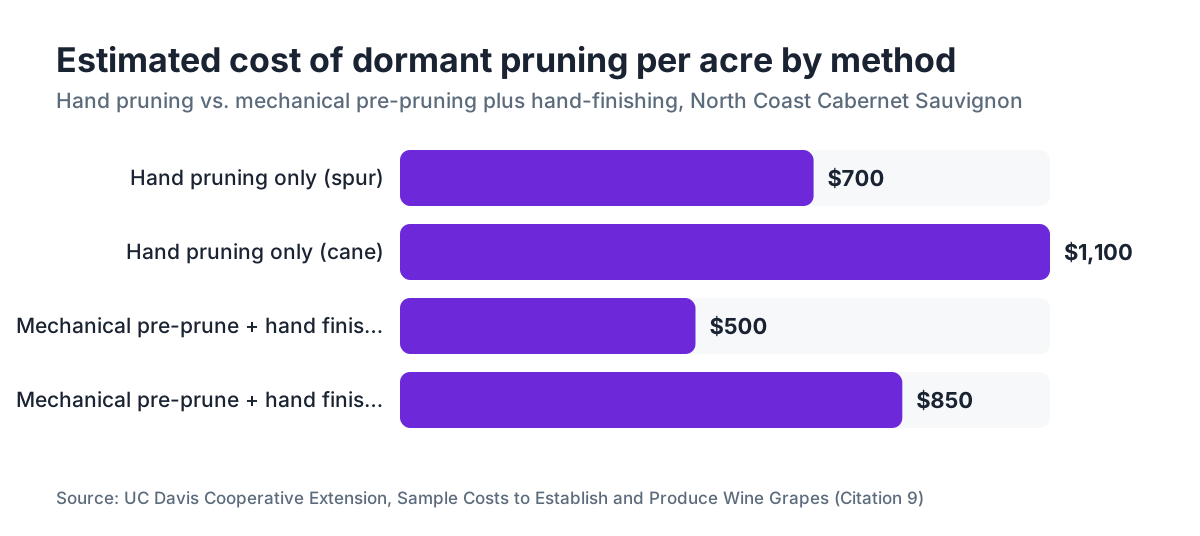
Labor runs the bill, and the range is wide depending on training system, vine spacing, and whether you pre-prune by machine. Hand pruning rates in published farm labor studies run about 1 to 4 hours per acre per worker per pass, scaling with system complexity.
UC Davis cost-of-production studies for North Coast Cabernet Sauvignon in recent years put total pruning cost (hand pruning plus tying, no mechanical pre-pruning) at roughly $600 to $1,200 per acre depending on vine density and training system. [9] Cane-pruned systems sit at the high end. Mechanical pre-pruning cuts hand-labor time by 30 to 50 percent and drops total pruning cost by $150 to $300 per acre in high-density blocks. [9]
Tool maintenance matters more than most growers budget for. Dull shears cause more repetitive strain and leave torn cuts, which are bigger infection surfaces. Pneumatic and cordless electric shears run $300 to $800 per unit but cut hand fatigue hard, and they earn their keep on full-season crews.
Then there's the cost nobody logs: timing errors. A Pinot Noir block nipped by a 29°F frost because you pruned three weeks early isn't just a sad story. UC Davis crop loss estimates put complete primary bud kill in Pinot Noir at 50 to 80 percent of that season's crop, with partial freeze events running 20 to 40 percent loss depending on how many buds are hit. [7] Against that, spending an extra $100 per acre on a delayed schedule that needs careful labor planning is cheap insurance.
Want to see how other growers run the scheduling math? The grape vine pruning video libraries at WSU and UC Davis extension both walk through crew sizing and timing alongside the technical instruction. [11]
What records should you keep for each pruning operation?
Good pruning-season records earn their keep four ways: they sharpen next year's timing, they document labor for cost tracking, they support WPS compliance audits, and they feed Ravaz Index math if you're weighing prunings.
At a minimum, capture by block: date pruning started and finished, crew size and hours, the bud stage you observed (woolly bud, bud swell), the buds or canes retained per vine if you track load, and any disease notes (Eutypa symptoms, Botrytis mummies left from harvest). Weighing prunings on a sample of vines? Record those too.
For WPS compliance, your spray records have to show that any active REIs expired before the crew entered. The EPA WPS requires that pesticide application records be kept for at least 2 years and that REI information stay posted at the central location for the duration of the REI. [8] If your pruning dates live in a separate system from your spray records, you're reconciling them by hand at audit time. Systems like VitiScribe connect block-level spray records and field operations in one place, so the REI check runs automatically instead of turning into a scramble across two binders.
For California growers, the County Agricultural Commissioner may also request pesticide use reports that line up with field entry records. Logging pruning dates against block IDs that match your pesticide use reports keeps you consistent across documents.
Frequently asked questions
Can you prune grapevines in the fall right after harvest?
You can, but most viticulturists advise against it. Fall pruning removes carbohydrates the vine is still moving from leaves into storage wood, and fresh cuts left open through winter are more open to Eutypa and Botryosphaeria infection. In very mild climates (parts of coastal California), light cane removal in fall happens for operational reasons, but the main structural pruning should wait for true dormancy after several hard frosts.
What temperature is too cold to prune grapevines?
There's no single threshold, but many growers and extension programs avoid pruning below 25°F or during active cold-injury risk. Frozen wood cuts differently and torn tissue is more prone to infection. More practically: mid cold snap, wait a few days. The bigger risk isn't the pruning-day temperature but early timing that leaves fresh cuts exposed to later cold events.
How many buds should you leave per vine when pruning?
Bud count depends on training system, variety, vine age, and target yield. A common starting point for spur-pruned vinifera in VSP is 4 to 6 spurs per cordon at 2 buds each, totaling 8 to 12 buds per vine. For cane-pruned systems, a single cane with 8 to 15 nodes is common. Use your Ravaz Index from prior years to adjust: high index means fewer buds, low index means more.
Does it matter if it's raining when you prune?
Yes. Wet-weather pruning raises infection risk from trunk disease fungi, especially Eutypa lata and Botryosphaeria species, which release airborne spores during rain and infect fresh wounds immediately. UC Cooperative Extension recommends avoiding pruning during rain and for at least 24 hours after it stops. If pressure forces wet-weather pruning, paint a labeled wound protectant on larger cuts on cordons and trunks.
What is the difference between dormant pruning and summer pruning?
Dormant pruning (late winter) is the main structural pruning that sets bud count and vine architecture for the season. Summer pruning is canopy management: shoot thinning, leaf removal, hedging, and cluster thinning done after bud break. Both affect yield and quality but do different jobs. Summer pruning doesn't replace dormant pruning; it fine-tunes the canopy after the dormant cut sets the framework.
Should you seal or paint pruning cuts on grapevines?
For large cuts on cordon or trunk wood, yes. A thumb-size or larger wound stays open long enough to be a real Eutypa entry point. Products with trichoderma (a biocontrol fungus) or chemical sealants like Topsin-M paste have documented efficacy in UC Davis trials. For small spur cuts, protectants generally aren't needed and the labor outweighs the benefit. Prioritize large cuts on older wood.
How do you prune grapevines that were injured by winter cold?
Wait longer than usual before final cuts. Cold-injured wood is hard to spot early. As bud break nears, cut back into canes or cordons until you see white, healthy pith instead of brown or discolored tissue. For severe trunk or cordon injury, you may need to select a sucker or young shoot as a replacement arm and train a new cordon, which is a 2 to 3 year process.
Can you prune grapevines in summer if you miss the dormant window?
If you miss the window and buds have broken, stop and assess. Light pruning of individual vines you didn't reach beats pruning the whole block. You lose some vine energy already spent on removed shoots, but more delay won't fix that. Waiting until full dormancy the following winter and pruning on time beats aggressive mid-season cuts. Never remove more than 30 percent of green canopy in a single summer pass.
Do young vines (under 3 years old) get pruned at the same time as mature vines?
Same timing, different objective. Young-vine pruning trains the trunk and sets the framework rather than a crop load. Year one, you're usually picking a single strong shoot and tying it to the stake. Years two and three, you start forming the cordon or head. The dormant-timing rules still apply, but you make far fewer cuts and protect the vine's ability to build structure over managing yield.
What are the signs that a grapevine was pruned at the wrong time?
Early-pruning mistakes show as higher rates of frost-killed primary buds in spring, visible as brown bud interiors when you slice a bud open a few weeks after bud break. Late-pruning mistakes show as wasted vigor: uneven shoot energy, weak renewal spurs, poor shoot placement. Systemic Eutypa infection, showing as wedge-shaped brown wood in cross-section and stunted yellow shoots, points to past wet-weather pruning regardless of timing.
How does delayed pruning work as a frost management strategy?
Pruning later delays bud break by roughly 7 to 14 days versus early-winter pruning, because carbohydrates stay spread across unpruned canes instead of concentrating in fewer retained buds. That delay can push bud break past the last average frost date on frost-prone sites. WSU Extension and Cornell both document the technique for cold-climate viticulture. The tradeoff is compressed labor time, since fewer weeks sit between your safe window and actual bud break.
Are there grape vine pruning video resources from university extension programs?
Yes. UC Davis Cooperative Extension, WSU Extension Viticulture, and Cornell Cooperative Extension all publish free pruning demonstration videos covering different training systems and regional timing. WSU's channel includes cane and spur walkthroughs for Pacific Northwest varieties. UC Davis has videos specific to cordon-trained vinifera in California conditions. These are among the best free resources for training new crew on cut placement and bud selection.
Does organic certification change when or how you can prune?
The timing of pruning isn't restricted by USDA NOP organic rules. What changes is your wound-protectant options: synthetic fungicides like Topsin-M aren't allowed under organic certification, so you're limited to approved materials like copper-based products or trichoderma biocontrols. Organic record-keeping means your pruning dates and any wound treatments have to be documented as part of your organic system plan.
Sources
- Cornell Cooperative Extension, Viticulture Program: Cornell Cooperative Extension recommends pruning 'late winter to early spring, just before bud swell' and describes delayed pruning as a frost-management tool for Finger Lakes and other cold-climate regions.
- Washington State University Extension, Viticulture and Enology: WSU Extension documents that early pruning advances bud break by 7 to 14 days compared to late-pruned vines, and recommends tracking 50°F growing degree days after January 1 to model bud break timing.
- University of California Agriculture and Natural Resources, Eutypa Dieback Management (UC IPM): UC Cooperative Extension recommends pruning at least 24 hours after rainfall and applying wound protectants to cuts larger than thumbnail size, because Eutypa lata and Botryosphaeria species enter through fresh pruning wounds during wet weather.
- UC Davis Department of Viticulture and Enology, Pruning Systems: Cane pruning takes 2 to 4 times longer per vine than spur pruning depending on training system complexity.
- Cornell University Network for Environment and Weather Applications (NEWA): Cornell's NEWA tool tracks growing degree days at weather stations across the Northeast and provides projected bud break dates by grape variety.
- University of California Agriculture and Natural Resources, Vine Balance and Ravaz Index guidelines: UC cites a Ravaz Index of 5 to 10 as the range associated with balanced vines for most Vitis vinifera, and estimates primary bud kill from frost causes 50 to 80 percent yield loss in Pinot Noir.
- U.S. EPA, Agricultural Worker Protection Standard: The EPA WPS requires that records of pesticide applications be kept for at least 2 years, that REI information be posted at a central location for the duration of the REI, and that workers not enter fields under an active REI without specific protections.
- UC Davis Agricultural and Resource Economics, Sample Costs to Establish and Produce Wine Grapes: UC Davis cost-of-production studies put total pruning costs for North Coast Cabernet Sauvignon at roughly $600 to $1,200 per acre, with mechanical pre-pruning reducing hand-labor costs by $150 to $300 per acre in high-density blocks.
- WSU AgWeatherNet, degree day monitoring: WSU AgWeatherNet provides real-time growing degree day tracking for Washington state weather stations, supporting bud break prediction for viticulture timing decisions.
- UC Davis Viticulture and Enology, pruning video resources: UC Davis publishes free pruning demonstration videos covering cordon-trained vinifera pruning methods and timing guidance for California wine grape production.
Last updated 2026-07-09