Vineyard floor management: the complete field guide
TL;DR
- Vineyard floor management controls the vegetation between vine rows to balance water competition, erosion risk, soil health, and pest habitat.
- Your best system depends on soil type, rainfall, slope, and grape variety.
- Most growers combine methods: permanent sod in alternate rows, plus a cultivated or herbicide-treated strip directly under the vine.
- No single system wins everywhere.
What is vineyard floor management and why does it matter?
Vineyard floor management is every decision you make about the vegetation, soil surface, and organic matter between your vine rows and directly under the canopy. That includes what you plant, what you kill, how you till, and when. It sounds like housekeeping. It isn't.
The floor affects water availability to the vines, nitrogen cycling, erosion rates, compaction, pest and beneficial insect habitat, and even fruit quality. A UC Davis study on cover crop effects in Napa Valley found that legume cover crops cut soil erosion by more than 90 percent compared to clean cultivation on sloped vineyards [1]. That number gets attention after one bad rain event.
For small operations, the floor is often the thing that gets managed last and thought about least. That's backwards. Get the floor wrong and you're fighting water stress all summer, wrestling with weeds under the trellis, or watching topsoil move downhill. Get it right and the floor does a lot of the agronomic work for you.
What are the main vineyard floor management systems?
There are four core approaches, and most real-world vineyards blend two or three of them depending on row position.
Clean cultivation (tillage) means mechanical disturbance of the soil surface, typically with a disc, rotary tiller, or under-vine cultivator. It controls weeds mechanically, incorporates organic matter, and breaks up surface crusts. The downsides are real: repeated tillage destroys soil structure over time, raises erosion risk on slopes above about 5 percent, kills beneficial fungi (mycorrhizae), and burns fuel and labor. UC Cooperative Extension estimates tillage passes at roughly $25 to $60 per acre per pass depending on equipment and terrain [2].
Permanent cover crops (sod culture) mean a managed plant community in the row middles, mowed or flailed rather than tilled. Grasses and clovers are common. Perennial ryegrass, fescue, and cereal rye are workhorses in cool climates. In dry climates, permanent sod in every row is usually a mistake because cover crops compete hard for water. Cornell's viticulture program recommends permanent sod in alternate rows in regions with less than 25 inches of annual rainfall, keeping tilled or treated strips in the other rows [3].
Resident vegetation (mowed natives) means you manage what's already there rather than seeding anything. This is the low-cost version of cover cropping. It works surprisingly well in many established vineyards where native species have settled in. You're just managing mowing timing and height. The risk is that aggressive species (bindweed, johnsongrass, bermudagrass) can overwhelm the beneficial plants if you stop paying attention.
Herbicide-based weed control uses pre-emergent or post-emergent chemistry to keep a weed-free or low-weed strip, typically under the vine canopy where tillage equipment can't reach safely. Glyphosate, oxyfluorfen, and flumioxazin are common actives. Herbicide strips under the trellis are standard practice in most commercial California and Pacific Northwest vineyards. They cut hand-labor dramatically. They also carry regulatory and resistance management obligations you can't ignore.
How do cover crops affect vine water use and fruit quality?
Growers in drier climates ask this one most. The short answer: cover crops definitely compete for water, and the size of that competition depends on species, timing of termination, and whether you're irrigating.
A Washington State University extension study in the Columbia Valley found that a living cover crop through June could reduce vine water availability equivalent to removing 2 to 4 inches of irrigation in a dry year [4]. That's a meaningful number in a region where summer rainfall is near zero. Terminating cover crops early (mid-April at many Washington sites) largely erases the competition effect.
On the quality side, controlled water stress is exactly what most red wine growers want. The floor can be a tool for inducing mild stress rather than fighting it. In coastal California, where soils hold more moisture, permanent sod in row middles has been shown to improve fruit color and concentration by reducing excessive vine vigor [1]. You're using grass competition as a vigor management tool.
The rule most experienced growers follow: in irrigated, low-rainfall vineyards, terminate cover crops or mow them to bare ground by bud swell or shortly after. In high-rainfall or drip-irrigated sites with vigorous soils, let them run longer or keep them permanent. Nobody has universally good data on the exact crop-load interaction; most of what you'll hear is observational. The WSU tree fruit and viticulture program has the most rigorous trial data in the West [4].
What cover crop species work best in vineyards?
Species choice follows your goal: erosion control, nitrogen fixation, early termination for water conservation, or habitat for beneficial insects.
| Goal | Good species | Notes |
|---|---|---|
| Erosion control (winter) | Cereal rye, oats, barley | Establish fast, tolerate cold, easy to kill |
| Nitrogen fixation | Crimson clover, hairy vetch, bell beans | Fix 50-150 lbs N/acre if incorporated at bloom [5] |
| Water conservation (early die-off) | Annual grasses (barley, mustard) | Terminate naturally or chemically before April |
| Beneficial insect habitat | Phacelia, buckwheat, sweet alyssum | Attract Anagrus (leafhopper parasite) and others |
| Permanent low-competition sod | Hard fescue, sheep fescue, creeping red fescue | Low water use, slow-growing, mow 2-3x/year |
Legume-grass blends are common because they do two jobs at once: the grass handles erosion and quick establishment while the legume fixes nitrogen. UC Davis Cooperative Extension recommends inoculating legume seeds with the right Rhizobium strain if legumes haven't been grown in that field before [5].
Avoid tall fescue in moderate-to-dry climates. It's aggressive, drought-tolerant, and will compete with vines harder than you want. Also avoid any species with allelopathic compounds near sensitive young vines, including some brassicas at high seeding rates.
How should you manage the under-vine strip?
The strip directly under the trellis, typically 18 to 36 inches wide on each side of the vine row, is where management gets complicated. Tractor-mounted tillage equipment can't safely get that close to the vine trunk on most trellised systems. That leaves three options: herbicides, under-vine cultivators, or hand labor.
Herbicides are by far the most common solution in commercial vineyards. Pre-emergent herbicides applied in late winter or early spring create a residual barrier that keeps weeds from establishing. Post-emergent contact herbicides (glyphosate, paraquat, carfentrazone) handle escapes. The California Department of Pesticide Regulation requires that any pesticide application to agricultural land follow the label exactly, including buffer distances from water, PPE requirements, and restricted-entry intervals [6].
Under-vine cultivators (spring-tine weeders, finger weeders, torsion weeders, and disc hillers) have gotten much better in the last 15 years. European makers like Clemens, Boisselet, and Braun build systems that sense the vine trunk and deflect, working to within 4 to 6 inches of the trunk. On established vineyards with good trunk placement, these work well. They struggle on younger vines, on rocky soils, and on irregular row spacing.
Hand labor is the fallback, especially in older vineyards with irregular planting patterns. It's expensive: hand weeding runs $150 to $400 per acre depending on weed pressure and the local labor market [2]. Most growers use it only as cleanup after mechanical or chemical methods, not as a primary strategy.
What are the soil health and erosion risks you need to plan for?
Erosion is the issue that keeps extension agronomists up at night. The USDA Natural Resources Conservation Service estimates that vineyards on slopes greater than 8 percent with clean-cultivated rows can lose 5 to 20 tons of topsoil per acre per year during heavy rain events [7]. That topsoil took thousands of years to form, and it carries your organic matter, biology, and cation exchange capacity downhill with it.
The fix is straightforward: keep ground cover on slopes whenever rainfall erosion risk is present. For most of California's North Coast, that means November through April. Seeding a quick-establishing winter annual in October is the standard move. Cereal rye germinates at soil temperatures as low as 34°F (1°C) and gives you meaningful cover within three to four weeks of seeding.
Compaction is the slower, less dramatic problem. Repeated tractor traffic on wet soils compresses pore space in the top 12 inches, cutting water infiltration and root penetration. Cornell research found that a single pass with a loaded spray rig on wet clay loam at 12 percent moisture can raise soil bulk density by 8 to 12 percent in the 0 to 6 inch zone [3]. Permanent sod in row middles cuts compaction sharply compared to bare or tilled rows because the root structure keeps macropores open and the surface spreads tractor weight.
Got compacted rows? Deep ripping (subsoiling to 18 to 24 inches) can restore structure, but you'll undo it within two years if you go back to tillage on wet soils. The fix is behavioral as much as mechanical.
How do floor management choices affect pest and disease pressure?
The floor is not neutral territory in your pest management program. It's habitat, and what you plant or allow determines which insects and pathogens live there.
Leafhopper control is the most-studied benefit of flowering cover crops in California vineyards. The egg parasitoid Anagrus epos overwinters in vegetation outside the vineyard and moves in when flowering plants draw it. UC Cooperative Extension research in the North Coast showed that vineyards bordered by French prune trees or containing flowering annuals had Anagrus populations high enough to suppress grape leafhopper below economic thresholds in some years [8]. That's a real spray reduction.
On the disease side, dense cover crops or tall resident vegetation can cut air circulation and keep humidity high near the soil surface, which raises Botrytis risk late in the season. Mowing before veraison to thin canopy density near the ground is standard practice in humid climates.
Voles and gophers get dismissed as a rodent problem when they're really a floor management problem. Dense cover crops, especially legumes, make excellent rodent habitat. If you have vine loss from gopher mounds, look hard at whether your cover crop is making things worse. Some growers on the Central Coast have switched from legume-heavy mixes to sparse annual grasses specifically to knock back rodent pressure.
What does herbicide use in vineyards require for compliance?
This is where a lot of small operations fall short on paperwork, and it's also where fines can be significant.
Under the EPA Worker Protection Standard (WPS), any pesticide application to an agricultural establishment requires that workers and handlers receive annual safety training, have access to pesticide safety information, and observe restricted-entry intervals (REIs) after applications [9]. The WPS was updated in 2015 and the current rule is codified at 40 CFR Part 170. For vineyards using any EPA-registered pesticide, including herbicides, the WPS applies.
At the state level, California requires that all pesticide applications by licensed applicators or under a pest control adviser's recommendation be recorded in a pesticide use report (PUR) submitted to the county agricultural commissioner within 30 days of application [6]. Most other western states have similar but not identical requirements. Oregon and Washington require pesticide use reports for restricted-use pesticides; check with your state department of agriculture for current rules.
Label compliance is federal law. The Federal Insecticide, Fungicide, and Rodenticide Act (FIFRA) makes it illegal to use a pesticide in a manner inconsistent with its label. That covers buffer distances, application timing, and specified PPE. The line "the label is the law" is not a figure of speech [10].
Tracking spray records, REI compliance, and worker training documentation is one of the things VitiScribe was built to handle. Every application gets timestamped with product, rate, applicator, and REI, so your records are audit-ready without hunting through notebooks.
For organic operations, OMRI-listed under-vine options include cultivation, flamers (propane or infrared), and steam weeding. Steam weeding equipment costs $80,000 to $200,000 and is usually cost-justified only in large operations or cooperatives.
How much does vineyard floor management cost per acre annually?
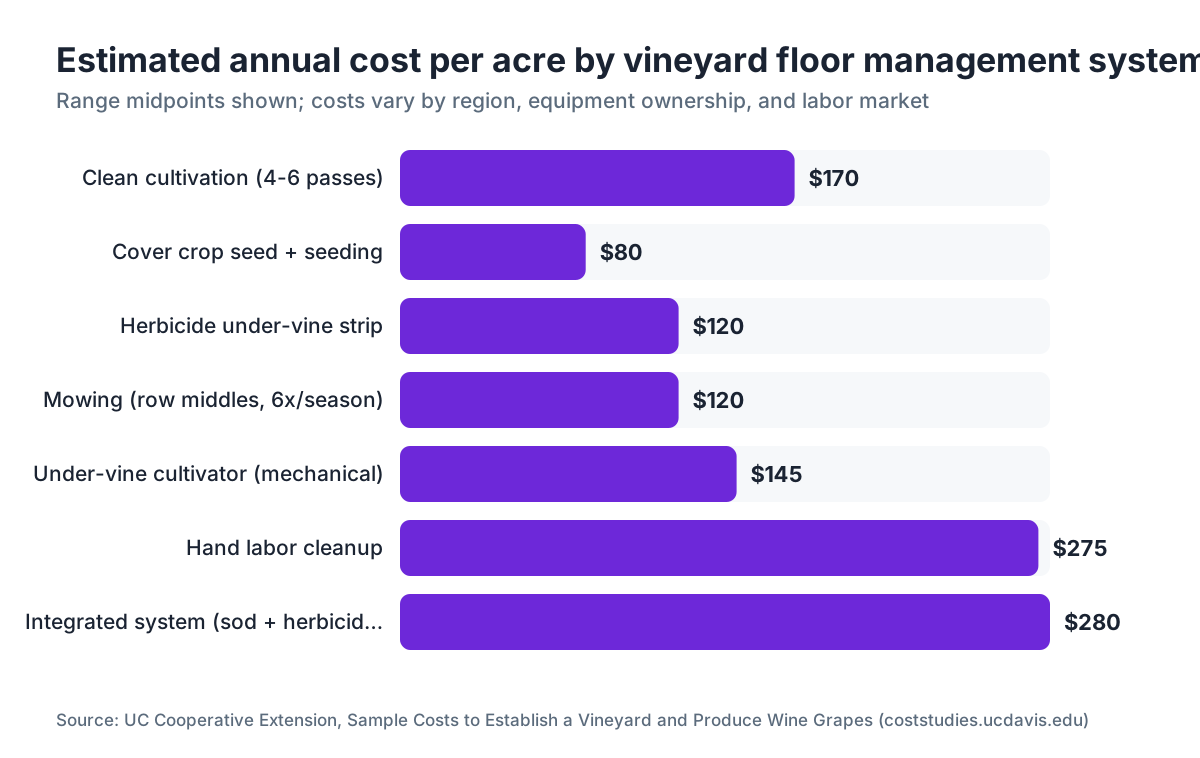
Cost ranges widely by system, region, and whether you own or hire equipment. The table below reflects published extension estimates from California and the Pacific Northwest [2][4].
| System | Approx. annual cost per acre | Notes |
|---|---|---|
| Clean cultivation, 4-6 passes | $100 to $240 | Fuel, labor, equipment depreciation |
| Cover crop seed + seeding | $40 to $120 | Annual reseeding; perennials cost less after yr 1 |
| Herbicide under-vine strip | $60 to $180 | Product + application; 2-3 apps/year |
| Mowing (row middles, 6x/year) | $80 to $160 | Tractor mowing or flail |
| Under-vine cultivator (mechanical) | $90 to $200 | Equipment amortized; slower than spray |
| Hand labor (cleanup) | $150 to $400 | As needed; highly variable |
| Integrated system (sod + herbicide strip) | $180 to $380 | Most common commercial approach |
The integrated system, permanent sod in row middles mowed 4 to 6 times per season plus a pre-emergent herbicide strip under the vine, is the standard in California's North Coast commercial vineyards for good reason. It controls erosion, cuts tillage costs, and keeps under-vine labor manageable. The upfront cost of cover crop establishment (first-year seeding, sometimes irrigation to get it going) runs $80 to $150 per acre but pays back over 3 to 5 years.
One thing that's genuinely a waste of money in most situations: expensive proprietary cover crop blends marketed specifically to vineyards. You're often paying a 40 to 60 percent premium over commodity seed for very similar species. A UC Farm Advisor and a commodity seed supplier can usually get you to the same outcome for less.
What floor management approach works best for organic vineyards?
Organic certification (USDA NOP) prohibits synthetic herbicides and synthetic fertilizers, which changes the under-vine math a lot. Cultivation, cover crops, and permitted natural products are your toolkit.
Under-vine cultivation is the backbone of organic floor management. The mechanical weeders mentioned earlier (torsion weeders, finger weeders) work well in established organic vineyards with good row uniformity. Most organic growers in California's Mendocino and Sonoma counties run under-vine cultivators 3 to 5 times per season to keep weed pressure manageable [11].
Flame weeding with propane torches is permitted under NOP rules and works well for annual broadleaf weeds in early spring. It's weaker on perennial weeds with deep root systems. Equipment runs from simple hand-held torches to tractor-mounted multi-row units ($3,000 to $15,000).
Cover crop nitrogen carries more weight in organic systems because synthetic nitrogen fertilizers are off the table. A well-managed legume cover crop can supply 50 to 100 pounds of nitrogen per acre per year when incorporated at or before bloom, depending on biomass [5]. That's meaningful, though the release timing doesn't always match vine uptake windows perfectly.
The honest reality: organic under-vine weed management costs more labor than conventional herbicide programs. Most published estimates put the premium at $150 to $300 per acre per year for weed management alone. That cost is part of why organic certification premiums matter. They're not arbitrary.
How do you transition from clean cultivation to a cover crop system?
Most vineyards moving from tillage to cover crops make the change gradually, partly because the soil needs time to rebuild biological activity and partly because weed seed banks can explode if you stop tilling before a cover crop is established.
Year one: seed row middles in October or November with a fast-establishing annual (cereal rye or oats) while continuing to manage under-vine strips with herbicide or cultivation as before. Don't try to change everything at once.
Year two: evaluate what volunteered in the annual cover crop row. If the stand was good, consider overseeding a perennial component (hard fescue or creeping red fescue) into the standing annual in early spring. The perennial establishes slowly under the annual canopy.
Year three and beyond: the perennial sod should be established enough to mow. You can cut seeding costs down to touch-up overseeding every few years.
The biggest mistake in transition is seeding too late in the fall and getting poor germination, leaving bare soil over winter on slopes. If your seeding window closes (soil temps drop below 40°F and rain is coming), you're better off waiting until early spring with a fast-growing annual than forcing a fall seeding.
WSU Extension has a practical transition guide for the Pacific Northwest that covers soil preparation, species selection, and cost-share programs available through NRCS [4].
What record-keeping do you need for vineyard floor management?
Record-keeping requirements vary by operation type and state, but several categories are nearly universal.
Pesticide application records are required for any commercial agricultural operation applying EPA-registered pesticides. Records must include the date, product name and EPA registration number, application rate, location, applicator name and license number, and for restricted-use pesticides, added detail about equipment calibration [9][10]. California requires PUR submission to the county ag commissioner; penalties for non-compliance start at $500 per violation and scale up quickly.
Worker training records under WPS must document that each worker and handler received annual training, including the date, trainer, and materials used. Records must be kept for two years [9].
For operations receiving USDA EQIP (Environmental Quality Incentives Program) cost-share payments for cover cropping or conservation tillage, NRCS will require documentation of practices implemented, including seeding dates, species, and rates [7].
For organic certification, your certifier requires that you document every input used in the vineyard, including cover crop seed treatments (some seed is treated with synthetic fungicides and isn't NOP-compliant), irrigation water sources, and any amendments applied.
Keeping all of this in one place matters more than it sounds. A notebook works fine until an inspector shows up and you can't find the February spray record for a block you haven't sprayed since. Tools like VitiScribe centralize spray logs, REI tracking, and worker records so you're not assembling a paper trail under time pressure during an audit. Whatever system you use, the goal is that any record is findable in under three minutes.
Frequently asked questions
Should I use herbicides or mechanical cultivation under the vines?
Most commercial vineyards use herbicides for the under-vine strip because they're faster and cheaper at scale. Mechanical under-vine cultivators work well in established vineyards with consistent row geometry. Organic operations don't have the herbicide option and rely on cultivation. The cost difference is roughly $60 to $120 per acre per season favoring herbicides over mechanical passes, not counting equipment capital.
How often should I mow cover crops in a vineyard?
Typical mowing frequency is 4 to 6 times per season in row middles. Timing matters more than the count: mow before cover crops get tall enough to compete for water (pre-bud swell in dry climates), again after bloom to cut humidity and Botrytis risk, and as needed through harvest. In wet climates, you'll mow more often just to keep equipment access clean.
What cover crops fix nitrogen in vineyards?
Legumes are the nitrogen fixers: crimson clover, hairy vetch, bell beans (fava beans), and field peas are the most common in vineyards. UC Davis Cooperative Extension estimates legume cover crops can fix 50 to 150 pounds of nitrogen per acre per year when properly inoculated and incorporated at bloom. Actual nitrogen availability to vines depends on incorporation timing and soil moisture.
Can a cover crop hurt my vines by competing for water?
Yes, in dry or irrigated climates with low rainfall. Washington State University found living cover crops through June could reduce vine water availability by the equivalent of 2 to 4 inches of irrigation in dry years. Terminating cover crops by bud swell largely eliminates the problem. In high-rainfall or vigorous sites, the competition can be a feature, not a bug, helping moderate vine vigor.
What does the EPA Worker Protection Standard require for vineyard spray operations?
The WPS (40 CFR Part 170) requires annual safety training for all agricultural workers and handlers, access to pesticide application information including REIs and safety data sheets, and decontamination supplies in the field. Restricted-entry intervals must be posted or communicated before workers enter treated areas. Records of training must be kept for two years. The 2015 revised rule applies to all agricultural establishments using EPA-registered pesticides.
How do I control weeds in a vineyard without herbicides?
Organic options include mechanical cultivation (under-vine cultivators), flame weeding, steam weeding, and mulching with wood chips or compost. Dense cover crops in row middles outcompete many annual weeds. Hand labor handles escapes. Organic weed management realistically costs $150 to $300 more per acre per year than herbicide-based programs, which is why organic price premiums matter economically.
What cover crop should I plant on a steep vineyard slope?
Cereal rye is the gold standard for erosion control on slopes: it germinates at near-freezing temperatures, establishes fast, and gives dense ground cover by winter. Oats and barley work similarly. For permanent slopes, hard fescue or creeping red fescue provide year-round cover with low water demand. NRCS estimates properly managed cover crops can cut erosion by over 90 percent on sloped vineyard rows.
How do I know if my vineyard has a compaction problem from floor management?
The simplest field test is a penetrometer (soil compaction meter). Bulk density readings above 1.6 g/cm3 or penetration resistance above 300 psi typically indicate compaction restricting root growth. Signs in the field include water ponding in row middles after rain, shallow vine roots visible when you dig, and vine rows showing uneven vigor with no obvious nutritional cause. Cornell viticulture research found a single pass on wet clay loam can raise bulk density 8 to 12 percent.
Does cover cropping qualify for USDA cost-share programs?
Yes. USDA NRCS's Environmental Quality Incentives Program (EQIP) has specific practice standards for cover cropping (Practice Code 340) and prescribed grazing, both applicable to vineyards. Payment rates vary by state and practice specification. Applications open annually through local NRCS offices. Conservation stewardship program (CSP) payments may also apply for organic transition. Contact your local NRCS office for current payment schedules.
What are the pesticide record-keeping requirements for vineyard herbicide applications in California?
California requires all pesticide applications on agricultural land to be recorded and a Pesticide Use Report submitted to the county agricultural commissioner within 30 days of application. Records must include product name, EPA registration number, rate, acres treated, applicator license number, and date. Restricted-use pesticide purchases require a permit. Penalties for non-compliance start at $500 per violation. The California Department of Pesticide Regulation administers the program.
How far in advance should I seed a cover crop before winter rains?
Seed 2 to 4 weeks before your average first significant rainfall, when soil temperatures are still above 45°F. For most of California's wine regions that means early to mid-October. For the Pacific Northwest, mid-September to early October. Seeding too late risks poor germination and bare soil through the high-erosion winter period. If you miss the window, fast-germinating winter barley can still establish in November with irrigation to get it started.
Is it worth buying expensive vineyard-specific cover crop blends?
Usually no. Many proprietary vineyard cover crop blends cost 40 to 60 percent more than equivalent commodity seed mixes. The core species (cereal rye, crimson clover, hairy vetch, fescue) are widely available through farm supply co-ops and commodity seed dealers. Work with a UC Farm Advisor or WSU extension specialist to design a mix from commodity components that matches your goals. Save the premium for certified organic seed if your certification requires it.
Can I use sheep or other livestock to manage vineyard floor vegetation?
Yes, and it's becoming more common in Sonoma, Napa, and Willamette Valley. Sheep graze cover crops and resident vegetation through winter and early spring, then leave before bud swell. The upside is reduced mowing cost and organic fertility input. Risks include vine damage if sheep access the rows too late, compaction on wet soils from animal hooves, and fencing and water infrastructure costs. It takes management coordination with a livestock operator or your own flock.
Sources
- UC Agriculture and Natural Resources, Cover Crops in Vineyards: Legume cover crops reduced soil erosion by over 90 percent compared to clean cultivation on sloped Napa Valley vineyards; permanent sod in row middles improved fruit color and concentration by reducing vine vigor on coastal California sites.
- UC Cooperative Extension, Sample Costs to Establish a Vineyard and Produce Wine Grapes: Tillage passes estimated at $25 to $60 per acre per pass; hand weeding at $150 to $400 per acre; integrated floor management system annual cost range.
- Cornell University Viticulture and Enology, Vineyard Floor Management: Permanent sod recommended in alternate rows in regions with less than 25 inches of annual rainfall; a single spray rig pass on wet clay loam at 12 percent soil moisture increases bulk density 8 to 12 percent in the 0 to 6 inch zone.
- Washington State University Extension, Cover Crops and Vineyard Floor Management in the Pacific Northwest: Living cover crops through June can reduce vine water availability equivalent to 2 to 4 inches of irrigation in a dry year in the Columbia Valley; terminating by bud swell largely eliminates competition effect.
- UC Davis Cooperative Extension, Nitrogen Fixation by Legume Cover Crops: Legume cover crops properly inoculated and incorporated at bloom can fix 50 to 150 pounds of nitrogen per acre per year; inoculation with the appropriate Rhizobium strain is recommended when legumes have not been grown previously.
- California Department of Pesticide Regulation, Pesticide Use Reporting: All pesticide applications on California agricultural land must be reported to the county agricultural commissioner within 30 days; penalties for non-compliance start at $500 per violation; label compliance is legally required.
- UC Cooperative Extension, Biological Control of Grape Leafhopper: Vineyards bordered by French prune trees or containing flowering cover crops had Anagrus epos populations high enough to suppress grape leafhopper below economic thresholds in some years.
- EPA Worker Protection Standard, 40 CFR Part 170: WPS requires annual safety training for all agricultural workers and handlers, access to pesticide application information, restricted-entry interval compliance, and retention of training records for two years; revised 2015.
- EPA Federal Insecticide, Fungicide, and Rodenticide Act (FIFRA) Overview: FIFRA makes it illegal to use a pesticide in a manner inconsistent with its label, including buffer distances, application timing, and specified PPE; the label is legally binding.
- UCCE Mendocino and Sonoma Counties, Organic Vineyard Floor Management: Most organic growers in California's Mendocino and Sonoma counties run under-vine cultivators 3 to 5 times per season; organic weed management premium estimated at $150 to $300 per acre per year over conventional herbicide programs.
Last updated 2026-07-09