Vineyard management practices: the complete field guide
TL;DR
- Vineyard management covers pruning, canopy work, irrigation, pest and disease control, soil health, spray record-keeping, and worker safety compliance.
- The right mix of these decisions sets your fruit quality and your legal standing with regulators.
- This guide walks through each practice with real numbers, extension-backed thresholds, and the paperwork you actually have to keep on file.
What does vineyard management actually include?
Ask three vineyard managers what their job is and you'll get three answers, all correct. Here's the short version. You're managing a perennial woody crop through its full annual cycle, and your decisions compound year over year. A choice you make pruning in February shapes the canopy you'll fight with in July.
The major practice areas are pruning and training, canopy management, irrigation, soil and nutrition, integrated pest and disease management (IPM), spray applications and record-keeping, and worker safety compliance. Each one feeds the next. Over-irrigate in July and you drive vegetative growth that wrecks your canopy architecture. Neglect your spray records and you're out of compliance with your state ag department no matter how good the wine turns out.
On small and mid-size operations, one or two people cover all of it. That's normal and it works. But it means you have to know enough about each practice to catch a problem before it costs you real money or a crop. This guide goes through each area with specific numbers, not generalities, because generalities don't help you make a call at the end of a row with the sun going down.
If you want to see how field operations connect to what a finished winery looks like from the visitor side, the vineyard overview reads well alongside this.
How should you prune grapevines, and how much wood should you leave?
Pruning is the single highest-leverage decision you make all year. It sets crop load, canopy size, and vine balance before a bud breaks. Get it wrong and you spend the rest of the season compensating.
The two main training systems are cane pruning and spur pruning. Cane pruning (used heavily with Pinot Noir, Riesling, and similar varieties) keeps one-year-old wood as fruiting canes, usually 8 to 16 nodes per cane, with two canes per vine being common. Spur pruning (Cabernet, Syrah, Zinfandel) keeps short two-bud spurs on a permanent cordon. Match the system to the variety's fruitfulness at the basal nodes: varieties with poor basal fruitfulness need cane pruning to push fruiting wood further out [1].
Bud load is where it gets quantitative. A common starting framework is the Ravaz Index, the ratio of fruit weight to pruning weight. UC extension guidance points to a Ravaz Index between 5 and 10 for balanced vines, with values above 10 suggesting overcropping and below 5 suggesting the vine is carrying too much vegetative growth for its fruit [1]. You weigh fruit at harvest and dormant pruning brush at pruning. If your index runs out of range season after season, you change bud numbers.
A rough rule of thumb holds reasonably well across varieties: leave 20 to 40 buds per vine on cane-pruned systems, depending on vine size and target yield. For spur-pruned systems, it's 2 buds per spur times the number of spurs. Washington State University extension puts typical spur counts at 10 to 20 spurs per vine for most Vitis vinifera varieties on a bilateral cordon [2].
Time your pruning around frost risk. Late pruning delays budbreak and can cut frost damage on high-risk sites. Some growers hold off until woolly bud stage where spring frost is a regular threat. The tradeoff is labor compression against everything else happening in spring.
What is canopy management and why does it affect wine quality?
Canopy management is everything you do between budbreak and harvest to control the shape, density, and microclimate of the leaf wall. Shoot positioning, leaf removal, hedging, shoot thinning. Done well, it keeps fruit in the right light and airflow. Done poorly, you get shaded, humid fruit that breeds disease and makes green, harsh wine.
The science here is settled. Shaded fruit clusters have higher malic acid, lower sugars, lower anthocyanins, and higher methoxypyrazines (the green-pepper compound) than clusters in dappled or direct light [3]. The gap is measurable and it carries through to the glass.
Leaf removal around the fruit zone is the highest-return canopy practice for most operations. Pulling three to five leaves on the morning sun side of the cluster zone at or shortly after fruit set improves air circulation, cuts botrytis pressure, and evens out ripening. Cornell's viticulture program found that early leaf removal (at 3 to 5 mm berry size) reduced Botrytis bunch rot more than late removal, and carried lower sunburn risk than pulling leaves at veraison [3].
Shoot positioning, whether by hand-tucking or movable catch wires, matters most on high-vigor sites. A vertical shoot positioning (VSP) system only works if you actually position the shoots. Untucked VSP is a trellis holding a mess.
Hedging, mechanically cutting shoot tips, is labor-efficient but blunt. Lateral growth speeds up after you hedge, so you're often better off hedging earlier and accepting a second pass than waiting too long and setting off a flush of dense lateral growth right before harvest.
How much water do grapevines need, and what is regulated deficit irrigation?
Grapevines in humid eastern US climates often need no supplemental water at all. In California, Arizona, and Washington, irrigation is the difference between a crop and a dead vineyard. Even in wet regions, drip is showing up more to manage vine stress and disease pressure.
The baseline figure is evapotranspiration (ET). The California Department of Water Resources publishes daily ET data by region through the CIMIS network [4]. Your actual vine water use is ET times a crop coefficient (Kc) that shifts by growth stage. Typical Kc values for grapevines run from about 0.15 at dormancy to 0.70 at peak summer canopy [4].
Regulated Deficit Irrigation (RDI) means withholding water on purpose to hold mild stress at specific growth stages, most often from fruit set to veraison. Mild stress slows berry growth and raises the skin-to-pulp ratio, which concentrates phenolics. UC Cooperative Extension work has documented 15 to 25 percent reductions in applied water with comparable or better berry quality in many California trials [4].
You measure plant water stress with a pressure chamber (the pressure bomb), not by guessing from soil sensors alone. Midday stem water potential is the reference measurement. Leaf water potential is faster to collect but noisier. Most RDI protocols target stem water potential of about -1.0 to -1.4 MPa between fruit set and veraison, then rehydrate slightly at veraison.
Drip management means walking the lines and checking emitters every week during irrigation season. A clogged emitter in a dry climate can kill the vine in its zone inside a few weeks of a bad summer. That's not an exaggeration.
What soil and nutrition management do vines actually need?
Grapevines aren't heavy feeders compared to annual crops, but they need the basics right: enough nitrogen without excess, enough potassium and magnesium without imbalance, and a pH that keeps micronutrients available. Soil pH of 6.0 to 6.5 is the sweet spot for Vitis vinifera. Below 5.5, manganese and aluminum toxicity turn into real problems. Above 7.5, iron and zinc deficiencies show up.
Petiole analysis at bloom is the most reliable read on what's going into the vine. Soil testing tells you what's in the ground. Petiole testing tells you what the vine is taking up. WSU Extension recommends sampling the petiole (leaf stem) opposite the cluster at 50 percent bloom for the most consistent reference values [2]. Most labs return results in a week to ten days.
Nitrogen is where small operations go wrong most often, usually by applying too much. Excess nitrogen drives vegetative growth, thickens the canopy, dulls fruit color, and raises Botrytis risk. Cornell's viticulture team notes that most established Vitis vinifera vineyards in the Northeast need 20 to 40 lbs of actual nitrogen per acre per year at most, and some need none if cover crops are fixing it [3].
Cover crops are the most underrated soil tool you have. A well-chosen mix (cereal rye, legumes, or native grasses depending on rainfall) builds organic matter, holds soil on slopes, manages vine vigor through competition, and feeds beneficial insects. The tradeoff in dry years is water competition, so you mow or roll the cover early and let it dry down. This is site-specific work, not a blanket recommendation.
How do you build an integrated pest management program for a vineyard?
IPM is a decision framework, not a philosophy. You monitor, set thresholds, and act only when the economic or quality damage from a pest beats the cost of control. That cuts spray inputs, slows resistance, and keeps beneficial insect populations intact.
The major pests vary by region. In the eastern US, grape berry moth (Paralobesia viteana) is the primary insect pest. Mites (spider mites, grape rust mite) are the main concern out west. Phylloxera, the root-feeding aphid-like insect that wrecked European vineyards in the 19th century, is managed through rootstock selection, not chemistry. You can't spray your way out of a phylloxera infestation.
For grape berry moth, Cornell's Network for Environment and Weather Applications (NEWA) runs a degree-day model that predicts adult flight and egg hatch off biofix (first sustained catch in a pheromone trap) [3]. The spray threshold is typically 2 to 3 moths per trap per week sustained over several days, though that shifts with vineyard history and how much damage you'll tolerate.
Disease management eats most of the spray budget. Powdery mildew (Erysiphe necator) and downy mildew (Plasmopara viticola) are the big two. Both are weather-driven, so you want temperature and moisture data, not a calendar. The UC Davis Powdery Mildew Risk Index is a real, free tool that combines temperature and wetness periods to predict infection risk [1]. Plenty of spray programs in California and the Pacific Northwest run against this index instead of a fixed calendar.
Botrytis bunch rot (Botrytis cinerea) is managed mostly through canopy work (air circulation) and by timing fungicides at the highest-risk windows: bloom and the start of berry touch. Post-veraison botryticide sprays are usually low-return unless you're growing a tight-clustered variety like Pinot Noir in a wet year.
Document every scouting observation with a date, a location in the block, and a count or rating. That data is what tells you whether the program is working and what to change. Tools like VitiScribe can structure the record-keeping so you're not hunting through notebooks when a state inspector shows up.
What spray records do you have to keep, and for how long?
Spray records are a legal requirement in every US state that runs a commercial pesticide application program, which is all of them. The EPA Worker Protection Standard (WPS) requires pesticide application records to be available to workers and their designated representatives, and kept for at least two years [5]. Many states require longer, and some (California, Oregon, Washington) layer on state pesticide use reporting with their own forms and deadlines.
California is the most demanding. Growers using restricted materials report applications to their county agricultural commissioner within 30 days of the end of the month in which the application occurred, and records must be kept for at least two years [6]. The California Department of Pesticide Regulation (CDPR) requires specific data fields: operator name, site location, pest to be controlled, product name and EPA registration number, application rate, total amount applied, date and time, application method, and target crop [6].
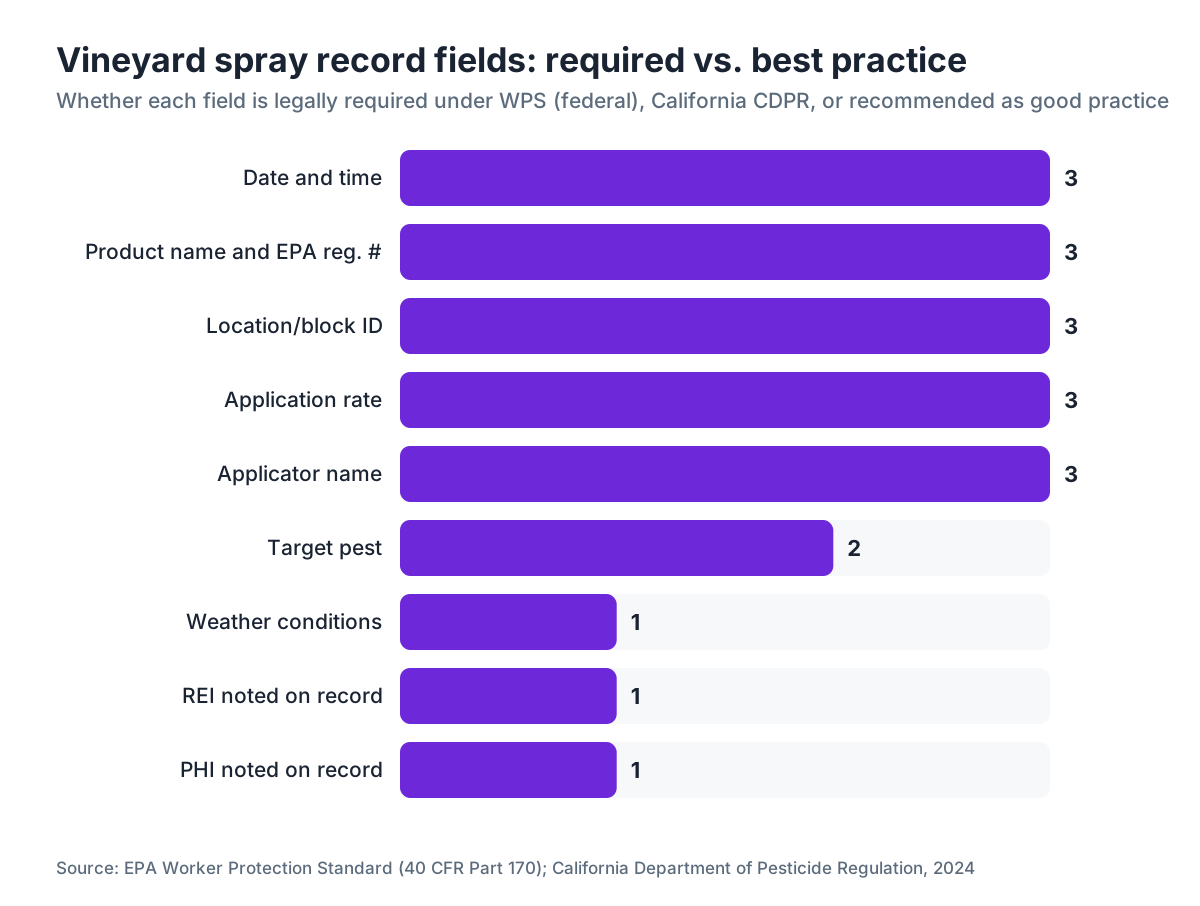
At minimum, every spray record should capture the date and time, the field or block ID, the pesticide product name and EPA registration number, the application rate and total quantity, the REI (re-entry interval), the PHI (pre-harvest interval), the applicator name, and weather at time of application (wind speed, direction, temperature). Those fields cover WPS and most state minimums at once.
Pre-harvest intervals (PHIs) are the most time-sensitive compliance issue you have. Apply a product with a 14-day PHI and harvest 10 days later, and you have a violation whether or not a residue test would find anything. PHIs live on the label. The label is a federal legal document. As the EPA puts it, "the label is the law" [5].
| Record Field | WPS Required | CA Required | Good Practice |
|---|---|---|---|
| Date and time | Yes | Yes | Yes |
| Product name and EPA reg. # | Yes | Yes | Yes |
| Location/block ID | Yes | Yes | Yes |
| Application rate | Yes | Yes | Yes |
| REI | Yes | No (on label) | Yes |
| PHI | No | No (on label) | Yes |
| Weather conditions | No | No | Yes |
| Applicator name | Yes | Yes | Yes |
| Target pest | No | Yes | Yes |
What does the EPA Worker Protection Standard require in a vineyard?
The EPA Worker Protection Standard (WPS), codified at 40 CFR Part 170, covers agricultural workers and pesticide handlers on farms, vineyards included [5]. It was revised substantially in 2015, with the revised rule effective January 2, 2017 [9]. The WPS is not optional, and it applies to any vineyard that employs workers. The immediate family of the owner is exempt from most provisions, but hired labor is not.
The core WPS requirements for vineyards: post application information at a central location, tell workers about applications before they enter treated areas, hold re-entry intervals, provide pesticide safety training, give workers access to application records, supply PPE to handlers, and keep eye-flush water available at all times for handlers [5].
EPA's WPS guidance states that agricultural employers must train workers before they enter a treated area during the restricted-entry interval, or within the first five days of the season, whichever comes first [9].
Training must cover how to recognize pesticide poisoning symptoms, how to get emergency medical help, and the basic safety content in EPA's Worker Protection Standard training materials. Training records must be kept for two years.
The central posting requirement is specific. You need a notice of application posted at the start of each application listing the product name, EPA registration number, active ingredient, location treated, date and time, REI start and end time, and whether the product requires PPE during the REI. The posting stays up until the REI expires.
Plenty of small operations underestimate this paperwork load. A vineyard spraying eight to twelve times a season with multiple products is generating eight to twelve posting and record obligations per event, times however many blocks you treat separately.
How do you manage vineyard labor efficiently through the season?
Vineyards run on brutal labor seasonality. Pruning, suckering, shoot positioning, leaf removal, cluster thinning, and harvest all pack into narrow windows. You can't compress harvest and you can't delay it. So labor planning comes down to how much you can get done before the season compresses, and what you hand off to machines.
Mechanical pruning (pre-pruning with rotary blade hedgers) handles 60 to 80 percent of wood removal on spur-pruned systems, with hand-finishing for cleanup and spur selection. That can cut hand-pruning labor by 40 to 60 percent per acre in WSU Extension trials [2]. The economics track with scale. A mechanical pre-pruner pencils out around 20+ acres. At 5 acres, it's a rental calculation.
Mechanical leaf removal is well-established in California and getting common in Oregon and Washington. On large VSP blocks, a pneumatic or mechanical leafer on the fruit zone runs faster and more consistent than hand work, at lower cost per acre past a certain scale.
Harvest is where labor peaks hardest. Night harvesting (picking at cooler temperatures) is common in hot climates and needs proper lighting and extra safety planning. A mechanical harvester asks for a different crew: equipment operators and a receiving team, not pickers. Mechanical harvest doesn't suit every variety, cluster type, or trellis setup.
Farm labor law compliance (wage and hour, H-2A visa programs, housing rules for housed workers) is a separate and legally dense topic. USDA's agricultural labor pages are a starting point, and most state departments of labor publish ag-worker guidance.
What are the most common mistakes in vineyard management and how do you avoid them?
The most expensive mistake is overcropping young vines. It's tempting to take fruit off a three-year-old vine, but the root system isn't there to carry it. WSU and UC guidance both point to removing all fruit for the first two growing seasons and cropping conservatively in year three [1][2]. Overcropping pushes back the vine reaching full potential by years, not months.
The second most common mistake is misreading canopy density. Growers eyeball the canopy from the end of the row and never look inside. The standard check is the point-quadrat method from Dr. Richard Smart: poke a thin rod into the canopy at random points along the fruit zone. If you're hitting more than two leaf layers before you reach fruit or open space, the canopy is too dense [1]. You want gaps at 20 to 30 percent of your measurement points for real light penetration.
Ignoring soil pH is a slow-motion mistake. Vines tolerate a wide range but perform best in a narrow one. If you haven't run a soil test in the last three years, you don't actually know what's happening under your feet. A test runs $20 to $50 per sample at a commercial lab. It's the cheapest information you can buy.
Over-applying nitrogen is common in newer operations. More fertilizer doesn't mean better vines. It means more vigor, more canopy work, and often worse fruit.
Inconsistent record-keeping creates compliance problems that good farming can't fix. A vineyard with excellent practices and missing spray records is in a worse legal spot than a mediocre operation with complete paperwork. Keep the records as you go. Reconstructing them later is inaccurate and it looks bad in an inspection.
How do vineyard certification programs (organic, CCOF, Lodi Rules) change management?
Organic certification under the USDA National Organic Program (NOP) limits you to approved materials on the National List of Allowed and Prohibited Substances [7]. Copper and sulfur-based fungicides are allowed organically, which covers most of the powdery and downy mildew load. Insecticide options are tighter. Kaolin clay, spinosad (with restrictions), and Bacillus thuringiensis (Bt) are on the allowed list. Glyphosate and most synthetic fungicides are not.
Organic certification requires a three-year transition from the last prohibited substance application to the first certified organic harvest. During transition, you carry the cost of organic practices without the price premium. That's a real financial gap to plan for.
The Lodi Rules for Sustainable Winegrowing is a third-party verified certification out of Lodi, California, built on a scorecard of over 100 practices across six categories including soil and water management, pest management, and human resources [8]. It isn't organic, but it has standards that go past generic sustainable marketing. Other regions run analogous programs: LIVE certification in Oregon, and the California Sustainable Winegrowing Alliance (CSWA) statewide.
For operations in southern California, Ponte Winery and South Coast Winery are larger Temecula operations that work regional sustainability programs alongside standard production. The Paso Robles AVA, home to many operations you can explore through Paso Robles wineries, has shifted hard toward water-efficient and dry-farming approaches given groundwater pressure in that basin.
Certification always comes with paperwork. Organic requires an Organic System Plan (OSP), annual updates, and inspection records. Budget 10 to 20 hours a year for certification administration at a minimum, more in the first two years.
How do you use technology and data to improve vineyard decisions?
Remote sensing, soil sensors, weather stations, and farm management software have moved from novelty to practical tools for operations of almost any size. The real question is which of these return value at your scale.
Weather stations are the highest-return investment for most vineyards. A $500 to $1,500 on-site station feeding a disease model (powdery mildew, downy mildew, Botrytis) can pay for itself in one season of avoided sprays or one infection caught before it spreads. The UC IPM online tools and Cornell's NEWA both accept data from common station formats [1][3].
Soil moisture sensors (capacitance probes, neutron probes, or tensiometers) earn their keep most in irrigated western vineyards. They tell you what's happening in the root zone instead of making you infer it from ET math. A basic two-sensor setup (one in the active root zone at 12 inches, one deeper at 24 to 30 inches) runs $300 to $800 per site depending on the technology.
Field record-keeping software, VitiScribe included, puts spray events, scouting observations, and irrigation logs in one place instead of scattered across notebooks and spreadsheets. The value isn't only tidiness. It's that you can look across seasons and blocks and see patterns a single spray record can't show you.
Drone and satellite NDVI (normalized difference vegetation index) imagery gives you a whole-vineyard vigor map in one pass. On large, variable blocks, that lets you target management: extra water in a dry spot, more leaf removal in a high-vigor zone. Consumer drones with multispectral sensors run $3,000 to $8,000, and subscription satellite services deliver imagery at 3 to 5 meter resolution for less. The honest caveat: knowing where the variation is doesn't tell you why it's there or what to do about it.
Frequently asked questions
How many times should you spray a vineyard per season?
It depends on disease pressure, climate, and the diseases you're managing. In a wet year in a humid eastern climate, 10 to 14 fungicide applications for powdery and downy mildew control is common. In a dry California summer, 6 to 8 may cover it. Spray timing based on disease models like the UC Davis Powdery Mildew Risk Index reduces unnecessary applications compared to a fixed calendar interval.
What is the Ravaz Index and what is a good number?
The Ravaz Index is the ratio of fruit yield to dormant pruning weight for the same vine, used to assess vine balance. UC extension guidance points to a target of 5 to 10. Below 5 suggests the vine carries more vegetative growth than its fruit justifies. Above 10 suggests overcropping, which depletes vine reserves and usually drops fruit quality over time.
What records are legally required for vineyard pesticide applications?
The EPA Worker Protection Standard requires application records kept for at least two years and made available to workers and their representatives. Required fields include product name, EPA registration number, location treated, date and time, and applicator name. California growers using restricted materials must also submit pesticide use reports to their county agricultural commissioner and retain records for at least two years.
What is regulated deficit irrigation and does it improve wine quality?
Regulated deficit irrigation (RDI) is controlled water stress applied from fruit set to veraison. The goal is to slow berry growth, raise the skin-to-pulp ratio, and concentrate phenolics. UC Cooperative Extension work has documented 15 to 25 percent reductions in applied water with comparable or better berry quality in California trials. You monitor vine water status with a pressure chamber, targeting stem water potential around -1.0 to -1.4 MPa.
When should you do leaf removal in the vineyard?
Early leaf removal, at 3 to 5 mm berry size shortly after fruit set, beats later removal on multiple metrics. Cornell University research found early removal reduced Botrytis bunch rot more than post-veraison removal and carried lower sunburn risk. The standard practice is pulling three to five leaves on the morning sun side of the cluster zone. Later removal on the afternoon side can add sun exposure.
How do you know if a vineyard's canopy is too dense?
Use the point-quadrat method: push a thin rod into the canopy at random points along the fruit zone and count how many leaf layers you pass before hitting fruit or open space. More than two leaf layers at most points means the canopy is too dense. You want open gaps at roughly 20 to 30 percent of measurement points for adequate light into the cluster zone.
What cover crops work best in a vineyard?
It depends on your goals and rainfall. Cereal rye and annual ryegrass work for erosion control and biomass on slopes. Legume mixes (vetch, clover) fix nitrogen, useful if petiole tests show a deficiency but risky in high-rainfall sites where they drive vigor. Native grass mixes feed beneficial insects. In dry climates, any resident vegetation needs careful management so it doesn't compete with vines for water during dry months.
What is the EPA re-entry interval and how does it work?
The re-entry interval (REI) is the minimum time workers must stay out of a treated area after an application. REIs are set by the EPA and printed on the product label. Common REIs run from 4 hours (many fungicides) to 48 hours or longer for more hazardous materials. Workers who must enter during the REI for specific tasks wear PPE as the label specifies. The REI applies whether or not any residue is visible.
How long does it take a vineyard to reach full production?
Vitis vinifera vineyards typically reach full production in year 5 to 7 from planting, depending on variety, rootstock, climate, and management. Most viticulture programs recommend removing all fruit the first two years and cropping conservatively in year three. A vineyard planted in year zero should not be expected to produce commercially useful quantities before year four and may not hit target yields until year six or beyond.
What soil pH do grapevines prefer?
Most Vitis vinifera varieties perform best at a soil pH of 6.0 to 6.5. Below 5.5, manganese and aluminum toxicity become significant concerns. Above 7.5, iron chlorosis and zinc deficiency are common. Native American species and many hybrid varieties tolerate lower pH better than vinifera. A soil test every two to three years is the only reliable way to track pH and plan lime or sulfur applications.
Is mechanical harvesting better than hand harvesting?
It depends on what you're optimizing for. Mechanical harvest is faster and cheaper per ton at scale, and night-harvesting machines deliver fruit cooler than a hand crew working mid-morning. The downsides are cluster damage (more juice oxidation in transport), no selective picking, and incompatibility with some trellis systems and varieties. Most premium operations in cold climates and all sparkling wine programs still hand-harvest.
What's the cheapest high-value improvement you can make in a poorly managed vineyard?
A soil test and a petiole test together cost under $100 and will almost certainly surface a fixable deficiency or imbalance that's been quietly costing yield or quality for years. After that, consistent shoot positioning to open the canopy costs only labor and usually improves fruit quality and disease pressure inside the same season. New equipment gets all the attention, but basic diagnostics and canopy work return more per dollar.
What pesticide training do vineyard workers legally need?
Under the EPA Worker Protection Standard (40 CFR Part 170), all agricultural workers must receive pesticide safety training before entering a treated area during an REI, or within the first five days of the season, whichever comes first. Training must cover how to recognize poisoning symptoms, how to get emergency help, and basic safety information. Training records must be kept for two years. Pesticide handlers need additional, more detailed training.
How do organic vineyard certification programs affect spray programs?
USDA National Organic Program certification limits you to approved materials on the National List. For fungicides, copper and sulfur are approved and cover most powdery and downy mildew needs. Synthetic fungicides like DMIs and QoIs are not allowed. Insecticide options narrow: spinosad has restrictions, kaolin clay is allowed, and Bt is approved. There is a mandatory three-year transition from the last prohibited application before you can label fruit as certified organic.
Sources
- University of California Agriculture and Natural Resources, Integrated Viticulture and UC IPM: Ravaz Index target of 5 to 10 for balanced vines; cane vs. spur pruning by basal fruitfulness; UC Davis Powdery Mildew Risk Index; point-quadrat canopy method; young-vine cropping guidance
- Washington State University Extension, Viticulture and Enology program: Typical spur counts of 10 to 20 per vine on bilateral cordon; petiole sampling at 50 percent bloom; mechanical pre-pruning labor savings of 40 to 60 percent per acre
- Cornell University NEWA (Network for Environment and Weather Applications) and Cornell Viticulture Program: Early leaf removal more effective than late removal for Botrytis reduction; established nitrogen rates of 20 to 40 lbs per acre; grape berry moth degree-day model and trap thresholds
- California Department of Water Resources CIMIS (California Irrigation Management Information System): Daily evapotranspiration data by region; crop coefficient (Kc) values for grapevines ranging 0.15 at dormancy to 0.70 at peak canopy; 15 to 25 percent water reduction with RDI documented by UC Cooperative Extension
- EPA Worker Protection Standard, 40 CFR Part 170: WPS requires two-year record retention, central posting of application information, pesticide safety training before REI entry, and mandatory eye-flush water for handlers; 'the label is the law' principle
- California Department of Pesticide Regulation, Pesticide Use Reporting: California growers must report restricted material applications to county ag commissioner; records retained at least two years; specific required data fields for pesticide use reports
- USDA National Organic Program, National List of Allowed and Prohibited Substances: Copper and sulfur-based fungicides allowed under NOP; three-year transition period required from last prohibited substance application; glyphosate and synthetic fungicides prohibited
- Lodi Winegrape Commission, Lodi Rules for Sustainable Winegrowing: Lodi Rules is a third-party verified sustainability certification based on a scorecard covering over 100 practices across six categories including soil, water, and pest management
- EPA, Agricultural Worker Protection Standard revised rule (effective January 2, 2017): WPS revised substantially in 2015, effective January 2, 2017; requirement to train workers before first entry into treated areas during REI or within five days of season start
- USDA Agricultural Research Service, Grape Production and Research: Phylloxera managed primarily through rootstock selection rather than chemical control; Vitis vinifera reaches full production in years 5 to 7 from planting under good management
Last updated 2026-07-09