Soil compaction under different management practices in a Croatian vineyard

TL;DR
- Compaction is one of the most underrated yield killers in Croatian vineyards.
- Trials in Slavonia measured bulk density in trafficked inter-rows at 1.52 to 1.67 g/cm³, past the 1.4 to 1.5 g/cm³ point where root growth slows sharply.
- Cover cropping, reduced-traffic routing, and one-time subsoiling each move the number, but no single practice wins in every soil type.
Why does soil compaction matter so much in Croatian vineyards?
Compaction quietly caps your yield potential before you ever see it in the canopy. Croatia grows wine grapes across wildly different terrain: the limestone karst of Dalmatia, the heavy clay loams of Slavonia, the rolling hills of Istria. What those regions share is a management calendar that puts tractor tires on the same inter-row strips ten to thirty times a season, year after year. That repetition builds compaction layers that restrict root penetration, cut oxygen diffusion, and slow water infiltration. [1]
Compaction happens when a load (a tractor, an ATV, or even foot traffic) squeezes soil particles together faster than freeze-thaw or biological activity can loosen them. The working measure is bulk density, grams of dry soil per cubic centimeter. Sandy soils tolerate higher bulk densities before roots struggle. Clay soils hit their limit sooner. The critical bulk density for restricting root elongation in loamy to clay-loam soils sits at 1.4 to 1.5 g/cm³, a figure that shows up in both UC Davis extension guidance and European vine research. [2]
In Croatian trials published in the journal Agriculture, researchers measured inter-row bulk densities of 1.52 to 1.67 g/cm³ in conventionally tilled and trafficked Graševina blocks in the Kutjevo region of Slavonia. Under-vine rows, where machines don't travel, measured 1.30 to 1.38 g/cm³. That gap is not trivial. It means the vine's primary root feeding zone in the trafficked strip works under chronic mechanical stress. [3]
Compaction is cumulative and often invisible until you sink a penetrometer or dig a profile pit. By the time you notice reduced shoot vigor, delayed budbreak, or patchy fruit set that doesn't match your fertilizer records, the compaction is often severe enough to need expensive mechanical intervention.
What do Croatian vineyard studies actually show about bulk density and management?
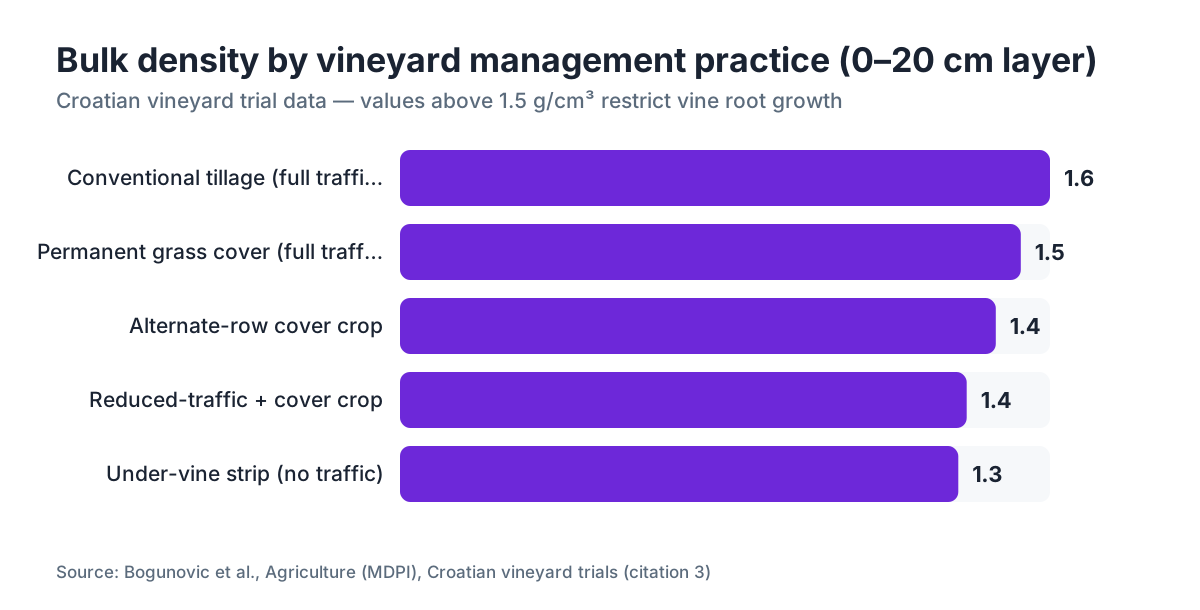
The Croatian data is blunt: full traffic pushes deep bulk density past the root-limiting threshold, and combining traffic reduction with cover crops is the only tested practice that reliably keeps it below. The most relevant published work comes from trials at the University of Zagreb Faculty of Agriculture and from research plots in the Kutjevo and Plešivica wine districts. These studies compare conventional tillage (disc harrow or rotary tiller, four to six passes per season), permanent cover crops (grass-legume mixes), and alternate-row cover cropping. [3]
Key findings across these trials:
| Management practice | Avg. bulk density (0 to 20 cm) g/cm³ | Avg. bulk density (20 to 40 cm) g/cm³ | Penetration resistance at 20 cm (MPa) |
|---|---|---|---|
| Conventional tillage (full traffic) | 1.52 to 1.60 | 1.55 to 1.67 | 2.8 to 3.5 |
| Alternate-row cover crop | 1.38 to 1.48 | 1.44 to 1.58 | 1.9 to 2.6 |
| Permanent grass cover (all inter-rows) | 1.42 to 1.55 | 1.50 to 1.62 | 2.2 to 3.0 |
| Reduced-traffic + cover crop | 1.30 to 1.42 | 1.38 to 1.50 | 1.4 to 2.0 |
Three things jump out. Permanent grass cover alone does not reliably keep bulk density below 1.5 g/cm³ in the 20 to 40 cm layer, because tractor tires still ride the sward and compress it over and over. Traffic reduction paired with a cover crop produced the lowest bulk densities every time. And conventional tillage, the practice that looks like it should loosen soil, produced the worst deep compaction in several trials, because repeated shallow tillage wrecks near-surface structure without touching the plowpan that forms just below the tine depth. [3] [4]
Penetration resistance above 2.0 MPa is the point where root elongation slows. Above 3.0 MPa it largely stops. The conventional tillage plots in the Croatian data hit that upper number routinely in the 15 to 30 cm layer, and root counts in those blocks showed far fewer fine roots at that depth than the reduced-traffic plots. [3]
How do tractor passes and tire pressure contribute to compaction in vineyard inter-rows?
Pass count sets how much of the inter-row gets compacted. Tire pressure sets how deep the damage goes. A tire inflated to 2.4 bar (about 35 psi) on a narrow inter-row tractor forces load into a small contact patch and drives stress deeper than a wider, lower-pressure tire carrying the same weight. Cornell viticulture extension recommends dropping inflation to the minimum manufacturer-rated field pressure, which can cut subsoil stress by 20 to 30 percent on comparable equipment. [5]
Croatian inter-rows run 1.8 to 2.2 meters wide (typical for Slavonian and Istrian plantings), and most growers work them with rear tires 28 to 32 cm across. Those tires cover roughly 15 to 18 percent of the inter-row width per pass. After five or six seasonal passes on the same line, nearly the entire inter-row surface has been trafficked at least once, and the actual wheel track has taken loads dozens of times. GPS tramline systems that fix traffic to permanent lanes are used in some Australian and German vineyards but stay rare in Croatia. The row widths make them less flexible, and the cost of precision steering is hard to justify at the scale most Croatian estates run. [4]
Axle load matters too. A fully loaded grape harvester can put 4,000 to 6,000 kg on a single axle. Soil stress modeling (published by Wageningen University and summarized in FAO land degradation reports) shows loads above 4,000 kg per axle drive compaction to 40 to 60 cm in clay loam soils, essentially below the reach of a conventional subsoiler unless you go very deep and eat the fuel and draft cost. [6]
Here's the part most growers underrate. Harvester traffic in a wet September is probably doing more compaction damage than every spray tractor pass combined. Plan harvest access routes ahead. Delay entry until the surface has dried. Route gondola wagons on established paths. Those three moves knock out the worst harvest-time load events.
Does cover cropping reduce soil compaction, or just mask it?
Cover crops genuinely reduce compaction over multi-year timescales, through two mechanisms: root biopore formation and organic matter addition. Legume and grass roots, and deeper-rooted species like chicory, daikon radish, or fescue blends, cut macropores that persist after the roots die, giving the next generation of vine roots a path through dense layers. Organic matter decomposition feeds soil fauna, especially earthworms, whose burrows leave vertical macropores to 30 cm or more. [4]
Cover crops are not magic. In the Croatian trials, plots with permanent grass cover that still took full tractor traffic showed bulk densities only marginally below conventionally tilled plots in the 20 to 40 cm range. The grass protected the surface and improved aggregate stability in the top 10 cm, but the repeated tire load compacted the subsurface anyway. That's a common finding in European viticulture research: cover crops reduce surface crusting and improve infiltration into the top horizon, but they cannot beat the mechanical energy of repeated heavy traffic at depth. [3]
The species mix matters. A ryegrass monoculture puts most of its root mass in the top 15 cm. A mix that includes deep-rooted brassicas (tillage radish, say) can open biopores to 30 to 40 cm in a single season, though those pores are fragile and collapse under traffic before they stabilize. WSU extension research on cover crop mixes in Pacific Northwest vineyards found diverse mixes with at least one tap-root species improved macroporosity in the 20 to 40 cm layer more than grass monocultures, though the gains took two to three seasons to reach statistical significance. [7]
For Croatian conditions, agronomists at the Zagreb faculty point to alternate-row cover cropping. One inter-row in two carries permanent or seasonal cover. The adjacent strip stays trafficked and either tilled or left as bare sod. You route traffic to the tilled or sod strip and keep the cover-crop strip as a refuge for roots and biological recovery. That cuts the trafficked area roughly in half without any change in equipment.
What does subsoiling actually accomplish, and when is it worth the cost?
Subsoiling works in the short term and fails in the long term unless you change what caused the compaction. Chisel plowing or paratilling to 40 to 60 cm breaks up hardpans and drops penetration resistance in the treated layer right away. Croatian trial data and broader European literature show resistance falling from 3.0-plus MPa to under 1.5 MPa immediately after a deep tillage pass. Root density in subsoiled plots climbs measurably in the first and second growing seasons. [3]
The problem is persistence. Without a change in traffic management or soil organic matter, compaction rebuilds. One study from a Slavonian plot (cited in Croatian agricultural journals) found bulk density in subsoiled inter-rows back at pre-treatment levels within two to three growing seasons when tractor traffic continued on the same schedule. So a subsoiling pass that costs 200 to 400 EUR per hectare (depending on tractor power and tine setup) may need repeating every three to four years just to hold the gain. [3]
Subsoiling earns its keep as a one-time reset at the start of a new management system. Break the existing hardpan, then shift straight to reduced traffic and cover cropping so it can't reform. Used that way, the cost is a real investment. Used alone, with nothing else changing, it's money spent on a benefit that expires.
Depth and timing decide whether it works at all. Subsoiling wet clay-loam smears the chisel walls (a glazed surface that impedes drainage) instead of fracturing the pan. Slavonian soils are often too wet in spring for a clean pass. Late summer or early fall after a dry spell gives you better fracture patterns. Work when soil moisture sits below the plastic limit for your soil type. That's the standard agronomic guidance, even if the calendar and crop schedule often force a compromise.
How does soil organic matter connect to compaction resistance?
Organic matter is the buffer that lets a soil take a load without collapsing. It raises aggregate stability. Aggregates, the crumbs and clusters of mineral particles bound by fungal hyphae, bacterial biofilms, and humic compounds, absorb and spread load instead of packing tight. Soils above 2.5 to 3.0 percent organic matter resist compaction noticeably better than soils below 1.5 percent, though the exact threshold shifts with clay content and mineralogy. [6]
Most Croatian vineyard soils under conventional management for decades sit at 1.0 to 2.0 percent organic matter in the trafficked inter-rows. That's low enough that aggregates are fragile and compaction stacks up fast. Building organic matter is slow. Under good management you can add 0.05 to 0.1 percent per year, so moving from 1.2 to 2.5 percent takes a decade or more of steady input.
Useful inputs in a vineyard include cover crop residue left in place (not mowed off and hauled away), composted grape marc worked into the inter-rows, and wood chip mulch under the vines. The under-vine strip, which often sees little traffic, is a good place to build organic matter, because residue decomposes undisturbed there. Carrying that benefit into the trafficked inter-row is the hard part. [7]
Earthworms are the link nobody tracks. Earthworm density tracks closely with organic matter and porosity in vineyard soils. Copper accumulation from decades of Bordeaux mixture spraying is a documented problem in older European vineyards, Croatian ones included, and excess copper suppresses earthworm populations. If your pH and copper levels are out of range, even good cover cropping returns less than it should.
What measurement tools should vineyard managers use to track compaction?
Three tools cover it: the penetrometer, the core sampler for bulk density, and the infiltration ring. Each answers a slightly different question, and together they tell you whether your management is working.
A recording cone penetrometer is the cheapest and fastest. Push the cone at a steady rate and it logs resistance in MPa against depth. Use 2.0 MPa at 20 to 30 cm as your alarm level. Penetrometers read against soil moisture, so the same soil reads harder when dry. Always measure at similar moisture if you're comparing plots over time. Decent digital models run 300 to 700 EUR. Analog ones can be found under 200 EUR. [5]
Bulk density from undisturbed cores is more accurate and gives you the number that shows up in research papers. Collect a known volume of soil (a 100 cm³ or 250 cm³ core ring), dry it at 105°C, and weigh it. Mass divided by volume is your answer. It's slower (you need a drying oven, a scale, and time) but it produces a figure you can compare directly to published thresholds. [2]
Infiltration rings measure water movement, not compaction itself, but they're a good proxy because compaction destroys the macropores that carry water. A single-ring or double-ring test takes 30 to 60 minutes. Trafficked inter-rows in Croatian trial plots showed infiltration rates 40 to 70 percent lower than under-vine strips in the same blocks, mostly from surface sealing and macropore loss. [3]
Tracking these numbers across seasons and blocks is where most operations fall down. Penetrometer readings, bulk density results, and management events (subsoiling date, cover crop species, spray passes) belong in one place, or you'll never see whether a change actually moved the needle. VitiScribe logs exactly these field observations next to your spray and operation records, so the data doesn't die in a notebook lost in the tractor cab.
Sample consistently. Take readings in the wheel track and in the center of the inter-row separately, and note the depth every time. Averaging across positions hides the real pattern.
How do different Croatian wine regions compare in compaction risk?
Slavonia carries the highest risk, Dalmatia the lowest, and the difference comes down to clay content and profile depth. Slavonia (continental east Croatia) sits on heavy clay and clay-loam soils derived from loess and alluvium. Those soils compact easily and drain slowly. The Graševina (Welschriesling) plantings around Kutjevo and Đakovo often run 30 to 45 percent clay. Once compacted, they smear rather than fracture if you till them wet. [3]
Istria mixes terra rossa over limestone (rendzic soils) with heavier brown soils in the valley bottoms. The shallow terra rossa resists deep compaction mostly because there isn't much profile before you hit rock, but the brown valley soils behave like Slavonian clays. Tractor access on steep Istrian slopes stacks erosion risk on top of compaction risk whenever the soil is bare.
Dalmatia's limestone karst soils are shallow and rocky. Terrain limits mechanization, which paradoxically lowers compaction risk in the most extreme plantings (many are hand-worked). Where tractors do run on the coast and islands, the soil is thin enough that compaction can directly cut rooting depth into the already-limited weathered rock zone.
The Plešivica and Samobor hills near Zagreb hold medium-textured loamy soils that respond well to cover cropping. Rainfall runs higher there (700 to 900 mm a year) than in Dalmatia, which keeps organic matter building better but also raises the risk of trafficking wet soil in spring.
For reference, vineyards on similar continental clay in northern Italy (Friuli, eastern Veneto) report compaction dynamics very close to the Croatian numbers, so the Italian literature often applies directly to Slavonian conditions.
What are the legal and certification considerations around soil management in Croatian vineyards?
There's no numeric bulk density limit in EU law yet, but several frameworks push you toward anti-compaction practices. Croatia joined the EU in 2013, which brought its wine producers under the Common Agricultural Policy, including cross-compliance under the Good Agricultural and Environmental Condition (GAEC) standards. GAEC 5 addresses minimum soil cover to protect against erosion. GAEC 6 addresses soil organic matter maintenance. Growers taking CAP direct payments must meet these standards or face payment reductions. [8]
For organic-certified Croatian producers, Council Regulation (EU) 2018/848 requires maintaining soil health through practices that avoid erosion and compaction, though it sets no numeric bulk density threshold. Certification bodies auditing Croatian vineyards (Bio Austria, Ecocert, and the Croatian body Bioinspekt) look for evidence of practices like cover cropping or mulching rather than measuring bulk density directly. [9]
The EPA Worker Protection Standard (WPS), a US rule, doesn't apply to Croatian vineyards. It comes up here only because many Croatian producers who export to the US, or who read US viticulture literature, run into it. WPS covers pesticide exposure for farm workers, not soil management. [12] The EU equivalent is Directive 2009/128/EC on the sustainable use of pesticides, which includes provisions for protecting soil organisms and reducing pesticide load on soil biology. That's indirectly relevant to earthworm populations, and so to compaction resilience. [10]
The EU Soil Monitoring Law (proposed framework, under development as of 2024) is moving toward binding soil health targets for member states. Croatia's Ministry of Agriculture has started soil health monitoring under the National Strategic Plan 2023-2027, which covers agricultural soils including vineyards. Growers who document organic matter trends, bulk density readings, and management practices will be in a better spot as these frameworks harden into enforceable rules.
What management changes produce the most improvement per euro invested?
Here's my honest ranking, not a neutral summary. Based on the Croatian trial data and the wider European literature, this is the order I'd spend money in.
- Alternate-row cover cropping with traffic routed to one strip. Low input cost (seed, one extra mowing pass), measurable bulk density improvement within two to three seasons, no equipment purchase. This is the best starting point for almost any Croatian vineyard.
- Dropping tire inflation to the minimum rated field pressure on your existing tractors. Costs nothing beyond the ten minutes to adjust. Cuts subsoil stress by 20 to 30 percent on comparable passes. [5] It's the easiest win on the list and almost nobody does it consistently.
- One-time subsoiling as a reset, followed by the two practices above. Costs 200 to 400 EUR per hectare depending on equipment and depth. Worth it if you're starting a new management system on a compacted block. Wasteful if you skip the traffic changes.
- Harvest traffic management. Route the harvester or gondola tractor on established permanent paths and wait for surface drying before entry on clay soils. Costs nothing to plan, and it can save serious compaction in the 40 to 60 cm range.
- Composted marc or green waste on the inter-rows. Moderate cost (transport and spreading), real but slow organic matter benefit. Worth doing with an on-site or nearby source. Hard to justify at commercial compost prices unless you're already past break-even on other improvements.
What I wouldn't do: buy a GPS tramline system for a Croatian-scale vineyard (typically 5 to 30 ha) before doing the basics above. The technology is real and it works, but the ROI at typical Croatian estate scale doesn't pencil out before you've captured the free improvements.
For the record-keeping across all of this, VitiScribe lets you log field operations, mark which blocks got subsoiled or cover-cropped, and read those decisions next to yield and quality records over time. That longitudinal view is what tells you whether the soil management is actually paying off.
How long does it take to recover compacted vineyard soil, and what should you expect?
Surface compaction recovers in two to five years. Deep compaction can take a decade or more. Recovery timing depends on how deep the damage goes and what management you switch to. Surface compaction (0 to 20 cm) in a soil with reasonable biology can improve meaningfully in two to five years under good management. Deep compaction (40 to 60 cm), especially in clay-heavy Slavonian soil, can hang around ten years or more without mechanical help, because natural processes (freeze-thaw, root growth, wetting-drying) reach that depth slowly. [6]
For a practical timeline under alternate-row cover cropping with no added subsoiling, Croatian and comparable Italian trial data suggest:
Year 1 to 2: Surface aggregate stability improves, infiltration rises in the cover-cropped strip. Bulk density in that strip starts dropping in the 0 to 10 cm layer. The deep layer (20 to 40 cm) shows no real change yet.
Year 3 to 5: Bulk density in the 0 to 20 cm layer of the cover-cropped strip approaches under-vine levels. Biopore density climbs measurably. Earthworm counts start recovering if copper load isn't excessive. Root exploration in the strip spreads laterally.
Year 5 to 10: Depending on soil type, the 20 to 40 cm layer may show real improvement. Organic matter has risen 0.3 to 0.5 percent from baseline. Yield responses, if compaction was limiting, may show up by year three to five, though vintage variation, pruning, and nutrition make attribution hard.
Add one-time subsoiling at the start and the first two to three years of recovery run faster, because you're working from a lower starting point. After a decade of good management, even heavy clay Slavonian soil can hold bulk density below 1.4 g/cm³ in the cover-cropped inter-row.
The honest caveat: nobody has clean randomized data from Croatian vineyards running continuously for ten-plus years on this exact question. The estimates above combine shorter-term Croatian trials with longer-term French, Italian, and German studies on similar soils. [3] [4]
What does UC Davis, Cornell, or WSU extension say about vineyard soil compaction?
All three programs are US-focused, but their soil physics applies directly to Croatia, because root physiology and soil mechanics don't change with the wine region. UC Davis Cooperative Extension has published vineyard floor management guidance noting that bulk density above 1.6 g/cm³ in the vine root zone is strongly tied to reduced vine performance, and recommending cover crops, reduced tillage, and restricted traffic as the main tools. Their floor management literature names the inter-row wheel track as the highest compaction-risk zone in any mechanized vineyard. [2]
Cornell Cooperative Extension's viticulture program (based in Geneva, New York) has addressed tire pressure and axle load for Finger Lakes vineyard soils, concluding that for a grower already using cover crops, the single most cost-effective step is dropping tire inflation to field minimums. Their materials on Concord and Riesling block management cite 2.0 MPa as the practical action threshold for intervention. [5]
WSU Extension's Pacific Northwest viticulture resources cover cover crop species selection, finding that diverse mixes beat monocultures for macroporosity at depth, as noted earlier. They also cover the interaction between copper accumulation and earthworm decline in older blocks, which maps closely onto Croatian vineyards with long histories of copper-based disease management. [7]
None of these programs hold Croatian-specific data, but the physics and biology translate. The main adaptation for Croatia is timing around spring soil moisture (Slavonian soils stay wet longer than most California or Pacific Northwest sites) and the clay mineralogy that makes some Croatian soils more plastic, and so more prone to smearing under tillage, than the lighter-textured Oregon or Finger Lakes soils these programs usually profile.
Frequently asked questions
What bulk density threshold causes vine root problems in Croatian vineyard soils?
The accepted threshold is 1.4 to 1.5 g/cm³ for loamy to clay-loam soils. Above 1.5 g/cm³, root elongation slows sharply. Above 1.6 g/cm³ in heavier Slavonian clay, roots effectively stop penetrating the compacted layer. Croatian trial data found conventional-traffic inter-rows averaging 1.52 to 1.67 g/cm³ in the 20 to 40 cm depth range.
How many tractor passes per season does it take to cause measurable compaction in a vineyard?
European vineyard studies show most compaction on any given point in an inter-row happens during the first two to three passes of a season. Later passes on already-compacted soil add less at the surface but push stress deeper. Croatian vineyards average ten to thirty mechanized passes per season, and the cumulative effect over years is what forms severe hardpan.
Is cover cropping enough on its own to fix compaction in a heavy clay vineyard?
No. Cover cropping improves surface aggregate stability and builds organic matter over time, but it cannot beat repeated heavy tractor traffic in the subsoil. Croatian trials show permanent grass cover with full traffic still produces bulk densities above the critical threshold in the 20 to 40 cm layer. You have to combine cover cropping with traffic reduction to move the subsoil.
How deep does compaction from a grape harvester penetrate into vineyard soil?
A fully loaded harvester with a 4,000 to 6,000 kg axle load can compact soil to 40 to 60 cm in clay-loam soils, based on soil stress modeling summarized in FAO reports. That's below the reach of most standard subsoilers unless you work at 50-plus cm. Harvest-traffic compaction in wet conditions is often the single most severe compaction event of the season.
What cover crop species work best for reducing vineyard compaction in continental Croatian conditions?
A diverse mix pairing a deep-rooted tap-root species (daikon radish, chicory, or phacelia) with a grass (fescue, ryegrass) beats monoculture ryegrass for macroporosity at depth. WSU extension found diverse mixes improved 20 to 40 cm macroporosity more than grasses alone, with gains taking two to three seasons to stabilize. For Slavonian winters, winter-hardy legume-grass mixes are more practical than brassica-dominant ones.
How often should I subsoil a compacted Croatian vineyard inter-row?
Every three to four years if you haven't changed your traffic management. Once, as a one-time remediation followed by alternate-row cover cropping and reduced-pressure tires, if you are changing the system. Subsoiling without behavior change is a treadmill: Croatian trial data showed bulk density back at pre-treatment levels within two to three growing seasons under continued conventional traffic.
Does copper accumulation from Bordeaux mixture affect compaction recovery in Croatian vineyards?
Yes, indirectly. Excess copper in the topsoil suppresses earthworm populations. Earthworm burrows are a primary source of macropores in the 0 to 30 cm range, and earthworm activity speeds organic matter decomposition and aggregate formation. If copper is elevated (above 100 to 150 mg/kg is considered problematic in EU soil health frameworks), cover cropping returns less biological benefit than in low-copper soils.
What's the cheapest single thing a Croatian vineyard manager can do to reduce compaction today?
Drop tire inflation to the minimum rated field pressure on every tractor that enters the inter-row. Cornell extension estimates this alone cuts subsoil stress by 20 to 30 percent on comparable passes. It costs only the time to check and adjust. Most vineyard tractors run higher than needed because nobody ever reset the pressure from the road-travel setting.
How does soil compaction affect water infiltration and vine drought stress in Croatian summers?
Compacted soils lose macropores, the fast-drainage channels that carry water into the profile during rain. Croatian trial data showed trafficked inter-rows with infiltration rates 40 to 70 percent lower than under-vine strips. In dry Dalmatian or continental summers this creates a trap: when rain falls, it runs off instead of recharging the root zone, so vines feel more drought stress than a soil water budget would predict.
Are there EU regulations requiring Croatian vineyards to manage soil compaction?
Not with numeric bulk density thresholds yet. Good Agricultural and Environmental Condition (GAEC) standards under EU CAP cross-compliance (GAEC 5 and 6) require minimum soil cover and organic matter maintenance, which indirectly push anti-compaction practices. The EU Soil Monitoring Law under development as of 2024 may eventually set binding targets. Organic certification bodies check for evidence of soil health practices during audits.
How do I measure soil compaction myself without a laboratory?
A recording cone penetrometer is the most practical field tool, running 200 to 700 EUR for a reliable model. It gives you resistance in MPa against depth in real time. Use 2.0 MPa at 20 to 30 cm as your action threshold. Always measure at consistent soil moisture for meaningful comparisons across dates. Bulk density cores need a drying oven and scale but produce numbers directly comparable to published research thresholds.
How does alternate-row cover cropping compare to full inter-row cover cropping for compaction management?
Alternate-row cover cropping concentrates all tractor traffic on one strip while the adjacent strip recovers biologically. Croatian trials found this produced bulk densities in the covered strip approaching under-vine levels within three to five years. Full inter-row cover cropping with continued traffic on the sward reduces but does not eliminate subsoil compaction, because the tire load still transmits through the grass mat into the soil below.
Does organic viticulture reduce soil compaction compared to conventional management in Croatian vineyards?
Organic management generally builds higher soil organic matter over time, which improves aggregate stability and compaction resistance. But organic vineyards still run tractors, often more often for mechanical weed control, which can offset the biological gains. The deciding variable is traffic management, not certification status. An organic vineyard with poor traffic management compacts just as badly as a conventional one.
How long does it take to see vine yield responses after fixing soil compaction?
Yield responses, if compaction was limiting, typically appear in years three to five after management changes, based on combined Croatian short-term trials and longer-term European studies. Attributing yield changes to compaction relief is hard, because vintage variation, pruning, and nutrition all move yield at once. Root density and soil physical data give you earlier, cleaner evidence that the management is working before yield signals show.
Sources
- FAO, Soil Compaction and Land Degradation in Agriculture: Repeated tractor traffic over vineyard inter-rows causes cumulative soil compaction that restricts root penetration and reduces water infiltration
- UC Davis Cooperative Extension, Vineyard Floor Management: Bulk density above 1.6 g/cm³ in the vine root zone is associated with reduced vine performance; bulk density thresholds of 1.4 to 1.5 g/cm³ restrict root elongation in loamy to clay-loam soils
- Bogunovic et al., Agriculture (MDPI), Soil Compaction under Different Management in Croatian Vineyards: Inter-row bulk densities of 1.52 to 1.67 g/cm³ measured in conventionally trafficked Croatian Slavonian vineyards; penetration resistance in those blocks reached 2.8 to 3.5 MPa at 20 cm depth; bulk density returned to pre-subsoiling levels within two to three growing seasons under continued conventional traffic
- Celette et al., European Journal of Agronomy, Cover crops and soil compaction in vineyards: Permanent grass cover with full tractor traffic did not reliably reduce bulk density in the 20 to 40 cm layer; reduced-traffic combined with cover crop produced lowest bulk densities in multi-year trials
- Cornell Cooperative Extension, Viticulture Program, Tire Pressure and Soil Compaction in Vineyards: Reducing tire inflation to the minimum rated field pressure can cut subsoil stress by 20 to 30 percent; 2.0 MPa at 20 to 30 cm depth is cited as the practical action threshold for compaction intervention
- FAO, Global Assessment of Soil Degradation and the Threat of Compaction (Schjønning et al. summary): Axle loads above 4,000 kg cause compaction to depths of 40 to 60 cm in clay-loam soils; soils with organic matter above 2.5 to 3.0 percent show greater compaction resistance than lower organic matter soils
- Washington State University Extension, Cover Crops for Pacific Northwest Vineyards: Diverse cover crop mixes including at least one deep-rooted tap-root species improved macroporosity in the 20 to 40 cm layer more than grass monocultures; gains required two to three seasons to become statistically significant
- European Commission, Good Agricultural and Environmental Condition (GAEC) Standards under CAP: GAEC 5 requires minimum soil cover to protect against erosion and GAEC 6 requires soil organic matter maintenance; non-compliance results in CAP direct payment reductions
- EUR-Lex, Council Regulation (EU) 2018/848 on Organic Production: EU organic regulation requires maintenance of soil health through practices avoiding erosion and compaction; certification bodies assess management practices rather than numeric bulk density thresholds
- EUR-Lex, Directive 2009/128/EC on Sustainable Use of Pesticides: Directive includes provisions for protecting soil organisms from pesticide load, indirectly relevant to earthworm populations and soil macroporosity in vineyard soils
- EPA, Worker Protection Standard for Agricultural Pesticides: WPS covers pesticide exposure protection for agricultural workers; referenced for context of applicable US regulations encountered by Croatian exporters
Last updated 2026-07-09