Vineyard soil testing: a complete guide for grape growers
TL;DR
- Vineyard soil testing tells you pH, nutrients, organic matter, and salinity before you spend money amending blind.
- Test in fall for a new site or a problem block, every two to three years for stable established blocks, and sample at 0-12 and 12-24 inch depths.
- A standard panel costs $30 to $80 per sample.
- Send it to a lab that reports in the units your fertilizer supplier uses.
Why does soil testing matter more in vineyards than in other crops?
Grapevines are perennial, so you can't rotate out of a mistake the way a vegetable grower can. Push potassium too high in year one and you'll fight elevated K and suppressed magnesium for years. Let pH drift above 7.5 without testing and you may watch manganese and zinc deficiencies show up on leaves before you realize the soil quietly lost its buffering capacity.
The other thing that separates vineyards from annual crops: rootstock selection locks you in for 20-plus years. Rootstocks respond very differently to soil pH, lime saturation, and boron. UC Davis Cooperative Extension notes that some rootstocks (like 5BB Teleki) tolerate active limestone up to about 20%, while others (like 3309C) suffer above 9%. [1] That decision gets made at planting, often without a complete soil picture. Don't be that grower.
There's a direct compliance angle too. If you apply any pesticide or fertilizer regulated as a restricted material in your state, your county agricultural commissioner may want documented soil or tissue data to justify application rates. California's nitrogen management rules for high-priority groundwater basins, for example, expect growers to show that nitrogen goes on based on realistic crop need, and soil data is part of that case. [2]
Soil testing is the cheapest agronomic tool you own. A complete panel from a reputable lab runs $30 to $80 per sample. [3] Set that against a mis-timed lime application or a season of chlorotic vines and it's a rounding error.
When is the best time to test vineyard soil?
Fall, after harvest and before any amendments go down, is the standard call from most extension programs. UC Davis and Washington State University Extension both point to fall for the same reasons: the soil moisture profile is stable, vine roots have finished their seasonal cycle, and you have time to order and apply lime or sulfur before the next growing season. [1][4]
For pH and macro-nutrient monitoring in an established vineyard, every two to three years is fine if your numbers have held steady. For blocks with a known problem (high pH, sodium accumulation, a history of over-fertilization), test annually. Pre-plant testing before a new vineyard goes in is non-negotiable. You need baseline data, and you need it before you pick a rootstock.
A few situations pull you outside the fall window. Foliar symptoms mid-season? Pull a sample and pair it with a petiole tissue analysis. The two together tell a story neither tells alone: the soil test shows what's available in the root zone, the petiole shows what the vine actually took up. When those diverge, you have a root health, compaction, or irrigation uniformity problem, not a fertilizer problem.
Spring sampling (bud break to bloom) sometimes gets done for nitrogen, but it's less reliable for phosphorus and micronutrients because soil temperature and moisture skew availability at that stage. Default to fall.
How do you take a good vineyard soil sample?
This is where most growers get it wrong. A single core from one spot in a block is not a sample. It's a guess. A proper composite pulls 15 to 20 cores from a consistent pattern across a management zone and combines them into one bag. [3]
Management zones matter. If a block has two soil types visible on aerial imagery or during a simple field walk, test them separately. Combine a clay-heavy draw with a sandy ridge cap and you get an average that describes neither. Same logic for blocks with different rootstocks, different vine ages, or a documented history of uneven performance.
Depth: pull cores at 0-12 inches and 12-24 inches as separate samples. The top layer captures where most fertilizer inputs and organic matter collect. The deeper layer captures the main root zone and flags subsoil trouble like high lime, sodium, or chloride from irrigation water. For deep-rooted blocks or known problem soils, some labs suggest going to 36 or 48 inches.
Avoiding contamination is simple but easy to skip when you're tired. Use a clean plastic bucket. Keep the probe free of oil and rust. Don't sample within a few feet of a fertilizer injection point, a drip emitter, or a vine trunk. The soil right under an emitter has completely different chemistry from the rest of the row.
Label each bag with the block name, depth, and date. Most labs supply pre-labeled bags. If yours doesn't, write on the outside of a sealed zip-lock with a permanent marker and drop a paper tag with the same info inside. Chain of custody isn't only for regulatory samples. It matters for your own records too.
For growers who want permanent sampling records tied to block maps and GPS coordinates, tools like VitiScribe let you attach lab reports directly to the block, so you're not digging through email two years later trying to remember the 2023 pH.
What should a vineyard soil test panel actually include?
A standard soil test covers pH, buffer pH, organic matter, phosphorus, potassium, calcium, magnesium, sodium, and cation exchange capacity (CEC). That's the baseline. For vineyards, add boron, zinc, iron, manganese, and copper. Boron toxicity is a real and underdiagnosed problem in arid and semi-arid wine regions. Copper builds up in soils with a long history of Bordeaux mixture or other copper fungicides, and past a certain level it turns toxic to soil biology and young rootlings. [5]
Add salinity (electrical conductivity, EC) if you irrigate with reclaimed water, water of uncertain quality, or you farm ground that's naturally salty. California's Central Coast and parts of the San Joaquin Valley have irrigation water EC values that can push soil EC into the range where vine growth suffers over a decade of accumulation. Cornell's viticulture program recommends checking EC whenever you add a new water source or switch irrigation systems. [6]
pH is reported in standard units. Buffer pH (sometimes called the SMP buffer) is a separate measure that tells you how much lime it takes to raise pH to a target. Soils high in organic matter or clay resist pH change more than sandy soils, and buffer pH accounts for that. Don't skip it.
Organic matter comes back as a percentage. California vineyard soils typically run 0.5% to 2.5% depending on region and management. [1] Below 1% you get limited biological activity, poor water holding, and weak nutrient cycling. Cover crops and compost are your levers there, and neither is a quick fix.
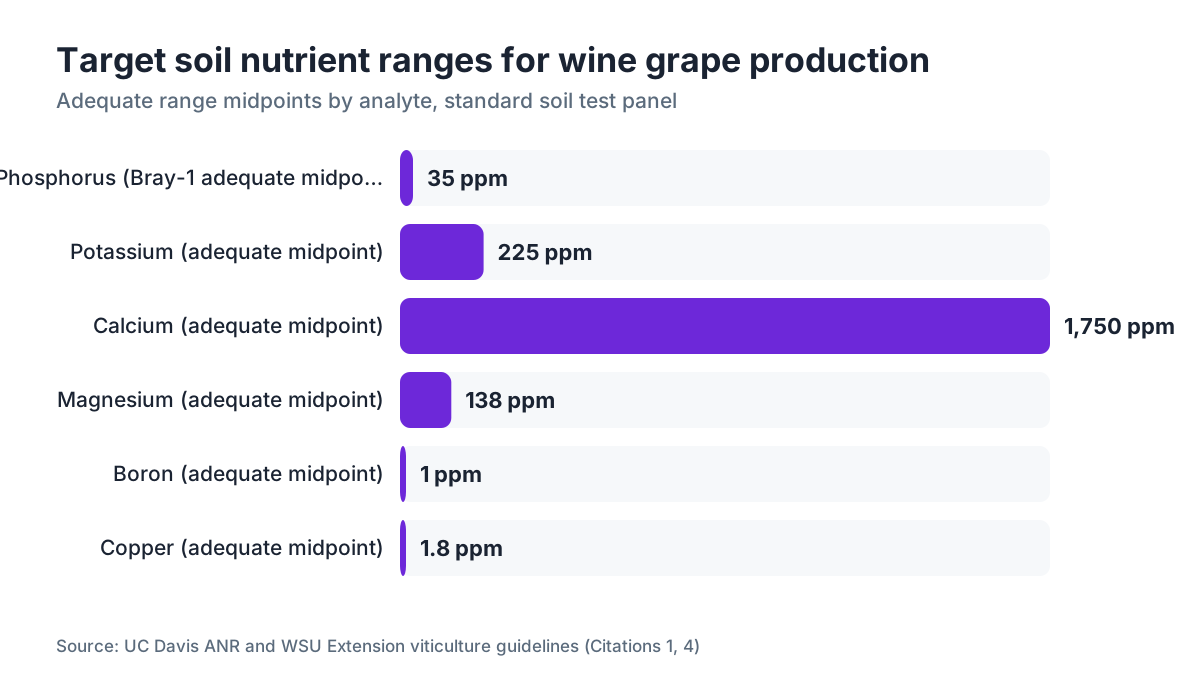
The table below shows common target ranges for key analytes in wine grape soils, compiled from UC Davis and WSU extension guidelines.
| Analyte | Units | Low | Adequate | High |
|---|---|---|---|---|
| pH | unitless | <5.5 | 5.8-6.5 | >7.5 |
| Organic matter | % | <1.0 | 1.5-3.0 | >4.0 |
| Phosphorus (Bray-1) | ppm | <10 | 20-50 | >80 |
| Potassium | ppm | <75 | 150-300 | >400 |
| Calcium | ppm | <500 | 1000-2500 | >4000 |
| Magnesium | ppm | <50 | 75-200 | >350 |
| Boron | ppm | <0.2 | 0.5-1.5 | >2.0 |
| Copper | ppm | <0.2 | 0.5-3.0 | >15 |
| EC (salinity) | dS/m | -- | <1.0 | >2.0 |
Ranges are approximations. Your lab's calibration matters, and results from different extraction methods (Mehlich-3 vs. Bray vs. Olsen) are not directly comparable.
Which soil testing lab should you use?
Use a lab accredited by A2LA, NELAC, or a state-recognized proficiency program, and use the same lab year over year. [7] Lab-to-lab variation in phosphorus extraction alone can hit 20% to 30% on the same soil sample. Consistency over time beats chasing the "best" lab and switching every couple of years.
Labs California wine grape growers lean on include UC Davis's analytical lab (which also runs petiole analysis), A&L Western Laboratories in Modesto, and Waypoint Analytical (regional labs across the country). For Washington and Oregon, WSU's soil and plant lab in Pullman is the default east of the Cascades. For New York and the Finger Lakes, Cornell's nutrient management program works with several northeast regional labs. [6][4]
Turnaround matters more than people expect. A fall sample submitted in October should come back in two to three weeks, so you still have time to apply lime before the ground freezes or before December rains in California shut down field entry. Ask about current turnaround before you commit.
Submit a short agronomic history form with every sample. Most labs include one. Write down your last two years of fertilizer applications, your irrigation water source, your rootstock, and your vine age. A good agronomist reads that before interpreting results. A lazy one won't, but at least you did your part.
Cost by lab type (rough ranges, 2024):
| Lab type | Standard panel | With micronutrients | With EC + Na |
|---|---|---|---|
| University extension lab | $20-$45 | $40-$65 | $50-$75 |
| Commercial regional lab | $30-$60 | $55-$90 | $65-$100 |
| On-farm meters (spot check) | $5-$15/test | Not applicable | $10-$20 |
On-farm meters earn their keep for quick pH and EC checks. They don't replace a wet chemistry panel from an accredited lab.
How do you read and interpret vineyard soil test results?
Start with pH. Everything else in the report hangs off it. Below 5.5, aluminum and manganese can reach toxic levels and phosphorus availability collapses. Above 7.0, iron, zinc, manganese, and boron get harder to take up even when total concentrations look fine. Most wine grape recommendations target pH 5.8 to 6.5 at planting, though some established blocks run at 6.8 with no visible trouble. [1]
CEC (cation exchange capacity) sets the context for the whole report. It's expressed in meq/100g (milliequivalents per 100 grams, sometimes written cmolc/kg). Sandy loam soils common in Sonoma or on Washington's Wahluke Slope might run CEC 5 to 10. Heavy clay loam runs 20 to 35. High-CEC soils hold more nutrients and resist leaching, but they also resist change, so raising pH in clay takes far more lime than raising it in sand. [3]
Base saturation tells you the share of your CEC held by calcium, magnesium, potassium, sodium, and hydrogen. Target values that show up again and again in viticulture literature: calcium at 60% to 75% of CEC, magnesium at 10% to 20%, potassium at 2% to 5%. Once potassium climbs past 5% of CEC it starts choking off magnesium uptake. That's one of the most common vine nutrition problems in intensively managed blocks. [1][4]
Phosphorus interpretation depends entirely on the extraction method the lab used. Bray P-1 is common in eastern states and works on acid soils. Olsen is calibrated for calcareous (high-pH) soils. Mehlich-3 is increasingly the standard at labs serving multiple regions. If your lab ran Mehlich-3 and your extension recommendation table assumes Bray, you need conversion factors, not a direct read. Ask which method your lab uses before you calculate any rate.
Boron cuts one way: high boron (above 2 ppm) in the root zone is harder to fix than low boron. You can leach boron with irrigation, but it takes a lot of water and time. If you test a new block and boron comes back high, that's a rootstock and variety placement question before it's an amendment question.
What are the right soil amendment rates for vineyards?
This is where a lab recommendation, not an internet article, does the final work. I'll give you the framework, not the prescription.
Lime for pH correction: your lab calculates a lime requirement in tons per acre from buffer pH and your target. A common rule of thumb from Cornell extension is that 1 ton of agricultural lime per acre raises pH about 0.1 unit in a loam soil with CEC near 15. [6] That's a starting point; the buffer pH calculation the lab runs is more accurate. Apply lime as far ahead of planting as you can, ideally 12 to 18 months out, and incorporate to 12 inches if you're pre-plant. Post-plant lime on established vines works slowly because you can't incorporate below the vine row without tearing up roots.
Sulfur for pH reduction: elemental sulfur oxidizes into sulfuric acid, driven by soil bacteria, so the rate depends on temperature and biology. A commonly cited rate from WSU is 200 to 400 lbs of elemental sulfur per acre to drop pH 0.5 unit in sandy loam. [4] Clay soils need more. Sulfur runs a multi-month lag, so don't expect movement in three weeks. Re-test after 6 to 12 months to see where you landed.
Potassium: if the test shows deficiency, potassium sulfate (0-0-50) is the preferred form in vineyards because it adds sulfur without chloride. Potassium chloride (muriate of potash) is cheaper, but chloride builds up in poorly drained soils and can reach phytotoxic levels over time in arid regions. Typical pre-plant K rates for deficient soils run 100 to 200 lbs K2O per acre, incorporated. Foliar K can supplement in-season if a mid-season petiole test comes back low, but it won't fix a soil-level shortfall.
Boron: micronutrients need precision. The toxicity threshold sits close to the deficiency line, so the margin is narrow. Granular borax at 2 to 5 lbs per acre is a typical corrective rate on deficient soils. Don't guess on boron. If the soil test says adequate, put none on.
How does soil testing connect to vineyard record-keeping and compliance?
California's Irrigated Lands Regulatory Program (ILRP) requires growers in certain groundwater basins to document nitrogen applications and show they're based on agronomic need. [2] Soil test data showing baseline soil nitrate feeds the nitrogen balance calculation. If you're in a high-priority basin and you get audited, "I applied 40 lbs N per acre because that's what I always do" won't hold. A soil test and a tissue test that back the rate will.
Pesticide record-keeping under the EPA Worker Protection Standard (WPS) doesn't specifically require soil data, but WPS does require you to keep records of every application, including active ingredient, rate, and restricted-entry interval, for two years. [8] If you use fumigants like chloropicrin or 1,3-dichloropropene for pre-plant nematode control, soil type and organic matter affect both the label rate and the treatment's effectiveness. A soil test with organic matter percentage is part of justifying your fumigant rate to an inspector.
Plenty of growers keep soil test reports in a physical binder in the farm office. That works until the binder gets wet, or until you're standing in block 4 trying to pull up the 2019 results on your phone. A field operations platform like VitiScribe lets you attach lab PDFs to each block's record and open them anywhere. Software or binder, the point is the same: these records need to survive the off-season and stay findable years out.
Organic certification adds a layer. Under USDA National Organic Program (NOP) certification, any soil amendment you apply has to be approved. Synthetic nitrogen fertilizers are out. Mined minerals like gypsum or elemental sulfur are generally allowed but sometimes need documentation of need. [9] Soil test data showing the deficiency is that documentation. Your certifier will ask for it.
What is the difference between soil testing and petiole tissue testing?
Soil testing measures what's in the soil. Petiole tissue testing measures what the vine actually absorbed. You need both, because the link between the two isn't always clean.
A soil with adequate magnesium can still grow magnesium-deficient vines if potassium is high enough to block uptake. High soil pH can leave iron in the ground but out of reach of the roots. Poor root distribution from nematode damage, waterlogging, or compaction can throw deficiency symptoms even when soil levels test fine.
Standard timing for petiole sampling in wine grapes is bloom (about 50% flowering) and veraison. Cornell's viticulture program publishes critical value tables for both timings across the major nutrients. [6] At bloom, for example, petiole nitrate-N should generally clear 1000 ppm for Vitis vinifera; at veraison, nitrogen reads more reliably from the leaf blade than the petiole. [6]
Troubleshooting a nutrition problem? Run both tests. For routine annual monitoring, most advisors recommend petiole sampling at bloom every year and soil sampling every two to three years. That's a reasonable, cost-effective protocol for most established blocks.
Tissue sampling technique matters as much as soil technique. Take petioles from healthy leaves in the same canopy position every time (opposite the basal cluster, fully expanded, mid-shoot). Pull 60 to 100 petioles from consistent vines across the management zone. Skip stressed vines, vines near a water problem, and vines on the block edge, which get different light and competition.
What do common soil test results look like for major wine regions?
Published regional data is thin, and I won't invent numbers. But extension publications give us enough to work with.
Napa Valley: many valley floor soils run pH 6.0 to 7.0, with volcanic hillside soils sometimes dropping to 5.5. Valley floor organic matter averages 1.5% to 2.5% under cover-cropped management. Potassium runs high in some alluvial fans because of the underlying geology. [1]
Walla Walla and Columbia Valley (Washington): soils are often loessial (windblown silt) with naturally high pH, some areas topping 8.0 from calcium carbonate in the parent material. WSU extension notes iron chlorosis is common in these calcareous soils, and choosing a lime-tolerant rootstock is one of the biggest planting decisions a grower makes there. [4]
Finger Lakes (New York): the classic Cabot, Honeoye, and Lima silt loams carry CEC in the 15 to 25 range, natural pH around 6.0 to 7.0, and decent organic matter. Potassium deficiency shows up less than in California thanks to higher natural base saturation. Cornell's program holds long-term soil data going back decades on some Finger Lakes blocks. [6]
Central Coast California: highly variable. Paso Robles has calcareous Linne clay loams in some subzones and sandy, low-pH soils in others. The Paso Robles AVA covers a big area and generalizations break down fast, which is exactly why block-level testing beats regional reputation. Growers curious about the region can read more at Paso Robles wineries.
The takeaway on regional variation: don't assume your block matches the regional average. Soil is local. Inside a single 50-acre vineyard, two blocks 1,000 feet apart can differ by a full pH unit.
How often should established vineyards re-test, and what triggers more frequent sampling?
For a stable, well-managed block with no history of problems, test every two to three years for pH, macro-nutrients, and organic matter. That's the consensus from UC Davis, Cornell, and WSU extension. [1][4][6] Annual testing of a block that's already proven stable mostly buys you confirmation you already have.
Some events, though, should trigger an out-of-cycle test.
Large compost or manure applications: a single 10 ton/acre compost application can shift pH, raise EC, and push potassium up in the top 12 inches. Test the following fall.
New irrigation water source: switching from well water to reclaimed water, or from one well to another with different chemistry, can move soil EC and sodium within two to three seasons. Test the year of the switch and the year after.
Visible foliar symptoms: don't wait for the scheduled test. Pull samples now and pair with tissue analysis.
Fumigation or heavy soil disturbance: fumigating for nematodes or deep-ripping changes the biology and chemistry of the top 24 inches. Test before and after.
Copper is worth watching every five years in blocks with a long history of copper-based fungicide programs. UC research has documented copper accumulation in California vineyard soils from repeated Bordeaux applications, with some blocks nearing phytotoxic levels in the top 12 inches after 20 to 30 years of use. [5] Once copper clears about 150 to 200 ppm in the top foot, replanting that block gets compromised.
What are the cost-benefit economics of vineyard soil testing?
The math is simple. A standard panel with micronutrients runs $40 to $90 per sample. A 30-acre vineyard split into 5 management zones costs $200 to $450 to test in full, once every two years. Call it $100 to $225 a year.
One over-application of lime that pushes pH above 7.5 can lock out iron and zinc for several years. At minimum it costs you the lime (agricultural lime runs $25 to $60 per ton at the field, and corrective rates hit 2 to 5 tons per acre). [3] The bigger cost is vine performance and possibly years of stunted growth in a perennial system where every season counts.
Nobody has clean, peer-reviewed economic data on the ROI of vineyard soil testing specifically. The closest work I've seen suggested that nutrient management based on soil and tissue testing cut fertilizer input costs 15% to 25% versus calendar-based programs in California wine grapes, but the sample was small and the work was funded by a farm advisory group rather than a university. Take that as directional, not settled.
The real case for testing isn't the direct savings. It's decision quality. When you're weighing a replant, a rootstock switch, or an organic conversion, the soil test is the baseline that makes every downstream call sharper. Running a vineyard without periodic soil data is like running a wine program without tasting notes. You can do it. You'll just make avoidable mistakes.
Frequently asked questions
How deep should I sample when testing vineyard soil?
Pull separate samples at 0-12 inches and 12-24 inches. The shallow sample captures fertilizer accumulation and organic matter; the deeper one reveals root-zone chemistry, lime content, and salt accumulation from irrigation. For blocks with deep-rooted vines or known subsoil problems, some labs and extension programs recommend adding a 24-36 inch depth as well. Always label depths clearly.
Can I use one soil test result for my whole vineyard?
No. One composite sample per management zone is the minimum. A management zone is any area with visibly different soil texture, drainage, vine performance, or history of different inputs. Mixing a heavy clay draw with a sandy knoll into one sample gives you an average that reflects neither area. Most 10-30 acre vineyards have three to six meaningful management zones worth separating.
What pH is best for wine grapes?
The most commonly cited target from UC Davis and WSU extension is 5.8-6.5 for established blocks. At this range, macro and micronutrient availability is generally adequate and aluminum toxicity is not a risk. Some varieties and rootstocks tolerate pH up to 6.8 without problems. Above 7.0, iron and zinc deficiencies become common; below 5.5, manganese and aluminum can reach toxic levels.
How much does a complete vineyard soil test cost?
A standard panel (pH, CEC, macro-nutrients) costs $20-$60 at most labs. Adding micronutrients (boron, zinc, copper, iron, manganese) brings the total to $40-$90 per sample. University extension labs like UC Davis's analytical lab and WSU's soil lab tend to run at the lower end. Commercial labs like A&L Western or Waypoint Analytical run slightly higher but offer faster turnaround and more detailed interpretation.
When should I test soil before planting a new vineyard?
Test at least 18-24 months before planting if possible. Pre-plant is when you can most effectively incorporate lime, sulfur, and phosphorus to depth. A complete pre-plant panel should include pH, buffer pH, CEC, organic matter, macro and micronutrients, boron, and salinity (EC). The boron level influences rootstock selection. High copper from previous agricultural use can affect vine establishment and should be flagged early.
What is the difference between Bray, Olsen, and Mehlich-3 phosphorus tests?
These are different extraction methods that pull different amounts of phosphorus from the same soil. Bray P-1 works best for acid to neutral soils. Olsen is calibrated for calcareous (high-pH) soils. Mehlich-3 is increasingly standard because it works across a wider pH range and extracts multiple nutrients in one pass. Results from different methods are not directly comparable. Always confirm which method your lab uses before applying extension recommendation tables.
Does cover cropping affect soil test results in vineyards?
Yes, noticeably. Cover crops increase organic matter over time, which raises CEC and can buffer pH. Legume covers fix nitrogen, which shows up as elevated soil nitrate in spring tests. Some cover crops are aggressive potassium scavengers and will temporarily lower K in the upper few inches. Sample consistently in fall after cover crop incorporation for the most comparable year-to-year results.
How does copper accumulate in vineyard soils and when does it become a problem?
Repeated applications of copper-based fungicides (Bordeaux mixture, copper hydroxide) add copper to the top foot of soil over decades. UC research has documented accumulation in California vineyards approaching or exceeding 150-200 ppm in long-managed blocks. At those levels, soil biology is suppressed, earthworm populations decline, and replanting success is reduced. Testing copper annually in blocks with long copper histories is worthwhile. Phytoremediation and organic matter addition are slow but documented options.
Do I need soil test data for California nitrogen management compliance?
In high-priority groundwater basins covered by California's Irrigated Lands Regulatory Program, yes. Growers must document that nitrogen applications are based on crop need, and soil nitrate testing is one component of that calculation. The requirement applies to operations above certain acreage thresholds and in specific regional board jurisdictions. Check with your local agricultural commissioner or regional water board for the current requirements in your basin.
How long does it take for lime to change soil pH in a vineyard?
Incorporated lime (ripped or disked in before planting) typically shifts pH measurably within 6-12 months. Surface-applied lime in established vineyards works much more slowly, often 2-3 years for meaningful pH change at 6-12 inches, because there's no mechanical incorporation. Finely ground lime reacts faster than coarse lime. Test again 12 months after a corrective lime application to see how far pH moved before deciding on a second application.
What should I do if my vineyard soil test shows high sodium?
High sodium (above about 5% of CEC, or an exchangeable sodium percentage above 5-15%) indicates sodic or saline-sodic soil, which causes soil structure breakdown, poor drainage, and restricted root growth. Gypsum (calcium sulfate) is the standard amendment: it displaces sodium from exchange sites, and irrigation then leaches the displaced sodium. Rates depend on the degree of sodicity and CEC; your lab should calculate a gypsum requirement. Check irrigation water EC and sodium adsorption ratio to fix the source, more than the symptom.
Is there a soil test for nematodes?
Nematode assays are a separate test from standard chemical soil tests, but they use the same soil sample. You submit soil to a nematology lab (many university extension labs run these) and they extract and count plant-parasitic nematode species and population levels. In California, UC Cooperative Extension recommends pre-plant nematode assays on all new vineyard sites. Nematode pressure affects rootstock selection as much as any soil chemistry factor.
Can organic matter be improved quickly in a vineyard soil?
No. Organic matter is slow to build. Cover crops, compost at 3-5 tons per acre annually, and reduced tillage can increase organic matter by roughly 0.1-0.3% per year under favorable conditions. Sandy soils in arid regions with low biological activity may gain even less. The main value of cover cropping and composting is maintaining what you have rather than quickly doubling a low baseline. Multi-year commitment is required.
How do I store soil samples if I can't ship them to the lab immediately?
Keep samples cool and dry. Air-drying the sample at room temperature for 24-48 hours before shipping is better than letting it sit moist in a sealed bag, which accelerates biological activity and can shift nitrate and pH values. Most labs can run standard panels on air-dried samples shipped without refrigeration within a week of sampling. For nitrate analysis specifically, refrigerate or freeze if you can't ship within 48 hours.
Sources
- UC Agriculture and Natural Resources (UC ANR), viticulture and soil fertility guidelines: Vineyard soil pH targets, rootstock lime tolerance differences, organic matter ranges, and potassium base saturation guidance for California wine grapes
- California State Water Resources Control Board, Irrigated Lands Regulatory Program: California nitrogen management requirements for high-priority groundwater basins require growers to document agronomic basis for nitrogen applications including soil data
- Penn State Extension, soil sampling and testing guidance: Composite sampling protocol of 15-20 cores per management zone, standard panel cost ranges, and lime rate rules of thumb for pH correction
- Washington State University Extension, soil management for Washington vineyards: Fall sampling recommendation, elemental sulfur rates for pH reduction, Columbia Valley calcareous soil guidance, and rootstock selection for high-pH soils
- UC Agriculture and Natural Resources (UC ANR), copper accumulation in vineyard soils research: UC research documented copper accumulation in California vineyard soils from repeated Bordeaux applications approaching phytotoxic levels in the top 12 inches after 20-30 years
- Cornell College of Agriculture and Life Sciences, nutrient management guidelines for New York vineyards: Petiole sampling timing and critical values at bloom for Vitis vinifera, Finger Lakes soil characteristics, salinity testing recommendations for new water sources
- A2LA (American Association for Laboratory Accreditation), agricultural testing accreditation: A2LA accreditation program for agricultural and soil testing laboratories, standard for confirming laboratory analytical quality
- US EPA, Agricultural Worker Protection Standard: WPS requires maintaining records of all pesticide applications including active ingredient, rate, and REI for two years; soil organic matter content affects fumigant label rates
- USDA Agricultural Marketing Service, National Organic Program: NOP certification requires that soil amendments be approved materials; soil test documentation of deficiency supports use of certain mined minerals under organic certification
- UC Agriculture and Natural Resources (UC ANR), pre-plant nematode sampling for vineyards: UC Cooperative Extension recommends pre-plant nematode assays on all new California vineyard sites; nematode pressure affects rootstock selection decisions
- UC Davis Department of Viticulture and Enology, soil fertility and vine nutrition: Boron toxicity thresholds in wine grape soils, copper phytotoxicity levels, and Bray vs. Olsen vs. Mehlich-3 phosphorus extraction method differences
Last updated 2026-07-09