Vineyard spray tracking systems: what they must do and how to choose one

TL;DR
- A vineyard spray tracking system records every pesticide application: who sprayed, when, which product at what rate, and when workers can safely re-enter.
- Federal law requires two years of records for restricted-use pesticides.
- California, Washington, and New York add more.
- A good system keeps you out of fines, speeds audits, and keeps your crew safe.
What is a vineyard spray tracking system and what does it actually do?
A vineyard spray tracking system is any organized method, paper binder or purpose-built software, for recording every pesticide and fungicide application made to your vines. At its most basic, it captures the product name, EPA registration number, application date, target pest, rate applied per acre, total acres treated, applicator name, equipment used, and the wind speed and direction at the time of application. That sounds like a lot. Most of those fields take under ten seconds to fill in once you're standing next to the sprayer.
You track all of this partly because the law says so and partly because it saves you. On the legal side, the Federal Insecticide, Fungicide, and Rodenticide Act (FIFRA) requires applicators of restricted-use pesticides (RUPs) to keep written records for two years after each application [1]. EPA's Worker Protection Standard (WPS), last revised in 2015, adds requirements for recording re-entry intervals (REIs), application information posted at a central location, and training records for agricultural workers and handlers [2]. If a state department of agriculture auditor walks into your operation, these are the first documents they ask for.
On the practical side, a real tracking system pays for itself the first time a neighbor complains about drift, the first time a worker asks what was sprayed near the block they were pruning, or the first time your insurance carrier wants your spray history after a crop loss claim. A well-kept spray log is both your defense and your data.
Paper still works for many small operations, and there's no federal requirement to use software. But once you have more than two or three blocks, multiple spray operators, or a contract with a retailer or winery that demands audit-ready records, paper starts to cost more time than software does.
What records does federal law require for pesticide applications in vineyards?
Federal law requires certified applicators to record the product brand name and EPA registration number, total amount applied, size and location of the treated area, application date, and the applicator's name and certification number. Keep those two years. Produce them within 72 hours of a state agency request.
FIFRA Section 8(a) and the regulations at 40 CFR Part 171 put that obligation on certified applicators and anyone working under their direct supervision, and they apply to restricted-use pesticides [1]. The 72-hour production window is not a suggestion. Miss it and you've created a violation on top of whatever prompted the request.
The EPA Worker Protection Standard, codified at 40 CFR Part 170, goes further for agricultural employers [2]. You must post, at a central location that workers can reach without entering a treated area, the following for every application: product name, EPA registration number, active ingredient(s), location and description of the treated area, date and time the application ended, and the REI. That posting stays up until the REI expires or 30 days after the application ends, whichever comes first [2]. The WPS also requires you to keep those application records for two years.
EPA's guidance states the posting requirement plainly: "Agricultural employers must post at a central location information about each pesticide application so workers can learn about applications in areas where they work." [2] Simple to say. In practice it means your spray log and your worker posting have to move together. Apply a product on Tuesday afternoon, forget to update the central location until Thursday, and you're already out of compliance.
Some general-use pesticide applications carry lighter federal recordkeeping rules, but many states treat them the same as RUPs for their own reporting. Check your state lead agency separately from the federal baseline.
What extra requirements do California, Washington, and New York add?
State rules vary a lot, and the three biggest grape states each stack layers on the federal baseline. California is the strictest, New York keeps records the longest, and Washington sits closest to the federal minimum.
California runs the most demanding system in the country. Every pesticide application, not only RUPs, must be reported to the county agricultural commissioner (CAC) within seven days under California Food and Agricultural Code Section 12981 [3]. The report includes the grower name and address, site identification, commodity, acres treated, pest treated, product name and EPA number, application method, and pounds of active ingredient applied. CAC data feeds the Pesticide Use Reporting (PUR) database, which is publicly searchable. Growers also keep a Pest Management Record for each field, and restricted materials need a permit from the CAC before purchase or use [3].
Washington requires pesticide application records under WAC 16-228, administered by the Washington State Department of Agriculture (WSDA) [4]. The state ties applicator license numbers directly to application records through its pesticide licensing system. Records must be kept two years and produced during a WSDA compliance inspection [4].
New York requires commercial applicators to maintain records under 6 NYCRR Part 325, and those records must be available for inspection at the farm for at least three years, one year longer than the federal minimum [5]. Cornell Cooperative Extension publishes field guides for grape growers that walk through the specifics [5].
Sell fruit to a winery or distributor that operates in multiple states and you may effectively be held to the tightest state standard in your supply chain, even if your farm sits in a state with lighter rules. Buyer audits and third-party certifications like SIP or USDA Organic carry their own recordkeeping checklists that often exceed state law.
What are re-entry intervals and why does your tracking system need to flag them automatically?
A re-entry interval (REI) is the time after a pesticide application during which workers can't enter the treated area without the PPE listed on the product label. REIs run from four hours for some low-hazard materials to 48 hours or longer for certain organophosphates and fungicides used in vineyards [2]. A few products carry extended REIs of up to five days for tasks like hand harvesting.
The risk is that vineyard work never stops. You spray a block Tuesday afternoon and have a crew scheduled for shoot thinning in that same block Wednesday morning. If your tracking system doesn't put that REI conflict in front of someone who's actually paying attention, the crew walks into a violation, and a health risk, without knowing it.
Good systems, whether software or a well-built paper log, show the calculated REI expiration date and time for every application so whoever schedules the next field task can check before assigning workers. Software can push alerts. Paper needs a human to physically check before scheduling. Both work. The paper failure mode just shows up a lot more often in a busy season.
The WPS also requires that early-entry workers who must enter during a restricted period get specific training, PPE, and notification. Log those early-entry exceptions too, because inspectors ask about them. UC Davis's Statewide Integrated Pest Management Program publishes guidelines on WPS compliance that cover REI documentation in detail [6].
One number worth memorizing: EPA set a federal minimum REI of four hours where no other REI appears on the label [2]. If a label is silent on REI, four hours is the floor.
Paper logs vs. spray tracking software: which is actually better for a small vineyard?
Paper works fine up to about 20 to 30 acres with a single spray operator running a predictable rotation. Past that, the friction of paper starts costing real money.
With paper, the enemy is transcription. An applicator fills out the log in the cab after spraying three blocks. It's hot, he's tired, he writes "Pristine 5 oz/ac" without noting which blocks, skips the wind speed, and hands in the log three days later. Now you have an incomplete record, and if the CAC wants it within seven days like California requires, you're scrambling. Paper doesn't prompt for missing fields, doesn't calculate REI expiration, and doesn't build the summary reports state systems want.
Software fixes the prompting and the math, then brings its own problems. The biggest is connectivity. Most blocks in most vineyards have poor cell service or none. Any spray app that needs a live connection to log data will fail in the field. Offline-first design, where the app stores data locally and syncs when it finds a signal, isn't optional for anything past a backyard plot.
The second problem is adoption. If logging a spray event takes more than 30 seconds, your operators quit using it. The best vineyard tools frontload the setup (products, blocks, operators) so logging one application takes fewer taps than a text message.
Cost is real but rarely decides it. Purpose-built vineyard platforms with spray tracking run roughly $50 to $400 per month depending on acreage and features. A generalist farm system might cost less and skip the grape-specific product library and state reporting integrations. A spray log notebook from your co-op costs about $15 and works perfectly until it gets left in the rain.
Operations running 50 or more acres, multiple labor crews, or third-party certifications almost always find software pays back in audit prep alone. VitiScribe is one platform built for this, with offline logging and state report export in the core workflow.
What features should a vineyard spray tracking system actually have?
A lot of spray tools are built for row crops, not permanent crops, and it shows. Block-level logging, a product library with label data, automatic REI flagging, state report export, offline operation, and an edit history are the features that matter for vineyards. Here's why each one earns its place.
Block-level logging is the one that matters most. Your spray program isn't uniform across the farm. You might run a resistance rotation that hits your Chardonnay blocks with one fungicide program and your Cabernet blocks with another, or hold a block under a neighbor's easement that can't take certain products. The system has to record at the block or row level, more than the farm level.
Product library with label data is a close second. A good system stores your active product list with EPA registration numbers, maximum seasonal rates, and labeled REIs pre-loaded, so the operator just picks "Flint Extra" from a dropdown instead of copying the EPA number off the bag every time. Some platforms pull from a national product database. Others make you build your own library. The manual build costs setup time but gives better accuracy for your actual rotation.
Automatic REI calculation and conflict flagging. When you log a spray event, the system computes the REI expiration and flags any scheduled field activity that lands inside that window. This is the single feature that most directly keeps you clear of a WPS violation.
State reporting export. California's CAC reporting, Washington's WSDA format, and New York's requirements each have specific field structures. A system that generates a report in the exact format your agency wants saves hours a year. Without it, you re-key data from your log into a state portal.
Offline functionality. Covered above, but worth saying again because it gets missed in demos, which always happen at a desk with good wifi.
Photo and GPS attachment. Tagging a spray event with a GPS location and a photo of the treated area is genuinely useful when a drift complaint lands or when you're reconstructing what happened in a block that shows unexpected burn. Not every operation needs it. It costs almost nothing to have.
Audit trail and edit history. Every change to a logged record should be timestamped and tied to a user. Sounds like overkill until you're across the table from an auditor who wants to know why a record got modified.
How do spray records connect to worker safety and what can go wrong without them?
The WPS violations that actually turn into fines cluster around a few failures: no central information posting, REI violations, refusing records to workers who ask about their exposure, and thin handler training records [2]. Every one of them traces back to the quality of your spray log.
FIFRA civil penalties for recordkeeping violations can reach $5,500 per violation per day for commercial applicators, under the penalty structure at FIFRA Section 14 [1]. State penalties stack on top. California enforcement can add penalties under the Food and Agricultural Code that run into the tens of thousands of dollars for willful or repeat violations [3].
Then there's liability. If a worker is exposed during an REI and you can't produce records showing when you sprayed and what the REI was, you're in a much weaker spot in any workers' comp or civil case. A spray log kept accurately and at the time of application is your primary evidence that you did what you were supposed to do.
UC Davis IPM and the California Department of Pesticide Regulation publish safety training materials that teach workers how to read the central posting and what their rights are to access spray records [6]. Your workers may know more about their right to inspect your records than you know about your duty to keep them. That's fine if your records are clean. It's a problem if they're not.
WSU Extension's viticulture and IPM programs report that operators who move from paper to electronic tracking tend to see first-year inspection results improve, largely because prompts and required fields kill the incomplete records that trigger follow-up inquiries [9].
What information should every single spray record entry contain?
A complete vineyard spray entry should carry the fields below. This list comes from the combined requirements of FIFRA (40 CFR 171), the EPA WPS (40 CFR 170), California FAC 12981, and the audit checklists organic certifiers and SIP use [1][2][3].
| Field | Why it's required | Minimum retention |
|---|---|---|
| Application date and time (start/end) | Federal WPS, state CAC reporting | 2 years federal, 3 years NY |
| Product name | FIFRA, WPS posting | 2 years |
| EPA registration number | FIFRA, state reporting | 2 years |
| Active ingredient(s) | WPS posting, state reporting | 2 years |
| Application rate (oz or lb per acre) | FIFRA, label compliance | 2 years |
| Total product applied | State CAC/WSDA reporting | 2 years |
| Acres treated | FIFRA, state reporting | 2 years |
| Block or field location | State reporting, audit trail | 2 years |
| Target pest or disease | State CAC reporting | 2 years |
| Application method and equipment | State reporting | 2 years |
| Applicator name and certification number | FIFRA (RUPs), state law | 2 years |
| Wind speed and direction | WPS, drift records | 2 years |
| Temperature at application | Best practice, some state rules | Best practice |
| REI expiration date and time | WPS central posting | Until REI expires |
| Restricted entry exceptions (if any) | WPS early-entry records | 2 years |
If you're organic or chasing a certification, add the lot number of the product you used, to prove you applied a certified organic input and not a conventional equivalent selling under the same trade name.
How long do you actually have to keep vineyard spray records?
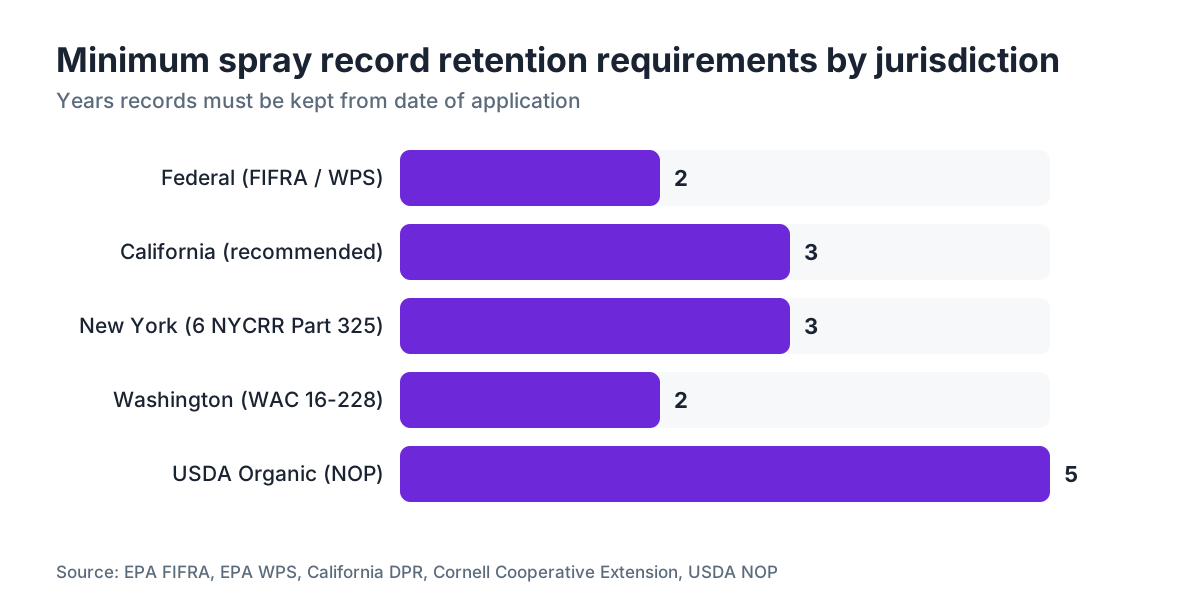
The federal floor is two years from the date of application, under both FIFRA for restricted-use pesticides and the EPA WPS for application and worker training records [1][2]. States go longer. USDA Organic goes longest at five years. Keep everything five years and you cover every rule you'll hit.
New York requires three years under its commercial applicator regulations [5]. California's CAC system effectively creates a permanent public record once data lands in the CDFA Pesticide Use Reporting database, but growers should keep their own copies at least three years to handle disputes or corrections [3].
USDA National Organic Program certification requires records for five years, the longest common requirement you'll run into [7]. If any part of your vineyard is certified organic or in transition, your whole operation's spray records tend to get pulled into that five-year window anyway, because certifiers want the full farm picture.
Third-party certifications like Sustainability in Practice (SIP) and LIVE (Low Input Viticulture and Enology) don't name retention periods in their public standards, but auditors typically ask for three years of history at a renewal.
The practical call: keep everything five years. Storage is cheap. The cost of not having a record when someone asks for it is not.
How do you build a spray tracking system from scratch if you're starting today?
Start with your product library. Before you log a single application, build a master list of every product you use, with the EPA registration number, active ingredient, signal word, REI, maximum rate per application, and seasonal maximum. Pull most of it from the label or from the National Pesticide Information Center's label database [8]. This setup takes a few hours, and it's the foundation everything else sits on.
Next, map your blocks. Give each block a consistent identifier, something like "Block 7 Cab" or a GPS-based ID, and record the acreage for each. Most software lets you draw blocks on a satellite map. On paper, a hand-drawn map with consistent block IDs stapled to the front of your log binder works fine.
Decide who owns the log. With a dedicated spray operator, that person completes the log immediately after each application, before moving equipment. In a smaller shop where the manager sprays, the log rides in the cab and gets filled out before the engine goes off. The longer the gap between application and documentation, the more errors creep in.
Set up your central location posting. Under the WPS, it goes somewhere every agricultural worker and handler can reach without entering a treated area [2]. A weather-resistant board near the shop or break area is standard. Some software prints a posting sheet or runs a worker-facing display mode. Either way, the posting has to happen, and it has to be current.
Last, name the person who checks records before field work gets scheduled. The REI check is a workflow step, not a filing task. Someone looks at the log before assigning a crew to a block. Build that into your daily scheduling routine and you've built the thing that actually prevents REI violations.
Want software without building it yourself? Platforms made for vineyard compliance, like VitiScribe, handle the product library, block mapping, REI calculations, and state report generation in one place. The alternative is stitching together spreadsheets, a paper log, and a phone calendar for REI reminders, which works but leans on a lot of manual coordination.
What does a spray records audit actually look like, and how do you prepare for one?
State department of agriculture inspections come in a few forms. Routine compliance checks are usually unannounced and focus on active applications or current postings. They might follow a complaint from a neighbor or worker, or they might be random. Formal investigations follow a specific complaint or an observed violation.
In a routine check, an inspector asks for your spray records for the current season and often the prior one. They cross-reference what you logged against the products on your shelves. If you logged 20 applications of a product and your remaining inventory doesn't square with your purchase records, that's a red flag. They also check your central WPS posting against your most recent application record and look at applicator certification documents.
The most common deficiencies found in vineyard inspections, based on published CDFA enforcement summaries, are missing or incomplete central location postings, REI information not posted, missing applicator certification numbers in records, and failure to report to the CAC on time [3].
Preparing isn't complicated if your records are current. Keep a summary log sorted by date, with a separate section for each field or block. Keep applicator certifications in a folder next to the spray log. Keep your product labels on file, physical or digital, because inspectors sometimes want the label for a product you used six months ago to confirm your rate stayed inside the labeled range.
On software, export a season summary report before any inspection and have it ready. On paper, make sure every entry is legible and every block maps back to your farm map. An inspector who can follow your records without asking you to explain every line is an inspector who finishes fast and moves on.
How do spray records fit into organic certification and third-party vineyard audits?
USDA organic certification requires that every material applied to the land be documented and available to the certifying agent [7]. Your spray log becomes an exhibit in your organic system plan, and any application of a non-approved material, even a mistake, has to be disclosed. Certifiers under the USDA National Organic Program can deny or revoke certification based on spray records that show prohibited materials.
The USDA NOP requires five years of retention, longer than FIFRA's two-year floor [7]. For a vineyard in the three-year transition, every application during those three years gets scrutinized to confirm no prohibited substances were used. Incomplete records for any month of that transition can push your certifier to extend the transition or deny certification outright.
Sustainability certifications like SIP, LIVE, and California Certified Sustainable Winegrowing (CCSWG) run their own checklists that include spray records as a line item. These audits usually happen annually and look at your IPM documentation alongside the spray log: what monitoring data prompted each application, whether you weighed non-chemical alternatives, and whether your timing tracked disease pressure models. A log that records what was applied but never why leaves gaps an IPM audit will find.
For operations tied to larger supply chains or retailers requiring Global GAP or similar standards, spray records have to connect to your food safety plan and your worker health records. The overlap between pesticide records and food safety is where paper systems almost always fall short, because the cross-referencing between systems is too manual to trust.
Frequently asked questions
Do I need to keep spray records for general-use pesticides, or just restricted-use?
Federal law under FIFRA specifically requires written records for restricted-use pesticides, kept two years. But California requires reporting all pesticide applications to the county agricultural commissioner, including general-use products, and New York and Washington have similarly broad state rules. Log everything regardless of classification. The paperwork is the same either way, and state rules are often broader than the federal baseline.
How soon after a pesticide application do I have to post information for workers?
Under EPA's Worker Protection Standard (40 CFR 170), the central location posting must be up before any worker or handler enters or works in the treated area after the application ends. There's no grace period. The posting stays up until the REI expires or 30 days after the application, whichever comes first. Failing to post before workers re-enter is one of the most commonly cited WPS violations in agricultural inspections.
What is the penalty for missing or incomplete spray records in California?
California can issue civil penalties under the Food and Agricultural Code for pesticide recordkeeping violations. Fines for commercial violations start at several hundred dollars per violation and reach tens of thousands for willful or repeat offenses. At the federal level, FIFRA Section 14 allows civil penalties up to $5,500 per violation per day for certified applicators. State and federal penalties are independent and can both apply to the same event.
Can my farm workers ask to see the spray records?
Yes. Under the EPA Worker Protection Standard, agricultural workers and handlers have the right to see the application information posted at the central location. Beyond the posted information, workers who believe they were exposed to a pesticide can request specific application details, and employers must provide them. Failing to do so is a WPS violation. This right is also reinforced under California state pesticide regulations.
What spray tracking software is specifically designed for vineyards?
Several platforms target vineyard and specialty-crop operations. VitiScribe is built specifically for vineyard compliance and field operations, with block-level logging, offline functionality, and state report export. Other options include AgWorld, Vine Vision, and general farm management platforms like Granular or Ag Leader with spray log modules. The differentiators for vineyards are offline-first operation, a grape-specific product library, and California CAC or WSDA export formats.
How do I track re-entry intervals across multiple blocks being sprayed the same day?
Each block application is its own log entry with its own REI expiration. When you log the application time and the product REI, your system should calculate the re-entry clearance for that specific block. Spray four blocks across a morning and each gets its own REI timestamp. Software that auto-calculates this per block is the cleanest solution. On paper, a column for 'REI expires' filled in at logging time is the minimum viable approach.
Do spray records need to include the GPS coordinates of the application?
Federal law and most state laws don't require GPS coordinates, only a location description that identifies the treated area. But GPS-tagged records help with drift complaint defense, precision application documentation, and third-party audits. California's CAC reporting uses a site identification system based on township-range-section or county assessor parcel numbers, not GPS, so coordinates are supplemental rather than required there.
What records do I need for organic certification spray programs in a vineyard?
USDA National Organic Program certification requires documentation of every material applied to certified land, including product name, lot number, date, rate, and location. Records must be kept five years. You also document why each application was made, meaning your IPM monitoring records. Certifying agents review these at least annually. Any application of a prohibited substance must be disclosed and typically results in loss of certification for the affected land.
How do spray records support a pesticide drift complaint defense?
A complete record showing application date, time, wind speed and direction, product applied, and block location is the primary evidence in a drift complaint investigation. It lets you show what you sprayed, when, under what conditions, and whether those conditions stayed within label guidelines. Without records kept at the time of application, your defense rests entirely on memory, which is much weaker in an administrative or legal proceeding. GPS and photo attachments strengthen the record further.
Is there a standard form for vineyard spray records, or do I make my own?
There's no single federally mandated form. FIFRA specifies required data fields but not the format. Many county agricultural commissioners publish preferred forms for CAC reporting, and some state extension services offer downloadable spray log templates. UC Davis IPM and Cornell Cooperative Extension both publish field-ready forms. Starting with a form from your state extension is reasonable because it's designed to match local reporting requirements.
How do I handle a spray record when a third-party contractor does the application?
Under FIFRA, the certified applicator who makes the application is responsible for the record. If you hire a licensed pest control operator or contract sprayer, they should give you a copy of the application record within the timeframe your state requires for reporting. In California, that's within seven days. Keep those contractor records in your own files alongside your internal logs, because an inspector wants the full application history regardless of who sprayed.
What does the EPA Worker Protection Standard say about handler training records?
The WPS (40 CFR 170) requires agricultural employers to train pesticide handlers before they perform any handling task and to keep records of that training for two years. Records must include the trained person's name, the date of training, and the type of training provided. This is separate from application records but gets checked in the same inspection. Handlers who run spray equipment without documented WPS training expose the employer to civil penalties under FIFRA Section 14.
Can I store my vineyard spray records electronically, or does the law require paper?
Federal law and most state laws accept electronic records as long as they're legible, accurate, and can be produced for inspection on request. California's CAC reporting is done electronically through the CDFA system. The practical requirement is that you can print or display the records fast when an inspector shows up. Back up your electronic records off-site or to cloud storage to protect against hardware failure, the biggest risk with digital-only systems.
How often should I audit my own spray records before a regulatory inspection?
A monthly self-audit takes about 20 minutes and catches most problems before they turn into compliance issues. Check that every application in the past 30 days has a complete entry, that central location postings are current, and that applicator certifications on file aren't expired. A deeper annual review before each growing season should verify prior-year records are complete, stored properly, and match your inventory and purchase records. This internal check separates operations that pass inspections from those that scramble during them.
Sources
- EPA, Federal Insecticide Fungicide and Rodenticide Act (FIFRA) Overview: FIFRA requires certified applicators to keep records of restricted-use pesticide applications for two years, and records must be made available to state lead agencies within 72 hours of a request; civil penalties can reach $5,500 per violation per day
- EPA, Worker Protection Standard (40 CFR Part 170): The WPS requires central location posting of application information before workers re-enter, sets a federal minimum REI of 4 hours, requires records kept two years, and the 2015 revision updated handler age and posting requirements
- California Department of Pesticide Regulation, Pesticide Use Reporting: California Food and Agricultural Code Section 12981 requires all pesticide applications to be reported to the county agricultural commissioner within seven days; data is compiled into the publicly searchable CDFA Pesticide Use Reporting database
- Washington State Department of Agriculture, Pesticides: WAC 16-228 requires Washington pesticide applicators to maintain application records for two years and make them available during WSDA compliance inspections
- Cornell Cooperative Extension, New York State Integrated Pest Management: New York requires commercial pesticide applicators to maintain records for at least three years under 6 NYCRR Part 325, one year longer than the federal minimum
- UC Davis Statewide Integrated Pest Management Program: UC Davis IPM publishes WPS compliance guidelines covering REI documentation and worker rights to access application records; training materials are used in California pesticide safety programs
- USDA Agricultural Marketing Service, National Organic Program: USDA NOP requires organic operations to retain all records for five years and document every material applied to certified land including product name, lot number, date, rate, and location
- National Pesticide Information Center, Oregon State University: NPIC maintains searchable pesticide product label and safety data sheet resources that applicators can use to verify EPA registration numbers, active ingredients, and REIs
- Washington State University, Viticulture and Enology: WSU viticulture and IPM programs have published guidance indicating that electronic spray tracking systems reduce incomplete records and improve first-year inspection outcomes for Washington vineyard operators
- EPA, Agricultural Worker Protection Standard (WPS): The 2015 WPS revision updated handler requirements, set the 4-hour minimum REI, and expanded central location posting rules including the requirement that postings remain until the REI expires or 30 days after application
Last updated 2026-07-09