How to set up a shared spray record system for a vineyard management company

TL;DR
- A shared spray record system for a vineyard management company needs a central data store your field crews can all reach, a fixed record format that meets each state's pesticide rules, a named owner for every property's file, and an audit trail.
- Most states require records kept two to five years.
- Get the structure right before the first spray and you skip weeks of cleanup at audit time.
What records does the law actually require you to keep?
The baseline comes from the EPA's Worker Protection Standard and state pesticide regulations, not from a single federal spray-record law. Under 40 CFR Part 170, the WPS requires handlers to post application-specific information at a central location for 30 days after each application. The core commercial applicator record-keeping rules, though, are set state by state under FIFRA Section 8 licensing [1][2].
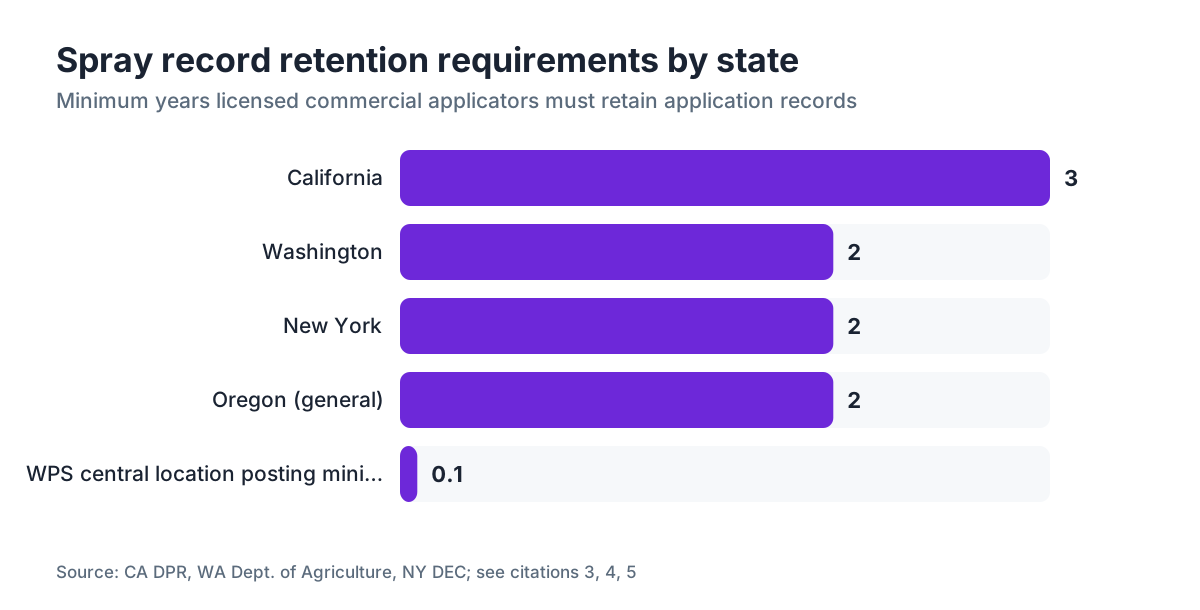
Most states land between two and five years for written record retention. California's Department of Pesticide Regulation requires licensed pest control advisers and applicators to keep application records for three years, and those records must reach the county agricultural commissioner within seven days of each restricted-use application [3]. Washington requires commercial applicators to retain records for two years [4]. New York uses the same two-year window for most agricultural applicators [5].
Every state record, whatever the format, has to capture the same core fields: applicator name and license number, date and time of application, property legal description or APN, crop and growth stage, pesticide product name and EPA registration number, application rate, target pest, equipment used, and weather at application. Some states also want the restricted entry interval (REI) and pre-harvest interval on the record.
Here's the practical point. If you manage vineyards in more than one state, your shared system has to run on the strictest ruleset by default, not the loosest. Build to California's seven-day submission and three-year retention even when most of your properties sit in Oregon, and you never have to retrofit.
Why does a vineyard management company need a different setup than a single-owner vineyard?
A single-owner vineyard has one operator, one set of county filings, and one person who knows where the binders live. A management company runs under separate Pest Control Adviser (PCA) or Certified Crop Adviser agreements for each ownership entity, files county documents under each property's grower license number, and has several crews applying in the same week across different AVAs.
That structure creates three failure points a solo operation never sees. The wrong property gets attached to a record because a crew lead fills out a paper form on the truck for one ranch and files it in another's folder back at the office. Records for different owners get commingled, which becomes a privacy and liability problem the moment an owner asks for their complete file. And nobody can pull a block-level spray history fast when a winery buyer or an auditor asks.
Multiple data entry points is the real problem. Four crews, three states, twelve ranches, and spray work happening Monday through Saturday means you can't lean on one person reviewing a paper stack Friday afternoon. The system has to catch the separation at entry, not at filing.
What fields should every spray record entry include?
Before you pick software or build a spreadsheet, write out the complete field list. Every state has a minimum. You want your internal standard to be a superset of all the states you operate in.
| Field | Required by most states | Notes |
|---|---|---|
| Application date and start/end time | Yes | Some states require both |
| Property name and legal description or APN | Yes | Match to county filing |
| Grower/owner name and license number | Yes | Per-property, not company-wide |
| Applicator name and cert. number | Yes | License number, more than name |
| PCA name and license number | Yes if PCA recommendation required | CA requires for RUPs |
| Crop and growth stage (BBCH or similar) | Yes | Phenology matters for PHI compliance |
| Block/vineyard block ID | No (recommended) | Essential for block-level reports |
| Product name | Yes | Exactly as on label |
| EPA registration number | Yes | 5-digit + 5-digit format |
| Application rate (volume per acre) | Yes | Both product and water volume |
| Total acres treated | Yes | |
| Target pest | Yes | |
| REI after application | Yes | Pull from current label |
| Pre-harvest interval | Yes | Pull from current label |
| Equipment type and ID | Varies | Required in several states |
| Wind speed and direction at application | Required in CA, recommended elsewhere | |
| Temperature at application | Recommended | |
| Adjuvants used | Recommended | |
| Applicator signature | Yes |
Two fields management companies skip and later regret: equipment ID and adjuvant tracking. When a tank mix drift complaint lands two seasons later, knowing which sprayer number sat on which block that day is how you defend yourself.
Growth stage notation in BBCH codes (standardized across grape phenology work at UC Davis and land-grant extension programs) also lets you cross-check PHI compliance far faster than descriptive notes like "post-fruit set" [6][7].
How do you structure the system so each property's data stays separate?
The cleanest architecture makes property the top-level object, not crew or date. Every entry lives inside a property record, and access to that record can be granted or restricted to specific users.
In practice, that means building or buying a system where a crew lead cannot post a spray record without first selecting the property from a list, and that list is tied to their assignment for the day. They shouldn't be able to see or write to properties they aren't assigned to.
This matters legally because the grower of record for each property is a separate entity. Their pesticide filings, their WPS central location postings, and their liability exposure are all distinct from your management company's. If you keep records on their behalf under a management agreement, you have to be able to export a complete, clean file for just that property at any time.
A role structure that works for most management companies:
- Field crew member: can create and edit records for assigned properties only, cannot delete.
- Field supervisor: can review and finalize records across assigned properties, can flag for correction.
- PCA/Agronomist: read access across all properties to verify recommendations were followed.
- Compliance officer or office manager: full access to all properties, can export and file county documents.
- Property owner (client): read-only access to their own records, cannot see other clients' data.
If your system can't enforce this natively, you can fake it with separate Google Workspace shared folders per property. That approach breaks fast once you pass six or seven clients.
What are the real options: paper, spreadsheets, or dedicated software?
Paper is still legal everywhere and still used by small operations. The problem for a management company is that paper forces a centralization step every time a record is created. Someone has to physically collect forms from four trucks, scan or re-enter them, and file them. That step eats time and breeds transcription errors. A 2019 USDA National Agricultural Statistics Service survey found about 37 percent of farms still used paper as their primary record-keeping method, though that share drops sharply among operations managing more than one entity [8].
Spreadsheets are a step up because they're centrally stored and searchable. A shared Google Sheet or an Excel file on SharePoint works if your team is small (two or three crew leads), your property count is under ten, and one disciplined person owns version control. The failure mode is simultaneous editing, formula breakage, and the urge to reformat columns for convenience. Your compliance officer goes on vacation, someone rearranges the sheet, and now you've got a problem.
Dedicated agricultural record-keeping software handles the permission structure, the required field validation, and the reporting format natively. Options range from farm management platforms like Agrivi, Granular (now part of Corteva), and AgriWebb, to vineyard-specific tools built around spray log compliance. VitiScribe is one of the vineyard-specific options, built around multi-property spray record management and county filing report generation.
Cost varies widely. Entry-level farm software runs roughly $50 to $150 per month for small operations. Enterprise platforms used by large management companies run $500 to several thousand per month depending on acreage and features. Here's the honest answer: if you manage fewer than 200 total acres across your properties, a well-disciplined spreadsheet with a strong protocol document beats a poorly configured enterprise platform every time.
How should you handle offline data entry when crews are in the field without connectivity?
This is the question that breaks a lot of digital systems in practice. Vineyard blocks in Paso Robles, the Carneros, or the Columbia Valley often have no cell signal. A crew lead who can't submit a record while standing in the block will either scribble it on paper and re-enter it later (back to the transcription problem) or skip it and try to reconstruct from memory.
Any system you choose needs a genuine offline mode: complete a full record on a phone or tablet with no connection, queue it locally, and sync automatically when connectivity returns. "Offline mode" that only saves a draft with no field validation is not the same thing.
Test it. Put the device in airplane mode, fill out a complete spray record, then toggle connectivity back on and confirm it syncs correctly. Do this before you commit to a platform, not after.
For paper-hybrid workflows, the most durable approach is a pre-printed field form (one per block, per application) with every required field already labeled. Crew leads fill it out in the field. A designated person at each vehicle photographs each form end-of-day and uploads it to a shared folder organized by property. Someone in the office reviews and enters it into the master system within 24 hours. It isn't elegant. It works reliably, and it gives you a photographic original.
Who is responsible for verifying records and signing off before county filing?
Define this before your first spray of the season. Ambiguity about sign-off is the single most common reason management companies miss county filing deadlines.
County filing responsibility in California sits with the licensed PCA for restricted-use pesticide recommendations and with the grower of record (or their authorized agent) for general use materials. When a management company acts as the authorized agent under a written management agreement, the company's compliance officer or office manager is usually the person who physically submits county documents. That person needs to be named in the management agreement.
A sign-off chain that holds up:
- Field crew lead creates and saves the record within 24 hours of application.
- Field supervisor reviews for completeness (all required fields filled, no obvious errors like a rate that's ten times the label rate) within 48 hours.
- Compliance officer pulls records weekly, generates the county report format, and files. In California, restricted-use pesticide reports must reach the county agricultural commissioner within seven days of the application [3].
One person should own step 3 per county, not per property. If your ranches span three counties, you need one point of contact for each commissioner's office. Some counties have moved to electronic filing through the CalAgPermits system; others still take paper or fax [3].
Assign backup contacts for each step. Harvest is when spray records fall behind most, and it's also when people are least available.
How do you migrate existing spray records into a new shared system?
Don't try to migrate everything at once. That path turns into a three-month project that never finishes, and a team that keeps using the old system because the new one still isn't ready.
The approach that works: draw a clean start date (the beginning of a spray season is ideal), migrate only what you legally must keep readily accessible (current year plus whatever your state requires backward), and archive everything older in a labeled folder that stays frozen.
For paper-only records, scan them to PDF organized by property and year. You don't need to re-key historical paper records into a digital system unless you plan to run queries on them. Scanned originals satisfy the "records retained" requirement in every state rule I'm aware of, as long as they're legible and organized.
For spreadsheet records, map your existing columns to the new system's fields before importing. Columns that don't map cleanly (a free-text "notes" field holding rate data, weather data, and a crew complaint in one cell) need manual review, not a bulk import. Budget time for that.
For records in a previous software platform, request a full export in CSV or XML before you cancel the subscription. Every platform will provide it; some make it easy, some require a support ticket. Get the export before you cancel, not after.
What should your standard operating procedure document cover?
A shared system without a written SOP is just software waiting to be used wrong. The SOP doesn't have to be long. It has to be specific.
At minimum, cover these points:
Record creation timing: records get created the same day as application, or before the crew vehicle leaves the property. Not "by end of week."
Who creates the record: the person who physically ran the sprayer, not a crew lead transcribing from verbal notes two days later. In California, the applicator's license number must be on the record, and that person owns its accuracy.
Handling corrections: when a record is wrong, who can correct it, how the correction gets logged (original value, new value, who changed it, when), and what triggers a county re-filing if the error touched a submitted record.
System access: how new employees get credentials, how terminated employees lose access immediately, and what happens to records when a management agreement with a property owner ends. That last one matters because the owner is entitled to a complete copy of their records on termination.
Annual record retention audit: once a year, someone confirms that records for the required lookback period are complete, legible, and accessible. It takes an afternoon and keeps you from finding a gap the moment an auditor asks.
WSU Extension's pesticide record-keeping guidance for commercial applicators and UC Davis's Integrated Pest Management program both publish templates and checklists worth pulling from directly instead of starting cold [6][7].
How do you train field crews to use the system consistently?
Training is where most implementations fall apart. The system is set up right, the SOP is written, and then field crews invent their own workarounds because the official method is slower or confusing on a phone screen.
A few things that actually help:
Train on the real device in real conditions. If your crew leads will use iPhones in 95-degree heat with dirty gloves, train them that way, not on a laptop in a conference room. Walk the form fields while standing in a block.
Cut the number of fields that require typing. Every field that can be a dropdown (product name from a pre-loaded library, block ID from a list, applicator name from a roster) should be a dropdown. Free-text fields have high error rates and take longer to complete.
Build a laminated quick reference card for the physical steps: open app, select property, select block, start record, fill these seven fields, save. Stick it in every crew vehicle.
Run a monthly record quality review for the first growing season. Pull ten random records, check them against the SOP, and share the results with supervisors without blame. You're hunting for patterns: the same field always missing, the same crew always using a wrong rate unit, the same property always filed late. Fix the system to kill the pattern, more than the individual record.
The EPA's WPS training rules for pesticide handlers (separate from record-keeping but adjacent) require annual handler training and central location posting of application-specific information before handlers enter treated areas [1]. Your SOP should link these explicitly so crews understand the record is part of the safety chain, more than paperwork.
What happens if spray records are missing or incomplete during an inspection?
The consequences depend on your state and whether you hold a commercial applicator license or a PCA license, but they're real. California's Department of Pesticide Regulation can issue civil penalties up to $5,000 per violation per day for record-keeping failures by licensed agricultural pest control businesses [3]. Washington's Department of Agriculture can suspend or revoke commercial applicator licenses for failure to maintain required records [4].
Beyond the regulatory side, missing records are a liability problem if a neighbor, worker, or buyer later alleges exposure or drift. A complete spray record is your proof of what was applied, when, and under what conditions. Without it, you're arguing from memory.
The most common audit trigger for management companies isn't a random inspection. It's a worker complaint to OSHA or a county commissioner, a drift complaint from an adjacent property, or a food safety audit from a winery buyer running a sustainability or organic certification program. All three request spray records immediately.
If you find a gap, document what you know from indirect sources (product purchase invoices, tank mix worksheets, PCA recommendations) and attach them as a reconstructed record clearly labeled as such. Don't leave a blank. Talk to your ag attorney before responding to an agency inquiry about a gap. This is the one area where professional advice (typically $200 to $400 per hour) clearly earns its cost.
How do you generate reports and export data when owners or wineries request records?
This is the proof-of-concept moment for any system. A client or winery buyer calls and asks for all spray records on a specific block from bud break through harvest. How long does it take you to produce a clean, organized file?
In a well-structured system, that report takes under ten minutes. Filter by property, filter by block, filter by date range, export to PDF or CSV. If you're digging through folders and reformatting cells, the system isn't working.
Common report requests management companies get:
- Full property spray log for a calendar year (for county filing or client annual review)
- Block-level spray history for a specific material (to verify PHI compliance before harvest)
- All applications of a specific active ingredient across all properties in a date range (for resistance management review or in response to a chemical drift inquiry)
- Worker protection documentation showing REI posting records
For winery sustainability programs like LODI Rules, California Sustainable Winegrowing Alliance, or LIVE certification, spray records are the primary documentation submitted during audits. These programs often use their own export templates. Build at least one test export against the LODI Rules format, or your regional program's format, before the season starts. Not the week before audit submission.
VitiScribe, for example, structures its export formats around the county agricultural commissioner report templates used across California AVAs, which cuts reformatting before filing. Worth checking whether any platform you evaluate has pre-built report templates for your specific county and certification program.
Frequently asked questions
How long do vineyard spray records legally have to be kept?
It depends on your state. California requires three years for commercial applicator records. Washington and New York require two years for most agricultural applicators. The EPA Worker Protection Standard separately requires certain application information posted at the central location for 30 days after each application, which is different from long-term retention. Build your system around the longest retention period that applies to any state you operate in.
Can I use Google Sheets or Excel as my shared spray record system?
Yes, and it works reasonably well for small operations with fewer than ten properties and two or three crew leads. The main risks are simultaneous editing conflicts, accidental column reformatting, and no built-in permission separation between properties. If you go this route, use one tab per property (never one tab per date), lock column headers, and set up view-only sharing for property owners. Back up the file weekly to a separate location.
What is the penalty for missing a spray record filing deadline in California?
California's Department of Pesticide Regulation can impose civil penalties up to $5,000 per violation per day for licensed agricultural pest control businesses that fail to maintain or submit required records. County agricultural commissioners handle restricted-use pesticide report submissions and can refer violations to DPR. Repeat or willful failure to file can also trigger license suspension or revocation proceedings.
Does every pesticide application require a record, or only restricted-use materials?
Most states require records for both restricted-use and general-use pesticide applications made by licensed commercial applicators. In California, the general-use record-keeping requirement applies to agricultural pest control businesses regardless of material classification. The county filing requirement applies specifically to restricted-use materials. Check your state's commercial applicator statutes; the line between what you keep and what you file varies.
How do I structure spray records so multiple crew leads can enter data without overwriting each other?
Use property and block as the top-level record identifiers, not date or crew. In dedicated software, each record is an independent entry, so there's no overwrite risk. In spreadsheets, assign one tab per property and have crew leads append new rows at the bottom without editing existing rows. A timestamp and user identifier on every row lets you track who entered what and when, which matters if a record gets questioned.
What information does the EPA Worker Protection Standard require to be posted at a central location?
The WPS requires certain application-specific information posted at a central location before pesticide handlers enter treated areas during a restricted entry interval. That includes the product name and EPA registration number, the date and location of application, the REI, and a warning that the area is under a restricted entry interval. The posting stays up for 30 days after the REI expires. Spray records and WPS postings are separate but should use the same underlying application data.
Can a vineyard management company use one pesticide applicator license for all its client properties?
This depends on your state's licensing structure and your management agreements. In California, an agricultural pest control business license covers the business entity, and each field applicator needs a qualified applicator certificate or license. The grower of record for each property usually holds the grower license, and the management company operates as their agent. You should have written management agreements that explicitly authorize you to apply pesticides and keep records on each owner's behalf. Confirm your structure with your state department of agriculture.
What should I do if a crew lead forgets to record a spray application the day it happens?
Reconstruct the record as soon as possible using direct evidence: the product purchase record or inventory log, the tank mix worksheet if one exists, the PCA recommendation, and a statement from the applicator. Label the record clearly as reconstructed with the reconstruction date. If the application involved a restricted-use material in California and the seven-day filing deadline has passed, notify the county agricultural commissioner proactively. Document your corrective action. A voluntary disclosure generally goes better than a discovered gap.
How do winery sustainability certifications like LODI Rules use spray records?
LODI Rules and similar programs use spray records as the primary evidence that a grower meets their pesticide use commitments under the certification standard. Auditors typically request block-level spray logs covering the full growing season and cross-check them against the list of restricted or prohibited materials in the program. Records exportable by block and date range, with product EPA numbers included, make these audits straightforward instead of a scramble.
Do spray records need to include REI and PHI for every application?
Most state regulations require commercial applicator records to include enough information to demonstrate label compliance, and PHI and REI are label-required safety intervals. California DPR guidance recommends including REI on all records. Even where it isn't legally mandated, leaving REI and PHI off your internal records is a bad idea: it removes the audit trail showing you checked for re-entry and harvest conflicts before applying. Include both fields as standard practice regardless of state.
How do I handle spray records when a management agreement with a property owner ends?
The owner is entitled to a complete copy of all spray records for their property, covering the full retention period required by state law. Before the agreement ends, export a complete record set organized by year and block, hand it to the owner in a format they can actually read (PDF is usually safest), and confirm in writing that they received it. Keep your own copy for the state-required retention period from the date of each application, regardless of when the agreement ended.
What's the difference between a pesticide application record and a WPS application-specific information document?
A pesticide application record is the historical log kept by the applicator or business, filed with the county where required, and retained for the state-mandated period. WPS application-specific information is a current safety notice posted at the establishment's central location before handlers enter a treated area during an REI. They use the same underlying data (product, date, location, REI) but serve different purposes: one is a compliance archive, the other an active worker safety notice. Both are required; neither substitutes for the other.
Should spray records for organic blocks be kept separately from conventional blocks?
Yes, and for more than organizational reasons. Organic certification under the USDA National Organic Program requires a complete audit trail showing which materials were applied to certified blocks and that no prohibited substances were used. Your certifier will request these records separately during annual review. Mixing organic and conventional block records in the same log creates confusion and raises the risk of a record being attributed to the wrong block type during an audit.
Sources
- EPA, Worker Protection Standard (Agricultural Worker Protection Standard): WPS requires handler records retention and application-specific information posted at central location; annual handler training required
- EPA, Pesticides program (FIFRA implementation): Commercial pesticide applicator record-keeping requirements are set state by state under FIFRA Section 8 licensing rules
- California Department of Pesticide Regulation, Pesticide Use Reporting: California requires restricted-use pesticide application records submitted to county agricultural commissioner within seven days; records retained three years; civil penalties up to $5,000 per violation per day
- Washington State Department of Agriculture, Pesticides program: Washington commercial pesticide applicators required to retain spray records for two years; license suspension available for record-keeping failures
- New York State Department of Environmental Conservation, Pesticides program: New York requires commercial agricultural pesticide applicators to retain records for two years
- UC Statewide Integrated Pest Management Program (UC ANR): UC IPM program publishes BBCH phenology staging guidance for grapevines used for PHI cross-reference and record-keeping standards
- Washington State University Extension: WSU Extension publishes templates and checklists for commercial pesticide applicator record-keeping compliance
- USDA National Agricultural Statistics Service, Farm Computer Usage and Ownership: Approximately 37 percent of farms used paper as their primary record-keeping method as of the 2019 survey
- Cornell University Cooperative Extension, Pesticide Safety Education Program: Cornell PSEP publishes commercial applicator record-keeping requirements and training materials for New York and surrounding states
- USDA National Organic Program (Agricultural Marketing Service): USDA NOP requires a complete audit trail of materials applied to certified organic blocks; prohibited substance documentation reviewed annually by certifier
- EPA, Restricted Use Products (RUP) program: EPA defines restricted-use pesticide classification and associated applicator licensing and record-keeping requirements under FIFRA
Last updated 2026-07-09