Vineyard sprayer types, costs, and how to choose the right one
TL;DR
- A vineyard sprayer applies pesticides, fungicides, and foliar nutrients to grapevines.
- The right machine depends on acreage, row width, trellis height, and budget.
- ATV boom sprayers start around $1,500; tractor-mount airblast units run $8,000 to $60,000+.
- Calibration, PPE, and spray records are non-negotiable for EPA Worker Protection Standard compliance.
What is a vineyard sprayer and how does it work?
A vineyard sprayer is a pump-and-tank system that moves a liquid mix (water plus a registered pesticide, fungicide, or foliar feed) from a reservoir through hoses and nozzles onto grapevine canopy, stems, and soil. Every sprayer shares the same core anatomy: a tank, an engine-driven or PTO-driven pump, pressure regulators, agitation to keep the mix from settling, a boom or air-delivery system, and nozzles that break the liquid into droplets.
The part that varies most across machine types is how the droplets get from the nozzle to the leaf surface. Airblast sprayers use a large fan to carry droplets deep into the canopy with high-velocity air. Boom sprayers rely on hydraulic pressure alone and work best on trellised systems where you can position nozzles close to the canopy. Electrostatic sprayers add an electric charge to droplets so they wrap around leaf undersides. Mist blowers, sometimes called tunnel sprayers, recapture and recirculate spray that misses the canopy.
Grape growing is unusual because the target is a three-dimensional canopy, not a flat field. That geometry is why most commercial vineyards above 5 acres end up with some form of airblast technology. Below 5 acres, or for tight hillside rows that a tractor can't enter, backpack and ATV-mounted rigs are practical. For a broader look at how vineyard layout affects equipment choices, see our overview of vineyard fundamentals.
What are the main types of vineyard sprayers?
Airblast sprayers (axial-fan tower sprayers): These are the workhorse of commercial viticulture. A large PTO-driven fan creates an air stream that carries fine droplets across and through the vine canopy. Tank sizes run from 100 gallons for small tractors to 1,200 gallons for large-scale operations [1]. They cover ground fast, roughly 3 to 6 acres per hour on moderate terrain, but they require a tractor with 40-plus horsepower and at least 10 to 11 feet of row width.
Boom sprayers: Horizontal booms with multiple nozzles positioned at canopy height. These are common for under-vine herbicide applications and low-density plantings. Pressure-based coverage is less thorough on tall canopies than airblast delivery, but boom rigs are simpler to calibrate and cheaper to maintain.
Backpack and hand-can sprayers: The right answer for fewer than 2 acres, research plots, spot treatments, or rows a tractor simply can't reach. A good backpack unit like a Birchmeier or similar costs $80 to $300. Coverage is slow, roughly 0.25 to 0.5 acres per hour, and operator fatigue and inconsistent pressure are real problems [2].
ATV-mounted sprayers: A 25- to 100-gallon tank bolted to a side-by-side or quad, usually with a small diaphragm pump running off the battery or a small engine. Brands like Fimco and others offer ready-to-mount kits. These are common on hillside properties where tractor access is limited. Searching for a vineyard sprayer for sale in this category, you'll find units from $400 to $2,500 depending on tank size and pump quality.
Electrostatic sprayers: Nozzles impart a negative charge to droplets, which are then attracted to the (grounded) leaf surface. Wrap-around coverage on undersides is genuinely better than conventional airblast for some pathogens. The technology exists in backpack form (E-Sprayer, Electrostatic Spraying Systems) and small tractor-mount form. Peer-reviewed work at Cornell shows electrostatic units can reduce spray volume by 25 to 50 percent for equivalent coverage, but field adoption remains limited because capital cost is higher and technician familiarity is low [3].
Tunnel/recycling sprayers: These surround the vine row with a shroud, capture overspray on the far side, and pump it back into the tank. Losses to drift can drop from a typical 30 percent down to under 5 percent. They're expensive ($30,000 to $80,000) and are most common in tight-margin regions with strict drift regulations.
Lipco vineyard sprayer (Lipco/Bargam): The Lipco vineyard sprayer for sale category refers to airblast units distributed by Lipco Equipment in North America, based on Italian Bargam and similar engineering. They're known for stainless steel tanks and compact tower designs that fit 9-foot rows. Used Lipco units show up at auction in the $4,000 to $18,000 range depending on age and tank size.
Croplands vineyard sprayer: The Croplands vineyard sprayer for sale line comes from Croplands Equipment (Australia/New Zealand heritage, now distributed in North America). Their Grapevine series uses multi-jet tower heads and optional GPS flow control. New units run roughly $15,000 to $45,000 depending on tank size and fan configuration [4].
How much does a vineyard sprayer cost?
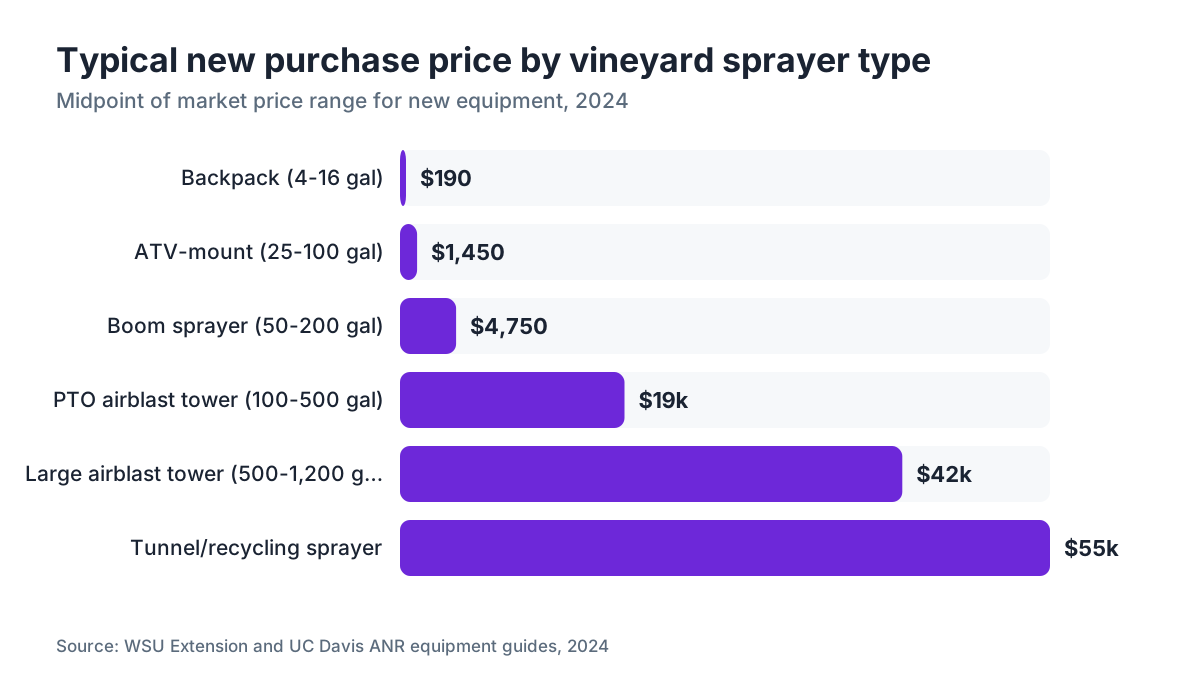
The range is genuinely wide, from under $200 for a 4-gallon backpack to $80,000-plus for a GPS-guided recycling tower sprayer. The table below organizes the realistic cost bands by sprayer type.
| Sprayer type | Typical new price | Typical used price | Min. tractor HP |
|---|---|---|---|
| Backpack (4-16 gal) | $80 - $300 | N/A | None |
| ATV-mount (25-100 gal) | $400 - $2,500 | $150 - $1,000 | None (battery/engine) |
| Boom sprayer (50-200 gal) | $1,500 - $8,000 | $500 - $3,500 | 25-40 HP |
| PTO airblast tower (100-500 gal) | $8,000 - $30,000 | $3,000 - $18,000 | 40-80 HP |
| Large airblast tower (500-1,200 gal) | $25,000 - $60,000 | $10,000 - $30,000 | 75-120 HP |
| Tunnel/recycling sprayer | $30,000 - $80,000+ | $15,000 - $40,000 | 80-140 HP |
Used equipment pricing is volatile. A machine that sold new for $22,000 in 2018 might fetch $8,000 or $20,000 at auction depending on whether the fan bearings and pump are healthy. Always ask for the service history and run the pump at full pressure before buying. A worn pump impeller or a cracked fan housing will cost you more than the discount you got.
Operating costs add up fast too. Nozzle wear is the one most people underestimate. Ceramic or stainless nozzles last 40,000 to 100,000 gallons; worn nozzles over-apply product by 10 to 30 percent, blowing your pesticide budget and potentially creating residue violations. Budget $200 to $600 per year for nozzle sets on a mid-size airblast rig [5].
How do I choose the right vineyard sprayer for my operation?
Start with acreage and terrain. Under 2 acres on flat ground: a backpack or ATV sprayer is fine and the capital cost of anything bigger doesn't pencil out. Two to 15 acres on moderate terrain with row widths above 9 feet: a compact PTO airblast tower on a 40- to 60-HP tractor is the standard answer. Above 15 acres or high-value estate production: look at larger tank airblast towers with multi-fan heads, or a recycling sprayer if drift regulations are tight in your appellation.
Row width is the silent variable that breaks deals. Most standard airblast towers need 10 to 12 feet of row clearance. Some European narrow-row vineyard designs (Guyot at 5-6 feet) require purpose-built narrow-profile machines. Measure your narrowest row before you call a dealer.
Trellis system matters too. A vertically shoot-positioned (VSP) canopy at 5 feet tall needs different air distribution than a Geneva Double Curtain at 8 feet. UC Davis Cooperative Extension has published detailed spray application guides that match nozzle configuration and fan speed to common California trellis systems [1].
Water source and tank fill logistics are underrated. A 500-gallon tank that takes 20 minutes to fill from a 25-gallon-per-minute pump means you'll spend almost as much time filling as spraying on a busy morning. Know your water delivery rate before sizing the tank.
Finally, think about who drives it. A machine that requires three hydraulic remotes and PTO fine-tuning to calibrate correctly will get set-and-forgotten by a crew that's already stretched. Simpler machines get calibrated more often and deliver better results than complicated ones that nobody touches after the first season.
How do I calibrate a vineyard sprayer correctly?
Calibration is how you convert a target rate (gallons per acre, or GPA) into tractor speed and pressure settings. Skip it, and you're either under-applying (disease risk) or over-applying (residue risk, wasted money, possible label violation). The label is the law: applying at a rate above or below the labeled range is a federal pesticide violation under FIFRA [6].
The standard calibration method for airblast sprayers:
- Fill the tank to a known level with water only.
- Set your target speed (typically 3 to 4 mph in most vineyards) and your target pressure.
- Spray one or more measured passes (1/10 acre is convenient for the math).
- Measure the water used in that measured distance.
- Scale to GPA and compare to your target.
- Adjust speed or pressure until output matches the label rate.
WSU Extension has a free calibration worksheet that walks through the arithmetic step by step, including correction factors for nozzle wear and viscosity [7]. It takes 30 to 45 minutes the first time; after that it's 15 minutes at the start of each season.
Nozzle output testing is the piece most vineyards skip. Place a catch cup under each nozzle for 30 seconds. Output should be within 10 percent of the average across all nozzles. Replace any that deviate more than that. Worn nozzles also change droplet size, which affects drift and canopy penetration in ways that a pressure adjustment can't fix.
For airblast tower sprayers, air velocity and direction matter as much as liquid output. Some university extension programs recommend a tracer dye test (using water-sensitive paper cards placed at various canopy positions) to verify that the spray actually reaches the fruit zone and vine interior. Cornell Cooperative Extension offers guidance on this technique as part of their integrated pest management resources [3].
What are the EPA Worker Protection Standard requirements for spraying in vineyards?
The EPA Worker Protection Standard (WPS), codified at 40 CFR Part 170, applies to any agricultural establishment where pesticides are used and workers or handlers are employed. Vineyards are explicitly covered [8].
Key WPS requirements that affect day-to-day spray operations:
Restricted-Entry Intervals (REI): Every pesticide label specifies an REI, the hours after application during which workers cannot enter the treated area without full PPE. REIs range from 4 hours (many fungicides) to 48 hours or more for certain insecticides. You must post treated fields and notify workers before they re-enter.
Handler PPE: Pesticide handlers (anyone mixing, loading, applying, or cleaning equipment) must wear label-required PPE. At minimum this typically means long sleeves, chemical-resistant gloves, eye protection, and a respirator when required by the label. The WPS requires that the employer provide, clean, and replace PPE.
Decontamination supplies: A WPS-compliant decontamination site must be within 1/4 mile of where handlers work. It needs water, soap, single-use towels, and a change of clothing.
Training: All workers and handlers must receive WPS safety training. Handlers must be trained before handling pesticides. Training records must be kept.
Central posting: The Safety Data Sheet (SDS) and application information for any pesticide with a 30-day or shorter REI must be posted at a central location for at least 30 days after application.
The 2015 WPS revision strengthened several of these requirements. As the EPA's own guidance states, "the 2015 WPS revisions provide additional protections for agricultural workers and handlers from pesticide exposure" including requirements for minimum age (no persons under 18 may handle pesticides) and annual training [8].
Sprayer operators who keep good application records, and track REIs alongside them, save themselves most of the compliance headaches. That's exactly the kind of workflow where a field operations platform like VitiScribe earns its keep: you log the application, the system flags re-entry windows so your crew lead doesn't have to keep that in their head.
How do I keep a legal pesticide application record for a vineyard?
In most U.S. states, any commercial agricultural pesticide application must be recorded. California's requirements under the Department of Pesticide Regulation (CDPR) are the strictest: records must be submitted to the county agricultural commissioner within 7 days of application, and must include the operator's name, license number, site description, pesticide product name and EPA registration number, amount applied, application method, acreage treated, and start and end times [9].
Other states have less frequent reporting requirements but still mandate record keeping. The federal requirement under FIFRA (Section 8) requires certified applicators to keep records for restricted-use pesticides for two years. Check your state department of agriculture for state-specific rules; they vary significantly.
A minimum legally defensible spray record entry includes:
- Date and time of application
- Pesticide product name and EPA registration number
- Active ingredient and rate applied (oz or lb per acre)
- Total acres and total product used
- Application equipment used
- Applicator name and license number (if required)
- Weather conditions at time of application (wind speed, direction, temperature)
- Target pest or disease
- REI and any re-entry restrictions posted
Keeping these records in a spreadsheet works legally, but tracking REIs and generating state-required reports from a spreadsheet is tedious and error-prone. VitiScribe's spray record module formats records to California and multi-state standards and exports directly to county commissioner submission formats.
Hold all spray records for at least two years for federal compliance, and three or more years if your state or a specific crop's GAP certification requires it.
What nozzle types work best in a vineyard?
Nozzle choice affects droplet size, coverage pattern, drift, and therefore both efficacy and compliance. The main types used in vineyards:
Hollow-cone nozzles: Standard on most airblast sprayers. They produce a cone-shaped spray pattern with fine to medium droplets. Good canopy penetration but higher drift potential than flat-fan nozzles. Most appropriate when canopy penetration is the priority (botrytis, powdery mildew in dense canopies).
Flat-fan nozzles: Even band coverage, used primarily for boom applications (under-vine herbicide, soil treatments). Less suited for canopy penetration.
Air-induction (AI) nozzles: Mix air into the liquid stream to produce larger, air-filled droplets that resist drift. Drift reduction can be 50 to 90 percent compared to hollow-cone nozzles, which matters when you're spraying near property lines or sensitive areas. The tradeoff is slightly reduced penetration into dense canopies.
Disc-core nozzles: The hollow-cone variant most common on tower-style airblast sprayers. The disc orifice size and core swirl angle together determine droplet size. Swapping disc-core combinations is the fastest way to adjust output without re-plumbing the machine.
The University of California IPM program recommends matching droplet size (measured as volume median diameter, or VMD) to the target pest and canopy density. For fungal diseases in dense VSP canopies, VMD of 150 to 250 microns balances penetration and drift. For systemic herbicides under the vine row, larger droplets (300+ microns) reduce off-target movement [10].
Nozzle spacing on tower heads matters too. On a standard airblast tower, nozzles are positioned at multiple heights on each side to match the canopy zone. If your trellis wire heights changed or you switched from VSP to GDC, recheck that your nozzle positioning still matches where the fruit zone actually is.
How do you reduce spray drift in a vineyard?
Drift is the movement of pesticide droplets or vapor away from the intended application site. It's an environmental concern, a neighbor-relations problem, and a compliance risk. The label on many products explicitly restricts application during wind speeds above 10 mph or 15 mph.
Practical drift reduction steps:
Spray during the lowest-wind windows of the day, typically early morning before 9 a.m. or evening after 5 p.m. in most growing regions. Keep a weather station at the vineyard or at minimum a handheld anemometer; estimating wind speed by feel is not reliable enough.
Switch to larger-droplet nozzles (AI or flat-fan) when spraying near property lines, water bodies, or non-target vegetation. Yes, you lose some canopy penetration, but the legal and relationship cost of drifting pesticide onto a neighbor's organic garden is much higher.
Reduce tractor speed. Slower pass speed reduces the air turbulence your equipment creates, which is a major secondary drift source on airblast machines. The air blast itself also needs to be matched to canopy density: running full fan speed on a leafed-out vine wall blows more spray through and out the far side than it actually deposits.
WSU Extension research found that reducing airblast fan speed by 25 to 30 percent on fully leafed-out canopies reduced drift by 30 to 40 percent with no meaningful reduction in disease control efficacy [7].
Buffer zones matter. Several EPA-registered pesticides now carry mandatory buffer zone requirements on the label itself. Read these before spraying near field edges.
What maintenance does a vineyard sprayer need?
Sprayer maintenance is seasonal and ongoing. Most problems that ruin a sprayer (or a spray application) trace back to skipped maintenance.
Before the season: Flush the tank and lines with clean water. Inspect all nozzles and replace worn ones. Check pump diaphragms or impeller for wear (a diaphragm pump that's losing prime or a centrifugal impeller with visible scoring needs rebuild or replacement). Test all pressure gauges against a known-good gauge; analog gauges drift over time. Lubricate all fittings, check PTO shaft and shear bolts, inspect fan blades for balance and cracks.
During the season: After every use, flush with clean water. Never leave pesticide mix in the tank overnight. Agitation systems left with settled product can clog and corrode. Check nozzle output monthly with catch cups.
End of season: Triple-rinse the tank. Use a tank cleaner product if you applied any sulfur or copper products (these leave residue that corrodes steel components). Fog the pump internals with a light oil if storage is over 30 days. Drain all lines in freeze-prone climates. Store indoors or under cover if possible.
Fan and air delivery system: On airblast sprayers, the fan is the highest-wear component after nozzles. Inspect blades for pitting, cracks, or warping each season. An unbalanced fan creates vibration that damages bearings and the fan housing. Bearing replacement on a standard airblast fan is a $200 to $600 repair; ignoring it leads to a $2,000 to $5,000 housing or shaft failure.
A well-maintained mid-range airblast sprayer (bought new at $15,000) should give 15 to 20 seasons of service. Neglected machines rarely make it past 8 to 10.
Where can you buy a vineyard sprayer, and what should you look for in a dealer?
Vineyard sprayers are sold through agricultural equipment dealers, direct importers, and online auction platforms. The brand landscape in North America includes a mix of North American manufacturers (Rears Manufacturing in Oregon, Durand-Wayland in Georgia) and European-origin machines imported under various names (Bargam/Lipco, Croplands, Nobili, Berthoud, Hardi).
For new equipment, dealer relationships matter more than they do for most equipment purchases. Vineyard sprayers have proprietary wear parts (nozzle bodies, pump rebuild kits, fan blade sets) that you'll need access to quickly mid-season. A dealer three states away who offers a $1,500 discount is a bad deal if they can't get you a replacement pump diaphragm within 48 hours in late May.
Searching for a vineyard sprayer for sale online, the main platforms are:
- TractorHouse.com (largest inventory of used agricultural equipment in North America)
- Machinery Pete
- Purple Wave Auction
- Local farm auction houses
- Direct from estate wineries that are upgrading or downsizing
When evaluating used equipment, bring someone who knows the brand or pay an independent mechanic for a pre-purchase inspection. On an airblast tower, specifically check: pump output and pressure, fan bearing play, nozzle body condition (cracks in plastic bodies are common and hard to see), agitation system function, and PTO drive condition.
The Croplands vineyard sprayer for sale market is primarily dealer-based in North America; their U.S. distribution has historically been through regional dealers rather than broad national retail. The Lipco vineyard sprayer for sale market has a similar dealer-centric model, with a reasonable used inventory showing up in California and Pacific Northwest auctions given their penetration in those markets [4].
If your vineyard is part of a larger estate operation or you're curious about how other vineyard estate setups approach equipment, visiting a destination vineyard like Gervasi Vineyard or exploring how larger estate operations in Paso Robles handle fleet management can give you practical reference points.
How does a vineyard sprayer affect wine quality and vineyard certification?
The connection between sprayer performance and wine quality is direct, even if it's not always credited. Inconsistent coverage means some vine blocks get adequate fungicide protection and others don't. Botrytis or powdery mildew pressure that breaks through in under-sprayed zones ruins fruit quality in ways that winemaking can only partly compensate for.
Over-application is the other side of the same problem. Copper accumulation in vineyard soils is a real agronomic issue in established vineyards; repeated high-rate copper applications from a poorly calibrated machine can suppress beneficial soil microbiology over time. Several European wine regions now have copper use caps (the EU cap is 28 kg per hectare over 7 years), and California organic programs have similar limits [9].
For organic certification, the sprayer equipment itself is not certified or prohibited, but the cleanliness of the tank matters. A sprayer used for conventional synthetic fungicide applications that isn't triple-rinsed before organic use could contaminate an organic block and trigger a certification violation. Keep a dedicated sprayer for organic blocks if you manage mixed-certification properties, or document triple-rinse procedures rigorously.
For GAP (Good Agricultural Practices) audits and increasingly for retail buyer compliance programs, spray records need to document more than what was applied. They also need the application method and equipment ID. Some audit frameworks ask for evidence of sprayer calibration records. Keeping a calibration log as part of your equipment records is a simple habit that pays off when auditors show up.
Frequently asked questions
What size vineyard sprayer do I need for 5 acres of grapes?
A 100- to 200-gallon PTO airblast tower sprayer on a 40-HP tractor handles 5 acres comfortably. At 3 to 5 GPA and 4 mph, a 100-gallon tank gives you roughly 5 to 8 acres per fill. An ATV-mounted 50-gallon unit can work but means frequent tank refills. If terrain prevents tractor access, a backpack sprayer is your practical fallback for this acreage.
How long does it take to spray 1 acre of vineyard?
With a tractor-mount airblast sprayer at 3 to 4 mph, covering both sides of each row in one pass, figure 15 to 20 minutes per acre on flat ground. Add 30 to 45 minutes total for filling, calibration check, and rinsing. Hillside terrain, tight turns, or narrow rows easily double that time. Backpack sprayers take 1 to 2 hours per acre.
What is the difference between an airblast sprayer and a boom sprayer for vineyards?
An airblast sprayer uses a high-velocity fan to carry droplets into the vine canopy from a distance, giving good three-dimensional coverage. A boom sprayer uses only hydraulic pressure and works best when nozzles can be positioned very close to the target, like under-vine herbicide applications. Airblast is the standard choice for canopy fungicide and insecticide applications on established vines.
Can I use a regular agricultural sprayer in my vineyard?
A standard flat-fan boom sprayer designed for row crops won't cover a tall grapevine canopy effectively. You can adapt it for under-vine applications, but for canopy coverage you need either an airblast tower or a purpose-built vineyard boom with nozzles positioned at multiple canopy heights. Trying to force the wrong machine leads to disease breakdowns and wasted product.
What is the EPA Worker Protection Standard requirement for re-entry after spraying?
Under the EPA WPS (40 CFR Part 170), workers cannot re-enter treated areas until the label-specified Restricted-Entry Interval (REI) has passed. REIs range from 4 hours for many fungicides to 48 hours or more for certain insecticides. Employers must post treated fields and notify workers of the REI before re-entry. Non-compliance is a federal violation with fines up to $19,000 per incident [8].
How often should vineyard sprayer nozzles be replaced?
Ceramic or stainless nozzles should be replaced when output deviates more than 10 percent from rated flow. Catch-cup testing monthly during the season catches this early. Plastic nozzles wear faster and in many operations need replacement every season. Running worn nozzles over-applies pesticide by 10 to 30 percent, which costs more in product than new nozzles do.
What records do I have to keep after spraying pesticides in my vineyard?
Federal law (FIFRA Section 8) requires two-year records for restricted-use pesticide applications by certified applicators. California requires submission to the county agricultural commissioner within 7 days [9]. Records must include product name, EPA registration number, rate, acreage, application method, applicator identity, and date and time. Most states require at least two years of retention; California-compliant records satisfy federal minimums.
What wind speed is too high to spray a vineyard?
Most pesticide labels restrict application above 10 to 15 mph. Practically, below 5 mph is ideal for airblast sprayers to minimize drift. UC Davis recommends spraying when winds are below 10 mph and avoiding temperature inversions (typically late evening into early morning) when fine droplets can be lofted off-site. Always check the product label first; its wind restriction supersedes general guidance.
Is a Lipco vineyard sprayer a good choice?
Lipco-distributed sprayers (primarily Bargam-based Italian engineering) have a solid reputation for stainless tank quality and compact tower dimensions suited to 9-foot rows. Parts availability depends on your dealer relationship. Used Lipco units in good condition are worth considering in the $5,000 to $15,000 range. As with any used machine, inspect pump output, fan bearing condition, and nozzle body integrity before purchase.
What is the best vineyard sprayer for organic grape growing?
The sprayer itself doesn't need organic certification, but tank cleanliness matters. Dedicated equipment for organic blocks avoids cross-contamination risk. Airblast sprayers work well for allowed materials like sulfur, copper, and biological fungicides. Electrostatic sprayers can reduce copper use per acre. UC Davis and OMRI (Organic Materials Review Institute) guidelines govern which products you can use; the sprayer is just the delivery system.
How do I calculate how much pesticide to put in a vineyard sprayer tank?
First calibrate your GPA (gallons per acre) output. Then multiply GPA by the acres you plan to spray to get total water volume. Multiply the label rate (oz or lb per acre) by total acres to get total product needed. Mix product into the tank proportionally. WSU Extension's spray calibration worksheet walks through this math with example calculations [7].
What's the difference between a Croplands and a Lipco vineyard sprayer?
Croplands (Australia/New Zealand origin) emphasizes multi-jet tower head designs and GPS flow control options; new units run roughly $15,000 to $45,000. Lipco distributes Italian Bargam-based machines known for compact, narrow-row tower profiles and stainless steel tanks. Both are credible mid-to-upper-tier brands. Your choice should hinge on dealer proximity, parts availability, and whether the tower profile fits your row width.
Can vineyard spray records be kept digitally?
Yes, and many operations have moved to digital records. California's CDPR accepts electronic records as long as they contain all required data fields and can be printed or exported in a compliant format for submission to the county agricultural commissioner. Cloud-based field operations software can automate the formatting and submission workflow. Keep backups; a record that can't be retrieved on demand is no record at all.
What happens if I spray over the labeled rate in my vineyard?
Applying a pesticide above the labeled rate is a violation of FIFRA Section 12. Penalties range from warnings to fines; California DPR fines can exceed $5,000 per violation per day [9]. Over-application also risks residue violations that can disqualify fruit for sale, particularly for export markets with strict MRL (maximum residue level) requirements. Calibration and accurate record-keeping are your protection.
Sources
- UC Davis Agriculture and Natural Resources, Spray Application Methods: Matching nozzle configuration, fan speed, and application rate to California trellis systems including VSP and GDC canopy types
- UC Cooperative Extension, Small Farm Pesticide Application Guidelines: Backpack sprayer coverage rate of approximately 0.25 to 0.5 acres per hour and suitability for operations under 2 acres
- Cornell Cooperative Extension, Vineyard IPM and Spray Application: Electrostatic sprayers can reduce spray volume 25 to 50 percent with equivalent coverage; water-sensitive paper tracer technique for verifying canopy coverage
- Croplands Equipment, Grapevine Sprayer Product Line: Croplands Grapevine series uses multi-jet tower heads and optional GPS flow control; new unit pricing range
- WSU Extension, Pesticide Application Equipment for Orchards and Vineyards: Nozzle wear rates, replacement intervals, and the effect of worn nozzles on over-application rates of 10 to 30 percent
- U.S. EPA, Federal Insecticide Fungicide and Rodenticide Act (FIFRA): Applying a pesticide inconsistent with its labeling is a violation under FIFRA Section 12
- WSU Extension, Calibrating Vineyard and Orchard Sprayers: Standard airblast calibration procedure; reducing fan speed 25 to 30 percent on full canopies reduces drift 30 to 40 percent with no meaningful reduction in disease control
- U.S. EPA, Worker Protection Standard (40 CFR Part 170): WPS requirements for REI posting, handler PPE, decontamination, training, and the 2015 revision language on additional protections
- California Department of Pesticide Regulation, Pesticide Use Reporting: California requires pesticide application records submitted to the county agricultural commissioner within 7 days; copper use restrictions in California organic programs
- UC Davis IPM, Droplet Size and Spray Coverage for Grapevines: Recommended VMD of 150 to 250 microns for fungal disease control in dense VSP canopies; larger droplets (300+ microns) recommended for herbicide applications
Last updated 2026-07-09