Vineyard spraying: a complete guide for grape growers
TL;DR
- Vineyard spraying controls fungal disease, insects, and weeds through a season-long program tied to vine growth stages.
- Most operations spray 8 to 15 times a season, timed by disease pressure, weather, and how susceptible the variety is.
- Coverage, canopy penetration, and re-entry intervals matter as much as which product you pick.
Why does vineyard spraying matter so much for grape quality?
Grapes are among the most spray-intensive crops in agriculture. One season of neglected powdery mildew can wipe out 50 to 80% of a crop in warm, humid conditions, and Botrytis bunch rot can take the rest at harvest. That's not hyperbole. UC IPM data ranks powdery mildew (Erysiphe necator) as the number one fungal threat to California vineyards, and Cornell's IPM program calls it the primary disease concern across the Northeast too [1][2].
The spray program does more than protect the crop. It shapes berry skin integrity, cluster architecture, and wine chemistry down the line. Let disease establish late and you often face elevated volatile acidity at crush, because Botrytis secretes laccase, an oxidase enzyme that destroys wine color and structure once the grapes hit the tank. Prevention isn't only cheaper than a lost crop. It's cheaper than the winery adjustments needed to partially rescue infected fruit.
Most small operations spray reactively, waiting on visible symptoms. That's already too late.
Vineyard disease management is almost entirely preventive. Fungicides and bactericides work by contact or by protecting healthy tissue from the inside, not by reversing an infection that's already set. By the time you see a powdery mildew colony, the pathogen has been sporulating invisibly for 7 to 10 days [2].
For managers at sites like the Paso Robles wineries or South Coast Winery, where maritime fog and temperature swings keep disease pressure windows open for weeks, this preventive mindset isn't optional.
What's a realistic vineyard spraying schedule by growth stage?
The calendar matters less than the vine's phenological stage. Growth-stage timing on the modified Eichhorn-Lorenz (E-L) scale is the standard taught by WSU Extension and Cornell's viticulture program, and it's how most fungicide labels are written [3][4].
Here's a practical framework for a moderate-pressure wine grape program:
| Growth Stage (E-L) | Approximate Calendar | Key Targets | Typical Applications |
|---|---|---|---|
| Bud swell to woolly bud (E-L 4-5) | Late Feb - March | Overwintering mite eggs, Phomopsis | 1-2 sprays |
| 3-5 inch shoot (E-L 9-12) | April | Powdery mildew, early Phomopsis | 1-2 sprays |
| Pre-bloom (E-L 17-19) | May | Powdery mildew, Botrytis (cluster stems) | 2-3 sprays |
| Bloom through fruit set (E-L 20-27) | Late May - June | Powdery mildew, Botrytis, leafhopper | 2-3 sprays |
| Post fruit-set to bunch closure (E-L 29-32) | June - July | Powdery mildew, Botrytis, mites | 2-3 sprays |
| Veraison to harvest (E-L 35-38) | August - September | Botrytis, sour rot, late-season mildew | 1-2 sprays |
The pre-bloom through fruit-set window is the one you cannot miss. Powdery mildew during early berry development costs the berry skin its elasticity, so the fruit cracks at veraison and invites Botrytis straight in. Skip one application across this 4 to 6 week stretch and you can lose the season in a high-pressure year.
Spray intervals during peak pressure run 7 to 14 days. Go shorter when conditions favor disease (temperatures 60 to 80 degrees F, relative humidity above 40%, long overcast periods) and longer through hot, dry spells [1]. Rain resets the clock because it strips off surface-active materials. Check your product label for rain-fastness, which ranges from 2 hours on some SI fungicides to 24 hours on many protectants.
Season totals run from about 8 for a low-pressure, well-ventilated inland site to 15 or more for a cool coastal or humid region site. That range comes from WSU spray trial work comparing Washington's Columbia Valley with Willamette Valley blocks [3].
What fungicides and pesticides are actually used in vineyards?
Vineyard fungicides fall into two camps: protectants and systemics. Protectants like sulfur, copper, and captan sit on the vine surface and kill spores on contact. They have zero movement into plant tissue, so coverage is everything, and they wash off. Systemics like sterol inhibitors (DMIs, FRAC code 3), strobilurins (FRAC code 11), and SDHI fungicides (FRAC code 7) move into or through the tissue and can cure early infections if you apply within 24 to 72 hours of an infection event.
Sulfur is the workhorse of organic and conventional programs alike. It's cheap, it beats powdery mildew, and it has no documented resistance. The catch: don't apply above 95 degrees F or within 14 days of an oil application, and it does nothing for Botrytis. Most dry wine grape programs use sulfur as the backbone at 3 to 5 lb per acre per pass, with systemics rotated in when pressure spikes [1].
FRAC code rotation is not optional if you care about resistance. Strobilurins (QoI fungicides like azoxystrobin and trifloxystrobin) carry moderate to high resistance risk, and resistant Erysiphe necator populations are documented in California and Washington. UC IPM guidelines recommend no more than 2 sequential applications of any single FRAC code class per season [1].
On the insect side, the main targets are grape leafhoppers (Erythroneura spp.), western grapeleaf skeletonizer, vine mealybug, and spider mites. Insecticide programs are far lighter than fungicide programs in most regions: 1 to 3 targeted applications a season, often with softer chemistries like insecticidal soaps, oils, or selective materials like spirotetramat for mealybug. WSU's pest management guide for wine grapes is the best single reference for the Pacific Northwest, updated every year [3].
Herbicides fill out the program. Most vineyards run pre-emergent and post-emergent materials under the vine row, with cultivation or cover crops in the middles. Glyphosate is still common, though plenty of growers are moving toward reduced-herbicide programs built on cultivation and mulching, especially the ones chasing certification.
How do you calibrate a vineyard sprayer correctly?
Calibration is where most small operations lose money and control. An airblast sprayer running 20% high wastes product and pushes you toward re-entry interval trouble. Running 20% low means your fungicide never hits the label dose, which means control failure, and on a systemic it means faster resistance selection.
The tree-row volume (TRV) method is the most defensible calibration approach for airblast sprayers in vineyards. Cornell's extension publications describe TRV as canopy height (feet) times canopy width (feet) times a region-specific constant to reach gallons per acre [2]. For canopies 3.5 to 4.5 feet tall and 2 to 3 feet wide, TRV rates usually land in the 50 to 100 gallons per acre range for conventional airblast gear.
Here's the basic calibration check:
- Fill the tank with clean water to a known level.
- Spray a measured distance at your target speed and PTO rpm.
- Calculate volume applied per acre (volume used divided by area covered).
- Compare to your target GPA.
- Adjust nozzles, pressure, or travel speed accordingly.
It sounds simple and it is, but do it at the start of every season and again after any nozzle swap. Nozzle wear in vineyards is real. Hollow-cone nozzles used for mildew sprays can jump 15 to 20% in output after a single season of sulfur, because sulfur is mildly abrasive.
On air-assisted sprayers, fan speed and deflector settings matter as much as nozzle output. You want enough air velocity to push spray into the cluster zone rather than onto the outer canopy surface, but not so much that you turn the whole thing into a drift machine. WSU's spray technology research group has published air-speed guidance by canopy density that's worth downloading [3].
What does EPA Worker Protection Standard require for vineyard spraying?
The EPA Worker Protection Standard (WPS), codified at 40 CFR Part 170, is the federal rule governing how agricultural workers and pesticide handlers are protected during and after applications in your vineyard [5]. If you have any employees working the vineyard, WPS applies to you. Full stop.
Here's what WPS actually requires.
First, restricted entry intervals (REIs). Every pesticide label carries an REI, the minimum time workers must stay out of a treated area after application. Common vineyard materials run from 4 hours (many sulfur formulations) to 48 hours (some systemic insecticides). The REI is federal law, not a suggestion. Workers cannot enter during an REI without full chemical-resistant PPE and closed-system equipment.
Second, pesticide safety training. Agricultural workers must get EPA-approved WPS training before working in areas where pesticides have been applied. Handlers, the people mixing and applying, need additional handler training. Training has to be documented and records kept for 2 years [5].
Third, central posting. You post application information at a central location (the WPS calls it the "designated posting location") showing the treated area, product name, EPA registration number, REI, and application dates. That posting stays up for 30 days after the REI expires.
The 2015 WPS revision, which took full effect January 2, 2017, added annual training, application exclusion zones, and mandatory decontamination supplies. EPA's pesticide worker safety page has the current regulatory text and a grower compliance guide [5].
State rules stack on top of federal WPS. California's Department of Pesticide Regulation, for one, requires a licensed Pest Control Adviser (PCA) for many restricted-use applications and county permits for certain materials [6]. Washington runs its version through the WSDA [7].
How do you keep spray records for compliance and liability protection?
Spray records are not optional in a commercial vineyard. California requires pesticide use reports (PURs) for every application, submitted monthly to the county agricultural commissioner [6]. Most other major wine states run similar requirements. Past state law, your spray records are the first thing you reach for when a neighbor claims drift damage, a worker files a WPS complaint, or a winery buyer audits your inputs.
A complete record for each application captures: date and time, product name and EPA registration number, application rate (product and water per acre), total acres treated, specific blocks or field IDs, applicator name and license number (if applicable), equipment used, wind speed and direction, temperature, and the pest or disease you were after.
That's a lot of fields to fill out in the field with dirty gloves on. In practice, most managers either run a paper log and transcribe it later or use a digital system that captures the data live. VitiScribe's spray log module is built for this workflow, with pre-populated product databases and automatic REI tracking so you're not doing re-entry math by hand after every pass.
Federal WPS requires records kept a minimum of 2 years [5], and California wants pesticide use reports submitted within the month following application [6]. WSU Extension's farm records guidance suggests holding spray records at least 5 years if you're anywhere with a history of drift litigation, because civil statutes of limitations often run longer than the federal floor [4].
For organic certified operations, spray records become part of the Organic System Plan and get reviewed by your certifier. Every input has to be on the National Organic Program's approved materials list and documented with lot numbers and application rates.
What equipment do you need for spraying vineyards?
The equipment call comes down to vineyard size, row spacing, and canopy shape. There's no universal right answer. Here are the main categories and where each one earns its keep.
Airblast sprayers are the standard for vineyards over about 5 acres. A large fan carries droplets into the canopy while a pump pushes solution through nozzles arranged around the fan housing. Tower sprayers (vertical airblast) have caught on in high-wire and VSP systems because you can aim at individual canopy zones. A used, well-maintained 200-gallon PTO airblast unit runs $8,000 to $20,000. New units from established makers (Rears, Durand-Wayland) run $25,000 to $60,000 depending on tank size and fan setup (these are current market ranges as of 2025, not a cited figure).
Backpack sprayers and hand guns make sense for vineyards under 3 to 5 acres, for touch-up work, or for hitting isolated disease hotspots. They're slow (1 to 2 acres an hour) but the coverage control is excellent and they need almost no calibration infrastructure. Every vineyard should keep at least one as a backup.
Sprayer drones are real and gaining ground. UC Davis has published preliminary efficacy data showing drone applications can match airblast for powdery mildew control in trellised vineyards with canopies under 5 feet, with the upside of cutting worker pesticide exposure [8]. The limits are real too: tank capacity (usually 2 to 10 gallons), flight time (15 to 25 minutes per charge), and a certified operator under FAA Part 137 for ag applications. Drones pencil out on steep blocks that are genuinely inaccessible or dangerous for ground equipment.
Whatever you run, nozzle choice carries a lot of the outcome. For powdery mildew, hollow-cone nozzles that throw a finer droplet (VMD 150 to 250 microns) are generally preferred, because mildew colonizes leaf undersides and berry surfaces and you need fine droplets to reach them. For botryticide at bunch closure, when drift risk and canopy interception both spike, switch to air-induction flat-fan nozzles (VMD 350 to 500 microns) to cut drift while still coating the cluster zone.
How does weather affect vineyard spray timing and efficacy?
Temperature, humidity, wind, and rain all interact with your program, sometimes turning a good product useless, sometimes turning a marginal window into the most important application of the year.
Powdery mildew infection needs leaf wetness for 0.5 to 4 hours and temperatures between 50 and 90 degrees F. The UC Davis risk model uses degree-day accumulation from a base of 50 degrees F to predict sporulation pressure, which is why UC IPM hosts a Powdery Mildew Risk Index tool updated seasonally [1]. High-risk windows are about more than humidity. They're the combination of time spent in the infection temperature zone and available inoculum from overwintered chasmothecia or flag shoots.
Wind is both an efficacy factor and a liability. Apply above 10 to 15 mph and you get significant off-target drift, which is an environmental violation if pesticides reach non-target land and a WPS violation if they drift into areas where workers are present. Most growers target 3 to 10 mph, aimed away from property lines, neighboring crops, and waterways. Night spraying is common in hot climates to dodge thermal inversions that trap the spray cloud near the ground.
Rain-fastness is its own math. Sulfur starts washing off within 2 to 4 hours of rainfall, so a quarter-inch event after application largely erases it. Some systemics hold better because they absorb partway into the cuticle wax within a few hours. Check the label's specific guidance and track your post-application rainfall against the label's stated rain-fastness window. If real rain lands before that interval, reschedule.
Temperature limits at both ends matter. Sulfur phytotoxicity is real above 95 degrees F and gets worse with oil tank-mixes or recent oil applications. Copper in cool, wet conditions can cause Bordeaux burn on young shoots. Weather-data integration in modern vineyard management systems can flag these risk windows before you send equipment out.
What are the differences between organic and conventional vineyard spray programs?
Organic grape production in the U.S. runs under the USDA National Organic Program (NOP), and the allowed materials are the National List of Allowed and Prohibited Substances under 7 CFR Part 205 [9]. For spraying, that means you lose most synthetic fungicides and all synthetic insecticides, which shrinks your toolkit fast.
The organic fungicide program leans hard on:
- Sulfur (the workhorse, same as conventional)
- Copper (copper hydroxide, copper sulfate, Bordeaux mixture) for downy mildew and Phomopsis
- Potassium bicarbonate (KHCO3, sold as Kaligreen, Armicarb) for powdery mildew
- Plant oils (neem, jojoba, mineral oils with OMRI listing)
- Biological fungicides (Bacillus subtilis products like Serenade, Bacillus amyloliquefaciens)
The honest read: organic powdery mildew programs work well in low-to-moderate pressure years but demand shorter intervals (5 to 7 days at peak instead of 10 to 14), because a protectant-only program has no curative activity. In high-pressure years in humid climates, organic programs genuinely struggle, and Cornell's plant pathology program has documented that in multi-year trials comparing organic and conventional efficacy in the Finger Lakes [2].
Copper is the environmental catch in organic programs. It accumulates in soil and turns phytotoxic at high concentrations. The NOP limits copper to 4 pounds of copper metal per acre per year for most crops, and California has additional DPR guidance on vineyard copper use [6]. Growers who've farmed organic for 20-plus years in the Willamette Valley or Finger Lakes are dealing with copper buildup that hurts root health in some blocks.
Conventional programs get more options but carry resistance-management duties. The Fungicide Resistance Action Committee (FRAC) and Insecticide Resistance Action Committee (IRAC) publish resistance risk ratings and rotation guidance that every conventional program should reference [10].
How do you manage spray drift and protect neighboring properties?
Drift is where spray programs turn into legal problems. One incident reaching a neighbor's organic vineyard can cost more than your whole year's spray budget, because the neighbor may have to decertify that block and you're on the hook for the lost income under most state agricultural tort frameworks.
Buffer zones on pesticide labels are federal law. When a label specifies a buffer (usually feet from a water body or non-target area), that buffer is a requirement, not a recommendation. EPA's label rules under FIFRA require buffer zones to appear on labels when residue or drift data shows non-target risk [11].
Practical drift reduction:
- Cut fan speed on airblast sprayers pre-bloom, when shoot growth is minimal and canopy interception is low
- Use drift-reduction nozzles (air-induction or twin flat-fan designs) that make larger droplets with less airborne fraction
- Apply in early morning, when thermal inversions tend to be milder and winds are calmer
- Log wind speed and direction at time of application (this is your paper defense if drift is later alleged)
- Talk to neighbors before major application windows, especially organic or beekeeping operations
State drift rules vary a lot. California's DPR has some of the most detailed drift-reduction requirements in the country, including county-specific wind speed restrictions for certain materials [6]. Washington requires handlers to take specific drift-avoidance training under its state WPS supplement [7].
If you farm in a valley crowded with other vineyards, informal coordination on spray schedules cuts conflict fast. Knowing your neighbor is applying a mold preventive this week lets you time around the overlap and gives you both documentation that you're coordinating responsibly.
How much does a vineyard spray program cost per acre?
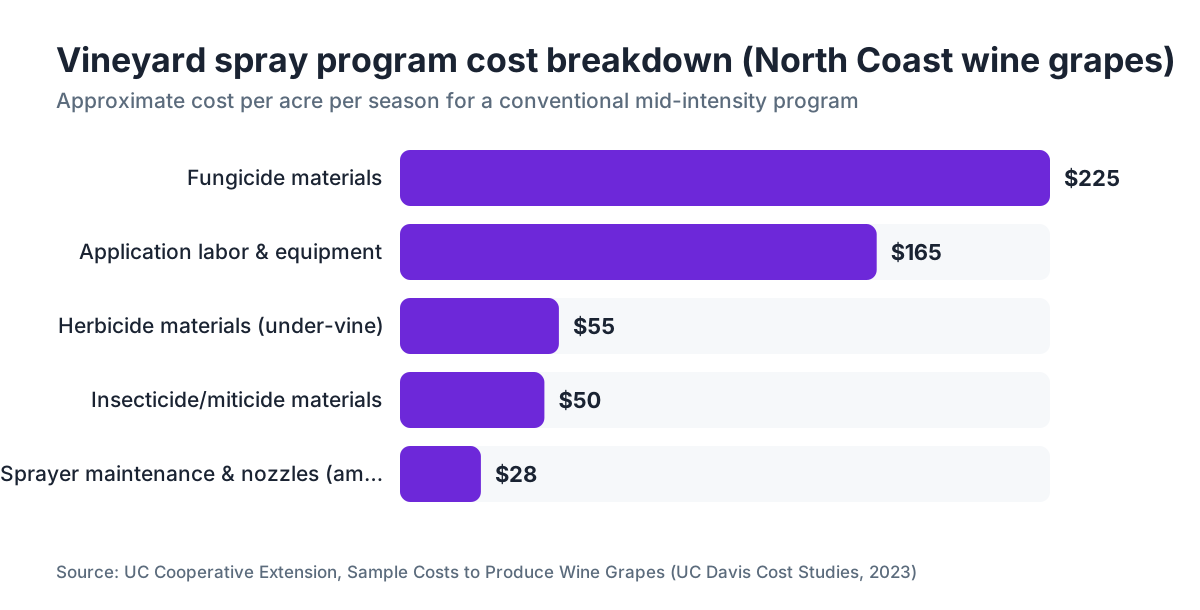
Cost estimates swing wide by region, program intensity, and whether you're paying for contract application or running your own gear. Nobody has clean nationwide data on this. The closest consistent source is the UC Cooperative Extension sample cost-of-production studies, updated by variety and region every few years [12].
The UC studies for wine grapes in the North Coast (Napa/Sonoma) put fungicide and pesticide materials at roughly $200 to $500 per acre per season, with application labor and equipment adding another $150 to $350 per acre depending on number of passes and whether the work is custom or owner-applied [12]. Central Valley table grape programs run lower (fewer disease pressure events), while cool coastal regions run higher.
Broken out by category:
- Fungicide materials: $100-350 per acre (conventional mid-intensity program)
- Insecticide/miticide materials: $20-80 per acre
- Herbicide materials: $30-80 per acre under-vine
- Application labor (tractor operator plus equipment): $80-200 per acre for the season
- Sprayer maintenance, calibration, nozzle replacement: $15-40 per acre amortized
Organic programs often cost more on materials, because OMRI-listed products cost more per unit than conventional equivalents. Copper hydroxide formulations and biologicals are not cheap at commercial rates. Organic premium pricing on grapes can offset that if you have a market for certified fruit.
Contract spraying by a licensed PCA/PCO (Pest Control Operator) in California typically runs $25 to $50 per acre per application at vineyard scale, which can pencil out for small properties that don't want to maintain their own equipment.
How do you track spraying records to stay compliant all season?
The paperwork load on a vineyard spray program is real. In California alone you're juggling pesticide use reports due to the county commissioner by the 10th of the month following application, WPS posting with specific fields, REI tracking by block and product, and often extra requirements from your winery buyer's sustainability program or a third-party certifier [5][6].
A paper log works, but it breeds downstream problems. Transcription errors, lost records, and the inability to pull up what went on a specific block for a specific date range are the usual failure modes. When a neighbor files a drift complaint or your buyer wants a full-season record for a sustainability audit, the gap between a clean digital log and a stack of field notebooks is wide.
This is where VitiScribe's record tools help: application logs with pre-loaded product databases, automatic REI countdown by block, and report exports formatted for California PUR submission or WPS posting. It doesn't replace your PCA's agronomic judgment, but it kills the lag between field application and compliant documentation.
Whatever system you run, build the habit of logging within 24 hours, while wind speed, applicator name, and any oddities (equipment malfunction, tank-mix adjustment) are still fresh. Rebuilding records from memory 3 weeks later is error-prone and can invalidate them for compliance.
WSU Extension's farm records program has spray log templates that meet Washington State requirements [4]. Cornell offers similar templates for New York growers through the New York State IPM program [2].
Frequently asked questions
How many times a year do you spray a vineyard?
Most wine grape vineyards need 8 to 15 spray applications per season, depending on regional disease pressure, variety susceptibility, and whether the program is conventional or organic. Low-pressure inland sites with hot dry summers may get by with 8 to 10. Cool coastal or humid regions frequently need 12 to 15 to hold adequate powdery mildew and Botrytis control through the season.
When should I start spraying my vineyard in spring?
The first spray usually times to bud swell or woolly bud (Eichhorn-Lorenz stage 4-5), which in most wine regions lands between late February and April depending on latitude and microclimate. At that stage the main targets are overwintering Phomopsis and early mite populations. Wait until shoot elongation for your first fungicide and you risk missing the early Phomopsis window, which causes cane lesions that cut next year's budbreak.
What is the best fungicide for powdery mildew in vineyards?
Sulfur is the most widely used and most resistance-proof material for grape powdery mildew. For curative activity after an infection event, sterol inhibitor fungicides (DMI class, FRAC code 3) like myclobutanil or tebuconazole work, but rotate FRAC codes to slow resistance. No single product is universally best. The right choice depends on infection stage, temperature, and your rotation history for that block.
What's the difference between a restricted entry interval and a pre-harvest interval?
The restricted entry interval (REI) is the time workers must stay out of a treated area after application, set by EPA's Worker Protection Standard. The pre-harvest interval (PHI) is the minimum days between the last application and harvest, set to let residues drop to legal tolerances. Both appear on every pesticide label. Violating either is a federal violation, and PHI violations can get your fruit rejected at the winery.
Can you spray vineyards during bloom?
Yes, with restrictions. Some fungicides, captan and certain synthetics in particular, carry label language limiting or prohibiting application during open bloom to protect pollinators. Sulfur and most systemics get applied during bloom in most programs, because pre-bloom and bloom is one of the highest disease pressure windows of the season. Always check the product label's pollinator language and notify beekeepers in your area before bloom applications.
How do I know what pesticides are legal to use on my vineyard?
Start with the EPA registration on the product label. If grapes or Vitis vinifera appear in the crop section, the product is federally registered for vineyard use. Then check your state's pesticide database for extra state restrictions. California's DPR keeps a searchable database of registered pesticides by crop. If you're organic certified, cross-reference the OMRI list and your certifier's approved materials list before buying any new product.
What PPE do vineyard workers need when spraying pesticides?
Handler PPE requirements sit on the product label and represent the minimum legal requirement under EPA WPS. Common requirements for vineyard fungicides include long-sleeved shirt and pants, chemical-resistant gloves, protective eyewear, and sometimes a respirator (typically for organophosphate or carbamate insecticides). Sulfur labels generally require less PPE than synthetic systemics. Never assume last year's label is current. Formulation changes can alter PPE requirements even for familiar products.
How do you reduce pesticide drift when spraying vineyards?
Spray in winds below 10 to 15 mph, aimed away from property lines and water. Use air-induction nozzles that make larger droplets with less drift-prone fine fraction. Cut fan speed on airblast sprayers during periods of low canopy density. Apply in early morning when temperatures and winds tend to be lower. Document wind speed and direction in your spray record for every application as a liability baseline.
Do I need a pesticide applicator license to spray my own vineyard?
For general-use pesticides, most states let the property owner apply without a license. For restricted-use pesticides (RUPs), requirements vary. California requires either a licensed private applicator or a licensed pest control operator for RUP applications, plus a Pest Control Adviser recommendation for many materials. Oregon, Washington, and New York run similar private applicator license programs through their state departments of agriculture. Check with your county ag commissioner.
How do I submit pesticide use reports for my vineyard in California?
California vineyards submit Pesticide Use Reports (PURs) to the county agricultural commissioner by the 10th of the month following application, as required by the California Food and Agricultural Code. Reports include the product name, EPA registration number, application site, acreage treated, and total pounds of active ingredient applied. County commissioners provide paper forms, and some counties accept electronic submission through the CalAgPermits system.
What's the right gallons per acre rate for vineyard airblast spraying?
Target GPA depends on canopy size and density, calibrated with the tree-row volume (TRV) method. For typical VSP-trained wine grape canopies (3.5 to 4.5 feet tall, 2 to 3 feet wide), TRV calculations usually yield 50 to 100 gallons per acre for airblast sprayers. Too little means poor coverage and inadequate dose. Too much means excess runoff, wasted product, and spray blowing out the back of the canopy, which creates drift.
How do organic vineyard spray programs differ from conventional ones?
Organic programs rely on sulfur, copper, potassium bicarbonate, plant oils, and biologicals. They lack curative synthetic fungicides, so intervals run shorter at peak pressure (5 to 7 days vs. 10 to 14 for conventional), and total spray counts often end up similar or higher. Organic materials cost more per unit but carry premium grape prices in many markets. Copper buildup in soil is a long-term concern for organic programs using heavy copper rates.
What records do I need to keep for the EPA Worker Protection Standard?
Under 40 CFR Part 170 you keep records of pesticide safety training for all agricultural workers and handlers (training date and materials used), pesticide application information posted at the central location, and records of decontamination supplies. Training records must be kept for 2 years. WPS doesn't require you to keep the application records themselves (that's a state requirement), but those records are your practical defense for REI compliance.
Sources
- UC IPM, UC Division of Agriculture and Natural Resources, Grape Pest Management Guidelines: Powdery mildew is the primary fungal threat to California vineyards; sulfur is the backbone protectant material; FRAC code rotation guidance limits sequential applications of any single class
- Cornell University, New York State IPM Program, Grape IPM: Powdery mildew identified as primary disease concern in Northeast vineyards; multi-year trial data on organic vs. conventional fungicide efficacy in the Finger Lakes; TRV calibration method described
- Washington State University Viticulture and Enology, WSU Extension: E-L growth-stage timing standard; multi-year spray trial data comparing Columbia Valley and Willamette Valley blocks; annual pest management guide for wine grapes; air-speed guidance by canopy density
- Washington State University Extension: Farm records guidance recommending spray records be kept at least 5 years in regions with drift litigation history; spray log templates meeting Washington State requirements
- U.S. EPA, Worker Protection Standard for Agricultural Pesticides, 40 CFR Part 170: WPS requires handler and worker training documented and kept 2 years; central posting requirements; application exclusion zones added in 2015 revision effective January 2, 2017
- California Department of Pesticide Regulation, Pesticide Use Reporting: California requires monthly pesticide use reports submitted by the 10th of the month following application; PCA requirement for restricted-use pesticide applications; copper use guidance for vineyards
- Washington State Department of Agriculture, Pesticide Program: Washington administers WPS requirements and requires handlers to take state drift-avoidance training under its WPS supplement
- UC Davis Department of Viticulture and Enology: Preliminary efficacy data showing drone applications can match airblast for powdery mildew control in trellised vineyards under 5 feet canopy height, with reduced worker exposure
- USDA Agricultural Marketing Service, National Organic Program, 7 CFR Part 205: National List of Allowed and Prohibited Substances governs organic spray materials including sulfur, copper, potassium bicarbonate, and biological fungicides; copper limit of 4 lb per acre per year
- Fungicide Resistance Action Committee (FRAC), FRAC Code List: FRAC code resistance risk ratings and rotation guidelines for vineyard fungicide programs; strobilurin (QoI) fungicides rated moderate to high resistance risk
- U.S. EPA, Pesticide Registration, Federal Insecticide Fungicide and Rodenticide Act: Buffer zones on pesticide labels are federal requirements under FIFRA, not recommendations; labels must include buffer requirements when drift or residue data shows non-target risk
- UC Cooperative Extension, Sample Costs to Establish a Vineyard and Produce Wine Grapes, North Coast (UC Davis Cost Studies): Fungicide and pesticide materials costs approximately $200-500 per acre per season in North Coast wine grape production; application labor and equipment adds $150-350 per acre
Last updated 2026-07-09