What does viticultural mean? A working definition for vineyard managers
TL;DR
- Viticultural refers to anything related to viticulture, the science and practice of growing grapevines for wine, table grapes, or raisins.
- The word covers soil management, canopy training, pest and disease control, irrigation, and harvest timing.
- It appears on spray records, pesticide labels, worker protection standards, and certification exams.
- If you work in a vineyard, you work in a viticultural operation.
What does viticultural mean, exactly?
Viticultural is the adjective form of viticulture. Viticulture comes from the Latin vitis (grapevine) and cultura (tending), so viticultural means "of or relating to the growing of grapevines." That's the whole definition. Nothing fancy.
The word shows up in three contexts. First, as a descriptor for a place: a viticultural area, which in U.S. regulatory language means an American Viticultural Area (AVA), a geographically defined grape-growing region approved by the Alcohol and Tobacco Tax and Trade Bureau [1]. Second, as a descriptor for a practice: viticultural management, viticultural records, viticultural scouting. Third, as a professional or academic label: a viticultural advisor, a viticultural science degree.
The word is not interchangeable with "winemaking" or "enological." Winemaking starts when grapes leave the vineyard. Viticulture stops there. That line matters for regulatory purposes, insurance coverage, and grant eligibility.
How is viticulture different from enology?
Viticulture and enology are the two halves of grape-to-glass science. Viticulture covers everything outdoors in the vineyard: planting, training systems, pruning, shoot and leaf management, irrigation, soil health, pest scouting, disease control, and harvest decisions. Enology (also spelled oenology) covers what happens once grapes hit the crush pad: fermentation chemistry, yeast management, oak aging, blending, and bottling.
UC Davis runs one of the most recognized programs in the world under its Department of Viticulture and Enology, and it describes viticulture as "the science, production, and study of grapes" while enology addresses wine production [2]. The two share a department but have separate curricula, separate internship tracks, and graduates who end up in very different jobs.
For a vineyard manager, this split has real paperwork consequences. Pesticide application records, worker protection standard training logs, and irrigation water use reports all sit on the viticultural side. Winery permits, SO2 addition logs, and label approvals sit on the enological side. Mixing them up during an audit is a fast way to create trouble.
What are the main disciplines inside viticultural science?
Viticultural science is broader than most people outside the industry expect. Cornell's grape program at the New York State Agricultural Experiment Station in Geneva organizes the field into several core areas [3]:
Vine physiology studies how the plant grows, moves water, allocates carbohydrates, and responds to temperature and light. Knowing vine physiology is how you make pruning calls that don't starve the plant.
Soil science covers texture, drainage, nutrient availability, pH, and microbial activity below the vine. Cover crop species and tillage timing trace back to this.
Canopy management is the hands-on side of vine physiology: shoot positioning, leaf removal, hedging, and cluster thinning to control fruit quality and disease pressure.
Pest and disease management includes integrated pest management (IPM) plans, scouting protocols, threshold-based spray decisions, and resistance management. This is where the heaviest compliance paperwork lives.
Irrigation science covers vine water status through pressure bomb readings or leaf water potential, soil moisture sensors, and evapotranspiration math.
Harvest physiology covers the chemistry of ripening: sugar accumulation (Brix), titratable acidity, pH, and phenolic maturity. It also covers the logistics of picking fruit at the right moment.
The hard part is that a decision in one area always has consequences in another. Pull leaves to fight mildew and you change fruit exposure, which changes ripening chemistry. Everything connects.
What is an American Viticultural Area (AVA) and why does it matter?
An American Viticultural Area is a defined grape-growing region recognized by the Alcohol and Tobacco Tax and Trade Bureau (TTB) under 27 CFR Part 9 [1]. As of mid-2025, there are more than 270 established AVAs across the United States, from large regions like California's Central Valley to tiny appellations covering a single ridge.
TTB rules say that if a wine label carries an AVA name, at least 85 percent of the grapes used to make that wine must come from within that AVA [1]. For multi-state AVAs the threshold drops to 75 percent. These are hard legal thresholds, not guidelines.
AVA designation matters to a grower because it shapes what your winery customers can put on their labels, which shapes what they'll pay for your fruit. Growers inside a recognized sub-AVA, like Sta. Rita Hills inside Santa Barbara County or Red Hills inside Lake County, often command price premiums over growers in the larger surrounding region. That premium is a direct function of the viticultural area designation.
Petitioning for a new AVA or a boundary change is a formal process. It takes evidence of geographic distinctiveness, a record of historical grape growing, and a public comment period. The TTB's rulemaking record for any established AVA is publicly searchable at regulations.gov.
Some of California's best-known growing areas, including Paso Robles wineries territory and the hills around several recognized sub-AVAs, spent years in the petition process. It takes real data on climate, soils, and growing history to make the case.
What compliance rules apply specifically to viticultural operations?
Several federal and state frameworks target vineyard operations directly, or hit agriculture in ways that land hard on vineyards.
EPA Worker Protection Standard (WPS): The WPS under 40 CFR Part 170 applies to any agricultural employer who uses or supervises workers who handle pesticides or work in treated areas. Vineyards are covered [5]. Requirements include training agricultural workers before they enter treated areas, posting pesticide application information at a central location, providing decontamination supplies, and keeping application records. The EPA's 2015 revision to the WPS added handler training rules and anti-retaliation protections.
Pesticide application records: Most states require licensed applicators to log every restricted-use pesticide application for at least two years: the crop (grapes), application site, product name, EPA registration number, amount applied, and applicator license number. California's Department of Pesticide Regulation requires monthly pesticide use reports filed with county agricultural commissioners [6].
Water quality compliance: Irrigated vineyards in many states fall under agricultural water quality orders. In California, most North Coast and Central Coast vineyards enroll in a Regional Water Quality Control Board program with annual reporting.
Food safety: Wineries sourcing from third-party growers increasingly ask for GAP (Good Agricultural Practices) compliance or FSMA Produce Safety Rule documentation, even though wine grapes currently have a qualified exemption from FSMA's produce safety rule under 21 CFR Part 112.
Keeping all of this straight is where a lot of small operations get burned. This is the problem VitiScribe was built to solve: a single field operations and compliance log that pulls pesticide records, WPS documentation, and water use into one place, so you're not chasing five separate spreadsheets.
What viticultural practices have the biggest effect on grape quality?
Honest answer: canopy management and the timing of water stress have the strongest documented effects on berry composition, based on decades of research from UC Davis, Cornell, and WSU.
Canopy density touches everything. A dense, shaded canopy cuts UV exposure to clusters, raises berry pH, drops anthocyanin development in red varieties, and builds the humid microclimate that powdery mildew and botrytis love. Work by Richard Smart and John Dyson, published in the American Journal of Enology and Viticulture, showed that canopy light interception above roughly 90 percent lowers fruit quality in most wine grape varieties. Getting leaf area right is often worth more than any spray program.
Deficit irrigation timing matters enormously. Pre-veraison regulated deficit irrigation (RDI) applied at the right soil water potential can shrink berry size, concentrate flavor compounds, and rein in vigor without pushing the vine past recovery. Post-veraison stress hits sugar loading and phenolic ripening differently. Nobody has a universal prescription here. The right protocol depends on variety, rootstock, soil depth, and your target wine style.
Pruning level, meaning how many buds you leave and where, sets the whole season's ceiling. Over-cropping is the single most common quality-limiting decision in commercial vineyards. A vine carrying 20 tons per acre cannot ripen fruit to the same Brix as one carrying 4 tons per acre. Full stop.
Soil organic matter and cover crops work on a slower cycle, feeding vine nutrition, water-holding capacity, and beneficial insect populations. The payoff is real but takes 3 to 5 years to show up clearly in vine performance data.
How do I read a pesticide label for viticultural use?
Pesticide labels are federal law. The EPA's own phrasing is that "the label is the law," so if a label says "do not apply within 100 feet of water," that restriction binds you legally. It's not a suggestion.
For vineyard applications, read four sections closely.
Crops covered. The label must list grapes (Vitis) or grapevines for the product to be legal in a vineyard. Some labels say "small fruits" broadly; others are crop-specific. If grapes aren't on the label, you cannot apply it. Period.
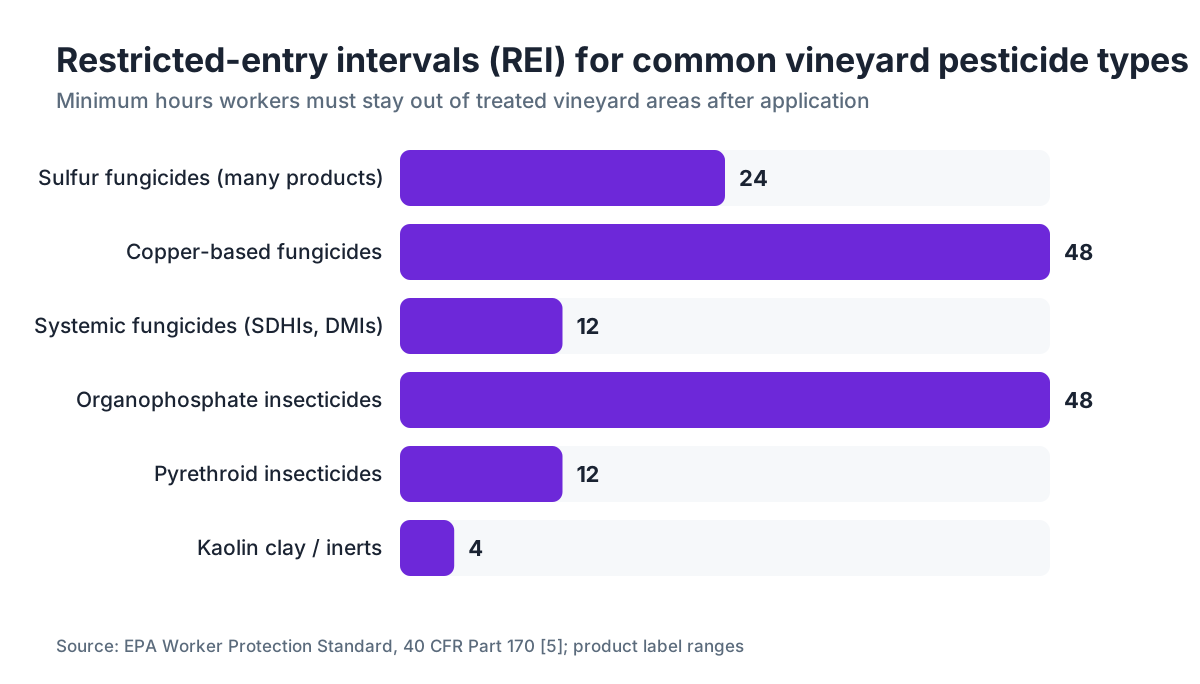
Restricted-entry interval (REI). The minimum time after application before workers without full protective equipment can re-enter the treated area. The WPS requires you to post the REI at the central display location and keep workers out for the full interval [5]. REIs for common vineyard fungicides run from 4 hours (many sulfur products) to 48 hours (some organophosphates).
Pre-harvest interval (PHI). The number of days between the last allowed application and harvest. Miss it and you have a residue violation. Your winery buyer's food safety program will catch it, or the state ag department will during routine sampling.
Use rate and water volume. Labels set minimum and maximum application rates per acre, and often a minimum gallons-per-acre water volume for coverage. Applying below the minimum rate is as much a violation as blowing past the maximum.
If you're using restricted-use pesticides, your license number goes on every application record. Keep those records at least two years, longer if your state says so [6].
What education and credentials do viticultural professionals have?
The most recognized academic programs are at UC Davis (B.S. and M.S. in Viticulture and Enology) [2], Cornell University's grape program at the New York State Agricultural Experiment Station in Geneva (research-focused graduate work and extension) [3], and Washington State University's Viticulture and Enology program in Prosser. Cal Poly San Luis Obispo runs a well-regarded Wine and Viticulture program with a strong hands-on bent.
Below the four-year degree, several community colleges in California, Oregon, and Washington offer associate degrees or certificates in viticulture, including Napa Valley College and Walla Walla Community College.
On the certification side, the Society of Wine Educators offers a Certified Specialist of Wine (CSW) that covers viticulture basics alongside wine knowledge. For a more production-focused route, the Court of Master Sommeliers Diploma covers viticulture in depth, and the Master of Wine credential requires demonstrated viticultural knowledge in written exams and a research paper.
For a working vineyard manager, the most useful credential is often a California Qualified Applicator License (QAL) or your state's equivalent pesticide applicator license. That license lets you supervise restricted-use applications legally, and it requires ongoing continuing education that keeps you current on new chemistries and rule changes.
Most working viticulturists I've talked with rate extension programs as more useful than degrees for day-to-day problem solving. Extension pest identification and spray-timing resources are genuinely good, and free.
How is viticultural practice different across major U.S. wine regions?
U.S. wine regions vary enough that a viticulture textbook written for Napa Valley will get you into trouble in the Finger Lakes, and the other way around. Here's how the key viticultural factors line up across major regions:
| Region | Climate type | Key disease pressure | Common training systems | Major viticultural challenge |
|---|---|---|---|---|
| Napa / Sonoma, CA | Mediterranean | Powdery mildew | VSP, lyre | Water availability, Pierce's disease |
| Paso Robles, CA | Continental (warm) | Powdery mildew | VSP, head-trained | Extreme diurnal shift, drought stress |
| Willamette Valley, OR | Cool maritime | Botrytis, mildew | VSP, Scott Henry | Ripening in cool years |
| Columbia Valley, WA | Arid continental | Spider mites, mildew | VSP, Geneva Double Curtain | Irrigation management, freeze events |
| Finger Lakes, NY | Cool continental | Botrytis, downy mildew | VSP, high-wire | Hybrid variety compliance, short season |
| Texas Hill Country | Hot semi-arid | Pierce's disease, mildew | VSP, cordon | Heat stress, inconsistent rainfall |
| Virginia | Humid subtropical | Downy mildew, botrytis | VSP | Fungal pressure, harvest timing |
Those differences explain why advice that works in one region can be actively harmful in another. Washington's arid climate keeps botrytis pressure low most years, so growers there can run fuller canopies than Willamette Valley growers who fight botrytis every harvest.
The vineyard setting and its microclimate always beat the general textbook line. That's the first principle most experienced viticulturists learn.
What records does a viticultural operation need to keep?
Record-keeping demands stack up from every direction: federal pesticide law, state agricultural commissioner rules, water board reporting, food safety audit standards, and TTB compliance if you sell to a bonded winery.
At minimum, a vineyard in any major U.S. wine state should keep:
Pesticide application records. Date, location (block or APN), product name and EPA registration number, target pest, application method, rate per acre, total area treated, REI posted, and applicator name and license number. FIFRA requires two-year retention for restricted-use pesticides [5]. Many states require longer.
Worker protection standard training logs. Proof that each agricultural worker and pesticide handler got WPS training before working in treated areas, with the training date, trainer's name, and topics covered, as specified in 40 CFR 170 [5].
Irrigation and water use logs. Required under many state water board orders and increasingly asked for by food safety auditors.
Scouting and crop monitoring notes. Not always legally required, but essential for showing IPM threshold-based decisions if a pest control call is ever questioned.
Harvest records. Block-level yield, Brix at harvest, pick date, and destination winery. Your buyer almost certainly wants these, and you need them for any block-level quality analysis.
The practical headache is that these records live in different places: paper spray logs, irrigation controller exports, handwritten harvest notes. Pulling them together is real work. Tools like VitiScribe exist to fold those streams into one auditable record.
Is viticultural the same as agricultural for tax and legal purposes?
Mostly yes, with a few nuances that matter. The IRS classifies grape growing as farming under Schedule F (Profit or Loss From Farming), so vineyard operations can use cash-basis accounting, take the Section 179 equipment deduction, and in some cases use the special farm income averaging provision under Section 1301 [7].
For property tax, most states with real wine grape production have agricultural preserve programs (California's Williamson Act, or state equivalents) that cut property tax assessments on land in active agricultural use, grapevines included.
For OSHA jurisdiction, farms with fewer than 10 employees are generally exempt from OSHA enforcement, but EPA WPS requirements apply no matter the farm size [5]. This trips up a lot of small operators who assume WPS can't touch a family operation. It does.
For H-2A agricultural guestworker visas, grape growing and harvesting counts as agricultural employment and is H-2A eligible. Winery work (crushing, fermentation) is not, because it's classified as manufacturing, not agriculture.
The practical lesson: the moment a vineyard crosses into winery operations, even small on-site processing, the legal classification of the work changes, and a different rule set kicks in.
Where can I learn more about viticultural science and practices?
The best free resources come from university extension programs. UC Davis Viticulture and Enology publishes research updates, pest management guides, and variety trial data [2]. WSU Extension's viticulture program in Prosser puts out free guides on site selection, spray timing, and irrigation scheduling. Cornell's grape extension in Geneva leans into cool-climate and hybrid variety management and publishes free fact sheets [3].
For California growers, the UC IPM Pest Management Guidelines for Grapes are the most authoritative free reference on disease and pest thresholds and treatment options, and they're updated regularly [8].
The American Journal of Enology and Viticulture (AJEV) publishes peer-reviewed research and is the primary scientific journal for the field. Full access needs a subscription or institutional library, but abstracts are free.
For AVA and regulatory questions, the TTB's website carries the full text of every AVA regulation under 27 CFR Part 9 and guidance on label compliance [1].
If you're near a major production region, your county's University of California Cooperative Extension farm advisor, or your WSU or Cornell county extension agent, is often the single best resource, because they know your specific soils, climate, and pest pressures. That local knowledge sits in no textbook.
Frequently asked questions
What does viticultural mean in simple terms?
Viticultural means anything related to growing grapevines. The word is the adjective form of viticulture, the science and practice of growing grapes. If you manage a vineyard, scout for pests, prune vines, or write spray records, you're doing viticultural work. The term covers everything that happens in the vineyard, before the grapes are crushed.
What is a viticultural area and why does it matter on a wine label?
A viticultural area is a federally recognized grape-growing region defined by the TTB under 27 CFR Part 9. If a wine label carries an AVA name, at least 85 percent of the grapes must come from that area. The designation affects label rights, fruit pricing, and marketing. There are more than 270 approved AVAs in the United States as of 2025.
What is the difference between viticulture and horticulture?
Horticulture is the broad science of growing plants: fruits, vegetables, flowers, and ornamentals. Viticulture is a subset focused only on grapevines. A viticulturist specializes in vine physiology, canopy management, and grape quality. A horticulturist might work with dozens of crops. At universities like UC Davis, viticulture programs sit separate from general horticulture departments.
Do viticultural operations have to follow the EPA Worker Protection Standard?
Yes. The EPA's Worker Protection Standard under 40 CFR Part 170 applies to all agricultural employers who use pesticides or whose workers enter treated areas, vineyards of any size included. Requirements cover worker training before field entry, posting application information at a central location, providing decontamination water and supplies, and keeping records. There is no small-farm exemption from WPS, even below 10 employees.
What degree do you need to become a viticulturist?
There's no single required degree. UC Davis, Cornell, Washington State University, and Cal Poly offer bachelor's and graduate programs in viticulture. Many working viticulturists hold associate degrees or certificates from community colleges like Napa Valley College or Walla Walla Community College. A pesticide applicator's license (your state equivalent) is often more immediately necessary for day-to-day vineyard management than a four-year degree.
What are the most common viticultural records I need to keep?
At minimum: pesticide application records (two-year retention under FIFRA for restricted-use pesticides), WPS training logs for each worker and handler, irrigation water use records, and harvest data by block. Most states add more. California requires monthly pesticide use reports filed with the county agricultural commissioner. Food safety audits usually want scouting records and spray decision documentation too.
How is viticultural management different in cool climates versus warm climates?
Warm-climate viticulture (California, Texas) leans on water management, heat stress mitigation, and reining in excess vigor. Cool-climate viticulture (Finger Lakes, Willamette Valley) centers on getting fruit ripe in a short season, fighting aggressive fungal pressure from botrytis and downy mildew, and opening the canopy to gather heat units. Training systems, pruning levels, and spray programs differ a lot between the two.
What does a viticultural advisor do?
A viticultural advisor, called a PCA (Pest Control Advisor) in California, gives site-specific recommendations on pest and disease management, canopy training, irrigation scheduling, and fertility programs. They're usually required to make written pesticide recommendations in states that restrict who can recommend restricted-use products. Many also help growers prep for food safety audits and handle compliance with water boards or county agricultural commissioners.
Is grape growing classified as farming for tax purposes?
Yes. The IRS classifies grape growing as farming. Vineyard operators report income and expenses on Schedule F and can use farm-specific tax provisions including cash-basis accounting, the Section 179 equipment deduction, and farm income averaging under Section 1301. Winery operations, including crushing and fermentation, may be classified as manufacturing, so operations doing both need to track expenses carefully between the two.
What is the pre-harvest interval and why does it matter in vineyards?
The pre-harvest interval (PHI) is the minimum number of days between the last pesticide application and harvest, stated on the product label. It's a federal requirement, not a suggestion. Picking grapes before the PHI expires creates a pesticide residue violation. Winery food safety programs and state agricultural sampling both test for it. Missing a PHI can get fruit rejected and cost you your applicator license.
How do viticultural practices affect wine quality?
Canopy management and water stress timing have the strongest documented effects on berry composition. Dense, shaded canopies raise berry pH, cut anthocyanins in red varieties, and raise disease pressure. Pre-veraison deficit irrigation can shrink berry size and concentrate flavor compounds. Pruning level sets crop load, and over-cropping is consistently the most common quality-limiting factor in commercial vineyards. Soil management and cover crops help too, but over a 3-to-5-year horizon.
What is the restricted-entry interval (REI) and how does WPS apply to it?
The restricted-entry interval is the time after a pesticide application when workers can't enter the treated area without full personal protective equipment. The WPS requires the REI posted at a central location and enforced for all agricultural workers. Common vineyard fungicides carry REIs from 4 hours (many sulfurs) to 48 hours (some organophosphates). Violating REI requirements is a federal WPS compliance failure.
What is Pierce's disease and which viticultural regions are most affected?
Pierce's disease is a fatal bacterial disease of grapevines caused by Xylella fastidiosa, spread by sharpshooter leafhoppers. It kills Vitis vinifera vines within 1 to 5 years of infection and has no cure once established. It's most severe in Southern California, Texas, and the Gulf Coast states where the glassy-winged sharpshooter is present. UC researchers work on resistant rootstocks and varieties. Northern California regions manage risk through the Statewide Pierce's Disease Control Program.
Can a small vineyard be exempt from viticultural compliance requirements?
Mostly no. The EPA Worker Protection Standard applies regardless of farm size. Pesticide record-keeping under FIFRA applies to any restricted-use application. Water quality reporting thresholds vary by state but often start at 10 acres or less. The FSMA Produce Safety Rule exemption for wine grapes is in place but subject to regulatory review. Small vineyards carry fewer administrative burdens than large ones, but the core compliance requirements still apply.
Sources
- TTB (Alcohol and Tobacco Tax and Trade Bureau): AVAs are defined under 27 CFR Part 9; wines labeled with an AVA must contain at least 85% fruit from that area (75% for multi-state AVAs)
- UC Davis Department of Viticulture and Enology: UC Davis defines viticulture as the science, production, and study of grapes and offers B.S. and M.S. programs in viticulture and enology
- Cornell University, College of Agriculture and Life Sciences (New York State Agricultural Experiment Station, Geneva): Cornell organizes viticultural science into vine physiology, soil science, canopy management, pest management, and harvest physiology
- Washington State University Extension: WSU Extension provides free online guides on pest identification, spray timing, and irrigation for viticulture
- EPA, Agricultural Worker Protection Standard (40 CFR Part 170): The WPS applies to all agricultural employers using pesticides, including vineyards of any size, and requires worker training, REI posting, decontamination supplies, and application records
- California Department of Pesticide Regulation: California requires monthly pesticide use reports submitted to county agricultural commissioners by licensed applicators
- IRS, Publication 225 (Farmer's Tax Guide): Grape growing is classified as farming under Schedule F; vineyard operators may use cash-basis accounting and farm income averaging under Section 1301
- UC IPM, Pest Management Guidelines for Grapes: UC IPM Grape Guidelines provide disease and pest thresholds and treatment options for California viticultural operations, updated regularly
- Electronic Code of Federal Regulations, 27 CFR Part 9: Regulations governing wine labeling, including AVA and grape variety content requirements
- EPA, Federal Insecticide, Fungicide, and Rodenticide Act (FIFRA): FIFRA requires two-year retention of application records for restricted-use pesticides including applicator license number, product EPA registration number, rate, and area treated
- University of California Agriculture and Natural Resources (UC ANR): Pierce's disease (Xylella fastidiosa) kills Vitis vinifera vines within 1 to 5 years of infection; UC research addresses resistant rootstocks and varieties, and the Statewide PD Control Program manages regional risk
- USDA National Agricultural Statistics Service (NASS): Real data on U.S. wine grape acreage and production by region, used for regional comparison context
Last updated 2026-07-10