What spray records are required for certified organic vineyard transition

TL;DR
- To transition a vineyard to USDA certified organic, you must keep at least 3 years of records proving no prohibited substances touched the land.
- Every application needs a record: date, product name, EPA registration number, rate, target pest, and applicator.
- Keep those records 5 years past certification and hand them to your certifier on demand.
What is the 3-year transition period and why do spray records drive it?
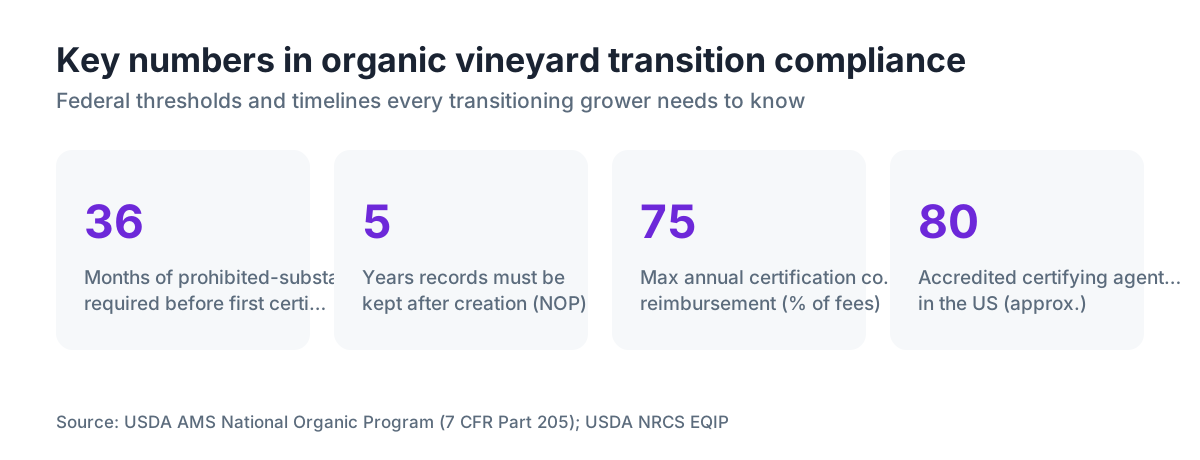
The USDA National Organic Program requires that land be free of all prohibited substances for 36 months before the first certified organic harvest [1]. That clock starts from the last date a prohibited material hit the ground, and your spray records are the only evidence your certifier can audit.
This is the piece that trips up most growers. The transition period isn't a calendar countdown from the day you decide to go organic. It runs from the last prohibited application. Spray a synthetic fungicide on August 14, 2022, and your earliest possible certified harvest lands sometime after August 14, 2025. Can't produce records proving that date? Your certifier may push the start date later, and there goes a season.
Records carry the burden of proof. The NOP regulation at 7 CFR 205.103 says a certified operation must "maintain records for no less than 5 years beyond their creation" and that those records must be "sufficient to demonstrate compliance with the Act and the regulations" [1]. Your certifier reads that to mean every input, on every block, every year, going back through the whole transition window.
Vineyard blocks with messy histories make the records problem worse fast. Take a block you farmed conventionally for a decade and then decided to convert. Any gap in documentation gets treated with suspicion. Miss a single season, and your certifier usually adds time to your clock rather than giving you the benefit of the doubt.
What specific information must each spray record entry contain?
The NOP doesn't publish one universal spray log template, but 7 CFR 205.103(b)(2) requires records that document the application of every substance used [1]. Certifiers and state organic programs have turned that into a consistent set of fields.
Here's what every application entry needs:
| Field | What to record | Why it matters |
|---|---|---|
| Date of application | Month, day, year | Anchors the 36-month calculation |
| Field or block identifier | Name or map code | Links application to specific acreage |
| Product name (trade name) | Full label name | Certifier checks it against approved lists |
| Active ingredient(s) | From the label | Distinguishes OMRI-listed from synthetic versions |
| EPA registration number | From the label | Confirms the exact product formulation |
| Application rate | Per acre, per gallon carrier, or per label | Required under WPS records too [2] |
| Acres or rows treated | Actual treated area | Allows total load calculations |
| Application method | Sprayer type, airblast, drone, etc. | Equipment audit trail |
| Target pest or disease | What you were treating | Shows agronomic justification |
| Applicator name | Who made the application | WPS and NOP compliance [2] |
| REI and PHI observed | From the label | Worker Protection Standard requirement |
| Weather conditions | Wind speed, temp, relative humidity | Drift documentation |
Some certifiers also want the lot or batch number of the material you bought, especially for copper hydroxide or sulfur, because formulation matters. An 81% wettable sulfur and a proprietary emulsifiable sulfur can carry different adjuvants, and some adjuvants aren't approved for organic use.
Buy a product with an OMRI (Organic Materials Review Institute) listing? Note it on the record. OMRI listing isn't required for organic approval, but it makes your certifier's review faster and less likely to spark an inquiry [3].
What counts as a prohibited substance that resets the transition clock?
Under 7 CFR 205.105, organic production prohibits any synthetic substance not specifically allowed on the National List (7 CFR 205.601) and any natural substance the list specifically prohibits [1]. In vineyard practice, the materials most likely to show up in pre-transition spray logs and stretch your clock include:
Synthetic fungicides: myclobutanil (Eagle, Rally), tebuconazole, trifloxystrobin, mancozeb, and any other DMI, QoI, or SDHI chemistry. One application resets your clock.
Synthetic insecticides: organophosphates (chlorpyrifos, malathion), pyrethroids, neonicotinoids (imidacloprid, thiamethoxam). These show up heavily in grapevine leafroll vector programs.
Synthetic herbicides: glyphosate, diuron, simazine. Herbicide records get scrutinized hard because between-row applications often run for years as a default floor management habit.
Synthetic fertilizers and soil amendments: anything with synthetic nitrogen, phosphorus, or potassium. Fertigation and soil injection records count here.
A few things growers assume will reset the clock but usually don't, since they sit on the National List: sulfur, copper-based fungicides (within rate limits), kaolin clay, spinosad, Bacillus thuringiensis, horticultural mineral oils, and approved biopesticides. Check the current National List directly at ams.usda.gov, because the list changes by rulemaking. What was prohibited in 2015 may be approved now, and the reverse happens too [1].
Herbicide residues in soil can be a separate issue from the application record. For blocks next to conventional farming, some certifiers ask for a soil test or tissue test as extra evidence. Nobody has clean universal data on how long synthetic herbicide residues last in vineyard soils. Glyphosate half-life studies in California soils range from roughly 3 to 130 days depending on soil type and microbial activity. That uncertainty is exactly why your records showing no applications matter so much.
How far back do pre-transition records actually need to go?
Your certifier needs to verify a full 36-month window of clean land history [1]. So you need records reaching back at least 3 years before your intended first certified harvest. Applying for certification in spring 2026 to sell a 2026 harvest as certified organic? You need documentation of every application (or non-application) back to spring 2023.
In practice, most accredited certifiers ask for records covering the full period since your operation or current land management began, whichever is shorter. Farmed the block for 8 years? They'll want at least the most recent 3 to 5.
Newly purchased or leased land is the complication. You're responsible for documenting the prior owner's or tenant's practices too. Buy a vineyard in 2024 and want to sell certified organic fruit in 2027? You need records or credible evidence that no prohibited substances went on from 2024 forward. In most cases that means signed affidavits from prior operators plus whatever spray logs or purchase receipts they can dig up. A bill of sale showing a synthetic pest control company had a service contract on the property is a red flag your certifier will chase down.
WSU Extension publishes a good primer on documenting transition period land history for Pacific Northwest operations, and their organic transition worksheets are worth requesting if you farm in that region [4].
What does an organic system plan require beyond spray logs?
Spray records are the backbone of the transition file, but they're one piece inside the larger Organic System Plan (OSP) that 7 CFR 205.201 requires every certified producer to keep [1]. The OSP is a living document you submit to your certifier and update every year.
Beyond application records, a complete organic system plan for a vineyard usually includes:
A field map or block inventory showing acreage, variety, and rootstock for each block. This sets the geographic boundary for every other record.
Soil and water management practices, including cover crop seeding records (species, seeding date, source, any seed treatments), tillage records, and irrigation logs if you fertigate.
A pest and disease management narrative describing how you scout, what economic thresholds you use, and the sequence of practices before you reach for a spray.
Harvest and post-harvest handling records if you're also handling the fruit as organic through crush. For most growers selling to a winery, this stops at the bin.
Equipment cleaning logs if your sprayer also runs on conventional blocks or for a conventional landlord. Cross-contamination from shared equipment is a real audit concern.
Sales records showing that certified organic fruit was sold as such, and to whom. The audit trail connecting your production to the marketplace is required under 7 CFR 205.103(b)(3) [1].
Keeping these records straight in a notebook is genuinely hard, especially across multiple blocks with multiple application events per season. Tools like VitiScribe structure exactly this kind of block-level field log, so when your certifier asks for the last 3 years of applications on Block 7, you pull a report instead of rewriting notes from a cabinet of spiral notebooks.
Which certifiers and accreditation bodies actually review vineyard spray records?
Under the NOP, certification is done by USDA-accredited certifying agents, not by the USDA directly. Roughly 80 accredited certifiers operate in the US [5]. For vineyard operations, the ones you'll see most in wine country include California Certified Organic Farmers (CCOF), Oregon Tilth, the Washington State Department of Agriculture Organic Program, and a handful of smaller regional certifiers.
Each certifier works from the same federal standards but may layer its own supplemental forms, checklists, and documentation preferences on top of the NOP baseline. CCOF, for one, publishes detailed transition application checklists that spell out field-by-field documentation requirements. Washington State's organic program runs certification through the state department of agriculture and has specific instructions for documenting transition in its operator worksheets [6].
The annual certification fee varies by certifier and by size of operation. For a small vineyard under 40 acres, expect roughly $400 to $1,200 per year in certification fees. That range isn't fixed, so request a fee schedule directly from each certifier. Cost-share programs exist too. USDA's organic certification cost-share has historically reimbursed a portion of certification costs, and the 2018 Farm Bill continued funding at up to 75% of certification costs, capped at $750 per year [7].
Your certifier does at least one inspection per year, and during transition years they focus mainly on your records. Federal rules don't require a soil or tissue test, though some certifiers ask for them as extra evidence when the paper trail has holes.
How do worker protection standard records overlap with organic spray records?
The EPA Worker Protection Standard (40 CFR Part 170) requires agricultural employers to keep records of every pesticide application for 2 years [2]. Those WPS records must carry the product name, EPA registration number, active ingredient, location treated, date, time, and the REI.
For organic transition, the required data set is nearly identical. One well-designed spray log can satisfy both frameworks at once. The NOP stretches the retention period to 5 years beyond creation, so NOP rules govern your retention schedule if you're building a dual-purpose log [1] [2].
Where WPS adds requirements the NOP doesn't is around posting treated areas and notifying employees. Those are operational safety rules, not record-keeping differences. For building your transition file, capture the NOP fields described earlier and you satisfy WPS automatically.
UC Davis publishes guidance on combined WPS and organic recordkeeping for California operations, and it's a practical starting point for designing a log that doesn't duplicate effort [8].
What happens if records are incomplete or missing for part of the transition period?
Missing records don't automatically end your certification application, but they create problems that are entirely avoidable.
If records are missing for a short window and you have other corroborating evidence (invoices showing you didn't buy synthetic pesticides, a long-term relationship with a crop advisor who can write a statement, aerial imagery showing you weren't running a conventional spray program), some certifiers will accept a combination of evidence. That's certifier discretion, not an NOP entitlement.
If records are missing for a substantial period and no corroborating evidence exists, your certifier will typically require that the 36-month clock restart from the date your reliable record-keeping began. This is the worst case. You think you're 2 years into transition, records are thin for one year, and suddenly you're starting over.
Fraud is worth naming directly. Falsifying spray records to speed up organic certification is a federal violation. The NOP regulations at 7 CFR 205.110 provide for revocation and civil penalties, and there have been prosecution cases under the Organic Foods Production Act [9]. The organic label depends on accurate documentation, and certifiers can tell when records look reconstructed.
Here's the practical advice: start your record-keeping the day you decide you might ever want to go organic, even years before you apply. A simple spray log with accurate dates and product information is far easier to produce and defend than a document you rebuild from memory at application time.
Are there record-keeping differences between USDA NOP and California, Oregon, or Washington state organic programs?
The short answer: state programs must meet or exceed NOP standards, and none of the major wine-producing states have written spray record requirements looser than the federal baseline [1].
California is the biggest nuance. California runs its own state organic program under the California Department of Food and Agriculture, and CDFA accredits certifiers operating in the state. For growers also subject to the DPR (California Department of Pesticide Regulation) restricted materials permit system, there are parallel record-keeping requirements for pesticide use reports filed with county agricultural commissioners. Growers in California's organic transition often find they're keeping three overlapping sets of records: NOP, WPS, and DPR pesticide use reporting. A well-designed block-level spray log satisfies all three if it captures the right fields [10].
Oregon's Department of Agriculture runs an organic certification program with transition documentation forms that align with but stay separate from private certifier forms. Washington State's organic program is administered by WSDA and is one of the more rigorous state programs on transition documentation review [6].
For interstate commerce, the NOP governs the certified organic label regardless of which state your vineyard sits in. Selling certified organic grapes to a winery in another state? Your NOP certification is what the label claim rests on.
What are the best practices for organizing transition records to make certification smoother?
Certifiers who review vineyard transition files have seen every record-keeping system imaginable, and the files that move through review fastest share a few habits.
Block-level organization beats date-based filing. File every application by date in one log, and your certifier has to manually pull all applications for Block 7 out of three years of entries. Organize by block first, then by year, then by date within that block, and you've done the work for them.
Product documentation should be attached or linked. Keep a file of product labels and SDS sheets for every material you applied during transition. If a question ever comes up about whether a product was approved, the label is the answer. OMRI publishes a database of approved materials you can cross-reference [3].
A negative record matters. If you didn't make any applications to a block in a given month or season, write that down. "No applications, Block 7, April through June 2023, cover crop only" is real documentation. It closes a gap a skeptical reviewer would otherwise question.
Annual summaries speed up reviews. Some growers build a one-page annual summary per block showing total copper applied (certifiers track copper accumulation), total sulfur, any pest issues and how they were handled, and any deviations from the organic system plan. This summary sits at the front of each year's file.
Managing more than a few blocks across multiple years turns the record-keeping burden real. Cornell's small farms program has published field records templates adapted for organic transition that are free to download and use as a starting framework [11]. Want a system that ties block-level spray logs to your OSP and generates certifier-ready reports? That's exactly the use case VitiScribe was built for.
One last thing: back up everything. Records lost in a fire, flood, or hard drive failure don't earn you a waiver from the certifier. Digital records with cloud backup plus a printed annual summary in a fireproof cabinet is the combination that lets you sleep during an inspection year.
What are the copper and sulfur accumulation limits organic growers need to track?
This is a question organic vineyard managers hit in year two of transition, often surprised it exists at all.
Copper-based fungicides are allowed in organic production, but the National Organic Standards Board has long recognized that copper builds up in soil and turns toxic to soil biology at elevated levels. The NOP's National List at 7 CFR 205.601(i) allows copper-based materials with the restriction that they be "used in a manner that minimizes accumulation of copper in the soil" [1]. There's no single hard federal numeric limit written into the NOP rule itself, but the EU has set a 28 kg/hectare limit over 7 years (4 kg/ha/year) as a reference, and some US certifiers use similar benchmarks in their own program guidance.
For practical management, CCOF and other certifiers may ask you to track annual copper applications in kg of copper metal per hectare, not the product weight. Different copper formulations carry different metallic copper content. Copper hydroxide at 77% active ingredient is a different animal from a 10% Bordeaux mixture. Your spray log needs the product, the rate, and ideally the metallic copper equivalent so cumulative load can be calculated [10].
Sulfur doesn't carry an accumulation limit concern the same way, but it does have label-based rate restrictions and PHI requirements that must appear in your records.
Tracking these numbers across multiple blocks and multiple seasons is one of the strongest arguments for moving spray record-keeping out of a paper notebook and into a structured system.
Where can growers find official transition record templates and guidance?
Several publicly available resources hand you record templates that are genuinely usable, well past introductory overviews.
USDA NRCS publishes organic transition cost-share and planning resources, and NRCS also funds SARE (Sustainable Agriculture Research and Education) transition guides that include sample logs [7].
UC Davis's Agricultural Sustainability Institute and its Sustainable Agriculture Research and Education Program have published organic farming record-keeping guides specific to California conditions [8]. These include spray log templates designed to satisfy both DPR and NOP requirements.
WSU Extension's organic farming program has transition timeline worksheets and field record forms calibrated for Pacific Northwest pest and disease pressures, including specific guidance on copper use in high-rainfall vine disease environments [4].
Cornell Cooperative Extension's organic farming resources include a transition record packet developed for Northeast producers that works well as a general-purpose template [11].
Your accredited certifier is also a primary resource. Every certifier publishes its own transition application packet. Request it before you need it, because certifiers like CCOF include specific forms they want completed rather than general guidance.
The USDA AMS organic program page is the authoritative source for the current National List and for finding accredited certifiers in your state [5]. Any other resource, including this article, is secondary to that primary regulatory text.
Frequently asked questions
How long do I have to keep organic spray records after certification?
Under 7 CFR 205.103, certified organic operations must keep records for a minimum of 5 years beyond their creation. A spray record from your first certified harvest year needs to stay on file until 5 years after that harvest. Most compliance advisors recommend keeping records indefinitely for land with a complicated history, since future buyers or certifiers may ask about older applications.
Can I start the 36-month transition clock if I only farmed part of my acreage organically?
Yes, the transition period applies per parcel or field unit, not to the whole farm. You can certify individual blocks while other blocks on the same property stay in conventional production. You'll need to keep parallel records for each block, clearly separated. Buffer zones and cross-contamination risk between conventional and transitioning blocks get reviewed by your certifier, and split operations require a documented plan.
Does the 36-month clock reset if a neighboring farm drifts a synthetic pesticide onto my block?
Not automatically. The NOP at 7 CFR 205.202(b) focuses on applications made by or for the certified operation. Documented drift from a neighboring operation is treated differently from intentional application. If residues turn up in a compliance test, your certifier investigates the source. Document any drift incidents immediately in writing and notify your certifier. Unintentional contamination doesn't automatically decertify or reset your transition, but intentional use does.
What's the difference between being in transition and being certified organic?
During the 36-month transition period, you're farming to organic standards but you cannot legally label or sell your grapes as certified organic. Once the 36 months are complete and your certifier has verified your records and issued a certificate, you can sell that year's harvest as certified organic. The label claim only attaches after certification is formally granted, not from the day you started transitioning.
Do I need a spray record for cover crop seed treatments applied during transition?
Yes. Seed treatments containing synthetic fungicides or insecticides are prohibited inputs. If you buy treated cover crop seed, that counts as a prohibited substance application, and it resets your clock. Always buy untreated seed during transition and keep the purchase invoice showing it was untreated. Many certifiers specifically ask about seed sourcing in their transition application packet, and OMRI maintains guidance on approved seed treatments.
Can I use Roundup between vine rows during the transition period if I'm just burning down cover crops?
No. Glyphosate (Roundup) is a synthetic herbicide and a prohibited substance under the NOP regardless of how or where you apply it on a transitioning block. Any application to transitioning acreage resets the 36-month clock from that date. Alternative floor management during transition includes mechanical mowing, cultivation, organic-approved contact herbicides like acetic acid (vinegar-based), or establishing permanent cover crops that cut the pressure for herbicide use.
Is OMRI listing required for a product to be used in organic or transitioning vineyards?
No, OMRI listing isn't legally required. What matters is whether the product's active ingredients and formulation components are allowed under the NOP National List. OMRI listing is a third-party review that confirms this, but it's voluntary. Some certifiers strongly prefer OMRI-listed products because it speeds their review. If you use a non-OMRI-listed product, your certifier may ask for the full ingredient list to verify compliance, so keep labels on file.
What records do I need if I hire a custom spray contractor during transition?
You're responsible for the records, not the contractor. Under both WPS and NOP rules, the agricultural employer or certified operator must keep the application records. Require your contractor to provide a written application record for every job that includes all required fields: product, EPA registration number, rate, date, acres treated, and applicator name. Build this into your service agreement before the season starts. Verbal confirmations aren't sufficient.
Are foliar nutrient sprays (like fish emulsion or kelp extract) considered pesticide applications that need to be logged?
They're not pesticide applications, but they're still input applications and should be logged in your organic system plan records. Some fish emulsions and kelp products have OMRI listings and are approved under the National List. Log them the same way you'd log a spray: date, block, product, rate, purpose. If a foliar material goes through the same equipment used for pest management, document that too. It shows your certifier a complete picture of everything that touched the vines.
How do I document a pesticide application that turned out to be a prohibited substance by mistake?
Document it accurately and notify your certifier in writing immediately. Trying to omit or alter the record is a federal violation with much more serious consequences than a disclosure. The certifier will reset the transition clock to that application date. Honest disclosure preserves your standing and your certification relationship. Falsification can result in permanent revocation and civil penalties under the Organic Foods Production Act.
What financial assistance is available for organic vineyard transition?
The USDA NRCS Environmental Quality Incentives Program (EQIP) Organic Initiative provides cost-share payments for transition practices including cover cropping, nutrient management planning, and pest management systems. Separately, USDA organic certification cost-share reimburses up to 75% of annual certification fees, capped at $750 per year. Some states run additional programs. California's CDFA has historically run its own organic transition assistance programs funded through the state budget.
Do I need spray records for the years before I decided to transition, or only from when I started farming organically?
You need records for the entire 36-month pre-certification window, regardless of your intent at the time. If you farmed conventionally for 2 years before deciding to transition, those 2 years of conventional spray logs are part of your required documentation. They prove when the last prohibited application happened. Without records from that period, your certifier starts the clock from the earliest date you have documented clean application history.
Sources
- USDA Agricultural Marketing Service, National Organic Program Regulations (7 CFR Part 205): NOP requires land be free of prohibited substances for 36 months before first certified harvest; records must be maintained for 5 years beyond creation; 7 CFR 205.103, 205.105, 205.201, 205.601
- EPA, Agricultural Worker Protection Standard (40 CFR Part 170): WPS requires agricultural employers to keep pesticide application records including product name, EPA registration number, active ingredient, location, date, time, and REI for 2 years
- OMRI (Organic Materials Review Institute), OMRI Products List: OMRI provides third-party review confirming whether a product's ingredients comply with NOP National List requirements; listing is voluntary but aids certifier review
- Washington State University Extension: WSU Extension publishes transition timeline worksheets and field record forms for Pacific Northwest organic producers including copper use guidance
- USDA Agricultural Marketing Service, Organic Program: Approximately 80 USDA-accredited certifying agents operate in the US; certifiers administer NOP standards for organic certification
- Washington State Department of Agriculture, Organic Program: WSDA administers state organic certification program with specific transition documentation forms and review standards for Washington producers
- UC Davis Agricultural Sustainability Institute: UC Davis publishes organic farming record-keeping guides for California including spray log templates satisfying both DPR and NOP requirements
- USDA Agricultural Marketing Service, Organic Foods Production Act (7 U.S.C. 6501 et seq.): Falsifying organic certification records is a federal violation under the Organic Foods Production Act; NOP regulations at 7 CFR 205.110 provide for revocation and civil penalties
- California Department of Pesticide Regulation, Pesticide Use Reporting: California DPR requires pesticide use reports filed with county agricultural commissioners; organic transition growers maintain parallel NOP, WPS, and DPR records
- Cornell Small Farms Program: Cornell publishes transition record packets and field record templates adapted for Northeast organic producers, usable as general-purpose templates
Last updated 2026-07-11