American Society for Enology and Viticulture: what it does and why it matters
TL;DR
- The American Society for Enology and Viticulture (ASEV) is the primary professional organization for grape growers and winemakers in North America.
- Founded in 1950, it publishes the peer-reviewed American Journal of Enology and Viticulture, runs an annual national conference, and awards scholarships to students in viticulture and enology.
- Active membership costs roughly $100 to $175 per year for working professionals.
What is the American Society for Enology and Viticulture?
ASEV is a nonprofit professional association founded in 1950 and headquartered in Davis, California, right next to the UC Davis Department of Viticulture and Enology [1]. Its members include winemakers, vineyard managers, researchers, extension specialists, and students across the United States, Canada, and about 50 other countries. The organization's stated mission is to "advance the scientific and practical knowledge of enology and viticulture" through research publication, professional education, and networking.
That mandate sounds dry on paper. In practice ASEV is the main place where the science behind grape growing and winemaking gets published, argued over, and eventually turned into what you actually do in the field. When a researcher at WSU Extension publishes a study on grapevine red blotch virus management, there is a good chance it lands in ASEV's journal first [2]. When UC Davis enology faculty want to share new findings on malolactic fermentation timing, ASEV's annual technical meeting is often where the work gets presented publicly for the first time [1].
For vineyard managers specifically, ASEV fills a gap that general agriculture associations don't cover well. The American Farm Bureau is enormous but generic. State growers' associations are local but thin on science. ASEV sits in the middle: national scope, heavy technical depth, and a direct pipeline to university research programs at UC Davis, Cornell, and Washington State.
How did ASEV start and how has it grown?
ASEV was founded in 1950 by California wine industry researchers and winery operators who wanted a dedicated scientific home for their work. Enology and viticulture were still establishing themselves as serious academic disciplines in the United States, and the industry was recovering from the long disruption of Prohibition, which ended in 1933 but left American wine science decades behind its European counterparts.
ASEV launched its flagship publication, the American Journal of Enology and Viticulture (AJEV), the same year. That journal is now one of the most-cited peer-reviewed publications in grape and wine science globally [3]. The organization has grown from a California-centric group to one with chapters across North America, including the ASEV Eastern Section, which covers the mid-Atlantic, Midwest, and northeastern states and runs its own separate annual meetings tuned to cool-climate and hybrid variety growing.
Membership tracked the expansion of the American wine industry itself. The 1970s Napa boom, the 1990s consumer health interest in wine, and the 2000s explosion of small-farm wineries and AVAs all brought new growers and winemakers who needed a professional anchor. Today ASEV has several thousand members, though the organization does not publish a precise count.
What does ASEV membership actually include?
Active membership for working professionals costs roughly $100 to $175 per year depending on your category [4]. Student membership is cheaper, usually $30 to $50. Life membership is a one-time payment for senior members. ASEV also offers institutional memberships for wineries and academic departments that want to give access to multiple staff.
Here is what you get with a standard active membership:
| Benefit | Details |
|---|---|
| AJEV journal access | Full digital access to all issues, current and archive |
| Annual meeting registration discount | Reduced rate for the national conference, typically held in June |
| Eastern Section meeting discount | Separate discount for eastern U.S. regional conference |
| Member directory | Access to the searchable member network |
| Scholarship eligibility | Members can nominate students; students can apply directly |
| Industry communications | Technical bulletins, policy updates, regulatory news |
The journal access alone is worth real money. AJEV's publisher (ASEV itself) charges non-member institutional rates for online access that run into hundreds of dollars per year for a single subscription. If anyone on your team reads grape science literature regularly, membership pays for itself fast.
The annual meeting is the other anchor benefit. It runs three to four days and mixes oral research presentations, poster sessions, and hands-on workshops. Vendors exhibit too, so it doubles as a place to see new equipment and software. For managers at vineyards who want to stay current on disease pressure, irrigation science, or new canopy management data without hiring a consultant, the conference is the most efficient annual update you'll find.
What is the American Journal of Enology and Viticulture?
The American Journal of Enology and Viticulture is a peer-reviewed quarterly journal covering original research in grape production, wine chemistry, sensory science, vine physiology, and post-harvest processing [3]. It has been published continuously since 1950, which makes it one of the oldest specialized agricultural journals in North America.
Articles go through standard double-blind peer review before publication. The editorial board includes active researchers from UC Davis, Cornell's New York State Agricultural Experiment Station, Washington State University, and major international institutions [1] [2] [5]. Acceptance is selective. The journal does not publish gray literature or product promotion.
For a vineyard manager, the most directly useful content sits in the viticulture sections: water stress thresholds, cover crop effects on canopy microclimate, fungicide resistance patterns in powdery mildew populations, and rootstock performance across soil types. These aren't abstracts. They're full studies with raw data you can compare against your own block records.
ASEV also publishes symposium proceedings and occasional technical supplements tied to specific topics like smoke taint, grapevine viruses, or sustainable winegrowing practices. Those are often free or available to members without extra charge.
How do ASEV scholarships work and who can apply?
ASEV runs scholarship programs specifically for students pursuing degrees in enology, viticulture, and related disciplines. This is one of the organization's most visible outreach activities, and it draws on both ASEV's own endowment and donated funds from industry members and companies [4].
The main awards are administered through the ASEV Scholarship Trust. Applications are typically open to undergraduate and graduate students enrolled in accredited U.S. programs with declared majors in viticulture, enology, food science (with a wine or grape focus), or closely related fields. UC Davis, Cornell, WSU, Fresno State, and Cal Poly San Luis Obispo are among the most common home institutions for applicants [1] [2] [5] [10].
Amounts vary by award. Individual scholarships have historically ranged from around $500 to $4,000 per student, though the exact figures change year to year based on available funding [4]. Some awards are general merit-based. Others are restricted by geography (say, students from a specific wine region) or by career focus (enology lab work versus vineyard management).
The application cycle generally opens in fall and closes by late winter or early spring, with awards announced before the June annual meeting. If you employ interns or work with students from viticulture programs, pointing them toward ASEV scholarships is a low-effort way to help fund their education.
Membership in ASEV is not always required to apply, but it is sometimes a preference or requirement for specific named awards. Check the current scholarship page on asev.org for the active cycle's rules, since these details change.
What is the ASEV Eastern Section and how does it differ?
The ASEV Eastern Section is a semi-autonomous regional chapter covering grape growers and wine producers east of the Rocky Mountains [6]. It holds its own annual meeting, separate from ASEV's main June conference, usually in late winter or early spring. The program focuses on eastern U.S. growing conditions: cold hardiness, hybrid varieties, humid-climate disease management, and the regulatory and market landscape in states like New York, Virginia, Pennsylvania, Michigan, and Missouri.
Eastern Section membership is available separately from national ASEV membership, and some eastern-focused members hold only the regional membership. Plenty of people who attend both meetings hold both memberships.
For a vineyard manager in the mid-Atlantic or Great Lakes region, the Eastern Section meeting is often more immediately practical than the national conference, which skews toward California and Pacific Northwest conditions. The research presented there covers Concord, Marquette, Chambourcin, and other varieties that rarely appear in the main ASEV program. Cornell's viticulture extension team and the Virginia Tech grape program are regular contributors [5].
The Eastern Section also publishes its own proceedings and has separate scholarship opportunities funded by eastern industry donors.
How does ASEV connect to university extension programs?
The tie between ASEV and North American university extension programs is tight and old. UC Davis, WSU Extension, and Cornell's extension service all have faculty who sit on ASEV's board, review for AJEV, and present at the annual meeting [1] [2] [5]. In many cases the applied research that becomes an extension recommendation starts as peer-reviewed work in AJEV.
UC Davis is the closest institutional partner. The Department of Viticulture and Enology has produced a large share of ASEV's leadership over the decades, and the annual meeting has historically been held in Davis or nearby California locations, though it does rotate to other major wine regions [1].
WSU Extension's viticulture program covers eastern Washington's Columbia Valley and produces research on Riesling, Cabernet Sauvignon, and Chardonnay under arid, high-elevation conditions very different from California [2]. Their faculty publish regularly in AJEV and present at ASEV meetings.
Cornell's New York State Agricultural Experiment Station in Geneva, New York, is the third anchor. Cornell's extension viticulture specialists work with the Finger Lakes, Hudson Valley, and Long Island industries, and their research on cold-climate variety performance and organic pest management shows up consistently in ASEV's publications [5].
For vineyard managers trying to stay current without reading every journal, the connection matters practically: extension publications from these universities are often the translated, field-ready version of work that ASEV peer-reviewed first. Following both channels keeps you ahead of regional agronomists who only read trade magazines.
Does ASEV address compliance and regulatory issues like EPA worker protection?
ASEV is primarily a scientific and educational organization, not a regulatory body. It does not set pesticide standards or write compliance rules. But it does address regulatory science, and that matters for field operations.
The organization publishes and presents research that informs regulatory decisions, including pesticide residue studies, worker exposure assessments, and efficacy data used in label registrations. When EPA updated the Worker Protection Standard (WPS) for agricultural workers in 2015 (with enforcement phased through 2018), research on pesticide exposure in vineyard settings, including re-entry intervals and spray drift, drew in part on AJEV-published studies [7].
For the WPS itself, your compliance obligations come directly from EPA and your state lead agency, not ASEV [7]. But ASEV's published research can help you understand why a given re-entry interval is set where it is, or evaluate a new fungicide's safety profile before you add it to your spray program.
Managing spray records, re-entry interval tracking, and worker training documentation is where tools like VitiScribe come in. The field compliance work happens in your operation, not at the professional society level. ASEV gives you the science. You still have to run the records.
ASEV also submits comments on proposed regulatory changes affecting the wine and grape industry, which gives the scientific community a coordinated voice in rulemakings that individual vineyard operators rarely have the time or resources to engage in directly.
What are ASEV's annual meetings like and should you attend?
The ASEV National Conference runs three to four days, typically in June, and alternates between California locations and other major wine regions. Past meetings have been held in Davis, Monterey, and Reno. The format mixes plenary sessions with concurrent technical tracks that split viticulture, enology, and industry topics, so you can spend most of your time in the vineyard management track without sitting through winemaking chemistry sessions if that's not your focus.
A typical day runs eight to ten hours of programming. Mornings tend to be formal research presentations, fifteen to twenty minutes each with Q&A. Afternoons often include workshops or field tours. The poster session, usually one evening, is where you talk directly with researchers one-on-one, which is often more useful than the formal talks for getting into the details of a study.
Member registration typically runs $500 to $800 for the full conference, and non-member rates are higher. Travel and hotel add to that. For a small winery owner or a vineyard manager at a single property, that is a real budget ask. My honest take: attend every two or three years instead of annually and you'll get most of the value at a fraction of the total cost. The journal keeps you current in between.
The Eastern Section meeting is smaller and cheaper, usually $200 to $400 for full registration, and for eastern growers it's often a better use of travel budget than the national conference.
What does ASEV membership cost compared to other industry associations?
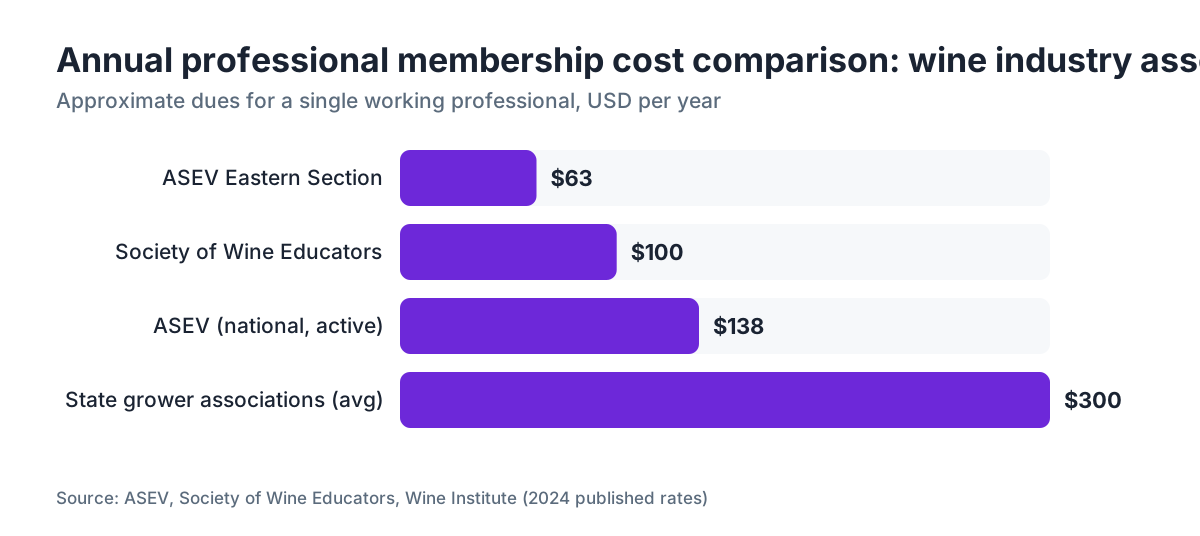
Here is how ASEV's pricing compares to other organizations a vineyard manager or small winery owner might join [4] [8] [9]:
| Organization | Professional membership | What you get |
|---|---|---|
| ASEV (national) | ~$100-$175/year | AJEV journal, conference discounts, member network |
| ASEV Eastern Section | ~$50-$75/year | Regional journal, eastern meeting discount |
| Society of Wine Educators | ~$100/year | Education resources, exam prep, certification path |
| Wine Institute | Varies by production volume | Regulatory advocacy, market access programs |
| State grower associations | ~$100-$500/year (varies) | Local advocacy, regional events |
| American Vineyard Foundation | Donor-based | Research grant funding |
ASEV's pricing sits in the middle of the range. It is not the cheapest option, and it is not the most expensive. The journal access is the benefit that sets it apart: no other U.S. wine industry association gives members direct access to a comparable volume of peer-reviewed research.
If you're choosing between ASEV and your state growers' association on a tight budget, the state association probably has more direct pull on your day-to-day business through regulatory advocacy and local events. But if scientific literacy and keeping up with research matter to you, ASEV is worth stacking on top of your state membership.
Is ASEV membership worth it for small vineyard operations?
Honest answer: it depends on how you learn and how you use information.
If you're a vineyard manager who reads research papers and applies findings to block-level decisions, ASEV membership pays for itself several times over in journal access alone. If you never open a scientific journal and you learn mostly from your PCA or your neighbor, the membership is probably not the best use of $175 a year.
The conference is where it gets more complicated. Attending the national meeting is a real investment of time and money for a small operation where you're the one driving the tractor. The Eastern Section meeting is more accessible and often more geographically relevant.
For student employees or family members entering the industry, ASEV scholarships are worth knowing about regardless of whether you hold a membership yourself. The programs have real money behind them and are underused, partly because small operations don't know they exist.
One thing ASEV does particularly well is professional legitimacy. If you're a newer manager trying to build credibility with a winery client or an absentee vineyard owner, citing current AJEV research in your management recommendations signals that your decisions aren't just gut feel. That kind of framing carries weight in contract negotiations and annual reviews.
For operations managing multiple properties or employing an agronomist-level staff member, ASEV membership is a straightforward yes. For a sole operator on ten acres, weigh the journal access against your actual reading habits and decide honestly. You can also look into the Paso Robles wineries community events and regional associations as lower-cost starting points for professional networking before committing to a national membership.
How do you join ASEV and what is the application process?
Joining is simple. Go to asev.org, pick your membership category (active professional, student, institutional, life), and pay online. There is no application review for standard membership. You pay, you're in. The organization does not gatekeep based on credentials or employer type.
Once you're a member, access to the AJEV archive is immediate through the member portal. Conference registration opens separately each year, usually in the spring, and the member discount applies automatically when you log in with your member credentials.
For Eastern Section membership, you can join through the eastern section's own website or sometimes through the main ASEV site, depending on the current platform setup. Check both.
If you want to get involved beyond basic membership, ASEV has committees for education, membership, technical program, and awards. Committee work is volunteer-based and a real way to build relationships with researchers and industry leaders. Some vineyard managers find that committee work, particularly on the viticulture technical program committee, gives them earlier access to research findings and stronger connections to university faculty than simply attending the annual meeting.
For vineyard managers who use compliance and field management software to keep spray records, pesticide applications, and worker training logs organized, ASEV membership works as the knowledge layer on top of your operational systems. Keeping the two separate but connected is how the best-run small operations stay both compliant and scientifically current. VitiScribe handles the operational side of that equation. ASEV covers the research pipeline.
Frequently asked questions
What does ASEV stand for?
ASEV stands for American Society for Enology and Viticulture. You'll also see it written as the American Society of Enology and Viticulture, with 'of' instead of 'for,' which is an alternate informal usage. The official name uses 'for.' The organization was founded in 1950 and is based in Davis, California.
How much does ASEV membership cost per year?
Active professional membership in ASEV runs roughly $100 to $175 per year depending on your category. Student membership is lower, typically $30 to $50. Life membership is a one-time payment available to senior members. The Eastern Section regional chapter has separate, lower dues in the $50 to $75 range. Prices are set by the organization and change annually.
What is the American Journal of Enology and Viticulture?
The American Journal of Enology and Viticulture (AJEV) is a peer-reviewed quarterly scientific journal published by ASEV since 1950. It covers original research in grape growing, wine chemistry, vine physiology, and sensory science, and it is one of the most-cited journals in the field globally. Full digital access to current and archived issues comes with active ASEV membership.
How do I apply for an ASEV scholarship?
ASEV scholarship applications are managed through the ASEV Scholarship Trust. Eligible students must be enrolled in an accredited U.S. degree program in viticulture, enology, food science, or a closely related field. The application cycle typically opens in fall and closes in early spring. Individual awards have historically ranged from around $500 to $4,000. Check asev.org for the current cycle's deadlines and award requirements.
Is ASEV only for California wine professionals?
No. ASEV has members in roughly 50 countries and a dedicated regional chapter, the ASEV Eastern Section, that serves growers and winemakers from the mid-Atlantic, Midwest, and Northeast. The Eastern Section holds its own annual meeting focused on cool-climate varieties, hybrid viticulture, and eastern U.S. market conditions. Members from Washington State, Oregon, New York, Virginia, and Michigan are well represented.
What universities partner with ASEV?
UC Davis, Washington State University, and Cornell University are the most closely affiliated institutions. Faculty from all three sit on ASEV's editorial board, review manuscripts for AJEV, and present at the annual conference. Fresno State and Cal Poly San Luis Obispo also have strong connections. Most applied viticulture research from these extension programs is either published in AJEV or draws on AJEV-published studies.
Does ASEV offer any certifications for vineyard managers?
ASEV itself does not offer a certification credential the way the Society of Wine Educators or the Court of Master Sommeliers does. It's a scientific and professional society, not a credentialing body. Some ASEV short courses and workshops carry continuing education credits recognized by other programs, but ASEV membership alone does not confer a formal certification.
What is the difference between ASEV and the ASEV Eastern Section?
ASEV is the national organization. The Eastern Section is a regional chapter covering states east of the Rockies. The Eastern Section has its own dues structure, its own annual meeting (usually winter or early spring), and its own scholarship and award programs. Some eastern growers hold only Eastern Section membership; others hold both. The national ASEV meeting skews toward California and Pacific Northwest conditions, while the eastern meeting covers hybrid varieties and humid-climate viticulture.
How is ASEV different from the Wine Institute?
The Wine Institute is a trade and regulatory advocacy organization primarily representing California wineries, with membership fees tied to production volume. Its focus is market access, labeling regulations, and legislative lobbying. ASEV is a scientific and educational professional society focused on research publication, technical education, and scholarships. They serve different functions, and most serious industry participants treat them as complementary rather than alternatives.
Does ASEV publish anything useful for spray program management?
Yes. AJEV regularly publishes research on fungicide efficacy, pesticide residue levels, resistance development in powdery mildew and Botrytis populations, and integrated pest management strategies. These studies are the upstream source for many extension recommendations you'll find from UC Davis and WSU. ASEV does not publish compliance forms or WPS training materials; that regulatory content comes from EPA and state lead agencies.
When is the ASEV annual conference held?
The ASEV National Conference is held annually in June, typically over three to four days. It rotates between California locations and other major wine regions. The ASEV Eastern Section holds a separate annual meeting, usually in late winter or early spring. Conference registration for members runs approximately $500 to $800 for the national meeting, with the eastern meeting generally less expensive.
Can winery owners join ASEV or is it just for grape growers?
Anyone in the wine and grape industry can join. ASEV's membership includes winemakers, cellar staff, vineyard managers, vineyard owners, researchers, extension agents, equipment suppliers, and students. There is no restriction by job title or company type. Institutional memberships are available for wineries that want to give access to multiple employees under a single account.
What happened to ASEV's in-person meetings during the COVID-19 pandemic?
ASEV shifted to virtual meetings in 2020 and 2021 in response to the pandemic, as most professional conferences did. In-person national and eastern section meetings resumed after that. Virtual attendance options have continued to varying degrees depending on the year. Check asev.org for the current meeting format for the upcoming conference year.
Sources
- UC Davis Department of Viticulture and Enology homepage: UC Davis viticulture and enology faculty have long-standing ties to ASEV leadership, editorial boards, and the annual conference program.
- Washington State University Extension, Viticulture and Enology: WSU Extension viticulture researchers publish regularly in AJEV and present at ASEV conferences, covering Pacific Northwest growing conditions.
- American Journal of Enology and Viticulture, ASEV publisher page: AJEV has been published continuously since 1950 and is one of the most-cited peer-reviewed journals in grape and wine science.
- ASEV Membership and Scholarship information: ASEV active professional membership runs roughly $100-$175/year; scholarship awards have historically ranged from approximately $500 to $4,000 per student.
- Cornell University, New York State Agricultural Experiment Station: Cornell's extension viticulture specialists publish cold-climate variety and pest management research that appears in ASEV publications.
- ASEV Eastern Section organization page: The ASEV Eastern Section is a regional chapter holding its own annual meeting focused on eastern U.S. grape growing conditions and hybrid varieties.
- EPA Worker Protection Standard for Agricultural Pesticides: EPA's revised Worker Protection Standard, updated in 2015 with phased enforcement through 2018, governs pesticide re-entry intervals, worker training, and exposure protections in vineyard settings.
- Society of Wine Educators membership page: Society of Wine Educators professional membership runs approximately $100/year, providing education resources and certification exam access.
- Wine Institute about page: Wine Institute membership fees vary by production volume and focus on regulatory advocacy and market access rather than scientific research publication.
- Fresno State Department of Viticulture and Enology: Fresno State is among the U.S. universities whose viticulture and enology students regularly apply for and receive ASEV scholarships.
Last updated 2026-07-09