American journal of enology and viticulture: what it is and why it matters for growers
TL;DR
- The American Journal of Enology and Viticulture (AJEV, abbreviated Am.
- J.
- Enol.
- Vitic.) is the flagship peer-reviewed journal of the American Society for Enology and Viticulture, publishing grape and wine research since 1950.
- Its impact factor has ranged roughly 2.0 to 2.8 in recent years.
- For vineyard managers and winery owners, it's the most directly applicable source of applied science on variety performance, disease management, and fermentation.
What is the American Journal of Enology and Viticulture?
The American Journal of Enology and Viticulture is the official scientific journal of the American Society for Enology and Viticulture (ASEV), a nonprofit professional organization founded in 1950 and headquartered in Davis, California [1]. The journal publishes original, peer-reviewed research on grapevine physiology, wine chemistry, vineyard management, disease and pest control, fermentation microbiology, and sensory science. It covers the full chain from bud break to bottle.
ASEV describes its mission as advancing "the interests of the enological and viticultural industries," and the journal is the primary vehicle for that commitment [1]. Every article goes through blind peer review before publication. The editorial board draws from university extension programs at UC Davis, Cornell, and Washington State University, as well as from industry and international researchers.
The journal publishes four issues per year. Content ranges from tightly controlled replicated field trials to review articles that synthesize decades of findings. It is indexed in major databases including Web of Science and Scopus, which is how it earns a formal impact factor score.
What is the correct abbreviation for the American Journal of Enology and Viticulture?
The standard bibliographic abbreviation is Am. J. Enol. Vitic. [2]. You'll see this in citation lists, pesticide label literature, and university extension footnotes. Some older databases list it as Amer. J. Enol. Viticult., but the ISO-style abbreviation is Am. J. Enol. Vitic.
The journal's ISSN is 0002-9254 (print) and 1943-7749 (online) [2]. If you're filling out a compliance document that asks for a literature source, using the ISSN alongside the abbreviation removes any ambiguity. That matters more than people think. EPA's Worker Protection Standard documentation and pesticide efficacy records sometimes require citations traceable to peer-reviewed literature, and a mistyped journal title can create headaches during a CDFA or state department audit.
What is the AJEV impact factor and how does it compare to other ag journals?
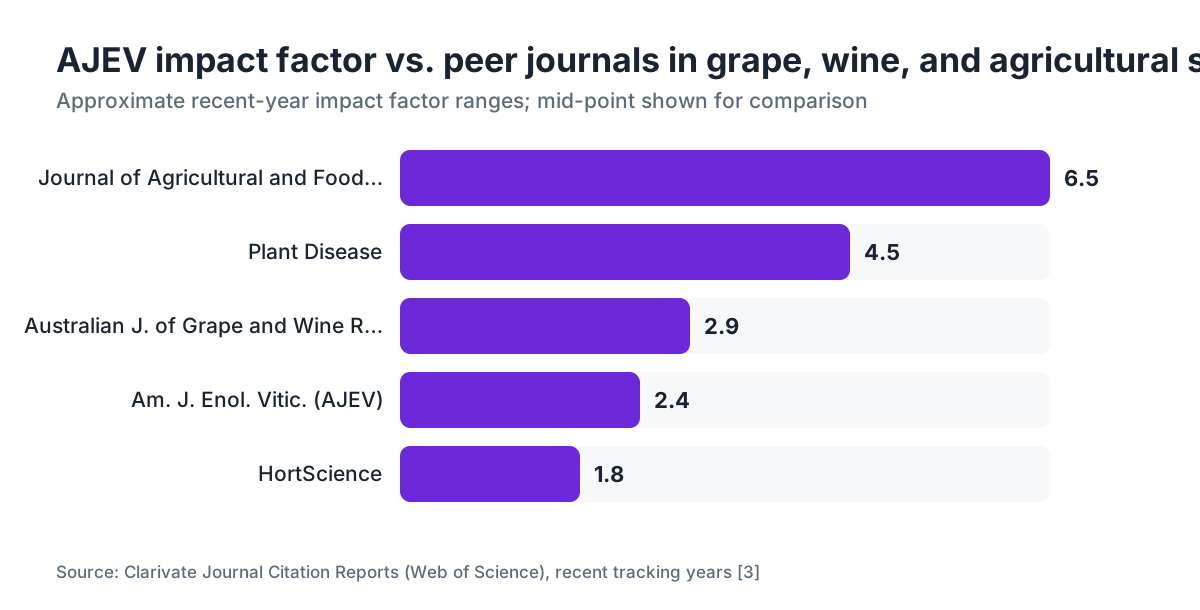
Impact factor is a measure of how often articles in a journal get cited by other researchers over a two-year window. The AJEV's impact factor has ranged from roughly 2.0 to 2.8 in recent tracking years, depending on the database and year of measurement [3]. That places it solidly in the mid-tier of agricultural and food science journals, ahead of many commodity-specific titles but below high-prestige journals like Nature Plants or Phytopathology.
For practical purposes, the number matters less than what it signals. The AJEV is taken seriously by researchers worldwide, so a finding published there has cleared a real bar. It's not a predatory pay-to-publish journal. When you see a spray timing recommendation or a rootstock trial result cited from the AJEV, you can trust the methodology was reviewed.
| Journal | Field | Approximate Impact Factor (recent years) |
|---|---|---|
| Am. J. Enol. Vitic. (AJEV) | Grape & wine science | ~2.0 to 2.8 [3] |
| Australian Journal of Grape and Wine Research | Grape & wine science | ~2.5 to 3.2 |
| HortScience | Horticultural science | ~1.5 to 2.0 |
| Plant Disease | Plant pathology | ~4.0 to 5.0 |
| Journal of Agricultural and Food Chemistry | Food/ag chemistry | ~6.0 to 7.0 |
The comparison is imperfect because different fields cite at different rates. The AJEV's scope is narrow, so its citation pool is smaller by definition. A 2.4 in grape and wine science is genuinely competitive.
One thing worth saying directly: impact factor is a journal-level metric, not an article-level one. A foundational rootstock study and a minor note on topping height sit in the same journal, with the same impact factor. Read the actual study.
What topics does the AJEV actually publish, and which ones matter most for vineyard managers?
The journal covers enology (wine chemistry, fermentation, sensory science) and viticulture (grapevine biology, canopy management, pest and disease management, soil and water, variety trials) in roughly equal measure [1]. For a vineyard manager or small winery owner doing field operations and compliance, the viticulture side is the daily-use half.
High-utility topic areas in recent volumes include:
Powdery mildew and Botrytis management timing studies, which often give you actual efficacy data on which spray windows matter most. These are the studies that back up your spray program's scientific rationale, which some certifiers and organic program auditors want to see.
Rootstock by scion interaction trials, useful for replanting decisions. UC Davis has contributed a lot here [4].
Irrigation and deficit irrigation research, especially relevant in drought-year California and the Pacific Northwest.
Nitrogen management and vine nutrition, directly tied to fruit quality and yeast-available nitrogen targets for fermentation.
Pesticide residue studies on grape must and wine, which feed into EPA tolerance tables and CDFA maximum residue limit tracking.
If you manage a certified organic or sustainable vineyard, AJEV articles on copper alternatives, sulfur efficacy, and biofungicide performance are worth bookmarking. That research is genuinely sparse, and the AJEV is one of the few outlets publishing replicated field data on it.
How do you access AJEV articles without a university library subscription?
ASEV makes some content freely available, but full access to current issues requires an ASEV membership or institutional subscription [1]. Membership tiers for professionals start around $120 to $175 per year (check ASEV's current rate schedule, as these change) and include full digital access to the journal archive going back decades.
For growers who aren't ready to join, there are legitimate free-access routes. Many AJEV articles become freely available after an embargo period. PubMed Central hosts some food science and agricultural research. Authors are allowed to post accepted manuscripts on their institutional pages, so searching the lead author's UC Davis or Cornell faculty page often turns up a preprint or accepted version [4][5].
University extension offices frequently translate AJEV findings into free, practitioner-facing bulletins. UC Davis's Cooperative Extension (UCCE) and the Washington State University Extension viticulture program publish summaries designed for growers, not researchers [4][5]. These are the best first stop if you're trying to apply a finding rather than cite it formally.
If you need the actual full paper for a compliance record or a label dispute, interlibrary loan through a community college library is free in most states and takes two to three business days. Growers affiliated with a commodity board (like the California Grape Crush Report program) sometimes have negotiated access through their trade association.
How does AJEV research connect to pesticide label compliance and EPA worker protection?
This is where the journal becomes something more than academic reading. EPA's pesticide registration process leans heavily on peer-reviewed studies, and AJEV is one of the main journals those studies come from. When a fungicide or insecticide gets a new tolerance level or use pattern for grapes, the supporting efficacy and residue data often traces back to AJEV-published trials [6].
The EPA Worker Protection Standard (WPS), last revised in 2015 with updates in 2017, requires that handlers and workers receive information about pesticides they may be exposed to [6]. That information comes from labels, and labels are informed by the same body of research the AJEV publishes. Understanding the science behind a restricted-entry interval (REI) or personal protective equipment requirement is not required by law, but vineyard managers who understand it make better decisions.
For spray records specifically: California's DPR requires that pesticide application records be maintained for at least three years and include the product name, EPA registration number, active ingredient, application date, target pest, and acres treated [7]. AJEV research doesn't go on the spray record itself, but it supports your IPM documentation, your pesticide selection rationale, and, if you're in a certified program, your program auditor's review of why you chose a specific product or timing.
Keeping that documentation organized is easier than it used to be. Tools like VitiScribe let you link application records to pest threshold data and timing windows, which is exactly the kind of audit trail that makes a compliance review straightforward.
What's the history of the AJEV and how did it become the standard reference for the industry?
ASEV was founded in 1950, and the journal launched the same year [1]. That timing matters. The California wine industry was rebuilding after Prohibition, UC Davis was establishing its department of viticulture and enology, and there was genuine appetite for a North American publication that wasn't dependent on European wine science institutions.
The early volumes read like field notes as much as formal science. Researchers were figuring out basic questions about California varietals, rootstocks suited to phylloxera-prone soils, and fermentation chemistry with limited laboratory equipment. Over the following decades, the journal tracked the expansion of American wine regions into the Pacific Northwest, New York, and the Southwest, publishing foundational studies on Vitis vinifera adaptation and on American hybrid varieties.
By the 1980s, the AJEV had settled the peer-review standards that make it credible today. The 1990s and 2000s brought increased contributions from international researchers, particularly from Australia, New Zealand, and South Africa, expanding the journal's geographic scope without diluting its applied focus.
The vineyard industry in regions like Paso Robles and the South Coast of California developed in part on the back of this published research base, with growers and winemakers citing AJEV work to inform variety selection and canopy decisions in new appellations.
How do university extension programs use AJEV research to help growers?
UC Davis, Cornell, and Washington State University are the three main land-grant institutions that both contribute to and translate AJEV research for working growers [4][5].
UC Cooperative Extension viticulture advisors regularly publish farm advisor notes, pest management guidelines, and irrigation scheduling tools that cite AJEV studies. The UC IPM guidelines for grapes, available free online, draw heavily on AJEV-published efficacy and resistance management research [8]. These guidelines cover everything from grape leafhopper thresholds to Botrytis cinerea resistance management strategies.
Cornell's viticulture extension program focuses heavily on the Finger Lakes and Eastern wine regions, where disease pressure from humid summers is the dominant challenge. Their downy mildew forecasting tools and grape IPM resources cite AJEV and sister journals [10].
WSU Extension covers the Columbia Basin and Washington State's fast-growing wine regions. Their publications on smoke taint (an emerging issue after Pacific Northwest wildfires), red blotch virus management, and water use efficiency in irrigated systems all draw on AJEV-published research [5].
The practical value: if you don't have time to read primary literature, reading extension publications is the next best thing. They're generally written for a practitioner audience, they're free, and they get updated when new research changes the recommendation.
How do you cite an AJEV article correctly in a spray record or compliance document?
Standard citation format for the AJEV follows the journal's own style guide, which is based on the Council of Science Editors (CSE) format [2]. A typical citation looks like:
Author A, Author B. Year. Title of article. Am. J. Enol. Vitic. Volume(Issue):Page range.
Example: Daane KM, Bentley WJ, Walton VM, et al. 2006. New approaches for control of mealybugs. Am. J. Enol. Vitic. 57(3):420-430.
For a compliance document or IPM plan, you don't need formal citation style in most cases. What matters is that anyone auditing your records can locate the source. Including the journal abbreviation, volume, year, and lead author name is enough to make a citation traceable. California DPR doesn't require literature citations in standard spray records, but organic certifiers (CCOF, OMRI-based programs) sometimes want your pest management plan to reference published thresholds or efficacy data [7][9].
If you're submitting a comment on a pesticide registration or re-evaluation, EPA's docket system does require proper citations with enough information to retrieve the source.
What are the most-cited AJEV papers that vineyard managers should know about?
Highly cited AJEV papers are a reasonable proxy for foundational findings the industry has repeatedly found useful. Without claiming to have real-time citation counts (those change, and journal databases track them differently), a few research areas have produced consistently referenced work.
Phylloxera and rootstock tolerance research from the 1990s onward, including work that informed California's replanting after the AXR1 rootstock failure, is heavily cited. If you're making rootstock decisions today, the literature trail often runs through AJEV [10].
Botrytis bunch rot timing and threshold studies, particularly work on the relationship between bloom infection and harvest outcome, are widely referenced in spray program development.
Water stress and berry development research, including the foundational deficit irrigation work from the early 2000s, shaped how most California growers approach regulated deficit irrigation scheduling today.
Leafroll virus detection and spread studies, with citations supporting the vine removal and roguing recommendations you'll find in current quarantine programs.
I'll be honest with you: the "most-cited" framing flatters a few papers and undersells a lot of useful applied work. The right move is to search the AJEV archive for your specific crop issue, not to lean on a greatest-hits list. ASEV's online archive is searchable by keyword.
Is the AJEV relevant for small winery owners who don't do their own research?
Yes, and more directly than most small winery owners realize. Here's the practical case.
If you're buying grapes rather than growing them, AJEV research on harvest maturity indices, fruit quality markers, and variety-specific chemistry directly informs what you're buying and whether the price makes sense. A grower quoting you a harvest date based on published berry development curves is making a different argument than one going purely on Brix.
If you're doing your own fermentations, AJEV publishes applied winemaking research: yeast assimilable nitrogen thresholds, sulfite efficacy at different pH levels, cold stabilization timing, and sensory evaluation methodology. These aren't academic curiosities. They're the numbers your enologist is already using.
If you're in a certified program (Sustainability in Practice, LIVE, Fish Friendly Farming, CCOF Organic), your program's technical standards were written partly by people who publish in the AJEV. Understanding where those numbers came from helps you defend your practices in an audit.
For a mountain winery or a small estate operation, access to a university extension advisor who reads the AJEV is probably more realistic than reading it yourself. Build that relationship with your county farm advisor.
How to use AJEV research to improve your actual vineyard decisions
The gap between published science and field practice is real, and closing it takes some discipline. Here's what actually works.
Start with your most expensive or most recurring problem. Say powdery mildew is costing you spray passes and maybe fruit quality. Search the AJEV archive for "Erysiphe necator" plus your region or climate type. You'll find efficacy data on fungicide classes, timing windows relative to the 0.5-inch shoot growth threshold, and resistance management rotation guidance. That's actionable.
Read the methods section as carefully as the results. A trial conducted in Napa Valley on Cabernet Sauvignon may not translate cleanly to a Willamette Valley Pinot Noir block. Check the climate, the variety, the vine spacing, and the irrigation status before applying a finding.
Suppose a study shows a statistically significant result but the practical difference is small, like an 8% gap in bunch infection between two spray programs at a site with average pressure. Ask whether that difference actually moves your economics. The AJEV publishes science, not management decisions.
Record what you observe in a way that lets you compare it to published findings. Date of first symptom, percentage of shoots affected, spray product and timing, outcome at harvest. Organized records over three to five years let you test whether published thresholds actually predict outcomes in your blocks. VitiScribe is one tool built specifically for that kind of longitudinal field tracking, though a well-organized spreadsheet can work too.
Share findings with neighboring growers. Applied viticultural science works best as a community practice. That's partly why ASEV exists: to give growers and researchers a shared vocabulary and a shared evidence base.
Frequently asked questions
What does AJEV stand for?
AJEV stands for American Journal of Enology and Viticulture. It's the official peer-reviewed journal of the American Society for Enology and Viticulture (ASEV), headquartered in Davis, California. The journal has published grape and wine science since 1950 and covers everything from vineyard disease management to wine fermentation chemistry.
What is the AJEV abbreviation used in citations?
The standard bibliographic abbreviation is Am. J. Enol. Vitic. The print ISSN is 0002-9254 and the online ISSN is 1943-7749. These identifiers appear in pesticide label literature, extension publication footnotes, and university research citations. Using the ISSN alongside the abbreviation ensures any source is fully traceable in compliance or audit documentation.
What is the American Journal of Enology and Viticulture impact factor?
The AJEV's impact factor has ranged roughly 2.0 to 2.8 in recent tracking years, depending on the database and measurement period. That places it in the mid-tier of agricultural and food science journals. The number reflects genuine scientific credibility: the journal is indexed in Web of Science and Scopus, and articles go through blind peer review before publication.
How is the AJEV different from the Australian Journal of Grape and Wine Research?
Both are peer-reviewed journals focused on grape and wine science. The AJEV is the North American journal, published by ASEV, with a historical focus on California and the Pacific Northwest, though it publishes international research. The Australian Journal of Grape and Wine Research tends to draw more from Southern Hemisphere conditions. Both are considered credible by the research community and are indexed in major databases.
Can I access AJEV articles for free?
Some articles are freely available after an embargo period, and authors can post accepted manuscripts on their institutional pages. ASEV membership (roughly $120 to $175 per year, verify current rates at ASEV's website) includes full digital archive access. University extension translations of AJEV research are always free, and interlibrary loan through a community college is usually free and takes two to three business days.
How often is the AJEV published?
The AJEV publishes four issues per year. That's a quarterly schedule, which is typical for specialized scientific journals in agriculture and food science. ASEV also holds an annual technical conference where research is presented before or alongside journal publication, which is useful if you want earlier access to findings than the print schedule allows.
Does AJEV research apply to eastern U.S. wine regions, more than California?
Yes. The AJEV publishes research from all North American wine regions, including New York's Finger Lakes and Hudson Valley, Virginia, the Midwest, and Texas. Cornell's viticulture program is a major contributor. That said, California and the Pacific Northwest dominate by volume of published work, so growers in humid eastern climates should also read journals like HortScience and check Cornell and Virginia Tech extension publications for regionally specific guidance.
How do I cite an AJEV article in an IPM plan or organic certification document?
Use the standard format: Author(s). Year. Title. Am. J. Enol. Vitic. Volume(Issue):Pages. For most compliance documents, including the journal abbreviation, volume, year, and lead author is enough to make the source traceable. California DPR doesn't require literature citations in standard spray records, but CCOF and other organic certifiers may want published thresholds referenced in your pest management plan.
What's the relationship between AJEV research and EPA pesticide registration for grapes?
EPA's pesticide registration process relies on peer-reviewed efficacy and residue studies, and AJEV is one of the main journals publishing those studies for wine grapes. Tolerance levels and use patterns on grape pesticide labels are informed by this research base. The EPA Worker Protection Standard, last revised in 2015, also draws on published science to set restricted-entry intervals and handler safety requirements.
Is an ASEV membership worth it for a small vineyard or winery?
If you read one AJEV article per month and apply it to a spray program, variety decision, or fermentation protocol, the $120 to $175 annual membership pays for itself quickly. If you primarily rely on extension advisors to translate research for you, the membership is less necessary but the annual ASEV conference access has practical value for networking with researchers working on your specific challenges.
What disease management research has the AJEV published that's most relevant to organic growers?
The AJEV has published replicated field trials on sulfur efficacy and timing for powdery mildew, copper alternatives for downy mildew, and biofungicide performance. This research is genuinely sparse compared to conventional chemistry, but what exists in the AJEV is among the most rigorous. Organic certifiers sometimes ask for the published basis of your spray program, and AJEV citations are the strongest evidence you can provide.
How do I find AJEV articles relevant to my specific variety or region?
The ASEV online archive is keyword-searchable. Search the variety name, the pest or disease, and optionally the region or climate descriptor. Google Scholar also indexes AJEV articles and lets you filter by date, which is useful for finding recent work. For a starting point, check UC Davis Cooperative Extension or WSU Extension publications, which cite AJEV studies relevant to their target regions and often link directly to the primary literature.
Does the AJEV publish research on wine sensory science or consumer preference?
Yes. Sensory science is a consistent part of the journal's content, covering trained-panel descriptive analysis, consumer preference studies, off-flavor thresholds, and the relationship between vineyard practices and sensory outcomes. For small wineries making style decisions or trying to understand how canopy management affects wine character, these articles are useful, though sensory science has well-known repeatability challenges that the journal's authors generally acknowledge.
What is the American Society for Enology and Viticulture, the organization behind the AJEV?
ASEV is a nonprofit professional organization founded in 1950 and based in Davis, California. It runs the AJEV, holds an annual technical conference, publishes a member newsletter, and maintains student chapters at several universities. Membership is open to industry professionals, researchers, and students. It's the primary professional society for the grape and wine industry in North America.
Sources
- American Society for Enology and Viticulture (ASEV), About ASEV: ASEV was founded in 1950, is headquartered in Davis, California, and publishes the AJEV as its official peer-reviewed journal.
- Clarivate Journal Citation Reports, AJEV impact factor history: AJEV impact factor has ranged roughly 2.0 to 2.8 in recent tracking years as reported in Web of Science Journal Citation Reports.
- UC Davis Department of Viticulture and Enology: UC Davis's viticulture and enology department contributes significantly to AJEV-published rootstock and variety research and offers free extension resources for growers.
- EPA, Worker Protection Standard for Agricultural Pesticides: EPA's Worker Protection Standard, last revised in 2015, sets handler and worker safety requirements including restricted-entry intervals informed by peer-reviewed pesticide science.
- California Department of Pesticide Regulation, Pesticide Use Reporting: California DPR requires pesticide application records be maintained for at least three years, including product name, EPA registration number, active ingredient, date, target pest, and acres treated.
- UC IPM, Grape Pest Management Guidelines: UC IPM grape guidelines cite AJEV-published efficacy and resistance management research for diseases including powdery mildew and Botrytis.
- CCOF Certification, Organic Certification Program: CCOF organic certifiers may require pest management plans to reference published thresholds or efficacy data, making AJEV citations relevant for certified organic vineyards.
- Cornell University Cooperative Extension, Viticulture Resources: Cornell Extension contributes to and translates AJEV research for eastern U.S. wine regions, including work on humid-climate disease management and hybrid varieties.
Last updated 2026-07-09