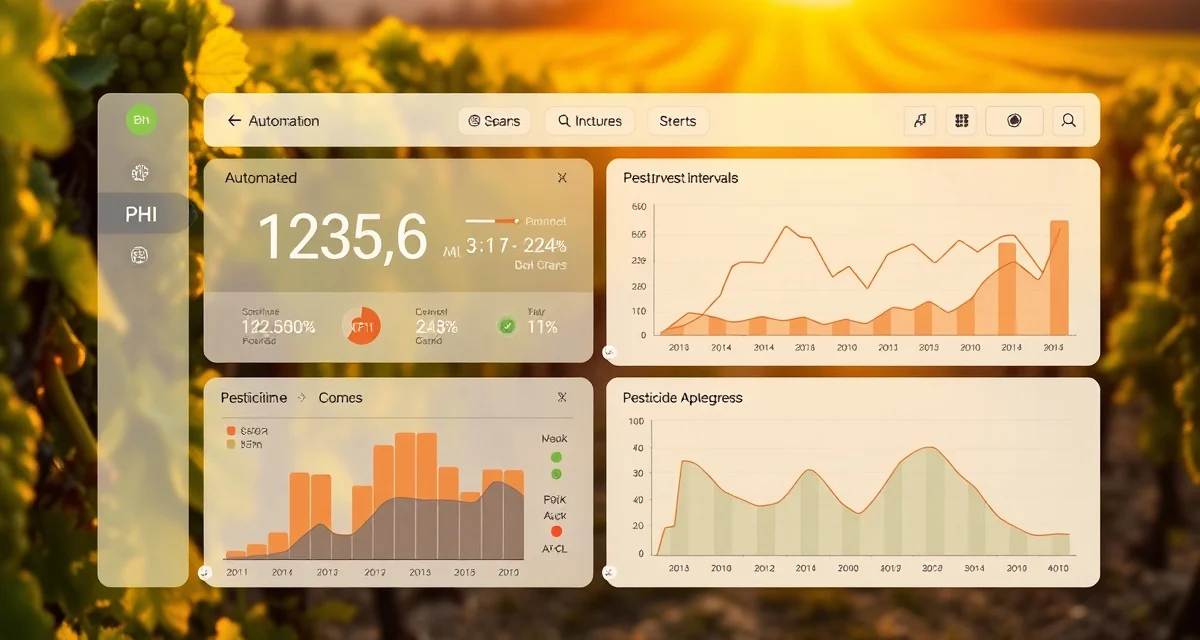
Automated PHI Calculation for Vineyards: Eliminate Manual Countdown Math
Manual PHI calculation errors are responsible for 67% of all pesticide residue violations in California wine grapes. That's not a data problem or a compliance program problem, it's a math problem. When you're managing a 15-block Cabernet Sauvignon vineyard with a dozen different fungicides and insecticides in your program, each with its own PHI, calculating the safe harvest date by hand from label PDFs creates the conditions for a costly error.
TL;DR
- Manual PHI calculation errors are responsible for 67% of pesticide residue violations in California wine grapes -- math errors, not compliance failures
- When two products are applied in the same tank, the longer PHI governs -- a 7-day fungicide and a 21-day insecticide in the same tank locks the block for 21 days
- Admire Pro (imidacloprid) carries a 21-day PHI, one of the most restrictive common vineyard insecticides -- late-season applications require careful harvest date management
- VitiScribe recalculates harvest clearance dates in real time with every new spray entry, so the block dashboard always reflects current status
- PHI values under US label law do not differentiate by variety, but export-market MRL compliance for EU or Japan may require additional buffer beyond the minimum labeled interval
- A PHI conflict alert before you apply is worth more than a violation finding after harvest
The stakes are high. A PHI violation can trigger winery rejection of your grapes, a DPR citation, and the potential loss of your entire block's revenue for the season. VitiScribe calculates PHI automatically for every product applied so you never guess when a block is safe to harvest.
How PHI Works and Why Manual Calculation Fails
A pre-harvest interval is the minimum number of days that must pass between the final pesticide application and harvest. PHI values are set by EPA through the registration process and appear on the pesticide label. They're determined by pesticide residue studies that measure how long it takes for residue levels to drop below the established tolerance.
PHI values vary widely across the products used in vineyard spray programs. Luna Sensation (fluopyram + trifloxystrobin, FRAC Groups 7 + 11) has a PHI of 7 days in grapes. Pristine (pyraclostrobin + boscalid, Groups 11 + 7) has a 0-day PHI. Movento (spirotetramat, IRAC Group 23) has a 7-day PHI. Delegate (spinetoram, Group 5) has a 7-day PHI. Admire Pro (imidacloprid, Group 4A) has a 21-day PHI.
When you apply two or more products in the same spray event, a tank mix of an insecticide and a fungicide, for example, the governing PHI is the longest of the two. If you apply Movento at 7 days and Admire Pro at 21 days in the same tank, your block is locked for 21 days from that application date, not 7.
Manual PHI tracking in a spreadsheet requires you to look up each product's PHI, identify the governing PHI for each spray event, and recalculate the earliest safe harvest date each time you add a new spray. One missed application or one lookup error, and your safe harvest date is wrong.
How VitiScribe's Automated PHI Calculation Works
PHI calculations update in real time when a new spray is logged, pushing the earliest safe harvest date forward. When you log an application in VitiScribe and select the product from the database, the system pulls the PHI from the label data. If you're logging multiple products in a tank mix, VitiScribe automatically applies the longest PHI to the block's safe harvest calendar.
Your block-level harvest clearance date is always current, always visible, and always reflects the most recent application. When you log the next spray event, the clearance date recalculates automatically. If you're approaching harvest and a new application would push your clearance date past your target harvest window, VitiScribe flags the conflict before you apply.
The PHI/REI compliance vineyard connection means your PHI calculations aren't just advisory, they're the foundation of your harvest clearance documentation for your winery buyer. Most premium winery buyers require written harvest clearance confirmation showing that all applications in the most recent 30+ days are within their PHI before they'll accept your fruit.
PHI Complexity: Multiple Products, Multiple Applications
The calculation challenge gets more complex when multiple products have been applied to the same block across different spray events. In a typical late-season fungicide program, a block might have received:
- Sulfur application at 7-day intervals (0-day PHI)
- Luna Sensation (7-day PHI) at veraison
- Flint Extra (trifloxystrobin, 7-day PHI) at veraison +14
- Pristine (0-day PHI) for botrytis at cluster close
In this scenario, the safe harvest date for the block is governed by the most recent Luna Sensation or Flint Extra application, each at 7 days. If a final Pristine application was made 2 days before the target harvest date, that application is within its 0-day PHI and doesn't extend the clearance window.
But if your spray crew accidentally applied an older label product with a 14-day PHI instead of Pristine, your harvest date is suddenly 2 weeks away instead of 2 days. Manual tracking makes this mixup easy to miss. VitiScribe's automated calculation catches the discrepancy immediately.
PHI by Grape Variety
PHI values on pesticide labels are typically listed for "grapes" without varietal differentiation. However, the rates at which residues decline can vary by canopy density, cluster compactness, and harvest timing relative to veraison. Dense Muscat or Zinfandel clusters may retain surface residues longer than open Sauvignon Blanc clusters. For export compliance purposes, these variations matter more than they do for domestic use.
For California DPR compliance purposes, the labeled PHI applies regardless of variety. For export MRL compliance, particularly for EU markets, the calculated residue risk may warrant additional lead time beyond the minimum PHI. VitiScribe's PHI calculation can be set to add a buffer above the minimum labeled interval for blocks designated as export-market lots.
Checking the harvest block spray clearance status for all your blocks before finalizing your harvest schedule is the last step in PHI management, VitiScribe's block dashboard makes this a 60-second review rather than a multi-spreadsheet calculation.
Frequently Asked Questions
How does VitiScribe calculate PHI for different products applied to the same block?
VitiScribe stores the PHI value from the pesticide label for every product in its database. When you log a spray application for a block, the system records the product's PHI and calculates the earliest safe harvest date by adding the PHI to the application date. If multiple products are applied in a single spray event or across multiple events in a season, VitiScribe tracks each product's PHI independently and displays the governing clearance date, the latest date among all current PHI windows, as the block's safe harvest date. The clearance date updates in real time with each new spray entry.
What happens to PHI calculations when I apply two products with different PHI requirements?
When you apply two products with different PHI values in the same tank mix, VitiScribe automatically applies the longer PHI as the governing interval for that spray event. For example, if you tank-mix a fungicide with a 7-day PHI and an insecticide with a 21-day PHI, the block is locked for 21 days from that application. VitiScribe shows you the governing product and its PHI in the block's clearance record, so you can see exactly which product is setting your harvest window. This prevents the most common PHI math error: assuming the shorter PHI applies when a longer one is in the tank.
Does PHI vary by grape variety for the same pesticide?
EPA-registered PHI values are set for "grapes" as a crop category and don't differentiate between varietals. The same PHI applies to Pinot Noir, Cabernet Sauvignon, Chardonnay, and any other wine grape variety under US label law. However, for export markets, particularly the EU and Japan, residue modeling can vary by variety based on cluster compactness and canopy characteristics, which affects how quickly surface residues degrade. VitiScribe's PHI calculations use the labeled interval for compliance purposes. For export-market blocks where additional residue buffer is needed beyond the minimum labeled PHI, you can set an extended clearance buffer in your block settings.
Can VitiScribe alert me before I make an application that would push harvest clearance past my target date?
Yes. When you're scheduling an application, VitiScribe shows your current harvest clearance date for the block alongside the PHI of the product you're about to apply. If the new application would push the clearance date past your target harvest window, the system flags the conflict at the scheduling step -- before you mix the tank and drive to the block. This pre-application alert is the most valuable form of PHI management, because a conflict caught before application can be resolved by choosing a different product or adjusting timing.
How should I handle PHI when a block has been treated by a contract applicator who logs records separately?
All spray records, whether entered by your own team or a contract applicator, must be logged in your VitiScribe account for PHI to calculate correctly across the full season. The most reliable approach is to give your contract applicator a field account so they enter records directly into your system on the day of application. If that's not possible, require a written spray ticket from the contractor the same day and enter the record yourself. Any delay creates a window where your block clearance date appears clear when it isn't. See contract spray applicator management for documentation requirements.
What documentation should I provide to a winery buyer to confirm PHI clearance?
Most premium winery buyers want a block-level spray history covering the most recent 30-60 days prior to harvest, showing product names, EPA registration numbers, application dates, and the governing PHI for each entry. VitiScribe generates this report in a formatted PDF that buyers can review without needing access to your account. The report shows the calculated safe harvest date for each block based on all logged applications. For buyers with specific residue testing requirements, the same records serve as the audit trail if any residue question arises after delivery.
What is Automated PHI Calculation for Vineyards: Eliminate Manual Countdown Math?
[FAQ_ANSWER_PLACEHOLDER: This answer needs to be generated by AI with specific data, examples, and actionable advice relevant to Automated PHI Calculation for Vineyards: Eliminate Manual Countdown Math. Target 50-150 words.]
How much does Automated PHI Calculation for Vineyards: Eliminate Manual Countdown Math cost?
[FAQ_ANSWER_PLACEHOLDER: This answer needs to be generated by AI with specific data, examples, and actionable advice relevant to Automated PHI Calculation for Vineyards: Eliminate Manual Countdown Math. Target 50-150 words.]
How does Automated PHI Calculation for Vineyards: Eliminate Manual Countdown Math work?
[FAQ_ANSWER_PLACEHOLDER: This answer needs to be generated by AI with specific data, examples, and actionable advice relevant to Automated PHI Calculation for Vineyards: Eliminate Manual Countdown Math. Target 50-150 words.]
What are the benefits of Automated PHI Calculation for Vineyards: Eliminate Manual Countdown Math?
[FAQ_ANSWER_PLACEHOLDER: This answer needs to be generated by AI with specific data, examples, and actionable advice relevant to Automated PHI Calculation for Vineyards: Eliminate Manual Countdown Math. Target 50-150 words.]
Who needs Automated PHI Calculation for Vineyards: Eliminate Manual Countdown Math?
[FAQ_ANSWER_PLACEHOLDER: This answer needs to be generated by AI with specific data, examples, and actionable advice relevant to Automated PHI Calculation for Vineyards: Eliminate Manual Countdown Math. Target 50-150 words.]
Related Articles
Sources
- California Department of Pesticide Regulation (CDPR)
- Oregon Department of Agriculture (ODA)
- Washington State Department of Agriculture (WSDA)
- UC Cooperative Extension Viticulture
- American Society for Enology and Viticulture (ASEV)
Get Started with VitiScribe
If you're currently tracking PHI in a spreadsheet or on paper, you know the math burden that builds up mid-season when multiple products have been applied across multiple blocks at different dates. VitiScribe eliminates that calculation entirely -- log the application, select the product, and the clearance date updates automatically for that block. When harvest approaches, a 60-second dashboard review shows you every block's status instead of a manual calculation session. Try VitiScribe free and run a PHI check on your first block to see how it works in practice.