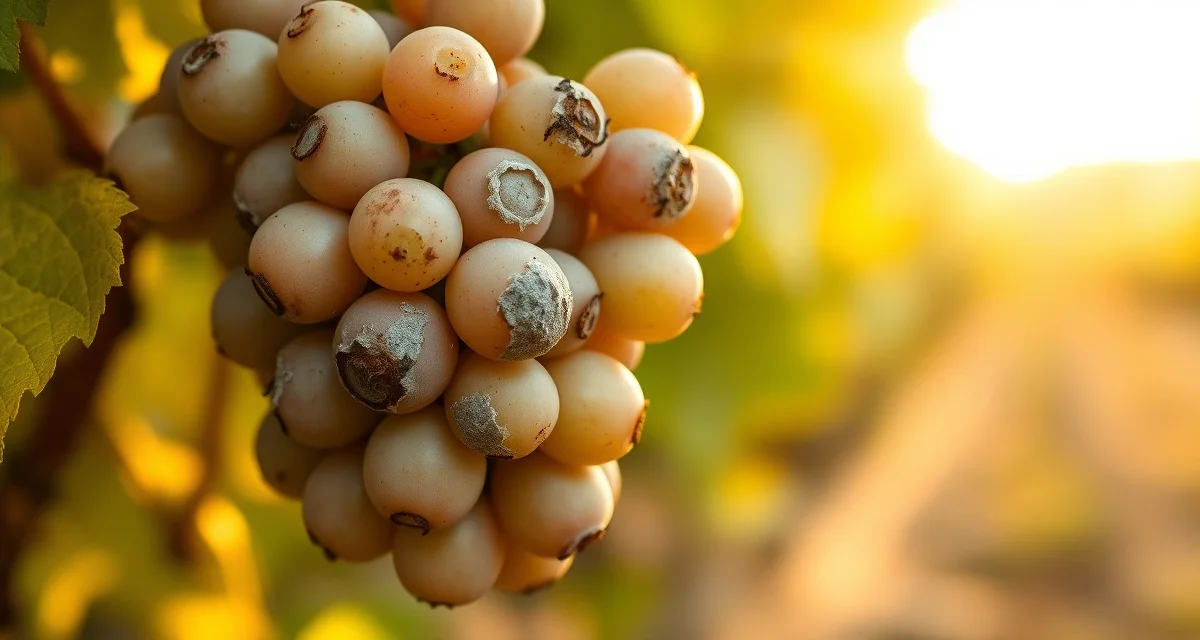
Identifying Botrytis Bunch Rot in Vineyards
Botrytis bunch rot is visually obvious when it's severe, the gray mold mass on collapsed berries is unmistakable. The problem is that by the time you see obvious sporulation, the cluster is already done and you're scouting for spread.
TL;DR
- Latent botrytis infections establish during bloom inside dead flower tissue and can't be detected by visual scouting -- assume latent infection exists in compact-cluster varieties after extended bloom periods
- Early-stage botrytis appears as a water-soaked, brownish softening on individual berries before any visible mold develops -- this is the stage where adjacent cluster protection still matters
- Gray sporulation (the visible cloud of mold) signals that the infection is fully established and spreading; removal and destruction of infected clusters is the only response at this stage
- In compact-cluster varieties like Chardonnay and Pinot Noir, botrytis can spread from a few berries to 30-50% cluster incidence within 3-5 days during wet harvest-season weather
- Scouting frequency should increase to every 2-3 days during wet weather near harvest -- weekly intervals are insufficient when conditions favor rapid spread
- Document both cluster incidence (percent clusters affected) and severity (percent berries within affected clusters) in scouting records -- these two numbers together tell a different story than either alone
The useful identification skill is recognizing early-stage botrytis before it becomes visible gray mold. That's where management decisions have actual effect.
The Stages of Botrytis Infection
Stage 1: No Visible Symptoms (Latent Infection)
During and after bloom, dying flower parts (calyptras, stamens) trapped inside developing clusters are colonized by botrytis. You can't see this. Infections are latent inside the cluster, waiting for conditions that favor development.
The only way to detect latent infection is with microscopy or wet incubation of cluster tissue, not practical for routine scouting. Assume latent infection exists in any cluster that had significant dead flower tissue retention, especially in Chardonnay, Pinot Noir, or other compact-cluster varieties.
Stage 2: Initial Berry Symptoms
- Individual berries develop a water-soaked, brownish appearance
- Affected berry skin is soft and slightly sunken compared to adjacent healthy berries
- No visible mold yet, this is the pre-sporulation stage
At this stage, the infection is established but hasn't spread to neighboring berries. Your window for any meaningful management response has passed for these berries, but protecting adjacent uninfected clusters is still valuable.
Stage 3: Active Sporulation, Gray Mold
- Dense gray mold (conidia mass) develops on infected berries
- Characteristic dusty gray appearance, if you touch it, spores puff off in a cloud
- Infected berries collapse and may have a brown, mushy interior
- Within a tight cluster, infection spreads to adjacent berries rapidly
This is what most people recognize as "botrytis." At this stage, remove and destroy infected clusters to limit spread. Do not leave them in the vine row, mummified berries and infected plant material harbor sclerotia that will cause next year's primary infections.
Stage 4: Full Cluster Collapse
- Multiple berries infected within the cluster
- In tight-clustered varieties (Chardonnay, Pinot Noir), the entire cluster may collapse within days of visible onset
- Juice leaks from berries, attracting insects and accelerating secondary rot organisms
- Smell: the distinctly "off" odor of botrytis-rotted fruit
Distinguishing Botrytis From Other Rots
Botrytis vs. Aspergillus Bunch Rot
Aspergillus (black mold) produces dark greenish-black sporulation rather than gray. More common in warm climates with berry damage. Less common than botrytis in cool-climate vineyards.
Botrytis vs. Rhizopus Bunch Rot
Rhizopus produces coarser, cotton-like white sporulation with black sporangia visible. Typically follows mechanical damage or insect injury. Less systematic spread than botrytis.
Botrytis vs. Sour Rot
Sour rot is a complex of yeasts, bacteria, and acetic acid bacteria, not primarily botrytis. It produces a vinegary smell and often follows botrytis or other rot entry. Berries develop a sour odor; sporulation may be mixed. Sour rot is more common in high-sugar, tight clusters.
Botrytis vs. Powdery Mildew Cluster Damage
Powdery mildew causes a dry, russet netting pattern on berry skin. Berries may crack from infection but won't have the brown collapse or gray sporulation of botrytis. The two diseases can occur together, powdery mildew lesions provide entry points for botrytis.
Scouting Protocol for Botrytis
When to scout:
- From bloom through harvest: weekly minimum
- After rain events, dew periods, or fog: within 24-48 hours
- During harvest: daily in high-risk blocks
What to count:
- Cluster incidence: Percentage of clusters showing any botrytis symptoms
- Severity: Percentage of berries affected within symptomatic clusters
Record both numbers. A 10% cluster incidence with 5% severity within clusters is a different situation than 10% cluster incidence with 40% berry severity, the second one is escalating rapidly.
Where to scout: Focus on:
- Interior rows (less air circulation)
- Dense canopy areas
- Low spots where humidity accumulates
- Clusters with visible mechanical damage or insect feeding
Documentation and Spray Decision Linkage
Document scouting results with VitiScribe's scout report template: date, block, growth stage, cluster incidence percentage, severity rating, and any relevant observations (rain event timing, insect damage observed, canopy conditions).
This documentation connects your observation to your spray decision. If your winery buyer or certifier asks why you applied a botryticide on a specific date, your scout record shows the incidence level that justified it. See botrytis spray schedule for vineyards for how scouting thresholds translate to spray timing decisions.
For the full botrytis management program, including fungicide selection, FRAC rotation, and canopy management integration, see the botrytis vineyard IPM hub.
Related Articles
- Identifying Powdery Mildew in Vineyards: Field Guide
- Botrytis Fungicide Resistance Management for Vineyards
FAQ
What does early-stage botrytis look like in grape clusters?
Early-stage botrytis appears as water-soaked, brownish discoloration on individual berries, with slightly soft or sunken texture compared to adjacent healthy berries. No visible gray mold is present at this stage. The infection has already occurred, what you're seeing is early symptom development. Gray sporulation (the visible "mold") appears as the infection progresses and conditions favor sporulation.
How quickly does botrytis spread through a vineyard block?
In compact-cluster varieties like Chardonnay and Pinot Noir under humid conditions, botrytis can spread from a few infected berries to 30-50% cluster incidence within 3-5 days after a rain event. Spread depends on cluster tightness (tighter = faster spread), canopy density, temperature (optimum around 65-75°F), and moisture duration. This rapid spread rate is why late-season scouting frequency should increase to every 2-3 days during wet weather near harvest.
Is gray mold on grapes always botrytis?
Gray mold in grape clusters is almost always Botrytis cinerea, but other fungi can produce grayish sporulation. Rhizopus produces coarser white mycelium with small black dots (sporangia). Aspergillus produces dark green to black sporulation. If you're unsure, your local cooperative extension plant pathology lab can confirm, submit a fresh symptomatic cluster sample. In most wine regions of North America, gray mold in clusters is Botrytis cinerea until proven otherwise.
How do I document botrytis scouting observations for organic certification audits?
Organic certifiers want to see that spray decisions for botryticides were triggered by observed disease pressure, not a fixed calendar. Your scouting records should show the date of observation, the cluster incidence percentage, the severity rating within affected clusters, and the weather event (rain, dew, fog) that preceded the scouting visit. The spray record that follows should reference the scouting observation so the connection between monitoring and application is clear. VitiScribe's scouting-to-spray record linkage creates this documentation automatically when records are entered in the system.
What incidence threshold typically justifies a botrytis fungicide application?
Action thresholds for botrytis vary by vintage conditions and the risk tolerance of the operation. Many advisors use a cluster incidence rate of 5-10% as an action threshold in pre-harvest periods when rain is forecast. In tight-clustered varieties or blocks with known botrytis history, some growers act at 3-5% incidence before rain rather than waiting. The relevant consideration isn't just current incidence but the trajectory -- 5% incidence after three dry weeks is different from 5% incidence after a rain event with more wet weather in the forecast.
What is Identifying Botrytis Bunch Rot in Vineyards?
[FAQ_ANSWER_PLACEHOLDER: This answer needs to be generated by AI with specific data, examples, and actionable advice relevant to Identifying Botrytis Bunch Rot in Vineyards. Target 50-150 words.]
How much does Identifying Botrytis Bunch Rot in Vineyards cost?
[FAQ_ANSWER_PLACEHOLDER: This answer needs to be generated by AI with specific data, examples, and actionable advice relevant to Identifying Botrytis Bunch Rot in Vineyards. Target 50-150 words.]
How does Identifying Botrytis Bunch Rot in Vineyards work?
[FAQ_ANSWER_PLACEHOLDER: This answer needs to be generated by AI with specific data, examples, and actionable advice relevant to Identifying Botrytis Bunch Rot in Vineyards. Target 50-150 words.]
Sources
- UC Cooperative Extension Viticulture
- American Society for Enology and Viticulture (ASEV)
- American Vineyard Foundation
- Oregon Department of Agriculture (ODA)
- Wine Institute
Get Started with VitiScribe
Early botrytis identification only helps your program if the observation makes it into your records and connects to your spray decision. VitiScribe's scouting records capture cluster incidence, severity ratings, and the conditions that triggered your monitoring visit -- and link directly to the spray record that followed. Try VitiScribe free and document your first botrytis scouting visit with the evidence trail your certifier or buyer expects to see.