How to record custom applicator vs. owner-applicator spray records

TL;DR
- Under FIFRA Section 8(a) and EPA's Worker Protection Standard, commercial (custom) applicators and owner-applicators both must keep pesticide application records, but the required fields differ.
- Custom applicators must provide a copy to the property owner within 30 days.
- Owner-applicators keep their own records.
- Both must retain records for at least 2 years, though most state ag departments require longer.
What is the legal difference between a custom applicator and an owner-applicator?
The distinction comes straight from FIFRA Section 8(a) and the implementing regulations at 40 CFR Part 171. A custom applicator is a commercial pesticide applicator hired to apply restricted-use pesticides (RUPs) on someone else's property for compensation. An owner-applicator is the property owner, lessee, or their direct employee who applies pesticides on their own operation.
In a vineyard context: if you hire a licensed pest control operator or a custom application company to spray sulfur, copper, or a restricted-use fungicide on your blocks, that contractor is the custom applicator. If you or your vineyard crew do it yourselves, you're the owner-applicator. Both situations create a paperwork obligation, but the obligations run to different people and require different data fields.
This matters practically because the custom applicator carries primary recordkeeping responsibility for the application itself, and they're legally required to give you a copy. You're more than a passive recipient of a courtesy document. Federal law requires that transfer. You also have obligations as the property owner to hold on to it.
Some states, California being the strictest, stack additional requirements on top of the federal baseline. California's DPR pesticide use reporting (PUR) system requires custom applicators to submit monthly reports to the county agricultural commissioner, and those reports carry data elements well beyond what FIFRA requires [1]. If your vineyard straddles multiple regulatory regimes (organic certification plus state PUR plus federal WPS), the paperwork for a single spray event can touch three separate systems.
What fields must a custom applicator spray record include?
Federal minimum requirements for restricted-use pesticide records by commercial applicators come from 40 CFR 171.8 and the broader FIFRA recordkeeping rule at 40 CFR Part 169 [2]. The required fields are:
- Name and address of the commercial applicator (the company or individual)
- Name and address of the property owner or operator (that's you)
- Location of the application (field, block, GPS coordinates if required by state)
- Date of application
- Pesticide product name and EPA registration number
- Total amount of product applied
- Size of the area treated (acres or square footage)
- Restricted-use classification confirmation
The custom applicator must give a copy of this record to the property owner within 30 days of the application [2]. That 30-day window is a federal hard deadline, not a suggestion.
State requirements extend this list. California's county agricultural commissioner reporting adds the application method, equipment type, target pest, and the certificate or license number of the qualifying applicator [1]. Washington State asks for the pest management decision rationale on certain programs [3]. Cornell's extension guidance for New York adds that restricted-use pesticide records must include the certified applicator's license number, something the federal rule doesn't spell out as a separate field [4].
If your custom applicator hands you a record missing the EPA registration number or the acreage, that record is deficient. Reject it. Ask for a corrected copy before you file it. You can't fix it yourself without guessing, and guessing on a compliance document is how you turn a vendor's mistake into your problem.
What fields must an owner-applicator spray record include?
Owner-applicators applying restricted-use pesticides on their own agricultural operation fall under 40 CFR Part 169 as well, but the record runs to themselves rather than to another party [2]. The required federal fields for an owner-applicator's RUP record are:
- Brand or product name
- EPA registration number
- Total amount applied
- Size of area treated
- Location of application
- Date of application
- Crop or site treated
- Applicator's certification number (where applicable)
For general-use pesticides, FIFRA imposes no federal recordkeeping requirement on owner-applicators. The requirement kicks in only for restricted-use products. Plenty of small vineyard operators get this wrong. They assume any pesticide spray requires a formal record. Federally, that's only true for RUPs. State law often goes further.
The EPA Worker Protection Standard (40 CFR Part 170) adds a parallel but related requirement [5]. Under WPS, if you have agricultural workers or handlers, you must keep a pesticide application and hazard information record that workers can access within 30 days of a request. This is separate from the FIFRA recordkeeping rule. The WPS record must include the pesticide product name, EPA registration number, active ingredient(s), restricted-entry interval (REI), and the location and date of application. The WPS record doesn't require an acreage figure, but the FIFRA record does. Build one record format that satisfies both at once.
For non-restricted-use products, many states impose their own tracking requirements anyway. WSU Extension recommends Washington growers keep records for every pesticide application regardless of classification, and points out that organic certification audits, food safety audits (FSMA), and buyer requirements routinely demand that documentation [3].
Side-by-side: custom applicator vs. owner-applicator required fields
The table below maps required fields against who must record them, at the federal baseline. State requirements may add rows.
| Field | Custom Applicator Record | Owner-Applicator Record |
|---|---|---|
| Applicator name and address | Required | Required (self) |
| Property owner name and address | Required (for the client) | N/A (same person) |
| Date of application | Required | Required |
| Pesticide product name | Required | Required |
| EPA registration number | Required | Required |
| Amount of product applied | Required | Required |
| Area treated (acres) | Required | Required |
| Application method/equipment | State-dependent | State-dependent |
| Target pest | State-dependent | State-dependent |
| Certified applicator license number | State-dependent | State-dependent |
| REI (for WPS purposes) | Recommend | Required if workers present |
| Copy to property owner within 30 days | Required by law | N/A |
| Retained by owner | Required (received copy) | Required (own record) |
The 30-day delivery obligation is the biggest operational difference. As a vineyard owner receiving service from a custom applicator, you should expect a compliant record inside that window, every time. Build it into your vendor agreements so it's a contract term, not a favor.
How long do you have to keep spray records, and who keeps them?
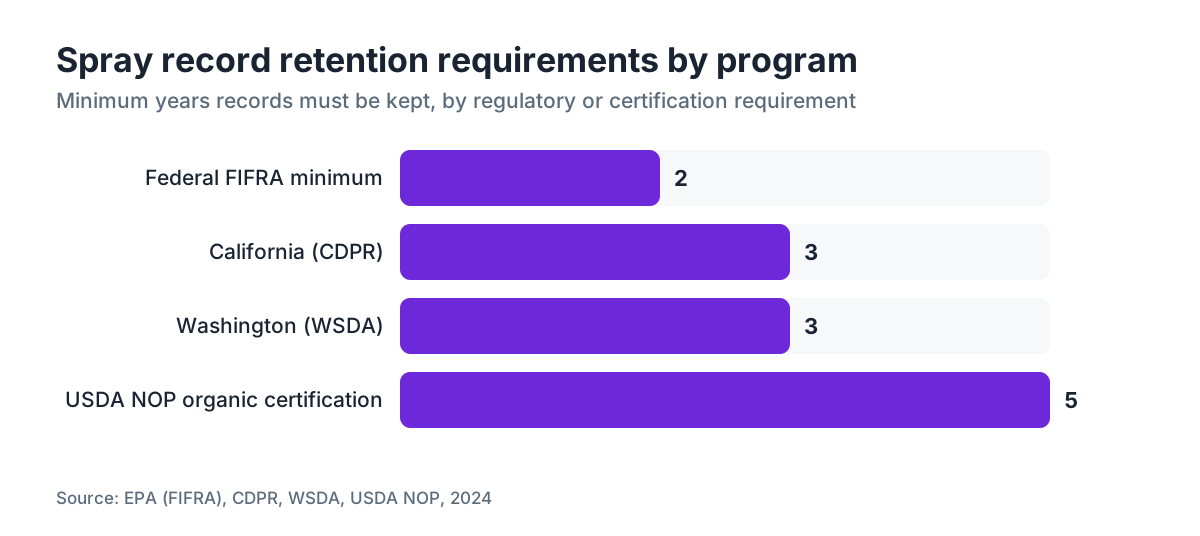
Federal law under FIFRA requires restricted-use pesticide application records be kept for 2 years from the date of application [2]. Both the custom applicator and the property owner who received a copy must hold their respective records for that period.
That 2-year federal floor is almost certainly not enough for your operation. California requires 3 years for pesticide use records under the Food and Agriculture Code [1]. Washington requires 3 years [3]. Organic certification under USDA NOP standards effectively demands 5 years of records, because a certification audit can look back at least 3 years and certification history matters for transfers [6]. Good Agricultural Practices (GAP) audits under USDA programs often ask for records going back further than the statutory minimum.
So keep everything for 5 years minimum, and store it in a format you can actually retrieve. Paper binders in a barn go missing. If you log spray events in software like VitiScribe, the record is timestamped, searchable, and survives a power wash of the spray room.
The custom applicator keeps their own copy for their business records, independent of what they deliver to you. Don't treat your contractor as your backup archive. Their business could close, get acquired, or simply lose the file. Your copy is your insurance.
What happens when a custom applicator fails to deliver records within 30 days?
Non-delivery or late delivery of custom applicator records is a FIFRA violation. The custom applicator is the party at fault, not you. But practically, you're the one running a vineyard with a hole in your compliance file.
First step: put the request in writing the moment the 30-day window closes. Email is fine. Document the date you made the request. This protects you from any regulatory inference that you knew about an application and ignored it.
Second: if the applicator stays unresponsive, most states let you report the violation to the state department of agriculture or the county agricultural commissioner. In California, that's CDFA's Pest Management and Licensing Branch or your local county ag commissioner [1]. In Washington, it's the WSDA Pesticide Management Division [10]. These agencies take commercial applicator compliance seriously because their whole licensing system depends on it.
Third, and this is the harder question: what do you put in your own records while you wait? WPS requires you to have information available to workers. Cornell Extension notes that when a property owner receives application information from a custom applicator, they must make that information accessible within the timeframes WPS requires, but they can't manufacture data they don't have [4]. Write in your log that an application was performed by [company name] on [date], that you requested records on [date], and that they haven't arrived yet. That documented good-faith effort matters if an inspector shows up.
How should you organize vineyard spray records to satisfy both requirements simultaneously?
The most practical approach is a single chronological spray log per block or management zone that says, right at the top of each entry, whether the application was performed by a licensed custom applicator or by your own crew. One field, one checkbox. Everything else flows from that.
For entries where a custom applicator did the work, your log captures the date you received their record, a cross-reference to the file location of that record, and confirmation that all required fields were present. You're not copying out the record, you're acknowledging receipt and filing it.
For entries where your crew did the work, your log is the primary record. Every required field lives there directly: product name, EPA registration number, application rate, total amount used, acres treated, REI, and applicator name.
Where this gets messy is the mixed-crew situation, where your employee holds a certified applicator's license and applies RUPs as part of their regular duties. That employee is not a custom applicator. They're working for you. The record is yours, as the employer-operator, not theirs. Their license number goes in the record as the qualified applicator of record, but you retain the document.
UC Davis Cooperative Extension recommends California growers keep a master field operations logbook that consolidates spray events, REI postings, and worker notification records in one place, since a state inspector can request all three at once [7]. That integration saves real time during inspections and certification audits.
What does the EPA Worker Protection Standard require beyond basic spray records?
The WPS (40 CFR Part 170) is not a pesticide record rule. It's a worker safety rule that carries its own recordkeeping provisions as a side effect of the notification requirements [5]. The overlap matters, because a spray record that satisfies FIFRA can still leave you non-compliant with WPS if it's missing certain fields.
Under the 2015 revised WPS, which took full effect in January 2017, agricultural employers must post pesticide application information at a central location accessible to workers and handlers. The posted information must include the product name, EPA registration number, active ingredient(s), location and description of the treated area, date and time of application, and the REI. According to EPA's WPS guidance, "the information must be posted no later than 24 hours after the application begins and must remain posted for 30 days after the REI expires" [5].
That posting requirement applies whether the applicator was a custom operator or your own crew. If a custom applicator sprays your Cabernet block Tuesday morning and doesn't hand you the record until Thursday, you still had to post notice by Wednesday morning. So you need the product information from the custom applicator before the 24-hour posting deadline, not within 30 days. Require your contractors to deliver application details by phone or email within a few hours of finishing, and let the formal written record follow on their own timeline.
WSU Extension's pesticide safety training materials note that many WPS violations found at inspections come not from wrong records but from gaps in posting, where a custom applicator assumed the owner would handle it and the owner assumed the applicator would [3].
How do spray records differ for organic-certified vineyards?
Organic certification under the USDA National Organic Program (NOP) adds a third layer of recordkeeping on top of FIFRA and WPS [6]. NOP requires certified operations to keep records sufficient to demonstrate compliance with NOP regulations for 5 years. For spray records, that means:
- Documentation that every material applied is approved under the NOP (referenced to your certifier's approved materials list)
- Evidence of need (the buffer and necessity requirements for certain substances like copper)
- Application records that can be cross-checked against invoices and purchase records
- Records sufficient to show that prohibited substances have not been applied
Custom applicators working on organic-certified vineyards have to understand they're applying inside an NOP system. Their record still needs to satisfy FIFRA minimums, but you need extra fields for your certification file: confirmation that the product applied was the NOP-approved formulation (brand name and lot number matter more here than the active ingredient), and the certifier-approved brand rather than just the generic chemical name.
The practical implication: if you use a custom applicator on an organic-certified block, get the product's label and a copy of the application record, and check the EPA registration number against your approved materials list before you file it. A custom applicator who swaps a conventional formulation for the organic-approved one you specified creates a certification problem that's expensive to unwind.
If you track your organic spray program digitally, VitiScribe lets you flag individual spray entries against your certifier's approved list, which makes audit prep a lot less painful than digging through paper files.
What are the most common spray record mistakes vineyard managers make?
Read enough WSU, UC Davis, and Cornell extension guidance and the same errors show up again and again [3][4][7].
The most common mistake is treating the custom applicator's invoice as the spray record. An invoice shows what was charged, not every field a FIFRA-compliant record requires. Invoices usually leave out the EPA registration number, the acreage treated, and the REI. File the invoice, but insist on a separate application record.
Second most common: incomplete REI documentation under WPS. Managers record the application but forget to log the REI end time and confirm that entry restrictions were enforced. A 4-hour REI sounds easy to track, but if your crew is irrigating at 6 AM and the spray finished at 10 PM the night before, someone needs to have confirmed clearance.
Third: recording the rate per acre but not the total amount applied. FIFRA requires total amount. State PUR systems (California in particular) require it for calculating use totals that feed into air quality permits and county reporting thresholds [1].
Fourth: failing to record the specific block or GPS location with enough precision. "East vineyard" is not a location. Block designations that match your farm map are required for any real traceability.
Fifth: accepting records from custom applicators without checking whether their license was current at the time of application. A lapsed license means an unlicensed application, which is a FIFRA violation on their part. You're not legally responsible for their license status, but you want to know you're holding a record from an unlicensed applicator before an inspector does.
Where can you find the official spray record forms for your state?
No single federal form covers pesticide application records. FIFRA specifies required fields, not a specific form. States may provide standardized forms, but using them is usually optional. You just have to capture the required fields somehow [2].
California's CDFA and county agricultural commissioners provide pesticide use report forms and instructions. The California DPR publishes annual PUR data and the forms tied to commercial applicator reporting [1]. Growers applying their own RUPs in California don't submit to DPR but must keep the records.
Washington's WSDA Pesticide Management Division publishes recordkeeping guidance and sample forms for both commercial and private applicators [10].
Cornell Cooperative Extension offers a pesticide recordkeeping guide for New York growers with a sample spray record form covering both RUP and general-use products, a practical starting point if you want a paper template [4].
UC Davis Cooperative Extension's Integrated Pest Management program offers a field spray log template that layers FIFRA fields, WPS posting fields, and California PUR fields into a single form [7]. That's probably the most complete single template around for a California vineyard.
For any vineyard crossing state lines or operating under multiple certification systems, a paper template almost certainly won't hold up long-term. The cross-referencing between FIFRA records, WPS posting logs, organic certification files, and food safety audit trails is real enough that most operations above 50 acres eventually move to a digital system.
Frequently asked questions
Does a custom applicator have to give me a spray record even for general-use pesticides?
Federally, the FIFRA recordkeeping requirement only applies to restricted-use pesticides. For general-use products, there's no federal mandate that a custom applicator provide you a record. Your WPS obligations, organic certification requirements, or state law may require documentation regardless of RUP status. California's PUR system, for example, covers many general-use pesticides applied commercially.
Can I use one spray log for both custom applicator records and my own crew's records?
Yes, and that's the recommended approach. Keep one chronological log per block that clearly marks each entry as either a custom applicator application (with a cross-reference to the received record) or an owner-applicator application (where your log is the primary record). A single integrated log is far easier to produce during inspections than two separate filing systems.
What is the 30-day rule for custom applicator spray records?
Under 40 CFR Part 169 implementing FIFRA Section 8(a), a commercial applicator who applies restricted-use pesticides must give a copy of the application record to the property owner or operator within 30 days of the application. This is a federal legal requirement. If your contractor misses that deadline, document your follow-up request in writing. Continued non-compliance is a reportable FIFRA violation.
Do I need a certified applicator license to apply restricted-use pesticides on my own vineyard?
In most states, a private applicator certificate is enough for owner-operators applying RUPs on their own agricultural operation. This is different from a commercial applicator license. Private applicator certification typically requires completing an approved training course and passing a written exam through your state department of agriculture. Check your specific state requirements, as they vary. California, Washington, and New York all have slightly different private applicator pathways.
What does the EPA Worker Protection Standard require in terms of spray record access for workers?
Under the 2015 revised WPS (40 CFR Part 170), workers and handlers must be able to request pesticide application information and receive it within 30 days. Application information must also be posted at a central location within 24 hours of an application and remain posted for 30 days after the REI expires. This applies to both custom applicator applications and owner-applicator applications.
How long do spray records need to be kept for organic certification?
USDA NOP regulations require certified operations to keep records for 5 years. That exceeds the 2-year FIFRA federal minimum and the 3-year requirement in states like California and Washington. Keep all spray records for at least 5 years if you're certified organic or expect to seek certification, since transitioning operations must demonstrate a 3-year history of no prohibited substance use.
What information do I need from a custom applicator before the 24-hour WPS posting deadline?
Under WPS you must post application information within 24 hours of when an application begins. You need the product name, EPA registration number, active ingredient(s), treated location, application date and time, and the REI. That means you need the information from your contractor within hours of the application, not within the 30-day record delivery window. Require same-day verbal or email communication from your contractors.
Does the employee who applies pesticides need to keep their own personal spray record?
No. When a licensed employee applies RUPs as part of their duties for an agricultural employer, the employer (owner-operator) keeps the record. The employee's certified or private applicator license number appears in the record, but the record belongs to and is retained by the operation. The employee isn't individually required to keep a separate record for work done on behalf of their employer.
What happens if a spray record is missing the EPA registration number?
A record missing the EPA registration number is non-compliant under FIFRA recordkeeping rules for restricted-use pesticides. If you received the record from a custom applicator, ask for a corrected copy immediately and document your request. If the record is yours as owner-applicator, amend it with the registration number from the product label if you still have the label or can access the EPA pesticide information at www.epa.gov. Do not guess.
Are spray records required for pesticides applied by a neighbor or a cooperative if they drift onto my property?
Pesticide drift is a separate regulatory issue from application recordkeeping. You have no recordkeeping obligation for a pesticide you didn't apply and didn't authorize. If drift is suspected and you have workers in the field, you still have WPS safety obligations. Document the incident with date, time, observed symptoms or evidence, and the neighboring operation's identity. That documentation supports any damage or health claim, even though it's not a spray record in the FIFRA sense.
How do I handle spray records when I switch from a custom applicator to my own crew mid-season?
Each application event is recorded based on who performed it. Applications made by the custom applicator before the switch are documented with the received records filed in your log. Applications made by your crew after the switch are documented by you as owner-applicator records. There's no special transition record required. The block spray log just shows the change in applicator, which is clear from the applicator name field.
Can spray records be kept digitally, or does the government require paper?
Neither FIFRA nor WPS require paper records. Both federal rules require records that are retained and accessible for inspection. Digital records satisfy this as long as they can be produced promptly during an inspection and contain all required fields. Some states have specific guidance on electronic record format or signature requirements for submitted reports (like California's PUR system), but internal spray logs can be digital in every major wine-producing state.
What records does a private applicator in California need beyond the federal minimum?
California owner-applicators who use pesticides classified as restricted materials under state law (which includes some products not classified as federal RUPs) must comply with county permit requirements and may face county-level use reporting. California's pesticide use reporting system is the most extensive in the country. Commercial (custom) applicators submit monthly reports to the county ag commissioner. Private applicators aren't required to submit to DPR, but must keep records available for county inspection for 3 years under California Food and Agriculture Code Section 12979.
Does a vineyard need separate spray records for each block, or can one record cover the whole property?
Federal law requires the location of the application be recorded, but doesn't mandate block-level granularity. Practically, recording by individual block is strongly recommended. Organic certification audits, GAP audits, and WPS inspections all benefit from block-level records because REI enforcement, re-entry permissions, and traceability to specific lots depend on knowing exactly which ground was treated. A single farm-wide record covering multiple blocks with different crops, REIs, or application rates is functionally inadequate.
Sources
- California Department of Pesticide Regulation, Pesticide Use Reporting: California requires commercial applicators to submit monthly pesticide use reports to the county agricultural commissioner, and private applicators to retain records for 3 years under California Food and Agriculture Code Section 12979
- U.S. EPA, FIFRA Recordkeeping Requirements (40 CFR Part 169): Federal FIFRA recordkeeping rules require commercial applicators to provide property owners a copy of RUP application records within 30 days and both parties to retain records for 2 years
- Washington State University Extension, Pesticide Safety Education Program: WSU Extension recommends Washington growers keep records for all pesticide applications regardless of classification, and notes that Washington requires retention for 3 years
- Cornell Cooperative Extension, Pesticide Recordkeeping Guide for New York: Cornell Extension notes that New York restricted-use pesticide records must include the certified applicator's license number, and that a property owner receiving records from a custom applicator must make that information accessible within WPS timeframes but cannot manufacture data they don't have
- U.S. EPA, Agricultural Worker Protection Standard (40 CFR Part 170): Under the 2015 revised WPS, the EPA states: 'the information must be posted no later than 24 hours after the application begins and must remain posted for 30 days after the REI expires'
- USDA Agricultural Marketing Service, National Organic Program Regulations: USDA NOP regulations require certified operations to maintain records demonstrating compliance for 5 years
- UC ANR, UC Statewide Integrated Pest Management Program: UC Davis Cooperative Extension recommends California growers maintain a master field operations logbook consolidating spray events, REI postings, and worker notification records, as a state inspector can request all three simultaneously
- U.S. EPA, Pesticides Program and Label Information: EPA registration numbers are required on FIFRA-compliant RUP application records and can be verified through EPA pesticide resources
- U.S. EPA, Pesticide Worker Safety and Applicator Certification: 40 CFR Part 171 defines commercial and private applicator categories and distinguishes commercial applicators applying pesticides for compensation from private applicators applying RUPs on their own agricultural operations
- Washington State Department of Agriculture, Pesticides and Fertilizers: Washington's WSDA Pesticide Management Division oversees commercial applicator licensing compliance and publishes recordkeeping guidance and sample forms for both commercial and private applicators
- U.S. FDA, FSMA Produce Safety Rule: Food safety audits under FSMA requirements frequently ask for pesticide application records beyond the statutory minimum retention period
Last updated 2026-07-09