Cluster thinning timing records and how they connect to spray program adjustments

TL;DR
- Record the exact date and severity of cluster thinning and you can recalibrate your spray program in real time.
- Thinning opens the canopy, changes disease pressure, and resets your residue risk window before harvest.
- Without a date-stamped record tied to your spray log, you're guessing at pre-harvest intervals and you can't prove compliance to an auditor or a buyer.
Why does the date of cluster thinning matter for spray records?
Because thinning changes everything downstream. When you drop clusters, you're doing more than managing crop load. You're physically changing the microclimate inside the canopy, which shifts the disease environment, which should shift your fungicide choice and rate, which feeds straight into your pre-harvest interval (PHI) math.
Most spray programs are built around a calendar or a degree-day trigger set before the season starts. That system assumed a certain vine architecture. The moment you thin, that architecture is gone. More light gets in. The bunch zone dries faster. Humidity drops. If you don't log the thinning date and connect it to your spray notes, you lose the thread that explains why you changed products, rates, or intervals mid-season.
This matters both agronomically and legally. Under EPA Worker Protection Standard (WPS) rules, your pesticide application records must be kept for two years and must document rates, timing, and restricted-entry intervals [1]. Inspectors can ask why your spray program drifted from the original plan on file. "We thinned" isn't an answer. A dated thinning record tied to a spray adjustment note is.
So treat cluster thinning as a formal field event in your record system, not a labor ticket. Log it the same day it happens. Note the severity as a percentage of clusters removed. Attach a note to any spray record in the following two to three weeks that explains the program change.
What canopy and disease pressure changes happen after thinning, and how should they affect your spray schedule?
Thinning at fruit set opens the bunch zone in ways that directly change your Botrytis and powdery mildew risk, which means your interval and rate assumptions are now out of date. Fruit set runs roughly 30 to 45 days after bloom depending on variety and region. UC Davis viticulture research on canopy management points to improved light penetration and air movement as the main mechanisms reducing bunch rot, with some trial data showing 30 to 60 percent lower Botrytis severity when thinning is paired with leaf removal [2].
Here's what that means for your program in plain terms.
First, if you were on a 10-day powdery mildew program using a high-rate protectant, you may be able to stretch to 14 days after heavy thinning with good canopy opening. Write that decision down and reference the thinning record.
Second, some fungicide programs call for higher rates in dense canopies to get coverage. Post-thinning, the lower end of the label range may be enough. If you cut the rate, document why.
Third, Botrytis sprays timed to bunch closure are now aimed at a different physical event. Thinning can push back effective bunch closure by changing berry-to-berry contact. Your spray timing notes should say so.
WSU viticulture extension work notes that canopy architecture is one of the strongest factors in spray program efficacy and timing, with penetration in dense versus open canopies differing by as much as 50 percent [3]. Your canopy changed. Your spray assumptions changed with it. The record is how you prove you noticed.
How do you structure a thinning record that actually supports a spray audit?
A thinning record built for audit support needs at least six fields: block ID, date, growth stage at thinning (using the Eichhorn-Lorenz or BBCH scale), estimated percentage of clusters removed, crew size (to show the event was real and datable), and a signature or initials. That's the floor.
The more useful version adds two fields: a notes column for canopy observations ("dense, no air movement pre-thin" or "already open from early shoot positioning") and a linked spray record ID pointing to the next application.
Here's why that last field earns its keep. An auditor reviewing your spray log sees a rate change or product switch on June 18. They need the field event that justifies it. If your June 14 thinning record carries the spray record ID right on it, the paper trail is instant. Without the link, you're rebuilding the story from memory under pressure.
Cornell's IPM guidance on pesticide recordkeeping for New York vineyards recommends keeping field operation records (pruning, thinning, irrigation) near your spray records so they support the "reason for application" field required by many state reporting systems [4]. A thinning record filed in a separate binder is worse than useless in an audit. It creates two half-stories instead of one whole one.
Digital or paper? Either works if you're consistent. Paper fails through misplaced records and illegible dates. Digital fails through records entered days later from memory. The rule holds for both: record on the day of the event, every time.
How does thinning timing interact with pre-harvest interval (PHI) calculations?
This is where records grow legal and food-safety teeth. A pre-harvest interval is the minimum number of days between the last application of a pesticide and harvest. EPA sets it at registration, it's printed on every label, and under FIFRA the label is the law [5].
The link to thinning timing is indirect but real. Thinning usually happens between fruit set and veraison, which is roughly 60 to 120 days before harvest depending on variety and region. If your thinning record has the exact date, you can use it as an anchor and work backward from your expected harvest date to set a last-application deadline for each product in your program.
Work through an example. Say you thin Pinot Noir on July 5 in the Willamette Valley. You expect harvest around September 20, so you've got about 77 days of spray window. You're running a systemic fungicide with a 30-day PHI. Your last legal application lands around August 21. Log that deadline the moment you record the thinning date. If late disease pressure hits in the last week of August, you already know you're in PHI-restricted territory and need a zero-PHI product instead.
The thinning record also catches harvest-date drift. Thin heavier than planned and maturity can speed up because the fruit-to-leaf ratio improved, so your estimated harvest date moves earlier. A dated severity note gives you a reason to revise the PHI window. Without it, you may never revisit the math.
EPA guidance under FIFRA Section 2(ee) is clear that applicators must follow PHI restrictions as labeled, whatever the field conditions [5]. Not knowing your own harvest window is no defense. The thinning record is part of building that calendar so it holds up.
What growth stage should you be thinning at, and does earlier or later thinning change the spray implications?
The agronomic sweet spot for cluster thinning in most wine grape varieties is around EL 27 to 29 (fruit set, berries 2 to 4 mm), though some growers push to bunch closure (EL 33 to 35) for specific quality goals. Cornell research on Finger Lakes Riesling found that thinning at fruit set improved Botrytis control more than thinning at veraison, partly because earlier thinning gave more weeks of better air movement through the late-summer disease window [6].
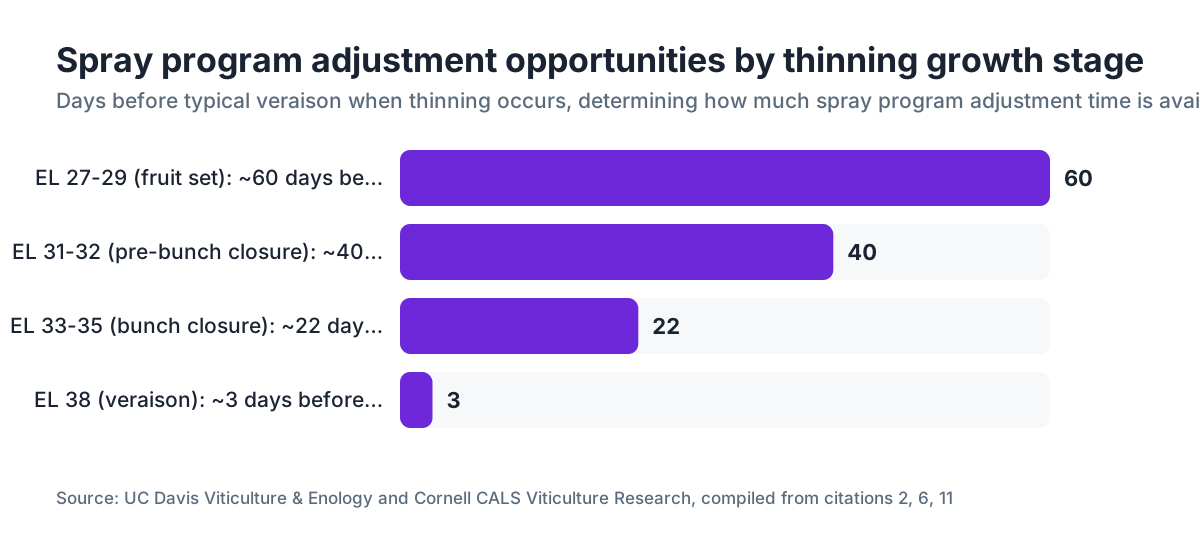
From a spray standpoint, earlier thinning buys you time to recalibrate. Thin at EL 27 and you've got six to ten weeks before veraison to adjust. Thin at EL 33 and you may be inside the hardest Botrytis pressure window before your program catches up to the new canopy.
The table below maps thinning timing to your adjustment window.
| Thinning growth stage | Days before typical veraison | Key program adjustment window | Main disease target affected |
|---|---|---|---|
| EL 27-29 (fruit set) | 50-70 days | Powdery mildew interval extension | Uncinula necator |
| EL 31-32 (pre-bunch closure) | 30-50 days | Botrytis timing reset | Botrytis cinerea |
| EL 33-35 (bunch closure) | 15-30 days | Rate reduction in open canopy | Botrytis cinerea |
| EL 38 (veraison) | 0-7 days | PHI window finalization only | n/a |
Logging growth stage next to the calendar date gives future-you (and any auditor) the context for the spray decision you made. A date alone doesn't tell the story. "July 5, EL 28, 40 percent clusters removed, canopy opened significantly" does.
How do spray records need to change after a significant cluster thinning event?
After any thinning that removes more than 25 percent of clusters or clearly changes canopy architecture, review four parts of your program: interval, rate, product selection, and application method.
Interval review is the most common adjustment. An open canopy dries faster, which shortens infection periods for both powdery mildew and Botrytis. If you were on 10-day intervals, 14 days may be defensible in a low to moderate pressure year. Put that in the "reason for application" or notes field with a reference to the thinning event.
Rate review matters because many fungicide labels list a rate range tied to canopy density or spray volume. Some DMI fungicides list rates from 4 to 8 oz/acre depending on disease pressure and canopy density [7]. Post-thinning, moving to the low end is agronomically sound. Note it and note why.
Product selection review applies if your pre-thinning program leaned on a product picked partly for its canopy penetration in dense conditions. After thinning, you may have better options at lower resistance risk or lower cost.
Application method review applies if you're running a speed sprayer calibrated to a dense canopy. Post-thinning, you may be over-applying into an open canopy, raising drift risk and possibly breaking label requirements about application volume. The record should say if you recalibrated.
One place digital records earn their cost: a tool like VitiScribe lets you attach a field event (thinning) to a spray block, so it can flag any spray record made after that event and prompt you to confirm your parameters still fit. Software or paper binder, the discipline is the same. Review the parameters after thinning. The record is your proof you did.
What do EPA and state pesticide regulators expect to see in a thinning-related spray record?
Federal WPS rules (40 CFR Part 170) require that pesticide application records include the product name, EPA registration number, application date, location, rate, and total amount used [1]. They don't explicitly require thinning records. States add layers on top.
California's Department of Pesticide Regulation (CDPR) requires growers to file a Pesticide Use Report (PUR) within a set window after application, and for restricted-use pesticides the record must include a pest or crop condition description [8]. Auditors use that crop condition field to check that applications were agronomically justified. "Dense canopy, high Botrytis pressure" holds up. So does "post-thinning open canopy, reduced rate justified." A one-word entry like "preventive" is technically compliant but thin in an audit.
Washington requires pesticide application records under WAC 16-228 to be kept at least two years and available for inspection [9]. WSU extension recommends documenting any deviation from a published spray program (extension recommendations or a PCA-signed program) with a field observation note. A thinning record is exactly that.
New York follows the federal WPS minimums, but DEC auditors have increasingly asked for field operation records that back up application justifications, per Cornell IPM guidance [4].
Across all of these, the point is the same. Your spray record doesn't have to cite your thinning record. But if an auditor questions an application, a linked thinning record can be the difference between a closed file and a Notice of Intent to Assess Penalty. Keep them in one system or one binder.
How should you handle organic spray programs differently after thinning?
Organic programs hit the same canopy-change dynamics after thinning, just with a narrower product toolkit and often shorter re-entry intervals under NOP standards. The record logic is identical: log the thinning date, note severity, tie it to a spray program review.
The practical difference is that sulfur and copper products, the backbone of most organic fungicide programs, depend on coverage more than many synthetics because they're contact protectants. Post-thinning, you may need to reassess coverage pattern and volume, more than interval.
Copper also carries NOP accumulation limits. Under 7 CFR Part 205 (National Organic Program), copper materials may be used but must be applied in a way that minimizes soil accumulation [10]. If thinning lets you drop application frequency or rate, that's an NOP-relevant decision and it belongs in your records. Certifiers increasingly want spray records that show a management rationale for copper. "Reduced rate post-thinning due to improved canopy openness" strengthens your organic system plan.
For OMRI-listed biorationals like Bacillus subtilis or Trichoderma products, thinning timing matters too. These products have shorter rain-fastness and need canopy conditions that let them reach the fruit. A thinning record documenting better canopy access on a given date helps justify a biorational-first approach in the sprays that follow.
How should thinning records be retained and what format works best for spray audits?
WPS rules require pesticide application records for two years [1], and your thinning records should ride along for the same period because they support those applications. Sell to wineries with sustainability certifications (California Sustainable Winegrowing, LIVE, Demeter) and you'll usually face a three to five year requirement, so two years is the floor, not the target.
Format matters less than consistency. A typed spreadsheet exported to dated PDF works. A handwritten field notebook with dated entries and block IDs works. What doesn't work: undated notes, entries attributed to "the crew" with no individual accountability, and records that live only in someone's head.
A few structural moves auditors and PCA consultants actually like. Organize by block, not by date. An auditor looking at one block wants every event for that block in sequence, not a chronological log they have to comb through for matching block IDs. Date within each block section, not as the top-level sort.
If you want a digital cross-reference, VitiScribe builds thinning events into the same block-level timeline as spray records, so the block-by-block view is automatic. A well-organized paper binder with a divider per block gets you the same result.
One format holds up in audits over and over: a two-column entry where the left column is the field event (thinning, with date and severity) and the right column is the program response (spray change, with date and rationale). That parallel layout makes cause and effect visible at a glance, which is precisely what an auditor or certification reviewer wants to see.
What are the most common recordkeeping mistakes growers make around cluster thinning and spray timing?
The most common mistake, by a wide margin, is logging the thinning after the fact. Three days late isn't terrible. Three weeks late isn't a record, it's a reconstruction. The credibility problem is real. An auditor can't verify a date that was clearly batch-entered at the end of the month.
Second most common: logging thinning as a labor event only. The labor ticket captures crew hours for cost accounting. It doesn't capture growth stage, severity, or canopy condition. The labor ticket is not a field record for spray purposes. These are two documents, and they should sit side by side.
Third: never revising the spray program after thinning. Growers who carefully record the thinning date, then keep running an unchanged program with no acknowledgment of the canopy change, leave the most valuable part of the record work on the table. The thinning record only pays off if it connects to a spray decision.
Fourth: storing thinning records away from spray records. Paper binders grow organically, spray records in one three-ring binder, field operations in another. It's understandable and survivable, but it needs an index or cross-reference. Without one, the two record sets are islands.
Fifth: ignoring partial-block thinning. Thin the upper third of a slope but not the lower third because of different vigor zones, and your spray adjustment applies only to the thinned rows. A record that treats the whole block as uniformly thinned can lead to over-application in the dense zone or misapplication in the open zone. Subdivide the block, or at least note which rows got thinned.
How do you connect cluster thinning records to harvest date forecasting for PHI compliance?
Harvest date forecasting isn't exact. Degree-day models, berry sampling, and varietal norms all carry error margins of one to two weeks in most regions. But those models sharpen when you feed them accurate thinning data.
Here's the mechanism. Crop load drives berry maturity rate. A vine carrying 60 percent of its original cluster weight after heavy thinning ripens the remaining fruit faster than an unthinned vine in the same block. UC Davis research on crop load and maturity found that severely thinned vines (down to one cluster per shoot) reached target Brix roughly 10 to 14 days earlier than unthinned controls in Cabernet Sauvignon trials [11].
Move your harvest date 10 to 14 days earlier and your PHI window closes earlier too. A fungicide with a 30-day PHI and a nominal last-application date of August 25 now has a real deadline closer to August 11. If you didn't update your spray calendar when you recorded the thinning severity, you may make applications you'll later have to defend or report.
The discipline is simple. When you log a thinning event, add a step that says "update harvest date estimate and check PHI windows." Write the revised PHI deadlines straight onto the spray program for that block. Five minutes. It prevents the late-season scramble where you're trying to decide if you can safely apply a product 28 days before a harvest date that might be 25 days out.
For growers selling to wineries with residue testing programs (common in export markets and premium tiers), this is worth building into your routine. A residue exceedance is an order of magnitude bigger than a recordkeeping gap. The records are what let you show due diligence if a residue result ever comes back unexpectedly.
Frequently asked questions
How long do I have to keep cluster thinning records?
Federal WPS rules require pesticide application records for two years [1], and since thinning records support those applications, keep them for the same period at minimum. Sustainability certifications like LIVE or California Sustainable Winegrowing typically require three to five years. Keeping thinning records for five years costs nothing and closes any gap if a late audit or buyer inquiry shows up.
Does cluster thinning severity affect which fungicide products I should use?
Severity determines how much the canopy architecture actually changed. Light thinning (under 15 percent of clusters removed) may not meaningfully shift disease pressure. Heavy thinning (over 35 percent) in a previously dense canopy can move you from a penetrant systemic to a protectant contact fungicide at a lower rate. Log the severity percentage so your program adjustment has a documented basis.
Can my labor payroll records substitute for a field thinning record?
No. Labor tickets capture hours and crew for payroll, not field conditions or agronomic observations. They don't record growth stage, percentage of clusters removed, or canopy condition. An auditor reviewing spray records won't find what they need in a payroll log. You need a separate field record documenting the agronomic specifics on the date the thinning happened.
What growth stage notation should I use when recording cluster thinning?
Use either the Eichhorn-Lorenz (EL) scale or the BBCH scale. Both are standard in extension publications and understood by PCAs and auditors. EL 27 to 29 covers fruit set, the most common thinning window. Logging growth stage alongside the calendar date beats date alone, because it gives context for the program decisions that followed.
If I thin a block in two passes on different dates, how do I record that?
Record each pass as its own entry with date, growth stage, and severity estimate. On the first entry, note that a second pass is planned. On the second entry, note the cumulative severity across both passes. Your spray record adjustment should reference both entries if the second pass meaningfully changed canopy conditions. Two partial records beat one composite estimate.
How does California CDPR's Pesticide Use Report system relate to my thinning records?
CDPR requires growers to file a Pesticide Use Report after each application, including a crop condition description for restricted-use pesticides [8]. Thinning records aren't filed with CDPR, but they're the supporting documentation you need if CDPR audits your crop condition entries. A dated thinning record is your evidence that a rate reduction or interval change was agronomically justified, not arbitrary.
Does thinning affect the re-entry interval (REI) requirements for any products in my spray program?
Thinning doesn't change REI requirements, which are set by EPA registration and the product label. It does change how you schedule worker access, since an open canopy dries faster and can shorten actual wet contact time versus the 4-hour standard REI on many products. The REI clock still starts at the end of application regardless of canopy. Your records should show REI end times for every application, unchanged by thinning status.
What should I write in the 'reason for application' field on my spray record after I've thinned?
Be specific. Instead of 'preventive Botrytis,' write something like 'Botrytis protective, post-thinning open canopy, reduced rate per thinning record 7/5, EL 28.' That links to your field record, explains the rate choice, and shows an informed decision. Generic entries are technically compliant but weak if an auditor wants to understand a rate deviation from your standard program.
How far in advance of harvest can I still thin clusters, and does late thinning still affect my spray program?
Very late thinning (at or after veraison, EL 35 and beyond) offers minimal disease management benefit because bunch closure has already happened. Spray adjustments at that stage are limited to PHI window finalization, not interval or rate changes. Cornell research found Botrytis control benefits from thinning were substantially reduced when thinning occurred post-bunch closure versus fruit set [6]. Earlier is better for both agronomics and spray flexibility.
Do organic certified vineyards have different recordkeeping requirements around thinning and spray programs?
USDA NOP regulations under 7 CFR Part 205 require organic producers to keep records for five years showing compliance with the organic system plan [10]. That plan covers your spray program. Thinning records support the NOP requirement to show inputs, especially copper with its accumulation concerns, were used at the minimum necessary rate. An open canopy justification for reduced copper rates is exactly what NOP certifiers look for.
Should my PCA sign off on spray program changes triggered by cluster thinning?
If your state requires a Pest Control Advisor signature for restricted-use pesticide applications (as California does for many), any change to product, rate, or timing needs to be covered by an updated written recommendation from your PCA. Thinning-driven changes are no exception. Contact your PCA right after a significant thinning event so they can issue the updated recommendation before your next application, not after.
What's the best way to estimate percentage of clusters removed during thinning for my records?
Count clusters on 10 representative shoots per block before thinning starts, then count the same shoots after. That ratio gives you a reasonably accurate block-level percentage. Some growers count dropped clusters in a catch frame per vine. Either method beats a rough 'moderate thinning' note. A documented count method, even an imperfect one, is more credible in an audit than an undocumented guess.
Can I use a single thinning record template across all my blocks, or does each block need its own form?
A single template is fine as long as block ID is a required field and each block's entry is clearly separated. The record must be traceable to a specific block for spray audit purposes. Lumped records covering multiple blocks in one entry ('thinned all reds today') are nearly useless when an auditor is looking at block-level spray applications. One entry per block per thinning event is the workable minimum.
Sources
- EPA, Worker Protection Standard for Agricultural Pesticides (40 CFR Part 170): WPS regulations require pesticide application records to be retained for two years and include product name, EPA registration number, date, location, rate, and total amount applied.
- UC Davis Department of Viticulture and Enology, Canopy Management: Improved light penetration and air movement from thinning and leaf removal reduce Botrytis severity, with some trial data showing 30 to 60 percent reductions.
- Washington State University Viticulture and Enology Extension: Canopy architecture is one of the most influential factors in spray program efficacy, with penetration rates in dense vs. open canopies differing by as much as 50 percent.
- Cornell University Integrated Pest Management Program: Field operation records including thinning should be kept in proximity to spray records to support the reason-for-application field required by state pesticide reporting systems.
- EPA, Federal Insecticide, Fungicide, and Rodenticide Act (FIFRA) Label Requirements: Under FIFRA, the pesticide label is the law and applicators are responsible for adhering to PHI restrictions as labeled regardless of field conditions.
- Cornell University College of Agriculture and Life Sciences, Viticulture Research: Thinning at fruit set improved Botrytis control outcomes more than thinning at veraison in Finger Lakes Riesling trials; Botrytis control benefits were substantially reduced when thinning occurred post-bunch closure.
- University of California Statewide IPM Program (UC IPM), Grape Pest Management: Some DMI fungicides list rates from 4 to 8 oz/acre depending on disease pressure and canopy density; lower rates are appropriate in open canopy conditions.
- California Department of Pesticide Regulation, Pesticide Use Reporting: CDPR requires growers to file a Pesticide Use Report after application; for restricted-use pesticides the record must include a crop condition description.
- Washington State Department of Agriculture, Pesticide Application Records (WAC 16-228): Washington State requires pesticide application records under WAC 16-228 to be retained for at least two years and available for inspection.
- USDA Agricultural Marketing Service, National Organic Program Regulations (7 CFR Part 205): NOP regulations require organic producers to maintain records for five years demonstrating compliance with the organic system plan; copper materials must be used to minimize soil accumulation.
- UC Davis Department of Viticulture and Enology, Crop Load and Fruit Maturity Research: Severely thinned vines (to 1 cluster per shoot) reached target Brix approximately 10 to 14 days earlier than unthinned controls in Cabernet Sauvignon trials.
Last updated 2026-07-10