How to set up a spray record logbook for vineyard compliance

TL;DR
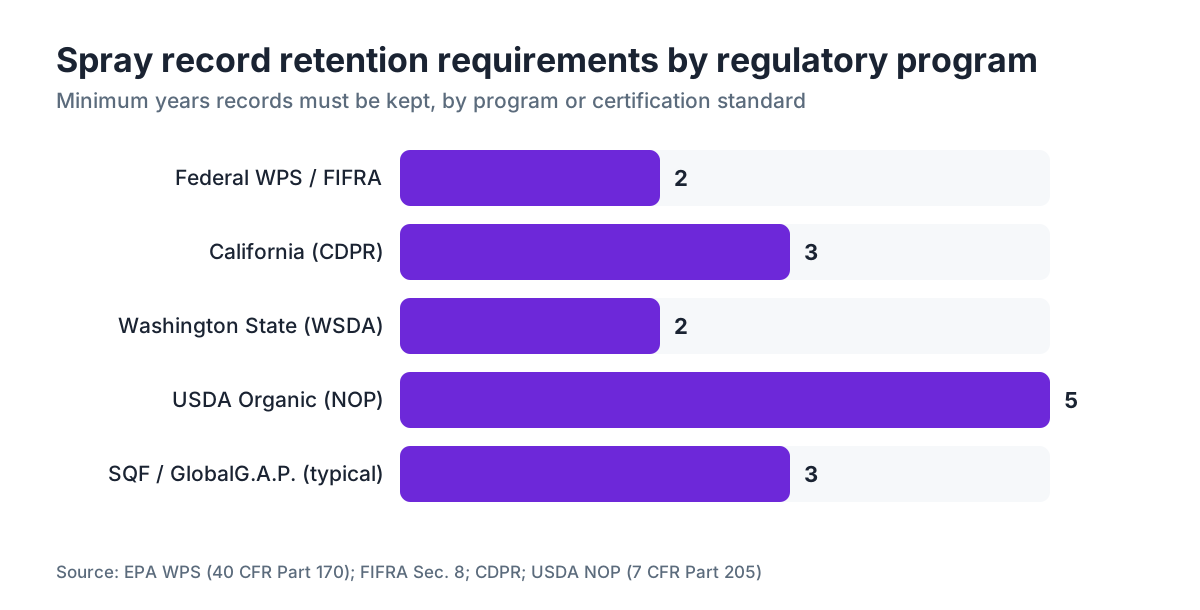
- Federal EPA Worker Protection Standard and most state ag departments require pesticide application records kept for at least two years, with California requiring three.
- A compliant vineyard spray logbook must capture the applicator name and license number, product name and EPA registration number, rate, target pest, date, block, and restricted entry interval end date and time.
- Miss one required field and an otherwise clean operation gets a violation notice.
What records are you actually required to keep?
Federal law sets the floor. Under the EPA Worker Protection Standard (WPS) at 40 CFR Part 170, agricultural employers must keep pesticide application and safety training records for restricted-use pesticides (RUPs) for at least two years [1]. The Federal Insecticide, Fungicide, and Rodenticide Act (FIFRA) section 8 separately requires certified applicators to keep records of all RUP applications, also for two years [2].
State requirements often go further. California's Department of Pesticide Regulation (CDPR) requires pesticide use reports filed monthly with the county agricultural commissioner, and the supporting application records must be kept for three years [3]. Washington State's Department of Agriculture requires two years for most operators but can extend that window if a violation is under investigation [4].
Here's the practical takeaway. Design your logbook for three years of retention even if your state only requires two. The extra year costs you nothing except storage space, and it protects you if a slow-moving investigation starts in year two.
One more layer surprises growers. If you sell grapes to a winery running a food safety program (SQF, GlobalG.A.P., or a retailer audit protocol), that buyer contract may require a longer retention period, sometimes five years, and may specify that records be available digitally on request. Check your grape purchase agreement before you design your system.
What fields does every spray record entry need?
This is where most homemade logbooks fall short. Inspectors and auditors work off checklists, and a single missing field is a violation even when the application itself was done correctly.
Here are the fields required by FIFRA and WPS for restricted-use pesticide records [2], plus the additional fields California's CAC reporting system requires [3]:
| Field | FIFRA/WPS required | CA CAC required | Best-practice add |
|---|---|---|---|
| Date of application | Yes | Yes | Add start and end time |
| Applicator name | Yes | Yes | |
| Applicator license/cert number | Yes | Yes | |
| Product name (label name) | Yes | Yes | |
| EPA registration number | Yes | Yes | |
| Application site (block/parcel) | Yes | Yes | Add APN or GPS center point |
| Target pest | Yes | Yes | |
| Acres treated | Yes | Yes | |
| Amount of product applied | Yes | Yes | Include both per-acre rate and total |
| Application method/equipment | No | Yes | |
| Water volume per acre | No | No | Add it anyway for efficacy tracking |
| Wind speed and direction | No | No | Required by many labels; add it |
| Temperature at application | No | No | Add it; label compliance |
| PHI (pre-harvest interval) | No | No | Calculate it; write it in |
| Restricted entry interval (REI) | Yes (post) | Yes | Write the REI end date/time |
| Re-entry area posted | Yes | Yes | Checkbox is fine |
| Mixer/loader name (if different) | No | Yes | |
| Spray equipment ID | No | No | Add for equipment calibration audit trail |
The PHI and REI rows deserve special attention. Fill in the actual calendar date and time when workers can re-enter, more than the hours off the label, and you eliminate math errors during a busy harvest push. Write "No re-entry until: [date] [time]" in the logbook. That one habit prevents most WPS re-entry violations.
How should you organize the logbook physically?
There's no federally mandated format, just mandatory content. That gives you flexibility. It also means there's a right way and a wrong way to organize for real use.
Don't organize by product. Organizing by date is fine for chronological compliance, but for agronomic decisions you want to know what you put on Block 7 before harvest, not what date you last sprayed a particular fungicide.
The most useful structure is by block, then by date within each block. Twelve blocks, twelve sections. Each section gets a tab or divider. Within each tab, entries run chronologically. This lets you pull Block 7's complete spray history in thirty seconds, which is exactly what you need when you're checking a resistance management threshold or a buyer asks about pre-harvest applications.
For small operations under 20 acres, a single spiral-bound notebook with tabbed dividers works fine. Use a printed master template for each entry and staple or tape it in. Loose-leaf binders let you insert pages, but they also let pages fall out. Whatever you choose, number the pages sequentially in pen before you start. Numbered pages make it obvious if one has been removed, which matters for regulatory credibility.
For larger operations, or anywhere a second applicator is spraying while you're across the property, paper gets messy fast. That's where a field-operations platform like VitiScribe earns its keep: every application logged at the point of spraying, REI timers that run in real time, and records exportable as a PDF that looks exactly like what a CDPR inspector wants to see.
Whatever format you use, keep the logbook at the farm, accessible to inspectors during normal working hours. The WPS requires that application records be available to employees and their designated representatives upon request [1].
What's the difference between a spray log and a pesticide use report?
Growers in states without mandatory pesticide use reporting sometimes think their internal spray log is the only document they need. In California, the log and the report are separate obligations that feed each other.
The spray log is your internal record of every application: who, what, where, when, how much, under what conditions. It stays on the farm.
The pesticide use report (PUR) is a monthly summary filed with your county agricultural commissioner. California's CDPR requires this for all pesticide applications, not only RUPs [3]. The PUR deadline is the 10th of the month following each application month, so January applications are due February 10. The county sends that data to CDPR, which publishes it in the statewide pesticide use database.
Your spray log is the source document for your PUR. If your spray log is complete and accurate, filling out the PUR is arithmetic. If your spray log is patchy, the PUR filing becomes guesswork, and the numbers won't reconcile if an inspector compares the two.
Washington and Oregon run their own reporting structures. Washington requires pesticide dealers to report sales, but applicators mostly need to maintain their own records [4]. Oregon's Department of Agriculture has pesticide reporting requirements for specific product categories. Check your state ag department's current guidance every year, because these rules do change.
How do you handle restricted-use pesticide records differently?
General-use pesticides and restricted-use pesticides (RUPs) sit in different regulatory categories, and your logbook should make that distinction obvious at a glance.
FIFRA section 8(b) specifically requires certified applicator records for RUPs, and those records must include the certified applicator's certification number [2]. If a non-certified employee does the application under the direct supervision of a certified applicator, the certified applicator's name and number still go in the record, plus a note that supervision was provided.
Some states require RUP records to be kept separately or flagged distinctly from general-use records. The simplest approach is a colored paper stock for RUP entries (say, yellow) versus white for general-use, or a plain "RUP" checkbox at the top of every entry form.
Purchase records for RUPs are a separate requirement. Keep copies of every invoice showing product name, quantity purchased, and the dealer's license number. These purchase records should reconcile with your application records. If you bought 5 gallons of a RUP and your spray logs show you applied 4.5 gallons to dated blocks, the half-gallon gap needs an explanation (spill, disposal, inventory carry-forward). Inspectors notice unexplained gaps.
What do Worker Protection Standard records specifically require?
The WPS is often misread as only covering re-entry. It covers record-keeping too, and vineyards are agricultural establishments subject to it whenever they employ agricultural workers or handlers [1].
The revised WPS took effect January 2, 2017. Under 40 CFR 170.311, employers must keep application records for pesticides applied to the establishment for two years from the date of application, including the product name, EPA registration number, active ingredient(s), location and description of treated area, date and times of application, and the REI for the pesticide [9].
The standard also requires that these records be provided to employees (or their designated representatives, including physicians) within 15 days of a written request. EPA's own guidance states that the rule is meant "to protect agricultural workers and handlers from occupational exposure to agricultural pesticides" [1]. That means your logbook isn't just for inspectors. A worker who thinks they were exposed during re-entry has a legal right to the application data.
Posting requirements sit on top of record-keeping. Warning signs must be posted at field entry points during the REI, and the posted information must match what's in your log. If your log says REI ends Wednesday at 6am and your sign says Tuesday, that's two violations for the price of one.
WSU Tree Fruit and its pesticide safety program publish WPS compliance checklists for growers that cover the record-keeping piece specifically [5].
How far back do spray records need to go for a full audit?
The legal minimum and the practical minimum diverge here.
Legally: two years federal (FIFRA, WPS), three years in California, two years in Washington and Oregon for most applicator categories [2][3][4].
Practically, if you're seeking USDA organic certification, the National Organic Program requires records that demonstrate compliance for at least five years, and those records must trace inputs back to their source [6]. If any blocks are transitioning to organic, your pre-transition spray history matters too.
For food safety audits (SQF, GlobalG.A.P.), the expectation is usually three to five years of accessible records. Some retail-driven programs want seven. This isn't regulatory, it's contractual. Read the standard you're certifying to.
For your own agronomic use, five to seven years of block-level spray history is the useful range. Resistance management decisions, vine health trends, and estate wine lot documentation all benefit from a longer trail. Storing paper for an extra few years is trivial. Not having it when you need it is expensive.
What's the best template layout for a vineyard spray record entry?
Here's a working template you can print or adapt. Each entry form should fit on one side of a standard 8.5x11 page so nothing gets cut off when you copy it for a CAC report.
Top block (identification):
- Block ID / Vineyard name
- APN or legal parcel description
- Acres treated
- Date of application
- Start time / End time
Applicator block:
- Applicator name (printed)
- Applicator signature
- Pesticide applicator license number and state
- Mixer/loader name (if different)
Product block (one row per product, duplicate if mixing):
- Product name (as on label)
- EPA registration number
- Active ingredient(s)
- Formulation (EC, WDG, SC, etc.)
- Rate per acre
- Total product applied
- Water volume per acre
- Tank mix total gallons
Application conditions:
- Target pest / disease / weed
- Growth stage of vine (BBCH scale or descriptive)
- Equipment used (sprayer ID)
- Application method (airblast, hand-gun, drip)
- Wind speed (mph) and direction
- Temperature (F)
- Relative humidity (%) if known
Compliance fields:
- PHI from label (days)
- Earliest harvest date (calculated)
- REI from label (hours)
- Re-entry allowed on: [date] at [time]
- Warning signs posted: Yes / No
- PPE worn (check all that apply): gloves / respirator / goggles / coveralls
Notes line: any deviations, equipment problems, weather changes mid-application.
That's more fields than the legal minimum, on purpose. The extra fields cost you thirty seconds to fill in and pay for themselves the first time you're trying to reconstruct what happened in Block 4 three months later.
Paper vs. digital: which system actually works better?
Honest answer: it depends on crew size and your own habits.
Paper works well when one person does all the spraying, records get filled in right after each application (not at the end of the week), and the logbook lives in a single known spot. The failure mode for paper is delay. Records filled in from memory two days later have errors. Records filled in during the spray by a driver with wet gloves get damaged. Paper also won't remind you that your REI expires at 6am tomorrow.
Digital works better for multiple applicators, multiple blocks sprayed in parallel, and operations where record-keeping falls to whoever's free rather than a dedicated person. The failure mode for digital is connectivity in the vineyard and device damage. A tablet that falls off an ATV costs more to replace than a notebook.
A hybrid approach is the most common in practice. A laminated field card on the sprayer captures the critical fields during application, and the data transfers to a digital system (or a clean paper log) within 24 hours. You get the immediacy of field notes without betting on a device surviving tractor cab conditions.
Cornell's Lake Erie Regional Grape Program has published guidance on record-keeping systems for small wineries and vineyards that's worth reading if you're on the fence [7].
For farms moving to digital, VitiScribe is built for vineyard compliance: it handles spray logs, generates the output format California CACs accept, and tracks REI timers across blocks automatically.
How do you train employees to fill out spray records correctly?
This is where compliance programs fall apart. The logbook design can be perfect and still generate violations if the person filling it out doesn't understand why each field matters.
The WPS requires annual pesticide safety training for all agricultural handlers, meaning anyone who mixes, loads, or applies pesticides [1]. That training is the right moment to walk through the logbook with everyone who touches it. Don't just hand them a blank template. Go through a completed sample entry field by field and explain what happens if one is missing or wrong.
Drill these specifically:
- EPA registration number: it's on the label, not the same as the UPC. Show them where to find it.
- Rate per acre vs. total applied: two different numbers, both required.
- REI end date/time: make them calculate it from the label REI in hours and the application end time. Have them write the calendar date, more than "48 hours."
- Signature: required. A printed name alone doesn't satisfy most state requirements.
Keep a current copy of every product label in the cab or spray shed. Applicators filling in registration numbers and REIs from memory make mistakes. Labels are the source of truth, and they change when products are re-registered.
UC ANR's Pesticide Safety Education Program has training materials on pesticide safety and record-keeping, including resources for Spanish-speaking agricultural workers, which covers most vineyard crews in California [8].
What happens during a pesticide records inspection?
County agricultural commissioners and state department of agriculture inspectors can show up unannounced. In California, the CAC has broad authority to inspect pesticide records during normal business hours [10]. Federal WPS inspections are conducted by state lead agencies under EPA delegation.
What inspectors typically do:
- Ask to see your pesticide use records for a set time period, usually the last one to two years.
- Cross-reference your records against CAC-filed pesticide use reports where applicable.
- Check that RUP records include the certified applicator's license number and that the license was current at the time of application.
- Verify that REI posting records match application records.
- Sometimes check product purchase records against application records for unexplained inventory discrepancies.
Common violations inspectors cite: missing applicator license number, no REI end date recorded, records not kept on-site, records more than 30 days behind (California requires monthly filing), and pesticide use reports that don't match field records.
Violations can bring written warnings, civil penalties, or in serious cases license suspension. California civil penalties for CDPR violations can reach $5,000 per violation [10]. First-time minor violations usually get a warning and a follow-up inspection. But "I forgot" is not a defense when the requirement has been in statute for decades.
Organize your logbook so you can put your hands on any block's records within two minutes. Fumbling through a disorganized binder doesn't inspire confidence.
How do you handle spray records for a lease or custom farming arrangement?
This catches a surprising number of growers. Who keeps the records when a custom applicator sprays your vineyard?
Under FIFRA, the certified applicator who makes the application is responsible for keeping the RUP records [2]. Under the WPS, the agricultural employer (the landowner or the entity that employs workers re-entering the field) is responsible for the application records and training records [1].
If those are two different people, which is normal in a custom application arrangement, you need both sets of records. The custom applicator keeps their own applicator records. You, as the landowner or employer of any farm workers, need a copy of the application record for each application to your property.
Get this in writing in your custom application contract. The contract should require the applicator to hand over a completed application record for each application within 24 to 48 hours of finishing. Specify the fields required. Don't accept an invoice that reads "applied Fungicide X at 1 qt/acre on 5/15" and treat it as a compliant record. It isn't.
For lease arrangements where a tenant farms your property, the lease should spell out who maintains pesticide records and who is responsible for compliance. If you're the lessor and workers are employed by the lessee, the lessee is the agricultural employer for WPS purposes, but you still want a copy of every application made to your land.
Frequently asked questions
How long do I need to keep vineyard spray records?
Federal law (FIFRA and WPS) requires two years for restricted-use pesticide records. California requires three years with monthly county filing. Oregon and Washington generally require two years, but check your state ag department annually since these rules update. If you're pursuing organic certification, USDA NOP requires five years of input records. Designing your system for three years covers most requirements and costs nothing extra.
Do I need to keep spray records for general-use pesticides, or only restricted-use?
FIFRA's specific record-keeping mandate targets restricted-use pesticides. But the WPS application record requirement applies to all pesticides applied to your farm where agricultural workers are employed, more than RUPs. California's pesticide use reporting covers all pesticides, period. Practically, log every application the same way regardless of RUP status. Selective logging creates gaps that look suspicious during an inspection.
What is the EPA registration number and where do I find it on the label?
The EPA registration number is a unique identifier for each registered pesticide product, formatted as two number groups separated by a hyphen (example: 34704-869). It appears on the front panel of the product label, usually near the net weight or volume statement, often labeled "EPA Reg. No." It's not the UPC or the lot number. Copy it from the label, not from memory, because re-registrations can change the number.
Can I keep spray records digitally, or does the government require paper?
Neither FIFRA nor the WPS mandates paper records. California's CDPR accepts electronic records as long as they're accessible and can be produced in a readable format on request. The practical requirement is that records be available to inspectors and employees during normal working hours. Digital systems need a reliable backup and the ability to print or display records on-site. Check your specific state's current guidance.
What is a restricted entry interval and how does it show up in my logbook?
A restricted entry interval (REI) is the minimum time between the end of a pesticide application and when workers can re-enter the treated area without full PPE. REIs range from 4 hours for some fungicides to several days for some organophosphates. In your logbook, record both the REI in hours (from the label) and the calculated calendar date and time when re-entry is permitted. Write it as 'No re-entry until [date] [time]' to eliminate math errors.
What's a pre-harvest interval and do I have to record it?
The pre-harvest interval (PHI) is the minimum number of days between the last application and harvest, as stated on the pesticide label. Violating it produces residue violations, which can mean rejected fruit, regulatory action, and market consequences. Federal law doesn't explicitly require you to log the PHI, but California and most state audit programs expect it. Record the PHI in days and the calculated earliest legal harvest date for every application. It's a five-second calculation that matters enormously at harvest.
How do I handle a spray record if the application is interrupted by rain or wind?
Record what actually happened. Log the start time, the time you stopped, the reason (weather), and whether you resumed. Record the acreage actually treated in each segment, not the planned acreage. If you applied product to half the block before stopping, that's what the record shows. If you resumed the next day, that's a second entry. Inspectors want accurate records of what happened, not tidy records of what you planned. Add a notes field for exactly this situation.
Do custom pesticide applicators who spray my vineyard have to keep their own records?
Yes. Under FIFRA, certified applicators are responsible for keeping records of their RUP applications regardless of whose land they're on. That's separate from your obligation as the agricultural employer to maintain WPS application records for your farm. Require every custom applicator to give you a completed application record within 24 hours of each application. Specify the required fields in your custom application contract. An invoice is not a compliant spray record.
What happens if an inspector finds my spray records are incomplete or missing?
Outcomes range from a written warning with a follow-up inspection (typical for first-time, minor deficiencies) to civil penalties. California's CDPR can assess up to $5,000 per violation for pesticide record violations. More severe cases involving worker exposure or RUP misuse can result in license suspension or criminal referral. Inspectors also check whether incomplete records correlate with unreported applications, which escalates the severity. Consistent, complete records are your best protection.
How do spray records connect to organic certification requirements?
USDA National Organic Program (NOP) requires certified organic operations to maintain records that fully disclose all activities and transactions for at least five years. For transitioning blocks, pre-transition spray records matter because certifiers need to verify no prohibited substances were applied in the three years before certification. Your conventional spray logs become the baseline evidence for transition eligibility. Keep them, organized by block, and don't discard anything for at least five years regardless of your current status.
Is there a standard vineyard spray log template I can download?
UC ANR, Cornell's viticulture programs, and WSU each publish spray record templates for growers. The UC ANR system has pesticide use record forms available through county farm advisors. The EPA doesn't mandate a specific form, just specific content. Start with your state cooperative extension's template since it will be pre-formatted to match state reporting requirements, then add the best-practice fields (PHI, REI end date/time, wind conditions) that the template may omit.
Can vineyard workers see my spray records?
Yes, under the WPS. Agricultural employers must provide pesticide application and safety information to workers within 15 days of a written request. This includes the product name, EPA registration number, active ingredient, location and timing of application, and REI. Workers' designated representatives, including physicians treating a potentially exposed worker, also have this right. Your logbook needs to be organized well enough to respond accurately within the required timeframe.
What's the difference between a spray log and a California pesticide use report (PUR)?
Your spray log is the internal application-by-application record kept on the farm. The California pesticide use report is a monthly summary filed with the county agricultural commissioner by the 10th of the following month. The PUR draws its data from your spray log; if your log is complete, the PUR is straightforward arithmetic. CDPR publishes PUR data in a statewide database, so your filings are public record. Discrepancies between your log and your PUR filings are a red flag during inspections.
How should I store completed spray logbooks?
Keep them dry, labeled by year, and in a location accessible to you and to inspectors during normal working hours. A fireproof filing cabinet in the farm office is ideal. For paper records, scan completed logbooks annually and back up to a cloud service as a secondary copy. Label each binder clearly with the year range and property name. Don't store them in the spray shed where moisture and chemical exposure degrade paper. For digital systems, maintain an off-site backup.
Sources
- EPA, Agricultural Worker Protection Standard (40 CFR Part 170): WPS requires agricultural employers to keep pesticide application records for two years and provide them to employees within 15 days of written request; the standard took effect January 2, 2017
- EPA, Pesticide Worker Safety and FIFRA Restricted-Use Pesticide Record-Keeping: FIFRA section 8(b) requires certified applicators to keep records of all RUP applications for two years, including the certified applicator's certification number
- California Department of Pesticide Regulation, Pesticide Use Reporting: California requires pesticide use reports filed monthly with the county agricultural commissioner by the 10th of the following month, with supporting records retained three years
- Washington State Department of Agriculture, Pesticides: Washington State requires applicators to maintain pesticide application records for two years
- Washington State University, WSU Tree Fruit Pesticide Safety Resources: WSU publishes Worker Protection Standard compliance checklists for agricultural growers covering record-keeping requirements
- USDA Agricultural Marketing Service, National Organic Program (7 CFR Part 205): USDA NOP requires certified organic operations to maintain records that fully disclose all activities for at least five years from date of creation
- Cornell Cooperative Extension, Lake Erie Regional Grape Program: Cornell's Lake Erie Regional Grape Program has published guidance on record-keeping systems for small wineries and vineyards
- UC ANR, Pesticide Safety Education Program: UC ANR provides pesticide safety and record-keeping training materials including resources for Spanish-speaking agricultural workers
- EPA, Agricultural Worker Protection Standard, 40 CFR 170.311 Application Record Requirements: 40 CFR 170.311 specifies that application records must include product name, EPA registration number, active ingredients, location, date and times, and REI for each application
- California Department of Pesticide Regulation, County Agricultural Commissioners: California county agricultural commissioners have authority to inspect pesticide records during normal business hours and to assess civil penalties for record-keeping violations
- UC ANR, Pesticide Use Record Forms and County Farm Advisors: UC ANR system provides pesticide use record forms for growers available through county farm advisors, pre-formatted to California reporting requirements
Last updated 2026-07-09