Cluster count methodology for vineyard yield estimation

TL;DR
- A reliable vineyard yield estimate requires counting clusters on a statistically representative sample of vines, typically 5-10 vines per block replicated across 3-5 locations, then multiplying average cluster count by estimated cluster weight and vine count.
- Documenting that process, including sampling dates, block IDs, counter names, and calculation methods, protects you in winery contract disputes and satisfies state tonnage reporting requirements.
Why does cluster count methodology need documentation, more than a number?
A lot of growers count clusters, scribble a number on a sticky note, and call it done. That works fine until the winery disputes your delivered tonnage, a crop insurance adjuster questions your loss claim, or a state agricultural commissioner asks how you arrived at your certified production figure. At that point, a sticky note is worthless.
Documentation turns a field estimate into a defensible record. It captures who counted, which vines they counted on which date, how they selected those vines, and what formula converted raw counts into a tonnage projection. If your methodology is written down and consistent year over year, you also get something more valuable than a single number: a trend line that tells you whether this vintage is running 20 percent above your five-year average or 15 percent below, information that shapes harvest logistics, tank space negotiations, and picker scheduling weeks before the first bin hits the scale.
Crop insurance under the USDA Risk Management Agency's Actual Production History program requires growers to report actual and appraised yields by crop year [1]. An undocumented estimate that differs materially from scale weights can trigger an audit. The documentation is your audit trail.
Certified organic? In a third-party sustainability program? Field records are part of the certification audit. The cluster count methodology doc is one more record that needs to exist, be dated, and be signed.
When should you do a cluster count for the most accurate yield estimate?
Timing matters more than most growers realize. Count too early and you're still losing clusters to shatter or coulure. Count too late and you're compressing your planning window for harvest.
The practical window is between fruit set and veraison, which in most California and Pacific Northwest regions falls somewhere between late June and late July depending on variety and site [2]. By fruit set, cluster architecture is largely fixed. You can see which clusters are full and which ones set poorly. Cluster weights are still weeks away from being estimable by eye, but the counts hold steady.
A second count at veraison, when roughly 50 percent of berries begin to color, gives you a chance to refine the estimate with early cluster weight assessments. WSU Extension recommends a two-count system for higher-value blocks: a count at fruit set for logistics planning and a second count with cluster weights at veraison for contract-level precision [3].
If you're only doing one count, veraison is probably the right moment. Cluster architecture is fully set, you can start estimating berry size, and you still have three to six weeks before harvest to adjust contracts or equipment. Cornell's viticulture program notes that estimates made within four weeks of harvest using both cluster count and average cluster weight data typically fall within 10-15 percent of actual scale weight [4].
Document the date of each count. A count taken on July 5 versus August 5 on the same block in the same year can produce meaningfully different cluster counts, and a reviewer needs to know which it was.
How many vines do you need to sample to get a statistically valid cluster count?
This is where a lot of home-grown methods fall apart. Five vines per block feels like plenty when you're out in 95-degree heat. It may be nowhere near enough, depending on how variable your block is.
The standard sampling framework taught by UC Davis and WSU Extension uses a coefficient of variation (CV) approach. You want your sample size large enough that the estimate has a confidence interval narrow enough to be useful for planning, typically plus or minus 10-15 percent of the true mean at 90 percent confidence [2][3].
In practice, for a relatively uniform block with low vine-to-vine variability, 5 vines per sampling zone replicated across 3-5 zones within the block gives you 15-25 total vines. For a block with high variability driven by soil type changes, old vine patchiness, or irrigation system differences, 10 vines per zone or more may be needed.
The zones matter as much as the vine count. Don't sample convenience vines near the road or the irrigation head. Randomly select rows first, then randomly select positions within those rows. Many extension programs recommend a systematic random approach: divide the block into equal strips, pick a random starting vine in each strip, count every Nth vine from there. This kills the unconscious bias toward picking vines that look "average" to your eye.
Document your selection method explicitly. "Selected 5 vines per zone from 4 zones, using random row selection and systematic skip-interval within rows" is a defensible methodology. "Counted vines that looked representative" is not.
| Block variability level | Vines per zone | Zones per block | Total sample vines |
|---|---|---|---|
| Low (uniform soil, full canopy) | 5 | 3 | 15 |
| Medium (some soil variation) | 5-7 | 4 | 20-28 |
| High (mixed soil, patchy vigor) | 8-10 | 5 | 40-50 |
| Very high or complex block | 10+ | 5+ | 50+ |
What data fields belong in a cluster count record?
A cluster count record isn't just a tally sheet. It's a document that someone who wasn't there should be able to reconstruct. Here are the fields that belong in every record, whether you're using paper forms or software.
Block identification: vineyard name, block ID or name, variety, clone if tracked, rootstock if relevant, and the year the block was planted. Without this, the record can't be tied to a specific APN or winery lot.
Sampling design: total vine count in block, sampling method (systematic random, stratified random, convenience, other), number of zones, vines per zone, row numbers or GPS coordinates of sampled vines.
Counting personnel: name of each person who counted, because inter-counter consistency is a real source of variability. If you have two counters working the same block, their results should be reconciled and the reconciliation noted.
Count date and conditions: date, approximate time of day, and any conditions affecting canopy density like recent hedging or leaf pulling. A leaf-pulled canopy is easier to count accurately, and that context belongs in the record.
Raw count data: cluster count per vine for every sampled vine, more than the average. Storing the vine-level data lets you calculate variance and flag anomalies later.
Calculated fields: average clusters per vine, estimated cluster weight (if assessed), estimated yield formula used, and the resulting tons-per-acre or tons-per-block projection.
Signing authority: the name and signature or digital confirmation of the person responsible for the record, important for insurance and contract use.
Building this in a spreadsheet? Keep the raw data tab separate from the summary tab. Raw data should never be overwritten. Summary calculations should reference it by formula, not by hand entry.
What is the standard yield estimation formula and how do you apply it?
The math is simple. The discipline is in getting each input right.
The standard formula is: Estimated Yield (tons) = (Average Clusters Per Vine) x (Estimated Cluster Weight, lbs) x (Vine Count) divided by 2,000 [2][4].
Average clusters per vine comes directly from your count. If you counted 25 sample vines and got a total of 312 clusters, your average is 12.5 clusters per vine.
Estimated cluster weight is the harder number. Early in the season, before berry sizing is complete, you're extrapolating from historical average cluster weights for the variety and site. UC Davis extension recommends using a rolling three-year average cluster weight from actual harvest records as your baseline, then adjusting based on visible berry sizing relative to historical photos or a calibrated weight check on a subsample of clusters [2]. At or after veraison you can cut 25-50 clusters from across the block, weigh them, and use that real number instead.
Vine count is straightforward for blocks with established row and vine spacing. Acres x vines per acre, where vines per acre is calculated from row spacing times vine spacing in feet, divided into 43,560. For a block with 8-foot rows and 5-foot vine spacing, vines per acre is 43,560 divided by 40, which is 1,089 vines per acre.
Say you have a 5-acre block at 1,089 vines per acre, so 5,445 total vines. Average cluster count is 12.5. Estimated cluster weight is 0.35 lbs, a reasonable Cabernet Sauvignon figure at fruit set using historical data. Estimated yield is 12.5 x 0.35 x 5,445 divided by 2,000, which is 11.9 tons. Document every one of those inputs. The formula itself is worthless without them.
Cluster weight estimates at fruit set carry real uncertainty. The same block counted at fruit set using historical cluster weights versus weighed clusters at harvest often shows a 10-20 percent difference, sometimes more in unusual weather years [4]. Be honest about that range in your documentation.
How do you account for block variability and avoid sampling bias?
The biggest error in most DIY cluster counts is unconscious selection bias. The person counting gravitates toward vines that look normal, skipping the weak ones on the end of the row and the especially vigorous ones near the water line. The result is an estimate built on imaginary average vines rather than the real block.
Stratified random sampling fixes most of this. Divide the block into geographic zones that correspond to visible variation: a zone with heavier soil and lower vine vigor, a zone on the knoll with thinner soil and smaller canopy, and the zone in between. Sample proportionally from each zone relative to its area in the block. If 30 percent of your block acreage is the heavy-soil zone, 30 percent of your sample vines should come from there.
For blocks with NDVI or other precision viticulture data, use the vigor map zones as your stratification layer. This is one place where remote sensing earns its cost. You already have a map that identifies low, medium, and high vigor areas. Use it to guide sampling and document that you did.
Document missing vines too. If you have dead or missing vines in a row, count them in your vine inventory but zero their cluster contribution. Growers who forget to account for missing vines consistently overestimate block yield because they multiply average clusters by the theoretical vine count rather than the actual live vine count.
WSU Extension's 2019 viticulture guide recommends walking each sampled row and noting any vines that were excluded from counting and why, so that the sample is clearly described as representing live, bearing vines only [3].
How do you use cluster count records for winery contract compliance?
Most purchase agreements include a provision for the grower to provide a crop estimate by a specific date, usually 60-90 days before anticipated harvest. That estimate is the number your winery uses to allocate tank space, coordinate picking crews, and order SO2. If your estimate is wildly off, someone pays for it, and that someone is often you through a contract adjustment or a strained relationship.
A documented methodology makes your estimate credible. A winery receiving an estimate with a signed methodology document, block-level raw data, sample size justification, and a stated confidence range is much more likely to trust it than a number arriving in a text message.
Some contracts allow for a tolerance range, commonly plus or minus 10 percent, without penalty. Others specify that if actual delivered tonnage exceeds the estimate by more than a threshold, pricing may be renegotiated. Your methodology document is the evidence that you counted carefully and that any variance came from the crop, not from careless estimation.
For estate wineries managing their own blocks and production, the cluster count feeds the winery's crush permit documentation. California's Department of Food and Agriculture requires licensed wineries to report the weight of grapes received by county and variety as part of the crush report [5]. Your block-level yield estimates, compared against actual scale tickets, should reconcile within a reasonable range. If they don't, documented methodology shows the estimate was sound and flags that something unexpected happened in the vineyard, a late frost event, unexpected mildew defoliation, or bird pressure, that explains the gap.
For growers selling into paso robles wineries or other appellation-specific contracts where variety and origin documentation is required for AVA compliance, the cluster count record is one layer of the production chain-of-custody record.
What role do cluster counts play in crop insurance and loss documentation?
Crop insurance under the USDA Risk Management Agency's Actual Production History program calculates your coverage based on your historical per-acre yields [1]. If you have a crop loss year and want to file a claim, you need to show both what you expected and what you got.
A pre-harvest cluster count with documented methodology establishes the "expected" side of that equation in a way that carries more weight with an adjuster than a verbal assertion. USDA RMA's grape crop insurance handbook specifies that appraisals may be conducted by the adjuster using sampling methods, but a grower's own pre-harvest estimate, if documented and reasonable, is considered in the appraisal process [1].
If you have a mid-season crop damage event, such as hail, frost, or severe powdery mildew, counting affected clusters immediately after the event and documenting the before-and-after comparison is how you establish your loss percentage. Without a pre-event count, you have no baseline.
The RMA does not specify a particular cluster count methodology growers must use, but it does require that records be kept and available for inspection. The agency's standard for "acceptable records" includes dated field notes, block-level summaries, and any photographs supporting the loss [1]. Photographs of counted vines, especially showing cluster condition, are worth taking during every count.
How do you track cluster count data across multiple blocks and vintages?
If you manage more than three or four blocks, paper forms will let you down. Not because paper is bad but because aggregating it across blocks, comparing this vintage to last vintage, and sharing it with a winery in a format they can use, requires data that lives somewhere searchable.
A spreadsheet works if you're disciplined about structure. Keep one master workbook per year with a tab per block. Each tab has the raw vine-level data in rows and the calculated summary at the top. A summary sheet pulls the per-block estimates into a single vineyard-level projection. Version-stamp every update with a date and your name in the file name.
Field operations software built for vineyard record-keeping can replace the manual aggregation step. VitiScribe, for instance, structures block-level field records so that cluster count data is tied directly to the block's permanent record, with date and counter attribution built in, which makes pulling a multi-vintage comparison a query rather than a spreadsheet archaeology project. A well-organized spreadsheet is genuinely fine for small operations under ten blocks.
What you want to avoid is scattered records: counts in one place, harvest weights in another, no link between them. The year-over-year comparison of cluster count versus actual scale weight is how you calibrate your methodology and figure out whether your cluster weight estimates are systematically high or low. That comparison requires both data sets to be findable.
For growers working with a vineyard management consultant or sharing data with a winery viticulturist, a consistent format, same fields, same block IDs, same formula, makes the collaboration much cleaner.
What are the worker safety and field access rules that apply during cluster counting?
Cluster counting happens in the vineyard, usually during the summer spray period. That makes EPA Worker Protection Standard compliance a real consideration, not a theoretical one.
Under the WPS (40 CFR Part 170), workers entering a treated area must have received safety training and must not enter during any restricted-entry interval (REI) posted on the pesticide label [6]. If you sprayed a fungicide with a 4-hour REI on Monday morning and you want counters in the block Monday afternoon, you need to confirm the REI has expired and that early entry provisions, if used, meet WPS requirements.
Your cluster count methodology documentation should include the spray record check: date of last application per block, product name, label REI, and confirmation that the REI had expired before counting began. This isn't just compliance paperwork. It's protection for you and your workers if there's ever a WPS inspection or a worker illness claim.
EPA's WPS central repository and your state's department of agriculture are the authoritative sources on current REI requirements and early entry provisions [6]. California's DPR has additional state-level requirements layered on top of the federal WPS that apply in California vineyards [7].
For counting crews entering multiple blocks in a day, brief them on which blocks were recently sprayed and which are clear. Keep a day-of log that lists which counters entered which blocks and at what time. That log, combined with your spray records, is your WPS documentation for the day.
How do you calibrate your cluster count methodology against actual harvest weights?
The only way to know if your methodology is working is to compare your pre-harvest estimates to your actual scale weights every year and do something with that information.
After harvest, pull your block-level scale tickets and compare them to your final pre-harvest yield estimates for each block. Calculate the percent error: (actual minus estimated) divided by estimated, times 100. Track this number by block and by vintage.
Underestimating a particular block by 12 percent year after year? Something systematic is happening. Maybe your cluster weight assumption for that variety is too low. Maybe the block has more live vines than your count reflects. Maybe your sampling is skewing toward lower-vigor zones. Each of those has a different fix.
If your errors are large but random, the problem is probably sampling variability, which means you need a larger sample size or better stratification.
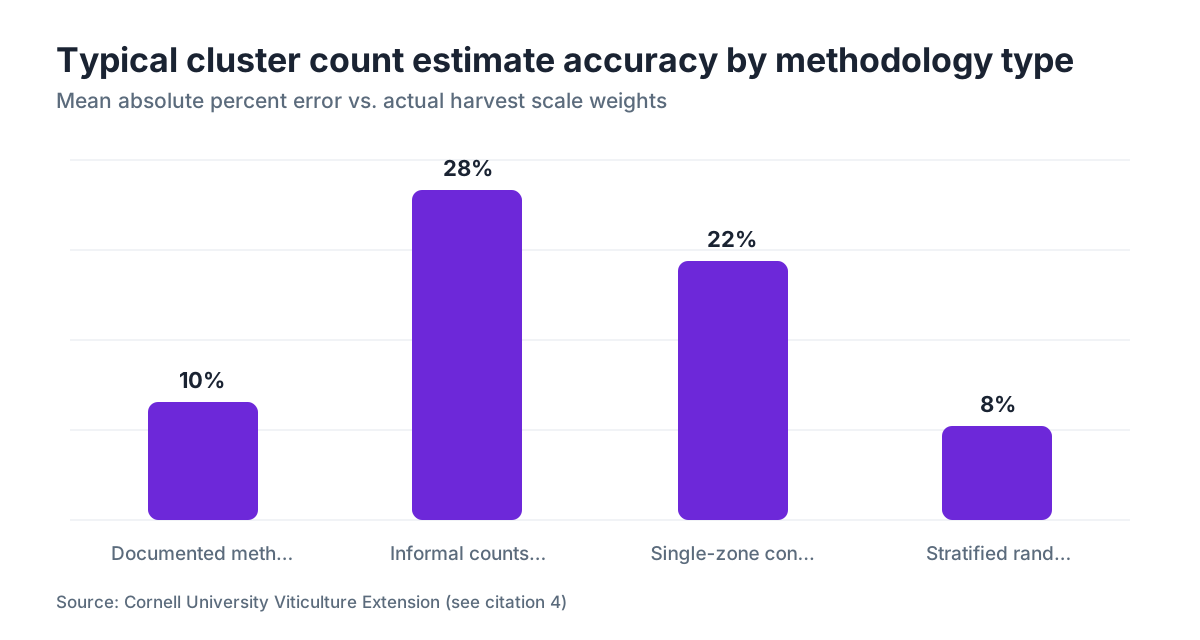
Cornell viticulture research found that growers using a documented, consistent methodology and calibrating it annually against scale weights achieved mean absolute errors of around 8-12 percent, while growers using informal methods without calibration showed errors of 20-35 percent in some blocks [4]. Eight to twelve percent is close enough to be useful for most planning purposes. Twenty to thirty-five percent is not.
Keep a calibration table. Year, block, estimated yield, actual yield, percent error, and a note on what you changed for next year. This is the document that turns cluster counting from a chore into a skill.
Frequently asked questions
How many vines should I count per block for a reliable yield estimate?
For a low-variability block, 15-20 vines sampled across at least 3 zones is a workable minimum. Higher-variability blocks need 40-50 vines or more to keep your confidence interval within 10-15 percent of the true mean. The key is using stratified random selection across zones, not picking vines by eye. WSU Extension and UC Davis both recommend this approach for commercial yield estimation.
What is the best time of year to count clusters for yield estimation?
The most useful window is between fruit set and veraison, roughly late June through late July in most California and Pacific Northwest regions. By fruit set, cluster counts are stable and not yet losing significant clusters to drop. A second count at veraison, combined with cluster weight sampling, improves accuracy. Cornell research suggests estimates made within four weeks of harvest fall within 10-15 percent of actual scale weight when both count and weight data are used.
What formula do I use to convert cluster counts into a tons-per-acre estimate?
The standard formula is: (Average clusters per vine) multiplied by (estimated cluster weight in pounds) multiplied by (vine count in the block), then divided by 2,000 to convert pounds to tons. Every input should be documented separately: how the average was calculated, where the cluster weight figure came from, and how vine count was determined. Using a historical rolling average cluster weight from your own harvest records gives the most reliable baseline.
Do I need to document my cluster count methodology for crop insurance?
Yes. USDA RMA's Actual Production History program requires that growers keep dated records of their production and any loss events. A documented pre-harvest cluster count with methodology, including sample design, dates, block IDs, and calculation, establishes the expected-yield side of a loss claim. Without a baseline count, you cannot demonstrate the magnitude of a mid-season crop loss to an adjuster. RMA specifies that dated field notes and block-level summaries qualify as acceptable records.
How do I account for missing or dead vines when estimating yield?
Count all missing and dead vines in your block inventory and subtract them from the total vine count used in your yield formula. If you use the theoretical vine count based on row and vine spacing, you will consistently overestimate yield on blocks with significant vine mortality. Document the live vine count separately from the planted vine count and note when you last updated it. This matters especially for older blocks with 5-15 percent vine gaps.
Can I use the same cluster count sheet for both my winery contract and crop insurance records?
Yes, and you should. A single well-designed block record that captures all required fields, block ID, sample date, counter name, raw vine-level data, methodology description, and calculated estimate, covers both purposes. Maintaining separate records for different uses creates reconciliation risk if the numbers differ. One authoritative record with a clear methodology is cleaner, easier to audit, and more credible to both a winery and an insurance adjuster.
What is a realistic accuracy range for a vineyard cluster count estimate?
Cornell viticulture research found that growers using consistent documented methodology and calibrating against scale weights achieved mean absolute errors of roughly 8-12 percent. Informal methods without calibration showed errors of 20-35 percent in some blocks. The 10-15 percent accuracy range is generally good enough for harvest logistics and contract estimates. If your contract has a tight tonnage tolerance clause, communicate your methodology's uncertainty range upfront.
Do worker protection standard rules apply to workers entering blocks for cluster counting?
Yes. Under EPA's Worker Protection Standard (40 CFR Part 170), any worker entering a recently treated area must not be inside a restricted-entry interval and must have completed WPS safety training. Document the date of last spray application per block, the product's label REI, and confirmation that the REI expired before counters entered. California vineyards must also comply with California DPR requirements layered on top of the federal WPS.
How does sampling zone stratification improve cluster count accuracy?
Stratification means dividing a block into zones that reflect real variability, such as soil type differences, vigor gradients, or irrigation coverage, and sampling from each zone in proportion to its area. This prevents the common error of sampling only from average-looking vines while missing the weak or overly vigorous ends of the block. WSU Extension recommends using any existing vigor mapping data, such as NDVI imagery, as the stratification layer when it's available.
How often should I update my cluster count methodology documentation?
Review it after every harvest by comparing your estimates to actual scale weights. If your errors are consistently biased in one direction, adjust your cluster weight baseline or sample size before the next season. The methodology document itself should be versioned: each year's document notes any changes from the prior year and why they were made. This creates an audit trail that shows your methodology is improving over time, more than a static protocol.
What should I do if two counters get different cluster counts on the same block?
Reconcile the discrepancy before finalizing your estimate. Have both counters recount a subset of the same vines together to identify where definitions differ. Common sources of counter disagreement include whether to count undeveloped clusters, whether to count a cluster with fewer than some threshold of berries, and how to handle clusters tucked inside dense canopy. Standardize those definitions in your written methodology and brief every counter on them before they start.
How do I estimate cluster weight before harvest when clusters haven't reached full size?
At fruit set, the most reliable approach is using a rolling three-year average cluster weight from your own harvest records for that block and variety. UC Davis extension recommends adjusting that baseline up or down based on visible berry sizing relative to historical reference photos or a calibrated subsample of weighed clusters. At veraison, cut and weigh 25-50 clusters from across the block to get a real measured weight rather than a historical estimate.
What records should I keep after harvest to improve next year's cluster count?
Keep your block-level scale tickets paired with your pre-harvest cluster count estimates in the same file or system. Calculate percent error per block. Note any mid-season events, frost, hail, disease pressure, or harvest delay, that might explain large errors. Record the actual average cluster weight from the scale tickets, more than total tons, so you can refine your cluster weight baseline for next year. This calibration step is what separates a useful methodology from a guess.
Sources
- USDA Risk Management Agency, Crop Insurance for Grapes: USDA RMA Actual Production History program requires growers to report actual and appraised yields by crop year; dated field notes and block-level summaries qualify as acceptable records.
- UC Davis Viticulture and Enology, Crop Estimation Methods: UC Davis recommends using a rolling three-year average cluster weight from harvest records as the baseline for fruit-set estimates, and counts between fruit set and veraison for stable cluster tallies.
- Washington State University Extension, Viticulture Notes: WSU Extension recommends a two-count system for higher-value blocks: fruit set count for logistics, veraison count with cluster weights for contract precision; also recommends documenting excluded vines and why.
- Cornell University College of Agriculture and Life Sciences, Viticulture Extension: Cornell viticulture research found estimates made within four weeks of harvest using cluster count and average cluster weight typically fall within 10-15 percent of actual scale weight; documented methodology reduced mean absolute error to 8-12 percent versus 20-35 percent for informal methods.
- California Department of Food and Agriculture, Grape Crush Report: California CDFA requires licensed wineries to report the weight of grapes received by county and variety as part of the annual crush report.
- US EPA, Worker Protection Standard (40 CFR Part 170): Under 40 CFR Part 170, workers must not enter a treated area during a restricted-entry interval and must have completed WPS safety training before field entry.
- California Department of Pesticide Regulation, Worker Safety: California DPR imposes additional state-level worker safety requirements on top of the federal WPS that apply in California vineyards.
- USDA National Agricultural Statistics Service, California Grape Acreage Report: NASS publishes annual California grape acreage and production figures by variety and county, usable as benchmarks for regional yield expectations.
- UC Agriculture and Natural Resources, Sample Size Determination for Vineyard Surveys: UC Cooperative Extension recommends a coefficient-of-variation based approach to sample size, targeting a confidence interval of plus or minus 10-15 percent at 90 percent confidence for commercial yield estimation.
- WSU Extension, Vineyard Sampling Protocols 2019: WSU Extension 2019 guide recommends walking each sampled row and noting any vines excluded from counting and why, so the sample is clearly described as representing live, bearing vines.
Last updated 2026-07-11