Food safety plan documentation requirements for small vineyard operations

TL;DR
- Small vineyards growing grapes for wine or juice keep food safety records under FDA's FSMA Produce Safety Rule, USDA GAP audit standards, and EPA's Worker Protection Standard.
- Core records are field activity logs, water test results, worker training certificates, pesticide application records, and a written food safety plan.
- Farms under $25,000 in average annual produce sales are exempt from FSMA.
- Those between $25,000 and $500,000 may qualify for modified requirements.
Does your vineyard actually need a written food safety plan?
It depends on two things: how much you sell, and who buys your grapes.
The FDA's Produce Safety Rule, finalized under the Food Safety Modernization Act (FSMA) in 2015, is the federal baseline [1]. If your vineyard's average annual sales of all produce over the prior three years are under $25,000, you're fully exempt. If you're between $25,000 and $500,000 in average annual food sales AND more than half of those sales go directly to qualified end-users (restaurants, retailers, or consumers in the same state or within 275 miles), you land in the "qualified exemption" bucket. That means modified requirements instead of the full rule [1].
Above those thresholds, or supplying large buyers like national wine brands, juice processors, or grape brokers who push their own FSMA liability upstream, a documented food safety plan is effectively required. Buyers ask for it whether or not the law does.
The USDA's Good Agricultural Practices (GAP) audit program is a separate thing. It's voluntary at the federal level, but many grocery chains and juice buyers make GAP certification a condition of doing business [2]. If a winery or juice company tells you their buyer requires GAP audits, that requirement lands on you.
Here's the part people miss. Even if you're technically exempt from FSMA's produce safety rule, you still need documented pesticide application records (required under FIFRA and state law), worker training records under EPA's Worker Protection Standard, and field activity logs that any serious buyer will ask to see. Run a vineyard in California, Washington, or New York? Our vineyard hub has region-specific compliance context.
What records does a small vineyard food safety plan need to include?
A working food safety plan isn't a binder of policies nobody reads. It's a set of dated records that prove your practices match what you wrote down.
Written plan document. This is the anchor. It describes how you manage each food safety risk: contamination from water, soil amendments, wildlife, workers, and equipment. Under FSMA's Produce Safety Rule, covered farms must keep specific written procedures for agricultural water, biological soil amendments, and worker training [1]. A USDA GAP audit uses a checklist that maps almost one-to-one to those same categories [2].
Agricultural water records. Use surface water for any contact purpose (frost protection sprinklers that hit the fruit zone, say) and FSMA wants a water quality profile based on testing against a geometric mean of 126 CFU generic E. coli per 100 mL and a statistical threshold value of 410 CFU per 100 mL [1]. Groundwater from a tested municipal system is simpler but still needs source documentation. Keep test results, lab reports, and records of any corrective actions.
Pesticide application records. FIFRA requires certified applicators to keep records of restricted-use pesticide applications for two years [3]. Most states require the same for general-use pesticides applied commercially. Each record needs the date, field location, product name and EPA registration number, rate and volume applied, target pest, and applicator name. Pre-harvest intervals (PHIs) belong in your planning records to show you checked them before harvest.
Biological soil amendment records. Apply compost, manure, or any biological soil amendment of animal origin, and FSMA wants the type, source, and application date documented, plus evidence that it meets treatment standards or that you're observing the required application intervals [1].
Worker health and hygiene records. Under FSMA, covered farms train workers and supervisors on food safety and keep records of that training: who was trained, when, and what was covered. EPA's Worker Protection Standard (WPS), revised in 2015, separately requires training records and pesticide safety information posting for agricultural workers and handlers in pesticide-treated areas [4].
Equipment sanitation logs. Harvesting bins, gondolas, shears, and anything that touches fruit needs cleaning and sanitation records. Date, method, and who did it.
Corrective action records. Fix a problem, write it down. Auditors hunt for these because they show your system is real and more than paperwork.
How do FSMA exemptions work for small and very small vineyards?
FSMA's produce safety rule uses a tiered approach based on a rolling three-year average of food sales [1]. These numbers decide everything.
| Farm Size Category | Average Annual Food Sales | FSMA Status |
|---|---|---|
| Very small farm | Under $25,000 | Fully exempt |
| Qualified exemption | $25K to $500K, majority direct sales | Modified requirements only |
| Small farm | $25K to $500K, non-qualified | Covered, extended compliance dates |
| Covered farm | Over $500K | Fully covered, standard requirements |
A qualified exemption farm still has to disclose its name and address on labels or at the point of sale, keep records proving the sales threshold and the sales-destination split, and be ready for the FDA to revoke the exemption if a food safety problem gets linked to the operation [10].
Grapes destined for wine sit in a gray area, and plenty of vineyard managers get this wrong. FDA has said that produce used for activities not subject to the subpart (further processing that destroys pathogens, like fermentation into alcohol) may be excluded. The language in 21 CFR Part 112.2(a) allows the exclusion, but only if the grapes aren't sold or consumed raw [1]. Grow table grapes or grapes for fresh juice and the exclusion doesn't reach them.
Exemption from the federal rule doesn't erase state law. California, Washington, New York, and Oregon each have their own produce safety regulations, and some carry lower thresholds or different documentation demands than the federal rule. UC Davis and the California Department of Food and Agriculture have joint guidance [5]. WSU Extension covers Washington's requirements separately [6].
Wine regions with dense buyer networks, like those around Paso Robles wineries or South Coast Winery, often carry informal expectations past what the regulation requires, because the large wineries face their own audit obligations and push documentation down the supply chain.
What does EPA's Worker Protection Standard require vineyard managers to document?
The revised Worker Protection Standard (WPS) took full effect in 2018. It applies to any agricultural employer with workers or pesticide handlers in areas treated with pesticides [4]. For a vineyard, that's everyone.
Here's what WPS wants documented.
Worker and handler training records. Workers get trained before working in treated areas. Handlers get trained before any pesticide handling task. Training covers all 23 required topics listed in 40 CFR Part 170. Document the trainee's name, the training date, and the trainer's name and qualifications. Keep records two years [4].
Pesticide application and entry-restriction records. For each application, keep the product name, EPA registration number, active ingredient(s), location and description of the treated area, date and time, and the restricted entry interval (REI). Workers must be able to reach this information. Under WPS, records for pesticides with a 48-hour or longer REI stay accessible for 30 years [4].
Designated representative access. WPS gives workers and their designated representatives the right to request copies of application records within 15 days. Your system has to make that retrieval realistic.
Central posting location. Safety data sheets (SDS) and application records must be posted or accessible at a central location on the farm during the REI period.
The EPA's WPS compliance guide is the document to read. Cornell's Pesticide Management Education Program has state-specific overlays for New York vineyards [7].
How do USDA GAP audits differ from FSMA compliance for a vineyard?
FSMA is a federal regulation with enforcement teeth. USDA GAP audits are voluntary certification, but the market consequences are real.
FSMA gives the FDA authority to inspect your farm, issue warning letters, and in serious cases force a recall or shut you down. GAP audits are pass/fail assessments run by USDA Agricultural Marketing Service auditors (or third-party certifiers) against a written checklist. Fail a GAP audit and no regulator shows up, but you can lose a contract.
The USDA GAP/GHP audit checklist covers general questions about the farm and its food safety program, a farm review (site history, adjacent land risks, water sources), field harvest and field packing, and a house-packing facility section if it applies [2]. Vineyards go through the farm review and field harvest sections at minimum.
For documentation, a GAP audit looks for:
- A written food safety policy
- Evidence of worker training (sign-in sheets, certificates)
- Pesticide application records with PHI verification
- Water source documentation and, for surface water, testing results
- Equipment cleaning logs
- Traceability records that connect a lot of grapes back to a specific field block and date
One practical difference. FSMA sets numerical water quality standards (the E. coli thresholds from earlier). USDA GAP audits lean on the checklist and give auditors some scoring discretion. Both programs want the same core documents, just with different emphasis.
Cornell Cooperative Extension has published practical GAP audit preparation guides for New York vineyards that are worth reading even outside New York [7].
What's the right format and retention period for vineyard food safety records?
Format is mostly your call. FSMA doesn't demand a specific one, only that records are "accurate, indelible, and legible" [1]. Paper works. Spreadsheets work. A field operations platform that auto-timestamps entries and exports a PDF audit trail also works, and it makes retrieval a lot less stressful when a buyer's auditor turns up on a Tuesday morning.
Some operations use VitiScribe because it ties spray records, field activity logs, and worker training records to specific blocks and dates, which makes traceability documentation faster to pull.
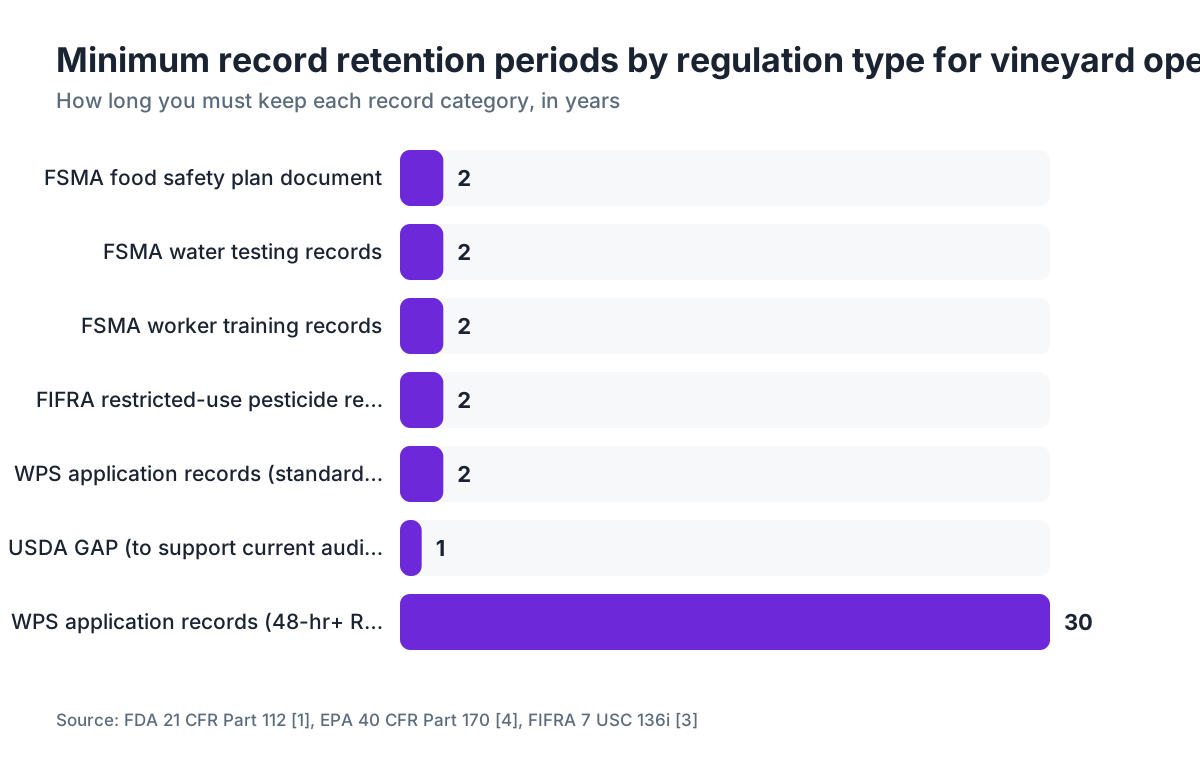
Retention periods vary by record type.
| Record Type | Minimum Retention Period | Authority |
|---|---|---|
| FSMA food safety plan (written plan document) | 2 years | 21 CFR Part 112 [1] |
| FSMA water testing records | 2 years after the end of the growing season | 21 CFR Part 112 [1] |
| FSMA training records | 2 years | 21 CFR Part 112 [1] |
| WPS application records (48-hour+ REI pesticides) | 30 years | 40 CFR Part 170 [4] |
| WPS application records (standard) | 2 years | 40 CFR Part 170 [4] |
| FIFRA restricted-use pesticide records | 2 years | 7 USC 136i [3] |
| USDA GAP (to maintain certification) | 1 year of records supporting current audit | USDA AMS [2] |
The 30-year WPS number catches people off guard. Apply any pesticide with a 48-hour or longer restricted entry interval and that application record needs to stay accessible for three decades. A record you write in 2010 needs to survive to 2040. Most managers don't clock that on a first read of the rule. Keep those in a format that won't degrade.
What does a pesticide application record need to include for legal compliance?
Pesticide recordkeeping sits where three regulatory schemes overlap: FIFRA (federal), WPS (federal), and your state's pesticide rules. Build a record that satisfies the strictest of the three and you've usually satisfied all of them.
Here's what a complete vineyard pesticide application record needs:
- Date and time of application (some states want start and end time)
- Field or block identifier (a name or map reference tying the record to a physical location)
- Product name (as it appears on the label)
- EPA registration number (printed on every registered pesticide label)
- Active ingredient(s)
- Target pest
- Application rate (product per acre, per gallon of water, and so on)
- Total volume or amount applied
- Total area treated (in acres)
- Application method or equipment
- Applicator name (and license number if a certified applicator is applying a restricted-use pesticide)
- Restricted entry interval (REI) (from the label)
- Pre-harvest interval (PHI) (from the label, and it matters most for vineyards)
- Weather conditions at application (wind speed and direction required in some states)
WSU Extension's pesticide recordkeeping guide for Washington growers is one of the cleaner references here. It maps state requirements against federal minimums and shows exactly where Washington's rules run stricter [6].
For restricted-use pesticides, FIFRA section 11 requires records be available for inspection by the EPA and state lead agencies [3]. So they need to be at the farm or retrievable within a reasonable time.
Vineyards in scenic spots like Gervasi Vineyard or mountain settings like Mountain Winery face the same federal baseline, but their state requirements differ, especially for soil and water applications.
How does traceability documentation work for grape growers?
Traceability is the ability to trace a specific lot of grapes from the harvested bin back to the field block, pick date, and key production records. Wineries want it. Large juice buyers want it. And under FSMA's Food Traceability Rule (finalized November 2022), certain supply chains may eventually be required to keep formal traceability records [9].
Wine grapes aren't on the FDA's Food Traceability List (the list of high-risk foods that trigger the rule's specific requirements), so most wine grape growers aren't subject to the Food Traceability Rule's formal requirements as of 2024 [9]. That can change. And your buyers probably want this information already.
A practical vineyard traceability record connects:
- Lot identifier (a code you assign each harvest event, like a block-date combination)
- Block or field location (GPS coordinates or a mapped identifier)
- Harvest date and crew supervisor
- Volume or weight harvested
- Where the grapes went (which winery, which tank, which purchase order)
- Key field records for that block (last pesticide application date, PHI status, water applications)
The block is the key unit. Organize your spray records, water records, and harvest records by block with consistent identifiers, and traceability falls out of good recordkeeping instead of becoming a separate system.
UC Davis has published practical guidance on vineyard record systems covering block-level organization, and its precision viticulture work has useful frameworks for tying field data to harvest lots [5].
What are the most common food safety documentation failures found in vineyard audits?
Published USDA GAP audit guidance and FDA inspection findings point to the same recurring gaps. They're predictable, and they're fixable.
Training records that don't exist or say nothing. "Workers were trained" is not a record. A sign-in sheet dated the same day as the described session, listing the topics covered and who ran it, is a record. Auditors want the specifics.
Pesticide records missing PHI verification. Application records that show what got sprayed but not that someone checked the pre-harvest interval before applying are a red flag. Some operations add a simple checkbox and the label PHI to each record.
Water testing gaps. Using surface water for frost protection or pesticide mixing without documented test results. Even where the risk to the finished wine is low, the record requirement still applies during the growing season.
No written corrective action documentation. You had a worker sanitation problem in July and fixed it. Is there a record showing what happened, what you did, and who made the call? Without it, your food safety plan looks theoretical instead of operational.
Inconsistent block identifiers. The spray record says "North Block." The harvest record says "Block 4." The winery's receipt says "Cab 2023 Estate." If those don't trace to one physical location, you don't have traceability.
An outdated or unsigned food safety plan. A plan nobody has reviewed and signed in three years looks like something printed once and forgotten. Annual review with a sign-off date is the floor.
Want to get ahead of these before an audit? A structured field log system, paper or digital, is the fastest fix. VitiScribe's block-level logging tackles the identifier problem directly, because every entry is tagged to a mapped block from the start.
Where do you get training resources and templates for vineyard food safety plans?
Several land-grant extension programs have built free, peer-reviewed resources for vineyard and small farm operations.
UC Davis and UC Cooperative Extension publish produce safety resources aligned with FSMA, including decision tools for figuring out your coverage status and sample food safety plan templates [5]. The Viticulture and Enology department has vineyard-specific guides too.
Cornell Cooperative Extension runs the Food Safety Initiative for produce growers in New York and has GAP audit preparation materials for vineyards and orchards [7]. Most of it works outside New York.
WSU Extension covers Washington state requirements and has pesticide recordkeeping guides that put federal and state law side by side [6]. Washington's Department of Agriculture also runs a GAP cost-share program that has reimbursed small farms for audit costs in recent years. Check current availability with the state agriculture department directly.
FDA's FSMA resources sit on FDA.gov and include the regulatory text of 21 CFR Part 112, a small entity compliance guide, and inspection preparation materials [1].
USDA AMS publishes the GAP/GHP audit checklist and scoring sheets. Download them even if you're not chasing certification, because they show exactly what an auditor will look at [2].
For day-to-day recordkeeping, a purpose-built field operations platform carries the documentation load so you're not reconstructing records from memory the week before an audit. A well-organized paper system with consistent block identifiers works too. The records matter more than the medium.
Running a destination property that mixes vineyard operations with hospitality? See how operations like Ponte Winery handle the dual load of farm-side and visitor-facing documentation.
Do organic vineyards have different food safety documentation requirements?
Organic certification and food safety compliance run on separate tracks. Meeting USDA National Organic Program (NOP) requirements does not exempt you from FSMA or WPS. And FSMA compliance does not satisfy your organic certifier.
An organic vineyard runs both sets of documentation at once.
NOP documentation includes field history records covering the past three years (to prove the land meets the transition standard), an organic system plan updated annually, input records for every approved amendment and spray, sales records supporting the organic transaction certificate, and corrective action records if a prohibited substance turns up [8].
Food safety documentation runs in parallel: the same water records, worker training records, pesticide records (documenting OMRI-listed or NOP-compliant materials, in organic's case), and harvest traceability any conventional vineyard keeps.
The overlap is real but partial. Your organic system plan describes inputs and land management. Your food safety plan describes risk control for pathogens and contamination. A good block-level recordkeeping system can feed both, but they stay distinct documents with distinct audiences.
One practical point. Organic growers applying copper-based fungicides or sulfur still keep WPS records for the handlers applying those materials, because WPS covers all pesticides, not only synthetic ones [4].
Frequently asked questions
Is a vineyard growing grapes only for wine exempt from FSMA's produce safety rule?
It depends on the end use. FDA's regulations at 21 CFR Part 112.2(a) provide an exclusion for produce not intended for human consumption in raw or fresh-cut form. Wine grapes destined for fermentation may qualify, but the exclusion isn't automatic. You need to document the intended use. If you also sell any fresh fruit or juice, the exclusion doesn't apply to those portions of your crop.
What is the income threshold that makes a farm exempt from FSMA produce safety requirements?
Farms with average annual food sales under $25,000 over the prior three years are fully exempt from FSMA's Produce Safety Rule. Farms between $25,000 and $500,000 may qualify for a qualified exemption with modified requirements if more than half of their sales go directly to end consumers, restaurants, or retailers in the same state or within 275 miles. Over $500,000 in sales means full coverage under the rule.
How long do I have to keep pesticide application records for my vineyard?
It depends on the pesticide type and the regulatory basis. FIFRA requires two years for restricted-use pesticide records. EPA's Worker Protection Standard requires two years for most application records, but 30 years if the pesticide has a 48-hour or longer restricted entry interval. State laws may add more. When in doubt, keep records longer. A pesticide that triggered a long REI in 2010 needs its records available through 2040.
What does EPA's Worker Protection Standard require vineyard owners to post or provide?
Under the revised WPS (40 CFR Part 170), vineyard employers must maintain a central location where workers and handlers can access pesticide application information: product name, EPA registration number, active ingredient, treated area, application date and time, and the restricted entry interval. Safety data sheets must also be available. Workers must be trained before entering treated areas, and training records kept for two years.
Do I need a food safety plan if I sell all my grapes to a single winery under contract?
Legally, your FSMA exemption status turns on your sales volume, not the number of buyers. In practice, if that winery supplies a retailer or buyer who requires GAP certification or FSMA documentation, the winery will push that requirement onto you through contract terms. Many contract grape growers end up needing documented food safety programs regardless of their exemption status, because the buyer requires it.
What does a USDA GAP audit actually look at in a vineyard setting?
USDA GAP auditors use a published checklist covering a general farm questions section, a farm review (site history, adjacent land use, water source and quality, worker sanitation facilities), and a field harvest section covering equipment cleanliness, container sanitation, harvester hygiene, and field packing practices. For vineyards, auditors ask for pesticide application records, water documentation, worker training records, and a written food safety policy. The audit is scored section by section.
How specific do worker training records need to be for food safety compliance?
Under FSMA, training records must include the individual's name, the date of training, and the topics covered. Under WPS, records need the trainee's name, date, and the trainer's name and qualifications. A sign-in sheet with a topic outline attached is the minimum practical format. Generic entries like "food safety training completed" without names and dates won't satisfy an auditor. The record must be specific enough that an inspector can verify who received what training on what date.
What water testing is required for vineyard irrigation and frost protection?
Under FSMA's agricultural water provisions, covered farms using surface water for any application that contacts the harvestable portion of the crop must test that water and show it meets a geometric mean of 126 CFU generic E. coli per 100 mL and a statistical threshold value (STV) of 410 CFU per 100 mL. Groundwater from a tested municipal system has a simpler documentation path. The FDA has revised implementation timelines for the water quality provisions; check FDA.gov for current compliance dates.
Can I use a paper-based system for vineyard food safety records, or is digital required?
FSMA requires records be accurate, indelible, and legible. There's no digital requirement. Paper binders are legal. That said, when an auditor or buyer asks for every pesticide application record for Block 12 going back 18 months, a paper system means someone hunting for them by hand. A consistent, well-organized paper system by block and date works. Many operations move to digital not for compliance but for retrieval speed during audits.
Do organic vineyards need separate documentation for their food safety plan and organic system plan?
Yes. They're separate documents for separate regulatory programs. An organic system plan (required by the USDA National Organic Program) covers input approvals, land history, and transition documentation. A food safety plan covers pathogen risk management, water quality, worker hygiene, and corrective actions. The two overlap in some areas, particularly input records and field history, but they carry different required content, different update schedules, and different reviewers or certifiers.
What records do I need to show traceability from vineyard block to winery delivery?
At minimum: a lot or harvest identifier (often a block plus date code), the physical block location (a map reference or GPS-tied identifier), harvest date and volume or weight, and a record of where the grapes went (winery name, delivery receipt or bill of lading). Tie your lot identifier to the block's spray records and water records so you can show the full field history for any delivery. Consistent block naming across all your records is the single biggest factor.
What happens if FDA inspects my vineyard and my food safety records are incomplete?
For covered farms, missing required records under FSMA can result in a Form FDA 483 observation (a written list of deficiencies found during inspection), followed by a warning letter if not corrected. Serious or repeated violations can lead to administrative actions. For farms with a qualified exemption, the FDA can revoke that exemption if it finds a reasonable probability the food could cause serious health consequences. Revocation puts you into full compliance mode immediately.
How often does a vineyard food safety plan need to be reviewed and updated?
FSMA doesn't mandate an annual review, but it does require you reassess your plan whenever your operation changes significantly, after a foodborne illness outbreak linked to your farm, or when new hazards show up. In practice, most auditors and buyers expect an annual review with a sign-off date. A plan nobody has touched in two or three years looks unused. Annual review is the realistic minimum.
Sources
- FDA, Standards for the Growing, Harvesting, Packing, and Holding of Produce for Human Consumption (21 CFR Part 112), FSMA Produce Safety Rule: FSMA Produce Safety Rule thresholds ($25K exempt, $25K-$500K qualified exemption), water quality standards (126 CFU geometric mean, 410 CFU STV), documentation requirements, and exclusion for produce not intended for raw consumption.
- USDA Agricultural Marketing Service, Good Agricultural Practices (GAP) and Good Handling Practices (GHP) Audit Program: USDA GAP/GHP audit checklist scope: general farm review, field harvest section, and documentation requirements including written food safety policy, training records, and pesticide application records.
- EPA, Pesticide Registration and the Federal Insecticide, Fungicide, and Rodenticide Act (FIFRA), Section 11 (7 USC 136i): FIFRA requires certified applicators to maintain restricted-use pesticide application records for two years and make them available for inspection.
- EPA, Agricultural Worker Protection Standard (40 CFR Part 170): WPS documentation requirements: worker and handler training records kept 2 years; application records for pesticides with 48-hour or longer REI kept 30 years; central posting requirements; 15-day window for records access by designated representative.
- University of California Agriculture and Natural Resources (UC ANR), Produce Safety and FSMA Resources: UC Davis and UC Cooperative Extension provide FSMA coverage determination tools, food safety plan templates, and vineyard-specific guidance on block-level record organization.
- Washington State University Extension, Pesticide Education and Recordkeeping Resources: WSU Extension maps Washington state pesticide recordkeeping requirements against federal minimums, identifying where state rules are stricter than FIFRA or WPS.
- Cornell Cooperative Extension, Food Safety Initiative for Produce Growers: Cornell Cooperative Extension provides GAP audit preparation materials for New York vineyards and orchards, including worker training templates and traceability record formats.
- USDA National Organic Program (NOP), Organic Regulations (7 CFR Part 205): NOP requires organic producers to maintain a written organic system plan, three-year field history records, input records for all amendments and sprays, and corrective action documentation.
- FDA, FSMA Food Traceability Rule (21 CFR Part 1, Subpart S): Wine grapes are not currently on FDA's Food Traceability List, so most wine grape growers are not subject to the formal Food Traceability Rule recordkeeping requirements as of 2024.
- FDA, FSMA Final Rule on Produce Safety and Small Entity Compliance Guide: FDA's small entity compliance guide describes qualified exemption conditions, disclosure requirements, and the FDA's authority to revoke exemptions if a safety risk is identified.
Last updated 2026-07-10